It’s a minor miracle that any flight at all leaves Athens airport on time. We saw the chaos when we landed and quickly decided we might feel safer with more time than less when it came time to head to Polska. We arrived at 10:45 for a 2:00 flight. Admittedly I thought that was a bit excessive, but I knew K would feel more comfortable, and she was probably right, I reasoned.
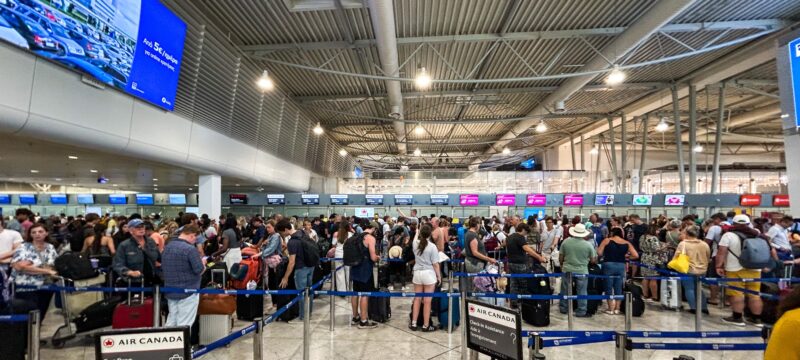
We unloaded our baggage from the taxi and entered terminal one at check-in desk 60. Not knowing where to check-in, K and the Boy waited with our baggage as L headed one way and I the other looking for the LOT desks. I made it to desk 1 without seeing anything, so I asked an airport attendant I passed. He liked it up: we were to check-in at desks 168-171—literally in the last desks in the terminal. “They will open the desks two hours before the flight,” he explained. I glanced at my watch: we had an hour to wait.
We began weaving our way through the crowd of passengers waiting to check in, heading to or from their check-in desks, and just sitting or standing with their luggage. It must be that chaotic regularly because there was a passage of large round decals forming a path on the floor directing people to find somewhere else to sit or stand as the decals indicated a walkway.
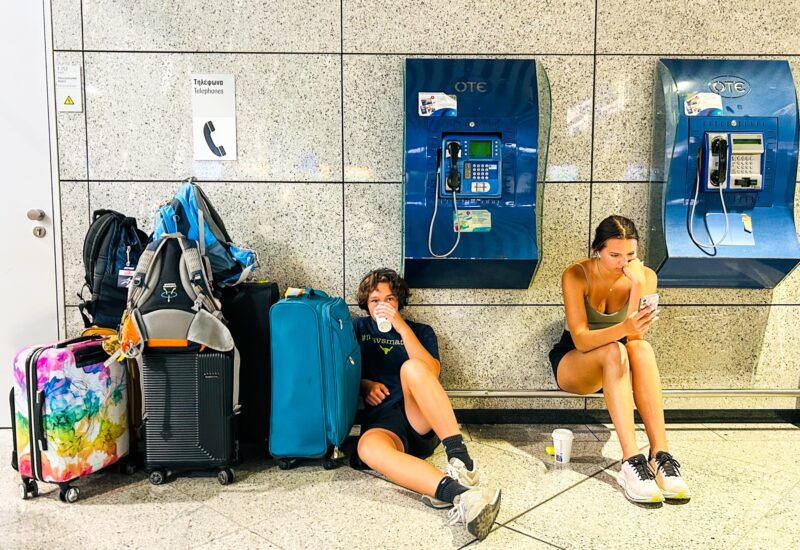
We quickly figured out why.
We made our way to desks 168-171 and found a spot to camp out, but within twenty minutes we realized we should go ahead and get in the line though no one was even at the check-in desks yet. Poles are expert queuers and there was already a line. (When I lived in Poland, I’d arrive at the administrative office in Krakow where I renewed my visa well before it opened only to find the line stretching halfway around the block.) Gathering our luggage, we joined the line, and to our surprise, four attendants soon began checking passengers in as the line grew behind us. With only about ten to twelve groups of passengers in front of us, I was sure wevavimg already checked in online, would be through quickly.
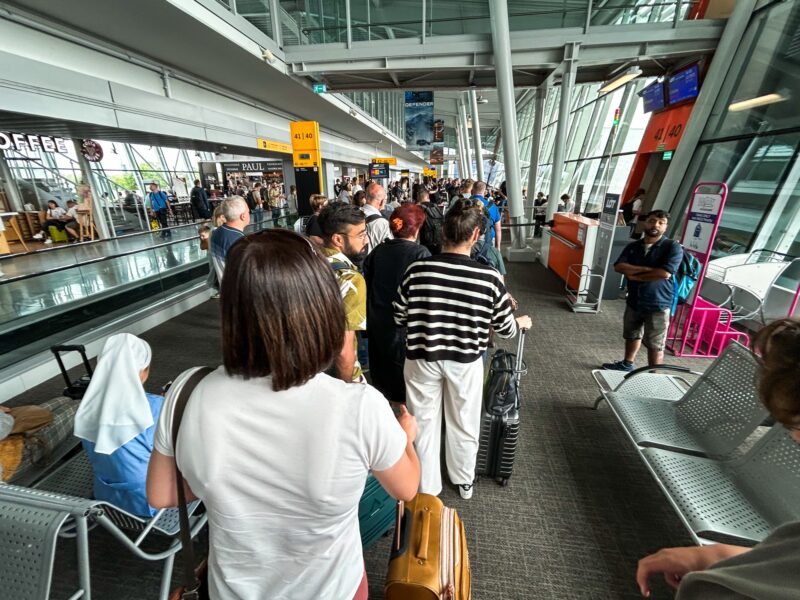
The first clue that the whole process might be a bit more time consuming than we anticipated was that the fourth attendant was not checking anyone in. Instead she was consulting with the third attendant, helping her almost continuously, and when she wasn’t, she was talking to someone on the phone. After a few minutes, the second attendant left while she was helping someone. He stood there for a while until the first attendant finished with her passenger and then finished with him. There was some problem or other with his baggage, and he must have been there ten to fifteen minutes. Meanwhile, the only other attendant working must have been completely inexperienced for she kept asking for help from the assistant in the fourth desk who was moving between five activities: talking on the phone at her desk, talking to the attendant in the third desk, taking on the phone at the third desk, talking to the worker at the first desk, and taking on the phone at the first desk. After a while, a fourth attendant came but she also checked no one in and insisted was apparently supervising the whole incompetent mess. Each group of travelers was taking at least eight to ten minutes to check in, with one group of Canadian travelers working on the process for well over fifteen minutes. In short, though we were very close to the start of the line, it took us well over an hour to get checked in.
Was it a technical issue, incompetence, inexperience, or some mysterious combination of the three? I feel we got an answer when we were checking our luggage.
After printing and attaching our first luggage label, the attendant told us, “I don’t see that you’ve paid for any checked baggage,” pointing to the screen (which we couldn’t see of course). K pulled up the reservation on her phone and showed her. She nodded in assent, ripped off the label, printed a new one and attached it. “Incompetence and technical stupidity it is,” I thought as we walked away.

Looking at the line snaking down the terminal, I wondered if there was any hope at all that we could take off on time. There were three times more passengers behind us than in front of us. “If this pace keeps up, it will take three more hours just to check everyone else in,” I grumbled. I’m really skilled with complaining when the perceived problem seems to be due to others’ incompetence, and I have an absolute gift at reading incompetence into my inconvenience.

Suffice it to say, we all somehow made it through and we took off only twenty minutes late.