matching tracksuits

fun in threes, sometimes fours

polska

My always obsession...

“I’m not anti-Semitic but . . .”

"I'm not anti-Semitic, but I just don't trust Jews."

I was sitting in a bar with an American friend and a Polish acquaintance when the Pole, in utmost seriousness, said that. He could not be made to see the inherent contradiction in what he'd said.

"I don't really know many Jews, but I don't like them."

Thus said another Pole to me, explaining a situation he'd had earlier that week in Krakow with someone who was "obviously a Jew." He too maintained he's not anti-Semitic.

Jews in Poland occupy a strange position. Before the Holocaust, "Poland's Jewish community numbered 3.5 million, which represented 20 per cent of world Jewry and 10 per cent of the pre-war Polish population." (Source) Today, Jews number less than twenty thousand in the whole country. Most people in modern Poland have never even met a Jew.

There were so many Jews in Poland thanks to Casimir the Great's opening the borders and accepting Jews in the Middle Ages when they were being expelled from many other countries in Europe. When they began prospering, the Poles began resenting them and their success.

Contemporary anti-Semitism in Poland is fueled by far-right parties like "Liga Polskich Rodzin" ("The League of Polish Families") and the populist party "Samoobrona" ("Self-Defense"), both of which overtly and covertly blame Poland's present economic woes on Jews. They deny that there are only about sixteen or so thousand Jews in Poland, and with some on the fringes insisting that President Kwasniewski himself is of Jewish descent.

Others blame the Jews for the Second World War, saying that Hitler was particularly brutal to Poland because of the large number of Jews here. The "logic" there is baffling, but I've personally heard the argument at least once.

Anti-Semitism is not just a problem in Poland, though. Jean Marie Le Pen's surprise success in the French elections some time ago showed that nationalism and rabid xenophobia find fertile ground even in supposedly liberal France.

Anti-Semitism is on the rise in Europe. A supposedly suppressed UN report that blamed "a new wave of Antisemitism on Muslim youth and on anti-globalization activists" (Listen to the NPR Report) shows that it's not just right-wing, neo-fascists who are spreading the ancient, illogical hate of Jews.

People talk of how to reduce anti-Semitism and other forms of xenophobia, but anti-Semitism seems like a hydra. It's been around for so long and taken so many forms that it seems always to be changing.

  • Anti-Semitism in Christianity has a long history. Jews are still "blamed" for having killed Jesus, as the recent outcries over Mel Gibson's brutal Passion showed.
  • Hitler magnified a "racial" dimension to anti-Semitism that had been brewing in Europe for at least a hundred and fifty years. Instead of being a religious-ethnic group, Jews became a different race. Indeed, a different species.
  • Contemporary liberals sometimes blame Jewry as a whole for Israel's sometimes-excessive dealings with Palestinians.
  • Even the super-nutty fringes are not immune. Take a look at Freedom Press and it won't take long to find a connection ultimately between Jews and aliens (?!?) through the supposed conspiracies of theIlluminati.

Anti-Semitism is, indeed, everywhere, and has been for ages. And despite our "enlightened" times, it appears we might be heading toward another wave of increased anti-Semitism.
Double your pleasure

In Polish, there are two plural forms for every noun.

It works like this. For numbers 2 through 4, and anything number that includes those numbers (i.e., twenty-two, thirty-five, but not eleven, twelve), there is one plural form; for numbers 5-10, there is another plural form.

“Huh?”

Exactly.

An example might help. “Piwo” is “beer” in Polish. “Two beers” would be “dwa piwa.” “Four beers” would be “cztery piwa.” But “five beers” is “pięć piw.” But at “twenty-one” (yes, I know — who needs to know how to say “twenty-one beers” in Polish?), it would change back to “piwa.” Until you decided to get really wasted and go for twenty-five, at which point you would order “dwadzieścia pięć piw.”

Another example: “Roll” in Polish is “bułka.” “Two rolls” is “dwie bułki.” At five we get the switch again: “pię bułek.” At twenty-one, it goes back to “bułki.”

Further, if you want to use a plural noun as a direct object in a positive sentence, you use the first plural form; if you want to use it as a direct object of a negative sentence, you use the second form. In other words, to say “I like rolls” you use “bułki,” but to say “I don’t like rolls,” you use “bułek.”

And Poles wonder why their language is so hard for non-Poles…

Any linguistic strangeness where you live?

Underheard

What is it about the popularity lately of singing through one's nose? This one is the absolute winner, but it seems to be the "in" thing now.

I was at a bar here in Poland with a friend sometime when that atrocious Anastacia song "Paid My Dues" came on the radio. "Read all the lyrics, sorry though they may be

As Anastacia sang, my friend got that lost-in-the-moment look, then asked me, "What is this song about?"

"I don't really know," I replied. "I've never really paid much attention to it."

"But I don't get it. 'Paint my juice?' What is that supposed to mean?"

Is nothing sacred?

In Poland, separation of church and state doesn't exist, and priests teach religion courses in publicly funded schools.

Today I caught a student writing cheat notes on his arm for a quiz he was having in religion class!

"You realize that when you take a test and you cheat, it's the same as lying, right?" I asked him.

"How so?"

"Well, when you take a test, aren't you implicitly saying that you're taking the information only from your own knowledge?" I asked.

"I guess," he muttered.

"Then cheating is a form of lying," I concluded.

A thoughtful moment. "So?"

So, indeed.

Shakes and Kisses

I’ve lived in Poland now for over six years, and there’s a custom I still haven’t come to terms with — the handshake.

In the States, we shake hands only when we first meet someone, or when we’re in some very formal environment. In Poland the handshake is much more common.

In short, you should shake hands with someone if:

  1. You’re a man.
  2. You encounter a man.
  3. You know the man you’re encountering or
  4. He’s with a man you do know.

You shake hands in bars, when you arrive at work, when you pass on the street. Kids shake hands; old men shake hands with young men; directors with teachers — everyone shakes hands.

Some examples:

  • If you go to a bar and you see a friend sitting at a table, you go shake his hand, and you offer your hand to every other man who’s sitting at the table.
  • If you’re walking down the street and an acquaintance is walking the other way, you shake hands, even if you just continue walking.
  • If you’re a student, you shake hands with all your friends every day. Sometimes you see a boy just moving down the hall, shaking hands like a politician.

But it’s not so simple as that. You’re only supposed to shake hands when you first meet each other. Other encounters during the day don’t get the shake.

Traditionally, you’re not supposed to offer your hand to a woman. Indeed, in a really traditional, formal setting, men still kiss women’s hands in Poland.

I’m still not sure when I’m supposed to offer my hand and when I’m not. Rather, I forget. I walk by an acquaintance on the sidewalk and I realize three steps too late that I only said “Czesc” and didn’t offer my hand.

As far as kissing women’s hands go, well, I just keep away. It seems too cavalier (pun intended) for me to do it.

But I kiss men here. In fact, I’ve kissed every single male teacher with whom I work. The three peck, right-cheek, left-cheek, right-cheek-again mwa-mwa-mwa kiss. The triple peck is used in congratulatory situations: name days, weddings, etc. and it’s the most difficult for me, an American, to get used to. After all, while I really like my director, I don’t want to kiss him on a regular basis. But from time to time, at a teacher�s meeting, we give a birthday gift to one of the teachers and then we all line up and mwa-mwa-mwa.

At our wedding, Kinga and I kissed almost all our guests . . .

Make You Squeal Like a Pig

This is going to be pretty disgusting. Fair warning.

Part of the preparation for my wedding to a Polish woman who grew up in a very rural area was a pig killing. My father-in-law bought a pig from a farmer some months before the wedding, and then about two weeks before, it was time to kill and dress the pig.

I shot some birds with a shotgun when I was little; I killed a mouse out of mercy because my cat was torturing it -- I've never seen anything quite that big killed before.

My father said "pig" is the wrong word. "It was a hog," he says.

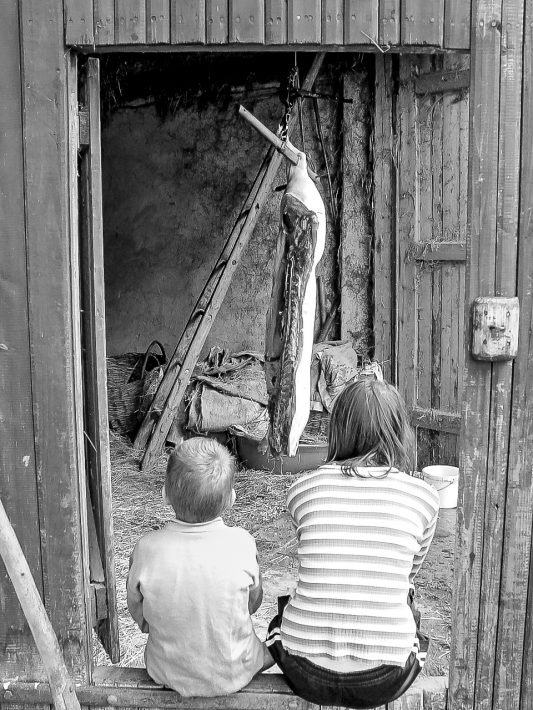
I'll spare the gruesome details for now. What astounded me was the behavior of the butcher's grandchildren. I was sick to my stomach a few times (but taking pictures nonetheless), and they were running around as if it were a Baptist picnic.

And they sat for a moment, and I was able to get the above picture.

EFL Materials

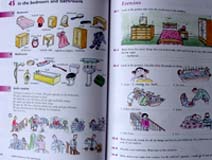
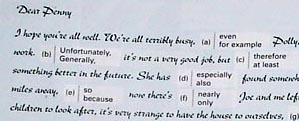
Ever wonder what an EFL (English as a Foreign Language) textbook looks like? I certainly did as I was preparing to come to Poland for the first time back in 1996. After all, how often do you get to see a textbook teaching something you already know fluently? Naturally, after four and a half years' experience, I've seen and used more textbooks than I care to remember. I thought I'd share a little about the books I've been using.
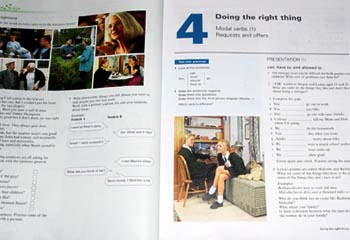
Most units tend to be thematic. For example, for practicing modal verbs such as "should," "must," and "have to" (among others), this particular book (and many others) use the idea of advice and "Doing the right thing."

There are certain groups of easily-confused words, and some activities are aimed at improving students' ability to choose the correct word from a similar pair. This particular book is written specifically for Polish students, and so that influenced the word choice (in other words, they might not seem like similar words in English, but they are in Polish translation, so . . .).

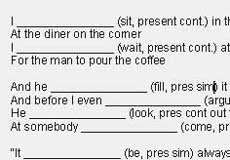
There are three tenses in Polish; there are twelve in English. When to use which tense can be somewhat confusing for students. Even remembering how to make them all can be difficult, so sometimes we have "easy" lessons that just make students think about how to make the tenses. (This particular exercise uses Suzanne Vega's "Tom's Diner," a rather popular song in Poland, making this one of the most popular lessons I've ever taught.)

Obviously, the most basic element needed to be able to use a foreign language is an adequate vocabulary.

Teaching English in Poland presented some special challenges. For instance, articles: when to use "a," when to use "an," and when to use "the." Polish doesn't have articles, so the sentence "Id? do sklepu" could be translated "I'm going to a shop" or "I'm going to the shop." Teaching students when to use which was initially very difficult.

The most difficult part, though, would be orthography: getting kids to remember that the dark part of a 24-hour period is "night" and a medieval soldier is a "knight" and they're both pronounced the same.

Irritation Squared

Today I went with Kinga (my wife, for the uninformed) and my father-in-law to Kinga’s brother’s house, which is being built just outside of Krakow. Kinga’s brother is now out of the country, so my father-in-law is taking care of the building process while he’s gone.

The house is “standing raw,” to translate directly from Polish. This means that the walls are done, the roof is done, and it’s ready for the interior finishing.

Houses here are built out of blocks and concrete, not the tooth-pick contracting familiar in America. My friend who spent some time in American working in construction said, “A house like that wouldn’t last a week here. The father would come home drunk one night and destroy the whole thing!"

Recently, the concrete for the floors was poured. There was to be five centimeters of concrete on each floor, poured over ten centimeters of Styrofoam insulation. We went to check that that was done.

“You can’t trust anyone here!” says my father-in-law. When he really gets ranting, he likes to say,

“This country has no right to exist!” and “Poland must be the richest country in the world, because everybody’s stealing and cheating, and yet there’s still something left to steal.”

So Kinga and I measured the area of all the floors while her father drilled random holes in the concrete to check its thickness. The upstairs was fine, but the downstairs floors were one centimeter too thin.

“It’s ridiculous we have to do this,” I muttered as we went throughout the whole house and measured everything. I was talking to my father-in-law about this, and he said, “Oh, it’s surely the same thing happens all over the world.”

And suddenly, we litigation-happy Americans looked pretty good, because, as I said to him, “At least in the States, you could take this guy to court for not fulfilling the contract. What can you do here?” I asked.

“Not much. We’ve already paid.” The point of all the measuring was this: the same company is supposed to come and finish the walls as well, and the hope of negotiation is what motivated the day’s measuring.

But what struck me was the fact that no contractor here has a reputation for being honest.

As my father-in-law said, “You can’t trust anyone here.”

Party Across the Hall

1-01

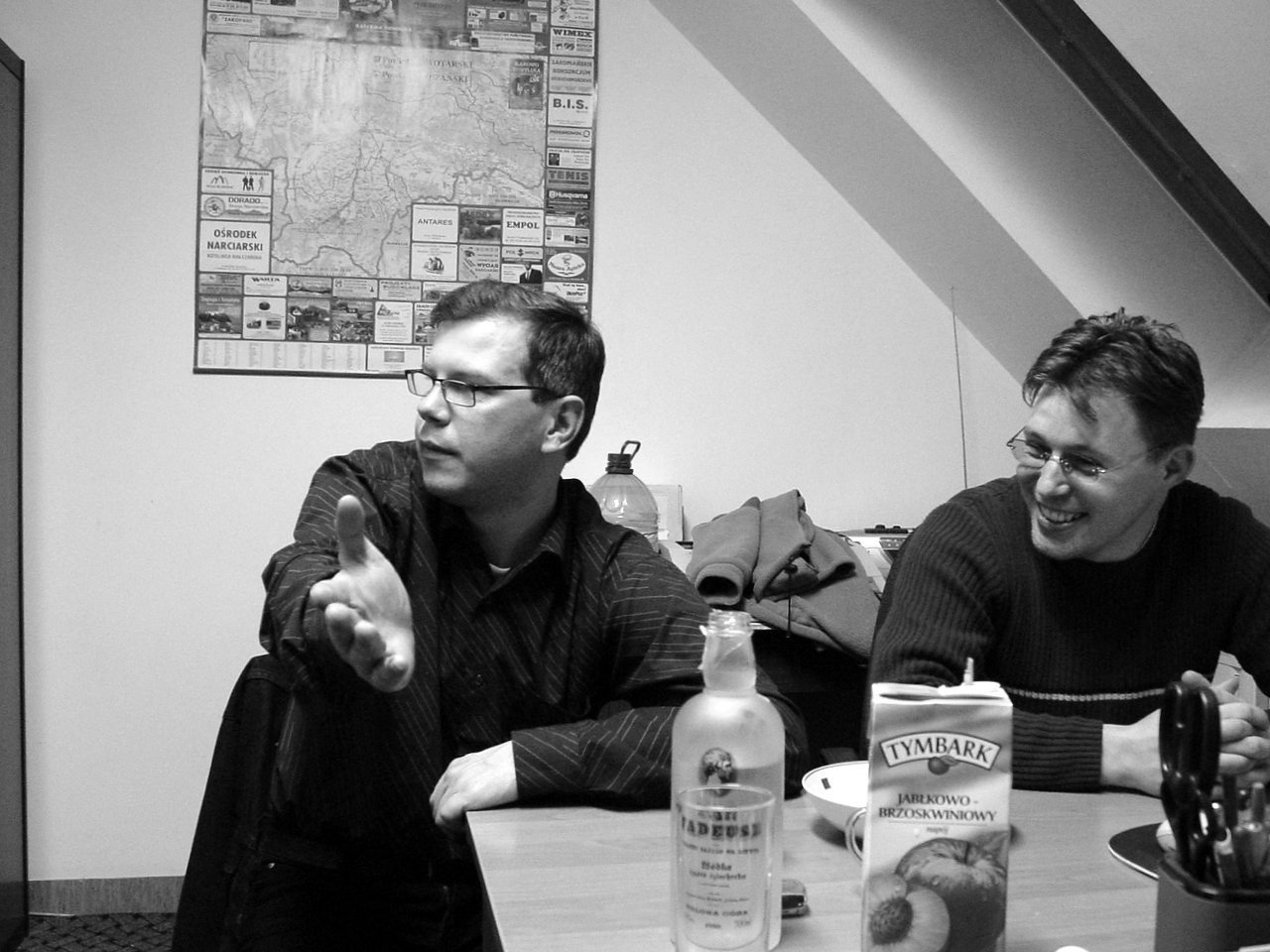
When your apartment is across the hall from a small office, and you know most of the people who work in the office, and they have an after-work party, you’ll probably end up there as well.

Us and Babia

Riding Round Babia
Slovakian view of Babia Gora

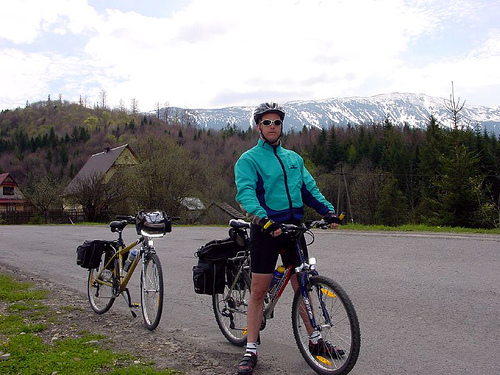
Last Saturday, Kinga and I went for a bike ride through Slovakia, around to the back side of Babia Gora. It'll probably turn out to be the last bike ride of the season, because the Indian Summer we'd been enjoying (called in Polish "lady's summer") came to an abrupt end recently. So no more pictures like the one at right . . .