matching tracksuits

fun in threes, sometimes fours

polska

My always obsession...

Cicho

"Cicho" would be spelled phonetically in English "chee-ho," with the "o" being very short.

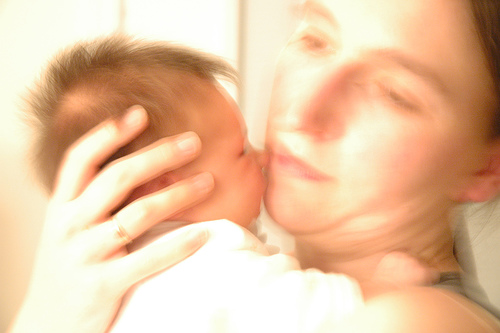
"Ciiiiiiiiii-cho, cicho, cicho, cicho. Ciiiiiiiiii-cho, cicho, cicho, cicho." K leans over L -- who is simultaneously howling, crying, screeching, and moaning -- and whispers the most onomatopoeic word in Polish.

"Quiiiiiiiiiiiiiiet, quiet, quiet quiet."
Calm

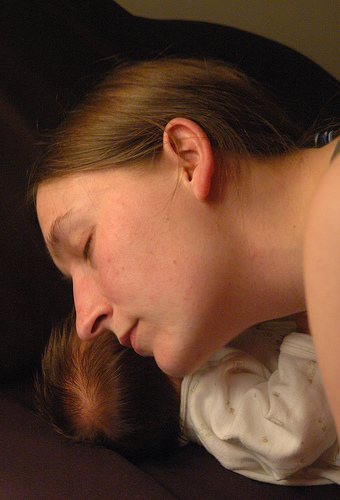
It's a word conducive to whispering, made up entirely of long, soft, quiet sounds. It has all the sounds of the womb, all the peace of a whisper, and all a rhythm that softly strokes the ear. Hearing "cicho" whispered makes one's eyes want to close.
DSC_4204

It's probably the most pleasant sounding word in a language made up of harshness. W Szczebrzeszynie chrząszcz brzmi w trzcinie (Translation). These are the sounds of Polish: a phlegmatic language best spoken with spit flying everywhere.

What's so remarkable about the word is that, when a mother whispers it, "cicho" contains the universal sound made for comforting a baby -- it contains an inherent "shush."

It is a candle being extinguished by damp fingers; the sound of walking through dry, light snow; the sound wind and leaves and trees.

If L chooses not to speak Polish to her own children many years in the future, I hope she chooses at the very least to calm them with a whispered "cicho."
Polish Scandal(s)

The Wielgus scandal in Polska right now highlights the strange role the church plays in the country's collective psyche. Intensely Catholic, Poland is a bit of a paradox when it comes down to praxis -- while most Poles label themselves "Catholic," there is a sizable percentage that doesn't live Catholic. Birth control is not a sin, nor is missing a Sunday mass. Still, Catholicism in Poland is big, to put it crudely. As Anne Applebaum put it in Slate,

This could only have happened in post-Communist Poland. Where else would millions of people be avidly watching the live transmission of an archbishop's inaugural mass? (Source)

I too have experienced the occasional spectator nature of Polish Catholicism. Sitting in a bar before John Paul II died, I was privy to a speculation about who could be his successor. And the discussion included names, and it had the free feeling of fans sitting in a sports bar, discussing the upcoming NFL draft.

The relationship with Communism is equally odd. While no one wants to go back to the days of informants, secret police, and closed borders, there is a longing in some quarters for a return to the "security" of Communism. Take into consideration the fact that the unemployment rate in Poland hovers around 19% and it's clear what that "security" is.

So when these to monolithic components of Polish identity collide, it's bound to be explosive. Even many not-so-devout Poles have a view of the Catholic church as being a stalwart moral guide under Communism. The Polish Catholic church stood up to Communism, and eventually, Communism collapsed. But priests and bishops are fallible, weak people too, it turns out, and the lure of privileges dangled by those in charge proved too tempting to some.

But why the sudden crisis, now, in 2007? John Paul II. Craig Smith writes, in the International Herald Tribune:

Perhaps the most explosive assertion by people in the church is that the taint of collaboration was known for decades but kept quiet out of respect for — or perhaps even at the behest of — Polish-born Pope John Paul II who died in 2005.

"The church didn't want to hurt the pope, but actually, more harm was done by keeping silent," said Zaleski at the hilltop compound of a charitable organization he runs outside of Krakow. (IHT)

So I expect there'll be more of the same in coming months and years.

To Spark a Controversy

Alright, I goofed. I mistranslated “iskra” as “ember” because, translating on the fly, I guessed from context and asked K whether it was “something from a fire…” Guess that covers ember and spark.

Nina corrected me, and I’ve been thinking about it since.

Not to be stubborn, I still prefer “ember.” Why?

“Spark” in my mind conjures images of particles floating, not sitting in a fire, as the “storyteller” in the lullaby is implied to be doing. It “winks” (mrugac); it doesn’t float; it doesn’t fly; it doesn’t soar. “Winking” is the perfect description of the what the small embers, buried under ash at the edge of the ash pit, do.

The only thing that “spark” has going for it (other than literalness) is the fact that in the verse it shines “for a moment” and then disappears. Embers tend to last longer than that.

Not content with all this, I went to a dictionary — an English-English dictionary, for there’s no question that “iskra” is literally “spark.” My only question was whether or not I was properly understanding “spark” in English, that all my connotations had been justifiable.

1. An incandescent particle, especially: a. One thrown off from a burning substance. b. One resulting from friction. c. One remaining in an otherwise extinguished fire; an ember. 2. A glistening particle, as of metal. 3a. A flash of light, especially a flash produced by electric discharge. b. A short pulse or flow of electric current.

And there it is: “an ember.”

The whole thing simply underlines what I was initially saying about translation: it can be very if-y. The original title of a biography of Singer I’ve been reading, literally translated, is Landscapes of the Memory. Madeline Levine, the translator, gave the title Lost Landscapes. Strictly speaking, this is incorrect — the word “lost” appears nowhere in the original Polish title — but I think it works better than the literal rendering.

Additionally, I’ve read English/Polish side-by-side editions of Czeslaw Milosz’s work and Wislawa Szymborska’s poems — often, so radically different from a literal rendering as to be shocking. But in each case, a literal rendering doesn’t capture nearly as much as the published translation.

I’ve never taken a course in translation, or read a book about it, so I can’t really say whether or not anyone would defend using “ember” instead of “spark” in the above example. But, bottom line, it works, underlining the slippery nature of language.

Psie smutki

I dislike my translation very much. There's no child's voice in it, no simplicity. But it gives you the idea of what the poem's about...

On the bank of a sky-blue river
live many small sorrows.
The first is sad because
he can't play in the garden.
The second -- that water doesn't want to be dry.
The third -- that a fly flew into his ear.
And what's more, that cats scratch,
That he can't catch the hen,
That he can't bite the neighbor's leg,
and that it never rains sausages,
And the last sorrow is that
People travel by cars, and a pup has to go on foot.
But just give him a little milk,
and bye bye sorrows.

Na brzegu błÄ™kitnej rzeczki
MieszkajÄ… małe smuteczki.
Ten pierwszy jest z tego powodu,
Że nie wolno wchodzić do ogrodu,
Drugi - że woda nie chce być sucha,
Trzeci - że mucha wleciała do ucha,
A jeszcze, że kot musi drapać,
Å»e kura nie daje siÄ™ złapać,
Że nie można gryźć w nogę sąsiada
I że z nieba kiełbasa nie spada,
A ostatni smuteczek jest o to,
Å»e człowiek jedzie, a piesek musi biec piechotÄ….
Lecz wystarczy pieskowi dać mleczko
I już nie ma smuteczków nad rzeczkÄ….

Christmas Dumplings

Boyhowdy, at “Not All Who Wander are Lost,” has a wonderful post about the Christmas season. He writes,

Somewhere in those years I fell in love with someone who loves Christmas, and ceremony, and peace on earth. Christmas came into my house, and nestled in me. (Source)

It’s something I can really relate to. Having grown up in a church that didn’t acknowledge, let alone celebrate, Christmas, it wasn’t until I was in my twenties, in Poland, that I first celebrated Christmas.

Cooking the Mushrooms

That first Christmas was a little odd. I returned to my host family in Radom, Poland, and since I was always at odds with the family’s son’s passive aggression, it was only mildly enjoyable.

I didn’t realize it then, but what was missing was simply the key element of Christmas: family. Subsequent Christmases in Poland I spent with those nearest and dearest to me in the area where I lived, and it only took about fifteen minutes of the real thing for me to fall in love with it.

Squeezing

Essential to the Polish Christmas is food. Huge amounts of it. Food that is time consuming to make, both due to its character and quantity. Dumplings and soups; salads and sides; deserts, deserts, and deserts.

It’s best to get started early.

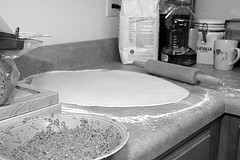
Dough

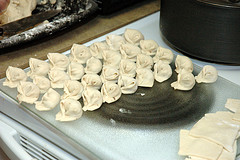
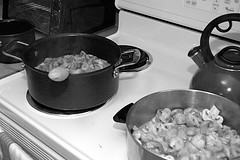
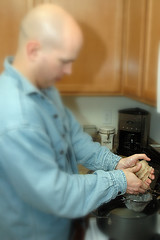
Hosting our second Christmas dinner, K and I began the cooking this weekend, making 100+ kraut and mushroom dumplings and around 80 mushroom dumplings (“ears” they’re called  for barszca, the amazing Eastern European beet soup). All told, almost 200 dumplings.

Ears

That calls for cooking many, many mushrooms, cooking much kraut, and squeezing the excess water out of it,making a lot of dough, and finally, making the dumplings.

It’s a time-consuming process, but it’s more than labor. It’s an investment, for the food serves as both the centerpiece of a traditional Christmas Eve and the backdrop for the talking and laughing that fills the evening.

Wedding Vodka

I’ve been going through old photos, occasionally putting some up on our Flickr account.

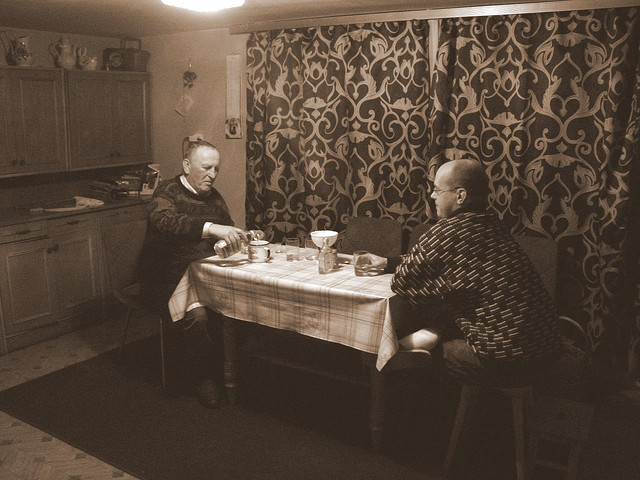
Making the Wedding Vodka I

I discovered a batch taken when my father-in-law and I were testing some Ukrainian spirit (something like 90% alcohol) for possible use in making the wedding vodka.

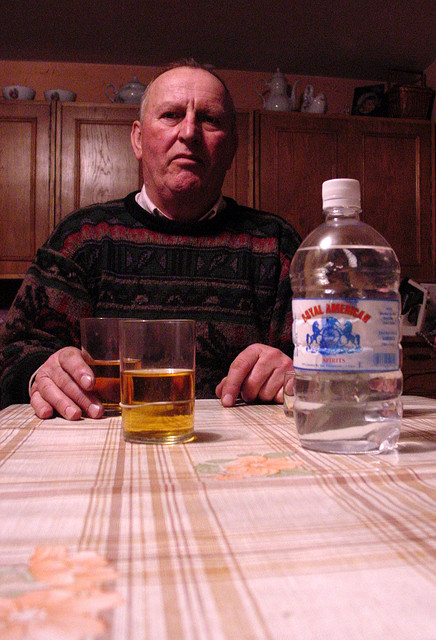
Making the Wedding Vodka II

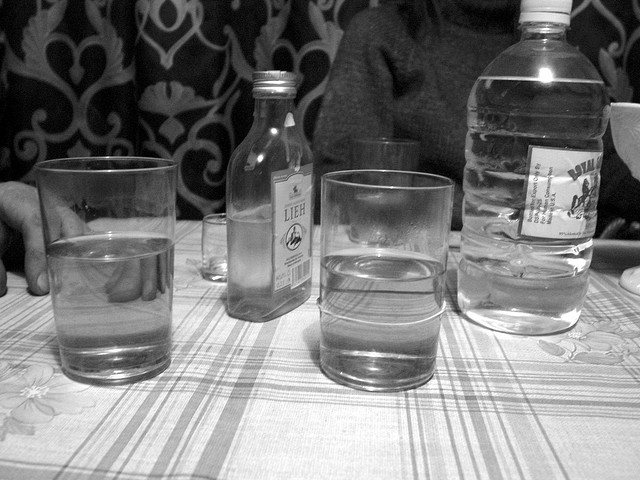
In the end, we decided that the quality was just not up to par. We compared it to “good old Polish spirit,” and it just tasted like it would produce a cheap hangover. (One of the things I learned in Poland: to avoid a hangover if you’re going to be drinking excessive amounts, one step is to go ahead and spend a little more money to buy quality vodka. If you drink enough water before going to bed, you can, in theory, wake up with a mildly sloshing head and little more. Drink cheap vodka and collapse into bed on returning home, and you might not get out of bed until late the next afternoon. Or so I’ve heard…)

Making the Wedding Vodka III

What an odd habit, making wedding vodka. It involves taking virtually pure grain alcohol, diluting it and simultaneously flavoring it. The flavoring added by introducing lemons, honey, or caramelized sugar to the mixture. (There are certainly other flavors, but those were the three we experimented with.)

In the end, we went with caramelized sugar and Polish spirit. The recipe is here. Let it sit for a few months and it’s actually pretty smooth and tasty.

Kononowicz the Great

At first I thought Krzysztof Kononowicz was a joke. "Some clever Polish YouTuber has done some video editing and acting and created an idiot," I thought. Apparently I'm not the only one. In comments posted about the video on YouTube, someone wrote,

ENGLISH: this is a hilarious electoral TV ad of a guy running for mayor of a town in Poland. The ad, which, incredibly, is NOT a joke, contains a huge amount of unintended humor. The cheesy jingle, the studio's awful colors, the candidate's look, and, last but not least, his horribly mangled and heavily accented Polish plus his dumbass ideas have made this video an instant classic of political humor. I'll be posting my translation on my profile soon.

I even said as much here, in a post that I removed as I thought about it and realized Kononowicz is not a joke, not even unintentionally.Kononowicz was a candidate for the mayor of Białystok. Elections were held Sunday, November 12. He didn't win. Watch the video, and even non-Polish speakers would have thought there was little chance he could win. But he did garner 3.5% of the votes.

What makes Kononowicz's candidacy seem like a joke is his naivety. His platform is simple, Catholic, and slightly nationalistic: stop underage drinking and underage smoking; get rid of crime; protect Poland's Ukrainian border against smuggling; improve the transportation infrastructure. They are all very practical political goals, from an obviously practical man.

Unfortunately, Mr. Kononowicz is not an eloquent speaker. He mumbles as if his mouth is filled with marbles and cotton. He begins by discussing his family, touching briefly on his mother, then speaking of his father (who fought bravely in the war but no longer lives with the Kononowicz family because "he relocated. He's in heaven now."), he refers to him as "Daddy."

He concludes that it's very much worth it to vote for him because "I am person truly honest, truly fair." He is not all talk, he assures voters:

"Other parties talk. They talk, and they do nothing. They did nothing for the city of Białystok. And what I said, I will accomplish everything. Because I am a faithful person and a practicing [Catholic]. And I know how to do it. How to fix the roads. How to do everything. How to get rid of cigarettes. How to get rid of everything!"

A simple man. With simple ideas. But necessary ideas.

There is indeed a lot of underage drinking in Poland, as everywhere. Indeed, there's just a lot of drinking, period, in Poland. Frigid winters and a 19% unemployment rate will do that to a country.

While I've only passed through Białystok's train station on my way to the northeastern corner of Poland, I'm sure the roads there are just as bad as everywhere else in Poland. Poles like to joke that their roads are so bad that even the holes in the road have holes.

I can't comment on the smuggling on the eastern border more than to say it makes the news regularly. Having lived on the southern border, I know there was a significant amount of smuggling things to the west — cheap alcohol mainly.

These are important concerns, but I never really heard politicians talk about them as directly as Mr. Kononowicz did. And that's why I've come to admire the man. Simple though he is, he decided to try to do something about the problems he sees his fellow Białystokites face. I can almost see him sitting at a table with his friends, probably over a bottle of vodka, saying, "Damn it, I'm going to do something about this! I'm going to stop sitting at this table complaining and go out and do something."

All Saints

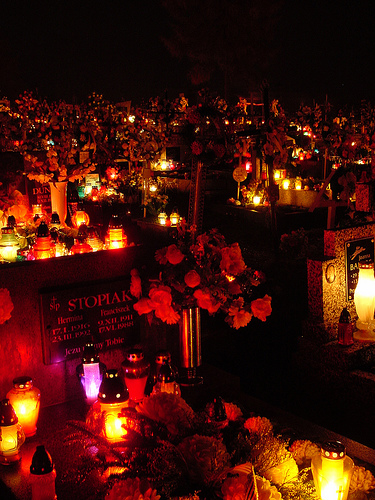
Tonight, Polish cemeteries will look like this:

DSC00035

Undoubtedly, one of the best times to be in Poland. Walking among the candles, hearing an occasional muted pop! as the glass of one overheats and fractures, having your clothes covered in the smell of candles — it’s really one of the most peaceful experiences I’ve ever had.

Unfortunately, we won’t be adding any new pictures this year, for obvious reasons. But more are available at Flickr.

How K and I Spent Saturday Afternoon

Translating course descriptions from Polish:

The course is presented in two parts. In the first part regarding the cadastre basics (semester V: professor Hycner), the course covers basic information regarding issues of land and building cadastre in Poland. The second portion regarding real estate economy (semester VI: Dr. Rutkowski), the course covers basic information regarding spatial development planning basics and information regarding real estate economy basics. The part regarding cadastre basics develops problems connected with establishing the land and building cadastre based on the existing land and building register. It also covers acquiring, storing, and actualizing cadastre information, which is developed in the laboratory, and students prepare cadastre documentation for a portion of the cadastral unit � using the most modern computer technology.

I was going to try to ramble on in a style similar to the original Polish of all these course descriptions, but it’s too hard. I guess you have to be “prof. dr hab. inz” to write like that…

The worst part is that for our purposes, we have to translate this as close to “word for word” as possible. A literal word for word translation, as in most cases, would make less than no sense. But the catch is that these are the writings of engineers and surveyors — in Polish they read awfully. So we’re trying to strike a “delicate” balance.

Translating anything is bad enough. Translating poorly written material is a nightmare.

Learning Polish

From my journal, ten years ago.

I’ve been working with my host mother on the basic Polish sounds and I have hit a real break through in [the] pronunciation of sz and rz. It’s great!

Earlier in the evening I was trying to pronounce one of the many “sh” sounds and after several failures I finally threw out a last attempt accompanied by a significant amount of spittle, and she cried “Tak!” with great delight.

Learning Polish was unlike learning Spanish and French for me because it occurred in Poland out of necessity. Survival even. And so the result is that I know much more Polish than I ever did French or Spanish, and I have an understanding of linguistic subtitles that escaped me in high school and university.

And I can finally say “chrząszcz” without drowning my conversational companions.