matching tracksuits

fun in threes, sometimes fours

polska

My always obsession...

Potter v Pope

In Poland, the Catholic Church is very much against Harry Potter -- sort of like religious conservatives here.

Why?

We all know the standard reasons: wizards and sorcery are simply forbidden in the Bible. It's that simple.

Yet K pointed out the "real" reason Potter worries the Polish church. I read the BBC News article opening to her:

The seventh and final Harry Potter book has broken sales records on both sides of the Atlantic, selling 11 million copies in its first 24 hours.

Harry Potter and the Deathly Hallows sold 2.7 million copies in the UK and 8.3 million in the US. (BBC)

She responded, "See, that's why the Polish church is so scared of Harry Potter. That's real power."

300+ pictures

Yesterday, during the late afternoon/early evening, I uploaded about 340 pictures to Flickr. It’s all part of a new plan to start using Flickr more and our own computer’s hard drive less. We have a 250 gb hard drive, and because of pictures and now films, we’re about full.

Most of the pics are from Poland, and so they’re at least two to four years old.

They’re available here.

Latin Roots

Last week, Pope Benedict has authorized increased use of the traditional Tridentine Mass (i.e., Mass in Latin). There are some concerns because the traditional Latin liturgy has a prayer for all Jews to be converted.

Still, others talk about “turning back the Catholic clock,” fearing that Benedict is on a mission to turn back the now-forty-year-old reforms of the Vatican II conference.

And still, others talk about the silliness of using an ancient, dead language for Mass, a language that most parishioners and probably all visitors will find unintelligible.

What to make of all this?

For all the disadvantages of using Latin, a sense of mystery is a definite advantage. Catholic theology is filled with mysteries

  • the Rosary includes meditation on “Mysteries” (their term, not mine);
  • at the end of the consecration of the host, the priest and parishioners into “the Mystery of faith.”

The candles, the architecture, the liturgical music — it’s all there to invoke a sense of the mysterium tremendum. The Latin — if parishioners understand what they’re saying — can only heighten that sense.

I have limited experience with Catholic Mass, but since K is Catholic, I do have more experience than I did ten years ago. Most of my Mass-going experience was in Poland, and when I came to the States, I found it odd to hear the liturgy in English. Odd, and demystifying.

Cheating?

When I was in Poland the first time, I made a vow: I will write in my journal every single day. I blew that pretty much within the first week, if memory serves. I was in Radom for "Pre-Service Training" with roughly 90 other Americans, and the late nights took a toll, I suppose.

A photo blog of Radom is available here, but it's all in Polish. Still, gives you an idea of the city.

So I modified my resolution: I will write in my journal every single day once I get to my site. And I did -- except, I believe, for one day.

Well, two. Evening I got in late and was bed before I remembered, so I got up to write something -- anything -- and I think I put down something like "This is just to keep my streak going."

This time, I came up with something a little better, I believe...

Ty Pan Du Sie Tu Vous

When learning Polish, for some reason I had the hardest time initially using the formal voice of address. English-only speakers might not know what I'm talking about, even though the formal/intimate distinction existed in English for hundreds of years.

In French, it's a question of "Vous" and "tu." "Vous" would be "you all" -- second person plural -- and is used in all formal occasions; "tu" is informal, and used with intimate friends or family. In German, it's "sie" and "du".

This is why Martin Burber's wonderful book Ich und Du is translated I and Thou and not I and You.

In English, it used to be "you" and "thou," with "thou" being the more intimate. Because most of us are exposed to "thou" exclusively through liturgical language, we get the sense that it's incredibly formal. In fact, it's the opposite.

Po Polsku

In Polish, there are two options. The first is the common use of "Pan" or "Pani" -- literally, "lord/master" or "lady/mistress."

The older, now-obsolete form is to use "Wy" -- "you all." It's still used in the mountainous southern region, and K in fact speaks to her grandmothers this way. "Co robicie ostatnio?" "What have you been doing lately?"

Out of this came an amusing verb: dwoic. While this is related to the word "dwa" (two), it's not, strictly speaking, "double" (which is "podwoic"). Instead, a better explanation would be "to use the second person plural." In that case, one might ask another, "why are you [dwoic] me?" meaning, "Why are you using the formal voice with me?"

The second method, and the one used now, is to use "Pan" and "Pani." To be polite, a shop attendant, for example, doesn't ask, "Do you need help?" Literally, he asks, "Does the lady need help?"

The problem for me was not so much remembering the odd construction but learning when to make the switch from "Pan" or "Pani" to "you." I called people "you" when I should have used "Pan/Pani" more times than I care to recall. And there really are no guidelines -- it depends, somewhat, on the person.

Linguistics of Diplomacy

I got to thinking about all of this due to an article by Charles Bremner. It begins,

Here is one of those stories that are difficult to convey to people who speak only English. President Sarkozy's government has annoyed the "progressive" sections of the teaching establishment with an order that school pupils must address their teachers with the formal vous rather than the familiar second person singular tu. Teachers are advised to use the respectful vous to Lyc�e teenagers in their classes.

While I could never imagine students in Poland referring to teachers in the second person, I could also never imagine teachers using the formal third person with teachers.

The piece goes on to discuss how world leaders refer to each other -- tu/du or vous/sie?

Angela Merkel dropped German formality enough to call him "Lieber (Dear) Nicolas" but stuck to the formal "sie" not the familiar "du". Sarkozy's matey reply jarred on old-fashioned ears. "Ch�re Angela... J'ai confiance en toi." (In older English I trust thee not you). Lib�ration joked that Franco-German harmony was still lacking. "They are going to have to start by agreeing whether they use tu or vous," it said. (Charles Bremner piece)

While the article doesn't mention George Bush, it seems safe to assume that, like Gordon Brown, his dependence on interpretors will solve the tu/Vous problem. But considering the little back rub he once gave Merkel, it's fairly reasonable to assume that Bush would opt for "tu" over "Vous."

Bush in that Country East of Germany

Bush went to visit Poland during the G8 summit. Yesterday in the car, I heard two different NPR news briefs about it -- not whole reports, but simply a mention in the headlines.

Neither time did the reporter refer to the Polish president by name.

The first time was something about Bush going to Poland to visit "that country's president."

The second time, it was a mention of Bush meeting his "Polish counterpart."

I've wondered why they didn't use the Polish president's name. Is the Bush's Polish counterpart's name so difficult to pronounce? Did the reporter not know the name of the president of Poland?

For the uninformed, it's Lech Kaczenski. (That "n" should have an accent on it.) That would be pronounced "Ka-chenee-ski."

Can they not pronounce it? Can they not remember it? At least they didn't have to say "president of Poland" in Polish -- that is a mouthful: "Prezydent Rzeczypospolitej Polskiej"

Dill

Dill

Dill is summer in Poland. Fresh, young potatoes topped with dill make me think of all the Polish summers I experienced, but in particular, the first one, which was well underway eleven years ago today. It seemed during that first summer in Radom, during pre-service training, we had potatoes with dill every single day. And so the scent instantly brings back to mind the large, Stalinist Polish cafeteria where we ate.

Maybe that first summer was simply dill overload, because no matter how many pleasant memories I associate with the odor, I honestly don't really like dill. It has such a fresh scent, and yet it so easily overpowers. Summer potatoes with dill taste, to me, almost exclusively of dill, no matter how sparingly it's applied.

Falwell’s Polish Legacy

It seems the Poles are taking a page from Falwell’s book of idiocy:

A senior Polish official has ordered psychologists to investigate whether the popular BBC TV show Teletubbies promotes a homosexual lifestyle.

The spokesperson for children’s rights in Poland, Ewa Sowinska, singled out Tinky Winky, the purple character with a triangular aerial on his head. (BBC)

Polish Climber

Long ago I found a video of Russian kids doing some really unbelievable tricks. Watching it, I thought, “Dang, that looks a lot like Poland.” The ubiquitous boxiness of Stalinist architecture is the same throughout Eastern Europe, I guess.

It turns out, some lad in Jablonka, K’s home, village discovered the video and, apparently impressed, learned some tricks and made a video himself called “Tricks by Buma.”

  • The fairground is a matter of meters from J’s family’s home.
  • The shots at the end were filmed at the entrance to K’s high school.

Small world…

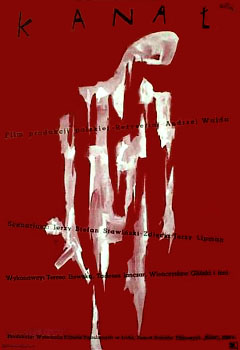
Kanał

Only a Pole could make a movie like Kanał (Canal, 1956). Such resigned nihilism can only arise from a country that has literally both ceased to exist (the Partitions) and been razed completely (Poland 1939-1940).

The second in Andzrej Wajda’s trilogy about World War II, Kanał tells the story soldiers in the Polish Home Army who were encircled by Germans during the last days of the Warsaw Uprising. Ordered to retreat, the 44 soldiers try to escape via the sewer system. Most of the film takes place in that most unimaginably horrid location: encircled by the enemy above, surrounded literally by s— below.

While at first glance Kanał seems to be a film about Poles resisting the Nazis, it’s equally — if not more — a critique of the lack of Soviet intervention during the Warsaw Uprising. The common Polish view is that the Soviet army camped out on the eastern bank of the Vistula and did little if anything to help the Polish soldiers. Some historians, it seems, dispute that account, but having lived in Poland and married a Pole, I am partial to the Polish view (and, generally speaking, the majority view, I believe). In that sense, it’s a minor miracle that the film made it past the censors, as it not only lacks a show of communist brotherhood but even hints at the opposite.

Certainly not a movie for simply “kicking back,” but well worth viewing.