matching tracksuits

fun in threes, sometimes fours

polska

My always obsession...

Jasełka

Nativity plays date at least from the time of St. Francis of Assissi, eight hundred years ago. This weekend, the concept was, once again, Polish-ized.
DSC_9080.NEF
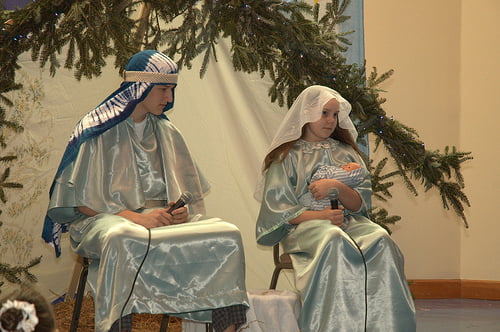
The Holy Family

To be fair, it was not a one-off occurrence. Nativity plays, called jasełka (ya-sewl-ka) in Polish, are as customary during the Christmas as wreaths and carols.
DSC_9091
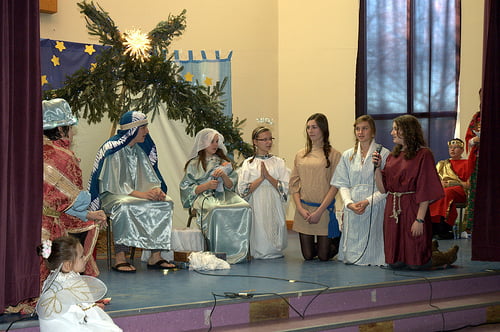
Shepherds' Visit

Unlike the modern American nativity play, which is often relatively high tech and performed by adults, Polish nativity plays are almost always entirely a production of children and adolescents -- under the direction of adults.
DSC_9093
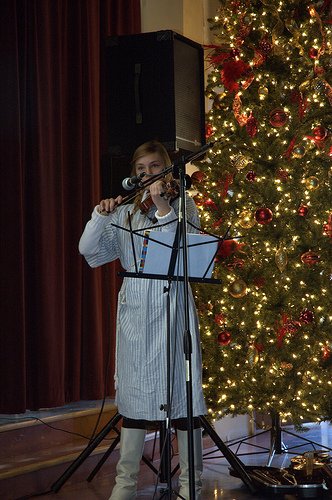
Carol Soloist

So in schools and churches throughout the Polish community worldwide, children are have been putting on nativity plays much like the one the small Polish community here watched this afternoon.

Yet this play was somehow different -- incredibly different -- than all the plays I watched while teaching in Poland. During the final days before Christmas break, students and faculty gathered to watch the year's play: it was often, it seemed to me, an attempt by the directing teacher simply to impress the other teachers.
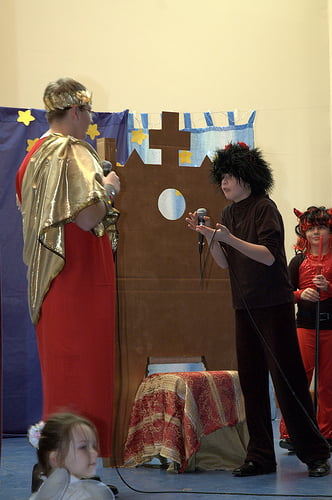
DSC_9108
The Devil Visits Herod

These actors were American children of Polish heritage, children who speak English naturally and Polish only when spoken to by an adult. Their Polish has the traces of limited exposure: accents, weak grammar, lower-level vocabulary: they speak Polish like I do, in other words. For all intents and purposes, Polish is a virtually-foreign language to them.

For them, it's the language of parents and parents' friends, a language to be spoken only when spoken to. When they sit around, waiting for their scene during rehearsal, they lapse to the more comfortable English, the language they speak without thinking.
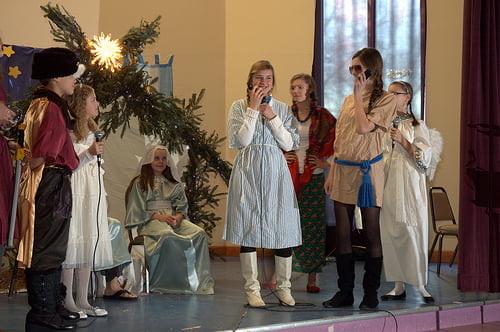
Updating
Updating

And yet they memorized line after line, exchange after exchange, and performed it with few cues.
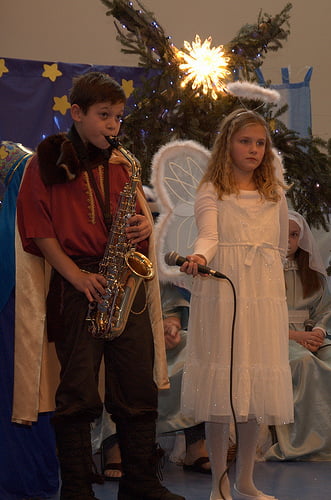
Carol Soloist
Carol Soloist
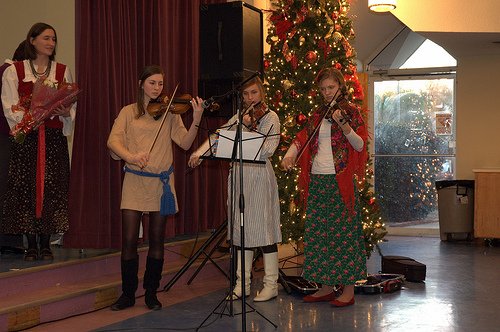
Accompanists
Accompanists

It was a showcase, a moment for kids to show their musical, acting, and linguistic talent. It was a celebration of one of the pivotal events in history -- the pivotal event in the West.
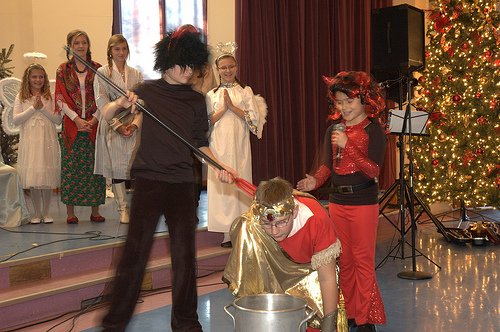
Herod Gets His Just Reward

At the heart of the afternoon was the sense of community, the sense of belonging. In between scenes, the audience joined the kids in various renditions of the most popular Polish carols. Put ten Poles in a room together and they'll end up singing: yet somehow, in suburban America, it had a special glow.

For K and me, there was a first -- a first of many, I'm sure. As part of the finale, L sang a solo.
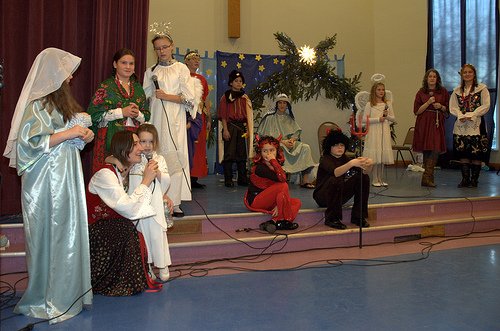
"Oj maluski maluski"

She was was off pitch and out of tune, but it was the sweetest moment I've ever experienced as a father.
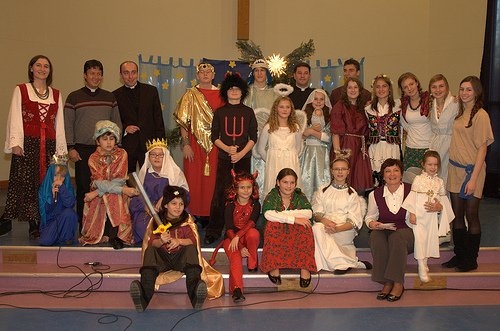
Cast and Crew
Cast and Crew

Preparation Begins

When Christmas Eve dinner includes two soups, multiple courses, and more desserts than one can possibly imagine, it's a good idea to get started a little earlier.

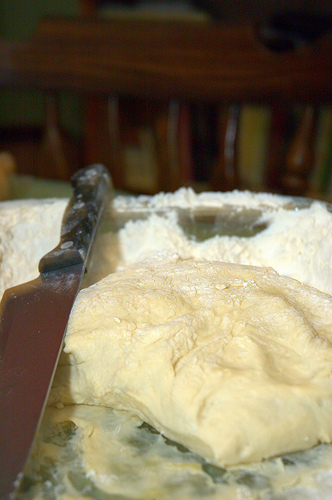
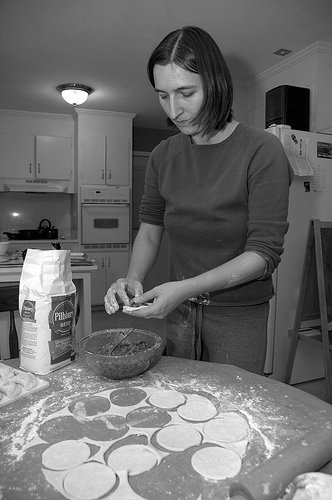
Filling for Dumplings

Ten days ought to do.

And so last night we began by preparing the cabbage/mushroom filling for the dumplings. It's neither a long nor a labor-intensive process, but when there will be cakes to bake and soups to season during the days before Christmas, it puts things into a little different perspective.

DSC_9002

So last night we cooked the sourkraut, sauted the onions, ground them to a literal pulp, mixed a sprinkle of bread crumbs and called it a night.

DSC_8996

Tonight, stuffing and fast-freeze.

Prayers and Candles

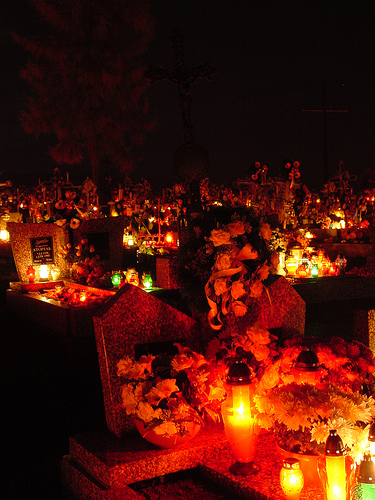
Today is All Saints' Day -- one of the best times to be in a Catholic country like Poland. This morning, every single cemetery in Poland had something like this going on.

DSC00332
Photo from 2001

Every year I write the same things and probably show some of the same pictures. Since we haven't experienced All Saints' Day in Poland since 2004 (has it really been that long?), I've only a very limited stock of photos, and an even more limited stock of stories: I can only tell the same stories so many times before even I get tired of them.

That's something of the appeal of it: the repeating ritual of the Catholic liturgical calendar means we're always coming back to the same place. It makes life less of a straight line and more of a spiral.

One of the most calming and consoling times in that spiral is the evening of All Saints' Day, when all the cemeteries flicker with the light of thousands of candles, and the hissing, crackling, and popping of the candles punctuate the prayers of the faithful.

All Saints

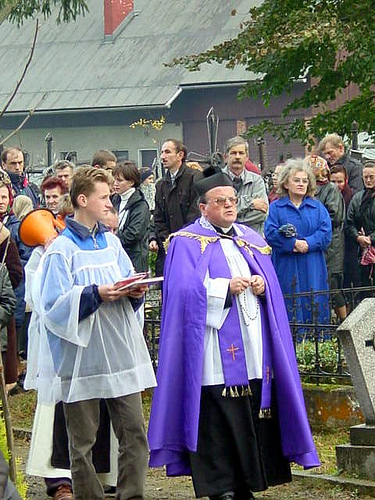
I would visit the cemetery at least twice: once when the priests were leading prayers and a second time when no one else was there. Both were calming in very different ways.

Surrounded by Poles who had intimate connections to the cemetery -- here lies a brother, a mother, an uncle, a great-grandmother -- I felt the peace of the community, even though I was an outsider. Catholicism is very communal and intimate, and prayers in a candle-light cemetery are the epitome of that intimacy and community spirit.

Yet it was when I was alone that I felt more calm than I've ever felt in my life. Surrounded by death, I felt more alive than any other time of the year.

Halloween, in comparison, is so distinctly American: commercial, whimsical, with just enough evil to make us worry but not enough to make us act.

I prefer the Polish Catholic version, and I would imagine I always will.

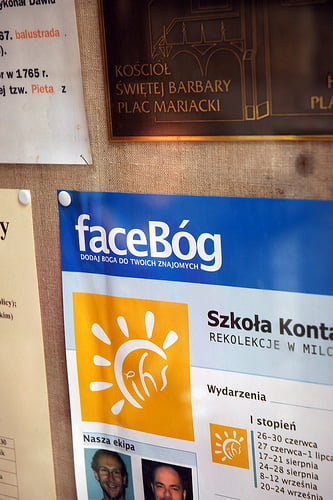
Face Bóg

Facebook is truly becoming ubiquitous, to the point that it can be used in Polish religious advertising.

Below was a poster at the entrance to one of the many churches in Krakow.

"Bóg" ("God") is pronounced much like the English "book," but with an obvious "g" instead of "k."

"Dodaj boga do twoich znajomych" literally means "Add God to your acquaintances," but a more Fackbook-eque translation would obviously be, "Add as friend."

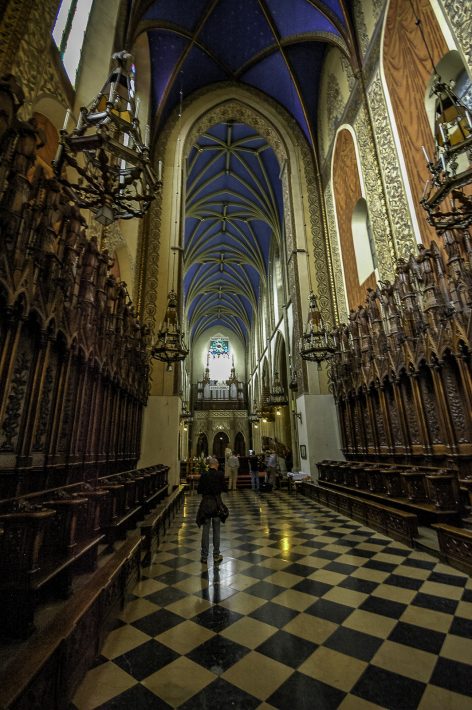
Basilica of the Holy Trinity (Krakow V)

“You know what I’m looking forward to?” I asked K before we left for Poland. “The smell of an old church.”

“Oh, me too,” she replied.

It’s an odor of slightly metallic dampness, old incense, leather, wool, and a thousand other notes that probably only a sommelier or blender of fine pipe tobaccos could notice and describe but which merge for us mere mortals into “old church.” It is to be in the midst of history: the structure is older than America. It is to be in the midst of profound calm: even in the most tourist-filled church, there is reverent silence.

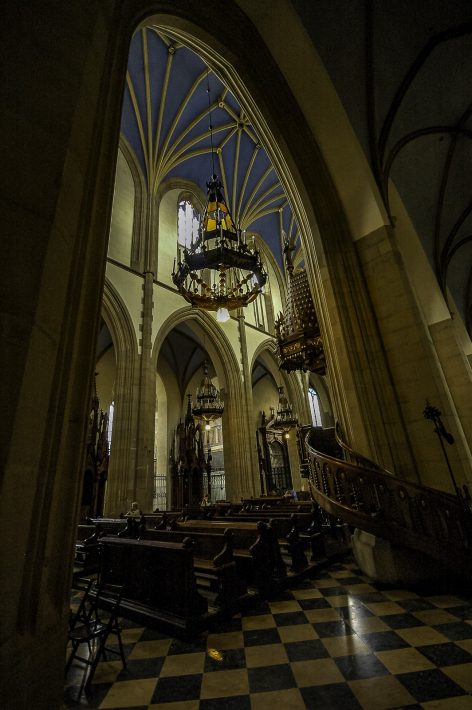
A day in Krakow, responsible only for myself. I decide there is only one thing to do: go into churches. I begin with one of K’s favorites: the thirteenth-century Gothic Basilica of the Holy Trinity.

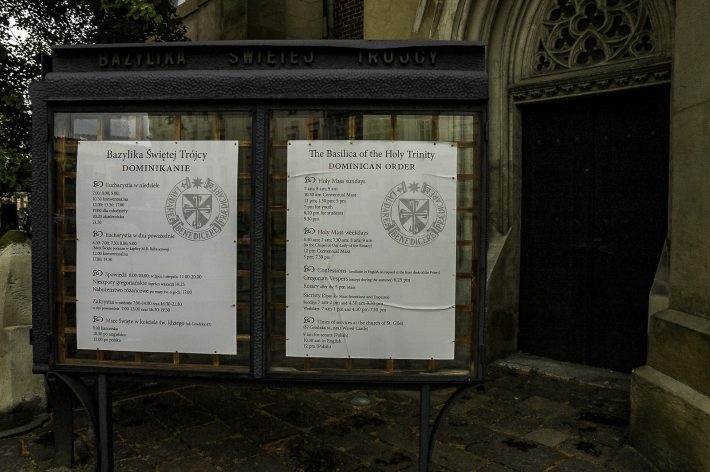
With so many churches in the Old Town of Krakow, it’s surprising how many masses the Basilica has. There are more on a weekday than on a Sunday at an average Catholic church here in the Old South, a clear illustration of the difference in relative demand. Then again, this particular church is popular among university students in Krakow.

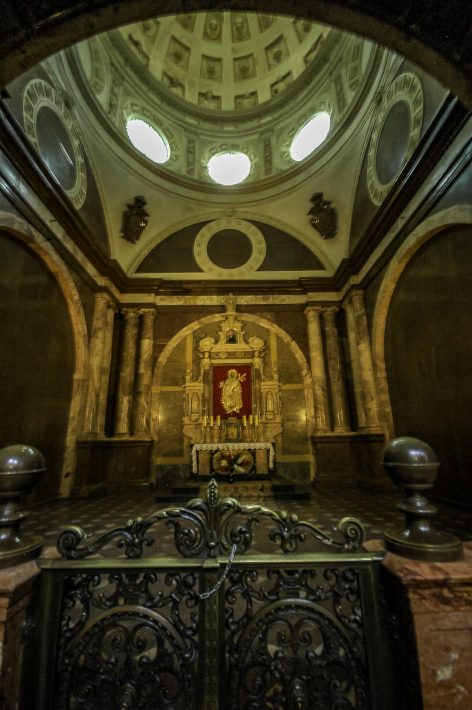
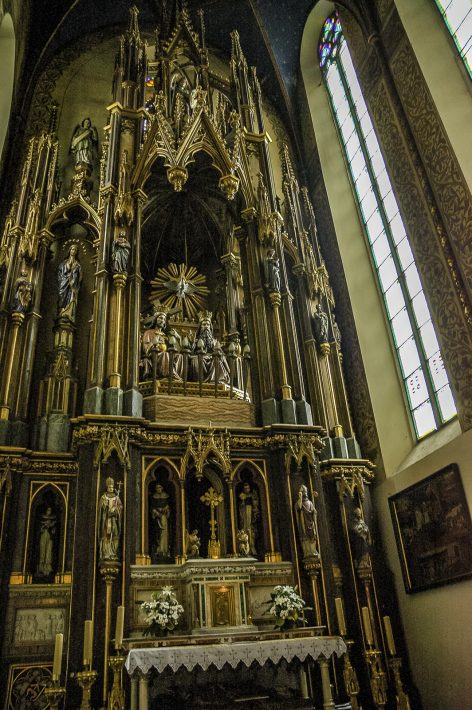
So many of the churches in Krakow — they begin to blend together after a while. That’s the tourist view, I’m sure. To parishioners, there’s a history and a relationship.

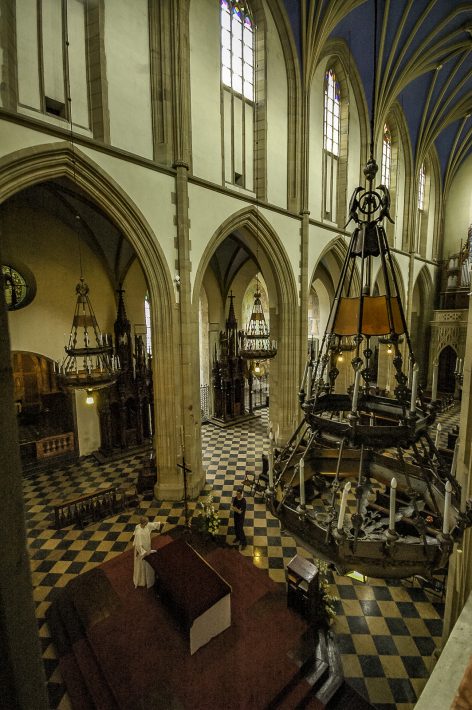
Yet, there are little details in each church, little architectural touches that set each one apart. The basilica, for example, has a small upper chapel.

The view provides a little different perspective. Instead of looking up — a common action in gothic churches, and very much by design — one has the opportunity to look down. Somewhat blasphemous in a certain sense: we mortals are to be looking up to God, and here I am looking down. And on what?

A young monk explaining an upcoming ceremony to four young men. I can’t hear what they’re saying, and every picture I take turns out later to be completely, irredeemable blurry. I make a logical assumption: these young lads are about to become monks themselves, but I’m not certain. I can’t eavesdrop without making it obvious, and something prevents me from simply walking up to them and asking. What’s stopping me?

The conspicuousness I always feel as a tourist certainly has something to do with it. Walking around, snapping pictures, changing lenses, taking more photos, changing lenses again — I’m simply a cacophony.

What’s worse, unlike the Catholic tourists, I don’t genuflect as I pass the altar, and I don’t cross myself on entering. I surely stand out, but what’s the problem? We all stand out.

Is it false modesty or simply an overactive ego?

Ну, погоди

Ну, погоди (Nu, pogadi) -- Just You Wait!
Ну, погоди (Nu, pogodi) -- Just You Wait!

Every time L meets Babcia (here or in Poland), Babcia turns L onto a new cartoon. This visit it was Wilk i Zajac (Wolf and Hare). In the classic tradition of the Roadrunner, Tweety Bird, and Tom and Jerry (to name but a few), it is the continuing attempt by a mildly evil character to capture (and presumably consume) an innocent character.

It's not a Polish cartoon, though. It's from the Soviet Union, with the first being created in 1969. The Russian title was "Ну, погоди¸" (pronounced "Nu, pogodi" Ну, погоди" is translated "Just you wait!"). It's easily translated to other languages (I'm sure Poland wasn't the only Soviet bloc country to have this imported) because about the only words spoken in each episode are "Ну, погоди¸". The Polish versions translate that as "I'll show you!"

L watched the DVD so many times that she basically had them memorized. She wasn't the only one in the house who came to have the cartoons seared into memory. By the end of our stay, I could tell which cartoon was playing just by walking by the living room.

Busted

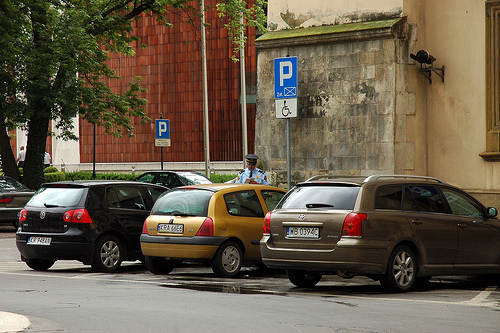
Parking in the Krakow Old Town can be hard to come by. Just ask this driver…

DSC_4676

Up (Krakow IV)

Krakow, like all European cities, is a mix of the old and the new. Young people walk along ancient cobblestone street checking email and updating their Facebook status on their cell phones. McDonald's sits on an ancient street in a building that is at least twice as old as the chain itself.

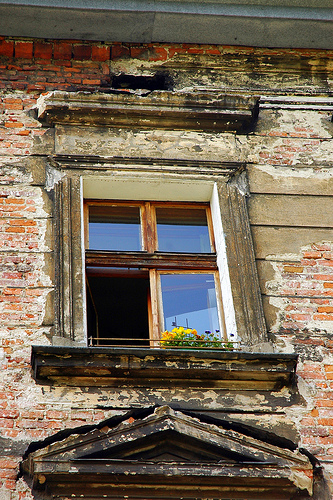
Often both are present at the same moment, in the same building. Visiting such an old city is a reminder that often, what's at street level is the least interesting sight. Or, perhaps more accurately, that which is above is at least as interesting as that which is at eye level.

DSC_4744

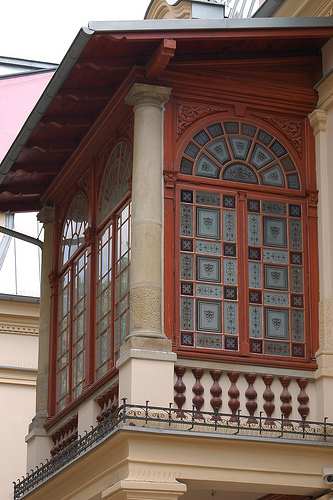
As I strolled along, taking a meandering walk from the rynek to Kazimierz, the old Jewish quarter, I began to pay attention to the balconies.

DSC_4962

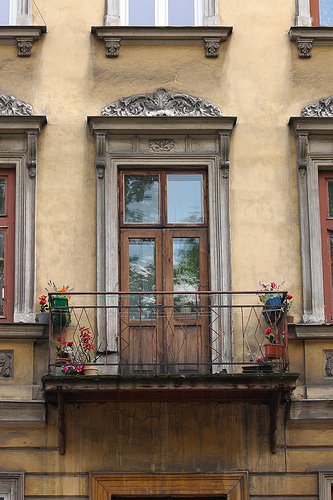
In an urban setting, balconies are often the only part of one's property that has anything at all to do with the out of doors. Parks, beautiful as they are, are after all public property. A balcony is the only "yard" a city dweller might own.

DSC_4801

A few flowers and it's positively garden-like.

Storage is another balcony option. I had a good friend in Warsaw who had a "balcony" at his apartment that couldn't have been more than ten square feet: just a little spot to stand. He stored his bike and a couple of other items on the balcony. After all, what else could you do with ten square feet? As a non-smoker and non-coffee drinker, he couldn't even enjoy a morning cigarette (if such things could be enjoyable) and cup of coffee on his balcony.

DSC_4802

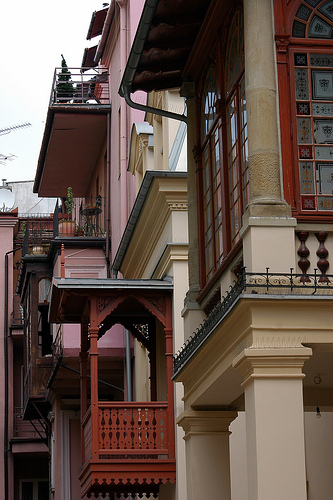
As in most urban areas, space is at a premium. Some decide to turn their little bit of outdoors into an additional room. Then neighbors get balcony envy and enclose theirs,

DSC_4804

resulting in an alleyway of enclosed balconies.

Given the size of some apartments I've visited, it makes perfect sense.

DSC_4805

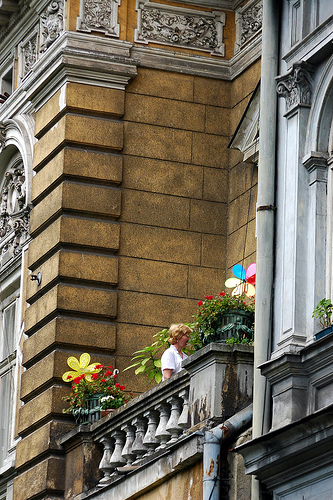
Still others, with a more classic balcony, simply leave it alone. Then again, if one's balcony is the size of others' apartments (and I have been in apartments in Warsaw that tiny), one probably has enough apartment on the other side of the balcony to make such a conversion unnecessary.

DSC_4816

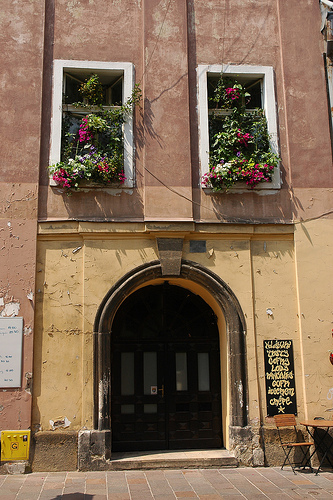
Yet not everyone has a balcony, especially in the Old Town. This is not to say they haven't carved out their own little outdoor garden. Some, more extravagantly than others.

DSC_4748

It makes for a bit of color in an otherwise gray setting.

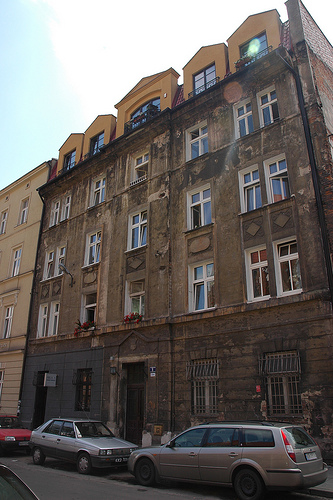
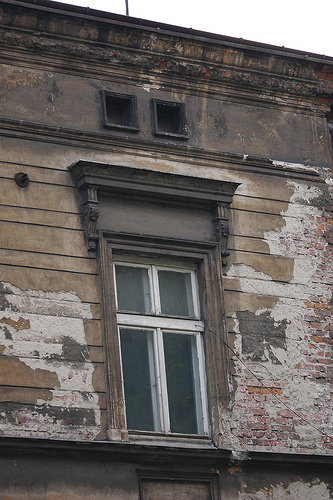
Many, however, just leave well enough alone. Perhaps they figure it's not worth the time. Perhaps the reason that there's not much use, given the state of the pre-war facade.

DSC_4800

With all the renovation going on all over the city (thanks, European Union), it's only a matter of time before such sights disappear. In a way, that's sad: such decrepit facades bear witness to history. They show the gritty underside of Poland, and they serve as a reminder to visitors that, as with much of Europe, the city hasn't always been filled with days of Italian ice cream and walks in the parks.

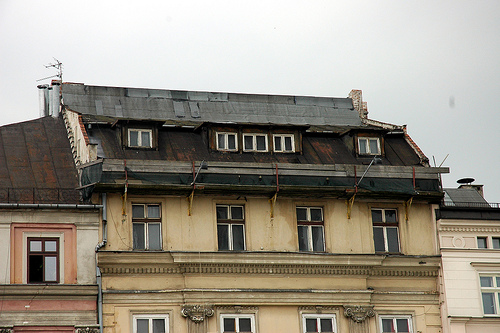
DSC_4675

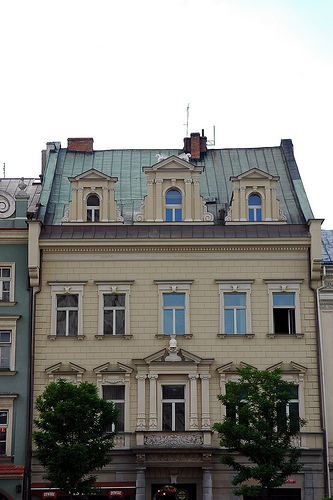
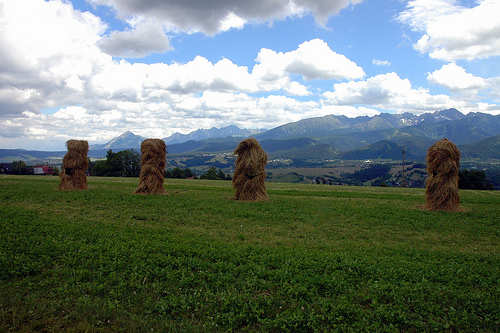
It also shows one of the paradoxes of modern Poland. The building above is literally on the rynek: the most prized location in Krakow real estate. Yet the roof is literally pathetic. It's the same as in Furmanowa, the meadow overlooking the Tatra Mountains in Zab: prized real estate that's used for cultivation.

Cousin It
Cousin It 9 July 2008

And yet the irony: so many Poles lament how so many of their compatriots have turned so materialistic in the last few years.

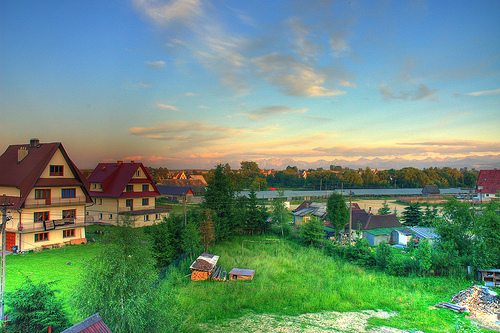
Top Floor

K’s parents have a large house. They have to: they run a little noclegi business — something like a bed and breakfast, but more often than not, without the latter.

This is the view from their highest balcony.

__

All the quirks of Poland, on display. The relatively rich live beside the poor. They both live next to an enormous flea market, where everything is available, and all prices are negotiable. All framed by the mountains that give the region its beauty and its culture.

In Motion

During K’s next-to-last night in Poland, we went out for a little family-and-friends party. I posted several pictures, but only now have I gotten around to the video.

Who could listen to this and sit still? Apparently, not many…