Matching Tracksuits

fun in fours

lent

Lent 2012: Day 2

Reading

We must first ask ourselves what kindness is. Words, which we are using constantly, soon cease to have much distinct meaning in our minds. They become symbols and figures rather than words, and we content ourselves with the general impression they make upon us. Now let us be a little particular about kindness, and describe it as accurately as we can. Kindness is the overflowing of self upon others. We put others in the place of self. We treat them as we should wish to be treated ourselves. We change places with them. For the time self is another, and others are self. Our self-love takes the shape of complacence in unselfishness. We cannot speak of the virtues without thinking of God. What would the overflow of self upon others be in Him, the Ever-blessed and Eternal? It was the act of creation. Creation was divine kindness. From it as from a fountain, flow the possibilities, the powers, the blessings of all created kindness. This is an honorable genealogy for kindness. Then, again, kindness is the coming to the rescue of others, when they need it and it is in our power to supply what they need; and this is the work of the Attributes of God towards His creatures, His omnipotence is for ever making up our deficiency of power. His justice is continually correcting our erroneous judgments. His mercy is always consoling our fellow-creatures under our hardheartedness. His truth is perpetually hindering the consequences of our falsehood. His omniscience makes our ignorance succeed as if it were knowledge. His perfections are incessantly coming to the rescue of our imperfections. This is the definition of Providence; and kindness is our imitation of this divine action.

Moreover kindness is also like divine grace; for it gives men something which neither self nor nature can give them. What it gives them, is something of which they are in want, or something which only another person can give, such as consolation; and besides this, the manner in which this is given is a true gift itself, better far than the thing given: and what is all this but an allegory of grace? Kindness adds sweetness to everything. It is kindness which makes life's capabilities blossom, and paints them with their cheering hues, and endows them with their invigorating fragrance. Whether it waits on its superiors, or ministers to its inferiors, or disports itself with its equals, its work is marked by a prodigality which the strictest discretion cannot blame. It does unnecessary work, which when done, looks the most necessary work that could be. If it goes to soothe a sorrow, it does more than soothe it. If it relieves a want, it cannot do so without doing more than relieve it. Its manner is something extra, and is the choice thing in the bargain. Even when it is economical in what it gives, it is not economical of the gracefulness with which it gives it. But what is all this like, except the exuberance of the divine government? See how, turn which way we will, kindness is entangled with the thought of God! Last of all, the secret impulse out of which kindness acts is an instinct which is the noblest part of ourselves, the most undoubted remnant of the image of God, which was given us at the first. We must therefore never think of kindness as being a common growth of our nature, common in the sense of being of little value. It is the nobility of man. In all its modifications it reflects a heavenly type. It runs up into eternal mysteries. It is a divine thing rather than a human one, and it is human because it springs from the soul of man just at the point where the divine image was graven deepest.

Response

Ask me some time ago -- two or so years -- about God and my reply would have quickly turned to the problem of evil and the problems it creates for any conception of God. The existence of consciously, conscientiously willed evil -- such as the Holocaust, the abuse of a child, the torture of individual, the slaughter of innocence -- presents certain difficulties for the believer. "How can such evil exist in a world with an omniscient, omnipotent, perfectly benevolent being? Either this being is not omniscient and simply doesn't know about the evil, or is not omnipotent and unable to prevent it, or is not completely benevolent and unwilling to stop it. In any case, then, this being might be many things, but it is certainly not God as we commonly think of the term." There are various philosophical ways to wiggle out of this, some more satisfying than others, but more difficult in some ways than the problem of evil is the problem of good, the problem of kindness.

In a strictly material, evolutionary sense, what meaning does altruism hold? Whence comes pity, or even more confounding, empathy? One can make a convincing argument for the material logic of kindness among one's own family or even clan: it's a question of preserving one's genetic line. But why with comparative strangers?

Theism offers an explanation: the secret impulse out of which kindness acts is an instinct which is the noblest part of ourselves, the most undoubted remnant of the image of God, which was given us at the first.

The reading is from Father Frederick Faber’s Spiritual Conferences, excerpted here.
Lent 2012: Day 1

Reading

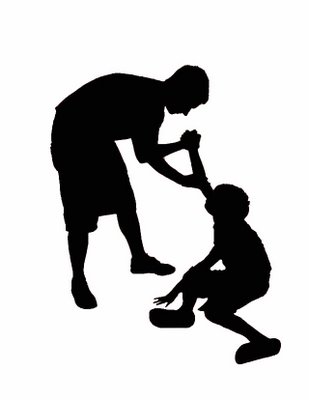
The weakness of man, and the way in which he is at the mercy of external accidents in the world, has always been a favorite topic with the moralists. They have expatiated upon it with so much amplitude of rhetorical exaggeration, that it has at last produced in our minds a sense of unreality, against which we rebel. Man is no doubt very weak. He can only be passive in a thunderstorm, or run in an earthquake. The odds are against him when he is managing his ship in a hurricane, or when pestilence is raging in the house where he lives. Heat and cold, drought and rain, are his masters. He is weaker than an elephant, and subordinate to the east wind. This is all very true. Nevertheless man has considerable powers, considerable enough to leave him, as proprietor of this planet, in possession of at least as much comfortable jurisdiction, as most landed proprietors have in a free country. He has one power in particular, which is not sufficiently dwelt on, and with which we will at present occupy ourselves. It is the power of making the world happy, or at least of so greatly diminishing the amount of unhappiness in it, as to make it quite a different world from what it is at present. This power is called kindness. The worst kinds of unhappiness, as well as the greatest amount of it, come from our conduct to each other. If our conduct therefore were under the control of kindness, it would be nearly the opposite of what it is, and so the state of the world would be almost reversed. We are for the most part unhappy, because the world is an unkind world. But the world is only unkind for the lack of kindness in us units who compose it. Now if all this is but so much as half true, it is plainly worth our while to take some trouble to gain clear and definite notions of kindness. We practice more easily what we already know clearly.
Thoughts

Being a teacher, I am able to exercise this one power of humanity on a daily basis. Children come to me from a range of different environments and daily events. Some come hungry; others come angry. Some come feeling betrayed; others come feeling abandoned. This hunger, anger, betrayal, and abandonment — and the hundred and one other emotions and experiences–can be taken literally, figuratively, or both. This, in a sense, unites us: we all feel hungry, angry, betrayed, and abandoned at some point or another in our lives. And all this stems from the unkindness of the world that we experience every day, with some of us experiencing more of it than others.

So I have to ask myself: when these kids come in grouchy, disrespectful, high-strung, or any other of a million little things that might or might not irritate or anger me, how do I react? Not knowing why this boy is scowling and daring me to say anything at all to him, why this girl is instantly angered by the smallest thing, how can I do anything but exert the one power that I as a human possess? The world is only unkind for the lack of kindness in us units who compose it. I can add to that, or take away from it.

Yet there’s more to it than that. My actions are the best teacher for these kids. We practice more easily what we already know clearly. If I show it clearly, perhaps they will know it clearly; if they know it clearly, perhaps they will begin to show it clearly.

The reading is from Father Frederick Faber’s Spiritual Conferences, excerpted here.

Surrender

“Lent is when you give up something that you like,” L explains, sharing what she learned during the Children’s Liturgy at Mass this Sunday. “Pretend you didn’t like dark chocolate,” she elucidates, smiling, as if it were possible for the Girl to claim with a straight face that she doesn’t like dark chocolate. “You couldn’t give that up because that would be nonsense.”

Indeed.

I tell L that it’s not enough just to give up something you like. “If it’s something like but don’t use often, then what are you really giving up?” I ask. Which is why dark chocolate is not an option for a meaningful Lenten sacrifice for me. At one point, it would have been cigars and libation: indeed, that’s what I did last year. But I’ve all but sworn off cigars, limiting myself to one a month, and libation quickly followed suit.

As I finish explaining this, L quickly replies that she’s going to give up making messes for Lent. K calls out from the kitchen, “I’m giving up cooking!”

Our actual decisions are somewhat less silly:

  • The Girl has given up two of her four Barbies and a favorite book.
  • I’ve sworn off online chess playing, deciding to replace it with a Lenten reading schedule and a bit more thinking out loud here about what I’m reading.
  • K, having given up so much for the baby, is giving up nothing in addition. Very wise.

#26 — Confession

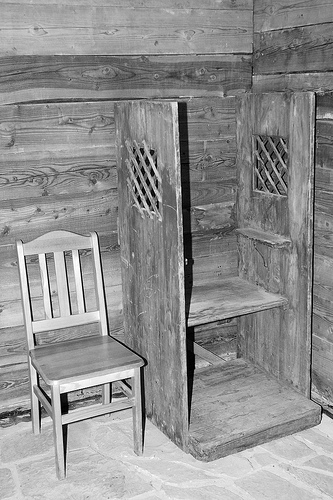
Confessional in Poland

Confession is perhaps one of the most inexplicable elements of Catholicism for non-Catholics. The common view is, "Why should I confess to a priest instead of confessing directly to God?"

It's not my intent to discuss whether or not confession is, as Protestants would press, strictly Biblical. In that end, I'll mention only the basics: The Catholic Church bases confession primarily on two passages. The first is John 20:19-23:

On the evening of that first day of the week, when the disciples were together, with the doors locked for fear of the Jewish leaders, Jesus came and stood among them and said, “Peace be with you!” After he said this, he showed them his hands and side. The disciples were overjoyed when they saw the Lord.

Again Jesus said, “Peace be with you! As the Father has sent me, I am sending you.” And with that he breathed on them and said, “Receive the Holy Spirit. If you forgive anyone’s sins, their sins are forgiven; if you do not forgive them, they are not forgiven.”

The other is the renaming of Simon in Matthew 16:17-19:

Jesus replied, “Blessed are you, Simon son of Jonah, for this was not revealed to you by flesh and blood, but by my Father in heaven.And I tell you that you are Peter, and on this rock I will build my church, and the gates of Hades will not overcome it.I will give you the keys of the kingdom of heaven; whatever you bind on earth will be bound in heaven, and whatever you loose on earth will be loosed in heaven.”

One can argue about the interpretation of those passages, but even a cursory reading seems to indicate that the Catholic Church is on fairly solid ground, Scripturally speaking.

Still, I'm not interested in proving anything; I'm fascinated simply by the act. So many non-Catholics seem to find it appalling, but it seems to be a healthy way to deal with guilt -- provided one is a believer. As I understand it, confession is not merely a matter of saying, "I've done this," and the priest responding, "Now go do this." If one is fortunate enough to get a good confessor, it seems like it would be more of a dialogue than a diatribe. One would not be going to confession over a matter one didn't think was a character flaw. The act of confessing -- truly confessing, and not just going through the motions -- indicates that one wants to change, and discussing how to make those changes seems healthy.

It is, after all, what psychiatrists do.

#25 — Mysticism

Mysticism is one of the many elements of religion that seem to exist in every faith. It is present in monotheistic religions and Eastern religions alike: there are Christian mystics, Muslim mystics, Sikh, Jain, Buddhist, and Hindu mystics.

The Catholic Encyclopedia defines mysticism as “either a religious tendency and desire of the human soul towards an intimate union with the Divinity, or a system growing out of such a tendency and desire.” In that sense, it’s easy to see why mysticism is a religious universal.

Yet by and large, there are no Protestant mystics. Indeed, part of the Reformation was a rejection of all that’s non-Biblical, and so reformers viewed mysticism skeptically.

Catholic history, though, is filled with mystical visions and experiences. As with so many other aspects of Catholicism, it seems to me to be something admirable regardless of one’s personal take on it. To so vehemently defend the importance of something the rest of the “modern” world explains away is the height of either or trust. Or perhaps a mix of the two.

It stands to reason that Catholics would be more included to accept mysticism than Protestants: at the heart of the Catholic faith is mystery. “Let us proclaim the mystery of faith,” says the priest at the end of the Eucharistic prayer, to which English speaking parishioners make one of four responses:

  • Christ has died, Christ is risen, Christ will come again.
  • Dying you destroyed our death, rising you restored our life. Lord Jesus, come in glory.
  • When we eat this bread and drink this cup, we proclaim your death, Lord Jesus, until you come in glory.
  • Lord, by your cross and resurrection, you have set us free. You are the Saviour of the world.

The mystery the priest speaks of is not a Mystery Machine type of mystery. In this sense, mystery simply means something we cannot fully grasp through reason.


#23 — Reasonable Redux

For example, if one were to set a Lenten goal and were not be able to make it despite intentions to the contrary, the Church is wise enough to realize that in many things, the intentions are as important, if not more important, than the actual action. And that is why I can write this exhausted post and still feel I'm keeping my Lenten promise.


#22 — Visual

Any Catholic space is a feast for the eyes. There’s so much to look at that it’s almost overwhelming: stained glass, statues, icons, frescoes, murals, carvings — a traditional (i.e., old, European) Catholic church is filled with visual stimuli.

DSC_3860

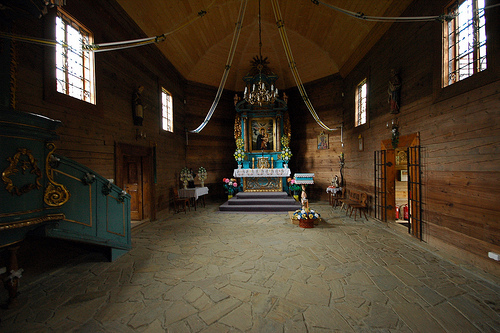
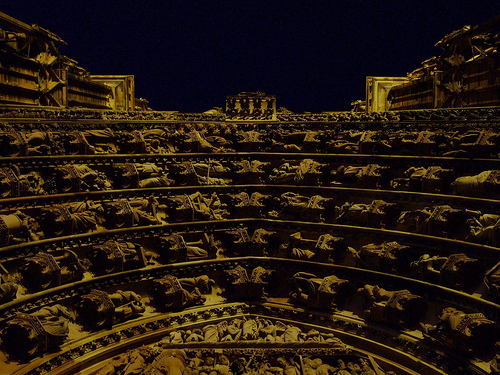
Even the simplest wooden church is filled with details that drawn individuals to get a closer look. And entering a great cathedral like Notre Dame of Strassbourg is an overwhelming visual experience.

Yet it’s not just what individuals see now that sets apart Catholicism; there’s a history of visions throughout the Church: corporal visions, imaginative visions, intellectual visions, visions of saints, visions of demons, and probably, at least once, visions of visions. They’ve happened all over the world, and they continue occurring today, so there’s something in Catholicism that either encourages this or encourages believers by causing this. It’s either wish fulfillment or genuine experience — or a mixture of both.

Now I’m not going to suggest that this impresses me. I don’t know whether these seers actually had an experience or whether it was all suggestion and will. That’s not something I can decide. However, I find it striking how very important vision is in the Catholic faith, especially compared to other faiths. Seeing is not believing, but it helps, and Catholicism realizes that and makes use of it.


#17 — Universality

"Catholic" means "universal," and that is an apt description.

Fr. Dwight Longenecker, a local priest with a reputation that extends well beyond the region, explains it better than I could:

We had confirmation at Our Lady of the Rosary parish on Tuesday. What I love about the Catholic Church is her universality. In the congregation were Vietnamese, Palestinians, Nigerians, Poles, Philippinos, Mexicans, El Salvadoreans, French, German and more...why there were even a few converts there too.

We were all united in one church, one faith, one baptism. The bishop was there and our priesthood was united with his and with the gift of Our Lord to the Apostles.

In addition to the ethnic mix there was the socio-economic mix--executives from Michelin and BMW mixing with Mexican immigrants and everyone in between. (Source)

Another measure of the universality of the faith is the number of languages used to celebrate Mass at a given church. The church we attend has Mass in English, Spanish, and, once a month, Polish. Other, larger cities certainly have even more variety.

#11 — The Tactile Church

Georges de La Tour 011
Georges de La Tour: Büßender Hl. Hieronymus

I am aware of the tactile sensations of my body in a Catholic church in a way that I never was in any Protestant church.

Part of this goes back to my first experiences with Catholicism in Poland. Going to a Mass with someone -- most often, K -- I knew would be painful. It was not that I hated the liturgy or thought it a waste of time. I knew it would be physically painful: there was very, very rarely free space in any pew, so we spent the Mass standing or kneeling. On a stone floor, this was always tough on my already-injured knees and prematurely-paining back. It added an ascetic dimension to Mass.

Yet mortification of the flesh is not the only -- or most common -- sense that I think of Catholicism as tactile. Anointing, genuflecting, crossing oneself, baptizing, and kneeling all heighten, in one for or another, one's awareness of the body. As a non-Catholic, I often feel the distinctness of my lack of action when the individual before me genuflects before entering the row of pews and I don't, or when my neighbor crosses herself along with everyone else and I don't.

I wonder if that would change were I to follow suit...

#10 — Smells

The camera was lent to me by my dear little br...
Image via Wikipedia

Walking into an ancient Catholic church can be overwhelming to the senses: the magnificence of the architecture, the completeness of the silence punctuated by echoing footsteps, the cool damp air on one's skin. Yet for first time visitors, the most distinctive surprise is the odors of a church.

A mix of old incense, wood, dampness, stone, cleaning solutions, humanity, and a thousand other mysterious odors almost seduce me from the moment I first entered an historic Catholic church. The stone has been gathering the breath of believers for ages, and the natural dampness of the air activates these strong, earthy odors in the walls and floors. Incense, one of the most noticeable Catholic/Orthodox distinctive practices, lingers from Mass to Mass, mixing with the stones and damp to form a redolence that can only be described as the smell of tradition.