Matching Tracksuits

fun in fours

lent

#21 — Filling and Creating Emptiness

To harm a person is to receive something from him. [...] We have gained in importance. We have expanded. We have filled an emptiness by creating one in somebody else (50).

Perhaps the best example of filling an emptiness by creating one in another is bullying. Working at a middle school, I'm witness to many major and minor instances of bullying on a daily basis, and it seems to be getting only worse. Statisticians tell us that's definitely the case, but even if they weren't providing empirical evidence, I get enough anecdotal evidence daily to make a strong case.

As a teacher, I find I have to walk a thin line. On the one hand, we've seen the headlines of recent years, this or that tragic suicide traced back to prolonged bullying, actions that have created situations in which some people feel suicide is the only alternative. Bullying, then, is literally a deadly serious, and as the authority figure in the room or hallways, I have a responsibility to put an end to it when I encounter it. Yet most bullying today is not like the bullying I occasionally encountered. Today's bullying, ban and large, is verbal. Indeed, there is a whole category of bullying that could be only mental: cyber bullying. In other words, a lot of bullying is of the type "Sticks and stones will break my bones but words will never hurt me." Yet the truth is, words do hurt. Still, we need resilient, self-assured kids who can take care of themselves and who know how to avoid internalizing the stupid little comments they hear and will hear, in one form or another, throughout life, so I don't want to help kids become dependent on me -- or anyone else -- to swoop in and save the day every single time says something mean and bullying.

And so when I do encounter something that I judge to be relatively minor but still behavior that could be considered "bullying," I try to strike a balance. I deal with the individual who said the hateful words, but I spend more time talking to the person to whom he or she directed the words. (That was a long way to get around saying "victim." It was a conscious choice.) I tell her that there are individuals who only feel good about themselves when making others feel bad. To quote Weil, these individuals have "gained in importance," but only in their own mind.


#20 — Evil as Remedy

We must accept the evil done to us as a remedy for that which we have done.

"That's not fair!"

As a teacher who works with fourteen-year-olds -- that strange beast that has a hyperactive, hyper-sensitive notion of justice and fairness -- I hear those words all the time. Yet to be honest, we all react that way at some point or another, and sometimes it really isn't fair.

Yet more often than we'd like to think, we've probably been on the dealing end of injustice (or its petty cousin unfairness). Weil suggests that we must accept one as payment for the other.

Injustice as justice -- the ultimate paradox.

#19 — Refusal

Weil writes,

God gave me being in order that I should give it back to him. It is like one of those traps whereby the characters are tested in fairy stories and tales of initiation. If I accept this gift, it is bad and fatal; its virtue becomes apparent through my refusal of it. God allows me to exist outside himself. It is for me to refuse this authorization.

It's not something I pretend to understand. Even with a conversion to Catholicism and resulting reading and studying, the whole reason for a deity to create anything confuses me. If God is perfect, why create anything? What does that provide a perfect being that said being doesn't already possess?

#18 — Future Pleasure

2012 Calendar

When we are disappointed by a pleasure which we have been expecting and which comes, the disappointment is because we were expecting the future. And as soon as it is there, it is the present. We want the future to be there without ceasing to be the future. This is an absurdity of which eternity alone is the cure (66).

As a kid, I used to look forward to the autumn with almost visible excitement. Every fall, we headed off for the closest thing to a vacation we ever had: a week-long religious festival that included enough relatively free time to make it feel like vacation. It meant missing school, which made it all the better, and given the fact that we saved all year for the one week, the relative affluence I experienced made it seem like Christmas every day. Yet every year, a strange melancholy overtook me ever so briefly at the beginning: it had finally arrived, and while I was thrilled about that, I also knew that I had nothing else to look forward to afterward.

Yet I think Weil is talking about more than the mere excitement of being in a metaphorical candy store. Underneath this longing for the future, this “absurdity which eternity alone is the cure,” is a very serious attempt to sketch out what some have described as a hint of the beyond, or as Peter Berger might have called it, a rumor of angels. That sense of never being fulfilled is a hint, Catholic writer Peter Kreeft argues, that there is something more to fulfill it.

Photo by danmoyle

#17 — Evil and Duty

Evil when we are in its power is not felt as evil but as a necessity, or even a duty.

He stood in the hallway, thinking I don't really know what. Was he not aware that I'd heard the profanity coming from his mouth? Was he not aware that the profanity, misogynistic and vile. had indeed come from him mouth? Was he bluffing, hoping for some -- what?

If I had asked him what possessed him to say those things, to call the female student a b----, to become enraged, he would probably (indeed, likely, even predictably) justify it.

"She started it."

"Did you see what she did to me?"

"Nobody's going to do that to me and get away with it."

A thousand and one excuses. A million and one reasons why the evil was not evil, but a necessity. A duty.

#16 — Imagination and Fiction

Imagination and fiction make up more than three quarters of our real life. Rare indeed are the true contacts with good and evil.

Weil's words read like a quote out of The Matrix or Inception, and it's easy to brush them off as metaphorical theorizing:

And it's easy to pass it onto the "madding crowd" and insist that we ourselves are not imagining things, not asleep. We are fully aware of the reality around us and can separate it from wish and fantasy, but the materialistic hordes around us can't. It's easy to think that way.

VIV_8847
Afternoon at Bounce House

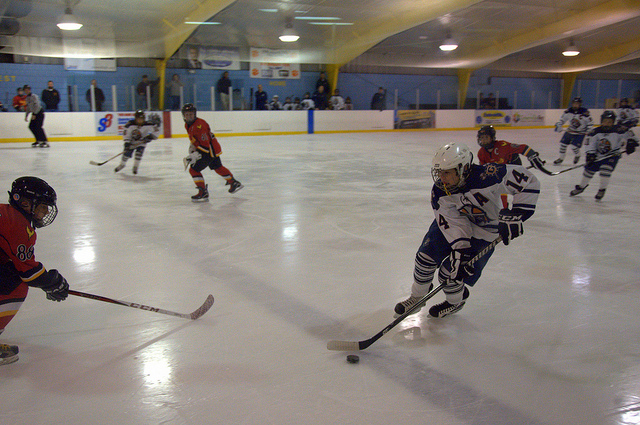
Surely, with rarefied reality all around us -- the screams of delight of children at play, the hard crack of a helmet against plexiglass, a blast of cold air when we get out of the car -- we are awake.

VIV_9005
A visit to the ice next to the Bounce House

Of course Weil doesn't mean anything so cinematic. She's simply pointing out our uncanny ability to deceive ourselves and fall for the farce completely, to create worlds out of our irrational fears and project them on everyone and everything, to believe that the way we see the world is the way everyone sees it and indeed the only true way to perceive it. I see the effects of this every day at school: some students have mastered already the art of fully deceiving themselves, convinced that they can do no wrong and that all the trouble they find themselves in can easily be laid at the doorstep of others (read: adults; read: teachers).

I'm not sure what the kick (to borrow a term from Inception) for this dream might be, especially when we're not even sure we can kick ourselves awake. Perhaps awareness is the first and, paradoxically, last step. An afternoon spent with the Girl at a birthday party followed by a bit of first-time exposure to live hockey should be enough to separate fiction from good, imagination from evil.

That's the secular answer.

I think Weil might not entirely agree, though. Like Inception, we need someone who doesn't share that same reality, someone who's at a level higher (literally in the film and in Catholicism too, I suppose) to help jar us out of the fictions we create for ourselves.

#15 — Temptation and Energy

The use of temptations. It depends on the relative strength of the soul and of time. To go on for a long time contemplating the possibility of doing evil without doing it effects a kind of transubstantiation. If we resist with merely finite energy, this energy is exhausted after a certain time, and when it is exhausted, we give in. If we remain motionless and attentive, it is the temptation which is exhausted -- and we acquire the energy raised to a higher degree.

For a little boy, temptation is a simple thing; for a little boy who can move about under his own volition, it's a simple thing that's simply everywhere. Closets hold treasures. Desks sit over snaking cables and wires.

VIV_8802

Cabinets hold bags of flour, sugar, and other mysteries. Desk cabinets conceal pencils, markers, and other goodies. 

The Boy doesn't resist temptation, reaching his pudgy fingers toward dangers and toys alike.

VIV_8803

But he's at that lucky point in life when temptation is all about learning, and vice versa.

#13 — Humility and Humiliation

humiliate ourselves before false gods

It's sometimes easy for me to grow depressed about the world we have brought our children into. There are so many different calls for attention, so many things that people place in the center of their lives, things that at their heart are not only meaningless but actually harmful yet somehow seen as the ultimate good. It all falls under the banner of materialism and instant gratification, and the technology of today only heightens it. Indeed, the technology is often part and parcel of the whole game: smart phones to take pictures of unhealthy food to share with friends who have just posted pictures of the new car they bought that they really can't afford; tablet computers that allow people to feed their obsession with sex, shopping, or whatever their fetish anywhere and everywhere; televisions large enough to cover most of a wall so we can see in painful clarity the details of our visual obsessions. Add to it the realization that children growing up today face new peer pressure to fit in by owning all these gadgets, using all these gadgets obsessively, virtually praying to these gadgets -- and anyone who doesn't fit in will faces a barrage of bullying, taunting, and rejection.

It's not a world I would personally like to have to grow up in.

Weil speaks of these obsessions in terms of false gods:

We do not have to acquire humility. There is humility is us. Only we humiliate ourselves before false gods.

The fact that humiliate and humility have the same root is ironic today, considering how so many people humiliate themselves, all the while thinking they're elevating themselves.

#12 — Natural Movements and Grace

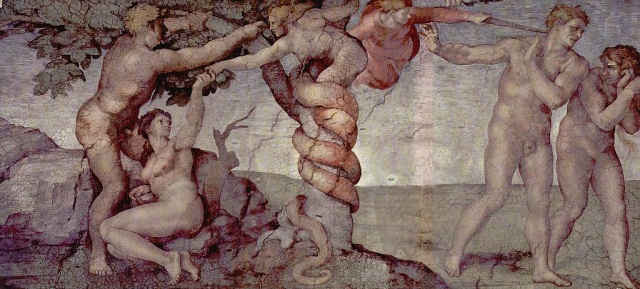
Michelangelo's painting of the sin of Adam and Eve from the Sistine Chapel ceiling

Some Christians explain it with the doctrine of Original Sin. Muslims reject the notion of an inherently sinful nature in humanity but believe that pride (an unwillingness to submit) is humanity's chief sin (ReligionFacts.com). Judaism seems to have no established doctrine on the matter, but the Jewish experience of the twentieth century -- indeed, in most centuries -- probably led many to believe in the tendency of humanity toward evil. Through countless rebirths, Buddhism  teaches, humans are to overcome a seemingly natural tendency toward attachment. Hinduism teaches that there is a reality beyond the everyday -- the Brahman -- that humans can achieve by changing not only their view but also their behavior, suggesting that the original state is an inferior state. Secularists use the term "human nature" to explain the simple fact that all religions recognize: the natural movement of the will tends to be downward.

All the natural movements of the soul are controlled by laws analagous to those of physical gravity. Grace is the only exception (Gravity and Grace, 45).

Yet life is generally about improvement. We want to become better people We want the "I" of today to be somehow more elevated than the "I" of yesterday and not quite so much as the "I" of tomorrow will be. Yet all this movement is relative to a standard. If we're saying "better" and "worse," it's in relation to something. And even though we could say, "Well, yes: that 'something' is our former self," that's still not quite satisfying. We seem to have the desire to move toward an ultimate goal. It's always about rising above the natural state we find ourselves in, and more often than not, it's about detachment. The things that drag us down are things that we can leave behind, religions teach us, and the first step to rising is to make ourselves lighter. Gravity can pulls down harder on more mass; grace works to remove those weights and pull us upward.

While it sounds somewhat more Eastern -- more Buddhist or Hindu than Christian -- than Fr. Robert Barron, in Catholicism, points out that there is an element of detachment in Jesus's most famous teachings, the Beatitudes, specifically the four, seemingly negatively framed Beatitudes. Barron begins by reminding us that Thomas Aquinas said there were four substitutes for God: "wealth, pleasure, power, and honor. Sensing the void within, we attempt to fill it up with some combination of these four things, but only by emptying out the self in love can we make the space for God to fill us" (43). The negative Beatitudes, then, are formulas for this emptying, and they form a perfect parallel with Aquinas's four substitutes.

  1. Wealth: "Blessed are the poor in spirit, for theirs is the kingdom of heaven." Barron suggests a slight reformulation: "how blessed are you if you are not attached to material things, if you have not placed the goods that wealth can buy at the center of your concern."
  2. Pleasure: Another negatively framed Beatitude becomes surprisingly apt for our culture when we reformulate it as Barron does: "Blessed are those who mourn, for they will be comforted" becomes "how blessed [...] you are if you are not addicted to good feelings." It's easy, Barron says, to see this addition to good feeling in today's society with its "prevalence of psychotropic drugs, gluttonous habits of consumption, and pronography" (44).
  3. Power: "Blessed are the meek, for they will inherit the land." Barron reforms this into, "How lucky you are if you are not attached to the finite good of worldly power" (44). We might be tempted to think this applies only to those with political power, but we all -- even children --  have some degree of power and control over someone in the world.
  4. Honor: "Blessed are those who are persecuted for the sake of righteousness, for theirs is the kingdom of heaven." The polar opposite of honor is persecution, and while honor is good, "when love of honor becomes the center of one's concern, it, like any other finite good, becomes a source of suffering" (45).

This is what Lent is all about: giving up some of the distractions and attachments that tend to pull us downward (often material objects) while paying special attention to the things that lift us up (often some form of giving). It's a sacrifice of the things for which we often sacrifice everything, our little mini-idols that occupy unhealthy proportions of our thoughts -- forty days of detachment.

#11 — Advanced Opinion

opinion has an effect

Humility is the great sin of the modern age. Whether it's "I'm okay; you're okay" or "I'm the king of the world," humility is on the other end of that spectrum. Many in the secular world find the notions of Christianity -- Catholicism in particular -- about the true, fallen nature of humanity to be distasteful because it offends the relatively modern sense of the inherent goodness in humanity. I think it probably has more to do with the humiliation of humility than it does with supposed dignity and inherent moral goodness. This is, of course, not to say that all individuals in today's culture lack humility -- just the prominent ones, the ones we as a society generally look up to.

Humility has as its object to eliminate that which is imaginary in spiritual progress. There is no harm in thinking ourselves far less advanced than we are: the effect of the light is in no way decreased thereby, for its source is not in opinion. There is great harm in thinking ourselves more advanced, because then opinion has an effect.

Having too positive an opinion of ourselves distracts us from the goal almost all religions set before us: the purification of our will. It not only distracts us; it deceives us.