Matching Tracksuits

fun in fours

learning

The Artist, Redux

The Girl likes to refer to herself as an artist. Just a few days ago, she was proclaiming that she's an artist but that it's a secret.

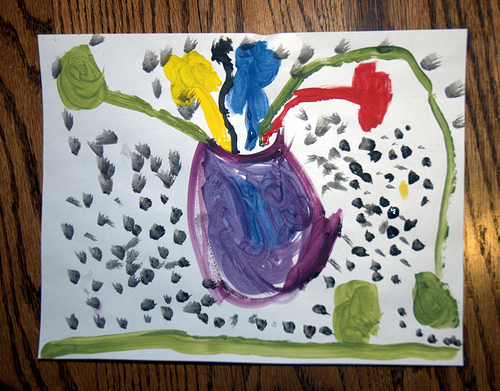
This morning, as I was planning some lessons, she came into the study from downstairs, picture in hand.

"Here Tata. I'm an artist."

I glanced at the picture, saying the obligatory, "I know honey," then stopped what I was doing to take a closer look.

"Did you help her with this?" I called out to K downstairs.

"No," came the reply.

"Not even a little bit?"

I think I can be forgiven my initial skepticism.
DSC_0405

The Artist

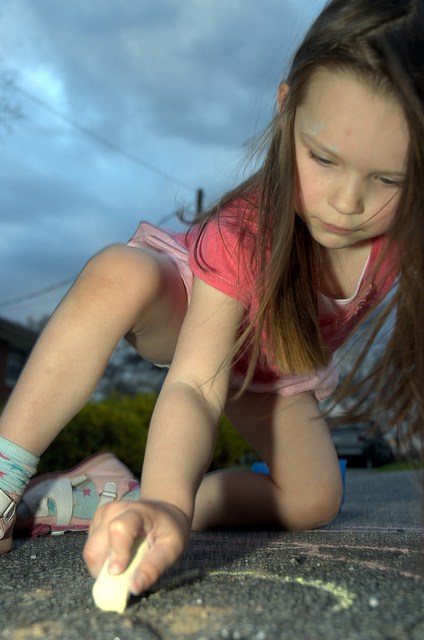
“I’m an artist,” L declares as she’s drawing on the driveway. “No one knows I’m an artist at school, and I have to keep it a secret,” she continues. “If anyone finds out, they’ll tell the teacher. Then the teacher will come to me and ask if I’m an artist.” She pauses for a moment, inspecting her work, then continues the creation and the explanation.

DSC_0220

“If they ask that, I’ll have to tell them that I am but that it was supposed to be a secret.” She looks up, holds her hands out to her sides, palms up, lowers one eyebrow, and does her best to look adult: “That’s why I have to keep it a secret.”

Bibo, ergo…

The Girl, tucked in bed, is trying to convince me that, despite having trekked down the hall just six minutes ago, she has to go again.

“Tata, I’m lying in bed,” she begins, thrusting her right fist out in front of her. “I’ve been drinking juice,” she continues, thrusting her left fist out as well. They float there, swaying back and forth as if she doesn’t know what she’s going to do with them.

She claps them together, providing an apt conclusion: “When the two halves meet…”

Slip Sliding Away

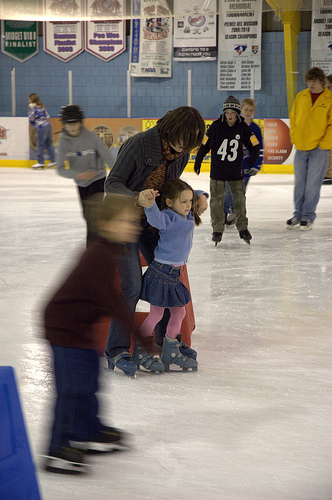
Stepping onto the ice for the first time in probably twenty-five years can be a bit of a stressful experience. My mind turns back to the last time I ice skated: I recall being fairly confident; I remember the importance of having tightly-laced boots; I think about how I was finally able to skate backwards the last time I ever went as a kid. Or was I? I did go only a handful of times, after all, and most of those times my attention was not on the ice but on those on the ice around me -- usually on specific person.

Maybe I only imagined I could skate, because the instant I step onto the ice, I'm fairly certain this is the first time I've ever ice skated.

DSC_9950

Yet I watch the Girl, who truly is on the ice for the first time, and I realize that perhaps I haven't forgotten everything. I push off and begin to glide -- I realize I have.

DSC_9945

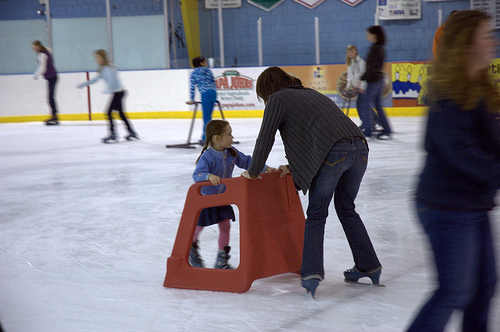
Perhaps because I have more experience and a more developed sense of balance, I'm not as bad as the Girl: her feet are slipping this way and that, forward, backwards, left right. She looks like she could have been the model for some cartoon about a character's first time on ice.

DSC_9956

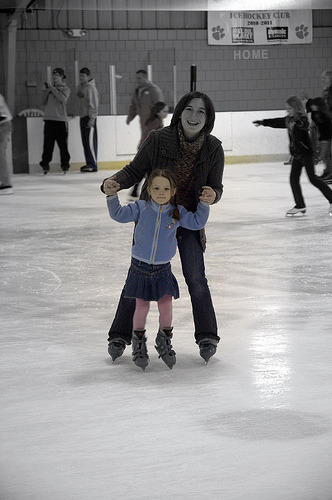
By the end of the hour, though, she's able to skate glide by herself from me to K and back again. A few more times and she'll be asking when she can try her first jump.

One Semester in One Month

I just finished up a course on diagnosing and correcting reading deficiencies in middle and high school students. One of the most useful courses I've ever taken -- especially the book: Kylene Beers' When Kids Can't Read: What Teachers Can Do. It's my new classroom Bible.

The course was a one-semester course crammed into one month, what my school calls, appropriately enough, "January term."

Which is finally over. And which explains how we could take the Girl ice skating for the first time and it receive nary a mention here...

Maybe over the weekend...

Puzzles and Dolls

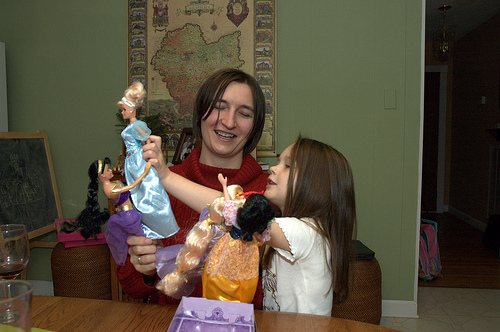
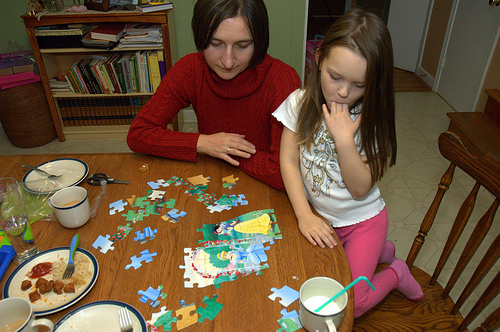
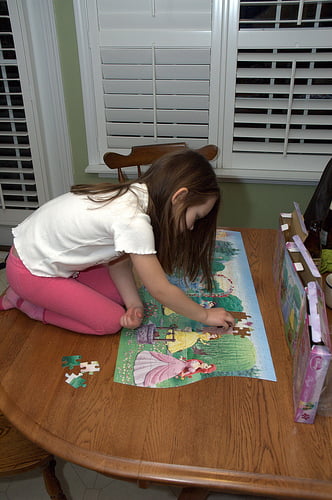
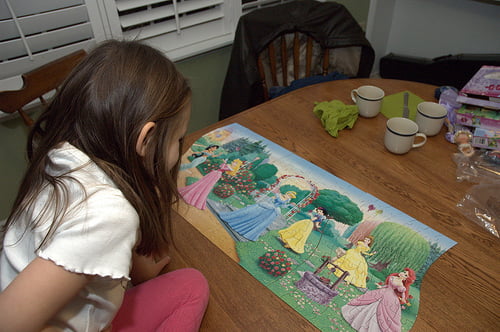
“Do you dream of being a princess?” coos one of L’s Christmas gifts before offering game-play options.

Why does L have such an obsession with princesses? It’s not like we initiated it, though we’ve done very little to encourage or to discourage it. (Relatives are a different story!)

DSC_9446

Granted, L has watched the films several times: Cinderella, Sleeping Beauty, The Little Mermaid, and several other princess films. She has a few princess books — usually thick books we refer to as “the princess collection” and “the other princess collection.”

DSC_9460

“Do you dream of being a princess?”

My concern is not necessarily the notion of being a princess; it’s the notion of being a twenty-first century princess, a highly sexualized image that encourages girls to flirt in grade school and has teen fashion magazines offering advice on the cover for how to have a “sexy beach” hair do.

DSC_9473

“It’s a long way off,” some might say. “She’s only four.” When I hear stories of six-year-olds getting cell phones, though, I realize the pressure begins shortly.

Or perhaps it’s already begun, the pressure to meet society’s standards of what a “Real Girl” is like. Perhaps that’s what the princess obsession is all about.

DSC_9485

Perhaps. It’s somewhat depressing to think that we’re entering a period during which peer pressure is as influential as — if not more than — parental influence. There’s a balance there that we are just beginning to feel out. Its contours are still nebulous because the actual relationships and ratios are still unclear. In the end, it’s all about awareness.

If only it were that simple.

Stacking the Deck, Redux

L and I are playing Candy Land. It’s a dry, boring game, to be honest, but I’m not doing it for my own entertainment: that comes from watching her.

Still, I’ve been trying lately to make it a learning experience, as a way to help her deal with her frustration. It’s a simple premise: stack the deck occasionally, placing the Candy Cane Forest card for the next drawing when she’s seventy-five percent complete.

“Oh, rats!” she declares, retreating almost to the beginning of the game board.

I try to make it a little more frustrating, dropping the ice cream cone card into place for my next drawing. Will she get frustrated that she “obviously” has no chance to win? Will she want to stop? Will she complain?

No — nothing but a laugh.

There’s only one thing left to do: make sure she gets a few doubles to catch up — not win, but catch up.

The game takes longer than it would have if we’d just drawn and let chance decide the winner. But the girl has uncanny luck and wins more often than not. A loss or two does the spirit good.

Other Side of the Desk

I sit quietly, looking at the long list of assignments upon which the professor will be basing our grade. Thinking of all my other obligations, I find myself wondering if I'll survive the next few months.

And I am pleased with that.

Being a teacher without being a student on a regular basis is about like being a mechanic who never drives. It's one thing to "dish it out." It's another to take it.

To see the classroom from both sides of the desk is to ensure reasonable expectations from one's own students.

Learning Space

Do much course work in education and you’ll soon find yourself covering some of the same names in various classes: Piaget, Vygotsky, Erikson, Binet, Skinner, Kohlberg, and the list goes on.

It’s frustrating to cover the same material in course after course, but the advantage is that it sits solidly in your head, and you find yourself thinking about it at the oddest times.

DSC_5228

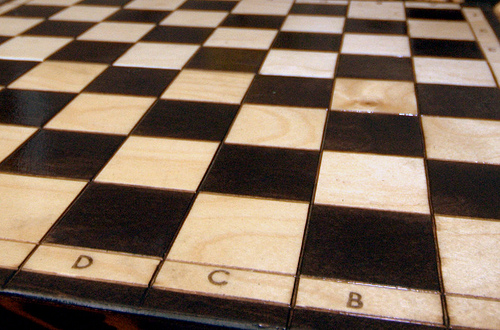
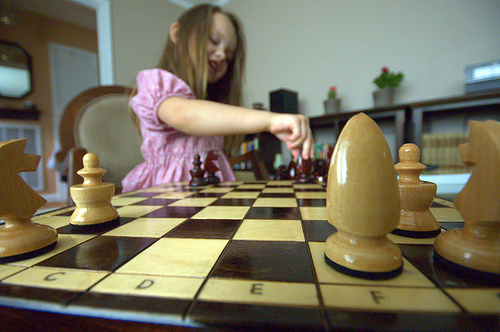
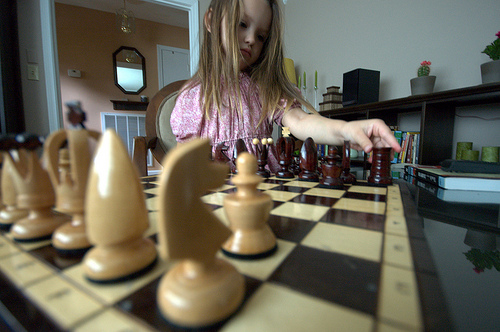
For example, L and I sit down to play chess. Our chess is usually random motions of random pieces, but instructive all the same: she learns that we take turns, and that the object of the game is to defeat your opponent by taking pieces. It’s fun, but her attention span usually only last a few minutes before it’s time to have “tea” or feed her baby or any number of other priorities.

DSC_5220

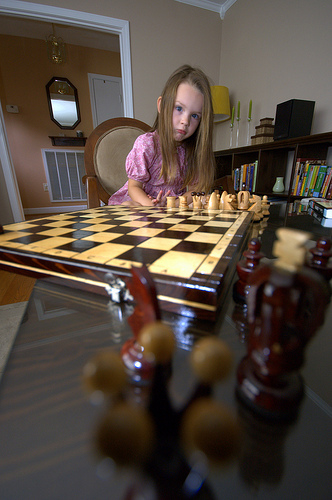
Today, we try something new. I tell her I’m going to set up pieces on my end of the board, and she needs to try to copy them on her end. A real challenge, to be sure. It is quite taxing on her spacial intelligence, for I am asking her to create a mirror image, which requires quite a bit of mental spacial manipulation.

I think of Piaget and Erikson — does she have the mental development for the task at hand. Technically, those gentlemen would probably say, “No.”

“She’s still at the very beginning of the preoperational state,” Piaget says.

Forget ed psych — let’s have some challenging fun.

DSC_5236

The beginning is slow, and it takes her a good ten minutes to figure out that she’s supposed to be mirroring my pieces. But she puts everything together slowly, and it’s obvious she can do it.

More importantly,  she loves it. And I figure it must be in her “zone of proximal development,” for she’s having great difficulty, but slowly she’s mastering it.

“Let’s do it again!”

And so we do it many times. Each time, I alter the order in which I put the pieces on the board. First one pawn, then the other, then a knight and bishop beside each other before moving to the other side. Sometimes a mix of major pieces and pawns.

DSC_5225

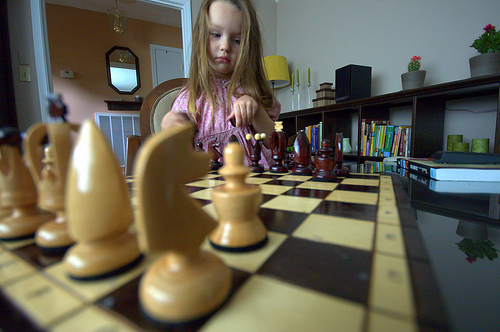
Toward the end, I give her the real challenge: most of the major pieces and some of the pawns are on the board when I tell her, “Figure it out.”

DSC_5226

She looks at my pieces, looks at her own, back at mine, and suddenly, in a flash, her side of the board is perfect.

Once we get the piece positioning down, we’ll start learning how the pawns move.

You Might Have To

I go home to learn about life from my daughter. I learn what goes on in her school, what her teacher says, how her teacher teaches.

L, like any good story teller, doesn't simply tell us, though, she shows: she begins incorporating various phrases from school into her own speech.

"You might have to" becomes the key phrase. "You might have to do this." "You might have to move that." I can imagine L's teacher helping her with this or that task, explaining, "You might have to try it a different way, like turning it the other direction." "You might have to wait. I believe someone else is using those crayons."

"That's okay" is another. I spill a little milk and mutter "Shoot" under my breath. L consoles me: "That's okay."