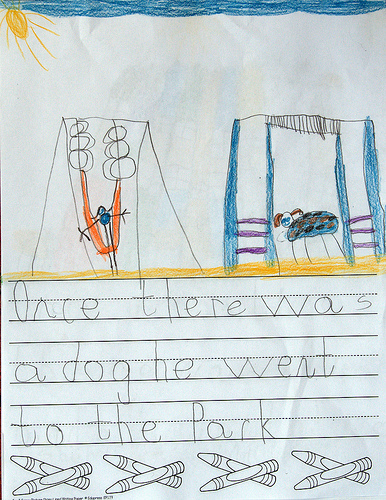
Once there was a dog. he went to the park.
fun in threes, sometimes fours
learning
Once there was a dog. he went to the park.
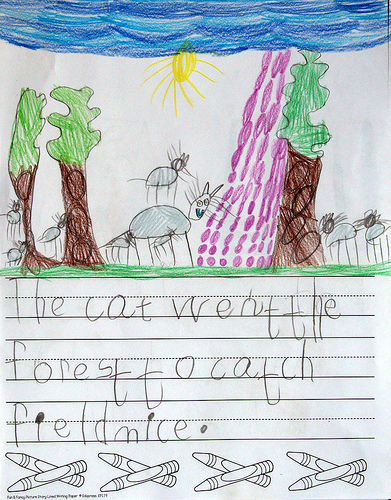
The cat went the forest to catch field mice.
It's nearing the end of the school year, which means my English I students are tackling the year's final project: an analysis of some facet Victorian England that is clearly evident in Great Expectations. Social class, adoption, education, and gender roles are popular motifs.
This year, having access to seemingly endless articles on JSTOR, I've decided to make the project a bit more challenging. After printing out twenty-five or so articles from peer-reviewed journals, I inform the students that we're going to do this one "old-school."
"No web pages as research sources."
The groans are audible throughout the school.
I flop five inches of journal articles down on a chair in the front of the room and explain that this is going to be one of their primary sources of information. We review how to skim a text effectively; we practice with a text projected on the board; we talk about the difficulty of the language; and I turn them loose.
Soon, kids are getting excited about titles like Alastair Owens's "Property, Gender and the Life Course: Inheritance and Family Welfare Provision in Early Nineteenth-Century England," struggling with passages like this: "Among families, property rights shifted according to changing circumstances and as individuals moved through their lives. Inheritance was obviously a unique phase in this life course, characterized by social and proprietorial upheaval." Fairly straightforward for adults; a struggle for young readers. But these are not kids who give up quickly, so they constantly call me over with the same request: "Can you read this passage, then listen to what I think it says, and tell me if I'm right?"
Others are combing through F. M. L. Thompson's "Social Control in Victorian Britain" in the hopes of finding something about the effects of the sense of genteel society on social behavior. Or, as they put it, how society and popularity in the upper class are related. Or something like that. I'm not quite sure I understand some of their topics, and I'm not sure some of them do either. But no worries. That's part of the point.
"What if we don't find anything for our topic?" becomes a common cry.
"Then I guess you'll change topics," I say, and sit with the frustrated student to help him find a way to narrow, broaden, or slightly shift his topic.
Their frustration seems overwhelming.
"How can we get all this research and writing done in just a couple of weeks?" is another common concern.
What they don't realize -- what I don't tell them -- is that the paper itself is of little importance at this point. Like so many things in life, it's the process. The struggle.
"I want them to have the experience of digging through a journal article only to determine that it's not of any use to them for their topic," I discuss with a colleague later. "I want them to struggle defining and redefining their research question as they find materials that shift their thinking."
By the third day of research, kids are taking copious notes (and I frustrate them by saying, "There's a good chance that twenty to thirty percent of these notes won't end up in your final paper"), sharing resources ("Allie, I know you're working on education, and this article on social class actually has something on education, too. Want it when I'm done?"), and actually smiling from time to time.
It was sometime during second or third grade, I believe, that I first realized I wasn't seeing the same things my classmates were seeing. I'd somehow discovered that if I pulled on the corners of my eyes, I could see better. The teachers noticed, said something to my parents, and shortly after that, I had my first pair of glasses.
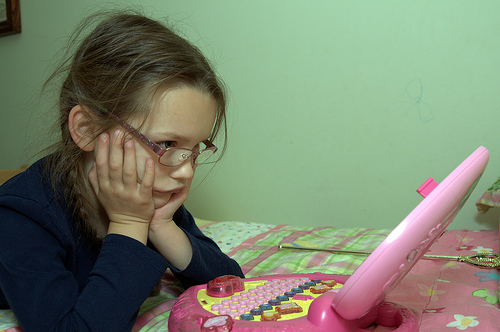
The Girl, it turns out, has the opposite problem: she's far-sighted.
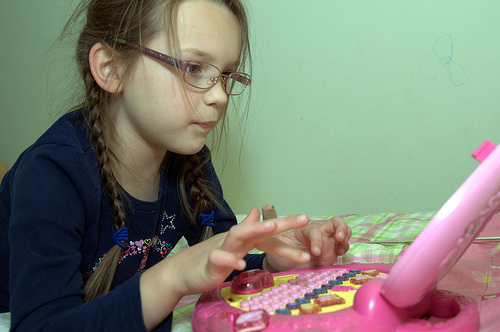
The optometrist tells us it's something she could outgrow in a few years.
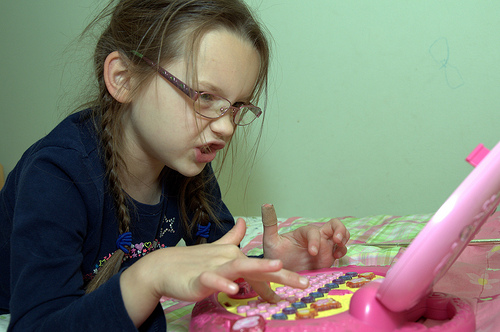
There are some things, however, she's likely to retrain for several years to come.

Girl 1: Did you lose your phone?
Girl 2: Yeah.
Girl 1: What for? For cussin' out your mama?
Girl 2: My mama don't care if I cuss her out.
Girl 1: Then what'd you lose the phone for?
Girl 2: I don't know.
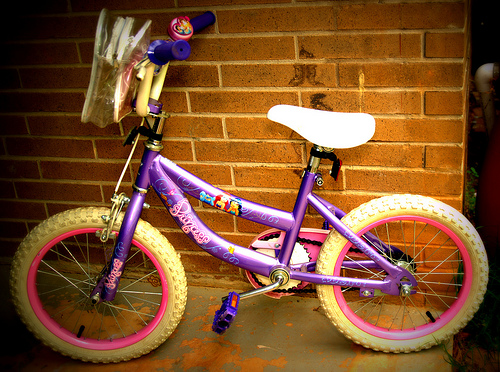
We've been working on it for some time now: riding a bike. It's something K and I take for granted, one of the shared interests that helped in its own little way to solidify our relationship years ago.
The Girl didn't take to it immediately. She was scared of everything: going up hill; going down hill; turning; going straight; starting; stopping. It all scared her. "I was beginning to think she'd be like Babcia," K remarked today.
It's been a long time coming...
http://www.flickr.com/apps/video/stewart.swf?v=109786
It’s the end of the year, which means the English I students are tackling Great Expectations, having just finished a brief overview/review of clauses and sentence types. “To understand Dickens,” I explained a couple of weeks ago, “you have to break apart some of his incredibly complex sentences into manageable chunks.” So we practice: every day, students entering class are greeted by a few sentences of from the previous evening’s readings. The bell-ringer, starter, whatever you want to call it:
At the appointed time I returned to Miss Havisham’s, and my hesitating ring at the gate brought out Estella. She locked it after admitting me, as she had done before, and again preceded me into the dark passage where her candle stood. She took no notice of me until she had the candle in her hand, when she looked over her shoulder, superciliously saying, “You are to come this way today,” and took me to quite another part of the house.
Students cross out unnecessary phrases — prepositional, gerund, participial — and try to find the gold: a single subordinate clause. “If you find a subordinate clause,” I explain, “you know it’s either a complex or compound-complex sentence; if you don’t, you know it’s a simple or compound sentence.”
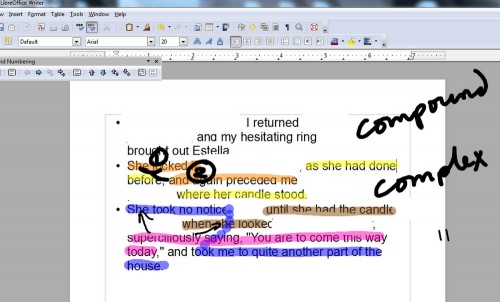
The results are improving daily.
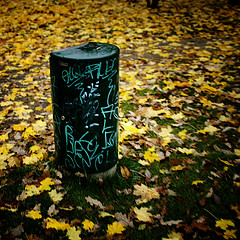
"Hey L, come help me take out the trash and recycling," I call as we finish up playing tag in the front yard, our new daily tradition. I pull into the laundry room the wicker basket we put our paper recycling in during the week and have her help me transfer the paper from it to the tub we'll take out to the street. And then she sees it: one of her drawings. There. In the recycling.
She gasps.
"What's this doing here?!" she asks, confused. "Are you throwing this away?"
I think fast and answer truthfully: "Well, we went through everything, and we're saving the best."
She looks at one of her crayon drawings and asks incredulously: "And this?!?"
Truthfully, it is quite good.
"Well, we can take that," I admit. "It's a good drawing."
"And this?!" she exclaims, pulling out another. "And my subtraction work?!"
Soon she's pulled out every single item of hers, each time accompanying the delicate removal with a gasp of shock and horror.
I explain to her that we can't keep everything, making a mental note to check with K before having the Girl help sort recycling again. Still, it's not a lesson she'll learn quickly: most of us tend to hold onto things more than we should.
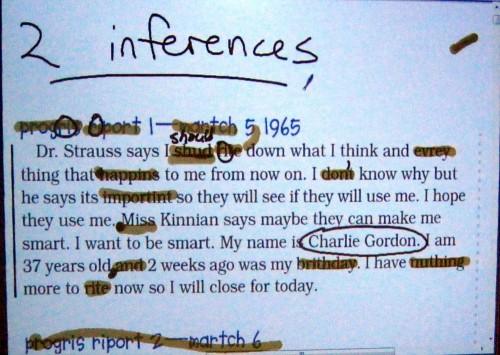
One class began working on Flowers for Algernon.
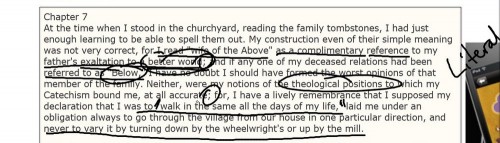
Another class continued with Great Expectations.
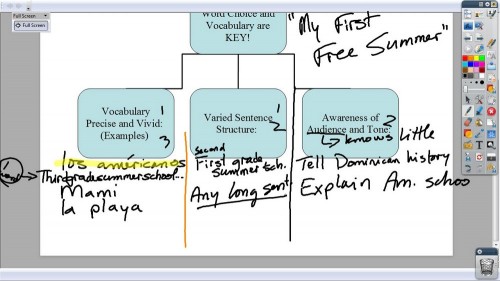
Still another class began looking at the notion of voice in writing.
Busy day back.
