Matching Tracksuits

fun in fours

language

Language Soup

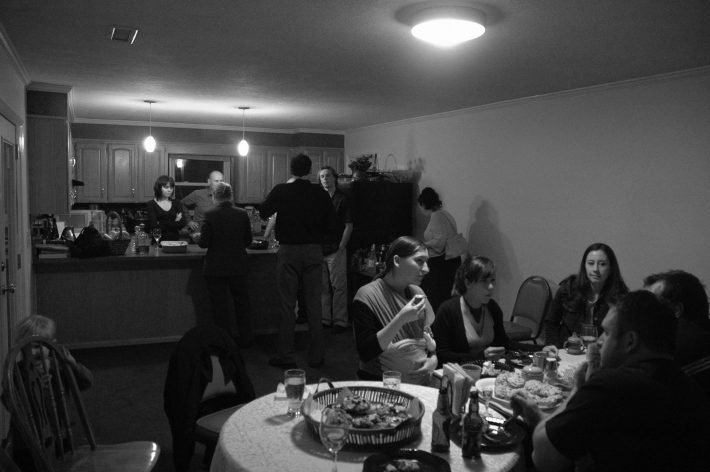
We have several Polish friends in the area, and a surprising number are in mixed marriages: a Pole and a Bulgarian; a Pole and a Czech; a Pole and an American. We went to a house-warming party at the Pole/Czech couple's house, and as always happens at such parties, I got to thinking about the effects of the English language's relative isolation. Last night, the Czechs spoke Czech, the Poles spoke Polish, and everyone was mutually intelligible. And a Slovak couple been there, they could have spoken Slovakian as well and we'd all get along fine.

I try to imagine what it would be like to experience something similar: to hear someone speaking Dutch, for example, and understand enough of it to be communicative. Poles understand Slovaks; Urdu speakers understand a sizable portion of Hindi; someone fluent in Spanish would make a bit of sense out of Portuguese -- but there's no equivalent in English, that I know of. Sure, German has "gut," and there are a lot of English/French cognates thanks to 1066, but nothing approaching the level of intelligibility speakers of Slavic languages experience.
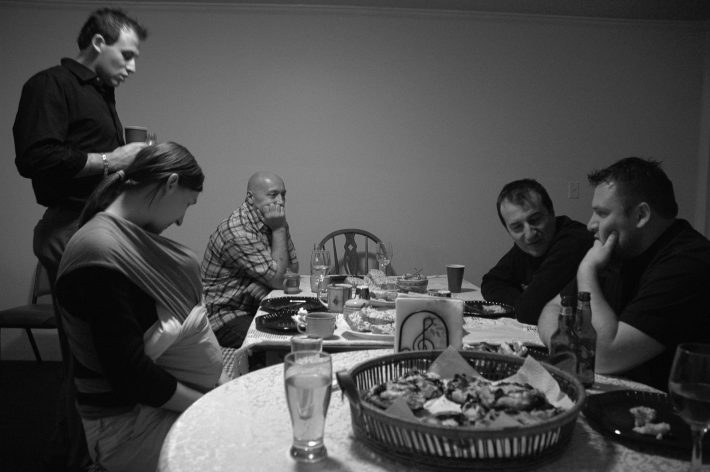
For me, it can be a bit of a nightmare. I understand a lot of Czech, but it's a stretch to get a real sense of what's being said.

Of course the real winners in such a situation are the children. Growing up speaking three languages -- what a gift to give your child. But I know of situation slightly more linguistically advantageous: a former Polish student of mine married a Spaniard. They live in Vienna and speak English to each other. Now if they could only get a, say, Chinese babysitter...
Cicho

"Cicho" would be spelled phonetically in English "chee-ho," with the "o" being very short.

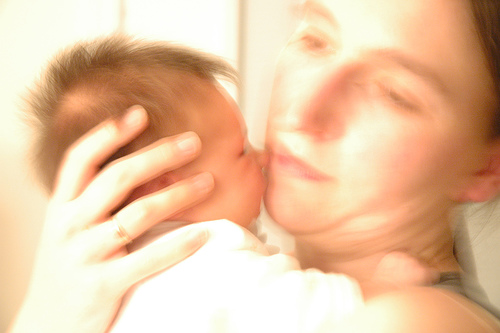
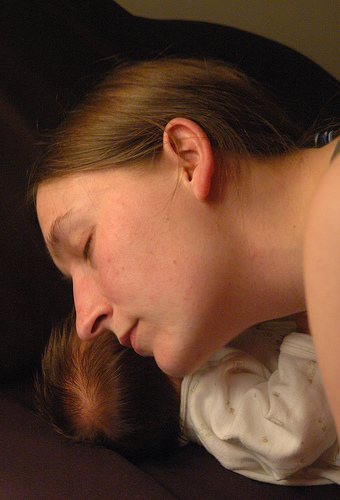
"Ciiiiiiiiii-cho, cicho, cicho, cicho. Ciiiiiiiiii-cho, cicho, cicho, cicho." K leans over L -- who is simultaneously howling, crying, screeching, and moaning -- and whispers the most onomatopoeic word in Polish.

"Quiiiiiiiiiiiiiiet, quiet, quiet quiet."

Calm

It's a word conducive to whispering, made up entirely of long, soft, quiet sounds. It has all the sounds of the womb, all the peace of a whisper, and all a rhythm that softly strokes the ear. Hearing "cicho" whispered makes one's eyes want to close.

DSC_4204

It's probably the most pleasant sounding word in a language made up of harshness. W Szczebrzeszynie chrząszcz brzmi w trzcinie (Translation). These are the sounds of Polish: a phlegmatic language best spoken with spit flying everywhere.

What's so remarkable about the word is that, when a mother whispers it, "cicho" contains the universal sound made for comforting a baby -- it contains an inherent "shush."

It is a candle being extinguished by damp fingers; the sound of walking through dry, light snow; the sound wind and leaves and trees.

If L chooses not to speak Polish to her own children many years in the future, I hope she chooses at the very least to calm them with a whispered "cicho."

To Spark a Controversy

Alright, I goofed. I mistranslated “iskra” as “ember” because, translating on the fly, I guessed from context and asked K whether it was “something from a fire…” Guess that covers ember and spark.

Nina corrected me, and I’ve been thinking about it since.

Not to be stubborn, I still prefer “ember.” Why?

“Spark” in my mind conjures images of particles floating, not sitting in a fire, as the “storyteller” in the lullaby is implied to be doing. It “winks” (mrugac); it doesn’t float; it doesn’t fly; it doesn’t soar. “Winking” is the perfect description of the what the small embers, buried under ash at the edge of the ash pit, do.

The only thing that “spark” has going for it (other than literalness) is the fact that in the verse it shines “for a moment” and then disappears. Embers tend to last longer than that.

Not content with all this, I went to a dictionary — an English-English dictionary, for there’s no question that “iskra” is literally “spark.” My only question was whether or not I was properly understanding “spark” in English, that all my connotations had been justifiable.

1. An incandescent particle, especially: a. One thrown off from a burning substance. b. One resulting from friction. c. One remaining in an otherwise extinguished fire; an ember. 2. A glistening particle, as of metal. 3a. A flash of light, especially a flash produced by electric discharge. b. A short pulse or flow of electric current.

And there it is: “an ember.”

The whole thing simply underlines what I was initially saying about translation: it can be very if-y. The original title of a biography of Singer I’ve been reading, literally translated, is Landscapes of the Memory. Madeline Levine, the translator, gave the title Lost Landscapes. Strictly speaking, this is incorrect — the word “lost” appears nowhere in the original Polish title — but I think it works better than the literal rendering.

Additionally, I’ve read English/Polish side-by-side editions of Czeslaw Milosz’s work and Wislawa Szymborska’s poems — often, so radically different from a literal rendering as to be shocking. But in each case, a literal rendering doesn’t capture nearly as much as the published translation.

I’ve never taken a course in translation, or read a book about it, so I can’t really say whether or not anyone would defend using “ember” instead of “spark” in the above example. But, bottom line, it works, underlining the slippery nature of language.

Psie smutki

I dislike my translation very much. There's no child's voice in it, no simplicity. But it gives you the idea of what the poem's about...

On the bank of a sky-blue river
live many small sorrows.
The first is sad because
he can't play in the garden.
The second -- that water doesn't want to be dry.
The third -- that a fly flew into his ear.
And what's more, that cats scratch,
That he can't catch the hen,
That he can't bite the neighbor's leg,
and that it never rains sausages,
And the last sorrow is that
People travel by cars, and a pup has to go on foot.
But just give him a little milk,
and bye bye sorrows.

Na brzegu błÄ™kitnej rzeczki
MieszkajÄ… małe smuteczki.
Ten pierwszy jest z tego powodu,
Że nie wolno wchodzić do ogrodu,
Drugi - że woda nie chce być sucha,
Trzeci - że mucha wleciała do ucha,
A jeszcze, że kot musi drapać,
Å»e kura nie daje siÄ™ złapać,
Że nie można gryźć w nogę sąsiada
I że z nieba kiełbasa nie spada,
A ostatni smuteczek jest o to,
Å»e człowiek jedzie, a piesek musi biec piechotÄ….
Lecz wystarczy pieskowi dać mleczko
I już nie ma smuteczków nad rzeczkÄ….

Thoughts on Translation

Writing the translation for “Bajka iskierki” was a fairly easy task, but there were a few words that gave me pause.

To begin with, there’s the title: Bajka iskierki. A literal rendering would be “Fairy Tale of the Ember.” But that implies that it’s a fairy tale about some little ember.

Yet it’s not that straightforward, for equally possible is “Fairy Tale of an Ember.”

Ah, those article-less languages give us a fit sometimes when we’re translating them to German or English or Spanish or Greek—any language with “a/an” and “the.”

Is this a “bajka” that the ember told—the only cognitive, communicative ember in the whole ash pit (we’ll return to that later)? Or is it a “bajka” that one of many embers could have told?

“The” gives it more import than “an,” and so I went with the latter.

Next: the question of “bajka.” When to use “fairy tale”�? When to use “story”�? When to use “bedtime story”�? Indeed, when to use “cartoon,”� as in “OglÄ…damy bajkÄ™?” “Little Red Riding Hood” and “Tom and Jerry” would both be called “bajka” in Polish. So all these would be acceptable translations in given circumstances, though the most strict translation is “fairy tale.” But “fairy tale” doesn’t capture the sense of this being something told when little WojtuÅ› is going to sleep, and so I changed it to “bedtime story.”

What about “zgasić“? In common usage, you “zgasi懔 a fire, or a cigerette. Literally, it’s “to die out” — or “to burn out” — or “to be put out”� or “to be extinguished,” — or, more actively, “to extinguish.” But none of these sound very poetic at all — not that “die” sounds any better.

Finally, there’s “popielnik.” “Ash pit”? There’s got to be a better term, but I can’t find it in any dictionary, and I can’t find it on the internet, and I certainly can’t find it in my own head. So I took the liberty of changing it to “the fire’s ashes,”� even though that’s not really what it says.

To translate poetry, one must be a poet — it’s that simple. The translation of poetry is completely unlike the translation of a legal document. With legal translation, you want as nearly as possible to translate every word exactly as it is. There’s no taking license with a legal document.

With poetry, the idea seems to me to be entirely different: read the poem in the original language; then read it again, and again, and again � until you know it almost by heart. Then take a piece of paper and write the same poem in your target language.

“A New Way Forward”

Geoff Nunberg, at Language Log, describes Bush's new slogan "A new way forward" thusly: "it sounds like a tagline an ad agency would come up with for a railroad trying to emerge from Chapter 11."

Short, and worth a read.

Veils and Teaching

The case of Aishah Azmi, the teaching aid in Britain fired for refusing to remove her veil, got me to thinking about what it would be like to try to perform the basic functions of her job while veiled.

What was her job, exactly?

Headfield Church of England Junior School, where Azmi taught 11-year-olds learning English as a second language, suspended her in November 2005 after she refused to remove her veil at work. School officials said students found it hard to understand her during lessons and that face-to-face communication was essential for her job. Officials said the decision to suspend her was made only after school officials spent time assessing the impact of wearing the veil on teaching and learning. British Panel Reprimands School in Veil Dispute

I have a little bit of experience in teaching English, and I can't imagine trying to do it without making my mouth visible. I spent much time sitting with students individually and showing them what my mouth was doing to make certain sounds, particularly "th". It would be extremely difficult to do so with my mouth hidden.

Additionally, I know what it's like from the learner's point of view as well. My experience living abroad showed me how critical to comprehension it is to see someone's mouth. When I was first learning Polish, a conversation that would have been simple enough in person was a nightmare over the telephone. If those who were trying to help me learn Polish had done so with their mouths completely hidden, I think I would have learned far less, far less quickly.

Veiling is not the same issue as observant Jews leaving work early on Fridays to get home before shabbat begins. Leaving early does not affect the quality of an individual's work while at work; wearing a veil, in this case, seems to do just that.

The question is whether or not personal religious convictions trump job requirements. When they come into conflict, what gives?

How K and I Spent Saturday Afternoon

Translating course descriptions from Polish:

The course is presented in two parts. In the first part regarding the cadastre basics (semester V: professor Hycner), the course covers basic information regarding issues of land and building cadastre in Poland. The second portion regarding real estate economy (semester VI: Dr. Rutkowski), the course covers basic information regarding spatial development planning basics and information regarding real estate economy basics. The part regarding cadastre basics develops problems connected with establishing the land and building cadastre based on the existing land and building register. It also covers acquiring, storing, and actualizing cadastre information, which is developed in the laboratory, and students prepare cadastre documentation for a portion of the cadastral unit � using the most modern computer technology.

I was going to try to ramble on in a style similar to the original Polish of all these course descriptions, but it’s too hard. I guess you have to be “prof. dr hab. inz” to write like that…

The worst part is that for our purposes, we have to translate this as close to “word for word” as possible. A literal word for word translation, as in most cases, would make less than no sense. But the catch is that these are the writings of engineers and surveyors — in Polish they read awfully. So we’re trying to strike a “delicate” balance.

Translating anything is bad enough. Translating poorly written material is a nightmare.