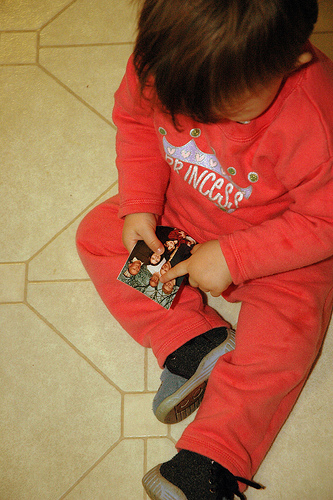
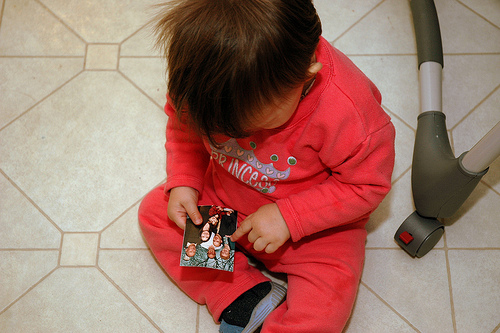
Matching Tracksuits

fun in fours

language

Babcia’s Coming

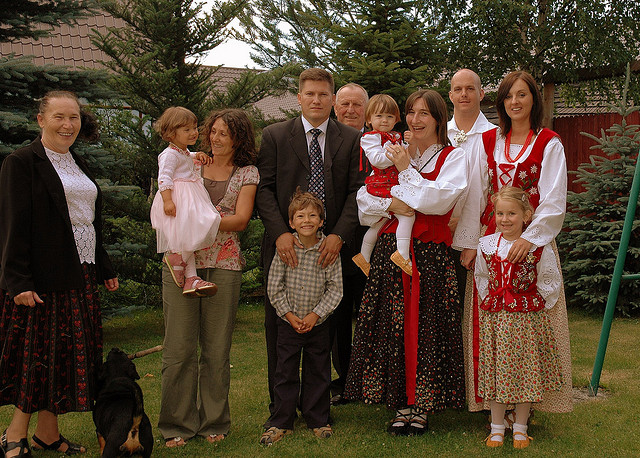
In a little over a month, Babcia will arrive for a several-week visit. It will be the first time in a year and a half that we’ve seen her; L has gone from being virtually an infant to being something more than a toddler.
DSC_7309

L is excited about the arrival. She mentions it every now and then, and every time an airplane flies over our house, L points and asks, “Is that Babcia?”

It will be a time of linguistic development for L. She understands Polish perfectly, and she even mixes a few Polish words into her English vocabulary. She doesn’t speak more than these occasionally mixed up words. When Babcia arrives, though, it will be time to start speaking Polish.

Only recently it occurred to me that this might be almost as difficult as learning to speak English. Her initial instinct will be to speak English, and knowing L’s stubbornness, she is likely initially to refuse even to try. Babcia has a secret weapon, though: fluent Russian. She might turn the tables on L.

Russian Spam

In our spam list was the following comment:

Ты как обычно радуешь нас своими лучшими фразами спасибо, беру!

Given the source, it seems to be a spam. But “беру” also seems to be an off-kilter version of my name, so I struggled with it a while.

Then I called K over, and we puzzled together.

Our Russian is rudimentary at best, but we pieced together a bit. Apparently, the spammer/commenter wanted to say that “You so…” (Ты как) something or other about “enjoying” or “being happy” about one’s own фразами.  And it ends with the the first word most folks learn in Russian: “спасибо.” “Thanks.”

Of course, these days, one doesn’t have to trouble oneself over an unknown tongue — there are plenty of translation sites out there. Google translates it, “You’re normally so happy about us with the best phrases thank you, take.” Little help there. Still, it sounds quite spamolicious.

In response, I say “спасибо.” I think.

Update

Russian spam looks just like English spam: Спасибо автору блога за предоставленную информацию. “Thanks to the blog author for the information provided.”

Hit or Miss Language

At school, everyone is "Miss." Miss Karen. Miss Cathy. Miss Deborah. Miss Brenda.

Miss Cathy -- L's favorite -- works in Toddler I. L no longer sees her on a daily basis, but her eyes light up when she sees Miss Cathy coming.

Miss Karen, Miss Deborah, and Miss Brenda work in Toddler II, where L spends her days now.

I wondered whether L thinks "Miss" is just part of their name, but it's become obvious that L has separated the "Miss" from the name. She understands it as a prefix, but she still doesn't understand its significance. It's a term she uses with individuals she really likes.

Hence, I am often "Miss Tata" now. K is "Miss Mama." Our cat, "Miss Bida."

Our Zoo

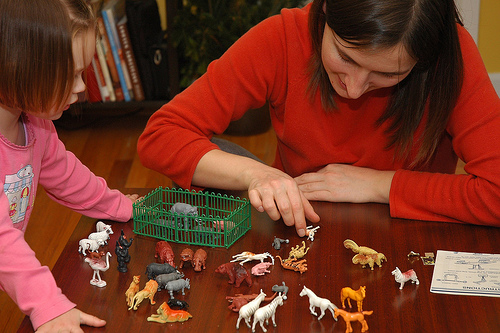
I was always a pack-rat growing up. I think it's genetic, or maybe not. I do know Nana saved a lot of my toys through the year, and the Girl has finally started playing with some of them. My old animal collection.

DSC_2997
1/60, f/5, 55 mm, flash off ceiling

She's excited about being able to recognize animals -- sometimes in Polish, sometimes in English -- and she enjoys telling us what various animals say.

This is also a "sometimes in Polish, sometimes in English" thing, for Polish dogs say "how how" (spelled phonetically in English) whereas American dogs say "woof-woof." Pigs here say "oink oink" whereas their Polish counterparts say "kwee kwee" (again, spelled phonetically in English). When we ask her, "Co mowi swinka?" she replies "kwee kwee!"; to "What does a pig say?" she'll respond "oink oink." That differentiation is a recent development, and it's only one of many little linguistic markers she's passing. She's connected "kupic" ("buy") and stores, so every time we pass a store, she says, in her wonderful mixed-up fashion, "Tata, mamma, kupi clementine." Now she's branching out: "Mama, kupi malinki i grapes."

In short, she's really coming to the understanding that she's learning two languages. The other day, she said to K, "Mamma, bug!" K, not making out what she said, asked, "Co?" ("What"). "Pajak," she replied, specifying not only animal but genus: spider.

Stories from L

Part of learning to talk is learning to tell stories, to string together a group of sentences in a coherent, meaningful way. Yet we’re learning that there are many different levels of coherence and meaningfulness.

Take, for example, this story L told me yesterday: “i whee i boom i cry!” (She’s saying Polish “i” — and, pronounced “ee” — and not the English first person singular personal pronoun.) Facial expressions and hand gestures accompanied this lovely story, which I would translate thus: “I was sliding down the slide! I was having a great time when I fell down. It hurt, and I cried.”

When K came home a few days ago, L told her the following story: “i Bida i no no i time out!” Translation: “I was playing and decided to pick up Bida[, our cat,] which is a no-no. Dad sent me to time out.”

Stories with three episodes. We are in the midst of what Stephen Pinker joking referred to as the “All-hell-breaks-loose” stage of language learning.

Cat Soup and Duff Nuts

The funny thing about English — funny in an infuriating way, for non-native speakers — is its spelling irregularities.

A friend in Poland once offered me “duff nuts.” Logical enough: -ough is often pronounced “uff,” as in “enough.”

K asked me the other day if I knew what cat soup was. I suddenly became very protective of our own cat, wondering what kind of Third-World recipe she had in mind. Turned out, we have cat soup in our fridge; it’s just spelled a little differently.

Words

L has begun talking. Single words, mixing Polish and English, but words all the time.

“More” is “ma,” often with the accompanying baby sign.

“Shoes” is “shas.” We discovered only yesterday that she’d learned that word when she was walking about with one of her shoes in her hand, trying to get one of us to put it back on.

“Ba” or “baba” can be a number of things. First it was banana. Then it became her name for our cat. It’s become so ubiquitous that, when in doubt, we refer to something as “ba.”

Of course, “dac” has been around for some time now.

Most of the words she speaks are English, but she understands both English and Polish. The dominance of English is an obvious function of living in the States, but I could help the matter by speaking more Polish at home.

Development

All of L's linguistic development is in Polish currently. But that's an entirely different post...

L is understanding more and more spoken language every day. She brings things to us; she takes things from one person to another; she puts things back; she gives hugs -- all when asked.

She also recognizes people in pictures.

"Pokaz Papa," I say.

DSC_3336

"Pokaz Nana," I ask.

DSC_3334

Dziadek, Mama, Tata, L, Babcia, Papa, Nana -- each and everyone she recognizes. (Babcia is in a different picture, though.)

Ty Pan Du Sie Tu Vous

When learning Polish, for some reason I had the hardest time initially using the formal voice of address. English-only speakers might not know what I'm talking about, even though the formal/intimate distinction existed in English for hundreds of years.

In French, it's a question of "Vous" and "tu." "Vous" would be "you all" -- second person plural -- and is used in all formal occasions; "tu" is informal, and used with intimate friends or family. In German, it's "sie" and "du".

This is why Martin Burber's wonderful book Ich und Du is translated I and Thou and not I and You.

In English, it used to be "you" and "thou," with "thou" being the more intimate. Because most of us are exposed to "thou" exclusively through liturgical language, we get the sense that it's incredibly formal. In fact, it's the opposite.

Po Polsku

In Polish, there are two options. The first is the common use of "Pan" or "Pani" -- literally, "lord/master" or "lady/mistress."

The older, now-obsolete form is to use "Wy" -- "you all." It's still used in the mountainous southern region, and K in fact speaks to her grandmothers this way. "Co robicie ostatnio?" "What have you been doing lately?"

Out of this came an amusing verb: dwoic. While this is related to the word "dwa" (two), it's not, strictly speaking, "double" (which is "podwoic"). Instead, a better explanation would be "to use the second person plural." In that case, one might ask another, "why are you [dwoic] me?" meaning, "Why are you using the formal voice with me?"

The second method, and the one used now, is to use "Pan" and "Pani." To be polite, a shop attendant, for example, doesn't ask, "Do you need help?" Literally, he asks, "Does the lady need help?"

The problem for me was not so much remembering the odd construction but learning when to make the switch from "Pan" or "Pani" to "you." I called people "you" when I should have used "Pan/Pani" more times than I care to recall. And there really are no guidelines -- it depends, somewhat, on the person.

Linguistics of Diplomacy

I got to thinking about all of this due to an article by Charles Bremner. It begins,

Here is one of those stories that are difficult to convey to people who speak only English. President Sarkozy's government has annoyed the "progressive" sections of the teaching establishment with an order that school pupils must address their teachers with the formal vous rather than the familiar second person singular tu. Teachers are advised to use the respectful vous to Lyc�e teenagers in their classes.

While I could never imagine students in Poland referring to teachers in the second person, I could also never imagine teachers using the formal third person with teachers.

The piece goes on to discuss how world leaders refer to each other -- tu/du or vous/sie?

Angela Merkel dropped German formality enough to call him "Lieber (Dear) Nicolas" but stuck to the formal "sie" not the familiar "du". Sarkozy's matey reply jarred on old-fashioned ears. "Ch�re Angela... J'ai confiance en toi." (In older English I trust thee not you). Lib�ration joked that Franco-German harmony was still lacking. "They are going to have to start by agreeing whether they use tu or vous," it said. (Charles Bremner piece)

While the article doesn't mention George Bush, it seems safe to assume that, like Gordon Brown, his dependence on interpretors will solve the tu/Vous problem. But considering the little back rub he once gave Merkel, it's fairly reasonable to assume that Bush would opt for "tu" over "Vous."

Entropy

The first time I was in Polska, I started making a little 'zine that I'd mail out to friends and family. I called it "Entropy."

I remember that yesterday evening and wondered who had "entropy.com." I knew it wouldn't be available, and I typed "entropy.com" in the address bar.It re-directed me to "entropy.ie".

"Entropy -- Secure Networking."

I'm not sure how much faith I'd put into a networking security company that's taken its name from a principle of decay.

What would its logo be? A frayed networking cable?

Anticipating user confusion, the company included this explanation:

Conall Lavery founder of Entropy decided upon the name after reading a book called "The Crying of Lot 49" by the American author Thomas Pynchon.

In the book the professor uses the two theories of Entropy (thermodynamics and communications) and invents a perpetual motion machine that is driven by telepathy.

There are various definitions of Entropy.

According to the Collins dictionary, Entropy means "a thermodynamic quantity that changes in a reversible process by an amount equal to the heat absorbed or emitted divided by the thermodynamic temperature."

In my view, that doesn't help clarify things that much.