Matching Tracksuits

fun in fours

faith

Social Media Theology

I'm scrolling through a social media group dedicated to the Bible in a Year program with Fr. Mike when I see a post that took me aback:
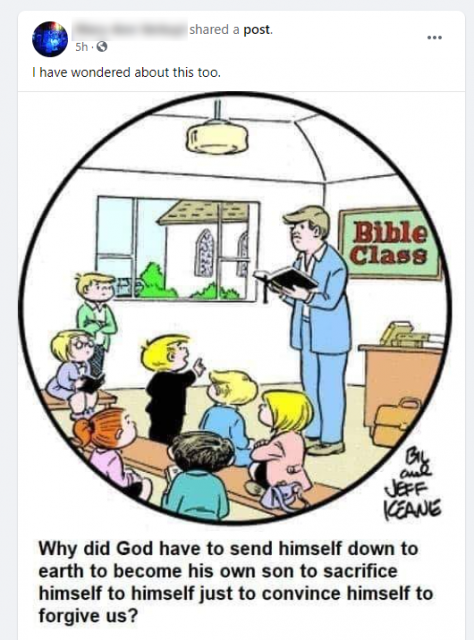
This seems to be a parody caption put under a Family Circus cartoon. I suspect this because:

  1. Family Circus is a fairly pro-Christian cartoon, and this particular cartoon is pointing out the circular logic and near-absurdity of the Christian idea of salvation and
  2. It seems like the font just doesn't fit the rest of the cartoon.

I recall when I expressed my own doubts how I was attacked and lambasted when, instead of accepting the offered explanations serenely, I replied the rebuttals I'd thought of long ago.

Michel, as if on cue, enters with a classic ad hominem argument.
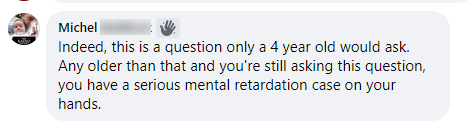
I try to keep quiet, but I can't: "An ad hominem argument from an apologist is always effective."

Yet one person doesn't see it that way:

How to interpret this? A misunderstanding or the dawning of doubt? Probably the former. But I was curious how they would respond to this ineloquent way of explaining a weird little knot of contradiction that lies at the heart of Christianity, all complicated further by the doctrine of the trinity.

The basic idea is this: Christianity teaches that Jesus had to die in order to make humanity right with God somehow. Through the "stain of Original Sin," humans are separated from God, and to bridge this separation required a sacrifice. But only a pure and unblemished sacrifice would do the trick because God is completely holy. So God sent "his only begotten son" down to die a horrid death he didn't deserve because he lived a perfect and sinless life, thus serving as the sacrifice that makes all good with God. God did this because he loves humanity and wants humans to spend eternity with him, but the sinful nature of humans prevents this. He's perfect; we're not. He can't be around the imperfect, so there must be some way of atoning for those imperfections. (I probably didn't explain that well because there are a million different interpretations on what exactly Jesus's sacrifice accomplishes depending on the denomination of the apologist. I know for a fact that I mixed and matched several different explanations of what Jesus's sacrifice, in the eyes of believers, really does, but that's kind of the point. They can't even agree on what's going on here.)

The first problem with this comes when we consider the supposed omnipotence of God. If God is all-powerful, why not just forgive and welcome everyone back into the fold? Why all this song and dance about Jesus? What's more, if you don't believe this and accept it, it's back to square one with you: you'll remain forever separated from God, destined for the eternal firy torments of hell. (Never mind for a moment the painfully obvious question: why would a being who is even vaguely decent let alone completely benevolent like Christians teach their god is send anyone to eternal punishment for anything?)

The biggest problem comes when we mix the trinity into all this. Because God and Jesus are the same entity (as well as the Holy Spirit -- never mind how that seems to make no sense in and of itself), we can replace all those instances of "Jesus" with the more generic "God." That shows the absurdity of it clearly. God is doing the sending and is sent. God is doing the condemning and the restitution. God is sending God to die to satisfy God's demand of punishment for humanity's disobedience of God. What kind of sense does that make at all? Skip all the middle man stuff and just forgive humanity.

That's what the cartoon is highlighting. The poster's comment of "I've wondered about this too" as well as Ashely's admission that she "never thought of it that way" with a smiley face indicates that the circular logic breaks through to others' thinking for just a brief moment.

Others jump in quickly, though, trying to explain why Jesus had, in Christian theology, to die.
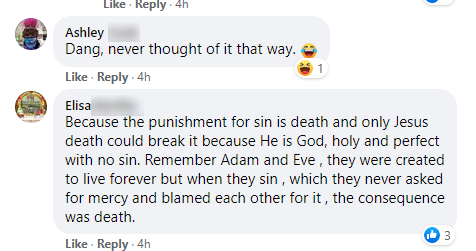
Elisa's contention is that Jesus could only "break" (not sure what that means) "the punishment for sin" by dying because "He is God, holy and perfect with no sin." Yet this doesn't get at the heart of the objection in the cartoon, which is that an omnipotent God shouldn't have to go through all this rigamarole to forgive people: if he's omnipotent, he just forgives them. End of story. This suggests that Elisa doesn't really grasp the underlying objection.

Others' explanations show the same lack of understanding:
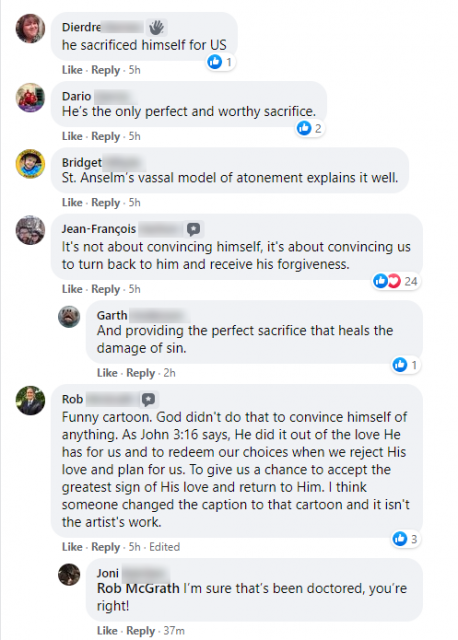
They all turn back to the same explanation I butchered above. Sin separates us. God loves us. God wants to bridge that gap. So on and so forth.

It is at this point that I jump in:
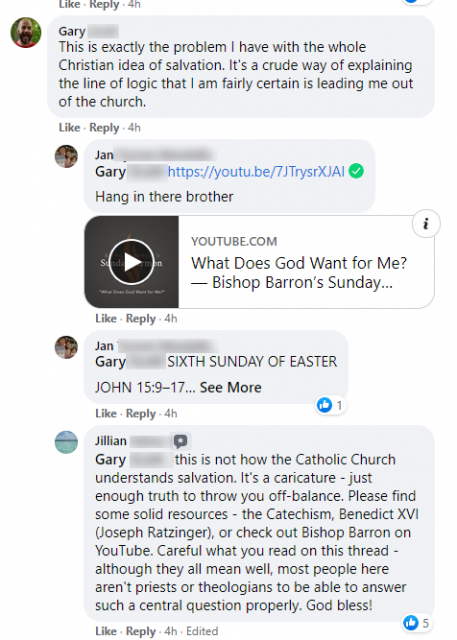
Granted, it's not "leading me out of the church." It and countless other objections have already done that. I just don't want to sound like an aggressive outsider. I want to see how they'll respond.

Bishop Barron's sermon that Jan links to just reiterates how God is love and that's why he died for us. It doesn't answer the question of why he couldn't just forgive outright.

Jullian rightly points out that "this is not how the Catholic Church understands salvation." He correctly admits that it's "a caricature." But that's the point. Caricatures by design highlight the absurdity of something to bring it in sharp relief. To make it stand out.

What's more interesting about Jullian's response is that "most people here aren't priests or theologians" who would be "able to answer such a central question properly." That raises an objection in and of itself. Why would an omnipotent god create such a convoluted system of salvation that only a specialist with years of theological study behind him (and remember that theologians don't really study God but simply study what other men have said about God) could answer?

Finally, Margaret calls a spade a spade:
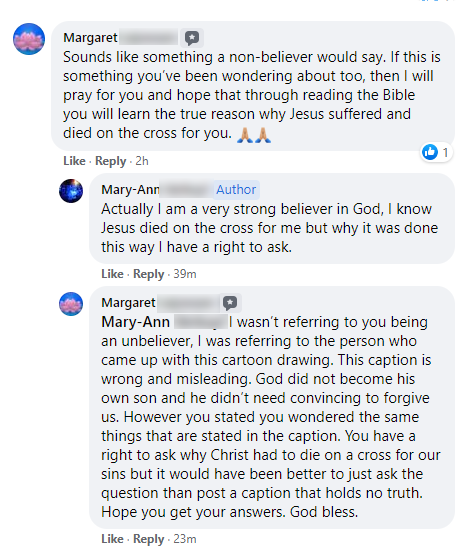
Mary-Ann, the post author, quickly reassures everyone (and likely herself) of her undying faith

Finally, Dan tries to explain everything:
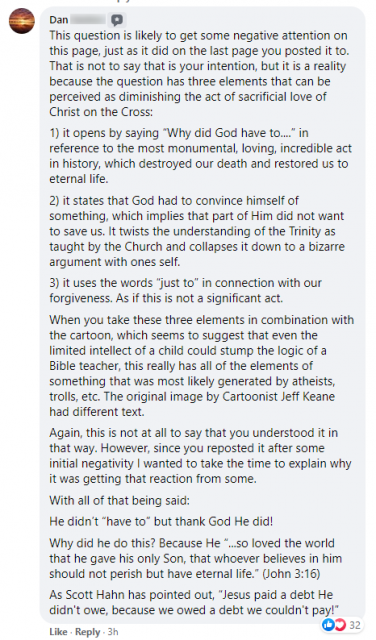
Dan's first objection is in using the formulation "Why did God have to." He didn't even answer what's behind the question: the notion is that without doing this, we can't be with God. If that's the case, and God wanted humans to be with him, then God did indeed have to do this.

Dan's second objection comes from the confusion this creates regarding the trinity: it "collapses it down to a bizarre argument with ones [sic] self." That is the point. In doing so, it highlights the absurdity of the doctrine of the trinity.

Dan's third objection is with "just to." I think that's meant to highlight the fact that, if God is omnipotent, he should be able just to forgive humans our foibles and move on. It's another reflection of the first objection, in other words.

He ends with Scott Hahn's assertion that "Jesus paid a debt He didn't owe because we owed a debt we couldn't pay." And we're right back where we started.

All this simply confirms what I've come to realize over the last couple of years: most believers don't seem to understand what's at the heart of most skeptics' objection to Christianity. Whether this is an inability to understand it because of their blind faith or an unwillingness to try because of a fear of the consequences, I don't know. Of course, there are other explanations, and it's likely the case that for most believers, it's a mix of any and all of them.

But I see these problems. And I can't unsee them.
Back to BIAY

Although I haven’t listened to a Bible in a Year podcast in over a month now, I’m still following a couple of groups on social media. Every now and then, I’ll see something that interests me: someone expresses a doubt or a worry, and I immediately begin listing the ways people will try to help. Sometimes, I make my own comment.

Today I read,

Although I had a lot of children’s bibles growing up, went to catholic school, and go to Sunday church so I know the stories of the Bible for the most part – this is my first time really “reading” the Bible all the way through with BIAY.

And honestly – I’m struggling. Every day it just seems like one depressing story after the next. Every day it’s just horrifying tales, little Joy, and lists of names. Men being awful and women’s lives being ruined. […]

I decided to use the line of reasoning that’s not entirely true at this point in time but was true some months ago:

I had similar problems. So much of the awfulness comes with God’s tacit approval or, worse, at his command. I’ve taken a break, but it’s done serious damage to my faith.

Granted, I’ve rejected faith altogether (again), but I did go through this process. I was wondering (again) how people would respond. Typically, there are a few responses to “Oh, that gory stuff in the Old Testament is troublesome.”

  • It’s for the Israelites, not for all of us.
  • Just because it’s in the Bible doesn’t mean God approves of it.
  • God in the Old Testament is slowing bringing about moral change. It’s a slow, gradual process. These are the first steps.
  • God said to do it, so it is right. Who are you to judge God?

Eric jumped right in with the tried and true “just because it’s in the Bible doesn’t mean acceptance” argument, almost word for word:

Assuming the existence of tacit approval is a dangerous move to make. It assumes that because a bad thing is recounted, it is recounted with approval, but that’s just not how biblical texts are written. I’m sorry to hear your faith is wounded, but rest assured God does not approve of immoral actions, even when He brings good out of them.

This reply always frustrates me because it misses the point. I’m not saying that the immoral behavior of various characters is troubling: I’m saying the immoral actions and commands of God are troubling. I replied:

Just look at all the awful punishments he commanded. Look at the genocides he commanded. That goes well beyond tacit approval.

His response? The classic “God said to do it, so that makes it acceptable” line. He didn’t ask me directly “Who are you to judge God,” but it was implicit:

OK so for those, did people other than God make those commands, or was it God, who after all does decide, every day, who lives and who dies? If I commanded that, or my national leader, that would be wrong, but when God commands punishment of people that are very clearly morally in the wrong, isn’t that the one time it’s OK?

It’s important to point out that according to this theory, the only thing that Islamic suicide bombers got wrong was the god. The reasoning behind what they’re doing is sound: God commands it; that makes it right.

Still, I didn’t go that line. I simply asked, “To punish by stoning?”

At this point, Eva jumped in:

God had to do a cleansing, just as he will when Jesus comes again. After all the evil in the world God still gave his son for our salvation. How much more can we ask of God? The world is lucky God is making the decision not mortal man because I as a human would have given up on humans a long time ago.

“God had to do a cleansing” sounds an awful lot like “God had to do an ethnic cleansing,” and that’s because it’s exactly what he does in the Bible. He commands the Israelites to wipe out whole nations. The Bible says it’s because they’re so immoral, but that just sounds like propaganda to me. Add to it the fact that there’s no evidence any of this immorality that keeps appearing in apologist arguments (namely, that the Canaanites burned their children alive as offerings to Ba’al). There’s simply a claim in scripture, which sounds a lot like after-the-fact justification.

Eric also replied, using another of the popular arguments: it’s a gradual movement to a more moral society:

Remember that God was leading his people gradually to an end point. The original moral framework He gave was just the 10 commandments. But when Moses came down Mt. Sinai and the people had sinned, God gave more laws—a lot more. And those extra laws are the ones that contain more age-specific laws that we rightly shake our heads at today.

Jesus himself made this exact point when he said that Moses had allowed things like divorce, it was not b/c that’s how things should be, but b/c that’s what the people were capable of at the time, but it was not always so and hence that’s not the rule now. Laws and commands for a people in 1000BC were tailored by God for them at that time. They weren’t His vision for How Society Should Work; they part of a larger plan for guidance, so they only needed to be Better Than What Came Before. Case in point: the lex talionis “an eye for an eye”. This sounds terrible compared to today, but the comparison we should make is with what proceeded it. “An eye for an eye” was *limiting* revenge to something approaching proportionality. And so on with other decrees of the law of Moses. You absolutely have to judge them in comparison to the societies Israel was surrounded by.

I’m sorry, but stoning someone is not a moral step up from anything. I can’t think of anything that would rank below that. Still, it shows how people fall back on familiar tropes to justify the unjustifiable because the alternative (rejecting the Bible, even in part) is utterly unthinkable.

The Slip

One thing I love about being a teacher is that I don't have to know everything. "I don't know" is a perfectly acceptable answer to a student's question, and I'm not afraid to admit as much. I follow that admission with a promise to find out, or, in some situations, I suggest to the student to do a little research herself.

When you're a priest leading who knows how many thousands of listeners through 365 days of Bible reading, you're going to encounter some troubling passages. You're probably going to do your best to explain them, and sometimes, the explanation might be reasonable. But statistically speaking, you will eventually say something that is so completely outrageous that you'd probably wish you hadn't said it.

Today Fr. Mike had just such a day reading Numbers 31. It tells the story of God's command to the Israelites to wipe the Midianites off the face of the earth. What was the Midianite crime? Well, they'd introduced the Israelites to the false god Baal, and the Israelites became so smitten with this new god that at least two of them conducted a fertility ritual in the Holy of Holies -- the holiest place on Earth, Fr. Mike explained. It's a troubling passage, and Fr. Mike struggles to explain it from God's point of view:

You have to go to battle against the people who have already corrupted you. ... You have already been corrupted, so you have to put an end to this. That's one of the reasons why the warfare there is, like, 'kill everybody,' which is really hard for us. And it's not because God wanted everyone to die. That is not the case. In fact, that kind of warfare would not have existed -- this is important for us to understand -- that kind of warfare would not have existed if the people of Israel had been faithful. This is so critical for us to note, that that is not the plan of God.

The first problem I have with this is that it's almost as if Fr. Mike has forgotten the reading from just the other day from Deuteronomy 28.63:

And just as the Lord took delight in making you prosperous and numerous, so the Lord will take delight in bringing you to ruin and destruction; you shall be plucked off the land that you are entering to possess.

Killing and bringing things to ruin seem to be what this god enjoys, and he seems to boast about how much he enjoys it. How does Fr. Mike reconcile these two passages? Simple. He doesn't. He probably didn't even notice it.

Second, what about the responsibility of the Israelites? If they went astray, the Midianites certainly had something to do with it, but ultimately, it's the Israelites who went astray, not the Midianites. Fr. Mike is essentially saying that they deserve total eradication because they tempted the Israelites to idolatry. But Fr. Mike tries to deal with this:

They are so weak that they worship other gods. It's because of the people's weakness that Moses has to command -- and I say, 'has to command' because it's just, like, no other way around their weakness than the kind of total destruction of the Midianites here. We're going to see this warfare again and again. It can be troubling for us, and that's okay that it's troubling for us because it's not good, right? It's not good. It's not what God would ultimately want.

There's no other way around their weakness?! This is an omnipotent, omniscient god we're supposedly talking about here. Surely he could figure out another way to deal with this that doesn't involve wholesale slaughter. Hell, I'm just a stupid human, and I can probably come up with at least half a dozen other ways that don't involve genocide.

It's as if Fr. Mike's version of the OT god is sitting up in heaven going, "Dang, I wish they hadn't done that. I don't know what I'll do about it. Well, I can't see any alternative to killing them all." It's ludicrous. But Fr. Mike doesn't see the box he put this god into. He just has to explain it.

He can't say, "I don't know. I just don't get it. It seems brutal, and I can't really understand it myself." That's not an option if you approach the reading with an a priori assumption that this book is the perfect word of a perfect being. That assumption forces you into saying utterly stupid things like Fr. Mike.

There's another little treasure in the reading that Fr. Mike didn't mention: "Now therefore, kill every male among the little ones, and kill every woman who has known a man by sleeping with him. But all the young girls who have not known a man by sleeping with him, keep alive for yourselves" (Numbers 31.17). "Keep the virgins for yourself," is what this god is saying.

Five, Six, Pick Up Sticks

Today’s reading with Fr. Mike included Numbers 15, and if I’m writing about it, you can probably guess why: more brutality. Verses 32 through 36 read

When the Israelites were in the wilderness, they found a man gathering sticks on the sabbath day. Those who found him gathering sticks brought him to Moses, Aaron, and to the whole congregation. They put him in custody, because it was not clear what should be done to him. Then the Lord said to Moses, “The man shall be put to death; all the congregation shall stone him outside the camp.” The whole congregation brought him outside the camp and stoned him to death, just as the Lord had commanded Moses.

Fr. Mike knew that this was a troubling passage. I could hear it in his prayer after the final reading:

Father in heaven, we thank you for your word. We thank you for your scripture today. We thank you also for the great wisdom you give to us in helping us understand your word. Lord God, for all the times we are perplexed and troubled — not just perplexed but deeply troubled, even troubled in our heart by you, by your teaching, by what you reveal about yourself, we ask that you give us not only a, not only take away a spirit of skepticism or spirit of cynicism, but you give us a spirit of openness, a spirit of truth and of honesty. A spirit of trust that when we don’t understand, we ask. And when we still don’t understand, we continue to ask. Lord God, give us a spirit of trust. Give us a spirit that is open to whatever it is you will for us this day and every day.

What’s wrong with a spirit of skepticism? Shouldn’t we be skeptical about a great many things? Just look at the news — Qanon, claims of a stolen election, anti-vaxers. There’s plenty we should be skeptical of. Being skeptical just results from being a critical thinker, so I feel like Fr. Mike is asking his god to turn off our critical thinking faculties for this passage.

To his credit, Fr. Mike does try to explain things this time. In the past, he’s just glossed right over it, but he deals with the troubling passage this time:

Remember: the heart of these laws is that God has said, “No, you are my people.” He has set his love upon them. This is so important. These laws, the consequences of sin, the consequences of going against the Lord are so great that they shock us, right? Capital punishment as a violation of the sabbath. For picking up sticks, it says here in Numbers chapter 15.

Then he reviews the passage before continuing,

We can look at that, we can hear that and think, “That is, um, I don’t want to say crazy, but that is something we wouldn’t expect […] out of God’s law. Clearly it’s not something we would expect from the god that is mercy and love. How do we understand this?”

That’s exactly my point: it’s something we wouldn’t expect out of a God that is described as loving and merciful. How do we deal with that contradiction? There are a few options:

  1. Suggest that this is evidence that this god is not loving and merciful.
  2. Suggest that this god’s sense of love and mercy is conditional at best, barbaric at worst.
  3. Suggest that we might not understand it and move on.
  4. Suggest that it is indeed loving and merciful but that we simply don’t understand it.

“It can seem so extreme for us,” Fr. Mike admits, but he simply points out that there is a provision for those who do this unwillingly. They’re not to be executed. It’s only those who do so willingly, flagrantly — those who thumb their noses at this god’s commands. He then suggests that the third tithe

Third tithe mentioned in Deuteronomy 14 somehow makes up for it.

Every third year you shall bring out the full tithe of your produce for that year, and store it within your towns; the Levites, because they have no allotment or inheritance with you, as well as the resident aliens, the orphans, and the widows in your towns, may come and eat their fill so that the Lord your God may bless you in all the work that you undertake.

It can seem “schizophrenic” (his word), but he points out that it’s extremely generous and merciful to take care of widows. That’s what we’d expect from a god of love

I joined a FB group for this Bible in a Year reading plan and posted my concern: “I struggle greatly with all these passages about stoning. Why would God command such a brutal and barbaric method of execution? I wish Fr. Mike would address that. Thoughts?”

One person responded, “That’s what they could understand 3,500 years ago. You can’t read the Bible with a 21st Century lens.” I’ve heard that argument so many times, but I just don’t understand it. From a Christian perspective, if it’s wrong it’s because God says it’s wrong; so if it is wrong in 21st century, it had to be wrong in all time.

I took a slightly different argument in my response, though:

God is not just condoning this. He’s not looking down from heaven and saying, “Well, they’re stoning people now. That’s wrong. I’ll take care of that, but it will take time because they’re so backward now. By the 21st century they’ll have outgrown this.” He commanded it. It was his instruction. There are other ways to kill that they could have easily understood. They would understand, “Hey, don’t stone people. It’s brutal. It’s awful. To execute them, here are some herbs you mix in water. It’s painless and nearly instant.”

At this point, there are lots of likes for the response to my question, little acknowledgment of the content of what I asked. And I get if: I’m asking questions that challenge comfortable belief. I’m asking questions about one of the many things that led me away from belief. I can understand if no one wants to touch it.

Questioning

At some point recently, K was reading to the Boy about Moses and the plagues, and as children are wont to do, he zeroed in the most shocking one: the death of the firstborn male. He was trying to figure out who in the family would be the firstborn male.

"Would it be Papa?" he asked.

How does one respond? How does one say the obvious: "No, it would be you"?

"But why would God do that? It's against the commandments."

This is the crux of the issue of me of late: how are we to incorporate all those horrible things the god of the Old Testament does with the notion that the Bible supposedly comes from the mind of an omnipotent, omniscient, all-beneficent being? (The story of the death of the firstborn is problematic both for God's beneficence and his omniscience: the Hebrews are to mark their doorway with the blood of a sacrificed lamb in order to indicate that the angel doing the killing is to pass over that house -- why wouldn't the angel know without that?)

Believers start with the premise that the Bible is from an omnipotent, omniscient, all-beneficent being, and then they work backward to try to explain these horrible passages. A skeptic like me starts with the premise that the Bible is supposedly from an omnipotent, omniscient, all-beneficent being and looks for evidence of that within the pages. The clear evil that the god of the Old Testament does, then, is clear and damning evidence against the supposition that the Bible reflects the mind of an omnipotent, omniscient, all-beneficent being. That god is petty and selfish, jealous and immature, narcissistic and self-absorbed, and above all, that being as portrayed in the Old Testament is evil, toying with some by demanding human sacrifice and then rescinding the order at the last minute (thinking of Issac here) and accepting human sacrifice in other situations (I'm thinking of Jephthah here). He is murderous and rampaging on both an enormous scale, commanding the Israelites to wipe out whole nations, men, women, and children, and a small scale, sending bears to maul children:

He went up from there to Bethel, and while he was going up on the way, some small boys came out of the city and jeered at him, saying, “Go up, you baldhead! Go up, you baldhead!” And he turned around, and when he saw them, he cursed them in the name of the LORD. And two she-bears came out of the woods and tore forty-two of the boys. From there he went on to Mount Carmel, and from there he returned to Samaria. (2 Kings 2.23-25)

Believers have to become apologists for God, coming up with reasons why these horrible actions are perfectly reasonable and in fact good. (Here's an attempt to explain the bear mauling.) They resort to explaining what it means in that time and culture, failing to realize that they've just placed a limitation upon this supposedly-divinely inspired book that counts against their argument. They discuss the nuances of the original Hebrew, failing to realize that they've just placed a limitation upon this supposedly-divinely inspired book that counts against their argument. They produce wildly different interpretations and explanations, failing to realize that they've just placed a limitation upon this supposedly-divinely inspired book that counts against their argument.

For the skeptic, things are so much simpler. Occam's razor simple. We mark these passages in the "Against" column and move on. In the end, we look at how many marks are in the "For" column and how many are in the "Against" and make a summary judgment from that. And there are vastly more things in the "Against" column.

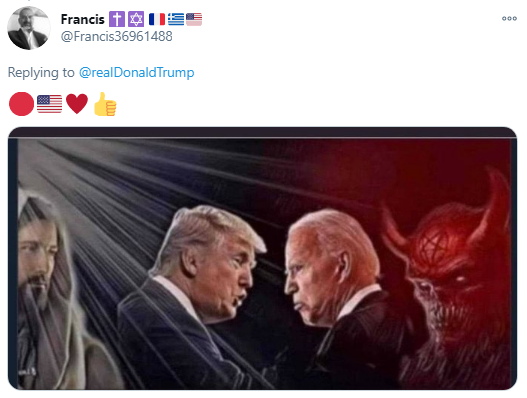
Trump and Biden as Spiritual Warfare

It’s sad a tweet can be a tragic harbinger of things to come.

When one side portrays itself as being God’s side and sees the other side as being of the devil, no good can come of that. No unity is possible when things are framed in terms of a good-versus-evil, spiritual battle. One does not compromise with the devil; one does not work with the devil; one does not even talk to the devil. Instead, one fights the devil; one shuns the devil; one destroys the devil. Mixing politics and religion is especially dangerous for that very reason.

The Civil War created fissures in our society that exist today. How long will the damage Trump and the Evangelicals’ Faustian bargain with him last? For generations, I fear.

And this guy is from France for heaven’s sake!

Critical Santa

During dinner tonight, the topic of Santa came up. "I don't believe in Santa Claus," the Boy said confidently, "but I believe in Saint Nicholas." I thought he might be thinking of the Polish version of Santa, Mikolaj, who comes on December sixth, or perhaps just he was just thinking of the actual Saint Nicholas of the Catholic church -- you know, the bishop from Turkey.

"I knew this time was coming," I thought. I've always felt a ting of guilt about the whole Santa thing: I knew perfectly well that Santa doesn't exist, but I kept playing along, telling our kids that Santa does exist. Eventually they figure it out, but it just left a bad taste in my mouth.

Soon, though, he kind of back-tracked: "Well, I'm not sure."

"What evidence do you have that Santa exists?" I asked him.

"What kind of evidence do you have that Santa doesn't exist," L jumped in like a typical thirteen-year-old who just wants to be contrary. (Is it only thirteen-year-olds that are like that?)

"No, sweetheart. Whenever people are making a claim, the burden of proof is on them. They have to provide evidence, not the skeptics who doubt the story," I clarified. I thought about going into what it means to beg the question, but I didn't, turning instead back to the Boy: "So what evidence do we have?"

He listed the toys, the imagery in movies, the stories.

"Can we explain those things with other methods? Is there a simpler way to explain the toys appearing under the Christmas tree?" Did I tell him we were applying Occam's Razor? Certainly not. But we were shaving away.

"Well, you and Mom could put the toys under the tree," he responded after some thought.

In the end, though, when pressed, he decided that he leaned toward a belief in Santa.

We'll see how he views it next year.

Confirmation Bias

What does it take to change a "Stop the Steal" Trump supporter's mind about the election? What about an outside opinion, reported in the Wall Street Journal?

A team of international observers invited by the Trump administration has issued a preliminary report giving high marks to the conduct of last week’s elections--and it criticizes President Trump for making baseless allegations that the outcome resulted from systematic fraud. (Source)

But see, it's not so easy for Trump supporters who reject the election results. They're predominately Evangelicals. They read the Left Behind series as history written in advance. They believe in an antichrist -- probably the pope -- who will literally perform miracles. They think that all the world will bow down and worship this man. They won't see this as confirmation that the election is fair; they'll see this as proof that it's an international conspiracy. This culminates, they believe, in the creation of a one-world government that will strip America of its sovereignty as part of the coming tribulation.

They won't see this as confirmation that the election is fair; they'll see this as proof that it's an international conspiracy. They will see this as part of the grand prophetic end of the world.

You can't reason with that. It's a faith as strong as any other, as strong as their faith that God will somehow deal with the coronavirus (those who believe it's real, that is) and pray for it despite evidence to the contrary. Nothing counts against that faith. If someone goes through the pandemic without falling ill, it was through God's grace. If someone falls ill but doesn't become overly sick, it's due to God's mercy. If someone falls deathly ill and has lasting complications, it's God's grace that he didn't die. And if someone falls ill and dies, it's God's mercy because he's gone home to the Lord. Nothing counts as evidence against that kind of faith. If nothing counts against it, if there is no way to falsify it, it's not a rational belief but merely a warm feeling.

Transfer that to the election: these Evangelicals see conspiracy everywhere. It's in the DNA of their religion. To forsake that is to forsake their very faith.

Exempt

Churches are exempt from paying taxes; political organizations are not. All too often, though, the former morph into the latter, and it’s for that reason that many of us feel that churches should not enjoy tax-exempt status. Usually, priests and pastors couch these statements in less obviously political language. It fools no one, and of course, the congregants generally support that language and their perceived right to say it in an organization that pays no taxes — it’s seen as first amendment rights.

So to be present when blatantly political speech takes place in the context of prayer makes someone who holds the above views quite irate.

Today, we went to mass at St. Elizabeth Ann Seton, a church that we’ve attended a few times, and probably would attend more often given the difficulty of signing up for one of the available slots at our parish’s reduced-capacity masses. But I for one will not set foot in that building again after the blood-boiling nonsense I heard today. During the general intercessions, when it came time for the priest to add his intentions, he prayed for Trump and his pick for the Supreme Court position. I really wanted to walk out at that point, but I remained. It wasn’t as if he were thanking his god — which I put in lower-case, for it seems to be the god of political power — for the death of Ginsberg; he was merely supporting the hypocrisy of the right. Given the historical hypocrisy of the Catholic Church, it shouldn’t come as much surprise that a priest would promote and praise political hypocrisy in the name of maintaining power.

As the mass was ending, though, during the time just before the benediction when the priest usually makes announcements, he launched into another political speech about the importance of the Supreme Court nomination. I’d had enough. I walked out.

Day 63: First Mass

Today, parishes across the state were able to have public Mass for the first time in two months.

The local Catholic newspaper hired me to photograph Mass at a couple of locations.

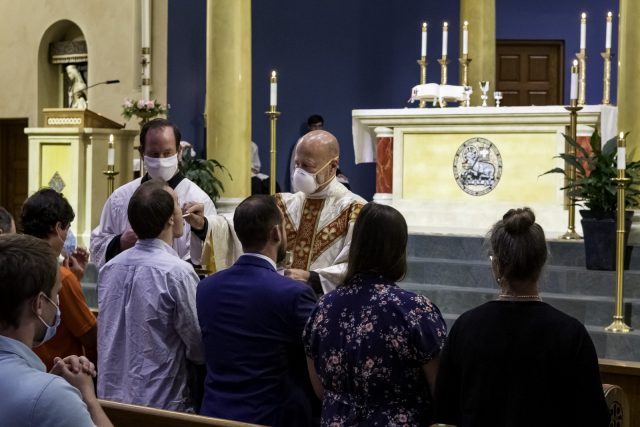
A surreal scene, to be sure.