On the way to work today, I listened to an episode of the Cults podcast, which was about the Australian group Hermes Far Eastern Shining, a group that teaches an Eastern-tinged variety of religious silliness. Their original leader, who claimed to have the same type of spiritual energy and ability as Jesus, died over a decade ago, but they're still peddling their quackery. Their primary product seems to be magic wands. That's not a joke: they sell magic wands, which are basically plastic tubes with a liquid that an Australian regulatory agency determined was nothing more than dyed distilled water.
One of their more inexpensive wands is the "Don’t Fence Me In Wand," which sells for only $55.00. What can we expect of this marvel of medieval superstition?
“... Give me room, lots of room underneath the starry skies...” Like inhabitants of “Flatland”, the usual person is hemmed in, unable and unwilling to step over the ‘line’. We are constrained within one-dimensional and two- dimensional levels of existence, by self and other possession. The one-dimensional is the atheistic scientific model of the universe, in which it is insanely suggested that an individual’s behaviour could be predicted by simply knowing where all their molecules are at one time and somehow knowing where they will be at some future time. This abysmal view is utterly and deplorably fallacious, “Thank God”. The two- dimensional aspect of this is other possession particularly and ‘self-possession’.
This consideration of ‘don’t fence me in’ is focused in other possession. This other possession has many forms; some of these are concept possession, lower astral possessions, entity possessions, parental and sibling possessions, friends, possessions, place possessions, time possessions, black witchcraft possessions, programming possessions, dimensional possessions and so on. This is all the stuff of Television drama; struggling with father, mother, brother, sister, lover or some idea that torments us. Penetrating the illusion of these possessions can be very freeing, leaving us at last with our own self-possession, which is our own moral responsibility, under the banner of energy and feeling.
(Being ‘psychic’ is simply what we are to understand as feeling. (Energy we are to understand as ‘action.’) Exit stage right, Alice1 disappears down the rabbit hole...
I'm not sure I understand what this product description is exactly claiming because, like all religious poppycock, it's long on poetic, esoteric nonsense and short of practical specifics. But at least they include instructions on how to use the wand:
The Wands can be carried with you throughout the day in your hand, pocket, handbag, briefcase etc. You can engage them at work, during exercise, recreational activities, meditation or at home. You can imbue a glass of water with the Energy of your Wand by tapping it to the side of the glass. Sip the water while holding the Wand and receive its energy.
Each Wand holds a specific intention of purification and transformation. The Wands are not influenced by other energies and so do not require 'cleansing', 'clearing' or 're-charging. They can be used personally, shared with others and used in your immediate environment.
You can also apparently hold it over someone's head for some kind of special effect.
Another option, in the $1,500 price range, is to buy an "Energy House," which holds several of these magic wands and makes you a particularly good reader.
"Energy Houses" -- quotes very much intentional
If you're already sold on the whole magic wand supersition, you can forego the tedium of adding them one at a time to your shopping cart and get a pack of 20 for a mere $2,250.
As our forms are lifted and transformed over time, so to is it necessary for the energy of the food and beverage that we receive. The Food and Beverage Spiritualiser brings a clearing and blessing energy to optimise the intensity of all that we ingest. In tern, this helps the energy of our food to combine with our forms more easefully and support us to be more like Light than flesh.
One of the original intentions of the Food and Beverage Spiritualiser was to help us awaken to the recognition that as we evolve, we must support our forms to incorporate and conduct the Eternal Current of Divine Light and Radiance.
In addition to the four golden, glass spheres holding a vast array of special Alchymeic Energies, the Food and Beverage Spiritualiser holds a clear Soul Fire Octahedron in the centre, with four diamond bezels in the four corners, sitting upon a spinning base.
Finally, there's the ultimate magic-water machine, the Bubbler.
This beautiful piece of quackery will set you back $6,000 -- I'm sure it's worth it for all the amazing benefits.
At one point, the Australian government shut down the whole operation for obvious reasons, but they opened again, adding a lengthy disclaimer to the website. Among the choice weasle-word passages about making no health claims is this stunning admission:
What we offer has no scientific backing, evidence or support. It is a wholly ‘esoteric’ matter, completely outside of conventional scientific understanding. There are no scientific verifications for our work. Hermes Far Eastern Shining does not claim and will not claim that conventional worldviews provide any support for our work.
In short, they are admitting that there is no way to determine whether or not their products actually do anything. The further explain,
When you choose to work with our products, any results that you may experience cannot be anticipated and they may not be readily observable. Any results are up to the Divine and how well you understand and apply what is presented.
Some people do report many things to us – some of them truly inspiring things – but we want you to be clear that this is a matter between you and the Divine and that we are not interested in persuading anyone or suggesting that this will be your experience.
In other words, it might not seem to work at all, and if it doesn't work, it's likely your fault because you don't have enough faith.
It's bad enough that this group bilks gullible people out of thousands of dollars. It also does real harm to those in the cult:
One former devotee Jackie Gate, said she joined the group with her boyfriend when she was 31-years-old.
She said the 'friendly' group took her in and made her feel secure.
But not long after she joined, she said she started to notice its dark underbelly.
When she fell pregnant, Ms Gate said the group tried to turn her against her boyfriend and take control of her and her unborn child.
She said a member told her 'you know this baby is yours and not the dad's, no matter how much you say you will be together. You don't need him, we will help raise your baby as one of us … don't rely on a man for help'.
Ms Gate said this was a turning point for her and her boyfriend.
She told the group she needed to fly to the UK for a funeral, and immediately booked flights home to Sydney.
'I stumbled across something that I thought looked wonderful, but felt dark,' she said.
Another former devotee Anna Fitzgerald said she was 'love bombed' by recruiters and spent eight years with the group after she was initially showered with kindness.
At 50-years-old, Ms Fitzgerald left her life in the UK and moved to Australia where she was given the name Perplexity Swings This and That.
But after eight years of working for up to 16 hours a day, Ms Fitzgerald said she realised she was just a victim.
'I realised I was being conned,' she said.
Ms Fitzgerald said she hatched up a plan in 2011, and asked some shopkeepers to help her escape.
She was driven to a hotel in Coolangatta where she hid until her family sent money to get back home. (Source)
That people fall for this stuff is a testament to the susceptibility even in these times to fall prey to silly superstitions. Other groups have magical objects and special water, but at least you don't (as far as I know) have to buy those: you get them after you've paid your dues in the organization!
In a post on social media in the group I’ve been following — people who have been participating in the “Bible in a Year” podcast, though I haven’t listened to any of it in weeks — someone posted the following:
I wish I am like Elijah who can hear God’s words.
This seems like a reasonable request. After all, if the Christian god is to be seen as a father, as he’s portrayed in the Bible, one would expect clear interactions with him. As a father myself, I try not to rely on the practice of maintaining physical distance from my children, being essentially invisible and leaving little evidence of my actual existence, while hoping we develop a good relationship through generic letters not necessarily written to them personally but to children in general. I find it’s much better to communicate to them directly, in their physical presence. This person clearly wishes her god engaged in parenting practices more like my own preferred methods and less like, well, most gods tend to prefer.
But it raises lots of questions if this god is going to maintain physical distance yet communicate audibly with his believers. I queried this believer about these concerns:
Even if it were an audible voice, how would we know it’s the voice of God and not something else, say schizophrenia? I think we pretty much discount people who say they hear God talking to them. How would we know the difference?
Her response was simple: she maintained that “somehow I think you’d know.” I naturally couldn’t let that stand: “How exactly? Especially if it were audible only to you.” She replied with the worst possible example I could imagine:
You just know! Unexplainable, but I will try. 🙂
When God spoke to Abraham. Only Abraham could hear him. Yet Abraham knew it was God.
The voices of schizophrenia is evil. Insane. The voice of God is good. Sane. The outcome of the two are complete opposites. (“How would we know the difference?—>)The results.
God does not boom to us vocally from the heavens today, like we surmise Him doing back in the Bible days. Its within. *God The Holy Spirit*, whether its for God, Jesus, Mary, Joseph, a Saint, or an Angel. We instinctively know which one it is. A miracle. A mystery that can not be explained. Then faith and trust follows, because its all you have left to explain the unexplainable.
There are few stories in the Bible that I find more disturbing than the story of Abraham and Issac. I couldn’t let it stand without comment:
The voice of God told Abraham to kill his son. That sounds pretty insane. If you heard what you thought was the voice of God, would you be willing to do the same? I know I wouldn’t.
The response:
God speaks in different ways…sometimes audibly..sometimes through others…sometimes in a way only your soul recognises.
So beautiful.
It’s like being in love. You just know.
“It’s like being in love.” Yes, I guess sometimes you just know — but most of the time I’ve “known,” I was wrong. I was right only once.
[G] I always know.. it comes in threes…usually through the media or through a priest during a homily.
What method did this person use to determine this? How do we know whether or not to count some event as part of those “threes”?
[G] You know. A voice you’ve never heard before, yet is some how the most familiar voice ever. The sound of pure, unconditional love. A peace and calmness, total serenity comes over you. 99% of the time God leads in ways other than a voice, and it can be difficult to decipher His will as He will not impose upon our freedom of will. However, if God wants to say something to you, there is no question, He will make Himself be known.
If you’re looking for a god, that’s exactly what you’ll find.
Today is the Feast of the Immaculate Conception, a feast day that always puzzled me even when I was actively trying to convince myself that I was a believing Catholic. Britannica defines it succinctly enough in a non-theological, non-devotional way:
Immaculate Conception, Roman Catholic dogma asserting that Mary, the mother of Jesus, was preserved free from the effects of the sin of Adam (usually referred to as “original sin”) from the first instant of her conception. (Britannica)
The question it at first raises, before the skeptic has a full understanding of the doctrine, is why God could not simply do for all humans what he did for Mary. Why not just preserve all people “from the effects of the sin of Adam” instead of this whole convoluted way of getting forgiveness in the Old Testament through blood sacrifice which then comes to full fruition in the New Testament with an actual human sacrifice (i.e. Jesus)? If he could do it for Mary, why couldn’t he do it for everyone?
A Catholic apologist at this point would explain that it’s not simply that God preserved Mary from the effects of this sin without the need of Jesus and his sacrifice. Instead, the apologist would explain, the sacrifice was applied to Mary in some kind of retroactive way. The Catholic Encyclopedia New Advent explains it thusly (emphasis added)
The immunity from original sin was given to Mary by a singular exemption from a universal law through the same merits of Christ, by which other men are cleansed from sin by baptism. Mary needed the redeeming Saviour to obtain this exemption, and to be delivered from the universal necessity and debt (debitum) of being subject to original sin. The person of Mary, in consequence of her origin from Adam, should have been subject to sin, but, being the new Eve who was to be the mother of the new Adam, she was, by the eternal counsel of God and by the merits of Christ, withdrawn from the general law of original sin. Her redemption was the very masterpiece of Christ’s redeeming wisdom. He is a greater redeemer who pays the debt that it may not be incurred than he who pays after it has fallen on the debtor. (New Advent)
Yet far from making this a simpler solution that solves the question of why God didn’t just do this for everyone, it makes an even more convoluted and illogical argument. Somehow, an event that hadn’t yet taken place affected the conception of the person who would later give birth to the individual to whom this salvific event would take place — see, there’s just no way to explain it without it sounding like some kind of theological Rube Goldberg contraption.
As we go through life, we start to see things differently. That really goes without saying, I know, but looking over old photographs makes this so much more literal. I saw today a photograph from 2015 and immediately saw flaws in it. The newest iteration of Lightroom allowed me to fix some of the flaws, but not all of them.
"Corrected" version
It was the little things.
That gate behind us -- why didn't I think to close it? It would have made the background that much more fluid. (Perhaps I thought I had. Maybe I closed it, but something opened it back up -- wind, gravity, a squirrel.)
Why didn't we move further down the hill so that more leaves would be behind us? It was a simple fix -- why didn't we see it? (Maybe we did -- maybe we were as far down as possible. Perhaps just beyond the bottom of the frame the leaves disappear.)
Why didn't I open the aperture a little more to get a little creamier background? (Perhaps it was as wide open as possible -- in 2015, we still didn't have a great portrait lens. Truth be told, we still don't, but we've got a much better lens than I would have used for this picture.)
It's no big deal, obviously, but looking back, I see so much wrong with this.
I had a similar thought in Polish Mass today. I hadn't been to Mass since the last Polish Mass a month ago, and the less frequently I go to Mass, the more foreign it seems. Everyone going onto the stage (I know that's not what it's actually called but I can't remember what it is called, and since it's an elevated platform upon which the whole ceremony is conducted, it is, for all intents and purposes, a stage) stopped and bowed or genuflected. When I first saw people doing that in Poland, I was curious: why are they doing all that bowing? Once I learned about the idea of the real presence of Jesus in the host (i.e., the idea that somehow the bread ceases to be bread and is actually the body of Jesus), I understood what was going on. It still didn't make sense because I didn't believe that was the case, but I understood why they did it.
When I tried being a Catholic, that was one of the doctrines that I thought was just a little off but put it out of my mind. I behaved as if I believed it even though, deep down, I know I never did. It doesn't make any sense: the official church teaching is that nothing physically changes. You can press a priest on the matter, and he'll even admit that nothing atomically changes. The logical conclusion: if nothing atomically changes, then nothing changes. Full stop. The bread is made of molecules which are made of atoms which are made of subatomic particles. If nothing in that chain of being changes, then nothing changes. It's not complicated logic -- it's quite basic in fact.
Yet Catholic apologists will start talking about substance and accident and making Aristotelian moves to suggest that the thing that makes bread bread -- the substance -- changes but the outward appearance doesn't. Yet nothing makes bread bread. "Bread" is the name we give molecules of wheat, water, and usually (though not in this case) yeast that have undergone chemical changes through the application of heat. The atoms themselves didn't change even in the cooking. It's not complicated logic -- it's quite basic in fact.
Still, as someone attempting to be a believer I watched everyone bowing, I was a little jealous that they seemed actually to believe. I knew I didn't, though I would not have admitted it to anyone. As my doubts resurfaced several years ago, I eventually realized I didn't have to pretend I believed anymore that the little tasteless wafer was Jesus himself, and I felt a bit of relief about that.
Today as I watched as the altar servers bowed before going on stage, as the lector bowed before going on stage, as all the parishioners bowed before taking the bit of bread, I found myself back where I started, knowing exactly why they were doing it but still thinking it made little objective sense.
Where is the re-visioning in all that? It's not that I believed the wafer became anything different; it's that I saw myself as someone who should believe that but never really did. The re-vision is an understanding that I was almost purposely deluding myself.
If God is the Father, Jesus the Son, and the Holy Ghost, and the Holy Ghost was the one responsible for impregnating Mary, and Jesus is the child, then God is both the lover and son of Mary.
Christianity gives comfort — that’s what its apologists claim. That comfort, though, is a comfort from a fear that Christianity itself creates. It creates the disease and then sells the cure.
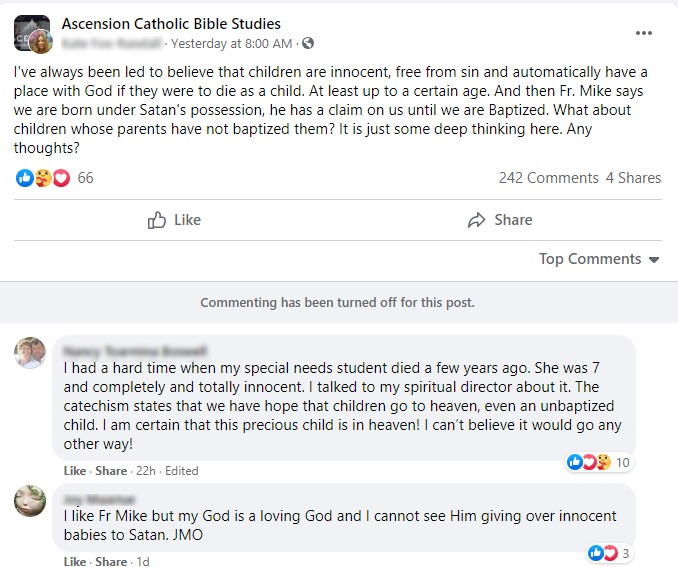
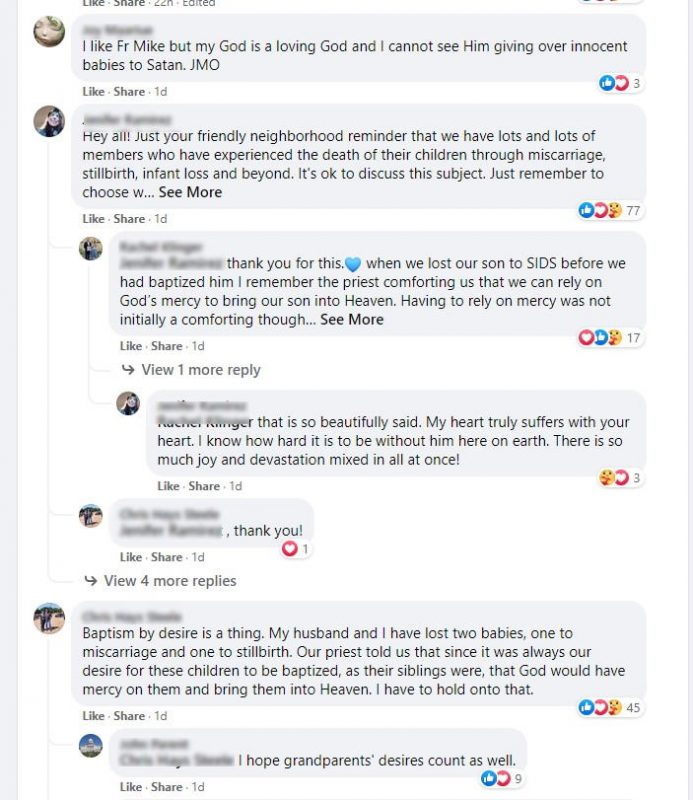
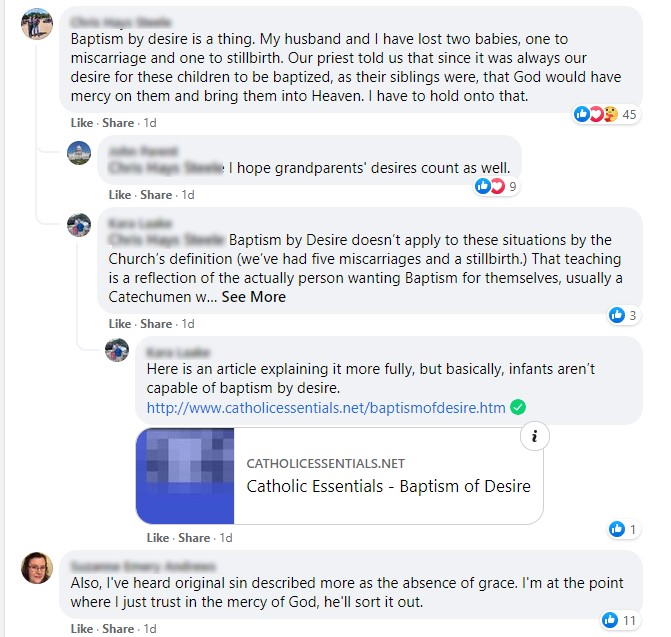
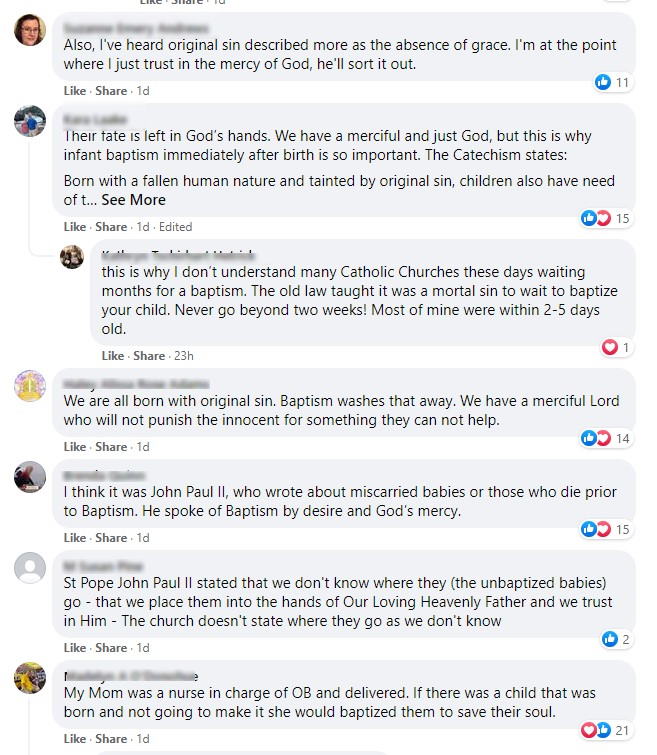
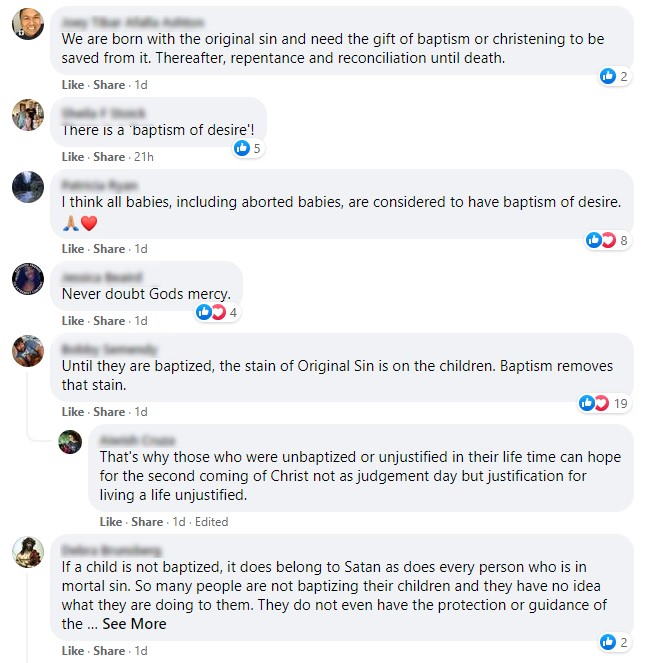
“I know my sins are forgiven by the blood of Jesus!” they’ll proclaim, but the whole notion of sin and the need for blood atonement via a perfect sacrifice — that whole idea comes from Christianity itself. But even if that irony escapes them (the savior is also the one twisting the thumbscrews), there should be enough discomfort in the idea of hell to give anyone second thoughts. Note the following exchange:
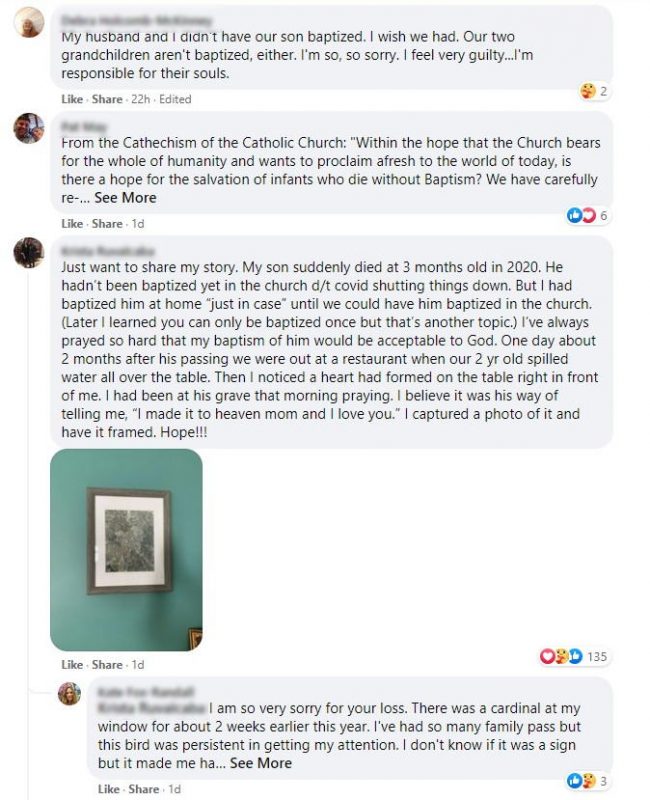
Here we have people tying themselves into ethical and emotional knots, tearing themselves apart because they can’t reconcile two things:
Their church teaches that children are born with the “stain of Original Sin” and are thus damned to hell unless they’re baptized.
There are lots of children who die unbaptized, and the thought of them being tortured in hell is, well, hellish.
How do you reconcile it?
In the midst of all these horrible losses, children still-born or dying shortly after birth, there’s the secondary pain that because their children weren’t baptized, they’re worried that maybe, just maybe, their god, in his infinite wisdom and mercy, is not letting them suffer as they, being stained with Original Sin, in fact, should.
They find a way to explain it, even though the church taught for ages that unbaptized babies went to hell. Limbo becomes something of a compromise, and now, if these posts are to be believed, intent seems to be enough. So these parents can rest easy: their children are probably not writhing in agony. They will be reunited in heaven.
Yet within even this is comfort there hides another discomforting fact: once these people get to heaven, they’ll discover that someone they love dearly is not in heaven. They’ll know that their brother or their aunt or their grandfather is in hell, in torment, in agony. How could you live in heaven knowing your loved one is in hell?
We could expand this beyond familial bonds: how could anyone enjoy heaven knowing that any person — with a few monstrous exceptions — is in hell? And while they’re living on earth, that knowledge must drive them crazy if they think about it. It must drive them to do one of two things:
Redouble their efforts to make sure everyone they love is at least baptized. (Of course, once we get into the Protestant tangle, it could be any number of things required to make sure you’re not going to hell, so it could be more complicated than that.)
Not think about it.
I would wager most choose option two.
Really, I suppose there’s another option: rationalization. Catholics especially are good at this. The Bible says Jesus had a brother James. The Catholic church says Mary was a perpetual virgin, so any siblings would be impossible. How to get out of this? Simple — Aramaic, in the language Jesus would have been speaking, there is no separate word for “brother” and “cousin,” so James was just the cousin of Jesus. Done. (There is, of course, one small problem with this line of reasoning: no matter what language Jesus spoke, the Gospels were written in Greek, which does have different words for “brother” and “cousin.” But it’s best not to think about that too much — it will lead to an unraveling of that seamless garment of Catholic faith.)
I guess they do what they have to in order to maintain the faith.
We see what we want to see. Social media offers the best example of that in the contemporary world, but sometimes, it’s not just evident in a macro-view but in individual postings.
One of the religion groups I follow posted a story about a meteor “demolishing an ancient Middle Eastern city” and speculated that it could have inspired the story of Sodom and Gemorrah. The individual sharing the article added the comment, “Always interesting when science catches up to The Bible.”
“Science catches up to the Bible?!” I laughed. The Bible that includes a talking snake, an apple curse, a talking donkey, and a man surviving in a whale’s stomach for days? The Bible that includes the story of a flood that inundated the whole world despite the fact that there’s nowhere near enough water in existence on the Earth to do that? The Bible that says the heavens are a bowl-shaped divider that keeps the water of the upper firmament out (that is where all the water comes from, I guess)? The Bible that has epileptics misdiagnosed as victims of demonic possession? The Bible that says a sky wizard created the world in six days, including creating light before there was no light source? The Bible that purports many men lived literally centuries, with several living close to a millennium? In short, the Bible that is so scientifically backward that apologists have to contort themselves into knots or declare troubling passages as merely metaphorical is in any sense ahead of modern science?
I, of course, couldn’t leave well enough alone, responding “Science caught [sic] to the Bible and left it behind long ago.” Given the context of what I just wrote, it’s clear what I meant: the Bible is backward and dated, especially when compared to modern science.
That’s not what they read, though. One young man replied,
tell it to scientist [sic] 50 years ago, they also thought they know everything, in terms that we’re developed at their time… eyes opened yet? 🙂
Cell phones? Radio waves? What, we know only as much as we know, and every decade some people think we know it all, ‘its called science!’ 😄😄 God Bless
It is, naturally, to be expected that someone posting on a pro-Christian board would have pro-Christian views, and my comment was somewhat vague — intentionally so. Still, I didn’t expect everyone to see it that way. It’s a perfect example of confirmation bias.
Another post on social media about Abraham’s near-sacrifice of Isaac, this time as a comedy:
I would think that such an event would cause near-trauma in the mother: any other reaction seems unhealthy. I would hope that if I came home with one of our children and told K that I’d almost killed the child because I was sure God had told me to sacrifice the child but thankfully an angel stepped in and stopped the whole thing that she’d gather the children and get away from me as fast as possible until I got substantial counseling.
As for the child, I would think it would be more than just a mere reluctance to go into the woods with the father.
A priest in a local parish recently included in his homily a quote that appears to be a variant of something Thomas Aquinas said. The priest phrased it thusly: “For those who don’t believe, no miracle is enough; for those who believe, no miracle is necessary.” Aquinas’s quote is a little different: "To one who has faith, no explanation is necessary. To one without faith, no explanation is possible." The order is different, but the idea is the same.
The quote has a certain rhetorical symmetry to it, a certain parallel structure that makes it resonate in believers' minds. That symmetry makes it more memorable, and that memorableness combined with its emotional resonance means it will stick.
The quote will seem clever as well. In believers' view, it encapsulates both the weakness of the skeptic's position and the strength of the believer's. It creates a simple juxtaposition that both validates their own position and invalidates the position of opponents. In short, it’s the perfect rhetorical flourish believers can take home with them and use when talking to or about skeptics.
Like many rhetorical constructions, however, this one ultimately fails because of its oversimplification of both sides of the structure. From the skeptic's point of view, it represents neither the skeptic's position nor the believer's position accurately. It is filled with generalizations and question-begging most believers would not notice.
The first part of this quote deals with skeptics. The assertion is that no miraculous event could convince the skeptic. There is some degree of truth to that. Were someone to rise from the dead, for example, the skeptic's first response would not be, "Oh, this is possible proof of God's existence." Rather, she would begin looking for natural explanations. Even if no natural explanation were obvious, the skeptic would not default to a supernatural explanation. Rather, the skeptic would simply say, "We don’t know." So in that sense, the assertion is correct: it’s doubtful that anything so puzzling could happen that a skeptic would move beyond a simple "I don’t know" into a theistic explanation based on the supernatural suspension of natural laws.
Believers, though, already primed for belief, eagerly accept as miraculous anything they can't understand. It's the argument from incredulity, which could be framed thusly: "I don't understand how this could happen, therefore God must have done it." Much creationist theorizing that attempts to refute the clear evidence of evolution lies along these lines.
This is no to say theists are not willing to admit ignorance. Indeed, when pressed on contradictions in their faith, the fall-back position is often simple: "God is a mystery."
"Why would a loving god allow such suffering among children who can gain nothing from it and who simply suffer?" the skeptic asks.
"I don't really know. I just know God has a plan, and that this is somehow part of that plan," the believer responds.
The second element of the quote in question that we need to examine is the nature of miracles: A miracle is the suspension of natural laws. Yet because it is is it a suspension of natural laws, there’s no way to test a miracle to prove that it is a miracle. All of our knowledge is bound up in the natural laws that govern the universe. The suspension of those laws in order to create a miracle would be indistinguishable from a new law or principle we have yet to discover, and as miracles are one-time events, there’s no way we could test it to prove that it was not, in fact, some bizarre quantum event but instead a miracle. So in that sense, this assertion is correct: because skeptics generally deny the possibility of miracles, it would not even be an option.
Yet if the purpose of miracles was to convince skeptics, an omniscient god would know exactly what it would take to convince a skeptic. The Christian god’s very characteristics make this merely a question of will: if this god exists and it wants a skeptic to believe, it knows what it would take and would merely need to do this. The fact that it doesn’t suggests — again, if it exists — that it chooses not to, that it doesn’t want to.
The quote from the believer’s side is quite disingenuous, but it’s not immediately obvious. It states that “for those who believe, no miracle is necessary.” This suggests that miracles are secondary to some other method of conviction. But if we’re discussing Christianity (as the priest obviously was and as Aquinas was), the entire religion is based on faith in a central miracle: the resurrection of an executed first-century Jew. So in fact, the quote has it exactly backward: the central tenant of the Christian belief system is a miracle.
When discussing why they believe in this miracle, Christians point to accounts of the event in the New Testament and to personal experiences they claim to have had with “the risen Christ.” In order to accept the accounts in the New Testament, one has to have a certain degree of confidence in the accuracy of the New Testament’s accounts, and given the fact that there is not a single eye-witness account in the whole collection of books but instead multiple second- and third-hand accounts decades after the event, most skeptics find the Biblical evidence weak at best. On the other hand, to accept the authenticity of a believer’s accounts of personal inner experiences with Jesus, skeptics must necessarily accept that believer’s interpretation of that inner event. No one would doubt that the believer had that moment of clarity, that experience of warmth and love that they claim. However, just because a believer had that experience doesn’t mean that experience came from some god or other. Believers are often looking for reasons to believe: they’re looking for miracles large and small. They’re seeking these quasi-mystical experiences with their god. Since they’re looking for them, they often find them. As Augustine of Hippo said, “Faith is to believe what you do not see; the reward of this faith is to see what you believe.”
Yet a believer is likely to protest that such an analysis is going too far. “It’s about skeptics’ calls for miracles to aid in belief now. ‘God, give me a miracle so I believe!’ skeptics proclaim, but this quote is suggesting that’s not necessary for believers.” Skeptics are skeptical, though, not because there are no miracles today; we’re skeptical because we find the evidence for the source of any potential miracles lacking. To look at an event, proclaim it a miracle, then use that as evidence for a god is question-begging: it assumes the god exists in the first place. It works backward to an unwarranted assumption. Skeptics see things that believers proclaim to be miracles and say, “Now hold on — there’s probably another way to explain that phenomenon.” And if there’s not, skeptics will simply say, “We don’t know how to explain it.”
In the end, the quote is just as much an indictment of believers’ question-begging as it is of skeptics’ lack of faith.
The pastor of K’s parish tweeted a link to “Has quantum physics smashed the Enlightenment deception?” by John Moran with the comment, “Reality is Rubbery.” I clicked through thinking, “Great — another ‘God of the Gaps’ article,” but hoping that I might be wrong. I wasn’t.
The article begins,
Forget Richard Dawkins, Stephen Hawking, Steven Pinker and the other high-profile God-denying “clever” boys. It is time for the broader implications of the 20th-century physics revolution, often described as quantum mechanics, to again be debated seriously and out in the “town square,” not just the backrooms of academia or in “deferring to the expert” interviews and documentaries.
The critical word there is “implications.” I’m not sure what Moran is suggesting here. At its heart, it’s simple: “Quantum mechanics is so weirdly different from the physics of our everyday reality that there must be implications for the nature of our everyday reality.” But must there be? There must be if we’ve already nurtured for millennia a belief in the supernatural, but all “quantum mechanics is weird” implies is “quantum mechanics is weird.”
Whatever these implications are in Moran’s mind, though, should be “debated seriously and out in the ‘town square,’ not just the backrooms of academia or in ‘deferring to the expert’ interviews and documentaries.” Part of the reason we “defer to experts” is because they are just that: they’ve forgotten more about their specialization than we laypeople even begin to understand. So when the people who actually work in quantum mechanics say, “No sorry — your implications that you want to discuss are based on misunderstandings of the quantum world,” as they do, we can just dismiss them. Who wants to defer to experts? After all, we’re seeing the benefits of not deferring to experts in the way covid is ravaging the conservative Christian anti-vaxers.
What does Moran say these implications are, though? To introduce them, he begins with a quote from a video by Leonard Susskind
It is hard to understand. Our neural wiring was not built for quantum mechanics. It was not built for higher dimensions. It was not built for thinking about curved space-time. It was built for classical physics. It was built for rocks and stones and all the ordinary objects and it was built for three-dimensional space. And that’s not quite good enough for us to be able to visualize and internalize the ideas of quantum mechanics and general relativity and so forth. …that can be extremely frustrating when trying to explain to the outside world. The outside world, by and large, has not had that experience of going through the rewiring process of converting their minds into something that can deal with five dimensions, 10 dimensions, or the quantum mechanical uncertainty principle or whatever it happens to be. And so the best we can do is to use analogies, metaphors.
Moran jumps on this:
Metaphor? So quantum physics has brought science full circle, back to the world of religion and the story telling methods of Jesus Christ and other religious figures.
Where quantum physics challenges everything, including those who arrogantly dismiss things like spirituality, is that it basically tells us two things:
There might not be such a thing as an objective material object; and
Consciousness has to be fundamental.
Now, let’s be clear. This new science does not prove the existence of God or anything else of that nature. But, it does shatter the arrogant certainty of those who think science is all you need and has killed off the spiritual. Through quantum physics we were again reminded of just how much we don’t know, especially about the mystery of the universe and the atomic world. In fact, we were not even close. This new quantum world was nothing like what scientists had envisaged prior to its discovery.
Why Moran gets so excited about Susskind using the word “metaphor” is confusing: does he not think that we use metaphor for anything other than religious ideas? After all, when we’re examining the quantum world, we’re looking at something so different from what we’re used to that we have to ground it in something we are used to — that’s what metaphor does. The use of metaphors does not equate scientists with theologians. This is an important distinction because scientists study the thing they study; theologians, unable to study gods directly, only study what other theologians have said. Scientists base their ideas on evidence; theologians’ try to do that, but their only evidence is ancient and anonymous manuscripts — again, studying what others have said about gods rather than studying the gods themselves. If, of course, we could study the gods themselves, there would be fewer atheists. Theologians would reply, “If we could study God, he wouldn’t be God,” but for one thing, that doesn’t necessarily follow. It’s based on the presupposition that gods must be so far beyond us that we can’t interact on their plane of existence. That very conveniently explains why there is no evidence for gods. For another, any god worth its salt could easily manifest itself regularly for study and confirmation of its existence. I do that with my own children daily; it’s too bad gods don’t do that with their children.
From there, Moran goes into a layman’s analysis of quantum theory brought about by this quote from Andrew Klavan’s article “Can We Believe?” subtitled “A personal reflection on why we shouldn’t abandon the faith that has nourished Western civilization.”
And is science still moving away from that Christian outlook, or has its trajectory begun to change? It may have once seemed reasonable to assume that the clockwork world uncovered by Isaac Newton would inexorably lead us to atheism, but those clockwork certainties have themselves dissolved as science advanced. Quantum physics has raised mind-boggling questions about the role of consciousness in the creation of reality. And the virtual impossibility of an accidental universe precisely fine-tuned to the maintenance of life has scientists scrambling for “reasonable” explanations.
Like Pinker, some try to explain these mysteries away. For example, they’ve concocted a wholly unprovable theory that we are in a multiverse. There are infinite universes, they say, and this one just happens to be the one that acts as if it were spoken into being by a gigantic invisible Jew! Others bruit about the idea that we live in a computer simulation—a tacit admission of faith, though it may be faith in a god who looks like the nerd you beat up in high school.
In any case, scientists used to accuse religious people of inventing a “God of the Gaps”—that is, using religion to explain away what science had not yet uncovered. But multiverses and simulations seem very much like a Science of the Gaps, jerry-rigged nothings designed to circumvent the simplest explanation for the reality we know.
The problem with Klavan’s thinking here is simple: he doesn’t realize that these conjectures are just that. No one is making dogmatic proclamations about multiverses or computer simulations. Why? Because there is no evidence or at least not enough evidence. Science is free to do what religion can never do: reject ideas it itself has created when evidence to the contrary appears. Indeed that is what science is all about.
It might seem ironic, though, that Klavan himself brings up the “God of the Gaps” fallacy in this article that amounts, in short, to the latest installment in the “God of the Gaps” theory since his whole idea here is nothing more than that. “Quantum theory is spooky and weird, and it’s outside our understanding now: therefore, God.” But irony is when the unexpected happens, and I’ve come to expect “God of the Gaps” theorizing in any apologetic piece, so far from being ironic, it is instead expected.
It is the Enlightenment Narrative that creates this worship of reason, not reason itself. In fact, most of the scientific arguments against the existence of God are circular and self-proving. They pit advanced scientific thinkers against simple, literalist religious believers. They dismiss error and mischief committed in the name of science—the Holocaust, atom bombs, climate change—but amberize error and mischief committed in the name of faith—“the Crusades, the Inquisition, witch hunts, the European wars of religion,” as Pinker has it.
By assuming that the spiritual realm is a fantasy, they irrationally dismiss our experience of it. Our brains perceive the smell of coffee, yet no one argues that coffee isn’t real. But when the same brain perceives the immaterial—morality, the self, or God—it is presumed to be spinning fantasies. Coming from those who worship reason, this is lousy reasoning.
There are just so many issues with this line of thinking here that I don’t even know where to start: with the false equivocation, with the question-begging, or with the general lack of experience this short passage exhibits.
To begin with, equating “the Holocaust, atom bombs, [and] climate change” is a curious mix. Certainly, some Nazis promoted pseudo-scientific reasoning for their antisemitism, but a far amount of it was good old-fashioned Christian antisemitism: the Jews reject the Christ, and so that is at the heart of their malevolence. The atom bomb is an unquestionably evil application of science so I’ll give him that. Climate change, though? I’m not even sure what he’s suggesting here. Is he saying that climate change was brought about by science? Well, it certainly was enabled by it, but our voracious appetites for convenience that science facilitated seem more responsible for climate change than the science itself. On the other hand, is he suggesting that climate change is a hoax that science is perpetuating on the world? That would seem more in line with the article’s source, City Journal, which is an unabashedly right/nearly-hard-right publication.
Klavan then equates, for all intents and purposes, the smell of coffee with God. “Our brains perceive the smell of coffee, yet no one argues that coffee isn’t real,” he writes, and I just scratch my head on that one. When my brain perceives the smell of coffee, I assume that there is coffee somewhere around because in my own experience, that odor has always been associated with coffee. However, if it’s terribly important to me to prove that there’s coffee, I can search for it. I can find evidence that the smell I’m encountering is indeed coming from coffee. It’s worth noting, however, that just because my brain perceives the smell of coffee there is coffee somewhere. I want to scream at Klavan, “Good grief, man, have you never encountered Scratch-And-Sniff stickers?!” We can fool our brain into thinking there’s coffee when in fact it’s not there. That’s why we investigate and examine and confirm. The smell of coffee is a bad example, though: we do this all the time when we think we smell something burning.
Klavan then equates smelling coffee with perceiving “the immaterial” such as “morality, the self, of God” in a perfect example of question-begging. No one suggests that people who say they are perceiving “the immaterial” are not having some sort of cognitive experience. Instead, skeptics are simply pointing out that what we think might be an experience of God isn’t necessarily that. We can fool people into thinking they smell coffee; atheists simply suggest that the mind is fooling itself into thinking it’s experiencing God.
It’s important to point out here that attaching the label “God” to any such experience depends on prior exposure to the idea that a god exists. If no one believed in a god, would we deduce it exists simply from these experiences? Scientifically illiterate people might; scientifically literate people probably wouldn’t. So this is a strange kind of cultural question-begging: the idea of a god was already in place; these experiences simply provide another hook on which to hang it.
Klavan concludes his article thusly:
Pinker credits Kant with naming the Enlightenment Age, but ironically, it is Kant who provided a plausible foundation for the faith that he believed was the only guarantor of morality. His Critique of Pure Reason proposed an update of Plato’s form theory, suggesting that the phenomenal world we see and understand is but the emanation of a noumenal world of things-as-they-are, an immaterial plane we cannot fully know.
In this scenario, we can think of all material being as a sort of language that imperfectly expresses an idea. Every aspect of language is physical: the brain sparks, the tongue speaks, the air is stirred, the ear hears. But the idea expressed by that language has no physical existence whatsoever. It simply is. And whether the idea is “two plus two equal four” or “I love you” or “slavery is wrong,” it is true or false, regardless of whether we perceive the truth or falsehood of it.
This, as I see it, is the very essence of Christianity. It is the religion of the Word. For Christians, the model, of course, is Jesus, the perfect Word that is the thing itself. But each of us is made in that image, continually expressing in flesh some aspect of the maker’s mind. This is why Jesus speaks in parables—not just to communicate their meaning but also to assert the validity of their mechanism. In the act of understanding a parable, we are forced to acknowledge that physical interactions—the welcoming home of a prodigal son, say—speak to us about immaterial things like love and forgiveness.
To acknowledge that our lives are parables for spiritual truths may entail a belief in the extraordinary, but it is how we all live, whether we confess that belief or not. We all know that the words “two plus two” express the human version of a truth both immaterial and universal. We likewise know that we are not just flesh-bags of chemicals but that our bodies imperfectly express the idea of ourselves. We know that whether we strangle a child or give a beggar bread, we take physical actions that convey moral meaning. We know that this morality does not change when we don’t perceive it. In ancient civilizations, where everyone, including slaves, considered slavery moral, it was immoral still. They simply hadn’t discovered that truth yet, just as they hadn’t figured out how to make an automobile, though all the materials and principles were there.
To begin with, the suggestion that an idea doesn’t have a physical correspondence only works with abstract things like morality and love. Two plus two equal four is simple: take two items; set two more beside them; count them. There. I don’t even know what Klavan is suggesting using that idea. “I love you” is harder to prove physically: we can’t scan brains and say, “Look — see that? That’s love.” Yet. All evidence points to the fact that our consciousness is bound in our brain, so it’s not unreasonable to think that we will indeed be able to do something similar in the future. It’s more “God of the Gaps” in action. “Slavery is wrong” is tricky because morality is tricky. Yet morality is very fluid at the same time. The Bible itself endorses slavery, and nowhere in scripture does Jesus or anyone else condemn the owning of other people. Indeed, it seems to suggest the opposite: in 1 Peter, we see an appalling command: “Slaves, in reverent fear of God submit yourselves to your masters, not only to those who are good and considerate, but also to those who are harsh” (1 Peter 2.18). The book of Philemon is almost as bad:
I am sending [Onesimus, your slave]—who is my very heart—back to you. I would have liked to keep him with me so that he could take your place in helping me while I am in chains for the gospel. But I did not want to do anything without your consent, so that any favor you do would not seem forced but would be voluntary. Perhaps the reason he was separated from you for a little while was that you might have him back forever—no longer as a slave, but better than a slave, as a dear brother. He is very dear to me but even dearer to you, both as a fellow man and as a brother in the Lord. (Philemon 12-16)
Here Paul could have said, “Slavery is wrong.” Here he could have said, “I am not sending him back because I have no authority to do so. He is a free human being with his own will.” But he sends him back and suggests that, since Onsemus is a Christian too, perhaps Philemon should treat him a little better.
Many proponents of slavery used the Bible to endorse the position so maybe this wasn’t the best moral to use in trying to suggest that morality implies a god.
From there, though, Klavan makes a hard, awkward turn to Christianity. He’s essentially saying, “Words often don’t have physical referents in the real world, and Christianity calls Jesus ‘the Word,’ so it’s likely true.” It’s a hard sell, completely out of the blue, completely illogical, for anyone other than a Christian who already accepts all this. Of course, given the fact that it’s a conservative source, Klavan is justified in assuming that most of the readers already accept these presuppositions, but the ideas themselves make very little sense without those presuppositions, which we skeptics reject. This, then, is still another example of question-begging.
The idea that Jesus spoke in parables in order to make the connection between language and ideas that have no physical referent is just speculation like scientists’ speculations about multiverses, so I’m not even going to deal with it.
Finally, there’s this: “In ancient civilizations, where everyone, including slaves, considered slavery moral, it was immoral still. They simply hadn’t discovered that truth yet, just as they hadn’t figured out how to make an automobile, though all the materials and principles were there.” Funny: if there was a god that felt that slavery is immoral and he wrote a book, it’s ironic that he didn’t say as much in that book but left it for us to discover while untold millions suffer in slavery.








 We see what we want to see. Social media offers the best example of that in the contemporary world, but sometimes, it’s not just evident in a macro-view but in individual postings.