fun in threes, sometimes fours
faith
There was a short film about Mass that a lot of people shared on the Catholic social media streams I was following last year as I went through the Bible in a Year podcast. It's called "The Veil Removed," and it offers a fascinating idea of what Catholics could argue is, in some sense, going on during the Mass.
In it, angels crowd around the altar, and the priest transforms into Jesus at the moment of consecration while also appearing crucified on a cross above the altar. A drop of blood falls from Jesus's crucified body into the chalice of wine that Jesus is also holding as he stands behind the altar, I guess symbolizing the so-called Real Presence of Jesus in the communion wafers and wine. The fact that Jesus appears literally twice, as a crucified man and as the priest actually celebrating the Mass would not be logically problematic to the average Catholic, I'm assuming, because the average Catholic already believes that God the Father, Jesus, and the Holy Spirit are somehow three but also the same.
In the course of the video, obviously-skeptical congregants miraculously see all the angels and such and lose all sense of doubt.
Yet this whole film, far from assuaging any doubts I have, only creates more: why doesn't this actually happen in Mass? What better proof of the claims of Christianity could there be then for this to be happening in all Masses, worldwide, often simultaneously? This is even echoed in the title: The Veil Removed. Why would a god put the veil there in the first place if this god wants what the Christian god supposedly wants (i.e., the salvation of all)?
I’m currently reading Trent Horn’s Hard Sayings: A Catholic Approach to Answering Bible Difficulties and at about halfway through, I’ve definitely formed some definite opinions about the book. Most strikingly, I’ve come to realize it’s mistitled. Instead of Hard Sayings: A Catholic Approach to Answering Bible Difficulties, it should be titled The Passage Makes Sense if We Assume… : A Catholic Approach to Answering Bible Difficulties. That phrase — “The passage makes sense if we assume…” — is a quote from the book, and it’s indicative of the whole argument. In fact, Horn doesn’t just suggest that we have to assume to Bible is correct to really understand how it’s correct, he says it outright:
[I]t is the critic’s burden to prove that there is a contradiction in the Bible because he is the one accusing the text of being contradictory. All the believer has to do is offer one or more reasonable explanations of how the passages could be reconciled, thereby showing that the critic’s evidence is not conclusive (152).
This is ridiculous: there is nothing to prove with the contradictions. They’re sitting on the page, obvious as the sun in the sky. This passage says X; that passage says not X. There — it contradicts itself. It’s the believer’s burden to explain how it only appears to be a contradiction.
But Horn’s approach makes it possible for him to weave his conditional explanations of problems with the Bible and feel that they suffice. And does this book ever have a ton of conditionals. Within X pages, we read that “Mark may have referred to him…”, that the “name Jethro appears to be a title on par with ‘your excellency,'” that it “could be that the Midianites…”, that “[o]ne way to resolve this contradiction … is to propose,” that “both are probably referring…”, and that “It could be the case.” Let’s make a list of those statements:
This is an argument of possibilities, all of which are extra-Biblical and simply endeavor to save the Bible for people who want it saved. These explanations are just ways of explaining away obvious problems, and these types of “arguments” will only appeal to those who have already accepted the conclusion. In other words, another possible subtitle could be “Begging the Question.”
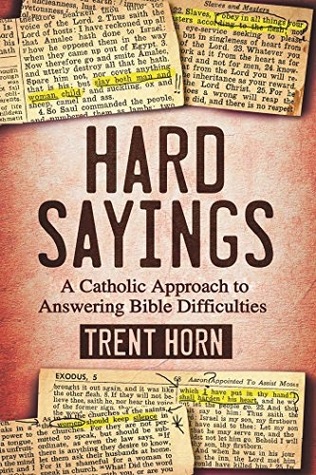 In the introduction to Hard Sayings: A Catholic Approach to Answering Bible Difficulties, Trent Horn quotes Dan Barker’s succinct point about the Bible: “An omnipotent, omniscient deity should have made his all-important message unmistakably clear to everyone, everywhere, at all times.” By this, Barker of course means that a god who is all the things the Christian god is supposed to be would send a message that couldn’t be so easily misunderstood, so easily used to justify so many conflicting ideas, as the Bible is.
There would be no difficult scriptures. For example, from the Catholic point of view, references to the “brother of Jesus” are troubling because Mary was, according to the Catholic Church, always a virgin. There was no way then that Jesus had brothers. How do we explain this, then? Well, in Aramaic, there is no term for “cousin.” Everyone is a “brother.” So that’s what the passage means. The only problem is that, although Jesus and his disciples would have been speaking Aramaic, the Gospels were written in Greek, a language that does have a word for cousin. In that case, why didn’t the Christian god inspire the gospel writers to say “cousin” and avoid all this confusion?
Horn responds to Barker’s claim most curiously:
I agree with Barker that God should provide an opportunity for all people to be saved since 1 Timothy 2:4 says God wants all to be saved. But that is not the same thing as saying that the Bible should be easily understood by anyone who reads it. Perhaps God has given people a way to know him outside of the written word? For example, St. Paul taught that God could make his moral demands known on the hearts of those who never received written revelation (Rom. 2:14-16). The Church likewise teaches that salvation is possible for those who, through no fault of their own, don’t know Christ or his Church.
Yet Barker never said anything about salvation. It’s not that Barker’s argument is that this god is doing a bad job of getting his salvific message out, but that’s what Horn’s response suggests. “No, no!” says Horn, “it’s not that people might lose their salvation over a confusing book. God also, according to St. Paul, communicates directly with people’s hearts.” In Horn’s strawman argument, Barker accepts that there is a god who wants everyone to be saved but just feels that this deity could be doing a better job of communicating that plan. But Barker is arguing the opposite: the massive amount of confusion stemming from this book suggests that is has a most decidedly human origin with no divine influence whatsoever. He’s arguing from the book to the hypothetical god that would have created it and saying that there is a significant incongruity between that hypothetical god and the Christian god.
Not only that, but Horn is quoting the Bible (Rom. 2:14-16) to provide evidence of his rebuttal (that God provides other means of salvation rather than through the knowledge gleaned from his book) when in fact it’s the Bible’s validity itself that’s at stake.
The problem is that for Horn, it’s impossible to see how someone could not accept the Bible as divinely inspired. He’s working with that presupposition so firmly in his mind that he doesn’t even realize when it causes him to go question-begging as he does in this response.
A curious story appeared in Newsweek the other day that highlights some of the quirks of Catholicism. Apparently, a priest there has been saying the wrong words during baptisms, which makes the baptisms invalid:
A priest with over two decades' worth of service to multiple congregations has resigned "with a heavy heart" in the wake of revelations that he incorrectly performed baptisms.
Father Andres Arango, who most recently served in the Roman Catholic Diocese of Phoenix, Arizona, was found to have used the wrong phrasing.
When performing the sacrament, Arango would say, "We baptize you in the name of the Father, and of the Son, and of the Holy Spirit."
However, as the Vatican's Congregation for the Doctrine of the Faith made the diocese aware, the use of the word "we" made the baptisms "invalid." Instead, Arango was supposed to use the phrase "I baptize" rather than "we baptize." (Source)
So all these families have been taking their children to the priest to say the right words in order to remove the effects of the apple curse and safeguard their children from the horrors of hell, and this guy has been saying the wrong words! According to Catholic teaching, if they're not validly baptized, they're not saved. If they died still a child, then they go to limbo heaven -- I forgot, the Catholic church changed that teaching when enough people protested that the idea of infants going to limbo for eternity was unconscionable. (Does this mean that all the infants in limbo never were in limbo, or did they get a "Get out of limbo free" card?)
For the poor schmucks who made it to adulthood and thought they were freed of the effects of the talking-snake-induced apple curse, it's another story. These folks died in the assurance of heaven only to awaken in the next life to the surprise of, well, not just their lives but of eternity.
"Um, excuse me, I think there's been some kind of mistake," they shriek, doing their best to maintain some kind of professional decorum.
"No, no mistake," the demon idly pulling their intestines out and wrapping them around its forefinger says, almost sounding bored.
"Yes, I think there was. You see, I was baptized."
The succubus pauses for a moment, tightens the ringlets of intestine just a bit, yawns and says, "No, I'm afraid you weren't. You see, Father Arango said 'we baptize you' when all decent priests know the correct words are 'I baptize you.' A simple clerical error, to be sure, but nonetheless, an error."
"But, but!"
The demon becomes irate: "Now look here -- we don't make the rules about these or those magic words. We're just as bound to the formalities as you are." He gives a good tug, dislodging the large intestines. "You'd have to take that up with God."
"Where is he?"
"Not here," giggles the tormentor...
All joking aside, there are lot of people now unnecessarily mentally tortured with the thought that their loved one is in fact in hell because of a priest's mistake. Just how many people might be going through this?
Katie Burke, a spokesperson for the Diocese of Phoenix, told Newsweek that while the diocese has no exact number of invalid baptisms Arango performed, the number is "in the thousands."
Thomas Olmsted, bishop of the Diocese of Phoenix, wrote a January 14 letter to his congregation informing them of the invalid baptisms. He said it is his responsibility to be "vigilant over the celebration of the sacraments," adding that it is "my duty to ensure that the sacraments are conferred in a manner" consistent with the Gospel and the tradition's requirements.
I guess Father Arango should have realized the importance of using the proper words...
I’m reading Trent Horn’s Hard Sayings: A Catholic Approach to Answering Bible Difficulties. He speaks of Karl Keating’s argument for scriptural inspiration, saying “when taken as just a reliable human document, the Bible shows that Christ not only rose from the dead, but that he established a Church built on the apostles.” These apostles “were then able to authoritatively declare the Bible to be the word of God.” So the Bible proves the church and the church proves the veracity of the Bible. That’s called circular reasoning, isn’t it? Horn doesn’t think so.
This is not a circular argument, in which an inspired Bible is used to prove the Church’s authority and the Church’s authority is used to prove that the Bible is inspired. Instead, as Keating says, it is a “spiral argument,” in which the Bible is assumed to be a merely human document that records the creation of a divinely instituted Church. This Church then had the authority to pronounce which human writings also had God as their author.
The level of cognitive dissonance in this statement is absolutely astounding. He can assert that calling it a “spiral argument” somehow removes the circularity of the argument, but in essence, he is still using the Bible to prove the Church to prove the Bible. No Christian ever regards the Bible as “a merely human document.” People regard the Bible as authoritative because they see it as divinely authored. I get that this is a distinctly Catholic explanation of things, but no Catholic ever sees the Bible this way, either. It is, defacto, divinely inspired in their eyes. The so-called divine nature of the Catholic church is in no way illustrated in the pages of the Bible, and we still have the basic problem of Biblical error: how are we to know that that particular portion of the Bible detailing the founding of the church is accurate? In short, we don’t. We have to take that on faith. And who is the one explaining all of this? The Church. So the Church says the Bible is just a humanly written document that proves the Church is divinely inspired, which then proves the Bible is not just a humanly-written document.
It’s almost as convoluted as God impregnating Mary to give birth to God to die to appease God’s anger, which is the story of Christianity in its most simplistic form.
This is from about a year ago, but it is very much worth the time it takes to watch it. And anyone who watches this and is not terrified on some level…
At the heart of this, Jeremiah Jennings (who goes by the name Prophet of Zod on social media) points out that functioning society involves discussing disagreements with people while holding a few assumptions in mind:
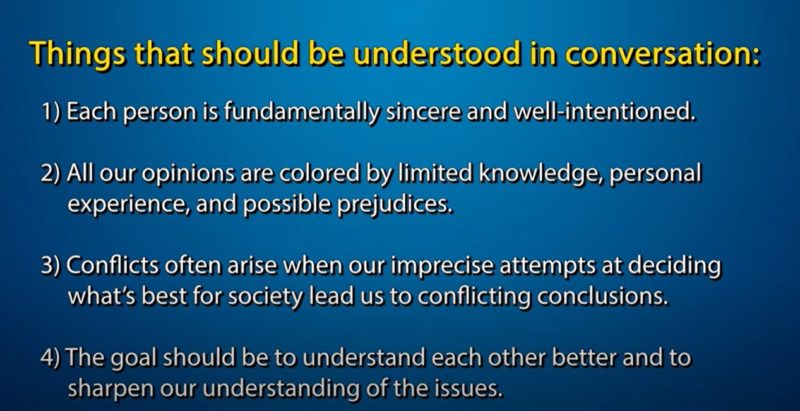
He then goes on to point out, very convincingly, how fundamentalist Christianity doubts or even outright disputes each of these claims. The implications this civic breakdown has for democracy are frightening.
https://www.youtube.com/watch?v=0lqaqp5TwnU
On Bishop Robert Barron's minstry's YouTube channel -- Word on Fire -- he had a conversation with staff member Brandon Vogt after Barron's interview with Alex O'Connor in which they promised to go a little deeper in the responses.
Vogt points out that Barron and O'Connor went back and forth for a long time on faith, and invited Barron to elucidate a little. Instead, he just gave the same analogy, changing it from getting to know his interlocutors to getting to one one's spouse:
The analogy which I think is very illuminating there I often use is come to know a person. So you're coming to know another human being. Of course, reason is involved all the time. I mean, reason understands all sorts of things, but there is a moment when that person, if you're coming to real intimacy with that person, reveals something about herself that you could not in principle know no matter how many google searches and how much analysis and how much how clever you. There's no way you'd get what's in that person's heart unless she chooses to reveal it, at which point you have to make a decision: do I believe it or not. Now is it credible what she's saying, and you might say, "Yeah it is because it's congruent with everything else I know about her." At the same time, is it reducible to what I know about her? No, otherwise it wouldn't be a revelation. So that's why it's a false dichotomy to say reason or faith. No, it's reason that has reached a kind of limit, but reason has opened a door. Reason has poised you for the self-manifestation of another.
Well, that's not just with God; that happens all the time. When two people are married and deeply in love, I'm sure you could point to those moments when [your wife] revealed something to you that you would never ever have known otherwise. You revealed something about yourself to her and then the two of you, because you're in love with each other, I imagine said, "Yeah, I believe that."
Now, can I reduce that to an argument? No, you never can. In a way it remains always mysterious to you yet your will, in that case, has commanded your intellect. That's exactly what Thomas Aquinas says about faith. It's a rare instance when the will commands the intellect. Normally, it moves the other way right? The intellect kind of leads the will. The intellect understands the good and then it leads the will, but in the case of faith, the will leads the intellect. It says, "No this is worthy of belief. This person who's speaking to me is worthy of belief, and what the person is telling me is congruent with reason yet beyond it, and so I choose to believe." That's the relationship between faith and reason it seems to me so.
In the debate with O'Connor, Barron defined faith as "the response to a revealing God." That makes very little sense in terms of how most people use faith. "You just have to have faith that God's plan, which involves this horrendous suffering, will result in good," someone might say. Let's switch those out: "You just have to have [the response to a revealing God] that God's plan, which involves this horrendous suffering, will result in good." Clearly, this definition of "faith" is not the same as the original sentence's sense of "faith." This might work for "the Christian faith" -- "the Christian response to a revealing God." That works. That's fine. You'd also have "the Muslim response to a revealing God," and so on -- but this "faith" just means "belief system" or even "religion."
Furthermore, the faith that Barron gives in this example is not faith -- it's trust. It's a trust that is based on experiential evidence. I believe my wife because she's shown herself to be trustworthy. I wouldn't make this same move (to use a favorite Barron term) with a stranger. The only time such a move (there it is again) is conceivable is if the revelation the stranger gives you is utterly trivial: "I have a dog."
This faith/trust often moves into faith/trust in Jesus, that we're to get to know Jesus and then we'll have faith in him. Or trust in him. But that is utterly different from the situation with my wife. My wife is physically present with me. She's not some hypothetical spiritual being out there but a real person that I can observe and talk to.
"You can get to know Jesus," comes the rejoinder. But how? Directly? No.
I can get to know him through the Bible, but that's problematic for obvious reasons that I've discussed numerous times here. It's filled with contradictions. The image of God presented in the Old Testament is positively barbaric. It's packed with immorality commanded from God -- it's just not a good example of a good supposedly written by an omnipotent being.
I can get to know him through what the church teaches about him, and here the Catholic church has a leg up on Protestants because they don't restrain themselves to the Bible. The magisterium has equal footing -- or nearly-equal footing. So if the Pope says it ex-cathedra, it's an article of faith. Still, that's just the same as relying on the Bible -- it's a product of humans.
Finally, I can get to know him in that way that Evangelicals and Mormons are especially fond of: that sense we have in our heart (it's telling that religions insist on using that metaphor when we've known for ages that the seat of our intellect is not our hearts but our brains -- it's an attempt, I suspect, to move the whole experience away from the intellect) that God is involved in our lives. That warm feeling in their hearts that Christians attribute to the Holy Spirit. I don't doubt the experience of that warm feeling, but to attribute it to anything outside one's own mind is itself an act of faith, an act not based on evidence. "It's the Holy Spirit!" the Bible proclaims and our pastors echo, and so Christians accept that explanation. Muslims have the same experiences but attribute that not to the Holy Spirit (that would be blaspheme, for God is one!) but to Allah. Hindus would make the same move. (It's rubbing off on me.)
So all three ways we get to know God or Jesus or the Holy Spirit are questionable: they're all open to interpretation; none are firmly grounded on rational reasoning based on evidence. That is what we skeptics mean when we say that faith is not reason, that it does not work in a similar way, and that it is separate from (sometimes anathema to) evidence.
I was listening to a debate between Alex O'Connor and Bishop Robert Barron on YouTube during my run this evening, and they got to talking about the nature of faith. I wanted to respond to it, but I didn't want to take the time to transcribe large portions of the video, so I tried my first-ever response video...
https://www.youtube.com/watch?v=jmkvZTjsnGU
The original debate is here:
“Language-like activity in the absence of meaning” — a good definition of glossolalia, the act of speaking in tongues. The Bible promotes it, and I’d always understood it to be the miraculous act of speaking a language one doesn’t have any foreknowledge of. For example, breaking into Farsi having never studied it.
“Surely,” I thought, “No one really believes that happens?! It’s so easy to debunk: record it and have a computer try to recognize and translate the language.” But it turns out, real speaking in tongues is not the miraculous speaking of an otherwise-unknown language: it’s speaking in the language of angels. It is, in simple terms, gibberish.
If you listen to these segments of people speaking in tongues, you’ll notice a few things:
I’m on the fence about the video, though, because they’re clearly mocking these people, and while it does seem silly, I find myself thinking that they must get something out of it. It likely gives a natural high of endorphins.
I once attended a church where there was a lot of calling down of the Holy Spirit, a lot of prayers for God to send the Holy Spirit to enter the building and enter them, with repetitive music playing, the congregants with their hands raised and their eyes closed, swaying to the music. It struck me how similar they appeared to people I’d see just a week or so earlier at a party who’d passed around a gigantic bong and gotten stoned out of their gourd. They all had the lost-in-the-moment look about them, and even in some churches that speak in tongues, one way they see the manifestation of the Holy Spirit is through uncontrolled laugher, the tell-tale sign that someone has smoked marijuana.
There’s also the element of crowd pressure — some of those people are clearly forcing their laughter. And perhaps some of them are closeted non-believers and they’re finally able to let out the laughter that they keep pent up every Sunday.
The king of all this nonsense is huckster Benny Hinn.
I just can’t understand how people can fall for this stuff. I’d love to get up on stage with someone like this and let him wave his arms at me, fling his coat at me, and just stand there looking at him. Wonder what would happen — I’d likely be hustled off the stage in a hurry…