Matching Tracksuits

fun in fours

faith

A Short Response

I've been listening to a discussion between Alex O'Connor, an atheist, and Trent Horn, a Catholic. At one point, an audience member asks Horn a simple question: what level of evil would have to exist in the world for you to think that perhaps it's an unjustifiable level of evil that thus counts as evidence against the existence of a god. His answer was revealing, so I made a one-minute response video.

Here's the whole discussion:
Belief Revisited

It's a quote I've used twice here:

[Belief] may be the battle of your life, but emotionally and intellectually, it could also be the most exhilarating one you’ve ever engaged in. Whether you experience God’s reality or are just intellectually intrigued by the idea, God can be a very real force in peoples’ lives – spiritual, emotional, supportive – that almost no other system can offer. But you must gird yourself for a fight and know that you’re going to have to try to reconcile very difficult things. Or at least hold them in suspension and bounce them back and forth and get tired. There’s no quick fix, but we have the benefit of drawing on thousands of years of religious thinking. You can’t learn it over a weekend. It’s an engagement for the rest of your life.

Burton Visotzky

I originally included it while discussing Winifred Galligher's Working on God, in which it's originally quoted.

I also reposted the quote on its own a few years later, undoubtedly just to have an easy way out of keeping up some artificial posting streak:

In some ways, I think I admired that quote, but now, I view it so very differently.

Visotzky writes that believers are "going to have to try to reconcile very difficult things. Or at least hold them in suspension and bounce them back and forth and get tired." I originally read this very ambiguously, not really thinking about what exactly one must reconcile. As I've returned to my skeptical positions of the past after a sojourn in faith, I see it simply: you're going to have to reconcile contradictions or ignore them. Contradictions between faith claims and scientific claims. Contradictions between various faiths' claims. Contradictions between claims of omnipotence and omnibenevolence and the evil we see around us. Contradictions within traditions' holy books. You might "get tired," he suggests. I think that's what happened to me: I got tired of the continual cognitive disonance.

Far from being a wise quote, I see this now as the dysfunctional heart of faith itself: it's seeing one thing that has an abundance of evidence and believing another that has little to no real evidence.

Perspective

Connected to Christ

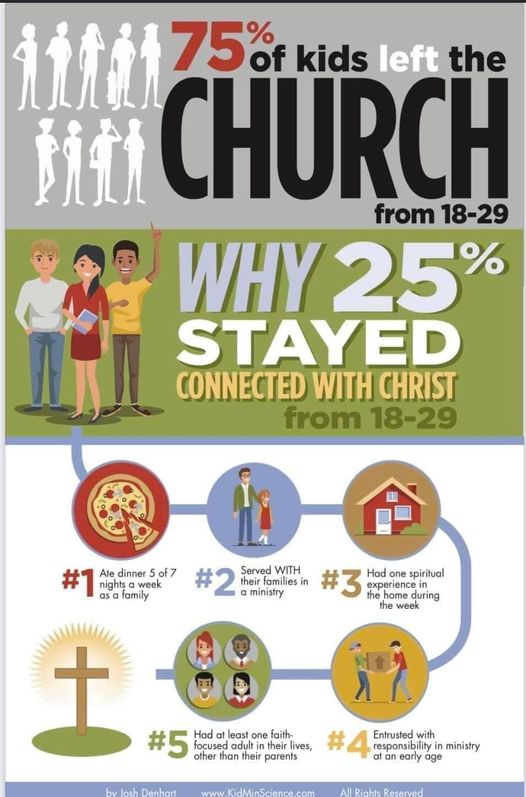
There's an infographic I've seen several times on several social media platforms. It's meant to encourage Christian parents to take concrete steps to make sure that their children stay Christian.

The fact that such an infographic exists let alone that it has gone somewhat viral speaks to the crisis in which contemporary Christianity finds itself. The "Nones" are the fastest-growing demographic in the States. This has a lot to do with the explosion of social media in the last decade. Skeptics have made good use of these media and present opposing viewpoints that churches were otherwise historically able to keep somewhat hidden from young people. No more -- now skeptics are explaining why Christian theology makes little to no sense and young people are listening. Additionally, Christianity's historic position on gay rights and its relative opposition to science (the Catholic Church's weak protests notwithstanding) leave young believers out of step with church teachings.

If they're connected with Christ, why are there so many people involved in this? If Jesus is real and the connection is real, why does it need to be so supported socially? Each one of these is a social connection. Each one is an example of what sociologists call plausibility structures. The more people someone has around them supporting their beliefs, the more likely they are to hold those beliefs.

If we look at the wording of each one, we see that it's obvious how this is using social psychology and sociology to enforce belief systems.

  1. Ate dinner with family
    This is critical for the initial creation of plausibility structures. Doing it five to seven times a week gives it the repetition necessary for it to remain relevant. This will be key for young children.
  2. Served with family in ministry
    Again, doing the same thing together with the same underlying motivation will increase the likelihood that an individual accepts as valid that motivation.
  3. Had one spiritual experience per week in the home
    This one is a little vague: what is that one experience? How do we determine that it is spiritual? Most likely this will occur through the instruction of the parents. This will enforce what children learn in church: that warm feeling you get sometimes when listening to "praise and worship" music or reading the Bible is the Holy Spirit at work. The experience itself cannot be questioned; the cause of it can. This makes sure that that cause always leads back to a deity.
  4. Entrusted with ministry responsibility at an early age
    This begins the transfer from trusting others' interpretation of your inner experiences (i.e., labeling them as coming from a god) to making it your own. In treating you like an adult, you become an adult, and when this is tied to "ministry," that ministry becomes part of your adult identity.
  5. Had one non-familial faith-based adult in life
    Again, this is adding plausibility to the belief structure. Step one (dinner as a family) will work with children; this step will be key for teens, who don't necessarily want to listen exclusively to the family because it's part of growing up. A close relationship with a non-familial adult will help the transfer process from "their worldview" to "my worldview."

I, of course, rose to the bait when this appeared on a friend's feed:

If Jesus is real and the connection is real, why does it need so much social support? These are all examples of what sociologists of religion call plausibility structures: the more people you have around you believing the same thing and suggesting, directly and indirectly, that such belief is plausible and logical, the more likely an individual is to accept that belief as such.

The individual who posted this meme responded:

[H]ow long can one coal burn (even with regular blowing) apart from the rest of the fire? We aren’t closed systems…the World, the Flesh, & the Devil are actively pulling us away from God. Driftwood doesn’t move upstream…it must be acted upon.

It's interesting that this response doesn't deny the fact that these are, in essence, plausibility structures. Instead, the response only highlights it. Sociologist Peter Berger suggests that the only way to maintain a given belief in the face of competing beliefs is to surround yourself with like-minded people. He calls this a "cognitive ghetto." The response posits that just such mental sequestration is necessary to keep out the three enemies:

  1. The World
  2. The Flesh
  3. The Devil

Of course, in such a Christian's worldview, these three can all be subsumed under the last one: the devil. But attributing one's loss of faith when confronted with conflicting viewpoints to the devil does little: it's an untested and unfalsifiable hypothesis without evidence, and as such, it can be dismissed without evidence.

Another person asked,

[D]on’t all relationships require some sort of support to survive? The very word relationship indicates two or more things, factors or people.

I replied:

I just don't understand why a relationship with a supposedly omnipotent being needs support. It seems to me that the omnipotent being could make it so obvious to the believer that it would be folly to reject it. As it is, in my experience with a believer, I only had my own inner experiences and other people's assurances that those experiences were of God.

My interlocutor did not respond.

Who Commanded What

I really don't know why I do it. I follow some of these Catholic groups online for no good reason, I think. Am I there just to pick a fight? I guess.

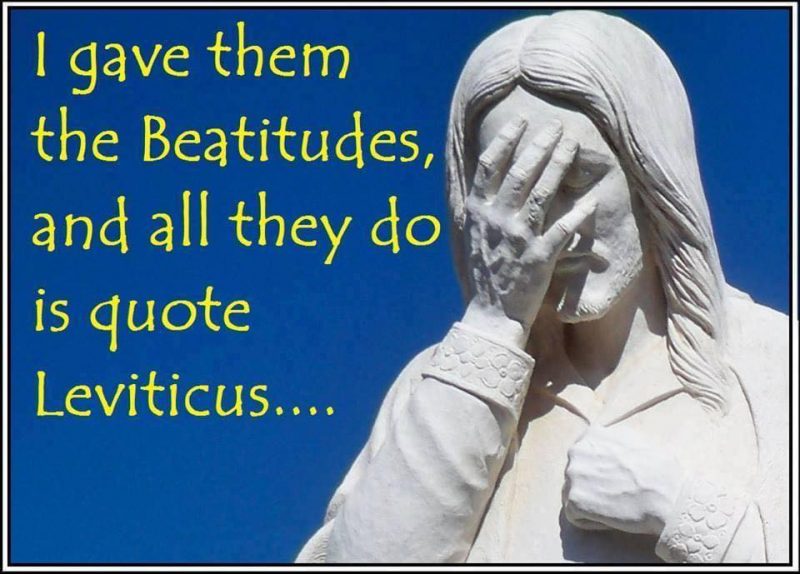
Today, this one popped up as a joke.

Everyone was laughing about it, so I guess humor is the new way of dealing with the awful things God commands in Leviticus. Of course, I replied: "But both come from God. Both are commands from God. That's the problem."

A user named Joseph responded, "no there is no problem. None of the levitical laws are valid anymore. Thus any command from Chirst is superior."

People just don't get it, though. Jesus might have done away with these laws, but because of the trinity doctrine, it was Jesus who created the commands in the first place. I responded to Joseph:

But the fact that they were commanded in the first place -- that's the problem I'm referring to. That God commanded his people to stone to death incorrigible children, stone homosexuals, stone people for breaking the sabbath -- THAT is the problem. Whether or not he did away with those laws is not as troubling as the fact that he made them in the first place.

At this point, Jesse jumped in to help:

[I]f you listened to the first couple of episodes, Fr. Mike clarified it. Some laws were "allowed", just as what Jesus said about the law on divorce. Also that some must be understood that they were given to a savage, nomadic, tent-living, and with frequent streaks of going astray kind of people who lived thousands of years ago.

I've heard this so many times I'm sick of it. No one sees the problem that the same god who gave us the kinder, gentler Jesus also gave us these commands in Leviticus! In fact, because of the trinity, it's the same being! I tried to explain this:

No, that doesn't fly. God didn't allow those laws. He didn't see them stoning people and say, "Well, I'll let you do that for a while." It was God who COMMANDED the stoning. Why does no one get that distinction?

There were a few more responses -- I replied to them all. And then everyone just stopped responding to me. Questions are unwelcome, I guess, and even more so follow-up questions.

Two Problems

I've been working on my own "Why I Am Not a Christian" a la Bertrand Russell's piece of the same name. There seem to be two logical problems Christianity encounters from the very beginning before taking anything else into account.


The two main issues I have with the Christian worldview are the problem of suffering and the nature of Christian salvation. The best way to highlight these problems is to reframe them in strictly human terms to see how much sense it would make for humans to do what the Christian god supposedly does.

The problem of suffering is simple: if there is a loving god who is omnipotent, it would want its creatures to live free of meaningless suffering. There is meaningless suffering in the world. Therefore, this god is either not loving, not omnipotent, or doesn't exist. Christians will likely quibble over the definition of "meaningless suffering," pointing out that that it is a value judgment and that we are in no way to determine if a given example of suffering is meaningless or not (that's their god's decision). Here it becomes useful to put it in concrete human terms: put simply, if I had the power to stop a child from being raped, I would. No questions, no hesitation: I would just stop it from happening if I could. If I had the power to stop a child from starving to death, I would. If I had the power to stop a child from being beaten, I would. The god of Christianity doesn't stop these things from happening. In fact, the supposed representatives of this god are all too often the ones inflicting this suffering on children.

The common apologetic response here is to suggest that the Chrisitan god's ways are not our ways, that we cannot know what good can come from this suffering. That might be so, but that supposed good that can somehow justify the evil and make it in fact a good -- that is merely speculation. What is not speculation is the suffering itself.

In response to this, apologists in turn bring up free will. Their god gave us free will, and we can use it, or we can abuse it. Their god lets us do whichever we wish because to do otherwise would be to limit our free will.

Another example shows the absurdity of this thinking. Imagine you walk in on your twelve-year-old son beating your three-year-old daughter to death with a length of two-by-four. Would you stop it? Of course, you would. But imagine you decide that to do so would be to violate your twelve-year-old's free will, so you let it happen. The authorities find out and charge you. At your trial, you make the defense that, because we all have free will, you are not ultimately responsible and that you were merely allowing your son to exercise his free will. Would the jury accept that defense? If the roles were reversed, and you were on that jury, would you accept that defense?

Thus, reframing the problem of suffering in strictly human terms leads to a strange outcome: we realize that we hold ourselves to a higher moral standard than we hold our idea of a god. We allow a god to get by with things we would find abhorrent in our own behavior by suggesting that we're just not smart enough to see the good that raping a three-year-old can bring.

At this point, the Christian apologist will likely suggest that this is all a moot point anyway because all this is due to the Fall, and then suggest Jesus's sacrifice solves this problem (i.e., the Fall). We might point out that the evil still exists but at least Christians have a way to explain where it comes from: we're flawed in our very nature due to the Fall. Jesus solves all this, the apologists assure us.

What happens when we examine that solution in human terms? Imagine my wife and I have a rule in my home: no one is to spill food while at the dinner table. The penalty for spilling food is three cuts on the forearm with a sharp knife. One night, predictably, my young son spills food. I take his arm and tell him that because of the rules, I have to make three cuts on his arm. However, because I love him so much, I'm going to take that punishment for him. I hand the knife to my wife, and she makes three deep cuts in my forearm. I look at my son lovingly and say, with tears in my eyes, "Do you see, son, how much I love you? I took this punishment for you. This should fill you with an incredible love for me!"

You, as an outside observer, would think all of this is quite absurd. You might question why I had such a strict punishment for such a relatively insignificant "crime." You would likely suggest that it was inevitable that my child would spill some food and ask why I had that rule in the first place. And finally, you would probably think the whole blood-letting for forgiveness was ridiculous: "Why not just forgive the kid if that rule has to be in place?" you'd ask before pointing out yet again that I was the one who created the law in the first place and that it was completely unnecessary to begin with. As for my suggesting that my son should love me all the more because I took his punishment, you'd likely think that it was a highly traumatizing event for my son.

Yet this is just what Christians think Jesus does for them: he takes a punishment that they deserve and in doing so, earns our undying love. However, Jesus is, according to the doctrine of the trinity, God, so this god set the rules himself as well as the punishment. He could have just forgiven us, but for some reason, he's insistent on a blood sacrifice to make up for sins that we didn't even necessarily commit, so Jesus steps in to fulfill that obligation.

At this point, Christians explain that their god would like to forgive us but because of his perfectly righteous nature, he can't. This is some bizarre argument: the nature of this god apparently restricts this god.

Communion

One of the most disturbing passages in the Bible comes in the Gospel of John after Jesus feeds the 5000. In the passage known as the Bread of Life passage, we read,

Jesus said to them, “Very truly I tell you, unless you eat the flesh of the Son of Man and drink his blood, you have no life in you. Whoever eats my flesh and drinks my blood has eternal life, and I will raise them up at the last day. For my flesh is real food and my blood is real drink. Whoever eats my flesh and drinks my blood remains in me, and I in them. Just as the living Father sent me and I live because of the Father, so the one who feeds on me will live because of me. This is the bread that came down from heaven. Your ancestors ate manna and died, but whoever feeds on this bread will live forever.” (John 6.53-58)

This is an echo of what we read in other gospel accounts about the Last Supper:

While they were eating, Jesus took bread, and when he had given thanks, he broke it and gave it to his disciples, saying, “Take and eat; this is my body.” Then he took a cup, and when he had given thanks, he gave it to them, saying, “Drink from it, all of you. This is my blood of the covenant, which is poured out for many for the forgiveness of sins. I tell you, I will not drink from this fruit of the vine from now on until that day when I drink it new with you in my Father’s kingdom.” (Matthew 26.26-29)

Mark’s account is similar because his gospel is a source for Matthew’s:

While they were eating, Jesus took bread, and when he had given thanks, he broke it and gave it to his disciples, saying, “Take it; this is my body.” Then he took a cup, and when he had given thanks, he gave it to them, and they all drank from it. “This is my blood of the covenant, which is poured out for many,” he said to them. “Truly I tell you, I will not drink again from the fruit of the vine until that day when I drink it new in the kingdom of God.” (Mark 14.22-25)

And the same for Luke:

And he took bread, gave thanks and broke it, and gave it to them, saying, “This is my body given for you; do this in remembrance of me.” In the same way, after the supper he took the cup, saying, “This cup is the new covenant in my blood, which is poured out for you.” (Luke 22 19, 20)

In all four accounts, Jesus makes the same ghastly claim: eating his body and drinking his blood is essential for human well-being. John 6.52 records the Jews’ response: “Then the Jews began to argue sharply among themselves, ‘How can this man give us his flesh to eat?'” While they’re not saying it outright, they are saying what most modern humans would say were they exposed to this notion for the first time: “This guy’s talking about cannibalism and vampirism!”

Indeed, there are few things in Christianity as disturbing as the cannibalistic ritual at its very core. No matter how one interprets this, it’s simply disgusting and barbaric. Protestants view it symbolically, which seems to lessen the effect, but it’s still troubling to think that millions of Protestants each Sunday symbolically eat human flesh. Catholics have an even stranger view of it, believing that the wafer they eat somehow mysteriously transforms into the actual body of Jesus even though it still looks like a cracker. For them, then, it’s not symbolic cannibalism but actual cannibalism.

If these Christians had not been raised hearing these words on a weekly basis and encountered it in another religion, they would be disgusted. It’s conceivable that Christians would reject whichever religion did teach this primarily on the basis of this teaching.

Thoughts on Hell

I’ve been in a Twitter conversation with a Christian fundamentalist about hell. What has come to light once again is the Christian double standard regarding hell and God’s omnipotence. This Christian and many like him suggested God doesn’t send anyone to hell. People choose to go to hell. They choose with their sins, they choose with their blasphemy, and they choose with their rejection of God. And most disturbingly, some will even admit that according to Christian doctrine and the idea of original sin, even newborn babies are deserving of this punishment because of the stain of original sin.

Yeah who determine the parameters that resulted in such consequences? Who determined that transgressions against gods will result in separation from God? God of course. God said all the rules and all the consequences, so why are you might want to try to suggest to ease your conscience that God doesn’t send anyone to hell, he set up all the framers to make that a certainty in some situations.

This Christian continued his argument by explaining that God didn’t Mikaël for humans but rather for the devil. Here once again we run into a problem when we accept the idea of God's supposed omnipotence and omniscience. He exists outside time, Christians explain, so he knows all things at all times. That means that when he created hell for the devil, he knew man would eventually end up there as well. But the Christian view creates a surprised God who thinks, "Crap -- that went off the rails quickly! I'd better do something!" My interlocutor explained it thusly:

Can you decide anything yourself? Free will. Man had free will & chose evil. He didnt have to, was warned not to but did anyway. Free will. Then God Himself made the way back. Man sends himself to hell. Your choice.

My response was along the lines above:

God made the consequences of disobedience hell. He could have made the consequences anything. He chose infinite punishment for a finite transgression—or, thanks to original sin, the transgression of a distant relative of eating a piece of fruit. Perverse.

But he'll likely continue to insist that I just don't understand God's grace, that I don't understand the finer points of the theological argument, that I just don't understand.

And that's another problem: why would a benevolent god make things so difficult to understand, so easy to misunderstand, when eternal punishment is on the line?!

Holy Saturday 2022

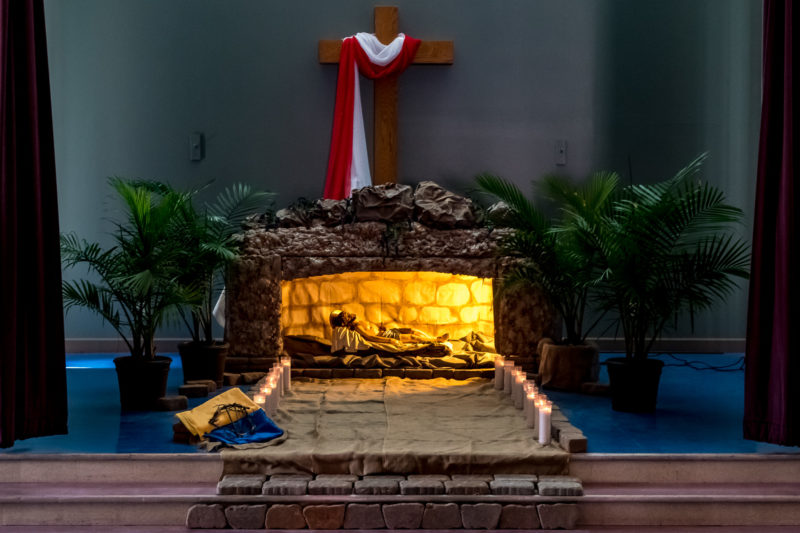
Today is the day in the Catholic liturgical year when Jesus is supposed to be in the tomb. Crucified yesterday afternoon, he was laid to rest according to the gospels in a tomb provided by Joseph of Arimathea. It is this tomb that various people will find empty tomorrow morning according to tradition in the gospels.

Who exactly find the tomb empty depends on which gospel you read. Critics point this out as one of many discrepancies which undermines the supposed factual accuracy of the gospels. Believers have various apologetics to explain away these differences. That’s a different issue for a different post. Besides that’s not until tomorrow. Today is Holy Saturday: I’m more interested in what’s going on today according to the gospels.

One piece of “evidence” that apologists like to put forth is the empty tomb, but first, we have to get Jesus in the tomb. What is the evidence we have that he was even buried? Only the Bible biblical narrative.

We do know from other contemporary sources, however, that most victims of crucifixion were not given a proper burial. This was part of the punishment. Your rotting corpse served as a deterrent for others. Furthermore, once burial took place, it was most often accomplish by tossing the remains not eaten by the birds into mass common graves. So we have two major problems with the account in the gospels: first, criminals’ bodies are traditionally left on the crucifixion steak to serve as a deterrent; second, once the remains were buried, they were placed in a common grave. The only evidence that we have Jesus was buried, comes from gospels written 50 to 70 years after he died. That’s not terribly convincing evidence, and I would bet that most Christians if this claim were made by another religion where is similar objections.

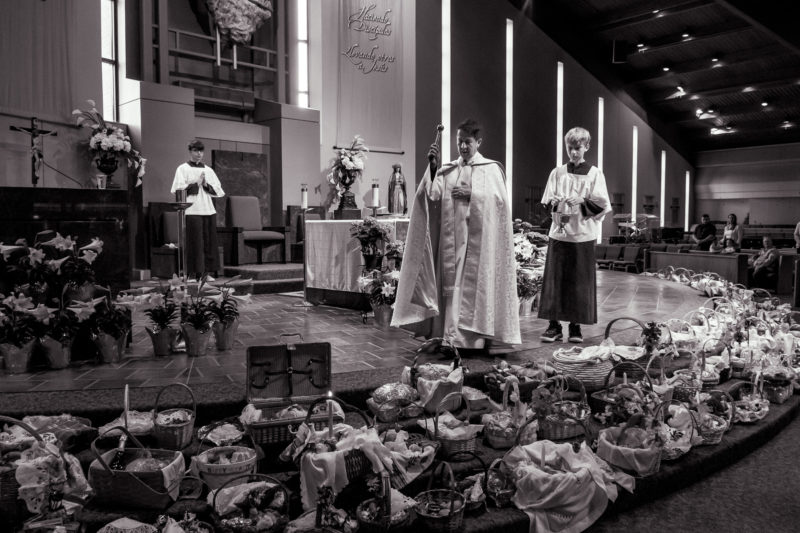
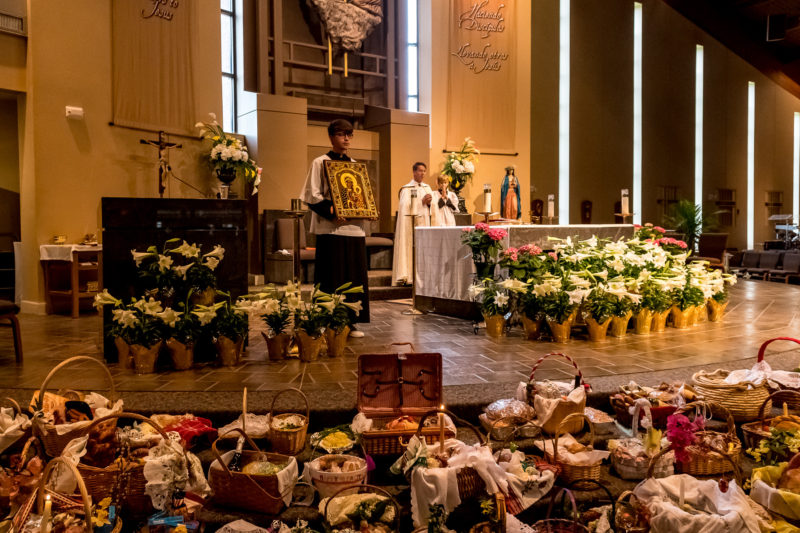
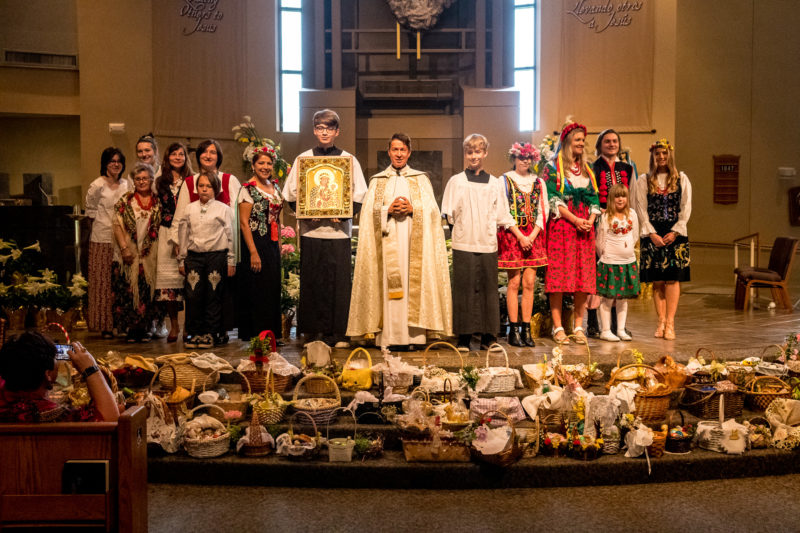
However, most Christians accept this as a simple fact it is beyond dispute, and from this narrative, Catholic secondary traditions have sprung up. Polish Catholics traditionally build a grave in their church and some sort of Jesus figure is placed in it, symbolizing Jesus and Joseph of Arimathea‘s grave tomb. Local Poles brought that tradition to our area, and the parish pastor has fallen in love with the tradition. So every year, the Polish community creates a tomb for Jesus just like they would do in Poland, and the faithful come and keep vigil with him throughout Friday night and Saturday. Of course, everyone knows that this is simply symbolic representation of Jesus in the tomb, but the fervor with which some people sit and pray in front of this tomb suggests that somehow that symbol has become for them very real. It is as if they are sitting by the actual tomb, which of course likely didn’t even exist. How is this possible?

I think there’s a certain predisposition among Catholics to turn the symbolic into the real, to suggest with a line between the symbol and the thing somehow blurs, somehow disappears completely. They do this every week with the bread and the wine. Catholic teaching is that this bread and this wine, after some words uttered by the priest, are no longer bread and no longer wine. It looks like bread and wine; it taste like bread and wine; scientific analysis would show that on a molecular level, it’s still bread and wine. None of these things matter. What matters is that the church has taught for ages that somehow despite all appearances to the contrary, this is now the physical body and blood of Jesus. When someone can make that kind of Leap, all other boundaries between symbol and symbolized unnecessarily begin to slip.

All of this is undergirded by the nearly universal notion that our world is it duality. There is a physical; there is a spiritual. Things can exist that don’t seem to exist, that leave no physical trace, they have no physical characteristics, they have nothing. Humans, according to Catholic teaching, are not just physical beings: at our core, we are a soul. This duality then spills into other things, so that we can suggest it bread and wine have a physical existence, but they have some other kind of existence. This is what changes Catholic say.

Of course, this other “existence,” which they call substance, cannot be shown to exist in any scientific manner. It is a philosophical construct. Once a group of people starts to imbue philosophical constructs with actual existence, then literally things that exist only in the head can be said to exist in reality, and in a certain sense, they do exist in reality, for our conscious experience of the world is the only experience of it we have. But they don’t have an external reality, they don’t have a reality that is not dependent on our contemplation of said philosophical construct.

Freedom doesn’t exist outside our notion of what freedom is. Justice does not exist outside of our notion of what justice is. And our notions of freedom and justice and every other philosophical construct vary widely from cultural culture, from time to time, from person to person. And so their existence is completely relative and completely dependent on human thought.

Once someone is comfortable with a squishy boundary between these two things, though, all sorts of ideas that they might otherwise think are silly can become the most profound, the holiest ideas that they hold. And so we end up with over one billion people in the world kneeling before a piece of bread and a bit of wine with the same reverence as if they were kneeling actually before the most powerful being in the universe. We have people shedding tears in front of a tomb that they themselves made that the houses a carving of a crucified man whose existence or might not be questionable but his characteristics, actions, words, and deeds have scant if any real likelihood of being accurately recorded in the one historical record we have of them. Which is to say, because we don’t actually have Jesus here physically with us it’s all in our heads.

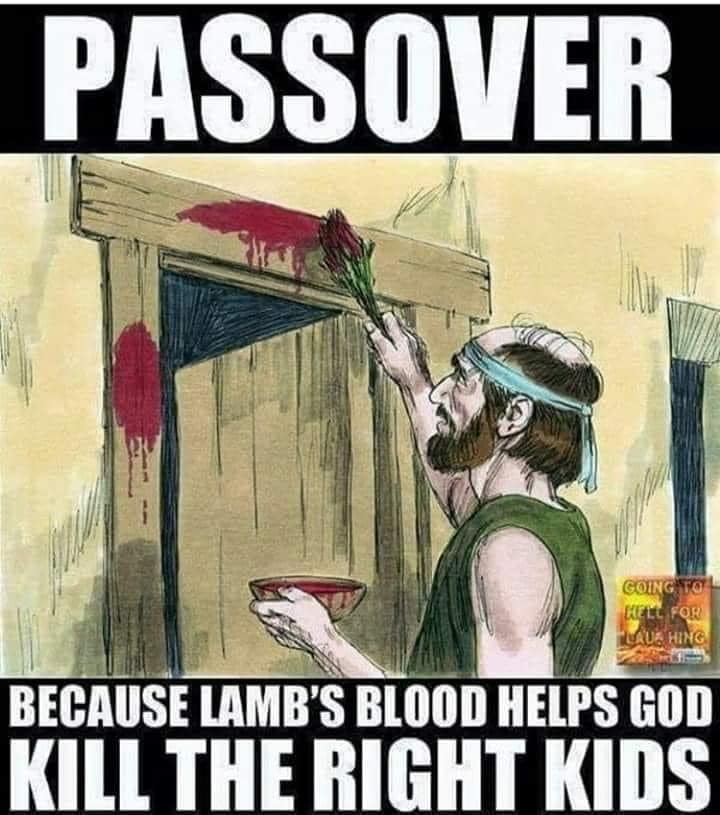
Passover

The story of Passover always confused me. The Israelite god is going to destroy all the firstborn of Egypt in order to convince Pharaoh to let the slaves go (after, according to the passage, this same god “hardened Pharaoh’s heart” against the idea of releasing his slaves). He commands the Israelites to smear blood above their door in order to receive protection and save their own firstborn. Why in the world did an all-powerful, all-knowing god need the Israelites to smear blood on their door lintel in order to indicate to this god that the occupants were, in fact, Israelites? This so anthropomorphizes this god as to make it laughable. It leaves readers imagining this god moving physically from house to house, door to door, checking to see if there’s blood, then acting accordingly. Now, granted, I believe the text refers to an angel doing the actual killing, but spirit is spirit, right (in whatever sense “disembodied mind that has the ability to affect the physical world” might mean)?

Yet there’s a more brutal way of expressing this confusion:


Image