Matching Tracksuits

fun in fours

faith

Babcia’s Candle

Any time the sky began growing dark with threatening clouds, Babcia would always shuffle to the kitchen, light a votive candle, and place it in a plate of water.

The motivation behind the small plate of water was obvious: it was protection against an unintentional fire. The bottom of the candle could get quite hot, after all -- an entirely reasonable precaution.

The candle itself, though, was to ward off the approaching storm. I'm assuming prayers accompanied the candle, but they must have been silent because the only thing I ever heard Babcia say was, "I must light a candle to keep the storm away."

If the storm never appeared or the clouds dissipated completely, I'm sure this felt like confirmation of the ritual's effectiveness. But it didn't always work. What then?

Looking back on it, this is the same approach Christians take to prayer in general. When a believer prays for something and God appears to have answered the prayer, then it's confirmation of prayer's effectiveness. But what happens when God doesn't seem to have answered the prayer? Most Christians simply move the goalposts.

Let's say a young child runs out into the road after an errant ball toss and gets struck by a car. The child's family rushes out to the child lying on the street, praying all the way. If the child gets up, the prayers were answered: God saved the child from all harm. If the child gets taken to the hospital but survived, the prayers were answered: God saved the child from serious harm. If the child ends up paralyzed because of the accident, the prayers were answered: God spared the child's life. If the child ends up dying, the prayers were answered: God has taken the child into eternal bliss.

This type of thinking persists in the conservative Christian community, and it begins to affect how they view other things. Just look at the followers of the MAGA movement, in particular Mike Lindell and his pronouncements that soon his lawyers will present information that will change everything about the 2020 election. He gives a date by which everything will change; that date comes; nothing changes; he grows silent; after a while, he gives a new date, and the cycle repeats. He's been doing it for nearly two years now, and those who follow him and believe him give him a pass each and every time.

What can we make of this mentality? If nothing counts against a claim, then it's not rational in any sense. Unfalsifiable claims are meaningless, and because they're unfalsifiable, nothing counts against them. But in the case of prayer and the My Pillow guy, they have been falsified, time and time again, and yet believers hold fast. The belief itself, the faith itself, is more important, it seems, than truth.
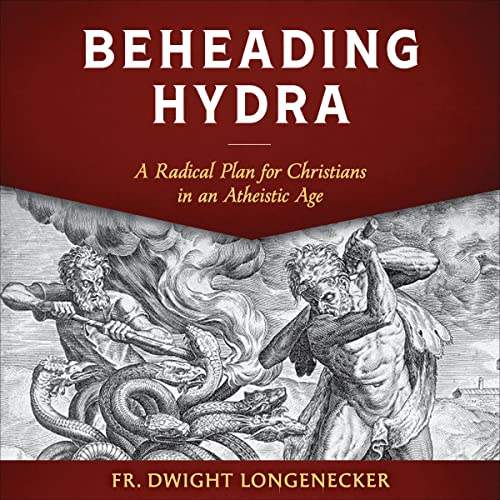
Beheading Hydra — A Review

Dwight Longenecker is the pastor of the parish we used to attend. He's a prolific author, and the title of one of his books caught my attention: Beheading Hydra: A Radical Plan for Christians in an Atheistic Age. It purports to be a "radical plan" for believers in an age of atheism. As a once-Catholic-now-atheist, I thought it would be interesting to see how Longenecker defines the problem and what this radical solution might be.

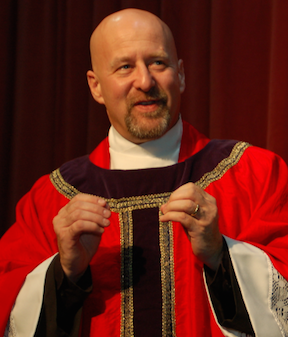
Fr. Longenecker

The problem of what Longenecker seems to see as a predominately atheistic society is a "perfect storm" which is "the culmination of five hundred years of devious philosophies, half-truths, godless ideologies, false religions, and rebellion against God, his Church, and His timeless truths" (7). That's quite a list of problems there, but what's key to me is the five-hundred-year timeframe. What really began happening then? Modern science was slowly emerging from the mix of alchemy, philosophy, and superstition that had been used to explain the world in the past. The rise in atheism tracks closely to the success of the scientific method. Granted, what I'm suggesting here is one of the "-isms" that Longenecker claims is problematic, namely scientism, which is the claim "that science alone can render truth about the world and reality" (Source). I certainly don't believe science is the only source of truth in our world, but when it comes to the physical world itself, it is certainly the most successful. Science continually knocks at religion's door and says, "Here, we'll explain that now," whereas religion never offers explanations that supersede previously accepted science.

But the book is not about just scientism but a whole bunch of "-isms"

  1. atheism
  2. materialism
  3. historicism
  4. scientism
  5. utilitarianism
  6. pragmatism
  7. progressivism
  8. utopianism
  9. relativism
  10. indifferentism
  11. individualism
  12. tribalism
  13. sentimentalism
  14. romanticism
  15. eroticism
  16. Freudianism

That's a whole lot of "-isms" to tackle in a book just a bit over 200 pages in length, but Longenecker plows through them all, explaining how they're problematic for Christians and how they contribute to this "atheistic age" he sees us in.

But how can this be? How can we live in a largely atheistic society when most atheists point out the number of elected officials who are Christian is many times larger than the number of elected officials who are atheist (to use one simple metric)? It's simple: "most atheists are blind to the fact that they are atheists" (21). I read that and immediately realized where he was heading: if you're going to call yourself a Christian, you'd better act like a Christian and a Christian as I define it. He frames it by saying that this tide of atheism can be slowed with people living authentic Christian lives, but suffice it to say his definition of "atheist" would leave most atheists scratching their head.

"But I'm not an atheist!" I hear you say. Really? Then why do you live like one? If you do not pray, if you do not tithe, if you are living without a real relationship with God, then your belief in God is only a theory (144)

That's the answer: prayer, tithing, and creating a close community.

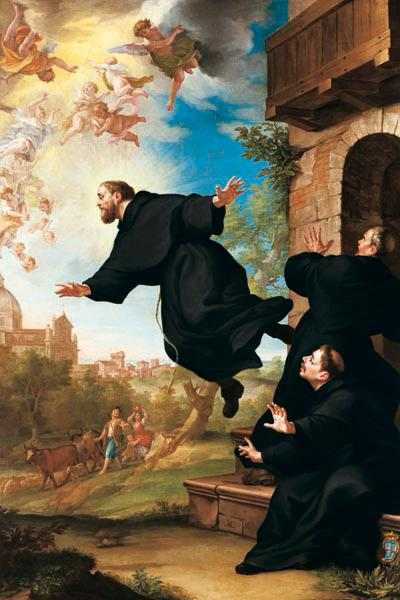
While the book is not an effort to disprove these "-isms" definitively, he does take some time to point out what he sees as flaws in them. Regarding atheism and materialism, for example, he makes the argument that miracles "remind us that weird things happen," and then gives us examples: "Friars float. Dead saints smell like flowers thirty years after they were buried. Seventy thousand people said they saw the sun spin and plummet to earth at Fatima" (30).

St. Joseph Cupertino

This short list he makes refers to

  1. St. Joseph Cupertino, who had "the gift of levitation" (27).
  2. St. Bernadette's body, which smelled like flowers thirty years after her death.
  3. The appearance of Mary at Fatima.

Cupertino lived from 1603 to 1663: this was a time when people were burning witches, so that Longenecker takes these fanciful claims that he could levitate seriously suggests to me a naivety that I would not have expected. Bernadette's body does indeed look lovely, but that's because of the efforts of the faithful: she's not that way naturally. And Fatima? It's just as hard to take that seriously.

It's easy to understand why Longenecker might willingly accept these things: "The spiritual person sees miracles--divine interruptions--all around him, and and through his everyday experience" (31). If you're looking for it, you'll find it. That might be advice he's giving believers, but I think it's a double-edged sword: when you go so far as to believe in 17th-century floating friars and someone else says, "Wait a minute," you're creating a crack in your belief system that doesn't have to be there.

What are his suggestions for dealing with all these "-isms"? It's to develop a "creatively subversive alternative." Real Christianity. Deep Christianity. Prayerful Christianity. After all, it's happened before: "Every five hundred years, there seems to be a major crisis in the Faith, and at each juncture, a new wave of witnesses rise up." First there was ancient Rome, but "the first Christians simply lived a graced life of charity and peace, and the pagan world was drawn to their example and converted." Then, in the sixth century, "St. Benedict stepped out and established simple communities centered on prayer, work, and reading," which served as a bulwark against the "listless and corrupt" church. By 1000 CE, there was more corruption and crime but the "Benedictine Order surged forth in the great Cistercian renewal." Finally, there was the Reformation and the Catholic Church's Counter-Freformation which "brought renewal simply by living out the creatively subversive alternative" (133).

Yet Longenecker's suggestion that this same kind of solution (returning to a prayerful traditional Christian life) will work in 2023 is almost laughably naive. The forces at work now are much more powerful than the forces at work in the previous periods, and they're driven by one thing: the internet. Subversion and alternate views can reach even the most sheltered people now, and the amount of material available that simply picks at thread after thread in the tapestry of Christian belief is overwhelming. Skeptics have methodically taken apart argument after argument and shown how the arguments simply don't make sense. They constitute an ever-present "yeah, but" to everything Christian apologists say, and no amount of praying is going to make that go away.

Really, the only answer is complete sequestration, and that is in essence what Longenecker is suggesting, and it's what he was doing in the parish, and it's a significant reason we left.

Magi Thoughts, 1

I'm reading Dwight Longenecker's Mystery of the Magi: The Quest to Identify the Three Wise Men. Longenecker is the pastor of the Catholic church we used to attend here in Greenville, so it's one of those rare experiences of reading a book whose author you know personally.

Naturally, as a skeptic, I picked up the book with a healthy dose of doubt: I don't buy the majority of the most basic gospel stories; a fanciful tale of wise men coming from afar, guided by a star, while not as crazy as the idea of a virgin birth, a talking snake, or an apple curse the dooms all humans, is a pretty tough story to sell as historical fact. That is, however, exactly what Longenecker is attempting in the book.

Early in the book, Longenecker begins explaining how so much of the Magi story we've come to associate with Christmas is not in the Gospel of Matthew (the only place the Magi appear). At its simplest core, the story is about some wise men who, guided by a star, come to see Jesus at some point after his birth. The camels and the arrival with the shepherds and all the other stuff -- that was tacked on later.

Longenecker explains,

Like all good stories, [the Magi story] spread, and as it spread, the simple became embellished, exaggerated, and exploited.

By the Middle Ages the elaborate versions of the Magi story were accepted as historical.

Mystery of the Magi, 24

That sounds awfully similar to skeptics' view about the development of the New Testament, in particular the stories of the gospels. When you look at the gospels from oldest to news (Mark, Matthew, Luke, John), you see a sort of increasing sense of the supernatural. The stories get more far-fetched. The sayings of Jesus become more philosophical and "deeper." The miracles increase. In fact, in Mark's gospel, there isn't even a post-resurrection appearance: the women go to the tomb, find it empty, and leave afraid. What comes after appears only in later versions of the gospel.

If I were to suggest this to Longenecker, though, I have a feeling he would have a way to explain it away. I doubt I'd be convinced, just as I wasn't convinced with Hard Sayings. Horn and Longenecker even use a similar rhetorical technique:

  • make a claim that is reasonable but is only an assertion based on logic;
  • explain how it is logical;
  • refer back to it later as established fact.

The Priest

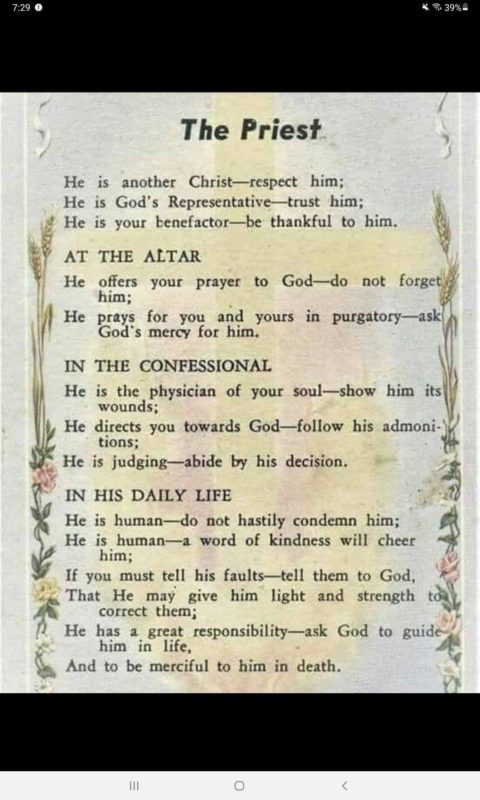
Priests in the Catholic church have always been afforded special status. Priests in Poland have almost god-like status. Why is this? A post on a Catholic social media stream might offer some insight:

If he is "another Christ" and "God's Representative," how could his status increase except by being declared an actual god?

5 Shocking Proofs of Jesus’ Resurrection?

Apologist Allen Parr posted a video in which he made the following bold claim:

Have you ever wondered whether the resurrection of Jesus really happened? I get it. I mean, how can we know FOR SURE that the resurrection of Jesus was an actual event in human history? Or have we been believing some myth or fable that has been passed down about the resurrection of Jesus for nearly 2000 years? In this video I give you 5 undeniable proofs of Jesus' resurrection.

Video Description

Undeniable?! That's a strong term. Let me see what I can do with them.

Proof 1: The Precautions of the Romans

Parr suggests that "[i]n order to prevent Jesus' body from being stolen, the Romans took three precautions (Mt. 27:64-66)," which he lists a guard, a stone, and a seal.

According to Parr, the Romans "posted a squad of 10-30 soldiers to protect and guard the tomb where Jesus' body was laid." This suggests that the Romans were worried that someone would steal the body. This seems like a legitimate precaution to prevent theft of the body. In addition, the Romans "placed a stone weighing close to 3,500 pounds in front of the tomb preventing people from coming in or out." Again, a wise precaution if they're worried about grave robbing. Finally, the Romans "placed a Roman seal across the stone that, if tampered with, was punishable by death." This is all very logical.

There's only one small problem with all this: it depends solely on one source, the Bible. This is a problem not because we have reason to doubt that Romans would not have set guards; it's problematic because we have reason to doubt that they would have disposed of Jesus's body in any other way than was customary: a mass grave.

Proof 2: The Faith of the Disciples

This is a favorite among apologists: Parr asks, "WHY WOULD THEY RISK THEIR LIVES FOR SOMETHING THEY KNEW WAS A LIE?" (The all-caps screaming was from him not me.) Parr's reasoning goes like this: "Before Jesus' crucifixion, the disciples were fearful and ran for their lives (Mt. 14:50). After the resurrection, they became fearless, willing to get beaten, burned, beheaded, sawed in two, stoned and crucified!"

Yet it doesn't follow that the only other option to "Jesus was really resurrected" is "The early Christians knowingly promoted the like that Jesus was resurrected." In other words, this argument rests on a false dichotomy.

Furthermore, there's very little evidence that anyone died because they were Christians who refused to renounce their faith. Certainly, Nero persecuted the Christians, but this was because they were a convenient group to scapegoat. It's not at all clear that Christians could have saved their lives by renouncing their faith. Furthermore, the persecution of the Christians was, at least to some degree, an exaggeration developed later in Christian history to back up the notion Jesus taught that people would be "persecuted in [his] name."

Proof 3: Jesus' Post-Resurrection Appearances

Parr here makes two simple points. First, he says, "The Bible teaches that Jesus spent 40 additional days on earth after His resurrection making convincing proofs that He was alive (Acts 1:3)." Again, the only source for this is the Bible, which is not exactly an unbiased source of unquestionable authorship. Much of the New Testament was written two or more decades after the events it supposedly narrates, and the gospel authors are completely anonymous.

Parr's second point is that in addition "to appearing multiple times to His disciples, Paul recounts when Jesus appeared to over 500 people at one time who were still alive to give testimony at the time of Paul's writing (1 Cor. 15:6)." This is a second- or third-hand account at best and even if they do exist, these 500 are completely anonymous.

Proof 4: Secular History Confirms It

Parr argues that if "the Bible was the only book that recorded the resurrection, people might criticize us for using circular reasoning." He insists that "it is well documented in SECULAR history books," then lists two: Josephus, The Words of Flavius Josephus and Thomas Arnold's History of Rome. These are problematic for several reasons, including the most basic being that Josephus didn't write anything called The Words of Flavius Josephus. He wrote The Jewish War and Antiquities of the Jews, and these works appear in The Works of Flavius Josephus. It might just be a typo, but it certainly wears at the credibility. But what does Josephus actually say about Jesus?

About this time lived Jesus, a wise man, if indeed one ought to call him a man. For he was the achiever of extraordinary deeds and was a teacher of those who accept the truth gladly. He won over many Jews and many of the Greeks. He was the Messiah. When he was indicted by the principal men among us and Pilate condemned him to be crucified, those who had come to love him originally did not cease to do so; for he appeared to them on the third day restored to life, as the prophets of the Deity had foretold these and countless other marvelous things about him, and the tribe of the Christians, so named after him, has not disappeared to this day.

Yet the bit about "He was the Messiah" is clearly a Christian addition as Josephus was a Jew and would not have accepted Jesus as the Messiah.

There is a second mention of Jesus in Josephus, but it is weaker than the first:

Having such a character [“rash and daring” in the context], Ananus thought that with Festus dead and Albinus still on the way, he would have the proper opportunity. Convening the judges of the Sanhedrin, he brought before them the brother of Jesus who was called the Christ, whose name was James, and certain others. He accused them of having transgressed the law and delivered them up to be stoned.

It's not even about Jesus but about his brother, James. What's important to note, though, is that neither of Josephus's passages deals with Jesus's supposed resurrection. We might use them to confirm that Jesus existed but nothing more.

As far as Thomas Arnold's History of Rome goes, I'm not even sure why Parr would suggest that this is pertinent in any way since it was published in 1838, a full 18 centuries (or if we're going to put it in the context of the Old Testament, 180 decades) after Jesus's death. That Parr includes this is simply laughable.

After this, though, Par includes a list of "ATHEISTS WHO BECAME CHRISTIANS"

  • Frank Morrison, Who Moved the Stone?
  • Lee Stroebel, The Case for Christ
  • Josh McDowell, The New Evidence that Demands a Verdict

I have no idea why he included this -- it has nothing to do with secular historians confirming Jesus's resurrection.

Proof 5: The Missing Body Was Never Found

Parr's final argument is the weakest: the body never turned up. He argues, "If Jesus never rose from the dead, then the Romans could have produced the body, thus destroying Christianity forever." But this assumes that the first-century Romans cared enough about Christianity or viewed it as any threat to do something like this. Remember: this is just after the supposed resurrection. How many Christians were there? How much of a threat did the Romans think they posed? Apocalyptic sects were all over the place: why would they have cared about this particular one?

Parr concludes, "But…the body was never found in the tomb because Jesus rose from the dead!" Or maybe because it was tossed in a mass grave like all other crucifixion victims' bodies.

Key Takeaway

Parr writes in his "Key Takeaway" that the "reality of the resurrection will not only give you more confidence about what you believe, but also give you the knowledge and ammunition you need to silence those who are skeptical about the Christian faith." If this is the best he's got, I'd advise his followers not use these arguments on any vaguely-informed skeptic.

Original Video

Exchange

But God is NOT a commanding officer, now is He??

Of course, he is.

Who made him commanding office? One of higher authority had to do so. So who was it?

Don't be silly with semantics. You know what I meant.

As you do mine. God IS and IS in command. So why do you rebel against your commander? And don't pull this crap that He's not YOUR commander.

But he's not. Sorry -- had to pull it.

What any rebel should say. Any treasonous rebel. Any delusional, treasonous rebel.

I'll bet you just can't wait to be in heaven watching me writhe in hell, right?

But what about YOU??? Evidently you wrote and then deleted. Afraid of your own lie? Yeah it's hard work figuring new ways to ignore truth. Why are you avoiding the issue?

I originally said that there's no hate like Christian love. You're a great example of that. Then I thought you'd probably say something like, "I look forward to watching you roast," or some such nonsense. I'm not afraid of anything; I'm not ignoring the truth; I'm not avoiding any issues. I just don't believe. But I'm not dripping with only slightly concealed hatred like you are.

Why is it "hatred" to say you are a rebel against God? Or why is EVERYTHING that is a contrary view labeled "hatred" by you people?? It's like the only verb you know.

So many Christians can't see themselves as others see them. It's a form of hatred because it's a judgment made on a personal standard that insinuates that joy I suggested you feel when you contemplate me in hell. It suggests that you will stand in judgment alongside your god and say with mock sadness, "Lord, you know best, but of course, I can't say anything about this miserable wretch other than to say he's rebelled against you -- which of course you already know, Lord," all the while anticipating getting watch me get my dues. "I told you so!" you can say. So on second thought, perhaps it's not hatred as much as childishness.

And how others see is always right and correct, huh? So we must cater to what YOU think? How bout non-Christians can't see themselves the way God sees them? And once again, the unbeliever makes a shambles of Christian doctrine while congratulating himself in his mockery. Dude…we were ALL rebels. We say nothing about you that we couldn't say of ourselves.

"How bout non Christians can't see themselves the way God sees them?" -- See? You're speaking for your god, standing by his side and passing judgment, eager to see your so-called enemy cast into the flames. As for "And once again, the unbeliever makes a shambles of Christian doctrine while congratulating himself in his mockery." -- I don't even see where that came from. I watched a couple of your videoes, so I know you have a real persecution complex like so many Christians, and you'll read into things persecution that's not even there, but I wasn't even talking about any Christian doctrine. I was talking about your attitude. This whole thing started with me making an off-hand comment about the Christian god being a sort of commander-in-chief (You know, like "Onward Christian Soldiers"?), and you've blown this up into -- I don't even know what. I'm just shaking my head in disbelief: I don't get you or your attitude. I never said anything derogatory about Christians or Christian beliefs. I just made a silly comment. Calm down, man. This has gotten way out of hand: you're frothing at the mouth.

No I'm nailing you to the wall for bring so flippant. You make it sound like you're not even referring to Christianity. Liar. Persecution complex? Not here, bud. You don't know what that is anymore more than you understand rebellion.

I read that imagining John Wayne was saying it. Very effective.

Please identify this "hate". You make reference to it but do not state what you consider hateful.

I did. A few comments ago. (That comment didn’t sound so great in a John Wayne voice. I was hoping for more “nail you to the wall” kind of bravado.)

Genocide

The commands to genocide in the Old Testament are particularly troubling for most people except for the most basic, literal-thinking fundamentalist (Protestant or Catholic). For them is simple: God said it, so it's morally right. Most other Christians take a little more nuanced approach -- at least the ones who know about the passages and want to deal with them honestly.

Capturing Christianity -- a YouTube apologetics channel -- invited Dr. Randal Rauser, who describes himself as "progressively evangelical, generously orthodox, rigorously analytic, [and] revolutionary Christian thinking," to discuss the troubling passages. He wrote Jesus Loves Canaanites, a book that deals with the various Christian attempts to explain these passages. I listened to the interview on my run this evening, and two things stood out.

How do we make sense of the fact that God is supposed to be love and yet he commands all these awful things? Surely this creates some cognitive dissonance that Christians want to deal with. How do we deal with it?

Rauser explains that, in dealing with these passages, Christians need to "develop different reading strategies to minimize the cognitive dissonance that is created when we read these passages." Earlier he mentions a new convert who discovered these passages and found them troubling, and Rauser suggests that new converts who haven't been "inculcated" with these reading habits might find these passages to be stumbling blocks to their faith. It's interesting that he uses the word "inculcated" because the definition Oxford is "instill (an attitude, idea, or habit) by persistent instruction." Persistent instruction -- drilling this into one's head. So in order to deal with these issues, one has to have drilled into one's head certain reading habits. What are these habits?

One of them is to ask if a given interpretation develops a love of God and man. If it doesn't, it's not the intended interpretation. But this puts the cart before the horse: one should not have to read the Bible with an ideal interpretive framework in place that automatically defaults to erring on the side of the Bible. That's not critical study; that's mindless acceptance.

Another reading technique is to apply what we know about God and ask if a certain interpretation reflects that.

He uses the extreme example of Dena Schlosser, who in 2004 used a knife to amputate the arms of her eleven-month-old baby because it was a sacrifice God had asked her to make. Rauser insists that

the vast majority of people today, we don't even give it a moment's consideration that God possibly willed such a thing to happen because we believe it is fundamentally inconsistent with who God is. And we would say, maybe she was influenced by a demonic entity or she is mentally ill, schizophrenic or something else, but what we don't think seriously is that God maybe or possibly commanded that.

Yet I don't see why we can't imagine God commanding that: he did command Abraham to do just the same thing. If we're going to accept that Abraham was justified in what he did, we have to at least consider that Schlosser was justified in what she did. After all, who are we to say that God wasn't talking to her?

But of course, we will say that because it's the only thing we can say. To suggest that God might be getting back into the business of having people slaughter each other at his bidding opens up such potential chaos and terror that it's unimaginable.

A favorite question of skeptics when the story of Abraham and Isaac comes up is to ask the Christian, "What would you do if God commanded you to kill your child?" Most Christians will hem and haw and suggest that they'd have themselves checked into a hospital to check for mental illness and yet at the same time deny that possibility for Abraham.

I commend Rauser for dealing with the issue, but like Trent Horn, he seems just to be offering possible ways out that allow a Christian some breathing room from the crowding cognitive dissonance that rattles thinking Christians' faith.

Strawman

This whole discussion starts with a sort of ad hominem attack on Harris, suggesting his view is "naive" and (later) silly. That's amusing since all Harris was doing was paraphrasing the basic core of the Biblical account of the ascension and second coming. There's a literal up motion and a down motion: Up toward the sky for the ascension, down toward earth for the second coming. All this "vast" and "rich" and "nuanced" theory that Davis presents is simply modern apologists' attempts at recasting these events in a way that doesn't so clearly contradict science. The fact is simple: for most of Christian history, a literal upward motion to heaven above us and vice versa was the only understanding. If you're criticizing Harris's view, you are in fact criticizing the Biblical account. All the theories Davis presents are simply speculative apology that has absolutely no support in the Biblical text.

Sapiens Thoughts

I've been reading Yuval Harari's Sapiens, and two early passages have led me to see religion in a whole new way. Unfortunately, neither epiphany is ultimately flattering for religion, but at least one thought from the book got me thinking that religion was a useful tool in our development.

The first realization comes from the argument religionists make about the existence of morality being ultimately due to the existence of a law-giver that created a conscience in us all that is somewhat similar. Murder, theft, and lying seem to be universally bad -- how could this be unless some god "wrote that on our heart" to use a Christian apologist metaphor. Harari points out, however, that because we Homo sapiens walk upright, our hips have to be narrower, which led to an evolutionary preference to earlier birth. But human babies need much more care and development time than babies of other species, and this necessitated help from others. This need, in turn, led to evolutionary selection for people more likely to cooperate and live together peacefully. And this would eventually result in a moral system that prized compassion and cooperation -- without the need for a god.

The second realization came from Harari's contention that Homo sapiens development into a species that can coexist in large groups, much larger than our closest evolutionary relative, the chimp, has to do with our ability to use language to describe things that aren't actually there. To create fiction, in other words. He writes, "Large numbers of strangers can cooperate successfully by believing in common myths." He continues,

Two Catholics who have never met can nevertheless go together on crusade or pool funds to build a hospital because they both believe that God was incarnated in human flesh and allowed Himself to be crucified to redeem our sins. States are rooted in common national myths. Two Serbs who have never met might risk their lives to save one another because both believe in the existence of the Serbian nation, the Serbian homeland and the Serbian flag.

This common myth enables large-scale cooperation that doesn't appear in the societies of other apes.

The problem, though, is that we are at a point in our development in which the competing myths can go to war with each other with catastrophic effects for the entire plant...

Friday Night Football

When I was in high school, Friday night football was, during the beginning of the year, the highlight of the week. Everyone would arrive early to stake out their seats and make sure all the lowly freshmen got the worst seats. Friends saved seats for each other, and had cell phones existed then, they likely would have been texting each other, asking where they were, demanding that they hurry.

All the students went to cheer on the team, to hang out, to escape parents, to escape the everyday. The cheerleaders led everyone with raucous, taunting chants, and the marching band took the spotlight during halftime. The football players looked, and probably felt, a bit like stars.

My next-door neighbor played on the football team, and though we were not close, I'd wish him luck with the game if I saw him that day. The neighbor across the street also played, but even though I was closer to him than my next-door neighbor during our childhood, by the time we reached high school, we rarely talked.

Win or lose, spirits were always high. While everyone wanted the home team to win, it wasn't just about the game's outcome. It was about the friendship and closeness that everyone experienced.

At least I'm assuming it was, for I never went to a Friday night high school football game as a kid. Not once. It was in part because of a lack of desire, I suppose: football was never really something I loved except for a short couple of years when I was in second and third grade. (Or was it first and second grade? Or third and fourth grade? Hard to remember.) The main reason I never went was because it was off limits: growing up in a sabbatarian sect, we observed Friday night sundown to Saturday night sundown as the Sabbath, and all worldly cares and events went by the wayside. A Friday night football game was most certainly out of the question.

I never really wanted to go, but I wouldn't have been able to even if I did want it.

Or I tell myself that. Could my inability to go, my knowledge long before I could develop a desire to go that I would never be allowed to go, my certainty that there was something deeply and spiritually wrong with going to watch a football game on Friday night -- could that have tempered my desire before it ever developed?

I tell myself that I would not have felt comfortable there even if I did go because most of that crowd -- the in-crowd, the popular crowd -- felt uncomfortable. But why? If I'm honest it's because I was always distancing myself to begin with: I knew I could never really do any of the things they did on the weekend even if I was invited, even if they begged me because they thought I was the most amazing person to be around, even if I were king of homecoming (which I could have never been because, well, it's probably obvious). I'd never been terribly close to any of them outside of school (and perhaps playing in the neighborhood after school) during elementary school, and that moved with me into junior high where it settled into a sort of permanent quasi-outsider sense that I carried with me into college.

So at tonight's high football game -- the first I, at nearly fifty years old, had ever been to in my life -- I found myself wondering how different my light might have been if I had not grown up in what can only charitably be called a sect. I'm not bitter about my childhood; I don't regret that life; I appreciate what I got in return for Friday night and Saturday events.

But I still can't help but wonder...