Matching Tracksuits

fun in fours

faith

Response: I’m Not All That Impressed with Exvangelical Deconstruction Stories

"Deconstruction" is the current term for deconverting from Christianity. I'm sure it's applicable to other religions, and I know not all people who deconstruct end up abandoning their faith altogether, but by and large, the end result of deconstruction is a new skeptic.

The Christian response to this has fallen into a few categories:

  1. They deny that the person was ever a true Christian to begin with.
  2. They blame the churches for incomplete catechesis.
  3. They play down the deconversions by calling them silly or suggesting that their objections are basic and even juvenile.
  4. They suggest that the new skeptic "just wants to sin."
  5. They blame the parents for not teaching their children their faith well enough.
  6. They suggest that de-conversions do not result in a lack of faith but rather a change in where the faith is placed.

Occasionally, a Christian response can't quite decide which tack to take and simple mixes and matches responses. Such is the case with Grayson Gilbert's "I’m Not All That Impressed with Exvangelical Deconstruction Stories" from a couple of years ago.

Gilbert begins condescendingly enough by referencing the "never-ending supply of pastors, pastor’s kids, and artists formerly known as Christians" who are leaving the faith. There may be a number of "grand excuses," Gilbert suggests, but he insists that the "fundamental issue behind every one of these de-conversion stories" is the fact that, as the Bible explains in I John 2.15, they "went out from us, but they were not of us."

Gilbert pretends to preempt objections in the next paragraph by acknowledging that for many it's not an inadequate answer because "it’s a bit too Calvinistic." That's a very theologically based objection, firmly grounded in an acceptance of the basic tenants of Christianity and quibbling over details, but most skeptics' objections would be to question the validity of Gilbert's and St. John's foundational assumption: they left Christianity because they were never really Christian.

Forget for a moment how utterly and arrogantly childish it is to suggest that, despite skeptics' protestations to the contrary, these true Christians can read the mind and know the intentions of those who have rejected Christianity. The truth of the issue is simple: most people who leave Christianity do so reluctantly. They want to believe, but they find they no longer can. Evidence and arguments that once convinced them no longer do. But for a Christian still in the fold, the thought that someone who is a true Christian (how Christians love to be gatekeepers with each other) could lose their faith is terrifying because it means if someone else lost their faith, they could, too. To allay these fears, the only option is to suggest that these individuals never were really Christian in the first place.

Gilbert then deals with a particularly famous ex-evangelical, Abraham Piper, who is the son of John Piper, a Protestant theologian who has written a number of books and runs a successful online ministry in addition to his real-world church. Gilbert points out that "Abraham has taken a fancy to TikTok with clever, catchy tidbits of him mocking the Christian faith." That sentence is just dripping with derision: Abraham's efforts online to point out the flaws he sees in Christianity are not a serious work but instead "a fancy." His succinct observations are merely "catchy tidbits" unworthy of serious consideration. And he is not critiquing Christianity, which would require a measured response; he's mocking Christianity, which can be easily dismissed and forgotten.

In a parenthetical remark, Gilbert suggests that mocking Christianity "is so in vogue today." Never mind that this is not a question of popularity; what's more significant is the notion that critics are merely "mocking" the Christian faith, much like childish bullies mock their victims. It produces the victim complex that Christians expect from exhortations in the Bible, and it downplays the seriousness of the critiques themselves. Christian theology has caused real-world pain and done significant damage in a lot of people's lives. It has destroyed self-confidence in its near-continual insistence that humans are worthless trash. It has caused untold damage in its institutional misogyny and homophobia. It has literally killed thousands upon thousands in religious wars. It threatens the planet with its denial of science. It stifles critical thinking and encourages blind faith obedience. Leaving this mindset can produce a sense of relief, but if this is something that the new skeptic's parents taught them, something that's been a central pillar in their life for so long, there can be understandable anger arising as a result. Gilbert explains he uses some of Abraham Piper's videos to discuss "the nature of the Proverbial fool" with his son, thus attempting to ensure that his son instinctively reacts as he does without giving further thought to the motives or reasoning behind a de-conversion.

Far from the fact that the son of a celebrated and admired pillar in the Evangelical community has left the faith might depress Gilbert, he insists that he now has "a deeper appreciation for John Piper.  "It led me to see that despite Abraham’s brutal mockery of all his father and mother stand for and love, it testifies of his paternal faithfulness," he insists.

How does Gilbert square this round hole? He explains that it is a sign of "the faithfulness of a man like John Piper in raising his son to be so inundated with biblical truth that he still can’t quite get away from it well into his adult life. It is constantly on the tip of the tongue; he cannot go about life without thinking of the God he professes to reject." This is an attempt, in other words, to turn a loss into a win. Gilbert doesn't consider the possibility that the reason Abraham Piper is critiquing Christianity online is to try to help people who are facing the pain and frustration that rigid, fundamentalist Christianity can inflict (see above). Notice, too, the wording: "the God he professes to reject." This is a not-so-subtle dig at Piper through a subtle allusion to Romans 1:20:

For ever since the world was created, people have seen the earth and sky. Through everything God made, they can clearly see his invisible qualities—his eternal power and divine nature. So they have no excuse for not knowing God.

Abraham doesn't really reject it, in other words. He knows there's a god -- he just wants to sin.

Still, even if John Piper had not been a good Christian parent, it's not his fault if his son rejects faith (and thereby condemns himself, in the Christian view, to hell):

Many a parent neglected to make the Word central in the home, raised their children to be good, obedient pagans, and then wondered why their children came back from school with all sorts of ideas that run contrary to the Christian faith. The onus is still on these children to search out the truth of Scripture, regardless of how bad a job mom and dad have done.

As a skeptic, I have to wonder how one could worship a god that creates such a confusing book that requires a library of explanation and commentary to understand and then sends you to hell if you don't understand it properly. That's probably something along the lines of what some of these de-conversion experiences went through as well.

Soon after this, Gilbert switches his argument and employs the "well, everyone is religious" suggestion: the "Religious Nones" are in fact misnamed: "everyone is a devotee to some belief system, whether agnostic, atheistic, or the ever-vague “spiritualistic but not religious” group." It's funny how "religious" becomes something of an insult in this case.

Finally, after tossing this argument and that argument at the idea of de-conversion, Gilbert launches his main attack:

I’ve come to be more and more convinced that the vast majority of those who reject the Christian faith do so on the basis of intellectual laziness, intellectual dishonesty, or simple ignorance. They either don’t care to find the answers, they don’t care to hear the answers, or, they don’t know where to even begin.

He classifies the case various ex-Evangelicals have leveled against Christianity thusly:

The objections that people like Rhett and Link, Abraham Piper, the Gungors, Newboys’ former member George Perdikis, dc Talk’s Kevin Max, Joshua Harris, Derek Webb, et al., have, are basic, Sunday school level objections. In where we are in the history of the church, these aren’t even the interesting questions that Christians have any more. These are some of the most basic elements of the historic Christian faith that it leaves many of us wondering if these people took much time at all to crack open some dusty, old tomes from dead guys on the subjects.

This is because for

anyone who has taken the time to actually study these things in depth, the question isn’t if someone has given a satisfying answer to reconcile the apparent contradictions of the Scriptures, given exhaustive treatment on things like textual criticism and transmission, or provided ample solutions to the “problem passages” we find as finite readers.

In other words, they reject Christianity because they are lazy, and even though all the answers to all their objections have been covered time and time again, they reject them in their ignorance. In still other words, they haven't read the right books, and indeed they probably haven't even looked for the right books.

Speaking as someone who has done the reading and looked for the answers, I can simply say this: it is entirely possible that someone can start questioning their faith, look for and find answers to their questions, and find those answers unconvincing. We cannot choose what ideas convince us and what ideas don't, and to suggest that the only other alternative is ignorance or laziness sloppy argumentation at best and simple vilification at worst.

But in the end, that's to be expected when we consider the intended audience. Gilbert is not seeking to convince wayward Christians of the errors of their ways; he's soothing the worried faith of those who worry that they in turn might find their Christian faith lacking. If someone like Abraham Piper can reject Christianity, anyone can. But not us, assures Gilbert. We're real Christians; we know that no matter the objection, there's an answer for it out there. Notice, though, that Gilbert didn't rehearse any of the objections or their answers. He simply swept them all away with an easy flick of the wrist: the answers are out there. Surely they're convincing...

Modern Gnosticism

I encountered a meme that got me thinking about the relationship between Christianity and conspiracy theories. It was a meme dealing with the supposedly soon-coming apocalypse that will usher in the end of the world and the return of Jesus (if you're a post-trib millennialist, I guess).

This sort of hyperventilating anticipation of being able to say "I told you so!" is fairly typical of the fundamentalist Christian mindset, and it's one of the reasons I'd be nervous having a fundamentalist Evangelical in the White House: he (and it would certainly be a "he") would be tempted to make decisions based on a sense of what might help prophecy along. At any rate, the meme suggests that skeptics will soon be put in their place:

This sort of gnostic conspiracy theory is part and parcel of the Evangelical tradition. They await anxiously the events suggested in the meme, and the suggestion that Christians have been waiting for 2000 years for something like this is wasted breath. Every Christian generation has had a portion of people who are sure that they are the last generation. Indeed, Jesus himself in the earliest gospel seems to think this:

And he said to them, ‘Truly I tell you, there are some standing here who will not taste death until they see that the kingdom of God has come with[a] power.’

Mark 9:1

I grew up in a heterodox sect that took this gnostic conspiracy theory nonsense to the next level, suggesting that its members (numbering less than 150,000 at its peak) were the only true Christians on the entire planet. That's probably why I'm so skeptical of this nonsense.

Review: The End of White Christian America

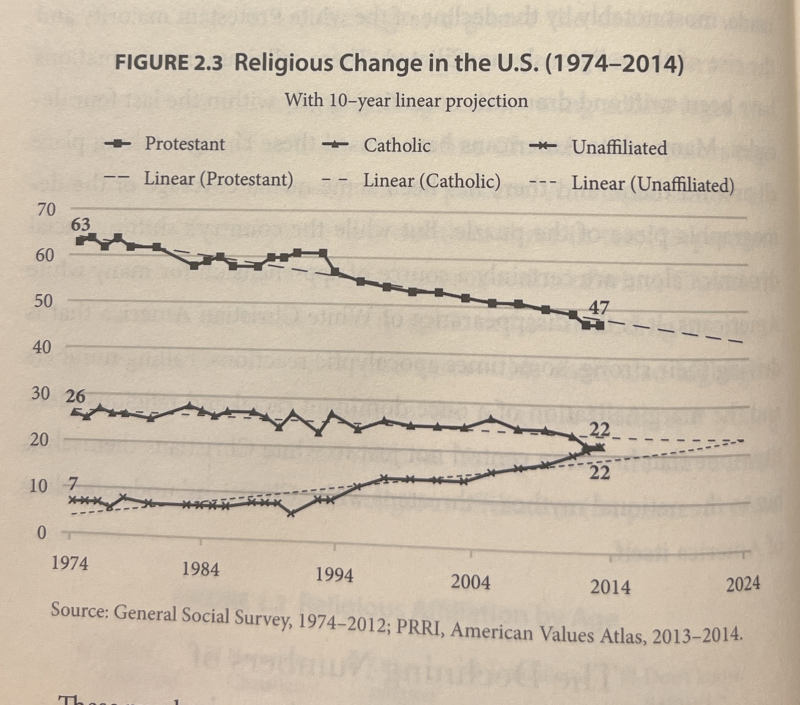
Evangelical Christianity as the dominant political force in America is dying from a self-inflicted wound. To suggest that Christianity in America is not waning is to ignore the obvious. But just in case, there are data to back it up:

Robert Jones's book looks at the decline of white Christian America (which he shortens to WCA) through a couple of lenses, but most significantly, the decline of WCA is due to its stance on homosexuality:

Today, many white Christian Americans feel profoundly anxious. As is common among extended families, WCA's two primary branches, white mainline and white evangelical Protestants, have competing narratives about WCA's decline. White mainline Protestants blame evangelical Protestants for turning off the younger generation with their antigay rhetoric and tendency to conflate Christianity with conservative, nationalistic politics. White evangelical Protestants, on the other hand, blame mainline Protestants for undermining Christianity because of their willingness to sell out traditional beliefs to accommodate contemporary culture.

Traditional Protestantism and more progressive Protestantism are both point their finger at the other, but the dilemma is real:

Moreover, more than seven in ten (72 percent) Millennials agree that religious groups are estranging young people by being too judgmental about gay and lesbian issues. Seniors are the only age group among whom less than a majority (44 percent) agree. The dilemma for many churches is this: they are anchored, both financially and in terms of lay support, by older Americans, who are less likely to perceive a problem that the overwhelming majority of younger Americans say is there.

As a skeptic, I can't help but find hope in this.

Leaving the Faith

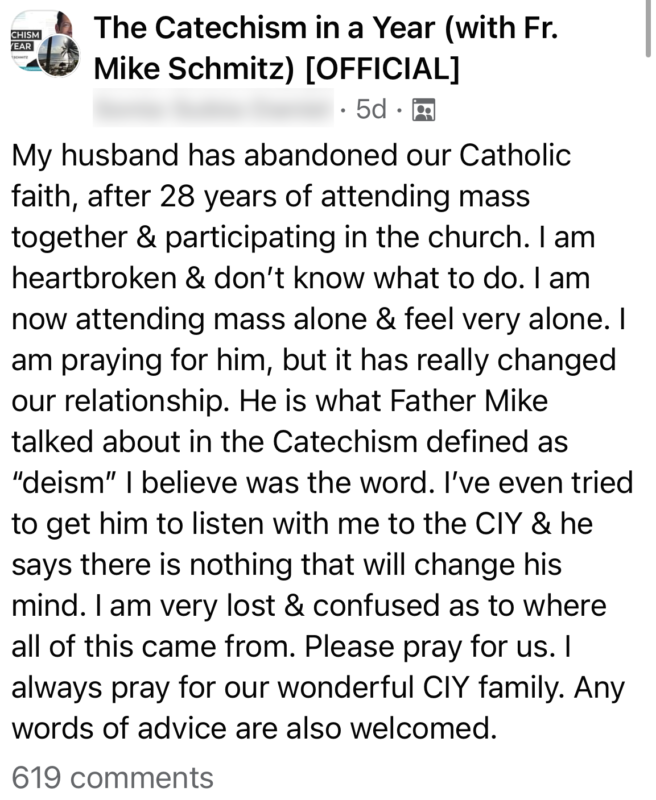
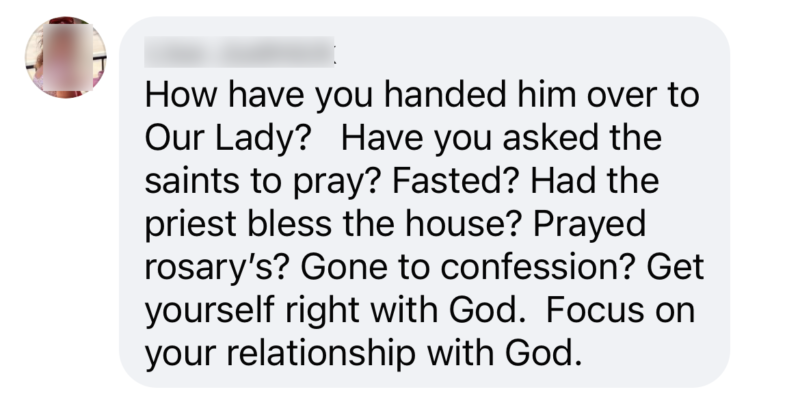
The post stood out immediately: I can relate, and so can K. Granted, I hadn't been attending Mass as long as the gentleman in question, but I could see myself in the post:

"I am very lost & confused as to where all of this came from," she admits, and I find myself wondering how this came about. Perhaps the husband had been on this long road of deconversion for years and simply kept it to himself because he didn't want his wife to worry. Perhaps as the issues piled up in his head he was in some sort of denial. Perhaps he dropped hints, unsure how to begin the conversation outright, and she just didn't pick up on them because they were so incongruous with everything she knew about him or because he, inexperienced with dropping such hints, was unable to do so in a sufficiently clear way. (That's the double problem with dropping hints.) Whatever the case, from her perspective, it's coming out of nowhere.

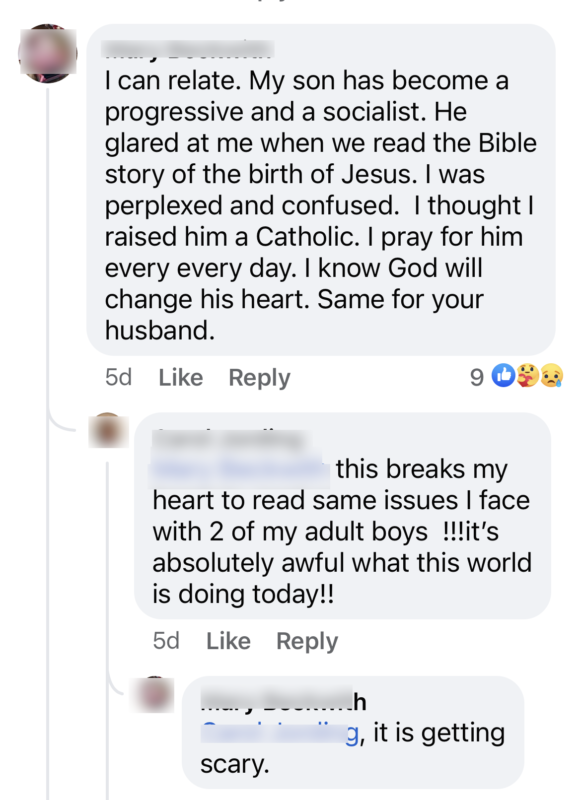
In responding to this, some people shared that they can relate. But at least a couple had me wondering if effective communication was actually taking place. One response declared that her son had become "a socialist."

Perhaps he does not align with a socialist political position, but knowing conservatives of the 2020s, it could simply be that he's now aligned himself with the Democratic party and the mother, true to Fox News talking points, simply labels him a socialist.

To that response, someone commiserated that "it's absolutely awful what this world is doing today," to which the original commenter replied that "it is getting scary." She suggests it's "this world," which is American Christian-ese "the Satan-influenced, Satan-worshiping society we live in," which in turn is simply the non-Christian segment of the population. And it's getting "scary" because more and more people are realizing that they don't need Christianity in their lives: church attendance is plummeting, especially among those under 40. These two ladies see the issue in terms of society as a whole, but they fail to understand the underlying causes, attributing it most likely to Satan's growing influence.

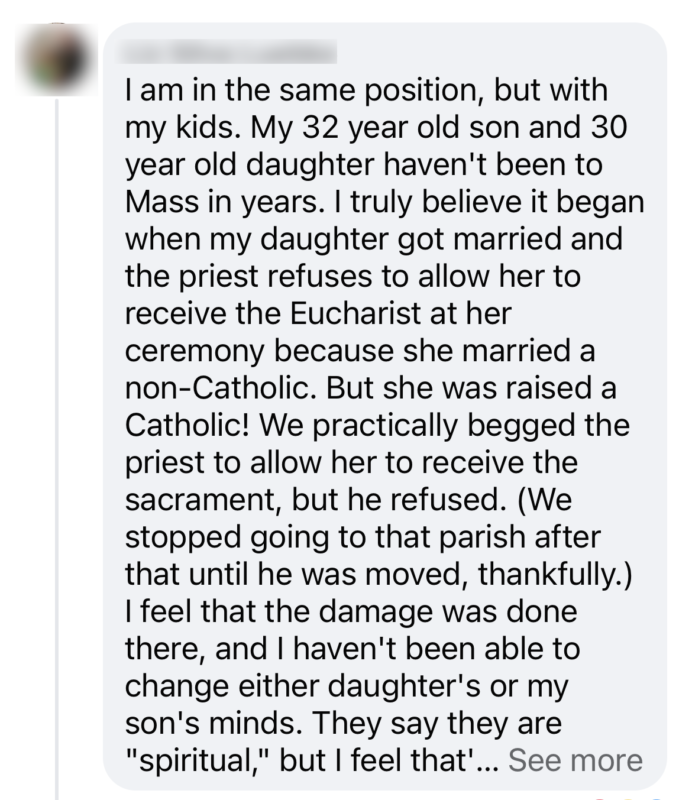
Some, however, did see that it wasn't simply a question of Satan's supposed influence but also a question of the hypocrisy and judgmental nature of contemporary American Christianity:

This comment reveals what I see as one of the primary causes of declining church attendance: the church is continually creating situations that amount to self-inflicted wounds.

Fundamentalist Christians insist that the Genesis account is accurate and that evolutionary theory is a Satanic lie. Then their children learn about the mountain of evidence supporting evolution and they're forced to choose between the faith of their parents or, as they see it, reality.

Fundamentalist Christians insist that homosexuality has no place in a Christian worldview. Then their children meet queer people and realize, "Hey, they're not the devils they're made out to be," and another church teaching falls to the side.

Fundamentalist Christians remove from their fellowship individuals who choose not to live according to fundamentalist interpretations of sexual morality, and their children find out their soccer coach has been fired, despite parents' and players' begging, mid-season because she got pregnant out of wedlock. Then the players are crushed, and a handful of them start thinking, "If this is how Christians behave, I don't think I need that in my life."

These are just a handful of the ways modern Christianity is sabotaging itself. Perhaps something like this went on with these commenters' children.

Others tried to fix the problem.

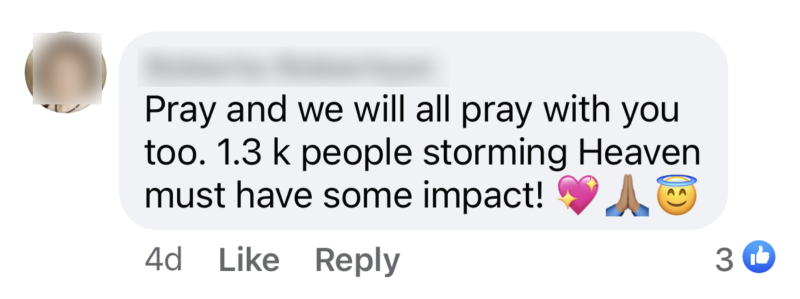
What happens when prayer doesn't work, though? What happens when these people are still not returning to church? These poor folks then have a second layer of doubt: why isn't God helping my child save herself? What am I doing wrong that is preventing this prayer from being answered?

As an aside, the metaphor of prayer as "storming heaven" is always a little strange for me. "Storming" is always used in the sense of an assault -- storming the beaches of Normandy. Soldiers storm a position because it's held by the enemy. In this case, "storming heaven" has connotations of viewing God as an enemy. I'm certain this is not what they intend, but I'm equally certain they've never really thought about the metaphor. It just sounds like strong, intense praying -- praying really hard.

Some people just passively-aggressively blamed the believers: it's your fault. You're not trying hard enough. You're not holy enough.

This could not possibly be helpful. Such a response only increases the sense of overwhelming guilt these people must feel. As with the "storming heaven" metaphor, this commenter probably didn't even think this comment out.

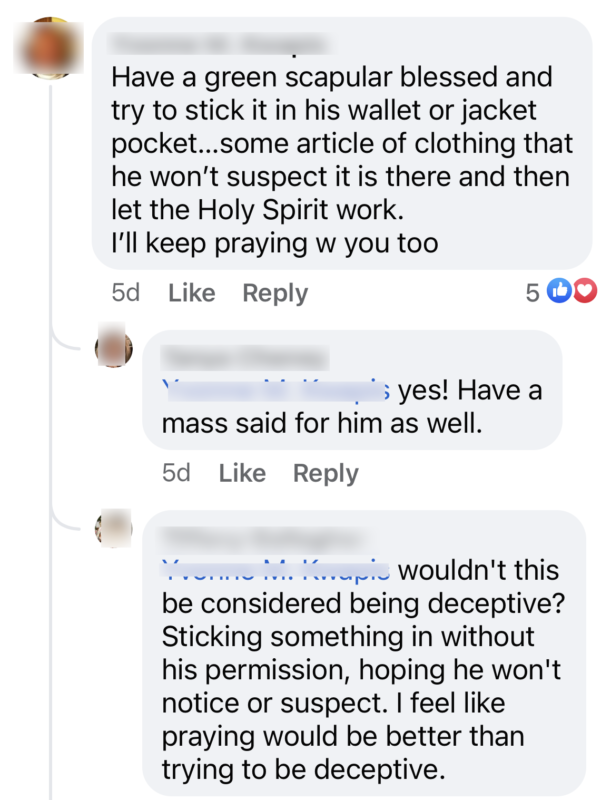
Finally, there was the Catholic sense of magical thinking on full display:

The Catholic reliance on relics and holy objects fascinates me. What would this scapular actually do? How would it affect things? And since this husband would be unaware that it's there, would that amount to God acting against this guy's will, thus negating the cherished notion of free will, a staple among Christians for explaining how evil exists on earth given the existence of an all-knowing, all-powerful, completely-benevolent god?

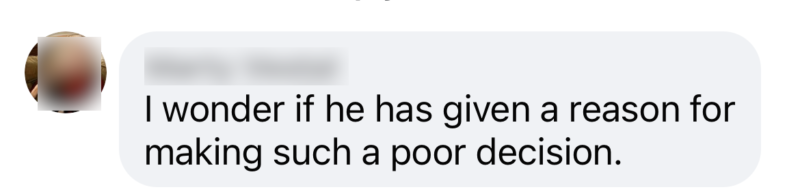
I can't really blame them for their thinking, though: there are certain lines a Christian cannot cross, and "he might have had perfectly good reasons for leaving Christianity, and he might have done so in good faith" is one of them. In such a case, if he found a reason to leave, perhaps I could as well -- and that's unthinkable.

No matter the reason he'd give, though, it wouldn't be good enough for them.

Spring Monday

The Boy and I have been listening to Josh Clark's The End of the World podcast, and it opens with a discussion of the Fermi Paradox, which the Boy tried to explain to his friend on the way to the pool this evening.

"See, the universe is millions of years old and..." he began when his friend cut him off: "No, it's only a few thousand years old."

Fresh shoots

"No," argued the Boy. "It's millions of years old."

"No!" his friend insisted. "It's only a few thousand years old. It's in the Bible."

At this point, I intervened: "Boys, stop arguing -- talk about something else."

On the way home, after dropping off his friend, I explained to the Boy what had happened, giving him a primer on young Earth creationism.

"But it's science!" he insisted incredulously. "There's evidence."

"But they don't accept that evidence," I explained, and he had a hard time understanding how someone doesn't accept evidence. I do too, truth be told. "It's just not worth arguing about because you won't change anyone's mind who thinks that way."

Hidden treasure

I went ahead and corrected his numbers while I was at it: "The Earth is, in fact, about 4.5 billion years old, and the universe is somewhere in the area of 13 billion years old -- much older than the couple million years you were insisting upon. I didn't correct you then because that would have meant correcting your friend, and I'm not sure how his parents would react to that."

My parents were young Earthers, too (at least for a while), but I'm not sure how they would have reacted to me coming home and announcing that one of my friend's father said indirectly that I was wrong and that the Earth is in fact much older than what they taught me. I don't imagine they would have prevented me from seeing the kid again, but if it had happened again, they might have. And certainly, very fundamentalist Christians would likely make such a move, and the Boy's relationship with his friend is much more valuable to me than what he's been taught about the universe.

Young blueberries

The Boy, then, experienced something like what I experience regularly: that sense when among more literalist Christians that we view the world in a completely different way.

An Apologist’s Response

While discussing the difference between the Old Testament god and the vision of the Christian god we see in Jesus, a social media commenter suggested I read Dr. Jeff Mirus’s “Making Sense of the Old Testament God” in which he attempts to “make God’s ways under the Old Covenant easier to understand” as a reader had requested. He concludes his introduction by admitting that he “can only do [his] best,” which seems to be a tacit admission that there really is no way definitively to reconcile these two visions of the Christian god and that it’s a matter of faith.

Mirus begins by suggesting that there’s not such a disparity between the seemingly harsh god of the OT and the loving god of the NT. There are two ways he does this. First, he argues that there are many passages in the OT that show a deity in line with what we see from Jesus. Fair enough. But he then suggests that Jesus had a harsh streak himself: Jesus’s “denouncing hard-hearted Jewish leaders, lamenting those who lead others into sin, rebuking the wealthy, condemning hypocrites, and foretelling disaster for unbelieving communities” were harsh elements of “Our Lord’s effort to wake us up.” He then quotes Matthew 11:21-24 in which Jesus does a lot of “Woe to you”-ing. Yet there is a big difference between genocide and harsh words. There is a chasm between rebuking someone and stoning them. This is like saying Truman was as harsh as Stalin because he yelled at people.

As the article develops, so does the offensive weirdness of Mirus’s logic. Regarding the harsh nature of the OT god’s commands to slaughter so many people, he suggests, "Finally, we must not forget the decisive separation of the sheep from the goats—those who will be sent into eternal fire." He is literally saying that the acts of cruelty we see from the Christian god in the OT pale in comparison to hell. In other words, "Yes, our god was pretty cruel in those times, but just think about how cruel he'll be toward you for eternity in hell!" There are elements of our god that are even more appalling than what we see in the OT, so this god is really actually good. This is another example of how Christians seem to suffer from Stockholm Syndrome: the very god that "saves" them is the being that creates the conditions from which they long to be saved!

Mirus then deals with a second “misconception [..] that the Old Testament authors thought of God’s will in exactly the same way as we do today."

This gets at the tension between the obvious fact that humans wrote the Bible and yet Christians claim that their god inspired the Bible. Where does divine authorship/inspiration leave off and human creation begin? In saying that "the Old Testament author thought of God's will" in any way that could be discernable in the text is to negate the divine authorship. Surely what the human authors thought would not interfere with the divinely giving knowledge of the reality of the situation. But this very idea that somehow the Biblical authors' own ideas got inadvertently mixed in with the divine revelation gives apologists the room they need to excuse the OT god of any wrongdoing.

Mirus continues by asserting that many of the abuses in the Bible are not God's responsibility: "It is easy to fall into the trap of believing that everything recounted in the Old Testament is the will of God." He then relates the story of Jephthah, who made a vow to sacrifice the first thing that came out of his door if his god would grant him military victory. When Jephthah returns home, his daughter runs out to greet him, which necessitates him slaughtering her as a sacrifice to his god.

Mirus argues that this is all on Jephthah and that we cannot hold the OT god accountable for this. That might very well be a good point that solves this dilemma, but it does nothing for the seemingly-countless times this god does indeed command people to do awful things. It’s a softball pitch intended to make readers more confident in the Bible and Mirus's argument.

In dealing with the OT god's commands for genocide, he asks, "Is there a significant difference between reading what God has done to this or that person or this or that people in the Old Testament, either directly or indirectly, as compared with the manner in which He appoints our lives, including the circumstances and agencies through which we will die, and which He alone both knows and contains within His own Providential limits?" In other words, our god is in control of how we die anyway, so does it really make him such a monster to kill us in this manner or that manner? He is, after all, a god: he can do what he wants! He made us; he sustains us; it's his choice.

First, imagine saying that about your own infant child: "Surely I can kill this child. I made her. I sustain her." What wretched monster would think like that?

Second, apologists can use this line of reasoning to excuse any action they undertake, no matter how horrific

Are You Tolerant?

While jogging this evening, I listened to a video by Prophet of Zod called "Do We Get Offended Because Christians Believe in Truth?" The entire video is below:

It's a critique of another video, this one by Impact 360 Institute, a Christian apologetics organization. The original video is here:

It's a ridiculous caricature of how non-believers view Christians, suggesting that non-Christians feel threatened and offended because Christians believe the things they believe, and these caricature atheists suggest in the name of tolerance that shouldn't be tolerated. It's as mind-numbingly stupid as it sounds.

However, there was a link to a set of questions designed to determine if one is tolerant or not. Intrigued, I went ahead and provided my email address (Gmail will sort out any of the spam the organization sends me as a result) and went through the questions.

Question 1: No one has the right to disagree with or criticize another person’s life choices.

The first question is a slow pitch that is based on the premises of the video: atheists are supposedly intolerant in the name of tolerance, and this first question is directed to that assumption. I don't know of anyone who would agree with this.

Question 2: College students should be protected from hearing ideas they disagree with because that would make them uncomfortable.

There is a fairly robust effort, it seems, to shut out voices that college students seem to disagree with, but it seems to be from the students themselves and not from the institute. The passive construction of the statement ("students should be protected") only suggests that it's the college itself that's doing the protecting. From what I've seen, it's the students who raise a stink. Sometimes, granted, the college caves, but often they don't.

Question 3: People should have the freedom to believe and publicly promote that two men or two women should be allowed to get married.

Notice the wording: it's saying that people should be able to promote it. Christians will say they have no issues with people advocating it. When it comes to implementing it, though, they will, as we have seen time and time again, vociferously disagree and fight it in the courts. Which leads to the next statement:

Question 4: A wedding photographer should be forced to use her artistic talents to celebrate and memorialize a same-sex wedding even though it violates her conscience and deeply held religious beliefs.

This is such a loaded, biased question that it's difficult to know where to start. First, we have the idea that the photographer "should be forced," which makes it seem like a draconian, totalitarian state that's behind it without coming out and saying it. It does this through the use of the passive voice. No one is suggesting that a photographer be forced to do this. If the photographer doesn't want to do it, she doesn't do it. It does mean, however, that can no longer be a photograph because they are denying their services in a discriminatory fashion. Some will say this is the same as forcing, but people have to do things in their jobs all the time that they don't really want to do. It's not, I suspect, that they don't want to "celebrate and memorialize" a same-sex wedding; they're homophobic and don't want to witness this wedding. Fine -- don't. But you can't withhold services because of that. We can frame this racially and see how bigoted it is: "A wedding photographer should be forced to use her artistic talents to celebrate and memorialize a [mixed-race] wedding even though it violates her conscience and deeply held religious beliefs." Suddenly, it looks different -- except that it doesn't.

There's also the word "celebrate." The wedding photographer is not a guest. She's not celebrating anything. She's recording the event. That's it. By doing so, she's not approving or disapproving of it -- she's taking pictures. If she's not willing to provide her services to anyone who wants to pay for them, she needs to find another line of work.

Question 5: No one should be compelled to embrace any religion against his will.

This is meant to help the individual (most likely a Christian since it is an apologetics site) feel good about their religious views: "We're not interested in forcing our religion on others!" Except if you're trying to outlaw (to use the previous example) same-sex marriage, you are attempting to force that particular tenant of your religion on everyone. You're compelling everyone to follow that particular part of your religion.

Question 6: People should have the freedom to publicly promote their view based on science that unborn babies are genetically distinct, living, and whole human beings and that their human rights should be protected by not aborting them.

Talk about stacking the deck: their view is "based on science." "We're just basing our views on science -- how can you argue with that?" Unless we bring up all the science they don't like -- evolutionary theory and global warming come to mind.

Question 7: Parents should have the freedom to believe, publicly promote, and teach their children that God designed marriage for a man and woman for a lifetime.

Now we're back to same-sex marriage -- isn't that what it's always about? Obviously, parents have the right to teach this, but implicit in this is the notion that they want to be able to support draconian laws to stop same-sex marriage. And that's fine, I suppose: it wouldn't be freedom if you couldn't be free to be a bigot. (Yes, I am aware of the loaded language I just used.)

By the same token, they have to accept that some of us are fine with same-sex marriage and think it might even be -- gasp! -- a question of equal rights.

Question 8: Muslims should have the freedom to believe and publicly promote that Allah is the one true God and Muhammad is his prophet.

What an out-of-left-field question! I really have nothing to say about it.

Question 9: It's not OK to respectfully challenge the truth of another person's sincerely held beliefs.

Christians themselves don't seem okay with this. "Why are you trying to push your atheism on us?!" they decry when all atheists have been doing is pushing back on centuries of the majority trying to stop them from "respectfully challenge[ing] the truth of another person's sincerely held beliefs."

Question 10: People of faith should not be forbidden to worship God according to their conscience or to express freely and publicly their deeply held religious convictions.

That depends, doesn't it? What about snake handers? They claim that three verses in the Bible allow, even call for, the handling of snakes as evidence of faith:

  • Behold, I give unto you power to tread on serpents and scorpions, and over all the power of the enemy: and nothing shall by any means hurt you. (Luke 10:19)
  • And these signs shall follow them that believe: In my name shall they cast out devils; they shall speak with new tongues. They shall take up serpents; and if they drink any deadly thing, it shall not hurt them; they shall lay hands on the sick, and they shall recover. (Mark 16:17-18)
  • And when they were escaped, then they knew that the island was called Melita. And the barbarous people shewed us no little kindness: for they kindled a fire, and received us every one, because of the present rain, and because of the cold. And when Paul had gathered a bundle of sticks, and laid them on the fire, there came a viper out of the heat, and fastened on his hand. And when the barbarians saw the venomous beast hang on his hand, they said among themselves, No doubt this man is a murderer, whom, though he hath escaped the sea, yet vengeance suffereth not to live. And he shook off the beast into the fire, and felt no harm. Howbeit they looked when he should have swollen, or fallen down dead suddenly: but after they had looked a great while, and saw no harm come to him, they changed their minds, and said that he was a god. (Acts 28:1-6)

Yet several states have legislation on the books that forbids this. Isn't that a restriction of their right "to worship God according to their conscience or to express freely and publicly their deeply held religious convictions"?

My Result

I answered as one might expect a left-leaning moderate atheist to answer. The response:

Congratulations, you are a truly tolerant person! In a culture that operates with a confused view of tolerance that thinks "real tolerance means agreeing that everyone’s moral, religious, or social viewpoints are equally valid and true," you have rightly rejected this false tolerance because it's unlivable. True tolerance respectfully allows others the right to be wrong because we disagree with them. The good news is you have strong beliefs about the way things should be. Continue to courageously and respectfully make your case and let the best ideas win. Is it messy? Yes. But true tolerance is the only way we will discover the truth about questions that matter.

Yet I'm sure in discussion, the makers of this "quiz" would determine that I am, in fact, not tolerant.

Fences and Guardrails

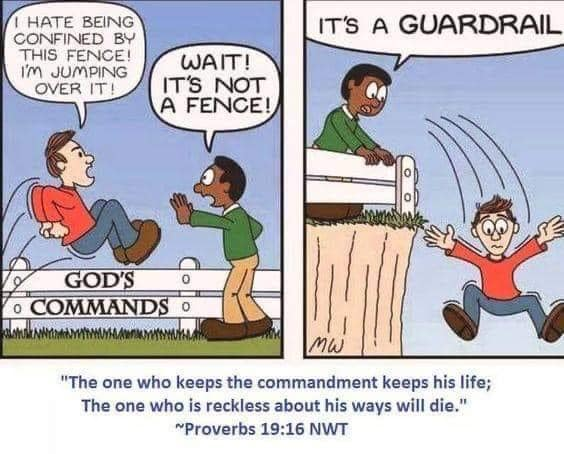
"God just puts these laws in place for our protection!" seems to be a common apologetic response to criticism of the laws of the Bible and the sense of absurdity some of them engender. There's even a cartoon about it.

This is such a silly cartoon -- it shows the absurdity of the argument better than apologists recognize. Most basically, the things that this god's law supposedly protects us from were created by that god himself! He made all the universe, according to apologists. He created all the laws of physics. He created all the contingencies and consequences. In other words, to relate it back to the cartoon, he created the fence ("guardrail") and the cliff. And he put the guardrail right at the edge of the cliff.

To turn it back to Christianity itself, this god created the laws and the consequences for breaking them (i.e., eternal damnation). If it were any other way, he would be dealing with something he didn't create.

This also plays into the idea of Jesus's salvific sacrifice. He's saving us from the consequences of breaking some god's laws. The trouble is, according to the doctrine of the trinity, he is that god! He's saving us from himself.

No matter how many times I point this out to believers, they just don't see it. They bring up free will and all that: "God created us with free will, and we can abuse it and reject God."

"Yes, but this god put in place the laws and their consequences. He's the one sending you to hell and then saving you from it," I reply.

"Yes, but he loves us so much that he sacrificed himself for us, to pay our debt."

"Our debt to him!" I want to scream.

If I am beating a child and then stop beating that child, I haven't saved him any more than the mafia, when receiving payment, is not saving you from anyone other than themselves.

How do they not see this?

Definitions

“I was just here a little while ago,” E lamented as we neared our parish church for basketball practice tonight.

“Why?” asked N, genuinely perplexed. N is a dear friend but not a member of the church.

“For religious education,” the Boy explained.

“What’s that?”

“It’s like school,” E said.

“What do you learn about?”

“Church.”

“That wasn’t a very informative answer,” N pressed.

“Well, we learn about,” the Boy pauesed for a moment before finishing, “well, it’s about everything church.”

“That still doesn’t tell me much,” N insisted.

“Well, today we learned about sacraments,” E clarified.

N thought for a moment before admitting, “I don’t know what that is at all.”

When I was N’s and E’s age, I, too, would have had no idea what a “sacrament” might be, and I certainly would have no idea what it’s supposed to do. According to the Catholic Church, sacraments are “outward signs of inward grace, instituted by Christ for our sanctification.” Even if someone told me that, I doubt I would have understood what any of that might mean.

Outward sign? Simple enough.

Inward grace? Not sure what “inward” means here, and even now as an adult, it's not clear. I suppose it's meant to be juxtaposed with "outward" to create an appealing bit of parallelism. But are we talking internal medicine "inward" or are we talking mental inward? Or are we talking spiritual? Of course, that doesn't even exist, but if they meant "spiritual" why not say "spiritual" instead of "inward"?

I certainly wouldn’t know what “grace” means here. I would have known "grace" from a basic Christian idea of forgiveness, but beyond that, I'm lost. And what's an "inward grace"? Are their other kinds of grace? What does the Catholic Encyclopedia say?

Grace (gratia, Charis), in general, a supernatural gift of God to intellectual creatures (men, angels) for their eternal salvation, whether the latter be furthered and attained through salutary acts or a state of holiness. Eternal salvation itself consists in heavenly bliss resulting from the intuitive knowledge of the Triune God, who to the one not endowed with grace "inhabiteth light inaccessible" (1 Timothy 6:16). Christian grace is a fundamental idea of the Christian religion, the pillar on which, by a special ordination of God, the majestic edifice of Christianity rests in its entirety. Among the three fundamental ideas — sinredemption, and grace — grace plays the part of the means, indispensable and Divinely ordained, to effect the redemption from sin through Christ and to lead men to their eternal destiny in heaven.

Source

Look at all those links -- they're all articles to offer further explanation about the various ideas.

“Sanctification?” No idea then as now. The Catholic Encyclopedia lists "grace" as "sanctifying grace" and has an article on the related topic of justification but nothing on sanctification. It's all just a confusing mess when you really look at it:

Since the end and aim of all efficacious grace is directed to the production of sanctifying grace where it does not already exist, or to retain and increase it where it is already present, its excellence, dignity, and importance become immediately apparent; for holiness and the sonship of God depend solely upon the possession of sanctifying grace, wherefore it is frequently called simply grace without any qualifying word to accompany it as, for instance, in the phrases "to live in grace" or "to fall from grace".

I suspect most adult Catholics wouldn’t be able to explain it beyond the memorized explanations they might have learned in religious education. Push these ideas a little and they begin to slip and slide for the average believer; shove and heave on these ideas and they begin to crack for the average parishioner.

Apologists would explain that this is due to “insufficient catechesis.” But eventually, even the most expert catechist is going to run out of answers. Or they're going to begin saying stuff like the quotes above, which sound elevated and sophisticated but which, when really examined, are empty and relatively meaningless -- when someone pushes back hard enough.

N, however, was content to sit in ignorance.

Slippin’ and Slidin’

Got into a discussion on Twitter with a Christian about morality. I made the point that Christianity invents the idea of sin (the transgression of a diety's law) and then sells the solution (Jesus). My interlocutor quickly moved to the "you have no grounds for morality if you don't believe in a god" argument. I said,

I know what you're getting at. I've seen it all before. It's a tiresome road to travel down. Your god commands the stoning of incorrigible children (Deut 21:18-21), so I don't think believers in the Bible can take the moral high ground as you're trying to do.

The interlocutor replied,

What you just cited was never Carried out. Even the Talmud says this. This was stated by Moses to put fear into GROWN children to obey the commandments to love their mother and father.

To which I responded,

Carried out or not, it was commanded. By your god, no less. You can't deny that. The fact that it wasn't carried out goes against your assertion that morality comes from your god. If it wasn't carried out, it means people realized it's a sick command.

To which she replied,

How could my God command it if he doesn’t exist?

I answered,

Just because I say "Juliet made a bad decision" doesn't mean I have to believe she existed. I'm working within the framework of your holy book. It's that simple.

What I learned from this exchange is the slithery, slimy nature of religious discussions. One topic slides off to another and to still another. Exhausting.