Matching Tracksuits

fun in fours

faith

Work as Prayer

Benedictine spirituality sees work as a kind of prayer. The rule of Benedict teaches that, through daily, mundane work, we can achieve holiness. Like so many holy orders of so many other religions, Benedictines from the beginning understood the beauty of the simple life. Theirs is an asceticism not only of the body but of the mind as well.

I thought of these things this evening as I was puttering about the kitchen, cleaning up after K went to bed, emptying the dishwasher, wiping off the counters, drying the remaining dishes that had been sitting in the sink drying rack. I continued wondering how work might be prayer as I went upstairs and, on an odd whim, pulled out the ironing board and iron. K earlier in the evening had expressed a certain frustration at how things in the house tend to build up: our to-do list seems always to be expanding, rarely if ever contracting. But if work is somehow prayer, I thought, that means we have paths to holiness all around us.

Yet that helped very little: how exactly is pressing a heated piece of metal against fabric to steam out the wrinkles in any way prayer? It occurred to me that it might be a question of re-framing what "prayer" means. Growing up in a decidedly non-Catholic home, I always had a very strict and limiting view of what prayer was or could be, and it make the Catholic notion of prayer seem somehow foreign. Marian devotion and prayers to saints were most decidedly and perversely wrong. But the Protestant notion of prayer might be closer to the Catholic notion of worship, and so Catholics through the centuries have had a broader view of what prayer is than Protestants.

Yet that still didn't help me understand how work might be prayer until I began thinking about motivation. I'd purposely put most of K's clothes on the top of the to-iron pile because I was doing it for her, to help her feel a little less behind, and it seemed somehow silly to be ironing my own clothes. "I helped you out by ironing my shirts and pants." It just seems somehow unseemly, arrogant.

Work in some sense then can be prayer through having a selfless motivation for work. Perhaps that's a first step in understanding Benedictine spirituality. Or perhaps it's just late night rambling of someone who should have been in bed some time ago.

Birth, Material, and Mystery

The birth of our son today leads to thoughts of matters of significance: of the miracles and improbabilities of love and life; of the cosmic scope of unbounded affection and the microscopic details it discovers; of the sweetness of sacrifice for sweetness; of the paradox of pain in beauty and beauty in pain; of phlegm and blood and the sacred oils of life; of the indescribable perfume of a newborn and the musicality of his cry; of the promise of motets, poems, and equations that threads through a life from the moment of conception; of the paradox that one plus one equals one, two, four, or more; of the perfect symmetry of our asymmetrical familial lives; of a softness too delicate to believe and too tough to be broken; of the illogical logic of a mother’s love; of trust and patience and a million other things that shouldn’t exist in a purely material world; of souls and blessings and angels; and of a father’s circular reasoning.

There are biological and anthropological explanations for all this. Studies of nature show we are unnaturally natural and naturally unnatural, that we have the same codes at the heart of our being as chimps and many of the same behaviors circling out from that almost-identical genetic blueprint. Physics and astronomy combine with chemistry to form a foundation for a biological explanation for why I would fight to the death for my son, daughter, and wife, but even the most elaborate string theory or quantum physics can make sense of it, can discover why I should, can illuminate the goodness of altruism.

And so I am left in a chilly room with an exhausted wife and a swaddled son, an energetic daughter bouncing from idea to idea with grandparents who can only try to keep up, and the realization that at the heart of it, the mystery of this all is what must be at the start and finish of any human endeavor. Mystery is the thread through our lives that strings together all our happy accidents and makes continuity out of chaos. Mystery, in the form of love, is the thread that makes embroidery out of our lives, but someone must be pulling on the needle.

Lent 2012: Day 13

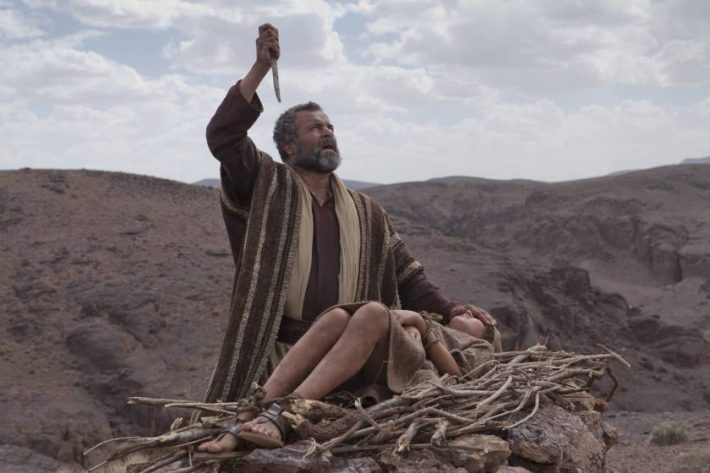
Yesterday's reading at Mass was one of the most famous in Scripture: the commanded sacrifice of Isaac. Here's a thought experiment I wrote over fifteen years ago when I was still in college.


Some time later God tested Abraham. He said to him, "Abraham!" "Here I am," he replied. Then God said, "Take your son, your only son, Isaac, whom you love, and go to the region of Moriah. Sacrifice him there as a burnt offering on one of the mountains I will tell you about."

So begins one of the most extraordinary stories in literature. The story of God's command to Abraham to sacrifice Isaac is undoubtedly one of the best known Biblical stories. Soren Kierkegaard says, "The story of Abraham is remarkable in that it is always glorious no matter how poorly it is understood." Indeed, it is an amazing story of faith and an incredible testament of ultimate trust in God.

One wonders, though, how the story might have changed had Abraham said, "No" to God's command. The possibilities are endless, for there are so many variables. God might simply have accept the answer and go off in search of someone else to become the Father of the Faithful. He could roar, "How dare you defy me!" and strike down Abraham in fiery wrath. God might take a more human approach and beg: "Ah, come on. Trust me; I know what I'm doing!"

However, before pondering God's response, one would have to take into account Abraham's reason for refusing to follow God's command. Perhaps it would be for selfish reasons. After all, Isaac is Abraham's only offspring, a miracle child born when Sarah was well beyond child-bearing years. It is only natural for Abraham to cling stubbornly to his only child; certainly, old age would prevent Abraham and Sarah from having another. Possibly it would spring from incredible love for Isaac: "I'll not do that to my son!"

Or it could be because Abraham feels homicide is wrong. He could shake a fist at God, declaring, "No! I will not kill, for any reason. I will not violate my conscience for any reason, not even divine command."

This produces an entirely new possibility in the historical story of Abraham: God's test of Abraham is open-ended. When God commands, "Take your son, your only son, Isaac, whom you love, and . . . Sacrifice him . . . as a burnt offering" God might be willing to accept either answer, "Yes" or "No."

Once Abraham submits to God's injunction, then there is no change from the actual account found in Genesis. Abraham is still regarded as the Father of the Faithful and the Bible remains in its present form.

If, however, Abraham refused on the grounds that the commanded act โ€“ murder โ€“ violates his conscience, God could respond, "I swear by myself that because you have done this and have not compromised your conscience for any reason, I will surely bless you and make your descendants as numerous as the stars in the sky and as the sand on the seashore." Abraham would then become the Father of the Morally Steadfast. The entire Bible might be radically and totally different. Wholly different lessons would be learned from the story of Abraham. James 4.17 might read, "Anyone, then, who knows the good he ought to do and doesn't do it, sins. For Abraham did what he knew to be right in his heart, even when God commanded otherwise."

A series of questions then arises: If it was an open-ended test, what was God hoping it would reveal about Abraham's character? If either obedience or disobedience was acceptable in this particular instance, what was God looking for in Abraham's response? The only answer is passion. God was simply looking for someone who would act vigorously, someone who was zealous and complete in his actions. Whether or not Abraham was obeyed would not have mattered, for obedience could be learned more easily than zeal.

God has a way of changing people's minds, but usually, they are already zealous in their activities, such as the apostle Paul or Jonah. Both men lived lives violently opposed to what God ultimately desired of them but both were dynamic and spirited in what they did. Jonah ran from God and his destiny and Nineveh with all the strength he could muster, and Paul persecuted the early Christians mercilessly, with every ounce of his strength. In both cases, God turned the men around and put them to his work, which they accomplished with even greater vigor, for they were now working toward a goal instead of running away from one.

This kind of passion could be exactly what God was looking for in Abraham. What God sought was a man who would be decisive and would back up the choices made with all his energy, ready and willing to accept the consequences of each action. God didn't want someone apathetic, someone lukewarm.

Of course, Abraham did not say, "No." He obeyed God even when it made no sense to him, even though God was asking him to do something from which there seemed to be nothing good that could arise, something ridiculously absurd. Some would label it blind devotion. Others call it faith. It is a kind of faith that to most of us in the twentieth century find alien, for there would be few โ€“ if any โ€“ people today willing to commit himself so fully to God's will. Many people are not able โ€“ or willing โ€“ to understand why Abraham did what he did. Antagonists of Christianity point to this story as evidence of the absurd cruelty represented in the Bible, in an attempt to discredit the Bible as barbarous and antiquated. Yet the story records Abraham's faith to the disbelief and astonishment of readers throughout the centuries.

The fact that Abraham did not disobey God makes the story even greater, adding immeasurably to its authority and puissance. It is a story of strength, of a strong man passing a test offered by an infinitely mighty God. Even the most fervent Christian must sometimes feel a little apprehensive about serving a God who would ask so much of one person, and this apprehension leads to great respect for Abraham and his faith. Underlying all of this is the question, "How could God ask such a thing, and how could Abraham obey such a ludicrously evil command?" It is the same question that antagonists of the Bible ask in an attempt to discredit the Bible. There must be an answer that glorifies the Bible and God. Yet it is sometimes difficult to get beyond the command itself and to understand the motivation of it's charge and the power of Abraham's obedience.

While talking to a friend about the magnificence of the story of Abraham and Isaac I was presented with a startlingly beautiful answer to this delimit. The test was not supposed to prove anything to God โ€“ the test was simply for Abraham to realize the power of his own faith. As God is spirit and outside of time, he would have been able to know exactly what Abraham's response would be. Not only that, but God's omnipotence would allow him to see inside Abraham's heart to behold the energy of faithful obedience pulsing deep within Abraham's being, out of even Abraham's knowledge. It took such a powerful test as God gave to bring into fruition such a powerful force as Abraham's faithful obedience.

Both Biblical precedence and common sense underscore the logic of this position. God commands obedience and the Bible is the story of those who obeyed and those who disobeyed. Always God rewards those who submit to his will and do what he commands. He didn't reward Jonah for running. He didn't reward Paul for persecuting. Yet he did reward Abraham for his obedience.

From a common-sense position, to say that the test was for God's sake is ridiculous, for God knows everything. He is outside of time, therefore knows the future, present and past all simultaneously. God is omnipotent, all-knowing โ€“ there was nothing that he could learn from Abraham's response that he didn't already know from the beginning of time.

On the other hand, to say that the test was for the sake of Abraham works either way โ€“ God wanted to prove to Abraham his own moral fortitude of his own powerful faith. God, being outside of time, knew Abraham's reaction long before Abraham was even born. God, therefore, knew the quality his test was to exemplify for as equally long. Accordingly, God knowing Abraham's reaction does not disqualify the submission that the test was open-ended.

Accidental Christmas Present

We were leaving the church after a Christmas Mass in Polish when we noticed a group of men standing around the priest's new Volvo. Apparently, someone had hit his car and driven off without anything. I saw a little scratch, but I couldn't discern any significant damage.

The priest was angry.

He called the parish pastor to let him know it had happened, and he requested that the local priest announce it in Mass, asking for information.

"I guess this is my Christmas present," said the Polish priest sarcastically.

Perhaps it was.

It seems to me that the material should not be terribly important to a priest. It seems to me he should have been more concerned with the individual who hit his car: what would cause someone to do this? Is this a lack of conscience or a fear of facing consequences? It would have been heartening to hear the priest say something like this.

So maybe it was a Christmas gift. Maybe it was an opportunity to show instead of tell the parishioners that the spiritual is more important and things like cars and iPods are of little value. Perhaps it was a chanceร‚ to preach with actions rather than words, to show forgiveness and express concern about the mental state -- the soul -- of the individual who committed the act. Possibly it was an occasion to show selflessness, to show concern for others before showing concern for one's own silly objects.

The homily had been about having Christ in one's heart and how God doesn't force himself on anyone -- a fairly common sentiment among Catholics and Protestants alike. I suppose the gift of salvation isn't the only gift God doesn't force humans to accept.

Thoughtful

What I was getting at in the last post is simple: most inspirational writing requires no mental unpacking. It tells; it doesn't show.

Nell Maiden (who, I recently and sadly discovered, died in 2003)  shows:

Prayer, September 29

Lord,
if it's going to happen,
pack it in an earthquake.

Give me epiphanies that blind,
that trip or wring
and tear but leave no doubt.

Deliver me from diurnal grinddown,
from innuendos, suspicions,
from mere cells quitting.

Let it be fatal and instant.

Or stripe it with rainbow.
Call me to action with purple.

Lord, let me know.

I sleep in lieu of deliberation.

I'm strung staccato.

I'm insensitive to puns, hair growing,
the lampshade wearing thin, that shy kiss
that hardly costs a breath.

Lord, grant me moans.

And when it's over, give me
a moment to realize and leave
me breath enough to say:
yes, yes, yes.

Amen.

That is what I mean.

But most Evangelical believers don't seem to be interested in things that have multiple meanings, especially when it comes to belief and faith. They seem to be less interested in instant epiphanies than instant religious gratification: microwave dinners for the soul.

I don't want my soul filled up with cliches.

I’m okay, you’re okay

Most Christian inspirational writing is simply an affirmation of mutually accepted beliefs. Much of it offers little new insight. At best, it’s semi-poetic reinterpretation of old Christian cliches; at worst, it’s painful restatements of the obvious.

Take this passage from Speechless, by Steven Curtis Chapman and Scotty Smith:

Jesus has taken away our punishment on the cross. There he defeated our great enemy, Satan. Godโ€™s loudest singing and his most passionate delight is expressed in the gospel of his grace. Through the gospel God is with us. By the gospel he saves us; In the gospel he delights in us. Through the speechless gospel he quiets us with his love. In the gospel we hear him rejoice over us with singing! Does your heart allow you to imagine God himself serenading you with his love songs?

What does this really say? Nothing that Christians don’t profess on a weekly, daily, or even hourly basis, depending on their level of personal piety: God loves us, and Jesus died for us.

“Jesus has taken away our punishment on the cross.” Heard it a thousand times. Nothing new there. It’s about like saying, “Mayonaise is made from eggs.”

“There he defeated our great enemy, Satan.” And hamburgers generally have meat in them.

“Godโ€™s loudest singing and his most passionate delight is expressed in the gospel of his grace.” This is a semi-original way of saying, “God’s happy when someone is saved.” What Protestant church doesn’t ring with those words at least once a week?

“Through the gospel God is with us. By the gospel he saves us.” Shoes generally have an element on the bottom known as soles.

“In the gospel he delights in us.” God loves you — that’s at least one being in the universe that loves you.

“Through the speechless gospel he quiets us with his love.” Really, God loves you.

“In the gospel we hear him rejoice over us with singing!” I’m not joking — God loves you.

“Does your heart allow you to imagine God himself serenading you with his love songs?” I’m only going to say this once: God loves you.

It’s like contemporary Christian music: what sense of satisifaction can someone get saying/singing the same thing over and over and over and over and over and over? There seems to be so little intellectual content. All emotion, all the time.

Even Schleiermacher would be distressed…

My New Hero

How easily are people manipulated? How quickly can someone change a complete stranger's will? Just how fragile are we, mentally speaking? A few videos from skeptic Derren Brown shows just how easily someone with skills can manipulate people.

But by far, the best (a tie):

Views from a walk


God in the Aisle

I sometimes go to Mass with my wife for companionship, and today, I was certainly glad I did. Before I get into the reason why, some theology.

Catholics of course believe in something they call the “Real Presence,” which is the belief that the bread and wine are the actual body and blood of Jesus. It’s based on an Aristotelian concept of accident and essence — what a thing looks like and what it really is. So the Catholic explanation of why it still looks suspiciously like bread and wine is that the outward appearance has remained, but the essential reality has changed.

This is why there’s all the genuflection in churches and especially before monstrances, because if that really is God in the flesh flour, then it only makes sense to bow.

This also goes a long way in explaining the controversy about how a parishioner can take the host: standing, kneeling, on the tongue, on the palm of the hand. I think the variety is strictly American. In Poland, the issue is vastly simplified: stand or kneel. There’s no way a priest will give it to your hand in Poland.

“Real Presence” also explains why some might be a little uneasy with the idea of anyone other than a priest handing out the host. In the States, members of the congregation hand out the blood and wine (though the priest has consecrated it and all that). Again, this is probably a completely American thing.

All this is to explain the significance of why I’ve always wondered what would happen if someone tripped and — whoosh — there’s God, all over the floor.

At this morning’s Mass, my question was answered.

An elderly woman, serving as Eucharistic minister, was heading back up to the altar (and so her chalices were probably almost empty) when suddenly there was a stumble, shuffle, and crash. I saw the whole thing out of the corner of my eye, and I immediately directed all my attention there — as did everyone else in the basilica.

The priest kept right ongoing, but not many people were giving him their undivided attention. Everyone was looking at the aisle, watching the lady pick up the hosts as another Eucharistic minister helped her. Then a deacon came with a cloth that had been dampened, I’m assuming with holy water, and wiped the spot.

The woman was obviously quite shaken. She said some words to the priest, and he sympathetically comforted her. Returning to her seat, she muttered something to her husband, and that was that.

It highlights how atypical Catholicism is in modern culture, where all sense of the sacred has disappeared. “And so much the better”ย many of us would add, but sacredness fosters a certain respect that I’m not sure you can get any other way. It’s simplistic to explain it, “Well of course it’s respect — born out of fear, a terror that some deity will toast you.” There’s certainly an element of truth in that.

Communism tried to foster some sense of the sacred — the working masses were the vessels for salvation. The working man is the communist messiah. Marches, songs, flag-waving, speeches — all these things to foster a sense of the sacred in the people. Yet it didn’t work. My wife grew up in that culture, and it was all a joke for everyone. Why?

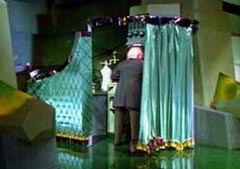
Man behind the curtainIt lacked mystery.

Without mystery, without an element of the unknown and inexplicable, nothing can be sacred. Indeed, sacredness could be defined as a sense of mystery about something thought to be of divine origin. If you see the little old man putting together the wizard show, hanging the curtains, preparing the control panel, it is only through an act of supreme wishful thinking that you can put your faith in the Wizard.

More on the Soul

Thud challenged that my comment โ€œThe belief in a soul becomes increasingly more difficult to maintain in the light of evolutionary psychology and advances in cognitive scienceโ€ is โ€œan unfounded assertionโ€:

How does it become increasingly difficult to believe in a soul? It may be increasingly difficult to believe that oneโ€™s sense of self is entirely separable from the physical form, but that doesnโ€™t mean thereโ€™s no soul. Thereโ€™s an enormous chasm between saying โ€œwho we are is changed by what we areโ€ -- I think thatโ€™s a safe statement -- and saying "we are nothing but meat."

Itโ€™s increasingly difficult because there are increasingly fewer things we can attribute to "the soul." Thud himself admits โ€œwho we are is changed by what we are,โ€ but how is that logically possible if who we are intrinsicallyย is spiritual? How can the physical affect the spiritual? The supposed miracles of the Bible show the reverse is generally the accepted view, but the belief in the soul requires the opposite to be true. A few questions then:

First, how could the soul be affected by the body? Simple -- memory. Memory and memory alone is what makes human identities possible, and if the soul is in any way equated with our โ€œidentityโ€ (and if itโ€™s not, whatโ€™s the point?), the memory will be a necessary component. So neurons firing a certain way in the hippocampus, the amygdala, or the mammillary somehow deposit a copy of activity in the soul? The soul is an all-in-one card reader? How does it work without stepping outside the boundaries of logical and basic scientific principles?

Second: weโ€™re talking about the soul without even considering where it came from. If we believe in a God, then weโ€™re his creation; if we believe the theory of evolution is a better explanation than the Book of Genesis, then weโ€™re the products of millions of years of cosmic chance; if we want to hold both beliefs at once, we call ourselves proponents of intelligent design. I hold to option two. Itโ€™s the option that has the most scientific evidence. Now, if I hold to that option and assert that thereโ€™s a soul, then where the hell did it come from? How did millions and millions of years of cosmic bumper ball create something spiritual?

Third: What effect do sudden changes in a personโ€™s identity have on the soul -- indeed, how is that even possible? What sort of โ€œsudden changesโ€ do I have in mind?

Phineas Gage, with his famous three-foot-seven-inch railroad spike through his head.

Some months after the accident, probably in about the middle of 1849, Phineas felt strong enough to resume work. But because his personality had changed so much, the contractors who had employed him would not give him his place again. Before the accident he had been their most capable and efficient foreman, one with a well-balanced mind, and who was looked on as a shrewd smart business man. He was now fitful, irreverent, and grossly profane, showing little deference for his fellows. He was also impatient and obstinate, yet capricious and vacillating, unable to settle on any of the plans he devised for future action. His friends said he was โ€œNo longer Gage.โ€ (Source)

But we donโ€™t have to look to 19th-century tragedies. Think lithium, anti-depressants, Prozac. I recall meeting with my grad school advisor and discussing this. โ€œHow many Kierkegaards have we destroyed with Prozac?โ€ Indeed -- Kierkegaard, Mahler, and how many other manic-depressives would never have created their classics if theyโ€™d been born in the late twentieth century.

All the way back in 1979 there was an article about this. The abstract:

Twenty-four manic-depressive artists, in whom prophylactic lithium treatment had attenuated or prevented recurrences to a significant degree, were questioned about their creative power during the treatment. Twelve artists reported increased artistic productivity, six unaltered productivity, and six lowered productivity. The effect of lithium treatment on artistic productivity may depend on the severity and type of the illness, on individual sensitivity, and on habits of utilizing manic episodes productively. (Source)

But we donโ€™t even have to look at medication for drastic changes. Watch some of your friends when theyโ€™re drunk.

So itโ€™s not that Iโ€™m suggesting that there isnโ€™t a soul. Iโ€™m simply saying that logic and science combine to show that there are, as Steven Pinker expressed it, fewer and fewer hooks on which to hang the soul.