Matching Tracksuits

fun in fours

faith

Immaculate

Tomorrow is the Feast of the Immaculate Conception, a holy day of obligation in the Catholic Church, which means you've got to go to mass. Our new parish, though, is only have a morning mass, so we went to the vigil mass tonight. At six. Which meant the Boy was ready to go to sleep before mass even began.

The notion of the Immaculate Conception has always confused me, no less now that I'm Catholic. The idea is that, to avoid the "stain of Original Sin" passing on to Jesus, God removed from Mary at her conception original sin. The mechanics of this, as I understand it, involve retroactively applying the salvific nature of her son's sacrifice to her -- which brings about an obvious question: why not just do that to everyone? In the spirit of "fake it until you make it," I go along with it. But the whole thing leaves me a little off kilter. So, truth be told, does the whole Christian story, and I guess that's supposed to be the point of it in some sense.
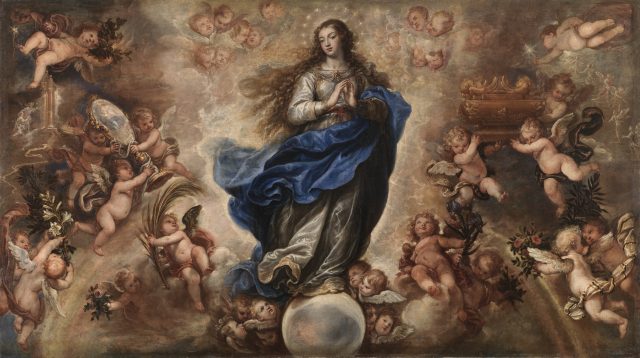
Mary's holy and immaculate conception, by Francisco Rizi, Museo del Prado, 17th-century, Oil on canvas. Via Wikipedia

There are so few things we encounter these days that we could call "immaculate." A newborn child. And I sit here, thinking about what I could add as a second item on that list, and even with the thought of adding a qualifying "perhaps," I'm stuck. Perhaps that's a good thing. Perhaps that's what Original Sin is all about. Perhaps it's human nature. Perhaps Original Sin is human nature. Perhaps it's not important at 10:50 on a Wednesday.

Part of growing up, I think, is that realization that "immaculate" really doesn't exist in our world. The natural world is filled with such cruelty, with wasps that plant their eggs in still-living organisms that the larva will literally eat alive -- and likely very painfully. Then there are all the natural disasters just waiting to happen, or just happening. Thinking about "immaculate" leads us to think about its opposite, whatever that might be, and perhaps that's a good thing. Perhaps that's the point.
Autumn Ritual

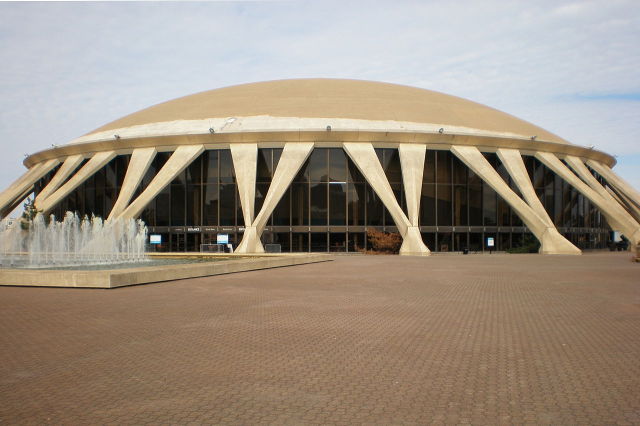
In years past, last Tuesday night's gathering would have filled a large-capacity auditorium, or even a civic center, like the Scope Arena in Norfolk, Virginia. They would have sat in dozens of rows on the floor, up risers, into the balcony area, and walking into the arena that first night would have produced an excitement in everyone that was audible.

Norfolk_Scope2

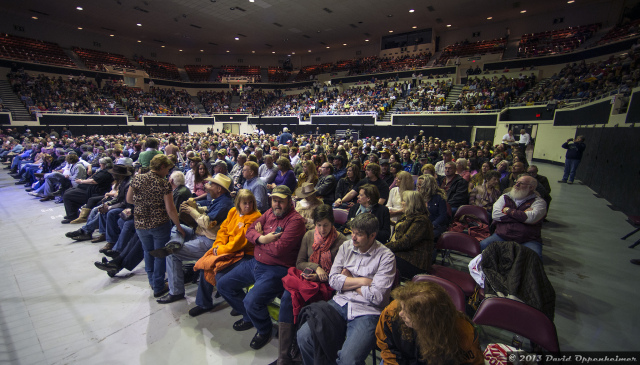
Thousands of people, gathering for eight days, in locations all over the world. It would look something like this, except for more formal attire.

8654388381_328f47d1aa_k

Part of my past that I haven't experienced in almost twenty years as best I can remember. Ninety-five was the last time, I think. Those gatherings have continued through those years, but my trajectory has gone in the opposite direction before veering back to something more like an eighty-degree angle: not quite the same beliefs, but certainly not a denial of all the beliefs.

Those gatherings have continued for the last twenty years, though the single, monolithic church organization that originally held it has splintered into almost countless pieces, with the organization itself changing its name and completely reversing most of its old doctrines -- like the required eight-day Old Testament festival observance -- so that it is indistinguishable from other mainline Protestant groups. The splinters that fell away have been keeping up the tradition, though, and last Tuesday night, in Bend, Oregon, a pastor opened the gathering with a message that has been repeated every fall with the regularity of the changing leaves.

They've been starting like that for decades now -- I still wonder every autumn how many more decades it will continue. When will a group that proclaims definitive prophetic events within our generation and has been proclaiming it in vain for something like seventy years (Germany will rise again, don't you know?) -- when will such a group (or in this case, groups) disappear for good? For how long can someone declare that "time is short" and warn people that a great confederation of European nations with Germany and the Vatican at the head will rise up and utterly decimate the United States? At which point does the hypothesis -- no, the sure prophecy -- become just too ridiculously and obviously wrong for anyone to take seriously?

Temptation

In Mass, there are a lot of temptations every Sunday morning. It really begins well before Mass, when as is always the case, we’re running late. My temper flares, and I have to consciously tell myself that barking out orders won’t make L put her shoes on any faster. But once we’re there, the temptations only increase.

Inordinate pride is a big sticking point. I like to say that my children will be well-behaved in Mass because

  1. they understand the ontological reality of what’s going on there and respect and believe in it;
  2. I am such an awesome parent that I have trained them like good little monkeys; and
  3. I don’t want to disrupt anyone else’s experiences in Mass.

In reality, it’s that second one that gets top billing: I’m just embarrassed because my kid isn’t as saintly as that kid, two pews up, just to the right.

Clothing is another area of temptation. Women come to Mass dressed like they’re going out for a night on the town, and men come dressed like they’re going to the beach or for a hike in the mountains. “Can you believe he/she wore that to Mass?” is on the tip of my tongue, and sometimes the temptation is just too great, and I point out to K the fashion offender. “Don’t they know why we come to Mass?” I always finish, then regret that I even brought it up, that I gave into the temptation.

Then of course there are the temptations of distraction:

  • “Boy, that lector is really stumbling over that reading. Perhaps he should have reviewed more.”
  • “Oh no! She’s singing the responsorial psalm?!”
  • “Dear God in heaven, could he distribute communion any slower?”
  • “Really? Checking Facebook just after receiving the Eucharist?”
  • “Well, if I’d known he was giving the homily, I might have just stayed home.”
  • “Why in the world would anyone select that hymn?”
  • “Doesn’t he know any better than to wipe his nose with his right hand just before we do the sign of peace?”
  • “Cheapskates: they never put anything in the offering basket.”
  • “I’m still kneeling here: you should be too so I don’t have your nasty hair in my face.”
  • “There is nothing in the missal to indicate that we should all be holding hands during the Our Father! Uggh!”
  • “If that kid doesn’t stop putting that kneeler up and down and up and down and up and down, I’m going to…”
  • “Dang, if that guy behind me sang any more off key, he’d be singing in a whole different mode.”
  • “Wow, that’s a big hat.”
  • “Really, only the priest should be praying in the orans position!”
  • “That is just the nastiest perfume on the planet. What is it? Eau de Dead Fish?”
  • “That’s right — do the Judas Shuffle: receive and leave. There’s piety for you.”
  • “You snotty little teenagers: this is the crying room, not the ‘don’t want to sit through Mass and would rather chat it up with my friends’ room.”

Of course in the summer, there’s a whole new batch of temptations, most commonly about clothing selections. It usually goes like this: “He is a grown man, with graying hair and kids who appear college age, and he’s still wearing shorts to Mass? Does he not realize that there comes a time in one’s life when one understands that comfort is not always the be-all, end-all goal in life?” That thought is more often than not amended with, “And he’s wearing flip-flops for heaven’s sake! There’s not a beach within three hours’ drive of here, and even if there were and even if you were going to the beach immediately after Mass, you should be dressed like you’re going to the beach while at Mass especially when you’re a grown man!” Occasionally I can match it with another gripe: “She’s wearing that top to Mass?! Really?” And every now and then, I can tack on one more: “And their teenage daughter is wearing tight short shorts?”

Pride is truly at the heart of all sin.

Candles

Gratitude

The small steps one takes to the greater goal: with the Boy today, it struck me that I don’t do enough with him during Mass to help him develop spiritually. I’d fallen into that silly line of thinking that he’s too young to get it. How ridiculous. We’d begun teaching him how to cross himself after dinner prayer. He gets the head — belly and shoulders, not so much. And he ends folding his hands together for “amen.” “If he can get that, of course he can begin other rudiments of the faith.” So today, during the Liturgy of the Eucharist, we knelt together for a moment. He ran his car on the floor after a few seconds, but it’s the small steps.

Small steps can of course grow into gigantic leaps, and Polish Mass today showed that as well. The choir, which began simply as K singing along with the organist, has grown in all senses, so that today the choir boasted seven members including an international accompaniment section that included a trumpet player who’d learned the hejnaÅ‚ played from St. Mary’s Basilica in Krakow hourly. I recorded the final hymn; watching the video, K mused about the irony: “That’s one of our most patriotic hymn, and we had a Latino accompanist and an Irish-American trumpet player.”

I can’t deny that at times, K’s choir involvement bothered me. Not because of what it was but the lengths to which she sometimes went to participate, singing when she was sick, singing when she’d rather do just about anything else. To have such a woman in my life at all could not fail to make me a better man; to have such a woman as my wife often leaves me speechless.

Given the rambunctious nature of our daughter, such a temperament as K’s seems nonnegotiable. It’s certainly not environment and it’s not obviously genetic — at least not in the first generation — but there it is all the same: energy that can be frustratingly exhausting, frustratingly difficult to redirect, frustratingly everything. Yet it’s not hard to see the gifts and wonder packed into her small frame as well. While playing tag after Mass, she reminded me just how incredibly nimble-minded she is. “JesteÅ› berkiem!” one of the boys called out, and she smiled as she ran after him: “I know I’m it!” She lives in the midst of two languages, two cultures, so effortlessly. If only it were effortlessly: it’s another struggle sometimes, but these little moments that show us that it’s not all in vain are welcome.

Back at home, I returned to my morning task, grading essays on Romeo and Juliet. As they’re all turned in online through a course management system, I can see the resulting word-counts in a simple list. Quantity is not quality, but seeing word-counts that average close to a thousand words, I remembered students’ incredulity at the beginning of the year when I told them that by the end of the year, five hundred words would seem restrictively short. And here it was, right on my computer screen: proof that I’ve had an impact. It’s easy to say, “We teachers can only plant seeds,” after days that seem like staying at home and bashing one’s head into the wall repeatedly would have been more productive, but such moments of clarity make those days all worthwhile.

Four things to be grateful for, in four different categories — spiritual, spousal, familial, and career. And the fact that it was so easy for me to think of these four things is itself something for which I can be thankful.

Donald Miller

Even our beliefs have become trend statements. We don't even believe things because we believe them anymore. We only believe things because they are cool things to believe.

The problem with Christian belief -- I mean real Christian belief, the belief that there is a God and a devil and a heaven and a hell -- is that it is not a fashionable thing to believe.

Burton Visotzky

[Belief] may be the battle of your life, but emotionally and intellectually, it could also be the most exhilarating one you’ve ever engaged in. Whether you experience God’s reality or are just intellectually intrigued by the idea, God can be a very real force in peoples’ lives – spiritual, emotional, supportive – that almost no other system can offer. But you must gird yourself for a fight and know that you’re going to have to try to reconcile very difficult things. Or at least hold them in suspension and bounce them back and forth and get tired. There’s no quick fix, but we have the benefit of drawing on thousands of years of religious thinking. You can’t learn it over a weekend. It’s an engagement for the rest of your life.

Eric Sevareid

One asks not only for the courage of his convictions, but for the courage of his doubts, in a world of dangerously passionate certainties.