matching tracksuits

fun in threes, sometimes fours

education and teaching

Honesty

Sometimes students stop me dead in my lesson, and I stand there, unable to think what to do next. I'm not talking about "stupid" questions, or even behavior problems. Rather, I'm referring to that tendency all students have to say or ask something that just makes you reflect.

The other day I was fed up with a class and its behavior -- not even putting forth the slightest effort in a group speaking activity.

Now, I know it's artificial. I realize when I give them a task to do in English, they could accomplish it immediately in Polish. But as I ask them, "What for?" Usually they cooperate. Sometimes they don't.

They other day, they didn't.

In retaliation (and that's really the right word, I think), I assigned them a lot of homework. Basically, they were to translate the entire text we were reading into Polish.

I got the expected response: a chorus of "Proszę pana!" ("Please, sir!") I stood firm, though, and refused to relent. "The whole thing," I told them.

As they were filing into the classroom the next day, I could sense something was up. Then one lad stomped in, flopped down in his chair, and gave me a glare. He violently opened his book bag, jerked his materials out, and slammed them on the desk.

He's a theatrical boy, this lad (we'll call him Maciej), and so I regularly would have paid no heed. But the general atmosphere in the class was, as I said, strange, so I had my guard up.

Roll checked, then my usual line: "Show me the homework," in the silly way that Cuba Gooding, Jr. did, sort of, in Jerry Maguire. And so they start pulling out a typed translation -- a first, to be honest.

They started handing it in, and it hit: it's the same paper, photocopied twenty times.

"Michał, do you have your homework?" I ask one boy.

"No," he said. Another in the back piped up, "He didn't have the twenty groszy for copying."

Shock -- here they are, admitting it.

"What?"

"Yes, we copied it all, sir," replied Boy in the Back Row.

Then Agata began to explain, "See, sir, we had a big test in math today, and we didn't have any time to do the English homework. So Maciej typed it into the computer, ran it through a translator, and we all photocopied it."

I glanced down at the work. "It's the product of a computer translation, that's for sure," I thought

"We have homework in English every day," Agata continued. "We don't have many grades in math, and this was very important."

"Maciej, how long did it take you to do this?" I asked.

"Two hours," he grumbled.

"And the math test?"

"Pała," he replied. I probably don't need to translate that.

So where did it leave me?

The facts were simple:

  1. It was an unreasonable assignment, given in wrath, so to speak, rather than from some pedagogical motivation.
  2. They were honest about it.
  3. Their reason for not doing the assignment was fairly compelling.
  4. It didn't seem fair to punish them, or even get angry.

I simply stood there, thinking, "What to do? What to do?" I wanted to be fair, but I also had to save face. With some classes, face and authority are equivocal for a high school teacher, so I had to strike a balance.
Dziennik

Each class has one. All teachers are responsible for keeping it up to date. Students have a right to look at it at just about any time. And the Ministry of Education can cause a lot of headaches if it doesn’t like what it sees in it.

So what is this mysterious thing called a dziennik?

I’m tempted to say it’s a direct consequence of The Fall, God’s punishment for all evil on earth, or other such silliness, but I’ll simply say that it’s one of the most annoying things about teaching in Poland.

“Dziennik” is Polish for “journal,” and The Dziennik (imagine a Charlton Heston-esque booming voice saying that) is the grade book for each class. It is the record of the entire class for the entire year, and keeping it up to date is the biggest headache I know of. All grades for all classes (biology, English, physics) are in this marvel of modern stupidity as well as the personal information of each student, and in addition, attendance is marked in one portion.

The most irritating and annoying part of it is the slots for lesson topics. For each lesson, I must write the topic in a special little slot. Now this doesn’t seem like much, but it can be an incredible pain in the ass. Teachers take the dziennik to class, and it is always bouncing through the school–one never really knows where it is. So you forget to write your topics one day.

Then that one day becomes two. Then three. Four. A week.

Then comes the fun.

The Polish equivalent of the homeroom teacher comes and points out all the slots where you forgot to write the topic, and you’re supposed to get out your notebook, look up that day, and write the appropriate topic.

Of course I write all my topics in English, so the obvious struck me long ago: “Only [Basia] (the other English teacher) knows enough English to understand what I’m writing in here. I can write anything I want.” So that’s what I started doing.

After that, topics included, “General Chaos and an Attempt to Keep Them Interested Forty-Five Minutes” and “Stuff.” Song lyrics can provide good topics: “Looking for someone, I guess . . .” or “Looking Over that Silly Four-Leaf Clove.” I suppose it’s immature, but we’re all allowed to be childish every now and then, right?

Mind, I didn’t do this regularly–just when I’d forgotten to write the topic or (more likely) the dziennik wasn’t available at the time.

Some years ago, when I did this more often, the other English teacher finally saw me doing it, and she asked me to stop. “I’ll be the one who gets in trouble,” she protested. At that time I didn’t speak much Polish, really, and she was the go-between.

Reasonably enough, she didn’t want to get yelled at.

I toned it down a bit, something like “Present Continuous in Questions and Cow Tipping.”–a combination of the two.

In theory, she explained, someone from the Ministry of Education might know enough English to understand what I wrote, and then the stuff would hit the fan.

I thought to myself, “If the Ministry of Education doesn’t have anything better to do than to sit and read every single topic in some little village’s school’s dziennik, then I think whoever was reading it might appreciate the humor.” But I said nothing. And wrote for my topic that day, “Telephone Vocabulary and Other Silliness.”

Singing in Class

One of the best things about being an EFL teacher is the fact that I can do "stupid" lessons and get by with it.

Like singing Christmas carols. Imagine going to math (or "maths" for those who prefer British English) class and the teacher says, "Today, we're going to sing Christmas carols." Even in, say, literature class it doesn't really float.

But in English class, it does. So I teach the kids a few songs. This year:

  • We Wish You a Merry Christmas
  • Jingle Bells
  • Silent Night

Nothing special. I've always wanted to do "Jingle Bell Rock," but they don't know the melody, and that's key. It's a language lesson, after all, not a music class.

I can't really recall learning Spanish Christmas carols in high school. Perhaps we did, but I have no memory of it...

Tom’s Diner

English has twelve tenses; Polish has three. It’s a nightmare for beginning students to keep all that straight. We spend a lot of time drilling, doing “boring” written work, etc. but from time to time, I’m able to think of something completely original and — dare I think — even entertaining.

It happened one evening that I was planning lessons, thinking, “I need a good, fun lesson for present continuous,” and wondering what I would come up with. (Present continuous, for those of you who don’t know, is, for example, “I’m reading a book at the moment.”) I put some music on, sat down, and began planning.

Gradually, I found my attention drawn to the music I’d begun planning, and I sat there, jaw open, as I listened to the perfect present continous lesson (not to be confused with the not-so-perfect present perfect continuous lesson) — Suzanne Vega’s “Tom’s Diner.” It had everything going for it: the whole thing is in present continuous; it’s very popular in Poland, especially the DNA mix; the vocabulary is relatively simple.

In the intervening years, it’s become one of my most successful lessons.

It goes like this:

  1. Students get a worksheet that has the lyrics printed out, but without the verbs, and in the incorrect order. For each verb, they’re provided the necessary infinitive, the tense necessary, and any additional information/words (like “not” or “already”).
  2. After students take fill in the verbs, we check them all, and make sure they have a basic understanding of the meaning.
  3. Then, I just put the song on and watch — who is going to catch on? Eventually, I point out that it’s the worksheet we’ve been working on and tell them that the next task is to put the stanzas in the correct order. We talk about what the song means and make sure they understand it all, or, they translate it all for homework — depending on how much time we have.
  4. The next day, they’re divided into groups and prepare to act out the song in time with the music — a live music video, I tell them. This takes only a few minutes, and then we do something else. The actual video is the next day.
  5. Show time — and some classes take it very seriously and come in dressed up, with props and materials.

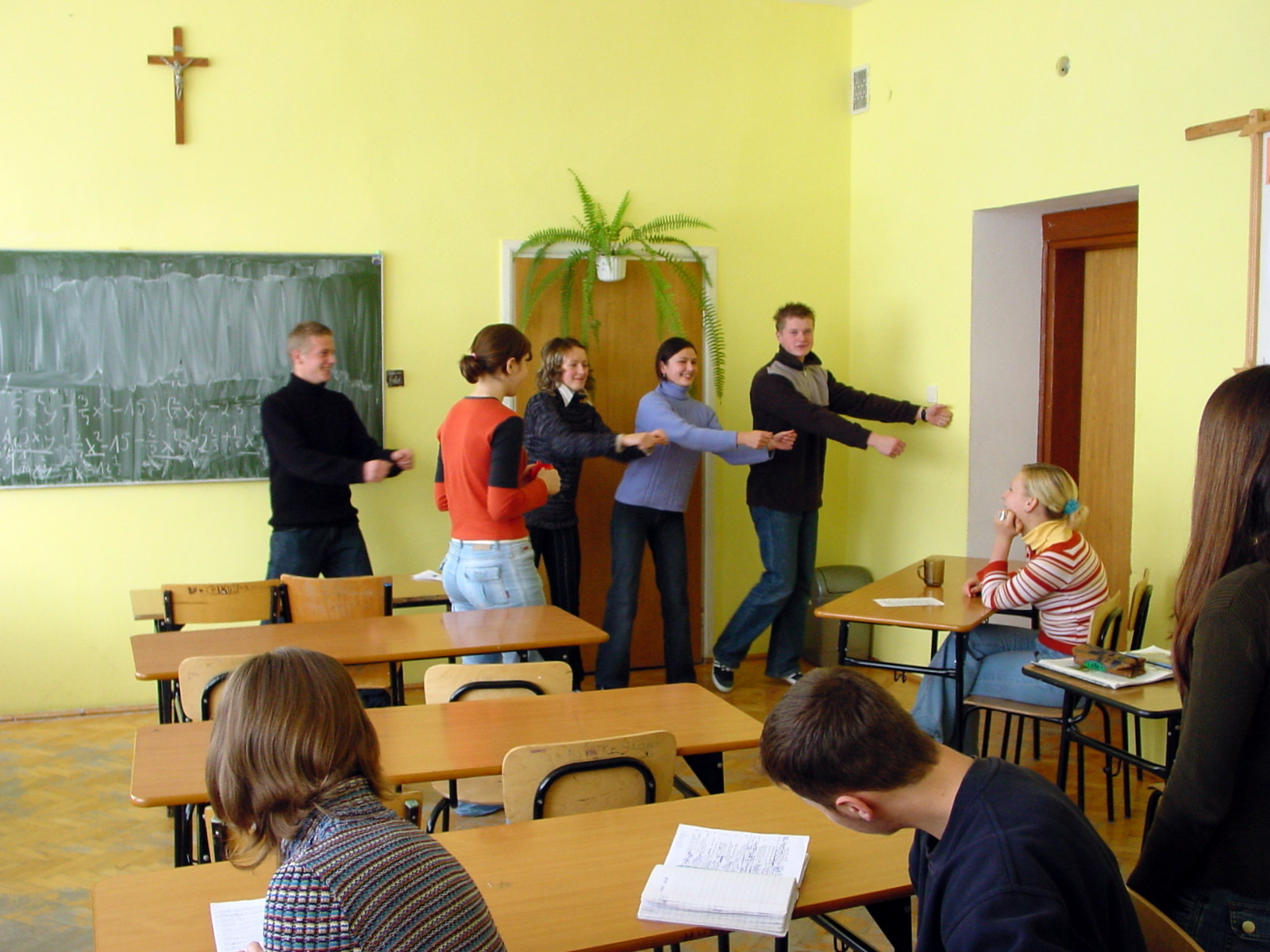
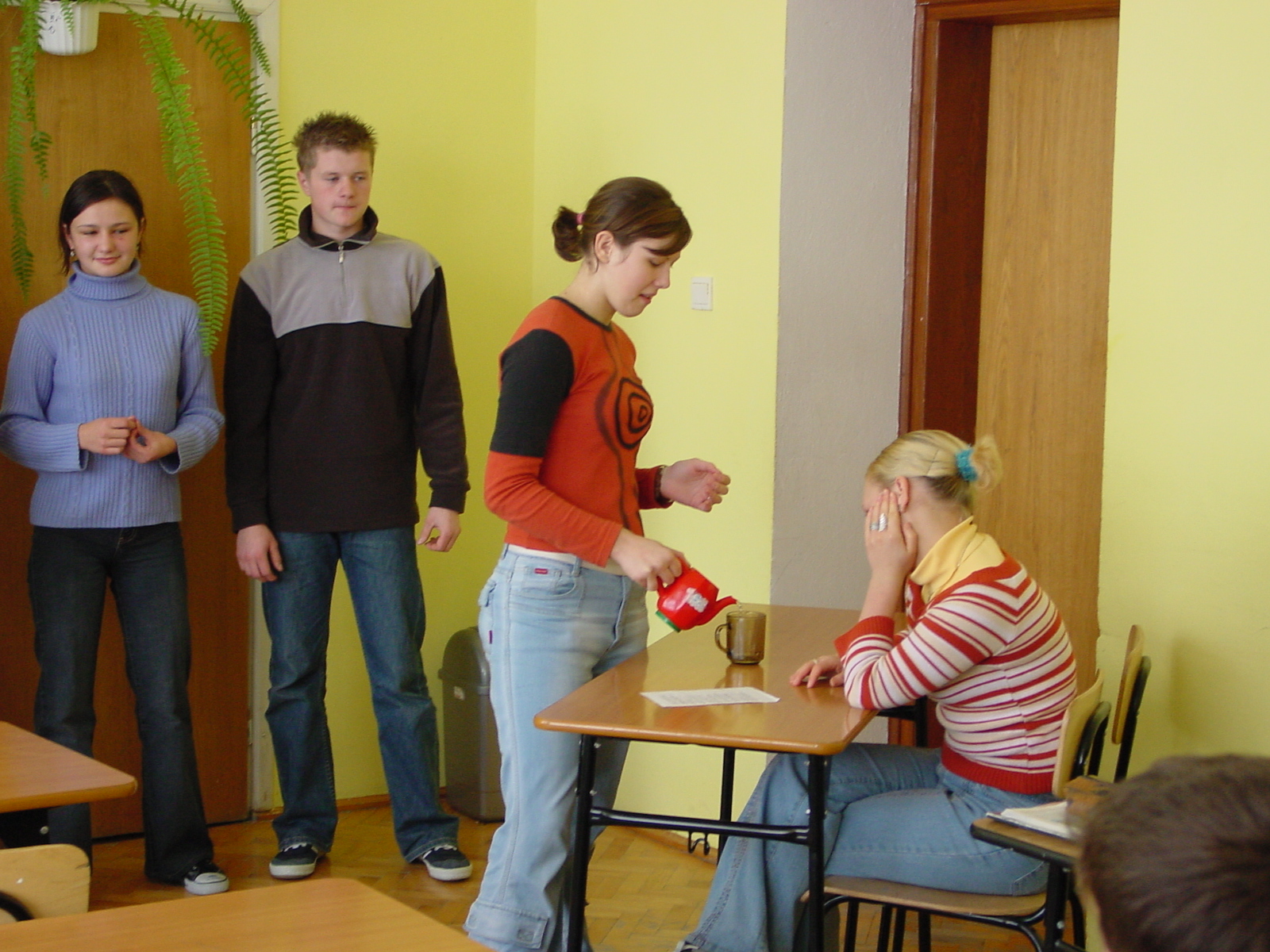
This was the most recent “performance” of the video. The day we were preparing the skits, several people were absent, who were then not absent when we were to perform it. What to do with them? Simple — they were a doo-wap chorus, and they even danced.

Most of the time, it’s very rewarding being a teacher. Sometimes, it’s simply fun, as well.

The Magic of Zamfir

Yesterday at school there was an unexpected “surprise” — a concert. Zamfir came, and brought his whole music-lite ensemble: a keyboard player. They began with a few classical-esque selections, but once the keyboard player got the programmed drum beats and bass going, there was no stopping them.

Many of the students were having trouble sitting still to such stirring music and would half leapt into the aisle to go Polka mad but for the fact that everyone was crammed like “herrings in a jar.” So they just tapped there feet and smiled merrily.

Some, moved by the music’s depth and power, sat in awe — I think I saw a tear or two trickle.

A couple of students whispered to me, “This is great, sir, but I sure wish we were back in class!”

Of course, ninety percent of this is made up. Ninety-nine, more like it. There was no Zamfir, no Polka sparkle in the eyes, no longing to go back to lessons. There was a concert, and it did include a young man of about twenty-five playing the pan flute while a woman accompanied. And the music was as artificial as you have probably been imagining.

I’m all for broadening students’ cultural awareness, but not in this way. Introducing them to such music as a way to get them interested in styles of music other than techno or metal (the two dominant preferences among my students) is doomed from the start, mainly because the students agreed to go (each class had the option of going or not, but they had to go as an entire class) in order to get out of lessons. Of course, I would have done the same thing at their age. Also, just giving a concert is not going to engage a sixteen-year-old male in any meaningful way if it’s the music he’s not used to, and he wrinkles his nose on first hearing it. Better to have a shorter concert, interspersed with explanations of the songs — their history, the period they come from, etc. — followed by perhaps short discussion afterward of the music. “Yes, that particular song did have a bird song quality to the melody. It’s because…” And for Mahler’s sake, don’t let it be simply a way to get out of class. That accomplishes nothing.

I try to introduce my students to various types of music throughout the year. One lesson I like to do toward the end of the year involves at least five different songs. It’s for intermediate students, and I simply have them do some free-writing (that’s where you just write uncritically what comes to mind — like most blogs, I would imagine) while I put on various songs. “Imagine you’re at the cinema,” I tell them, “and as the movie begins, this is the song you hear. What’s the movie about? What do you see happening?” And then I put on an incredibly eclectic mix: Ben Folds Five, Mozart’s requiem, Albert King, Ella Fitzgerald, and Johnny Cash come to mind as I recall past lessons.

The reaction is generally bad.

But at least once I held them in rapt attention. While doing some quite writing work (not related to the lesson described above), I put on Bruce Springsteen’s The Rising and told them that much of this album was connected to 9/11. Students who were usually squirmy sat and wrote quietly, while others just listened to the music, hands on folded arms, eyes wide open, utterly still.

I’m still at a loss, though, as to how effectively to broaden students’ musical awareness.

Is nothing sacred?

In Poland, separation of church and state doesn't exist, and priests teach religion courses in publicly funded schools.

Today I caught a student writing cheat notes on his arm for a quiz he was having in religion class!

"You realize that when you take a test and you cheat, it's the same as lying, right?" I asked him.

"How so?"

"Well, when you take a test, aren't you implicitly saying that you're taking the information only from your own knowledge?" I asked.

"I guess," he muttered.

"Then cheating is a form of lying," I concluded.

A thoughtful moment. "So?"

So, indeed.

This is only a test

Three of the seven classes had a test today on passive voice. You all know what “passive” means, right? You remember getting those papers back from your high school teacher with “passive” scribbled in the margin and wondering, “What the hell does that mean?”

My handy-dandy, five-step, active-to-passive transformation guide.
1. What is the main verb?
2 .What tense is the main verb in?
3. What is the direct object?
4. What is the verb “be” in the tense from question two?
5. What is the past participle of the verb from question one?
And then — 3+4+5=passive voice

If you’re a non-native English speaker reading this, I’m sure you don’t need this explained.

And that’s the irony of it all. In many ways, non-native English speakers know grammar much better than thoseof us who grew up speaking the language.

There’s a whole side of our native language that we native speakers don’t naturally know. For example, if I were to challenge most Americans to construct a sentence in present perfect continuous tense in the subjunctive voice, there might be a bit of head scratching, even thoughthey would understand the sentence, “I would have been writing this forever if you hadn’t helped.” (Yeah, thatexample is a bit awkward, but it works.)

When I first came to Poland to teach English, I had no idea about many such things. For instance, what’s wrong with the sentence, “I have done it yesterday”? Several years ago, though I was an English major in college, I would have had a hard time explaining. Now, it’s simple: “I have done it” is in present perfect tense, and present perfect tense is used for the indefinite past. “Yesterday” is fairly definite, I would say.

Back to the issue at hand: passive voice. A sentence is passive if the subject is not the “doer” of the verb. For example: A ball was thrown. They ball had nothing to do with the action — it indeed received the action. The active would be something like, “My mother threw the ball.”

Today’s test was designed to check students’ ability to change sentences from active to passive, as well as to decide when a sentence should be passive and when active. Some samples from the test:

  • (President / send / me / a letter of congratulations || Present Simple) A letter…
  • (People / write / more books about computers / than about any other subject || Present perfect) More books . . .

Correct answers:

  • A letter of congratulations was sent to me by the president.
  • More books are written about computers than about any other subject.

Some involved just putting the verb in the correct tense. Sort of.

  • This car ______. It’s too old. (not/to steal – Future Simple)
  • This street ______ because of snow. (already/to close – Present Perfect)

Among the English-to-Polish translation (a rarity in my tests) were “tree sap” and “unleaded.” Results, thus far, are less than spectacular.

EFL Materials

Ever wonder what an EFL (English as a Foreign Language) textbook looks like? I certainly did as I was preparing to come to Poland for the first time back in 1996. After all, how often do you get to see a textbook teaching something you already know fluently? Naturally, after four and a half years' experience, I've seen and used more textbooks than I care to remember. I thought I'd share a little about the books I've been using.
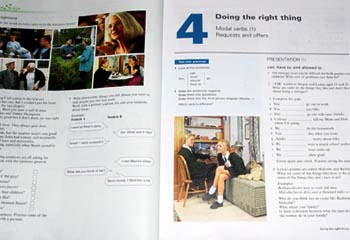
Most units tend to be thematic. For example, for practicing modal verbs such as "should," "must," and "have to" (among others), this particular book (and many others) use the idea of advice and "Doing the right thing."

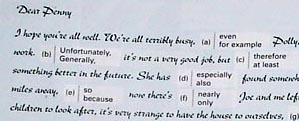
There are certain groups of easily-confused words, and some activities are aimed at improving students' ability to choose the correct word from a similar pair. This particular book is written specifically for Polish students, and so that influenced the word choice (in other words, they might not seem like similar words in English, but they are in Polish translation, so . . .).

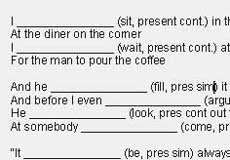
There are three tenses in Polish; there are twelve in English. When to use which tense can be somewhat confusing for students. Even remembering how to make them all can be difficult, so sometimes we have "easy" lessons that just make students think about how to make the tenses. (This particular exercise uses Suzanne Vega's "Tom's Diner," a rather popular song in Poland, making this one of the most popular lessons I've ever taught.)

Obviously, the most basic element needed to be able to use a foreign language is an adequate vocabulary.

Teaching English in Poland presented some special challenges. For instance, articles: when to use "a," when to use "an," and when to use "the." Polish doesn't have articles, so the sentence "Id? do sklepu" could be translated "I'm going to a shop" or "I'm going to the shop." Teaching students when to use which was initially very difficult.

The most difficult part, though, would be orthography: getting kids to remember that the dark part of a 24-hour period is "night" and a medieval soldier is a "knight" and they're both pronounced the same.

Why they do it

Michele asks in a comment if it’s “not MORE difficult to cheat in the field of English because of the essay style answers that are required?” Perhaps in theory, but remember: essays require vocabulary, which is conducive to cheating.

Explaining how students in Poland cheat leads naturally to explanations as to why they do it.

One of the reasons, I think, is the sheer number of courses they take every year. Here’s a list of courses for one third-year (senior) class:

  1. Polish
  2. History
  3. Mathematics
  4. Biology
  5. Chemistry
  6. Physics
  7. English
  8. German
  9. Computer science
  10. Geography
  11. PE
  12. Social studies
  13. Religion

That’s not possible courses — that’s the required course work. As opposed to the American system, where you have physics only your final year, with chemistry your junior year and biology as a sophomore, they have all three sciences throughout high school. Of course they don’t have each course every day. For example, senior students have four hours of English a week, and so they meet Monday, Wednesday, Thursday and Friday — like the university scheduling system in the States. Still, that’s an insane amount of studying every week.

A second cause, put forth by a teacher, was historical. “Teachers during communism were seen as the Establishment, and so it was a way to fight the establishment.” Sounds weak. I don’t buy it.

Option three: the rote memory required by many teachers necessitates it. This might have some merit. I know teachers here sometimes simply dictate from a book and the students just write down everything and vomit it back up the next lesson. Admittedly, I do something similar when I give vocabulary quizzes — and I give an obscene number of such quizzes. “Without words, all the grammar in the world won’t help you!” tell the kids.

Choice four, which is the most logical now: as a fellow English teacher put it, “We let them.” Pure and simple. I do my damnedest to stop them from cheating, and I sometimes fail them for even a glance to the side (and that’s no exaggeration — I do it early in the year with first-year students, usually with a not-so-important grade, to set a precedent), and I take no excuses. And yet they still cheat.

The cheating won’t disappear soon, I’m afraid. I always use as an example the cultural attitude in the States towards cheating, but I know that that is slowing being eroded and that more and more students are cheating in the States.

Dude, what’s number three?!

I am a high school English teacher in a small village in southern Poland. One of the things that still amazes and annoys me, after more than six years of teaching here in Poland, is the culturally engrained habit of cheating. Simply put, the majority of students here will cheat in any and all perceived opportunities.

  • They whisper to each other.
  • They attempt to peak in their books.
  • They write on desks before a test.
  • They hide cheat-sheets in more places than you can possibly imagine.
  • They write on their hands, arms, and legs.
  • They copy their homework from each other.

And that’s just the stuff I’ve caught them doing.

It’s not that they’re morally degenerate, though. Rather, it’s a full-fledged, much-loved cultural difference. For us Americans, cheating is something of an embarrassment. I cheated once in sixth grade, and got caught doing it. My parents were called in for a conference, and I was quite ashamed of the whole situation. (I did cheat once in junior high, but that was merely because the teacher was on his own planet and my friends and I wanted to see how blatantly we could cheat.)

Poles don’t even see it as cheating, but more as “helping.” Intellectual honesty is, in my experience here, hard to come by. Cheating begins in elementary school and continues through university and into the workplace.

Two examples show the tolerance Poles seem to have for cheating:

  • A friend was working on a development project in the north of Poland some years ago. Individual cities wishing to participate in the project had to submit budget proposals. One town copied another’s proposal.
  • A high-ranking minister (I believe in the Ministry of Education, if memory serves) admitted to having plagiarized his doctoral dissertation some years earlier. It was deemed “excessive” punishment to revoke his doctoral degree, though I can’t remember what ultimate punishment was.

It’s no wonder, then, that students cheat. It seems to be in the blood.

But how do they do it?

To begin with, they talk. Literally, if I turn my back for one moment a murmur spreads across the classroom. But I usually watch them like a cliché hawk (no reading books while they’re taking a test here . . .), so they have to resort to written methods.

The most common method (aside from writing on hands) is to make cheat sheets that are then hidden in shirt sleeves, taped to the knee (if it’s a girl wearing a skirt), taped to the inside of clothing, or numerous other places.

All this cheating makes the instances of intellectual honesty all the more poignant. I once had a student — one of the hardest working in the school — copy entries for the journal that I was requiring her class to keep. She explained later that she simply didn’t know. She’d never cheated, and she was a model student, but I knew I had to fail her for the assignment. I told her I would think about it. She came to me the next day and said, “It’s not fair that I don’t get a failing mark. I should have known better. Please give me the ‘1’.” I did, but made sure it didn’t affect her overall grade.

Another place students like to use these little “aids” is in conjunction with a pen. There are two methods: the cruder form is simply to take the small, virtually illegible sheet on the outside of a pen. The more sophisticated way is to put it inside a pen with a clear casing. Whenever I happen to find these, I keep them – so there’s at least a minimal consequence to cheating: loss of a złoty.

Despite my best efforts, I can’t seem to stop this. I might have better luck trying to get my friends to give up smoking and drinking. It doesn’t matter than I have a zero-toleration policy, that I remind students of before every test or quiz. Students know that there’s no questions asked, no arguing tolerated, and begging is ignored – they cheat in any form and I fail them for the assignment, regardless of the weight of the grade.

I even fail them if the appear to be cheating! I’ve told them, “If your lips move, you get a ‘1,’ because am I to know what you’re saying?” It’s excessive, in a sense, and even unfair, but I know if I’m not this strict, they’ll say, “I wasn’t cheating! I was asking for a pencil/tissue/eraser/whatever.”

And still they cheat. And some of them, after being caught, do it again!

Usually I’m remorseless about failing them. After all, I’ve warned them repeatedly. But sometimes a usually hard-working, generally honest student (in other words, someone I really like) cheats. And that’s when it’s difficult to fail them. But I do, explaining my desire not to show favoritism and be fair at all costs.

For any casual readers from the States, I have a question: Did you ever cheat in school? How did you feel? Did anyone every find out? What was their reaction?