matching tracksuits

fun in threes, sometimes fours

education and teaching

Dumbfounded

Young Lady
You teachers are so disrespectful. It's so unfair.
gls
I'm sorry -- I don't follow.
Young Lady
You tell me to be quiet and that's fine. But what happens if I tell you to be quiet?
gls
[Pauses in thought; wonders if he heard correctly; contemplates an adequate response.] Well, generally kids don't tell adults to be quiet.
Young Lady
God -- you don't get it. [Storms out.]
gls
[To self.] No, you don't get it.

So many of my students think that they're adults' equals, that they can talk to adults just like they talk to their peers.

Did our teachers think the same of us?
A School with Character, No Doubt

I received an email with the title,

You are nominated for a Ph.d

I think I’ll pass.

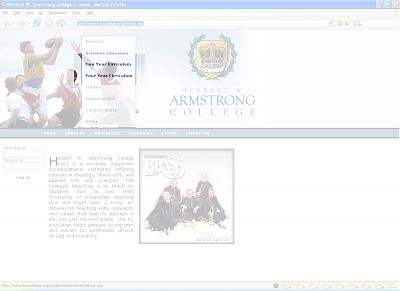
Still, it’s not as bad as Armstrong College spelling “curriculum” with two “i’s” (i.e., “cirriculum”) on their “Academics” menu when their little site went live a couple of years ago…

Screen shot

Showing One’s Needs

I'm starting my related arts class this quarter. I was scheduled to teach "Study Skills," but after looking at my roster and talking to folks in guidance, I switched. I'm teaching "Self-Advocacy," which I'm interpreting as socials skills (i.e., learn the skills to deal with problematic situations and come out positively).

And some of these students really need social skills.

Yesterday, while talking to the new students, I asked one of them her name. She mumbled something, and at the same moment, someone in the front of the class said her name as well. I really didn't catch either one, so I asked her again.

"She already told you. Why do I gotta tell you again?" she responded, with -- as the students would say -- attitude.

If I were teaching anything other than social skills, I don't know that I could have kept my cool as well as I did. I simply turned it into a teachable moment when I had a one-on-one moment with her.

But it's that kind of response that just floors me. "What in the world are you hoping to accomplish by responding to an innocuous question like that with such disrespect?" I thought.

Another example today: I was handing out note cards. "What are these for?" one young man asked -- a young man who has a reputation in the school as one who would talk back to a brick wall. I didn't say anything immediately and he looked at the note card, looked at me, smacked his teeth, and asked again, "What are these for?!"

Again: "What in the world are you hoping to accomplish by responding that way?"

Talk in the Hallway

Our school has a fairly strict dress code, and part of that includes the prohibition of wearing jackets inside the building. If students are cold, they are to bring a sweater.

Yesterday, before the last period, a young man came sauntering down the hall, slightly dragging one foot behind him in that ever-so-fashionable gangster shuffle, his camouflage jacket on, and everything about him shouting, "I have low self-esteem."

As he approached me, I found myself thinking, "Come on -- take the jacket off now so I don't have to say something." It was the last day before Christmas break; I'd finished all my classes; I did not want to have a confrontation over something silly.

But he didn't, and so I said something, and he started showing his full "gangster" plumage. He refused to look at me; he refused to acknowledge me; in short, he acted like a two-year-old throwing a tantrum.

I told him, "You're making an issue of something that need not be an issue by showing me extreme disrespect. If we're unable to work this out here, I'll simply write a referral to the administration and let the vice principle work it out." Nothing, for a moment. Finally, he looked at me. "That's a start."

As we talked, I eventually asked him, "How many times have you gotten in-school suspension."

"Two."

"Notice what I did?" I asked. "I didn't even ask you 'Have you ever gotten ISS?' I knew. I don't even know your name, yet I knew you'd had ISS. Want to know how I knew that?"

A begrudging, "How?"

"Your body language screams it," I told him. "No one who hadn't been to ISS would have acted as you've been acting over a stupid coat. Your slouching refusal to give me eye contact, your silly refusal to acknowledge anything I said, the way you smack your teeth as if to provide punctuation to every single sentence I utter -- all these things said, 'This is a kid who finds himself in trouble a lot.' Did you want to tell me that?"

These kids have no idea how much they communicate without even opening their mouths, something I hope to start remedying next quarter when I teach my related arts class. More later -- right now the syllabus is still in development...

Walk the Line

What is it that's so difficult about walking in a line? Is there some genetic abnormality that appeared about the same time as public education that makes it all but impossible to walk in a single-file line 100 feet to the media center?

I have to preteach each and every class before heading down the hall to the library or to the computer lab, or anywhere for that matter, and of my four classes, only one manages to do it consistently well. Another manages most of the time. The other two are just disasters.

Time for Natural Consequences.

What is the natural consequence of people walking down the hallway disruptively? Kids in the classrooms they pass lose learning time. The cost is time; the consequence, then, should be time. And that's why our sixth period spent some portion of the twenty minutes of pre-lunch outside time practicing walking in a straight line. But I really didn't want to belabor the point, and as always, I didn't want to make it seem vindictive. Time for classroom management technique number two: provide choices, not threats.

"So, folks, we have a choice before us: either we're going to walk down the hall in a manner befitting mature eighth graders and then we'll go outside, or we'll continue to try it until we do get it right."

Of course they nailed it the first time, which is for them both good and bad. It's good because they got to go outside immediately; it's "bad" because they've once again shown that they're capable of it and that there's no reason for them to do otherwise.

The Cough

The other day, in sixth period, a significant number of the boys decided it would be amusing if they started coughing when I turned my back. Not sick, tickle-in-the-throat type coughing, but that one single cough we’ve all given at one point or another to warn someone that some authority figure is coming.

Why? They’re eighth graders — there’s no logical answer to questions about eight graders’ motivation.

It was one of those moments that I stand there with a stern look to hide the fact (probably not too successfully) that I’m running through all the various classroom management tricks I can remember in an attempt find effective means of ending this nonsense. Running through my mind was something along these lines:

I’m not really sure who’s doing it. I don’t really think it’s a significant enough issue to devote a lot of time to it. I want to make sure it doesn’t come back. I want to keep those who are working from thinking it might be fun to join in. I don’t want to seem vindictive, because it’s really not a big deal — just disruptive.

And a phrase I’d read some time ago in a book about classroom management popped into my head: make the disruption part of the consequence.

Basically, I had them cough like that continuously for a few minutes. I told them, “You’re going to do this for the next five minutes because it’s so fun and I want you to have fun in my class,” but I had no intention of trying to force them to go the full five minutes. “Ninety seconds should do the trick,” I thought as I walked away from the boys. Sure enough, after a little while, one of the boys exclaimed, “Mr. S, this is stupid.”

“I agree. Maybe we can stop doing this stupidity and get back to work, huh?”

Not a single disruption from them for the rest of the period.

Science in the ELA Classroom

The other day, right as we were in the middle of our starter, the principal walked into the room, strode purposefully to the back of the room, and sat down. A bit of a hush fell over the class at a time when I do not require complete silence--they're doing pair work, after all. Still, everyone was especially quiet.

A principal observing a classroom is the perfect illustration of the bane of modern science: the inability to observe something without changing it in the process of observation.

Oh, what a beautiful morning…

A teacher who wakes up thinking, "Oh my, what lovely light streaming in through the window" on an early-September Thursday morning has such calming thoughts for only a few milliseconds until the realization hits, the panic sets in, and stupid certainty that there's no way he'll get to work on time.