matching tracksuits

fun in threes, sometimes fours

education and teaching

Forever Innocent

"I didn't do that! I'll put it on my mother!"

"Well, you see, what happened..."

"Didn't you see all those others doing it to?"

"But she was talking to me!"

"But he tried to trip me!"

"Well, he knocked my books off the desk."

"No. No -- that is not what I did."

"What?!"

Sometimes, the excuses pile up. When they all come from one individual, someone who is always in the middle of things but always innocent, we see a life stretching out in front of this him that is so frustrating because he has such a warped perception of everything going on around him. We hope he can begin to look around and start taking some of the responsibility for the negative consequences he faces almost every day, but sometimes it seems the odds are against him.

Third Time Is the Charm

Currently, three of my classes are finishing up a short unit on persuasive writing. We looked at various types of arguments (argument from authority, reason, emotion, etc.) and, after practicing with a fairly harmless topic (our school's dress code -- everyone, not surprisingly, wrote that the dress code should be abolished), we're working on something weightier: capital punishment. It's a cross-curricular assignment: it will also count as a social studies grade.

But the nagging problem with school writing is audience. "Who am I doing this for?" some kids ask, and "Your teacher and yourself," while a true answer, is not a satisfying one.

How about, "For the world"?

I've tried several times to get class-related blogs started. I haven't always been successful. I'm trying again, though: students.ourenglishclass.net.

The aims are simple:

  1. provide students with a medium to publish their writing; and
  2. teach students how to use use basic content management software.

So if you don't mind, take a look, give it a mention if you have a blog, visit often, and leave a comment or two.

Assessment

Middle School Artillery

A teacher workday can disappear faster than a sugar cube in hot water. I had all these plans for today: finalizing grades; re-organizing my room; extensive planning for the related arts class I'll be teaching this third quarter; listening to Bach's Mass in D Minor in its entirety. Only one thing got completed, and that was only because I had no other choice in the matter: grades for the first semester are now complete.

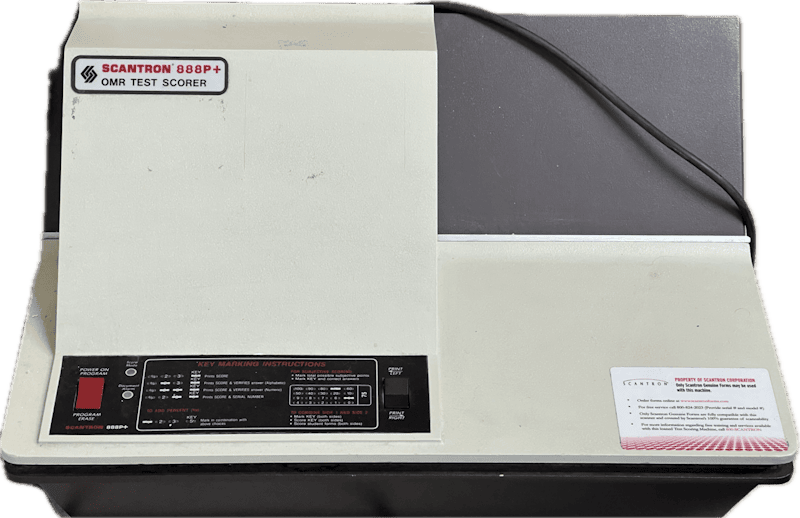
Much of this week was geared toward today's end. It was, in other words, a week of assessment. And as much as I feel an odd sense of accomplishment watching kids take a test–perhaps it's a perverse sense of accomplishment–I hate what I know is coming: grading. And that dreaded grading leads me to take the easy way out: Scantrons.

I can vaguely justify it with the understanding that all standardized testing requires filling in endless dots. “Kids have got to get used to it,” I hear, and I think, “If they haven't by now, thanks to NCLB, they never will.”

I walked down the hall with a stack of Scantron sheets, and teachers I passed inevitably made firearm jokes. “Hope it doesn't sound like a machine gun,” one said. The history teacher put it in perspective: “Storming the beaches of Normandy?”

It is an odd experience, though, listening to one's test results. Whir whir whir grrr grr grr grr whir whir grr whir grr grr whir whir grr grr grr whir whir whir grr whir grr whir grr grr whir grr grr grr whir grr grr grr grr grr grr grr grr grr grr. “He did badly,” one thinks, hoping for better results with the next Scantron sheet

400+ Years

Jan Svab as Capulet
Jan Svab as Capulet

More than four hundred years separate us from Shakespeare's time -- four centuries' worth of linguistic change. I was curious what might happen in the course of 24 eighth-graders' first true encounter with Shakespeare.

We began Romeo and Juliet today, and students acted out the opening quarrel scene. After class, one student came up to me.

"You know how pirates say 'argh' and such?" he began, hesitantly.

"Yes," I replied, wondering where this was leading.

"Well, when Lord Capulet was trying to get Lady Capulet to hand him the sword, was he just, like, saying something pirate-like, or was he degrading her?"

"No," I answered, smiling. "No, he wasn't degrading her. He was just being enthusiastic."

The line in question, of course, is, "What noise is this? Give me my long sword, ho!"

Working Together

The last two weeks, I've been on Christmas break -- one of the great advantages of being a teacher. Teaching a new course (English I Honors), I wasn't planning on having much time to myself as I was planning to, well, plan. Starting Monday, I'll be leading the class through Romeo and Juliet, and I've never taught that particular selection. I did Macbeth when I was student teaching, but "Double, double toil and trouble; / Fire burn, and caldron bubble." with twelfth graders is a far cry from "What, art thou drawn among these heartless hinds?" with gifted eighth graders.

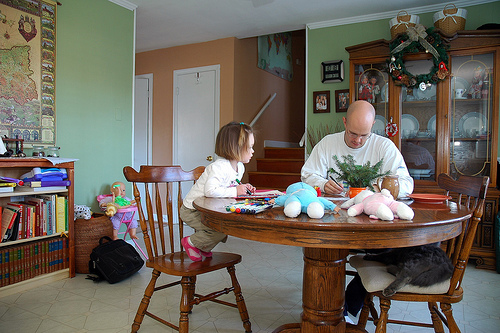
I had high hopes for a productive time, especially during the second week, with Christmas behind us. And then L got sick: a moist, lingering cough that kept her out of day care for a week. But one thing you learn having a two year old is that she can imitate anything, including Tata working.

DSC_2972
1/5, f/4, 18 mm, slow-sync flash off ceiling


In Line

I fancy I can tell a lot about someone from their shopping cart's contents. Lots of frozen foods or processed packaged foods means little time for and/or interest in cooking. Lots of power tools means new homeowner or generous present. A collection of books on the MLA format means a son or daughter working on a research paper.

Generalizations, certainly, but they're probably accurate at least occasionally. I look in our cart and I can tell quite a bit. Of course, I have the Cliff Notes to my own life, so there's not much guess work there.

More revealing, though, can be the conversations in the line. One of the reasons I prefer to Polish in public is the privacy it provides. I certainly wouldn't want those around me to hear an exchange between L and me like the one I overheard yesterday.

A mother and her two children were piling up frozen foods at the checkout when the oldest daughter -- probably around fourteen or fifteen -- pulled a copy of Twilight from under a bag of frozen fries and asked, "Do I have to put it back?"

Mother's response was stunning: "You won't read it! I've never seen you sit and read anything."

The girl turned the book over in her hands a couple of times, and with a sigh, trudged off to replace the book on the shelf.

The temptations: "Has she ever seen you sit and read anything?" "Wonderful job of encouraging your daughter to read." The greatest, though, was the most dangerous: as the girl passes me, "Here -- I'll buy it for you."

Instead, I whispered to L, in Polish for added security, "I'll buy you all the books you want."

Shopping cart photo by Dan4th.

Table Rock

I’ve been writing all day. Planning lessons (putting the finishing touches on a unit about the memoir in which we study Maya Angelou’s I Know Why the Caged Bird Sings) and preparing materials for my PAS-T notebook. The former I don’t mind; the latter is a hastle.

PAS-T is an acronym for “Pain in the…” — no, rather it’s “Performance Assessment System for Teachers”. It is, in short, a pile of paperwork that I am to provide three different evaluators as they come through my classroom two times each throughout the year for formal observations. My PAS-T notebook is to include things like,

  1. Summary of plan for integrating instruction
  2. Class profile
  3. Annotated list/samples/photos of instructional activities/materials/displays
  4. Lesson/intervention plan
  5. Summary of staff consultations
  6. Syllabus
  7. Lesson plan(s)
  8. Differentiation
  9. Annotated photos of class activities
  10. Sample handouts/transparencies/Thinking Maps
  11. Student samples of technology integration
  12. Record-keeping/monitory system
  13. Labeled and dated grades
  14. Teacher-made tests/assessments
  15. Example grading rubric
  16. Grading procedures
  17. Student work with feedback
  18. Progress reports/letters for parents/students
  19. Survey and summary
  20. Class rules with description of development procedures/reinforcement system
  21. Classroom diagram with comments/alternative room arrangement
  22. Class schedule
  23. Explanation of behavior management philosophy/procedures
  24. A printed copy of the teacher’s home page
  25. Log of rapport building efforts (notes, calls, conferences)
  26. Copy of newsletter
  27. Agenda from orientation/fieldtrip
  28. Documentation of Technology Proficiency or letter of intent
  29. Resume
  30. Certificates, agendas, support materials from presentations given
  31. Certificates, agendas, support materials from presentations attended
  32. Documentation of membership/participation in professional organizations
  33. Performance goal setting forms
  34. Chart of student progress throughout year
  35. Analysis of grades for marking period
  36. Log of collegial collaboration
  37. Documentation of meeting established annual goals

It is difficult to think of this as more than busy work. I mean, how useful can a classroom diagram with comments be to an evaluator who’s sitting in my classroom?

I’m all for accoutability, but this is starting to feel like an extra burden.

Still, I will perservere, and I will get only “Exemplory” ratings because anything else would drive me mad. If I’m to jump through hoops, I want to jump through them while juggling chainsaws and lecturing on Kant — I want to blow people’s minds.

Fortunately, I didn’t spend the whole weekend at a desk; we spent some of it at a table, so to speak: Table Rock State Park, which means more hiking and more waterfalls.

DSC_9645

Such a burden.

DSC_9652

DSC_9715

A few more pictures are available at Flickr.

Resources

We often hear schools’ complaints about the lack of this or that resource. I always assumed that was because of lacking something more fundamental: money.

I found out yesterday how wrong that simplistic thinking could be.

My wife brought me a computer from her office some time ago. “It doesn’t have any memory,” she said, “And there’s no operating system installed, but maybe you can use it.”

Can I use it? Of course I can use it. No teacher complains about having too many computers for his students.

The plan was simple: at the beginning of the year, I would take some of the funding I get from the state for supplies, buy a half-gig of memory, load some form of Linux on it, and I’d have a new computer for my room.

In talking to a fellow teacher, though, I learned that it might not be so simple. I went to our school’s IT guy for clarification.

Short answer: sure, I can use it, but no student can touch it.

It seems we have a contract with a particular computer manufacturer that stipulates two things:

  1. Each computer for student use must be purchased through through Distributor X. That rules out using my computer.
  2. Each computer for student use must be running Windows XP. That rules out the closet full of laptops I discovered we have, sitting unused because they have Windows 2000 on them.

Now, it seems to me that if Computer Manufacturer X was really interested in educating students that they wouldn’t really care whether or not we use other computers or use other operating systems. It seems that teachers wouldn’t be punished for taking some initiative to get more materials for students.

But underlying that would be a mistaken understanding of the nature of the capitolistic drive, wouldn’t it?

Busy

School is starting up again. I’ve been moved to a new room, which means reorganization. I’m teaching new courses, including English I Honors — a high school class taught in eighth grade. Translation: bright, motivated students. Additionally, I’m coaching the girls’ volleyball team this year. And I’m going through my formal evaluation this year.

In other words, no time. For this, or anything else.

Ideas abound; time doesn’t.

Year’s End

I'm sitting on the back porch with a bit of scotch and a cigar, reflecting on the day-the last day of school. It ended on a positive note, with a few very positive emails from parents and relatively peaceful final classes. It's fairly amazing how all perceived animosity burns itself out in those final days and students and teachers alike seem more able to see the positive side of school -- not to mention each other -- than they have for weeks, or even months.

It being my first year teaching in the States, I did a lot of experimenting. I used in-class journals, Moodle, various writing workshops; I tried different forms of classroom management: some experiments were frustratingly unsuccessful, while others were more effective than I'd ever dreamed they'd be.

It was a year of relearning how to be a classroom teacher. It was a year of relearning all the wonderful things from adolescent psych about what thirteen-year-olds can, can't, will, and won't do. It was a year of fighting bureaucracy that I didn't know existed in American schools. It was a year of relearning content-area knowledge, like how to spell "onomatopoeia."

In trying to determine whether it was a successful year, I'm left wondering what "successful" means. How do I as a teacher measure success? My MAP test scores were higher in all classes in the spring than they were in the fall. Does that constitute success? NCLB says it does. I had a student who was brilliant and brilliantly troubled, and I never managed to make a chink in her armor so that we could string together more than two consecutive learning-filled days. Does that constitute failure? I taught some vocabulary well enough that some students were referring to other students' disruptive behavior as "superfluous." Does that constitute success?

This year I realized again what I'd learned years ago in Poland: the immediate, clear successes are few and far between. But there's no way to know what seeds were planted. Teaching in a small village in Poland afforded me the opportunity to see what seeds I'd planted, because students would often come back years later and tell me what they were using their English for. Some got jobs abroad because of their English; some fell in love with foreigners because of English; several became English teachers. So I simply have to trust that I did accomplish good, that I did teach the 90+ young men and women in my charge for 180 days something, and maybe even something more than English.