matching tracksuits

fun in threes, sometimes fours

education and teaching

Stage Fright

Ron sits in the front row and raps. Sometimes it’s an audible mumble, but it’s often just a whisper.

Harvey likes to turn his desk into a drum set. He’ll beat, thump, scratch — he’ll get more sound out of a school desk than one would think possible.

Keeping them quiet is a recurring task. It’s not a constant battle, but I do have to ask them a few times a week to stop the disruption.

Working on poetry and teaching meter, I was having students gradually move from dryly reciting the poem (“Cat!”, from yesterday) to rapping it. The idea was to get them to create a rap and “a beat” and point out that it all depends on the pattern of stressed syllables in the poem. I asked Ron to rap; with a nervous laugh, he eventually begged off. When a student finally volunteered, I turned to Harvey to supply the beat. He too said he’d rather not.

Another ironic moment in the classroom.

Choral Cats

Photo by Hannibal Poenaru

Photo by Hannibal Poenaru

We’ve started a poetry unit; as I always do, I began by asking students to do some free writing to answer a simple question: “What is poetry?” Inevitably, the first or second response mentions “feelings.” If I’m lucky — as I was today — they make broader connections, such as “music” or “enlightenment.”

Teaching poetry to adolescents is a trick. Boys don’t like it because, at this age, “feelings” are not something they generally care to delve into. Poetry has to seem alive and less academic. Today I rediscovered that a poem that is strongly rhythmic and filled with fun sound devices (onomatopoeia, alliteration, a bit of assonance) combined with some choral reading makes for a great start to a poetry unit.

“Cat!” by Eleanor Farjeon fit the bill perfectly.

Cat!
Scat!
After her, after her,
Sleeky flatterer,
Spitfire chatterer,
Scatter her, scatter her
Off her mat!
Wuff!
Wuff!

Treat her rough!
Git her, git her,
Whiskery spitter!
Catch her, catch her,
Green-eyed scratcher!
Slathery
Slithery
Hisser,
Don’t miss her!
Run till you’re dithery,
Hithery
Thithery
Pftts! pftts!
How she spits!
Spitch! Spatch!
Can’t she scratch!
Scritching the bark
Of the sycamore tree,
She’s reached her ark
And’s hissing at me
Pftts! pftts!
Wuff! wuff!
Scat,
Cat!
That’s
That!

Starting with an animated reading, we moved to a semi-choral reading, with students reading the italicized portions. Then a few students took a try at reading this verbally challenging poem. By then, it was easy slide into a discussion of onomatopoeia and verbal rhythm.

A successful lesson that leaves me eager to return tomorrow.

Photo by Hannibal Poenaru

Scat Cat

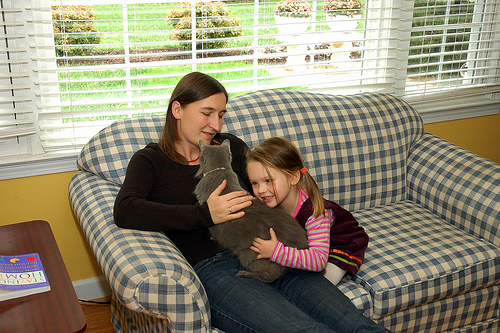
It’s still a cliche love-hate relationship: L still loves, the cat still hates. Or perhaps “the cat fears” would be more accurate.

In my pre-parenthood thoughts of what fatherhood would be like, I never realized that literally everything must be taught — even how to show love. It’s a given when we look at the dysfunctional relationships that are everywhere (most commonly on the covers of magazines in the checkout line). Still, I thought that if we taught by example, L would learn how to express affection.

DSC_8763

We teach by example; we illustrate by experience (“See? We’re gentle with the cat and she comes to us.”); we instruct directly (“Hitting the cat is not a good way to show affection.”). Sometimes it works. Generally, Bida continues to head the other way whenever L enters the room.

Measured Words

Lesson Planning

Robert Frost reportedly said, "Writing poetry without rhyme is like playing tennis without a net." The same could be said of meter-free poetry.

We've been working on poetic meter in English I Honors, and yesterday I sent them packing with deceptively simple homework: write a sonnet.

"What's a sonnet?" they thought. Fourteen lines of iambic pentameter -- da-Dum times five.

One by one they filed in today, and one by one they declared, "That homework was a nightmare!"

We took some individual lines and examined them, adding words and massaging the lines until they were roughly iambic pentameter. The homework for tonight: rework the first four lines so that they are all the proper meter. Just before the bell, I reminded them of the next hurdle in sonnets: "Remember, we're working on English sonnets, so ultimately we'll be having an a-b-a-b rhyme scheme for this first quatrain."

The moans were overwhelming, but at the very least, they have a newly found respect for Shakespeare: "He wrote 154 sonnets."

"Did he not have any friends?" one young man asked.

Manic Depressive

The problem with teaching is that it leads to manic-depressive thinking. When things are up, they’re really up. Confidence soars; it’s easy to get out of bed; grading and planning are a snap. When things are down, it can make one lose confidence in the entire national competency and grind one down into a pessimism that is almost palpable.

Trust but Verify

When Gorbachev and Reagan signed the Intermediate-Range Nuclear Forces Treaty, Reagan used one of his most loved slogans:

The President: [...] We have listened to the wisdom in an old Russian maxim. And I'm sure you're familiar with it, Mr. General Secretary, though my pronunciation may give you difficulty. The maxim is: Dovorey no provorey -- trust, but verify.

The General Secretary: You repeat that at every meeting. [Laughter]

The President: I like it. [Laughter] (Source)

It was in that spirit that I approached an administrator to verify a student's explanation of her absence.

"No she did not come talk to me" came the reply, and my own words to the students, from the beginning of the year, echoed: "You have my trust now. Once it's gone, it will take a long time to rebuild it." This young lady, sadly, has lost my trust.

I'm not sure she'll care. I can see her brushing it off as if it's no big deal, and it might very well not be a big deal. Someone who hasn't spent much time in an environment that fosters trust might not know what it's worth, and in that case, it's difficult not to try to care for her.

Busted

Reading over student work, I find a sentence that troubles me: it has a maturity that belies its author. I continue reading, and within a few moments, I'm pulling out the laptop and Googling the suspect sentence: it's lifted directly from Wikipedia. With a sigh, I write "See me" at the top of the paper, underlining it emphatically.

Dealing with plagiarism is one of my absolute least favorite duties as a teacher; it's especially tough when it's a student I really like, a student who is sensible and gives every impression of being a conscientious student.

Plagiarism is a sin that is hard to treat evenly. Is unintentional plagiarism as bad as intentional? Is malicious plagiarism ("He'll never catch on, the old doddering fool.") worse plagiarism motivated by laziness or procrastination?

As I'm reading, and I begin to grow concerned about the authenticity of a particular essay or poem, I find myself tensing up. A brier patch of issues awaits, and it's seldom a pleasant experience.

Celuacy for non-Poles, is a grade above an "A". It signifies mastery of a subject accompanied by superior extra-curricular work.

On one occasion, though, a young lady of supreme character managed not only to avoid losing respect but managed to increase it. She was a student in Poland, and she worked hard to have celuacy ("excellent") in as many classes as she could. She turned in a journal that was clearly plagiarized. (With English learners, it's easier to discover copied work, for obvious reasons.) I spoke to her about it, asking her why she'd done it.

"I just didn't understand that we weren't supposed to copy."

A lame excuse, but she had so endeared herself to me (to all teachers) with her hard work and dedication that I put off the inevitable. "Well, I'll think about how we can handle this; my standard policy, though, has always been to give a failing grade for plagiarism." She said nothing, but she was clearly upset.

The next day, she approached me. "I've been thinking about it," she began, impressing me with her correct use of the present perfect continuous tense. "I should have known better. I want you to give me a zero."

I did, but I made sure she had plenty of opportunity to offset that zero and maintain her high average.

She did.

Every time I've had to deal with plagiarism since then, I've hoped for such a response. So far, no luck.

Maybe tomorrow.

Outsourcing

For the first several months of L’s life, K and I could be fairly sure that everything she knew was something we’d taught her, directly or indirectly. Sometimes she would imitate us with prompting, sometimes without. There were few moments that prompted comments of “Where’d she get that?” and the like.

When she started spending time with other kids and adults at daycare, the gradual shift began. Slowly she picked up as much at daycare as at home; then, daycare overtook us.

Now she comes home with songs we’ve never heard:

Twinkle, twinkle traffic light…
Red means stop
Green means go
Yellow means very, very slow

She comes home with skills we haven’t touched on: tracing numbers and letters is the most recent.

These things come from the teacher, who told K this morning during the first of many parent-teacher conferences, that L is a “good old-fashioned girl” with good manners and a strong sense of right and wrong.

DSC_8285

Other things come from friends. Brooke taught her how to swing by herself.

DSC_8289

She’s growing more and more independent.

DSC_8298

Now, she knows she can get her information from other sources, that she’s not dependent on us mentally any more than she is physically.

DSC_8303

Which, in reality, is still quite comforting: still many years to go. It comes in mercifully slow steps.

Shock and Disbelief

In preparing to read the dramatization of Anne Frank’s diary, I spent some time going over the Holocaust with students. I was taken aback at how little they seemed to know about it. “A bunch of people — I think they were Jews — got killed” seemed to be the general view. They do know something about it now, but their questions revealed both how complicated and unfathomable such an act is.

Most common was, “Why did they hate Jews?” Why indeed? Many answers, none of them short and simple. I offered a few: notions of Jewish conspiracies; Jews as “Christ killers” and the old blood libel; the fact that there are a substantial number of Jews in banking (which is directly traceable to early Christians’ reluctance to engage in usury) as proof of some international Jewish conspiracy. All those explanations in turn (which is why I was silent about The Protocols of the Elders of Zion).

As I spoke, though, and showed pictures and short clips of survivors, it was almost eerie how closely they paid attention. Any noise brought immediate shushing, and the look of shock on everyone’s face told me that there is at least one thing they’ll remember from their time with me.

This Is a Test

I gave three of my four classes a test a few days ago. It's worthy of comment because I so rarely give tests. In fact, I despise giving tests. It's true that they're a relatively quick way to assess student understanding, but our school district has such a regimen of standardized tests and tests from other teachers that I seem always inclined to find alternative methods of assessment.

Recently, our state mandated yet another standardized test for eighth graders. We now take the MAP (Measure of Academic Progress), ITBS (Iowa Test of Basic Skills), Explore, and PASS (Palmetto Assessment of State Standards) tests. Additionally, students who elect to pay the fee can take the PSAT test. Each of these tests require multiple days to complete, and so we have thirteen testing days built into the 180-day calendar (not including the day it takes for the PSAT).

When teachers complain that their students are drowning in an acronymic sea of standardized testing, this is precisely what they mean. When states complain that their schools are underfunded, these tests represent a significant expenditure.

What are these tests for? What is taxpayers' money buying?

The PASS test is the assessment used for NCLB (No Child Left Behind) compliance. It's a new test, replacing the PACT (Palmetto Something-or-other Challenge Test or something like that) at the start of the 2008/9 school year.

Because it's a new test, there are additional costs as the first year's results are audited to determine cut-off points for the achievement standards. This in itself is problematic for me, because it underscores the arbitrary nature of any standardized test. Once the results were in, test administrators began analyzing the scores to determine what score should be the thresholds for the Exemplary/Met/Not-Met standards. And what standard did they use to determine those standards? Did they perform basic statistical analysis that showed X% scored within some range, Y% scored within another range, and Z% within yet another and then used those numbers as the thresholds? If so, that would only measure future test takers against the first year's results. Surely there must be an objective standard, right?

The MAP test is administered twice, at the beginning and end of the school year. It is just what the name implies: a measure of the progress of individual students in the school year. It's useful for teachers to see how much progress individual students have made; it's useful for administrators to determine how much progress the teacher has made. Of all the tests, this has the most practical application.

The ITBS is a measure of basic skills. I'm not sure its purpose. We get attractive printouts that we send home. That's about all I use it for.

The Explore test is the newest addition. It is, as far as I can determine, a pre-ACT test. Useful, I suppose. For all students in eighth grade? I'm not so sure.

We began taking the Explore test today; we'll finish up during the first half of tomorrow. The one heartening aspect of the test: at least one student wondered aloud about the impact so much testing was having on his education.