matching tracksuits

fun in threes, sometimes fours

education and teaching

Heading Home

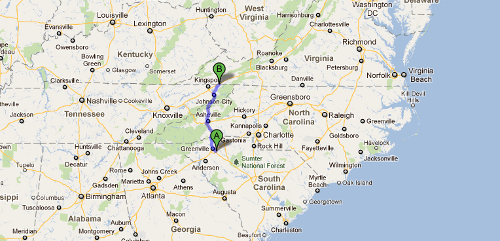
I grew up in a border town -- half in Virginia, half in Tennessee -- about three hours north of where we presently live.

In the last fifteen years, I've only gone back a handful of times. Today, K and I are making the trip to meet with people I haven't seen in twenty years, most of whom I knew only in passing, and many of whom I probably won't recognize, and if I do, I likely won't remember their names immediately. Yet there are a few, and to see them again will be worth it.

I wonder, in the age of social networking, will future generations have twenty-year reunions?

In Their Lives

In a world of spin and deception, to be trusted with someone’s greatest victories and deepest tragedies is rare indeed. For one hundred and some adolescents to trust someone that way can only happen in one, obvious environment: the classroom. The level of trust some students show (and hopefully, I earn) reminds me daily the privilege I have of teaching thirteen- and fourteen-year-olds.

Students write in essays and journals about things I sometimes worry few other adults in their lives know about: anxieties about the future; frustrations with current situations; sorrows over tragedies large and small. They come to me excitedly when they’ve done well, looking for a high five and a smile; they come to me dejectedly when something’s gone wrong, hoping for a sympathetic ear. They tell me when they’ve fallen in love and when someone’s broken their heart.

With some, I need to show only a little attention, ask a few questions genuinely from curiosity, and a smile blooms that makes my day and causes me to wonder why people would want to do anything else with their lives.

Letters, Part Three

We were writing about writing -- an odd thing to my class of 25 eighth-graders, but they complied. Heads down, they scribbled for half an hour, turning out some of the best writing they'd done all year.

One young lady, Tina, after fifteen or twenty minutes of writing, declared, "I'm done!" I told her she should continue writing and that she could write about anything she chose.

"Even you?" she asked.

"Sure," I replied, wondering what I might get. After all, Tina had a reputation, and I could tell from the first few moments of the first class that it might be a challenge to keep her quiet and focused.

In short, Tina said whatever came into her thoughts. If a comment was "stupid," she let the poor bloke know it. If she realized she was hungry, sleepy, bored, thirsty, excited, amused, or anything else, she shared it with the whole class the instant she realized she was hungry, sleepy, bored, etc.

I'd spoken to her about it a few times. It was easy to lose my cool and simply react to her provocations, but I knew such reactions would serve little purpose. I also knew that, were I to leave her alone, she would quickly burn through all the steps in the school discipline policy; it would be easy then to get her out of class on a regular basis simply by writing administrative referral after referral.

By the end of the first quarter, she'd calmed down significantly. Her outbursts were increasingly rare, and she responded to my mild reminders to stay on task with a smile rather than an argument.

All of that went through my thoughts as I walked away from her desk. Immediately after all students were on their way to the final period of the day, I went through the papers and dug hers out.

She wrote,

Now I'm going to speak upon the Great Gary Scott. Mr. Scott, the best, is my favorite teacher. He may be boring, but he believes everybody can do it if they try. He has helped me so much and I thank him greatly and I have to say he is a great father figure. His daughter has a good daddy at home.

"She probably has no idea how great this makes me feel," I muttered to myself, so I thanked her as she walked to the bus. "Those were very kind words, and I appreciate you sharing with me."

She smiled and said "You're welcome" quickly, bolting away from me as she suddenly saw a friend.

Another Door Closes, Opens

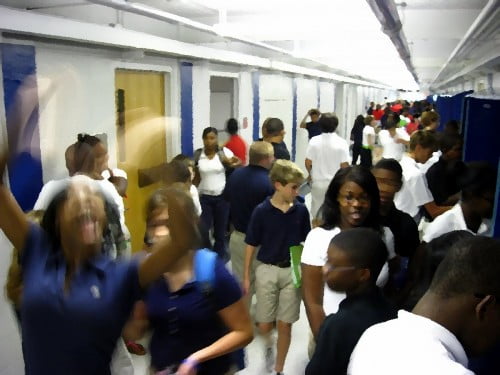
Thursday I said my goodbyes to the fourth group of eighth graders I've taught here in Greenville. I shook countless hands, gave numerous hugs, and reassured many crying students, all the while thinking how blessed I am to have such an honorable job.

I understood their pain. Endings are so painful when we're young. Each transition is filled with such uncertainty, and like everyone, I've been through my share of painful transitions. In 1999, I was on the verge of tears as a friend drove me through the Polish village I'd called home for four years on the way to catch the train that would take me to Warsaw to catch a flight home. That longing all my students felt only briefly Thursday afternoon was so intense twelve years ago that it eventually led me back to Poland, back to the same village, back to the same students whom I'd left as freshman and returned to as seniors. It was the best decision I've ever made.

But I know the secret: we start again. Every ending is a beginning. Every chapter is followed by another, and if we do it right, the next chapter is always better. I tried to tell my students that Thursday. I'm not sure I was successful: no one can ease a pain that's almost voluntary. Adolescence loves misery in small doses, especially the pain of loss.

I like to think I'm still an adolescent at heart, so now I sit, smiling, looking through pictures I snapped the final day, feeling honored that I had the privileged of working with such incredible kids, wondering what the future holds for those fourteen-year-olds that I grew to love. What do we know when we're fourteen?

I know many of my students, due to the tragedies and misfortunes they had no part in, know more about pain than I know though I'm twenty-five years older than them. I tried to make the daily fifty minutes I spent with them a pleasant experience, but I know I let them down. It haunts me, and it's the bitter part of the bittersweetness of the end of a school year.

Thursday evening I met a former student -- I'll call him Ed -- who gave me utter hell when he sat in my sixth period class. "I gave everyone hell," he would say if he read this. "I was just making bad decisions. I just wanted to be bad," Ed explained Thursday night as he explained the path his life has taken in the intervening three years. I finished that year thinking I'd let him down, swearing I'd never do it again, and now I know I have done it again. And I'll do it yet again -- probably next year.

So I sit, scrolling through pictures, wondering where the lines of these kids' lives will lead them, eager to get to know next year's batch, wondering if I'll ever lose this sadness I feel at the end of school years, and hoping I never will.

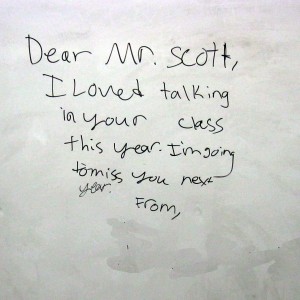
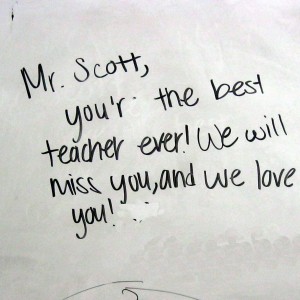
How could I, when students leave notes like this on my board?

Transfer

I sit in class with fourteen other adults, and we go through essays that students have submitted for group review. We share what we like and what works for us as well as what we think could be improved. We're courteous but sufficiently critical. We take initiative, ask and answer questions, volunteer observations. The author jots notes about this or that comment, sitting silently yet respectfully listening.

Why can't I get this to happen in my own classroom? I have a list of excuses:

  • Students don't come prepared.
  • Students don't have the necessary background knowledge.
  • Students don't have the sufficient motivation.
  • Students don't have the necessary skills, social or subject.
  • Students don't care.

For any given student, one or more of these end-of-the-day excuses might be true. Or none. Or all. Some are in my control; many are not. The common element, though, is probably the problem: "Students don't."

I make an effort to incorporate workshops into my teaching. Things don't go as well as I'd hoped, so I refocus -- "Stop thinking 'students can't' and 'students don't'!" -- and re-plan and try again. Somewhere, the right balance of innumerable factors exists, and someday, I'll be leading a class like the one I participate in every Tuesday evening.

Studying

I'm taking two classes this semester, still working toward a Master's; I have to study.

K is taking a class this semester, beginning her course work toward an eventual professional license; K studies.

Language Work

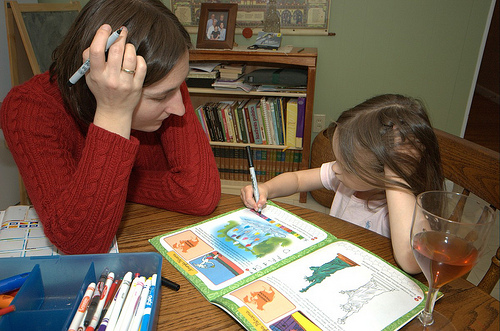
L, seeing the two of us, has decided she needs to study.

Letters, Part Two

Over the summer, a former student tracked me down on Facebook and sent me a note. I'd had an interesting relationship with the young man: at times, I felt he was very frustrated with the class. Indeed, he said as much. And he also said that very often, when he'd asked for help, I didn't really help him. I thought about this for a moment, then realized that he wasn't yet recognizing what I was trying to do. It's something along the lines of the saying about giving people fish versus teaching them to fish.

The young man's note included one of those compliments that feels a little like a backhanded insult. He wrote, "I want to thank you for being such a great teacher and making the class not extremely boring." Apparently I was boring, just not extremely so. Yet the next few sentences simply set me to smiling:

You would help me sometimes and most of the time you didn't, and I am glad you did that. I realized that I can't be helped all the time and that I need to learn to do things on my own more often.

He closed by saying that I "made the class and literature enjoyable" for him, but that's really of little significance compared to helping him develop self-reliance.

One of the things I love most about teaching eighth grade is the simple fact that I teach more than my subject content. I came to realize this fully the other day, when I received the third letter.

To be continued, again...

R&J

It’s that time of the year, the highlight of my teaching year in many ways: I go over Romeo and Juliet with my English I class. I know I’ve mentioned this before, even at roughly the same time of the year. (The start of the second semester is just such a perfect time to begin the most challenging read of the year.) I suspect I’ll be writing about it every January, because I get such a thrill out of introducing a new group of kids to arguably the greatest writer in English.

It’s such a time of uncertainty for the students. Shakespeare has held such a vaunted place in their imaginations for so long that they’re certain it will be the most stilted, boring bunch of aristocratic nonsense they’ve ever encountered.

And then they hear the nurse making one sexual innuendo after innuendo: “I am the drudge and toil in your delight, / But you shall bear the burden soon at night.” They notice that Juliet is prone to making them, too:

‘Tis but thy name that is my enemy;
Thou art thyself, though not a Montague.
What’s Montague? it is nor hand, nor foot,
Nor arm, nor face, nor any other part
Belonging to a man.

They see Mercutio being a positively provocative smartaleck: “And but one word with one of us? couple it with / something; make it a word and a blow.” They find themselves not liking characters: “Mr. Scott, Romeo is kind of creepy in a way.” And out of the seeming blue, they find themselves able to follow three scenes (2.4-2.6) in a recorded performance without the aid of the text before them.

Every day, I ask the same question: “On a scale of one to five, how difficult are you finding Shakespeare now?” I ask students to hold up the number of fingers to express their difficulty with the text. After the first reading of the prologue, it was all fives. Now, after two acts, it’s a mixture of fours, threes, and twos.

I have the privilege of watching 100+ eighth graders grow and develop over the course of nine months. I see them developing self-control, self-confidence, and occasionally even calm humility, but these are part of the natural course of growing up. Seeing them gradually make their peace with an author they feared only months before (and I can claim all 100 for this, for everyone in my classroom comes to terms with the Bard at some point and some level) is something I can claim at least partial credit for, and it’s one of the many thousands of reasons I can’t imagine doing anything else.

Photo by -JvL-

One Semester in One Month

I just finished up a course on diagnosing and correcting reading deficiencies in middle and high school students. One of the most useful courses I've ever taken -- especially the book: Kylene Beers' When Kids Can't Read: What Teachers Can Do. It's my new classroom Bible.

The course was a one-semester course crammed into one month, what my school calls, appropriately enough, "January term."

Which is finally over. And which explains how we could take the Girl ice skating for the first time and it receive nary a mention here...

Maybe over the weekend...

Letters, Part One

Teachers have a dream letter. It’s the letter that says simply, “Thanks. You helped me.” Sure, it’s an ego boost, but more than that, it’s confirmation that a teacher is doing his job effectively from the only source that matters: the student.

I received one such letter after my student teaching. A young lady in the honors course I was teaching was frustrated with the amount of reading I’d assigned. She came to me after class and explained that she has great difficulty comprehending what she’s read. “I have to have my mother help me. She reads it and explains it,” she said quietly, wiping her tears and glancing about to see if any other students were in the room.

The next day, I gave her a list of techniques I’d created the night before while pouring over all my notes and books from college. I explained how each technique worked, modeling a couple. She used them at home and said they were helpful.

When my cooperating teacher had the students write letter to me before I completed the assignment (one thing you liked, one thing you didn’t, and advice for the future), she wrote a sentence that, though I have long since lost the letter, I remember clearly: “You’ve helped me more than you realize.”

Fifteen years later, I receive another letter.

To be continued