matching tracksuits

fun in threes, sometimes fours

education and teaching

Lent 2012: Day 22

Kind words will set right things which have got most intricately wrong. In reality an unforgiving heart is a rare monster. Most men get tired of the justest quarrels.

If I could teach my students one extra-curricular lesson, it would be this. I have calmed furious students (sometimes furious at me, most often furious about something some peer has done) with a few kind words so often that it has become almost instinctive: “Get the kid away from the situation and say something kind.” A smile helps as well.

Yet they re-enter the same quarrel, sometimes only hours later (occasionally, even more quickly), and I can see a certain Sisyphean fatigue in them as they fuss. “A calm answer…” I mutter to myself, wondering if I can teach that by example alone.

The quoted excerpt is from Father Frederick Faber’s Spiritual Conferences, excerpted here.

Lent 2012: Day 17

A kind interpretation of actions is such a far-removed idea for me at times, but perhaps the most challenging times are when I'm in a heated situation with a student and when I'm driving in Greenville.

We must come to esteem very lightly our sharp eye for evil, on which perhaps we once prided ourselves as cleverness.

The latter is the most consistent challenge. While I don't necessarily see other drivers' motivation as being a result of evil, I constantly pride myself on the cleverness of my own driving as compared that of my fellow pilgrims on the road. This idiot doesn't know how to turn left at a traffic light. That dolt waits until the car in front of him is twenty car lengths ahead before pulling starting from a green stop light. This moron pulls so far into the intersection that it's difficult to make a left turn around her. That dork is so busy texting that he misses at least five seconds of the light. This one is a matter of merely reminding myself that I've no idea what these people drive the way they drive and that perhaps they have very good reasons. Perhaps the person hesitant to make a left turn recently had a terrible accident doing so. Maybe the person who is waiting for the care in front of him to be a seemingly ridiculous distance from him before starting is having car problems and the car doesn't respond as well as he wishes. Possibly person pulling too far in to the intersection is on the way to a critical meeting -- perhaps a family member is ill in the hospital -- and made a last-minute decision not to push the yellow light. And perhaps the person texting is texting about the death of a loved one.

Calmness while driving -- offering what Faber calls "kind interpretations" -- is fairly simple: there's very little at stake. A few moments lost here or there is hardly something to get enraged about, and whether or not the kind interpretations are justified, it all seems a relatively moot point when we consider who brief and insignificant the interaction.

The former example of heated situations with students is of much greater import. These are not brief, insignificant interactions. Like it or not, the student and I will meet again tomorrow -- and the day after and the day after that -- and will have to work together productively. So when a student begins the day with a smart comment to me, simply wants to come in and sleep, simmers with anger at a mild request from me, or any number of things that I would normally be tempted to take personally as an assault on my classroom authority and my personal dignity, I really have two choices in how I deal with the situation, and the decision I make depends on whether or not I create for myself a kind interpretation of the individual's motives. Students come to class with any number of significant and insignificant emotional weight pulling them down, and the simple truth is I have no idea when someone has placed more mass on her shoulders. Perhaps this young man comes from an abusive home and he just faced down a violently angry parent to deflect injury from a younger sibling. Maybe this young lady is responsible for a eight-week-old sibling during the night because their mother works the night shift. This young man might not have eaten breakfast this morning and had very little dinner the night before. Any one of these situations would be enough to set a day off on a crooked trail. And while I know more about these kids than the average stranger, most of them are still virtual strangers to me when it comes to the clockworks of their lives.

A kind interpretation of their anger, apathy, exhaustion, and frustration results in a kind answer, and we all know what that does.

The quoted excerpt is from Father Frederick Faber’s Spiritual Conferences, excerpted here.
Lent 2012: Day 8

Thus does kindness propagate itself on all sides. Perhaps an act of kindness never dies, but extends the invisible undulations of its influence over the breadth of centuries.

“We can only plant the seeds. We never know how they will grow” It’s a common refrain in teaching, and I always kind of thought it was a cop-out. At times I feel like, quite frankly, such a failure as a teacher. Kids spend 180 days with me, and some of them seem none the better for it. It’s perhaps a useful guilt: it might spur teachers to become better at their job, to seek training and experiences that will increase their effectiveness.

Perhaps an act of kindness never dies

But saying, “We can only plant the seeds” seems somehow to alleviate that guilt. We plant the seeds; it’s up to the kids to tend the resulting crop.

Faber suggests otherwise: it’s not a cop-out. We can sow kindness and know, with some certainty, that it will grow into more kindness. We can know that we’ve had a positive impact on someone’s life. Perhaps it’s a good sign that we’re more willing to admit the opposite, or maybe it’s just another sign of our condition.

The quoted excerpt is from Father Frederick Faber’s Spiritual Conferences, excerpted here.
Lent 2012: Day 5

the immense power of kindness in bringing out the good points of the characters of others

When I can lift myself above my wounded ego — “What?! How dare you be cruel or disrespectful to me, who is only trying to help you get an education!” — and respond thoughtfully and kindly, a change sometimes occurs, a softening, a reflective moment of calm.

A kind word or tone can transform conflicts into positive experiences. A simple kindness of offering to help a kid by holding books while he rummages through his locker can bring a smile where once there was anger.

Even if all is well in the student’s life at the moment, an act of kindness can echo into the future. Relationships are like bank accounts: we can make deposits through kindness that will give us a buffer against emotionally stressful withdrawals.

The quoted excerpt is from Father Frederick Faber’s Spiritual Conferences, excerpted here.
Lent 2012: Day 4

Probably the majority of repentances have begun in the reception of acts of kindness, which, if not unexpected, touched men by the sense of their being so undeserved.

Reading Faber, I keep returning to thoughts of school and interactions with students. And I can't deny that there are times, based on behavior of various students, that I find myself thinking that this or that student doesn't deserve kindness. When someone is disrupting others, making it difficult to focus on the task at hand, focusing all her energies on getting everyone's attention, she is attempting to take opportunities away from others. It's a myth to think that students today aren't interested in learning -- the vast majority are, keenly so. But it only takes two or three in a classroom to derail the whole process, and an incorrigible student soon draws the ire of other students and the teacher.

It is precisely at those moments that I most decidedly don't feel like being kind. It is in those situations that the temptation to cruelty is most acute. Responses come to mind that are so ineffably and cruelly inappropriate but at the same time seem so perfect. Yet a kind word can sometimes calm the whole situation, while cruelty will only debase everyone in the room. It's the easy way out, which is why kindness can be so difficult.

The quoted excerpt is from Father Frederick Faber’s Spiritual Conferences, excerpted here.
Teachable Moments

DSC_6782

It often astonishes me how few social skills some students have. Among other tendencies, they exhibit an inability to accept criticism, to delay gratification, to express frustrations in a positive manner, or to know when it's best to keep a particular thought to themselves. "How is this possible?" I sometimes wondered in the past; having a child whose verbal abilities and cognitive skills increase daily has taught me: these students simply haven't had sufficient direct instruction.

There are so many things that kids pick up on without being taught directly -- chief among them, the most unique characteristic of humans: language -- that it's easy to forget that some things we take for granted actually have to be taught. We think that correction is teaching.

Tonight, I came home with a bit of spare change in my pocket, and as the Girl is saving for a Barbie camper, I give her a bit of my loose change when I have it. I gave her a quarter; she smiled and asked, "Can I have more?"

The easy response -- the response I suspect a few of my students got as children -- would be, "Can you what?! Don't you go asking me for more when I've already given you something!" And that would be the end.

Tonight, I took the quarter back and explained calmly that, when someone gives you something, it's really not very polite at all to ask for more. "Let's try it again," I said, directing the Girl to return to the spot where she was standing.

"I have something for you," I smiled again.

"What!?" she asked in almost genuine excitement -- she's a good play-actor.

I gave her the quarter, raised my eyebrows ever so slightly, and she replied, "Thank you!" and put it in the piggy bank.

Explicit teaching followed by directed practice. Sounds like I what I do eight hours a day...

Map Work

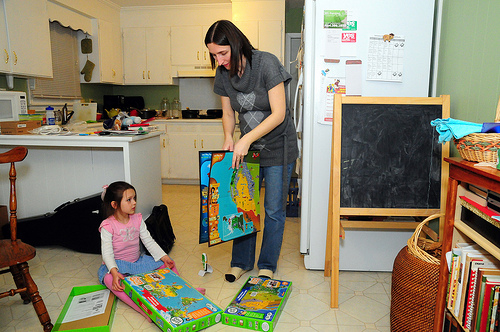
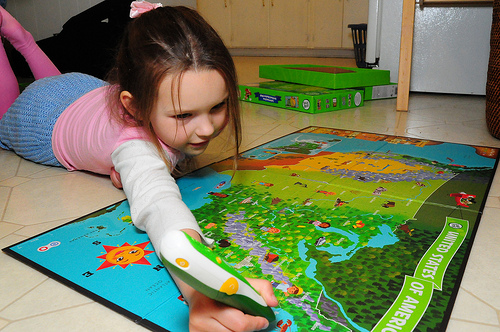
The Girl has been working on puzzle maps at school, learning, continent by content, states and countries -- Europe, North America, and South America down, currently working on Africa.

DSC_6618

Almost every day since then, we've gone over countries and states, an effort to remember what's learned and add new states so she can finish a continent and bring home her hand-colored map.

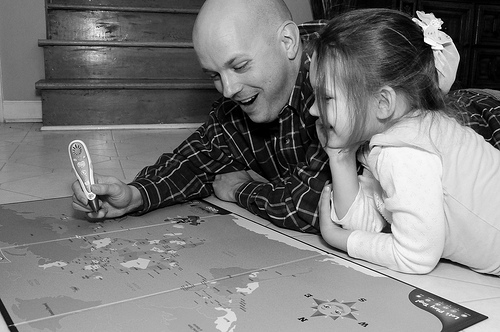
In Poland this autumn, she drove everyone crazy showing all the maps she knew. Only Dziadek, a former geography teacher, could sit down and listen to her, time after time, catalogue the shifting geography of an ever-changing world. "Many of those countries didn't exist when I was born," I think as she names them for me; as for Dzaidek, even Poland was a different country when he was born. Those nuances are lost on L as she points and names, proud of her memory.

DSC_6625

As a reward, though, we agreed to buy the Leap Frog interactive maps for her when she completed Europe, and they arrived today.

DSC_6630

Endless fun on the horizon.

The Games We Play

DSC_6585

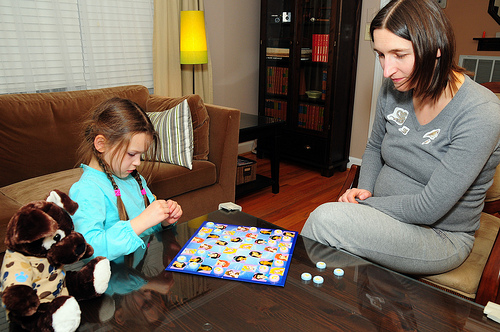
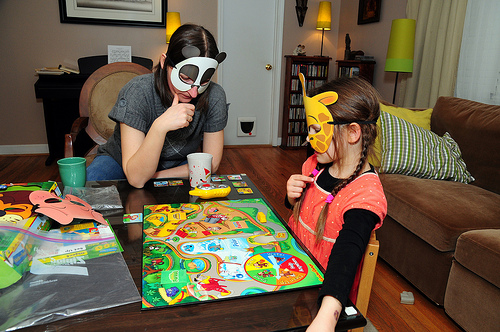
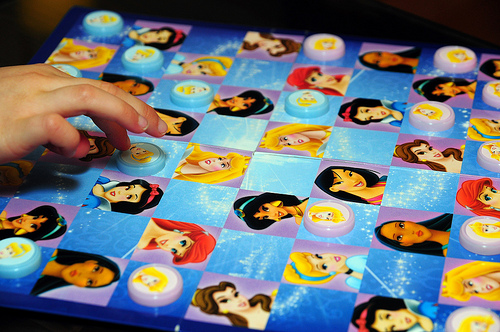
The Girl simply loves playing games: Candy Land, checkers, Go Fish, "the memory game" (Never just "memory" for her), Curious George -- you name it, she'll play it.

DSC_6583

The long-standing challenge for us as parents has always been teaching her to win with humility and lose with dignity. It's tough to teach a child something you yourself are not good at, for it must be said that I don't always lose with dignity myself. Chess is about the only game I play, and while I don't pitch a fit, my pulse quickens at a loss, and I'm soon berating myself for my obvious mistakes.

DSC_6596

Yet by their very nature, these games make excellent benchmarks for social skills development. There are countless metrics:

  • How far into the game does the first fuss appear?
  • How long does the first fuss last?
  • Once it subsides, does the first frustration return immediately?
  • Is the Girl capable of finishing the game or has she worked herself into an irreversible tizzy?
  • When it begins to look like a loss is inevitable, does she give up or continue playing?

Recent gaming adventures have shown that L is developing a tolerance for the inevitable eventual loss, an ability to recover quickly from initial frustrations, and the poise to win and lose well. It was, in short, truly a phase.

Thoughts on the Balcony

We all go into the classics of literature with certain preconceptions and assumptions. We grow up hearing about Romeo and Juliet, and knowing that it is considered a classic love story, we expect to find a valiant and noble Romeo. What we find, as the play develops, is a character that is entirely more human than we expected. In fact, early impressions of the young man sour quickly.

These are some of the impressions from my eighth graders after a two-day look at 2.2, the famous balcony scene.

  • I think Romeo is a little obsessive. Like when he was in love with Rosaline, he fell deeply in love, but he quickly moved on to Juliet. He didn't even know who she was and he was already making out with her! I think nowadays he would be considered a player.
  • He's a major creeper and totally a player. I would never date him.
  • I think Romeo has good logistics but when it comes to love, he's a bit tipsy! He is a star-crossed stalker.
  • I can't believe he went to her balcony. That is mega-weird.
  • Romeo is a psycho-creepy stalker!
  • Romeo is very spontaneous. He lacks a lot of common sense that Juliet has.
  • Romeo is someone I would trust but would not fully trust.
  • I can see why Rosaline left [Romeo].
  • Even though he is a creeper, he seems romantic and sweet.
  • Boy is he a CREEPER! Come on now! You just met her!
  • Romeo is brave yet incredibly stupid.
  • I hope as we read on he will get back to the person I thought he might've been before, like charming and funny and bold.
  • [Romeo] is annoying and very stalkerish, but I don't see him as mean.
  • I wish Romeo was more of a perfect gentleman, funny, daring.
  • Romeo is a creepy, weird person. I thought he was cool at first, but not anymore.
  • I feel like Romeo is being shallow.
  • Romeo is a creep.
  • [Juliet] seems like she would make smart decisions like not to smoke or drink.
  • I think Juliet would be a cool person (without the old English).
  • You're telling me you wouldn't risk life and limb for your belovèd? That's not very gentlemanly. (In response to another student.)
  • I probably wouldn't be friends with Romeo because he confuses me a lot of times.
  • [Juliet] has good views on love and is an independent girl. We will soon be BFFs :)
  • Romeo is a professional psycho. 'Nuff said.
  • [Juliet is] NOT creepy, like Romeo!
  • The crazy part of it is that Juliet ends up killing herself for the psycho! See, she's the one that needs to be checked into a mental institution for liking him!
  • Romeo is a stalking creep. Nope, we wouldn't be friends. We'd be best friends. We'd go stalking together.
  • Romeo goes with his heart and blacks out his mind, which is not good at all!
  • Romeo falls in love a lot.
  • Romeo would be the kind of person that would be overprotective and call or text you every day, say "I love you" a lot. (Clingy.)
  • I'm not being friends with some mushy guy!
  • I'd be [Romeo's] friend as long as he stays away from my window!
  • I wouldn't want to listen to [Romeo] sob about love and girls all the time.
  • Romeo is a dreamer and a gal-pal and would be annoying.
  • Romeo is starting to turn out a little weird.
  • I think it's pretty hardcore that Romeo lives in the present.
  • I'd keep a fair distance [from Romeo].
  • If Romeo says you can only love one person, then why does he love two?

The Return to Reality

The return after a long break is both nerve-wracking and refreshing. The former comes from the unpredictability of fourteen-year-olds. The latter is a simple function of having a long period away from each other. As much as I like my students, it's good to be away from them from time to time -- to be around adults more than kids. (Well, having a five-year-old daughter, I'm not sure how much that's really possible.)

For everyone today -- teachers and students -- it seemed the "refreshing" won out. Far from being reluctant to return to studies, many students seemed positively eager to come back -- at least that was the feeling I got in my classes.

It was a good Monday, and often can one say that, especially after a long break?