matching tracksuits

fun in threes, sometimes fours

education and teaching

Work

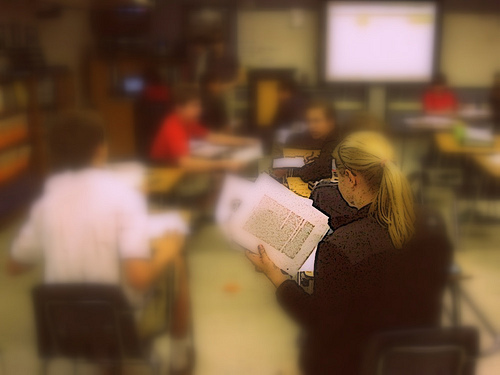
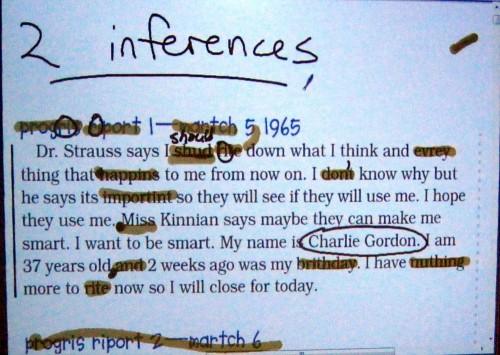
One class began working on Flowers for Algernon.

Another class continued with Great Expectations.

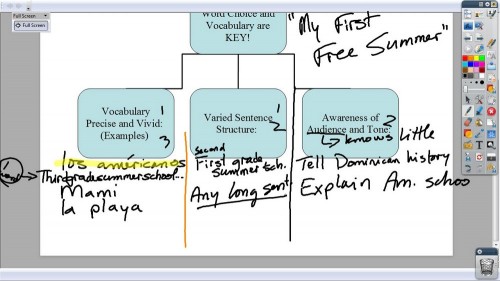
Still another class began looking at the notion of voice in writing.

Busy day back.

Preparing

The day before school starts again, I always get a bit nervous. What's the return going to be like? Is it going to be like pulling teeth to get them to work? What will their attitudes be like? What will my attitude be like?

Spring Break?

The first day of spring break 2012 proper, and it starts like any spring day should: sun, warmth, clear light. Freshly emerged leaves offset the patch of Azalea blue (or is that purple? I've never checked, i.e., asked K) in the back corner. It would be great to be out in the warmth, to do some work on our small raised-bed garden, to work up the first sweat of the year. The grass needs mowing; autumn's leaves need raking; the raspberries need netting shortly -- yet none of these are options.

April Morning

With a major paper due in a week, I'm sequestered, reading through articles, planning an attack, drowning in coffee and tea.

I spend the day filling a folder with articles from JSTOR, Gale, and seemingly countless other online resources that make it possible to research most anything from home. Then I write, write, write.

"In calling these stories 'parabolic,' we encounter an critical etymological parallel with geometry."

Did I really just write that?

Still, I take my own advice, the mantra to my students that I seem to chant daily: "It's a first draft. Don't worry about making everything perfect -- or even close to it -- in a first draft."

Evening approaches and with it, new tasks. I help the Girl get ready for bed; I trim tenderloin and prepare the brine for smoking later this week. K reads the Girl stories and prepares a salad for tomorrow's lunch. Having to go to work tomorrow, she trundles off to bed; I sit down once more at the computer.

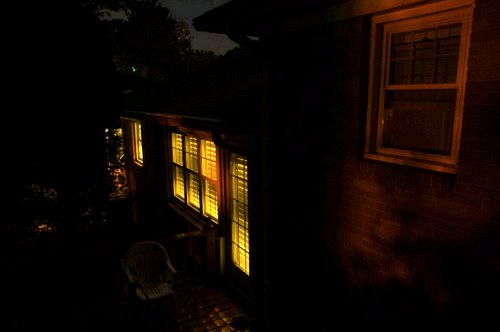
Others I'm sure are enjoying a first evening at the beach or the sounds of crickets at a mountain retreat. Me, I'm just ready to turn out the lights and head to bed.

At Work

At times I want to strangle them. Sometimes, five minute later, I want to hug them.

Lent 2012: Day 30

There is always one bright thought in our minds, when all the rest are dark. There is one thought out of which a moderately cheerful man can always make some satisfactory sunshine, if not a sufficiency of it.

Sometimes, I wonder. Some of the students I work with on a daily basis seem to have few bright images in their minds. Life is a constant crisis for them: everything from someone bumping them in the hallway to a perceived injustice from a teacher sets them off. They wear a scowl on their faces most of the time, and life seems to be one big trial for them.

Faber, in the quote above, is speaking of the belief in a joyous afterlife, but sometimes I wonder about the usefulness of that hope for someone who's already lost all hope for a happy life here and now, and all by the age of fourteen.

The quoted excerpt is from Father Frederick Faber’s Spiritual Conferences, excerpted here.

Lent 2012: Day 27

There is also a grace of kind listening, as well as a grace of kind speaking. Some men listen with an abstracted air, which shows that their thoughts are elsewhere. Or they seem to listen, but by wide answers and irrelevant questions show that they have been occupied with their own thoughts, as being more interesting, at least in their own estimation, than what you have been saying. Some listen with a kind of importunate ferocity, which makes you feel, that you are being put upon your trial, and that your auditor expects beforehand that you are going to tell him a lie, or to be inaccurate, or to say something which he will disapprove, and that you must mind your expressions. Some interrupt, and will not hear you to the end. Some hear you to the end, and then forthwith begin to talk to you about a similar experience which has be fallen themselves, making your case only an illustration of their own. Some, meaning to be kind, listen with such a determined, lively, violent attention, that you are at once made uncomfortable, and the charm of conversation is at an end. Many persons, whose manners will stand the test of speaking, break down under the trial of listening. But all these things should be brought under the sweet influences of religion. Kind listening is often an act of the most delicate interior mortification, and is a great assistance towards kind speaking.

One of the curses of teaching middle school is multi-tasking one must do during certain times when a student is trying hard to clarify something that happened in class -- homework, a proofreading trick, a comprehension check, or any number of little things that might require some additional explanation. And these moments come, often enough, as I'm standing at the door, supervising students as they change classes. Hardly the time to be able to listen kindly.

I once had a young lady terribly upset -- unbeknownst to me -- because of this. She felt I was never listening to her, that I never had time for her questions. She was a most studious, hardworking girl. It took a while to work out, but I learned, again, the value of kind listening.

The quoted excerpt is from Father Frederick Faber’s Spiritual Conferences, excerpted here.

Lent 2012: Day 22

Kind words will set right things which have got most intricately wrong. In reality an unforgiving heart is a rare monster. Most men get tired of the justest quarrels.

If I could teach my students one extra-curricular lesson, it would be this. I have calmed furious students (sometimes furious at me, most often furious about something some peer has done) with a few kind words so often that it has become almost instinctive: “Get the kid away from the situation and say something kind.” A smile helps as well.

Yet they re-enter the same quarrel, sometimes only hours later (occasionally, even more quickly), and I can see a certain Sisyphean fatigue in them as they fuss. “A calm answer…” I mutter to myself, wondering if I can teach that by example alone.

The quoted excerpt is from Father Frederick Faber’s Spiritual Conferences, excerpted here.

Lent 2012: Day 17

A kind interpretation of actions is such a far-removed idea for me at times, but perhaps the most challenging times are when I'm in a heated situation with a student and when I'm driving in Greenville.

We must come to esteem very lightly our sharp eye for evil, on which perhaps we once prided ourselves as cleverness.

The latter is the most consistent challenge. While I don't necessarily see other drivers' motivation as being a result of evil, I constantly pride myself on the cleverness of my own driving as compared that of my fellow pilgrims on the road. This idiot doesn't know how to turn left at a traffic light. That dolt waits until the car in front of him is twenty car lengths ahead before pulling starting from a green stop light. This moron pulls so far into the intersection that it's difficult to make a left turn around her. That dork is so busy texting that he misses at least five seconds of the light. This one is a matter of merely reminding myself that I've no idea what these people drive the way they drive and that perhaps they have very good reasons. Perhaps the person hesitant to make a left turn recently had a terrible accident doing so. Maybe the person who is waiting for the care in front of him to be a seemingly ridiculous distance from him before starting is having car problems and the car doesn't respond as well as he wishes. Possibly person pulling too far in to the intersection is on the way to a critical meeting -- perhaps a family member is ill in the hospital -- and made a last-minute decision not to push the yellow light. And perhaps the person texting is texting about the death of a loved one.

Calmness while driving -- offering what Faber calls "kind interpretations" -- is fairly simple: there's very little at stake. A few moments lost here or there is hardly something to get enraged about, and whether or not the kind interpretations are justified, it all seems a relatively moot point when we consider who brief and insignificant the interaction.

The former example of heated situations with students is of much greater import. These are not brief, insignificant interactions. Like it or not, the student and I will meet again tomorrow -- and the day after and the day after that -- and will have to work together productively. So when a student begins the day with a smart comment to me, simply wants to come in and sleep, simmers with anger at a mild request from me, or any number of things that I would normally be tempted to take personally as an assault on my classroom authority and my personal dignity, I really have two choices in how I deal with the situation, and the decision I make depends on whether or not I create for myself a kind interpretation of the individual's motives. Students come to class with any number of significant and insignificant emotional weight pulling them down, and the simple truth is I have no idea when someone has placed more mass on her shoulders. Perhaps this young man comes from an abusive home and he just faced down a violently angry parent to deflect injury from a younger sibling. Maybe this young lady is responsible for a eight-week-old sibling during the night because their mother works the night shift. This young man might not have eaten breakfast this morning and had very little dinner the night before. Any one of these situations would be enough to set a day off on a crooked trail. And while I know more about these kids than the average stranger, most of them are still virtual strangers to me when it comes to the clockworks of their lives.

A kind interpretation of their anger, apathy, exhaustion, and frustration results in a kind answer, and we all know what that does.

The quoted excerpt is from Father Frederick Faber’s Spiritual Conferences, excerpted here.

Lent 2012: Day 8

Thus does kindness propagate itself on all sides. Perhaps an act of kindness never dies, but extends the invisible undulations of its influence over the breadth of centuries.

“We can only plant the seeds. We never know how they will grow” It’s a common refrain in teaching, and I always kind of thought it was a cop-out. At times I feel like, quite frankly, such a failure as a teacher. Kids spend 180 days with me, and some of them seem none the better for it. It’s perhaps a useful guilt: it might spur teachers to become better at their job, to seek training and experiences that will increase their effectiveness.

Perhaps an act of kindness never dies

But saying, “We can only plant the seeds” seems somehow to alleviate that guilt. We plant the seeds; it’s up to the kids to tend the resulting crop.

Faber suggests otherwise: it’s not a cop-out. We can sow kindness and know, with some certainty, that it will grow into more kindness. We can know that we’ve had a positive impact on someone’s life. Perhaps it’s a good sign that we’re more willing to admit the opposite, or maybe it’s just another sign of our condition.

The quoted excerpt is from Father Frederick Faber’s Spiritual Conferences, excerpted here.

Lent 2012: Day 5

the immense power of kindness in bringing out the good points of the characters of others

When I can lift myself above my wounded ego — “What?! How dare you be cruel or disrespectful to me, who is only trying to help you get an education!” — and respond thoughtfully and kindly, a change sometimes occurs, a softening, a reflective moment of calm.

A kind word or tone can transform conflicts into positive experiences. A simple kindness of offering to help a kid by holding books while he rummages through his locker can bring a smile where once there was anger.

Even if all is well in the student’s life at the moment, an act of kindness can echo into the future. Relationships are like bank accounts: we can make deposits through kindness that will give us a buffer against emotionally stressful withdrawals.

The quoted excerpt is from Father Frederick Faber’s Spiritual Conferences, excerpted here.