matching tracksuits

fun in threes, sometimes fours

education and teaching

Head Down, Finger Up

Dear JT,

I’m ashamed to admit it, but I’ve come lately simply to ignore when you’ve put your head down in my class. There are enough behavior problems in that class to deal with that I don’t want to pick a fight, so to speak, with you. I know I’ll likely only get attitude, and even if you do comply, it’ll only be temporarily.

It bothers me because it’s disrespectful, but quite honestly, you don’t seem to care, and you’re only a kid, so like I said earlier, bigger fish to fry and such. Today, however, you were disrespectful to close to 10,000,000 people. Did you know it was even possible to disrespect so many people at the same time? I really didn’t either: I’d never really given it much thought. But when you put your head down and slept through our Holocaust-based writing exercise as we prepared to read Anne Frank’s diary, you basically put your middle finger up to all those who died in one of the evilest atrocities in history. For all intents and pursposes, you said,

I don’t care about you. I don’t care that you lost your family to a murderous regime. I don’t care that the last image you had of your child was of her being ripped out of your hands, screaming. I don’t care that you had the responsibility of burning the corpses of thousands upon thousands of gassing victims. I don’t care that you were “experimented” upon, shot, kicked, beaten, tortured, and treated like a roach. What I care about is that I’m a little sleepy now in first period, so screw you — I’m going to sleep.

I anticipate your response being something along the lines of, “I don’t care.” That’s fine. No one can make you care about anything. But if you find yourself one day alone, if you find yourself wondering if anyone in the world cares for you, and if you decide that the answer to that question is, “No, no one other than my mother,” perhaps you’ll know how those millions upon millions of Holocaust victims felt. And ironically, the fact that you put your head down during that class session would go a long way in explain why no one cared for you.

Then again, maybe that’s what you’re experiencing now. Maybe you already feel that way. It’s a bit presumptuous of me to suggest that I know you so well as to make such an accurate assessment. After all, I only see you for a small slice of your life. Still, it strikes me as a real possibility.

At the same time, there are plenty of others who have lived lives devoid of anyone really showing them any concern or compassion as children who have grown up to be perfectly empathetic individuals. (And there are plenty who have experienced the opposite.) I do know that you’ll have an easier time in life — a more fulfilling life — if you manage to purge “I don’t care” from your vocabulary.

Still caring for you, but with greater difficulty today,
Your Friend in Room 302

P.S. I said nothing to you when you put your head down the second time after I’d already asked you politely and privately to show some respect. I didn’t want to damage the atmosphere I had created in the classroom. I will, though, address it tomorrow.

Trying

Dear Paul,

I hope you won’t take this the wrong way. I like you a lot, and I enjoy having you in my class, but sometimes, buddy, you just try too hard. Way too hard. I see you trying to carry on with some of the other kids as if you’re like this with them (visualize me crossing my middle finger over my forefinger), and it pains me. You’re a sweet kid: all this “gangsta” air you’re trying to affect just doesn’t suit you. And the other kids see it, too. And that’s probably why you don’t fit in, because you’re trying to squeeze yourself into a shape that just isn’t you. You can’t fit into the self you’re trying to create, so how can you then take that shape at fit it into anything?

Please know that you don’t have to be “tough” to be loved. You don’t have to have “swag” and bravado to be popular. You don’t have to strut (and let me tell you, as a friend, your strut looks a little more like a limp) to get attention. You’re a kind, sweet kid. Let that be your calling card and I guarantee you’ll have more friends than you know what to do with.

Sincerely,
Your Friend in Room 302

Broken Spell

Occasionally, there's an absolute spell in the classroom. Somehow, all the stars and temperaments align, the moon is waxing, everyone has a full belly and sufficient motivation, and things just work. The kids just work. Even kids who previously had done little or nothing work. They ask intelligent questions. They work together as adults. And I sit -- for a brief moment, because in such situations, rare as they are, I'm always helping this or that kid -- in the midst of it in awe.

Earthquake Drill

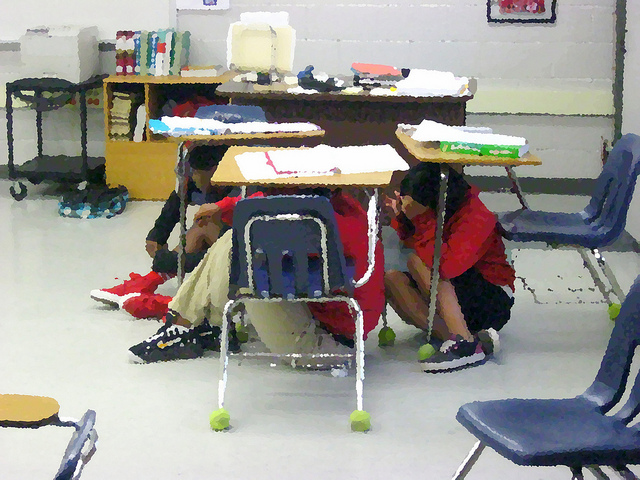
And then the earthquake drill (in South Carolina?!?!) comes and breaks the spell into a million little shards of idle conversation.

Choices

Dear Terrence,

I spoke to your English teacher today. She told me about a problem you had with another student, that this boy did something that so angered you that you were willing to fight him. That you turned over a desk and started marching toward the kid with every evil intent that anyone could imagine glowing your eyes.

Remember, we had a conversation in the hallway about this the other day. You’re letting people push your buttons. You’re essentially giving them a remote control and saying, “Hey, you want me to hop on one leg, press this button. You want me to laugh, press that one. If you want me to hit you, the red button’s the one.”

What saddened me most about what your teacher said, though, was your response later, how you asked in a low voice, “Ms. Jones, did you write me up for that?”

“What choice did you give me, Terrence?” she said.

I know that you feel you don’t have a lot of choices right now, Terrence. I know you feel that no matter what decision you make, things always turn out the same way. I know that a lack of choices feels like a prison, but not a conventional one — this one has invisible bars that seem to change location but hold you fast just the same. I know you feel you have few choices, but I’m wondering if your teachers don’t feel the same way.

“What choice did you give me, Terrence?” asked Ms. Jones, and in that, I can almost hear as much frustration as I hear when you tell me some of your stories. What choice does any teacher have when facing a child like you, a child who really needs some positive attention and someone who can sit down with him and explain and practice, as many times as it takes, some of the rules of the game that you seem somehow to have missed out on?

Before you can learn math, science, history, or English, you need, quite frankly, to learn how to learn. To learn how to be comfortable with your own stillness. To learn how to look at someone who’s giving you instruction the same way you look at me when we’re standing in my doorway, chatting. To learn how to listen with a slight smile of anticipation like you do when I call your name out as you walk down the hall and motion you over to me.

But unfortunately, we’re not in a situation where we can take a lot of time to teach you how to learn. We teachers have got deadlines and testing hovering over us, and it feels like the tests are pressing our buttons. We have choices — I’m convinced of that — but I’m not sure we’re all aware of these choices, of the various options that might lead to more success for you and kids like you in the classroom. I’m certain there are choices, but I’m not as sure that they’ve even all been discovered yet. So in a way, we teachers are just groping around, feeling out these invisible bars just like you.

I do know that for most of us, being in the classroom is a conscious choice. We’re an idealistic group at heart: it’s what led most of us to the profession and it’s what keeps us there. Maybe if you can keep that in your conscious thoughts — that everyone who stands in front of you day in and day out is there because they choose to be there, because they want to help, because they feel called to do what they do — then you’ll start to see some new choices, too.

Sincerely,
Your Friend in Room 302

Connections

Nightjohn tells the story of a young slave girl, Sarny, who surreptitiously begins learning how to read -- an act that is utterly forbidden for a slave. She and John, her teacher, face potential whipping and worse in scratching out letters in the dust of the slave quarters. It's a vivid example of the power of education and literacy, and the two classes of mine that are reading it have become utterly engrossed. So when I was munching on peanuts during my planning period, taking the ten minute news break I allow myself, and I read the story of Malala Yousafzai, I knew I had to incorporate her story into our unit.

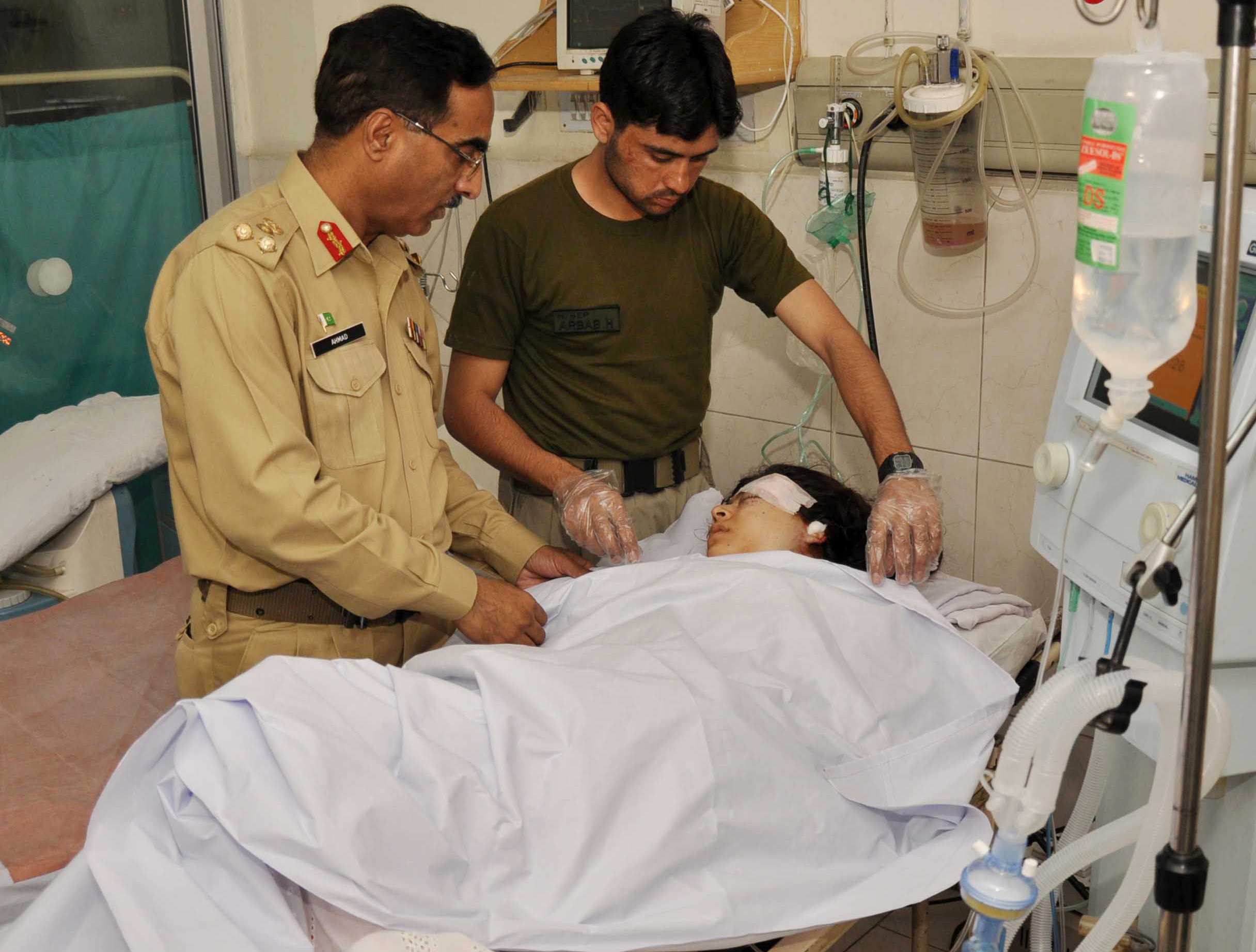
Malala Yousafzai in her hospital bed

Yesterday I had students read an article from the Washington Post, practicing some literacy strategies we've worked on this year to make sense of the difficult passages, then had students write a brief compare/contrast paragraph about Malala's situation and the dangers Sarny faces in the book. The parallels are striking: both girls are risking death for an education; both girls are being denied an education because of xenophobia; both girls defiantly stand up to the xenophobia; both girls suffer because of their courage -- the list could be virtually endless.

Today, the students came into class talking about the story.

"I watched it on the news. The article we read said she was shot in the neck, but on the news, they said she was shot in the head," one girl explained.

"Yeah," another added, "but I heard she's been moved to another hospital and should be okay."

They continued this way for some time and were excited when they discovered the bell ringer included passages from Yousafzai's diary.

At the end of the day, when my first period comes back for the final thirty minutes of "flex time" (which doesn't seem to be as flexible as the name would indicate), a girl who often seems disengaged and occasionally even refuses simply to do anything in class came in excited to tell me that the Yousafzai story was featured on the daily kids news show students watch in social students.

"Mr. Scott, she wasn't shot in the neck," she explained. "She was shot in the neck and the head!" She, who sometimes would sleep through class if I allowed it, was excited, engaged, and eager to discuss it -- one of those moments that make me realize what a blessing it is to be a teacher.

Making Me Smile

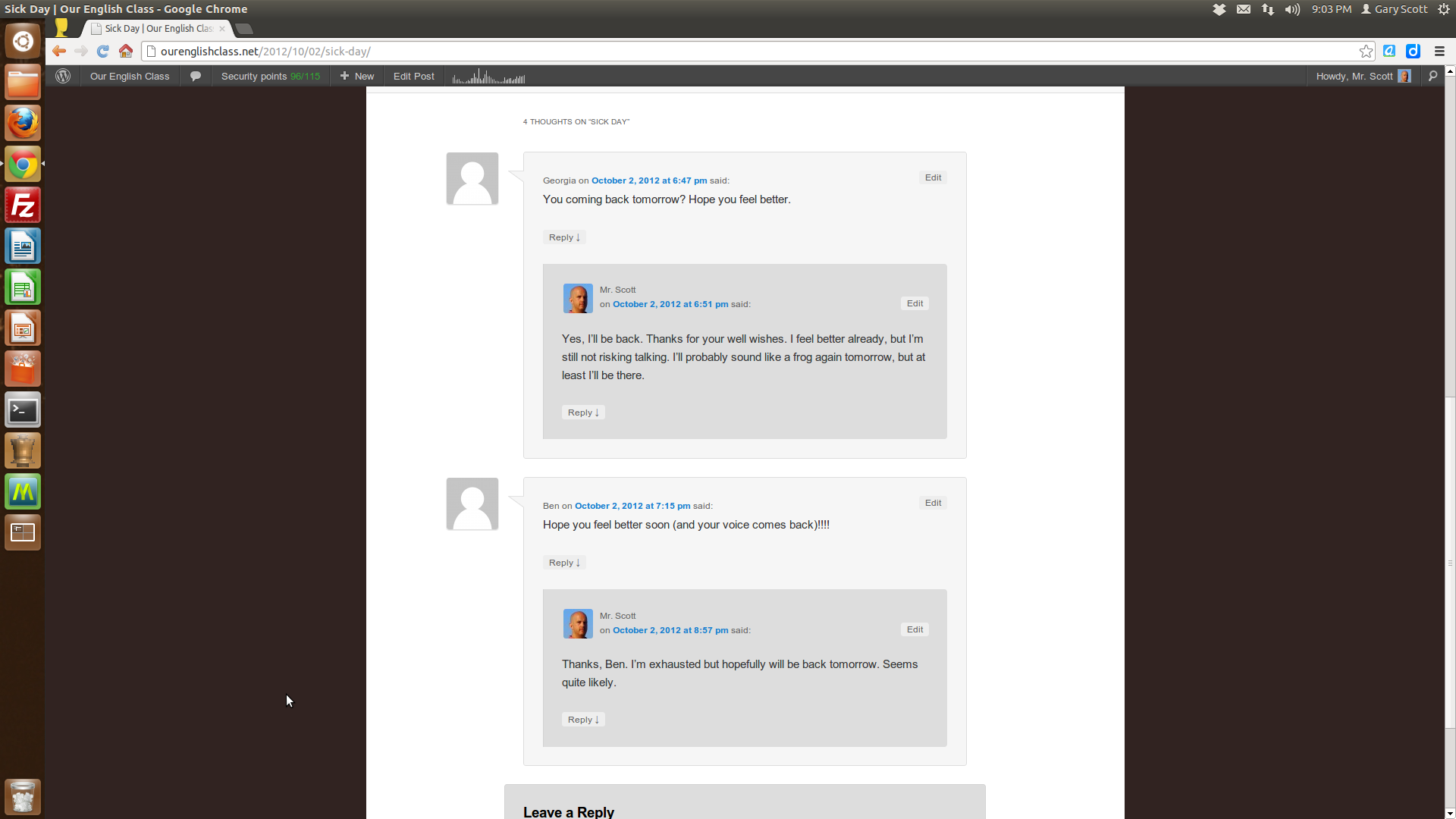
I was out sick today: it's hard to teach when one can't talk, and that was indeed the case for me today. Still, duty calls, and I updated my school web site to reflect the fact that I wasn't there and therefore there is no homework.

I shortly got a couple of responses from students wishing me well. It did more for my spirits than all the meds I'm now taking.

Homework with the Girl

She sits at the table — fewer distractions — and draws. “Draw three pictures each of things that begin with the letters P, Q, R, S, and T.” It’s getting close to the Girl’s bedtime, and as we know she is a perfectionist, we encourage her to choose examples that are easily drawn.

Homework

For “P” she settles on pot, pencil, and potato. “Q” seems tricky, but the Girl thinks of quilt, question mark, and Q-tip. “R” yields red (my own idea that got the Girl giggling), ring, and rain. For “S” she ends up with snake, sun, and star. At three objects per letter and twenty-six letters in the alphabet, we’re looking at more than seventy-five drawings over the next few days.

A bit much?

Boosterthon

It’s half bet, half bribe. It’s a fundraiser, an exercise event, and certainly for some, a bit of a pain.

DSC_3870

I suppose one might argue that it’s an exercise in school spirit and self-confidence. Elementary school activities, we’re finding, tend to combine several elements like that. Show, exercise, fundraising, dance party — I suppose it covers several state educational standards.

DSC_3874

For “the biggest fundraiser for the year” at her school — so it was explained at a recent PTA meeting — L had to gather pledges for a run around a small, 1/16th of a mile route set up in the field behind the school. Nana and Papa pledged a significant amount per lap, adding a cap as assurance of not having to mortgage the house to pay their commitment.

DSC_3886

Sure enough, when it came time to run — and hop, skip, walk, dance — through the boosterthon, the Girl did the maximum 35 laps.

DSC_3903

Which amounts to just over two miles, which is fairly impressive for a five-year-old.

Homework

The bane of most students and many teachers, too, homework seems in some ways to speak to the inadequacies of our educational system. Alfie Kohn and others certainly argue that, but they're certainly in the minority among educators. Most of us educators see homework as practice: just as a world-class gymnast or swimmer puts in extra time beyond formal coaching to improve his or her skills, so too young learners put in the extra time to master new skills.

DSC_3398

For the Girl, it's turned into something of a rite of passage. "When will I have homework?" she used to moan when she found me going over student work. Now that she has homework -- of a sort -- she's thrilled. "Tata!" she squealed as she ran into the room the other day, "I love homework!"

And what's not to love about it if it's done right? It can be a moment of bonding between a parent (or grandparent) and a child, an intense social and intellectual engagement where the two engage in a task with a specific and common goal.

Our Own Trisha

Every year, as we begin a unit on the Gary Paulsen novel Nightjohn, I read Patricia Polacco's Thank You, Mr. Falker. The story of a young dyslexic girl who was suffering the taunts of peers and the seeming neglect of teachers, the book emphasizes the life-changing nature of literacy. Trisha, the protagonist, spends the first four grades of school hiding her inability to read, feeling dumb for not being able to keep up with peers, and taking solace in her one skill, her exceptional artistic ability. It's such a touching story that even a room of rowdy eighth-graders ends up sitting in silence, visibly moved. Every now and then, a girl -- always a girl, for a boy will never show such a "vulnerability" -- sniffles in the back or wipes her eye occasionally as the story nears its conclusion.

"We have Trishas in this room, guaranteed," I tell the class this afternoon. "Someone here has felt stupid about something, been taunted for something out of her control, taken refuge in solitude and some seemingly non-academic talent that doesn't fit today's educational mold."

"We've probably all experienced it," says a boy who has never struck me as being particularly attuned to the pains and sufferings of others. I nod solemnly in agreement. And I think back to the quiet girl a couple of years ago who, leaving the classroom after that particular lesson, murmured, "I have a lot in common with Trisha."