matching tracksuits

fun in threes, sometimes fours

education and teaching

Hidden Skills

"Teachers, please check your email now. Again, teachers, please check your email now." With the weather forecast that students had been bouncing around among themselves before school started -- snow, sleet, blizzard, nothing, depending on the individual student's optimism -- it seemed obvious what the email would tell us. Sure enough: "School will be dismissed early today. Will let you know more details later."

I finished reading and, turning around, met a chorus of pleas: "What did it say?!" "Tell us!" "Are we getting out early!?" I just smiled and continued with where I'd been in the lesson.

"Come on!!" was the only response I got.

Still, I pressed on. We were working on using transition words as markers in an argument. "Even if" was our phrase of the moment, and I smiled and gave as an example, "Even if we have early dismissal today, it won't affect our first period class."

Still later, a trickle of announcements begins interrupting our work: "Jane Doe, please come to the office for early dismissal." "Michael Smith, please come to the office. You have an early dismissal."

It seemed obvious by now, but still, I said nothing.

Finally, though, the clincher: "Those students who borrowed a belt from Mrs. Thomas, please return them now." With a mandatory belt a part of our school's dress code, Mrs. Thomas has taken to lending belts to students who arrive without in an effort to help them avoid the inconvenient consequences. But that's not what the students heard. They heard, "We're getting an early dismissal."

It was a teachable moment I couldn't pass up. Recalling a student's comment earlier in the year about how she never infers as part of her day, I asked the class, "Since you all now think you're getting an early dismissal, would you mind telling me what skill you're employing to reach that conclusion?"

Miss I-Never-Infer-And-Likely-Was-Only-Trying-To-Be-Contrary said, "We inferred!"

We went through the observations we'd made in order to make that inference:

  1. "You got that email. No one ever makes an announcement for teachers to check their email!"
  2. "You used that 'Even if' example!"
  3. "We've been having half the school called to the front for early dismissal."
  4. "Everyone only has to take their belts back to Mrs. Thomas. You only have to do that at the end of the day."

I agreed to each one, probing a bit further to get them to express their reasoning a little more fully. Finally, I asked, "What about the most obvious piece of evidence?"

Seemingly all hands in the room pointed to the window. "The weather!"

Only one thing to do -- put a bow on it: "So don't tell me you don't infer endlessly on a daily basis."

Overheard

Overheard, after passing out report cards:

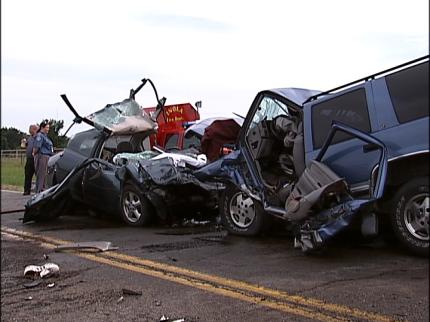
“My parents don’t care what I get, as long as I pass. Sometimes, when I brought home an F, my dad would yell at me. But I yell back. He knows better. He sometimes forgets, but I yell back, and he backs off.”

Empathy

empathy

The questions for the anticipation guide were seemingly straightforward. One would think that responses -- "Do you agree or disagree and why?" -- to these questions would be somewhat predictable.

  1. Sometimes, it's better to remain ignorant about certain things.
  2. It's fair to treat people differently based on their intelligence.
  3. It is better to be smart and lonely than unintelligent and happy.
  4. Our relationships with other people, not our achievements, are what fulfill us.
  5. It is better to accept your fate than to try to change it.
  6. It is important to have empathy for others.

Granted, for question one, adolescents might not necessarily have learned the beauty of ignorance. It seems unlikely that any adult would disagree with the statement, and in fact, a slight majority of the students agreed this afternoon.

Question two is a bit tricky: most kids think of it as a question of politeness and manners. I'm almost always the only person indicating agreement with the statement. When I explain about differentiation and remind them of special education services, most students understand where I'm coming from and smile at how I "tricked" them.

Question three is fluff. It gets conversation going, but there's really no expected response for what I (and I hope others) would consider a well-adjusted, emotionally healthy individual.

Question four hints at the shallowness of materialism. Students seem split on the issue, but for eighth graders, one might expect that.

Question five is an interesting question for my students because so many of them -- particularly those who struggle in school -- are completely fatalistic. Perhaps they don't see that in themselves, though, because many disagree with this statement.

Question six, though, seems almost painfully predictable in a room of well-adjusted, emotionally healthy individuals. The inability to feel empathy, after all, is one of the most horrifying aspects of sociopaths and one of the most tragic facets of autism.

So when a young man looked at me this afternoon with an expression of disgust and almost anger when I asked him why he didn't think empathy is important, why he disagreed when almost everyone else agreed, why he seemed put off by the fact that I was unable to hide my surprise at his response, it left me briefly speechless.

"You mean don't think it's important to try to understand the lives of those less fortunate than you?" I asked after a moment.

"I never thought about it," came the flippant response.

"And now that you've thought about it?" I continued.

He shrugged and glared.


Defining Courage

I've been using ideas from George Hillocks, Jr.'s Teaching Argument Writing (Heinemann) in my classroom for some months now. South Carolina's shift to the Common Core standards necessitates a shift in writing focus to argumentative writing, which is not the same as persuasive writing. The latter relies on rhetorical tricks -- arguments from emotion, arguments from authority, etc. -- while the former involves claims, counterclaims, evidence, warrants, backing, and a host of other rhetorical goodies.

We've been working on "how to develop and support criteria for arguments" (to quote Jim Burke's blurb about the book), and one of the things Hillocks suggests is to use inductive reasoning to determine some general criteria from specific examples. The extended example he uses in his book is about courage, and since that fits perfectly with my current district-mandated heros-theme unit (the theme is mandated, not the unit itself -- well, not entirely), I thought I would use it as is, out of the box, so to speak. Hillocks provides specific scenarios for students to discuss and generalize about. I gave students all the scenarios and told the groups to choose five.

We began working as a class so we could get the feel for the work, and I gave them as an example the easiest.

In the small town of Clinton, teenage boys liked to play “chicken” with their cars. Two boys raced their cars directly at each other. The first boy to swerve to avoid the crash lost. Were the boys courageous when they played “chicken”?

Obviously, the boys of Clinton might be foolhardy or immature, but a courageous act this is not. Indeed, it somehow seems to be the opposite of courageous. Yet a handful of students doggedly insisted, against the judgment of the rest of the class that this acts lack of overriding noble cause (not their exact words) made this foolish at best, that this was a very courageous act.

"They're risking their lives! They could die!" they persisted.

I thought it might be a fluke, perhaps some kids insisting on playing devil's advocate. But these same kinds held the same line in all similar scenarios.

Harry learned that millions of dollars in gold would be moved by train from Washington, D.C. to Chicago. He knew it would be heavily guarded and protected by the very best alarm systems. The security guards were top-notch and heavily armed. Harry and his two companions were also heavily armed when they dropped from a bridge to the top of one of the train's boxcars. They immediately took fire from a guard stationed on the top of another car. They returned fire, killing the guard. Was their attempt to steal the gold courageous?

Who cares about these guys' motivation? Who cares that they were violating countless moral dictates and laws for material personal gain: these guys were risking their lives and that made their acts courageous.

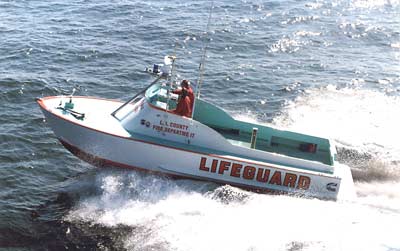
On the oceanfront, Mr. Jones heard a swimmer shouting for help. He saw sights indicating that this part of the beach was extremely dangerous because of undertows. A lifeguard asked Jones to help him move a boat into the water to be used to help rescue the drowning man. Instead, Jones said, “Don't be silly!” He ran into the water to swim out to the drowning person. Was Jones's effort to save the swimmer courageous?

Who cares that the lifeguard clearly knows something Mr. Jones doesn't, hence his insistence on using the boat? Who cares that in acting impetuously, Mr. Jones was likely giving the lifeguard another potential victim. He was risking his life, and that's all that matters.

I know of course that much of this is a function of age: thirteen-year-olds are quite fond of justice and courage, and they see the lack of the former in as many places as they see examples of the latter.

Sonnets, Again

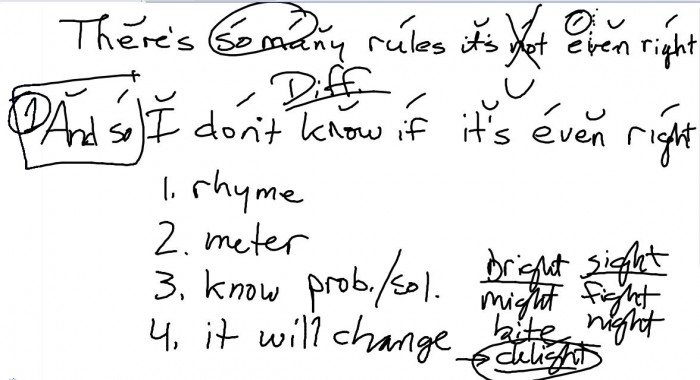
We're writing sonnets again in English I. "The hardest thing I've ever written" is the common consensus. So much to worry about: meter, rhyme, thematic development.

Notes from the board

The kids wonder why we're doing it. "It's not like we'll ever write one of these again," some protest, and it's true. At the same time, they've never struggled over a piece of writing word by word; they've never searched for the right word only to find it's actually not quite right; they've never planned a piece of writing simultaneously word by word, line by line, quatrain by quatrain. In short, they've never written like a poet.

What's the value in this? In a society where most of these kids are fluent with text shortcuts and seem never to slow down, the question almost answers itself.

Observing and Inferring

Of the many things I have to teach my students, one of the most difficult is the art of inference. When we read, we infer, but I try to show students that we infer constantly: about people’s body language, about who’s walking behind us, about the mood of our mothers and fathers — simply everything. But as we begin working with it at a visual level, inferring from photographs, I find that students often think an inference is merely an observation. In other words, they look at a situation, make a generalization about it, and think they’re merely reciting facts.

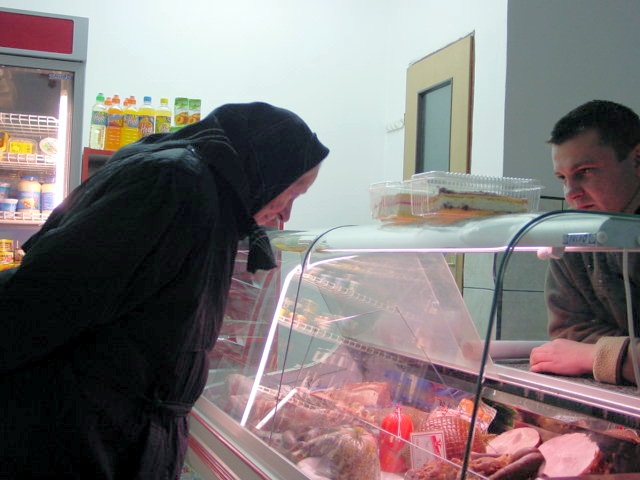
For example, take a look at the picture below.

It’s tempting to say that one observation is simple: this is in a store. After all, there’s plenty to indicate that:

  • in the foreground there’s a display case with meat;
  • in the background there’s what looks like a refrigerator display case; and
  • there are people who appear to be client and salesman.

However, the very verbage of the description belies the fact that it’s not an observation (after all, I used the term “indicate”) but instead an inference. It might be an inference with a very high degree of probability, but an inference it is.

I think that this might be a source of political friction between the liberals and conservatives. They’re both making inferences that they assume to be mere observations, and when the other side calls them on it, the discussion often slides into ad hominem arguments. Anyone who can’t see the obvious inference — which to the speaker is just an observation — is an idiot. After all, it’s as simple as seeing that the woman in the picture above is clearly shopping for Christmas dinner.

The Privilege of Teaching

“You’re raising our daughter! She spends more time with teachers than with her parents,” a parent once told me regarding a student.

It was the first time anyone had said aloud what I’ve thought often enough. Such notions most forcefully — and most obsessively — worked their way into my thinking when we began leaving our daughter with “strangers” at day care. It was a stab of guilt, feeling K and I were somehow neglecting our responsibilities as parents, letting someone do the majority of our childrearing for us.

The irony of being a teacher myself didn’t go unnoticed. I thought of a film — I can’t remember the title — that had a scene in which a young girl drops off her child for day care then heads uptown to her job as a nanny.

I see into parts of their lives no one else sees. A young man writes, “I ask my mom [to play chess with me]. ‘I’m too busy at the moment. How about later?’ Knowing that later will be near 7 PM, I slither back to my room.” It’s a vivid flash of what his evening is like, of what he might be experiencing at the very moment I’m reading his paper. It’s a window few look through.

Free Time

Dear Terrence,

The other day was a teacher workday, which means we teachers are at school while you kids are free. I wonder what that freedom brings you.

I know you have more “freedom” than the average student because of all the out-of-school suspensions you’ve served. I’ve often wondered about the wisdom of that. I’ll bet in some ways, at least during some of the more tiring stretches of the school year, OSS seems more like a gift than a punishment. After all, there’s no one to make you do this or that. You get to choose who you spend your time with. You can pass that time however you please.

Or can you? Perhaps your mother makes you clean house while you’re serving OSS. Maybe she has a long list of tasks that she expects completed fully and well when she returns from work. Possibly, but somehow I doubt it. She might be struggling just to get enough money to keep a roof over your head and food on your table — she might not sweat the small stuff. Whatever it is you do during those OSS days, I’m fairly certain you prefer it to what you do at school.

And all of this makes me wonder about the wisdom of OSS. I’ve already mentioned to you that I think you would benefit from some direct instruction in how to learn, in how to be successful in school and life. Couldn’t we replace OSS (and ISS, for that matter) with something like that? It would be tricky, because we would have to find a teacher with a certain patience and dedication to young people because, let’s face it, you and your friends can be a real handful in the classroom. It seems possible and even desirable, but I somehow doubt it will ever happen. The American school system likes to think of itself as being cutting edge and progressive, but it’s still relatively set in its old ways in many regards, and how to help students like you is a perfect example.

So I don’t really know what you might be doing today during your day off. Whatever it is, I hope it’s not what I’ve heard in rumor among teachers: I hope you’re not spending all your time trying to impress the members of some gang — for all I know, your gang, for I hear, as the colloquial expression goes, that you “bang.” I have some thoughts I’d like to share with you on that as well, but for now, I’ll let you get back to whatever it is you’re doing on your day off.

With hope,
Your  Friend in Room 302

Lost

Dear Terrence,

I heard today: You’ve been tossed out of alternative school, with your latest offense being the proclamation to a teacher that she could just “– off.”

It’s time I took the gloves off, so to speak. That’s stupid. That’s simply stupid. Look back over your long, checkered school experience: when has something like that ever made a situation better? When has such behavior ever helped? When has such behavior ever brought about anything but more trouble from a teacher? When has a teacher ever replied along the lines of, “Oh my! I’m so sorry to have offended you. Please forgive me!”? When has such language ever helped get you out of trouble? When has that language ever done anything other than get you into more trouble?

I swear, sometimes I think you guys simply don’t think.

Annoyed and saddened,
Your Frustrated Friend in Room 302

Board

It's one of the highlights of the year for me as a teacher. After working (some might say "struggling") our way the Odyssey, I surprise students with the culminating project: a board game based on Odysseus's adventures. They think it's fun; I design the details of the assignment to require some real problem-solving practice, legitimate "technical" writing (they have to create instructions for their game, and they must be clear enough that other groups can play without their help), and some creativity.

Today, they played the game.

Students playing peers' board game

I walked around, snapping pictures, listening in on conversations, smiling when they get so involved in the whole procedure that they don't even notice me, don't even remember they're also supposed to be evaluating the projects as well.

It's a good day to be in the classroom.