Matching Tracksuits

fun in fours

education and teaching

Chess Claims

Every now and then, a student will challenge me to a chess game with much braggadocio and bravado.

"I'm going to beat you so bad, Mr. Scott!" comes the claim. "You don't stand a chance."

My response is usually simple: "Perhaps." There are plenty of thirteen-year-old chess players in the world (probably in the county) who could, indeed, thrash me. When facing an opponent for the first time, I prefer humility. Usually.

What I was thinking, though, was anything but humble: "Perhaps. But remember, young one, I have worked with you for quite some time now. I know how you think. I know your critical thinking abilities. I know how much patience you have (or in this case, don't have). I know how easily (or not) you make connections between seemingly disparate passages of the text. I know how well you infer. Very strong chess players do all these things better than the average person; you do most of these at about an average (or even below average) level. Also, to beat me, you'll need to know chess theory better than I do, which requires study and focus -- two things you don't always excel at. Therefore, taking all of this into consideration, it's highly unlikely that you will beat me."

Now, thinking all these things, I often just play along with the trash talk: "Buddy, I'm going to kick you so hard your grandmother is going to feel it." The most brutal trash talk I do is when, after a couple of moves, I just give the player my queen. "I won't be needing that." Among those who have a basic understanding of chess, this always elicits hoots and laughs. One student might run over to someone not watching the game and recount excitedly what I just did.

I thought about that today as students in my last period class struggled mightily with making claims for an argumentative writing assignment with which we're concluding the semester. I thought I'd set everything up perfectly for them to see some connections that would lead to good claims. We were annotating the text for things illustrating the narrator's family's poverty and the acts of kindness they perform and in turn receive. I made sure students saw two passages:

  • We were one of the last families to leave because Papa felt obligated to stay until the rancher’s cotton had all been picked, even though other farmers had better crops. Papa thought it was the right thing to do; after all, the rancher had let us live in his cabin free while we worked for him.
  • She made up a story and told the butcher the bones were for the dog. The butcher must have known the bones were for us and not for the dog because he left more and more pieces of meat on the bones each time Mama went back.

Here we have two acts of kindness that directly contribute to the family's survival. Yet none of the students could make the connections and inferences necessary to come up with a simple claim about this: "The family receives basic needs from the actions of others."

The co-teacher in the class, seeing the same problem, started searching online for some sentence stems to help them with their claims. When working with struggling students, sentence stems (also known as frames) help students orient their thinking and direct their writing.

"Since claims can be so varied," I told her, "I doubt you'll find much." She's a great special education teacher and a real advocate for all students: she didn't give up. Still, she found nothing.

"I just don't know how to teach these kids such basic critical thinking skills," I said. I've tried logic puzzles and similar ideas, but I'm just not good at that. I feel that's teaching skills (inferring, categorizing, comparing/contrasting) that most kids have learned years ago. It's something an elementary teacher would be trained to teach. Not someone who studied secondary education.

It's from classes like this that the "I'm going to beat you badly!" chess claims emerge. One such kid kept bragging while I set up pieces, and he put his class materials away. He sat down across from me and said, "Okay, so how do you play this game?"

Map

Sept 19, 2017

Our state is no longer using the Measures of Academic Progress (MAP) assessment that it has used since I first began teaching in South Carolina over a decade ago. The test was a nationally-normed test that provided teachers with a wealth of useful data about kids' skills and abilities. And since it was nationally normed, it provided a broad overview for parents (and teachers) about where an individual child was nationally in relation to the rest of his peers.

As a teacher, I was able, at a glance, to see what a student needed. If the national normal for eighth graders in the fall was 220 points, I knew that a kid scoring 210 was fairly far behind the norm, and a kid reading below 200 was reading at something like a first grade level.

Then last year, a funny thing happened: it was announced that the national norm for eighth graders had been re-established at 218. This was the former norm for seventh graders. This suggests that as a nation, we've dropped a little over the last decade.

What can the state do about this? It reflects so badly on our schools that we must do something. What do we do? Get serious about holding back students who don't master content? Implement a serious, statewide program to deal with the behavior problems that correlate (and likely significantly contribute to) this decline? Budget more money to decrease class size?

None of these things. Instead, they dumped the test. The test is showing results we don't like, so what do we do? We stop using that test. Easy -- problem solved.

Keeping Them Informed

One key skill a good reader consistently employs is the simple cognitive act of connecting what she's reading to what she already knows. "Connect to Background Knowledge" says the teacher's poster of effective readers' skills. When talking to the district language arts coordinator about skills our students are lacking, this was one that the three eighth-grade English teachers agreed was one of the most critical and yet most lacking skills.

"I remember sitting with my family when I was their age," I said, "watching the local news at six and the national news at six thirty." I knew about current events and how they were connected to previous events as a result. I knew about Chernobyl as it was happening (with of course the Soviet propaganda delay taken into account). I watched the fall of the Berlin Wall in almost real-time. I knew about the Tiananmen Square massacre because Peter Jennings, Tom Brokaw, and Dan Rather told me about these events. I was, therefore, constantly building new background knowledge.

"Why don't we get back to watching the CNN Kids news to remedy this?" the ELA coordinator suggested. We all thought it might be a good idea and decided to talk to the social studies teachers about why they weren't doing it anymore.

I should have guessed why.

"There was just too much pushback from parents," a social studies teacher explained. "This one is mad about the network choice. 'Why CNN and not another news station?'" Never mind for a moment that no other media outlets produce, to my knowledge, the equivalent. "They would say stuff like, 'Why are you showing our kids liberal propaganda?' And then there were those on the other side who felt it was too conservative."

"How about telling the parents, 'Well, that sounds like an excellent conversation to have tonight at the dinner table,'" I suggested.

More Banning?

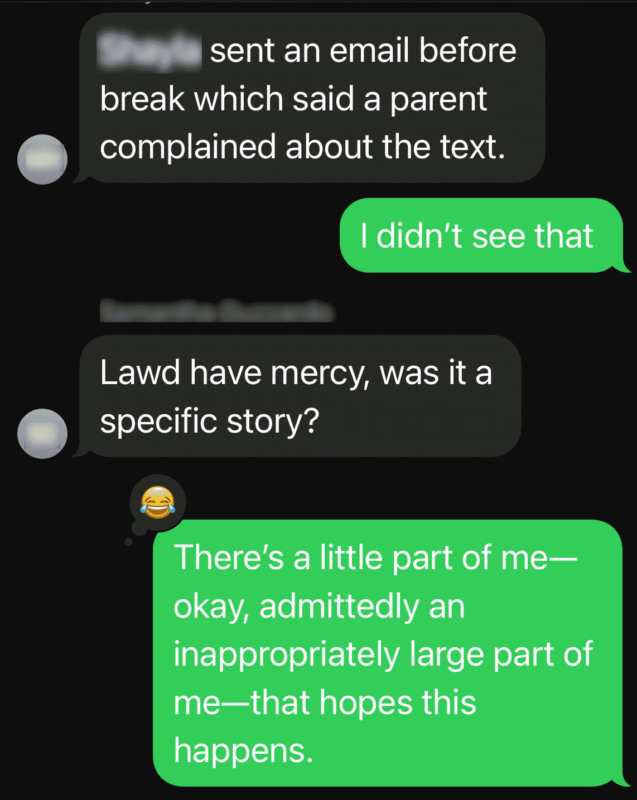
"Have you checked your messages lately?" the co-teacher who works with me during seventh period asked when she came in.

"Nope." But I was curious. So while I walked back to my desk to enter roll, I checked my phone. There was a message on a group chat.

I couldn't help it. I just started laughing. Howling, in fact.

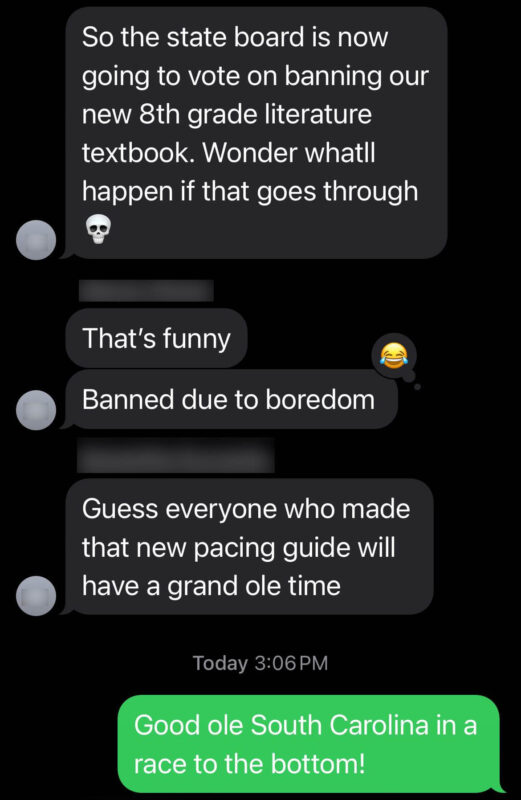
"Mr. S?! What happened?" several students asked. While I'm not a "don't smile before Christmas" type of teacher, I rarely find myself simply laughing so hard it's difficult to control myself, but when your world suddenly goes from absurd to Czech-film absurd, there's no other reaction possible:

That's right -- the state board of education is voting on whether or not to ban the textbook our district adopted.

Now, as absurd as that sounds, it's not entirely the school board's fault. The new state law allows any South Carolina citizen to challenge any book that's currently used in any school in the state. So some parent found something in the textbook that she didn't like and lodged a formal complaint. According to the state regulations (as I understand them), that sets in motion the whole process of reviewing a book and then voting on its status.

At the end of the day, I added my own thoughts: Mississippi, look out! South Carolina is hell-bent on making to the bottom of the education ladder. Then as students were dismissing, the chat picked up again:

Why would I want this? Because perhaps that would shake up enough people that many would finally start campaigning against this absurd new policy. Were the book to be banned, that's literally millions of dollars down the drain.

"We as taxpayers should consider a class-action lawsuit if that happens," the science teacher suggested. I don't even know if that's possible, but it's a lovely thought.

In the end, I don't think it will get banned, for the fiscal reasons outlined above. But it did get me thinking: if I were a retiree living in close proximity (say, a thirty- or so minute drive to Columbia), I would challenge books on a weekly basis. I would challenge elementary school books, middle school books, high school books. Before one challenge got resolved, I would lodge another. I would make it my personal mission to gum up the system so much that the school board itself would regret the legislation and push back against it.

Four Thursday Vignettes

Practice

Every morning I have hall duty in the arts wing. On one side is the band; on the other, strings. I walk back and forth between the two, listening to a beautiful cacophony of kids learning music.

A young lady is practicing her violin part. I recognize the melody.

"Do you know what that is? Who wrote it? What it's called?" I ask with a smile. The boy standing with her is one of my favorite students, but I don't teach him. He's on a team down the hall, but he's a sweet young man who smiles a lot and is friendly with everyone, so we've chat a little almost every morning. He glances at the sheet music at the same time she does. I beat them to it, though.

"Edvard Grieg. It's called In the Hall of the Mountain King." One of those pieces we all recognize from this or that film or advertisement, but few can identify by name. "Bet you didn't expect an English teacher to know that, did you?" I laugh. They both agree it was unexpected, then go back to practicing.

Texting

We received a text this morning about some visitors to our school: we would be having district personnel touring, and they are not paying attention to us teachers; they're looking for what students are doing. In other words, no need to talk to them or anything. I got admittedly a bit snarky and replied,

Usually, when someone on the group text makes a comment everyone likes, hearts and thumbs-up start bouncing all over the place. For this -- nothing. Several teachers later said they appreciated my text, but no one felt comfortable expressing it in a way that everyone could see it. I think that speaks to the overall feeling that seems to be sitting like a low, heavy fog, and if I were to guess, I'd say it's not just our school.

The Visit

Of course, the district personnel come to my classroom. The first one comes accompanied by our principal. Did he guide her here? As soon as they leave, another administrator brings another district person to our classroom.

It was a good day to visit, truth be told. The kids are having a Socratic Seminar -- one of their favorite activities. After we'd watched a bit of Harvest of Shame yesterday in preparation for our unit on immigration stories, we transitioned to Harvest of Shame Revisited -- a 2010 return to the topic of conditions migrant farm workers face. The common question on the viewing guide was the same: "Why do these folks earn so little money?" So this morning, I decided to change plans. We discussed that. In a limited way. In a South Carolina way.

All the kids discussed how we could do this or do that, but the bottom line was that all their ideas cost money. "Who's going to pay?" I pointed out there are a couple of sources, but one is we, the people. "They get paid so little because we want cheap food." That's true enough, and it led to the discussion I was intending about the necessity sometimes to sacrifice for the good of others.

Left out of the discussion -- the elephant in the room for some perhaps -- was the exorbitant salaries of CEOs. Where does that money come from? It can come from the consumers, but it can (many say should) also come from reduced CEO salaries or increased taxes on those earning at that level.

But this is South Carolina. And that is socialism. Not really, but it's going to be labeled Socialism (always with the capital letter) in many South Carolina homes. And that's at least part of the reason I didn't even bring that up.

Truth be told, the fact that it might raise some parents' dander is only part of the reason. To cover this well, I'd need to get a couple of articles for the kids to read about CEO wages compared to employee wages, and this was a spontaneous lesson. I'd decided to do it only this morning after reading yesterday's responses. But I do take that ugly s-word into consideration.

Such is teaching in South Carolina.

Teaching the Boy

I've been reticent to force my own teaching methods and ideas on our kids. L turned out to be a good writer without my help, but E has been struggling a bit. Still, offers of help but nothing more.

Today, he asked for help with his essay. I showed him how I have my students plan and organize their writing, and he found the technique simple and useful. He went upstairs and rewrote his entire essay using my method.

"The essay is so much better!" he gushed.

"That and the fact that you spent two hours in the evening working on it are things you can be really proud of," I replied.

"Thank you."

I've always oved that about the Boy: when you complement him, he quietly and modestly thanks you for the complement. It has always made me smile.

Tuesday

Tuesday has very little going for it. It doesn't have the unambiguous "you have to get through it" feeling of Monday. It's not hump day. It's not Thursday (a.k.a. almost Friday). And of course, it's not Friday. But Tuesdays this year are even more intolerable because of our Collaborative Team Meeting. A weekly mandatory meeting, it's as bad as it sounds. Occasionally, we get something useful from it, but like so many things these days in education, it just has the feeling of being a report mill for the higher-ups (who usually make two, three, four, or more times the average teacher's salary) so they can justify their job.

It's often a day for giving a test. I would have said "A day for testing," but "testing" now has connotations of standardized testing, and the increase in standardized testing is one reason so many of us are trying not to give tests of our own as much as possible. After all, how much can these kids be tested?

"Why not just use all the tests you have to administer for the district as grades?" Today, for example, we went over our benchmark scores. The benchmark, according to the powers that be, is supposed to be an accurate reflection of the degree to which the students have mastered the standards we are to teach in a given quarter. The only problem: they always include questions from other standards which we are to teach in other quarters!

"How is that a benchmark?" I asked one of our leadership team (another useful bit of jargon).

"Well, it's also predictive," came the response.

Predictive of what? I don't need a test to tell me how well the students are going to do on a standard I haven't even covered yet.

And the questions themselves -- so often a jumble of confusion. We went over one question today (they are allowing us to see isolated questions this year, but only when they were projected on a screen without us taking pictures or copying it in any way -- profits over the kids!), and I had trouble making sense of how they were even supposed to answer it, let alone which was the correct answer.

"If I am struggling to make sense of the question, what chance do my students have?" I asked.

"Let's focus on the things in our control," came the reply.

When you start your day of with that kind of a meeting, it's a challenge to regain a positive footing when the kids start coming into the classroom. And had it been last year's kids that came in after such a meeting, I would have stood by the door as the students entered and daydreamed about simply walking to the front office and saying, "Someone better get in my room -- there's no adult there, and I'm not coming back."

But this year, I have such wonderful kids. Sure, some are disruptive and a little argumentative. Many are immature. Several are chronically lazy. But there's not a kid about whom I could say, when he's absent, "Well, thank the heavens for small mercies." There's not a kid that I just dread working with because I know she's going to turn every single thing into a confrontation and make me thing it would be more productive to bang my head against the cinder block wall for the entirety of the period than to work with that kid. And trust me -- I've taught plenty of kids like that. But this year, not a one.

So it's easy to reign in the frustrations of a meeting and put on a positive face when such a great group of kids comes in. But it makes all the uselessness of all bureaucratic nonsense all the more acute.

Reading

Here in South Carolina, we've grown paranoid about what books students might be reading in school. These books might be exposing our children to horrid ideas that could shake the very foundation of our state, of our country. Ideas like, "Gay people exist." Notions like, "White people in the past did some very bad things to black people." Ideas such as, "Horrible things like sexual assault happen," or "Teens sometimes commit suicide." We aren't quite to the point that the notion that "Jews suffered terribly during World War Two" is controversial, but just give us time!

To prevent students from being exposed to books that might in turn expose them to such awful, harmful notions, South Carolina teachers now have to make a list of every single book, article, poem, Power Point presentation, Excel spreadsheet, Google Doc, video clip, painting, sculpture, and any other artifact we haven't thought yet to add to that list. The list is to be available to anyone (not just any parent of a student in that class; to anyone in the state) so that if anyone has a problem with those materials, they can lodge a formal complaint and work to have that material banned. It's not just that parents of students in a given classroom can do this; anyone can protest a book, even if they don't have children in the school in question. Or children at all.

It's a wonderful time to be an English teacher in South Carolina.

Recently, parents presented three books to be banned. This happened at the State School Board office (none of those positions on the board are elected positions -- they're all appointees from the governor) at 11:00 a.m. on a Thursday. A great time to have an open discussion about the merits of this or that book.

The first book they were considering banning was To Kill a Mockingbird. This is not because of the growing complaint that it presents a skewed view of the African American experience by making it a story of "a white man saves the day!" It's always been curious to me how we could tell that story without the defense lawyer being a white man: African American lawyers deep in the Jim Crow South were not exactly that numerous. But that was not the potential-book-banner's complaint. The complaint is the sexual assault that occurs in the book. Except that it doesn't occur. And that's the whole point of the book. Still, they made their case before the board.

The second book that some wanted banned was Romeo and Juliet. This was due to the supposed sexual content and the suicide at the end. It is of course silly to suggest that he book in any way promotes suicide, but that was the complaint.

I was anxious about this: These two selections represent the majority of my second-semester work with my honors students. "They are banned, I have no second semester," I told anyone who'd listen. I decided if they got banned, I'd just do Lord of the Flies instead of Mockingbird. It's already on our vetted list for our school. (That's another joy: all novels we read in school must be vetted. Who does the vetting? The school district that recommends it? No -- teachers who are told to teach it. "That way," they cleverly explained, "if it gets challenged in one school, it's not necessarily challenged everywhere." I just think they wanted us to do their job for them.) As for Shakespeare, I thought I'd do a greatest hits type unit: I can teach excerpts without the vetting process (though I do still have to list it on my "List of things you might get nervous about" document).

The third book was one that I've never taught because our district reserves it for senior year in high school: 1984. That's right: they wanted to limit access to a book about a totalitarian regime that limited access to information. That's ironic enough, but one of the reasons someone protested was because -- you're probably not ready for this level of complete and utter ignorance -- it's pro-communist. That's right: 1984, banned in the Communist Soviet Union, is pro-communist. "Tell me you've never read the book without telling me you've never read the book," was the common response among English teachers in our school.

In the end, though, the board was reasonable and declined to ban any of those books. And I can't believe I just used the word "reasonable" to describe a very basic tenet at the foundation of our constitution.

But it is a temporary victory: those board members can be replaced, and as previously explained, they're not elected. They're appointed. And given South Carolinians’ current MAGA-happy political orgasm (a very deliberate word choice: you did see the footage of Trump simulating fellatio with a microphone stand at one of his final rallies, didn't you?), members of that board are likely to be increasingly conspiratorially minded and less reasonable with each appointment.

It's a wonderful time to be an English teacher in South Carolina.

Department of Defense

I was discussing with my principal how I'd like to reward the class (fourth period) that had absolutely no NHIs for the whole quarter. That means every student turned in every assignment. Seems basic, mundane even. To put it in context, one class had 57 NHIs for fewer assignments.

"I'd really like to reward them, but it would be great to be able to do something really big for them, like buy everyone lunch. But we'd need a budget like the Department of Defense," I said.

"We are the DoD," he laughed. "Those people out their have no idea what we're saving them from..."

Our Instructional Goals

Today we had our first benchmark for this school year. It's not a benchmark anymore -- I can't remember the new jargonistic name we call it. A something-something predictive assessment. "Predictive" means that it predicts how well students will perform on the SC-Ready test, the end-of-year, state-mandated assessment. Except that it doesn't. The company that sold the program (Mastery Connect) to the district bragged that it is over 90% accurate in its predictive assessments. Except that it isn't. We had questions today that weren't in the pacing guide for first quarter.

"Mr. Scott, what's a 'gerund'?" several asked.

"Don't worry about it. We haven't covered it. It's not in the pacing guide until second or third quarter. I can't remember which. Either way, we will have covered it by the time we get to the SC-Ready test."

The assessment would be a little more useful (i.e., a little more predictive perhaps?) if it weren't for one small issue, which I elucidated on my daily update for my class website:

All students began the day with the first benchmark of the quarter. We’ll go over the results at some point next week, but since the test is proprietary, we won’t be able to look at or discuss the actual questions because of licensing and copyright. It makes it challenging to use the benchmark as any kind of instructional experience, but we’ll do our best.

That's right -- I don't get to see the test. At all. I can't go over the test with students. At all. All in the name of capitalism and profits.

What kind of questions are they? Well, if they're anything like the questions from our textbook's unit tests, they're something like this:

Example 1

A quick question about a straightforward topic: plot structure:

How does the plot structure and specific events in Passage 1 contribute to the overall meaning of the text? 

They create a sense of mystery and suspense, leaving the reader questioning the truth behind Mrs. Sappleton's husband and brothers' disappearance.

They highlight the importance of social etiquette and the consequences of misjudging social situations.

They emphasize the theme of deception and the power of storytelling to manipulate perception.

They showcase the protagonist's journey towards self-discovery and overcoming his anxieties.

But it's not so straightforward. What exactly does this question mean by (pardon the repetition) "overall meaning"? What is the "overall meaning" of a text? I'm not sure. I know what the overall theme is. I know what the main idea of a text is. I can figure out what a specific, confusing passage means. And I can teach my students to do all these things. But the overall meaning of a text? According to Google's AI explanation,

The overall meaning of a text is the main idea, or central idea, which is what the text is mostly about. The main idea is the point or message that the author presents and the reader takes from the text.

So it's just main idea. Or central idea. Still, I hold that, considering how "meaning" is generally used, the question is confusing as hell.

Example 2

This question has two parts. Students are literally instructed, "First, answer Part A. Then, answer Part B." But knowing middle schoolers' reading habits, perhaps it's best to maintain clarity:

Part A

Which character undergoes significant development in Passage 1?

Framton's sister

Mrs. Sappleton

Vera

Framton Nuttel

Part B

How does the character development contribute to the overall meaning of Passage 1?

Mrs. Sappleton's character development enriches the text by revealing her resilient and upbeat demeanor despite the lingering grief over her family's tragedy, thus underscoring the theme of coping mechanisms in the face of loss.

Framton Nuttel's character development adds depth to the narrative by showcasing his transformation from skepticism to terror, highlighting the impact of the tragic backstory on his psyche and reinforcing the theme of unexpected shocks in ordinary situations.

Vera’s character development serves to contrast her initial composed facade with her vulnerable moments, emphasizing the theme of appearances versus reality and suggesting the fragility of human emotions.

Framton's sister's character development provides context for Framton's state of mind and his motivations for seeking refuge in the countryside, thereby deepening the reader's understanding of his character and enhancing the exploration of themes related to mental health and escapism.

Again with the confusing use of "meaning."

But in the end, it's not even the confusing use of words. What is the point of these questions? What is the practical application?

I know there's a practical application; I know there's a point. I'm not dumb. But I am frustrated. I have some kids who can barely on a third-grade level, and I'm expected to get them to the point that they can not only make sense of such questions but also answer such questions.

It's overwhelming.

Pacing

We're starting a new unit at with the on-level eighth graders this week, and as I always do, I consulted the district pacing guide to see what the recommended teaching topics were and how much time we should spend on each topic.

It's a unit on horror fiction (because of Halloween, I suppose), and the first piece in the textbook is a relatively short literary analysis called "What Is the Horror Genre?" -- it's short, but not easy for eighth graders. Nor is it what we could call a high-interest text. The piece in its relatively short entirety:

Many people define horror by its subjects. We all think of creatures like Frankenstein’s monster, Dracula, and the wolfman as monsters in the horror genre. Each one of these creatures has a history and developed over a period of time. But we also know that horror covers more than just these monsters. We could all make long lists of the kind of creatures we identify with horror, especially when we think of films as well as literature. The minute we would start to make such a list we would also realize that not all monsters are alike and that not all horror deals with monsters. The subject approach is not the clearest way to define this genre.

Some students of this genre find that the best way to examine it is to deal with the way horror fiction is organized or structured. Examining the organization of a horror story shows that it shares certain traits with other types of fiction. Horror stories share the use of suspense as a tactic with many other kinds of literature. The tension we feel when a character goes into the attic, down into the basement, or just into the abandoned house is partially a result of suspense. We don’t know what is going to happen. But that suspense is intensified by our knowledge of the genre. We know that characters involved in the world of horror always meet something awful when they go where they shouldn’t. Part of the tension is created because they are doing something we know is going to get them in trouble. Stephen King refers directly to our anticipation of horror. In Salem’s Lot Susan approaches the house which is the source of evil. “She found herself thinking of those drive-in horror movie epics where the heroine goes venturing up the narrow attic stairs . . . or down into some dark, cobwebby cellar . . . and she . . . thinking: . . . I’d never do that!” Of course Susan’s fears are justified. She does end up dead in the basement, a victim of the vampire

If the horror genre uses the character’s search for information to create suspense, it controls when and where we get our knowledge. Because we are outside of the situation we usually know more than the characters. Our advance knowledge creates suspense because we can anticipate what is going to happen. The author can play with those expectations by either confirming them or surprising us with a different outcome. When suspense is an important element in fiction we may often find that the plot is the most critical part of the story. We care more about what happens next than about who the characters are or where the story is set. But setting is often considered a part of the horror genre. If the genre has traditional monsters, it also has traditional settings. Only authors who want to challenge the tradition place events in bright, beautiful parks. We expect a connection between the setting and the events in this genre. We are not surprised to find old houses, abandoned castles, damp cellars, or dark forests as important elements in the horror story. Some people make further distinctions based on how the stories are organized. We can divide stories into different categories based on how we come to believe in the events related and how they are explained to us. Stories that deal with parallel worlds expect us to accept those worlds without question. We just believe Dorothy is in Oz; we accept Oz as a parallel world separate from ours. Other times events seem to be supernatural but turn out to have natural explanations: the ghosts turn out to be squirrels in the attic, or things that move mysteriously are part of a plot to drive someone crazy. Sometimes the supernatural is the result of the way the central character sees the world, as in stories told from the point of view of a crazy person. But at times we are not sure, and hesitate about believing in the possibility of the supernatural. When I first read Dracula I seriously considered hanging garlic on my windows because I believed that vampires could exist. This type of hesitation, when we almost believe, falls into the general category of the “fantastic” (Todorov 25). Often horror has its greatest effect on us because we almost believe, or believe while we are reading the book or watching the film, that the events are possible.

Yet another way of categorizing works of horror is by the source of the horror. Some horror comes from inside the characters. Something goes wrong inside, and a person turns into a monster. Dr. Frankenstein’s need for knowledge turns him into the kind of person who creates a monster. Dr. Jekyll also values his desire for information above all else, and creates Mr. Hyde. In another kind of horror story the threat to the central character or characters comes from outside. An outside force may invade the character and then force the evil out again. The vampire attacks the victim, but then the victim becomes a vampire and attacks others. Stories of ghosts or demonic possession also fall into this category.

We can also look at the kinds of themes common to horror. Many works concentrate on the conflict between good and evil. Works about the fantastic may deal with the search for forbidden knowledge that appears in much horror literature. Such quests are used as a way of examining our attitude toward knowledge. While society may believe that new knowledge is always good, the horror genre may question this assumption, examining how such advances affect the individual and society.

Not exactly a thrilling read for eighth graders. I make an argument before we begin: "Think of this as practice for all the times you'll have to read a text in the future that really holds no interest for you but is important for this reason or that -- job, education, whatever it might be." But why should be subjecting reluctant readers to something so dry and boring? Why do I do it? The short answer to the second question is simple: the district requires it. Hardly a compelling reason. As for the first question -- I don't have an answer. The situation is simple, though: no one wants to read it because it's not terribly interesting and it's at a reading level that's overly challenging for them. I don't want to force them to read it because they're reluctant readers as it is: forcing this shit down their throats only makes them less interested in reading. But the state adopted this textbook which included this piece; the district made the pacing guide; administrators require us to follow the pacing guide; and we teachers are left with the unenviable task of trying to get kids to read this.

As for the pacing guide, we're to spend four days on this. Day one has four options for the learning target.

(A few words about "learning target." Education is obsessed with jargon, and the experts at the district and state levels seem to think that changing the name of the jargon and slightly altering how we word the jargon will make qualitative and quantitative differences in the students' education. Our district used the "Essential Question" as the framing device for each lesson. We were to put them on the board and use it to frame our planning and instructional delivery: the kids at the end of the lesson should be able to answer the question. It might sound like this: "How do I analyze how supporting details contribute to the development of two or more central ideas within an informational text?" Now we've got a new silver bullet: the learning target. How would the learning target differ from the essential question above? It's a radical difference, one that has revolutionized my classroom. "How do I analyze how supporting details contribute to the development of two or more central ideas within an informational text?" becomes "I can analyze how supporting details contribute to the development of two or more central ideas within an informational text." It's made a big difference in my classroom. Formerly disengaged learners have come up to me afterward and explained, "Mr. Scott, when we had those essential questions, I felt so lost. I really didn't know what was going on, and all learning just seemed pointless. With theses new learning targets, though, everything has changed. I'm a new boy! My attention is more focused. My desire to be disruptive has disappeared. And I even do my homework now! Thanks, learning target!")

The district pacing guide suggests four possible learning targets for the first day:

  1. I can analyze how supporting details contribute to the development of two or more central ideas within an informational text.
  2. I can analyze how supporting details contribute to the development of two or more central ideas across informational texts.
  3. I can summarize the most important ideas and content from grade-level texts to enhance comprehension.
  4. I can paraphrase content from grade-level texts while conveying the same meaning to enhance comprehension.

What are we doing for day two? The district suggests this learning target: "I can edit to use a comma or dash to indicate a pause or break when writing compositions." So we're going to make it through this challenging text in one day? Really?

Still, I guess I can see how we could do focus on commas for a while after we finish the text. We might spend some time looking at how the article used commas (Did it really make use of commas? There are a few.) or dashes (Did it really use that many dashes? Not a single one.) and then the next day, we could perhaps do some independent practice with commas. That would be a logical day 3 learning target.

Day 3: "I can identify and revise inappropriate shifts in number when writing compositions."

What the hell is this? We're just supposed to suddenly change to another grammar-based idea out of the blue? What happened with comma practice? Are we to get all instruction and all practice done in one day? With squirrely eighth graders? And just what, pray tell, is the connection to our anchor text (another lovely bit of jargon)? Surely day four is going to continue with this subject/verb agreement lesson of day three.

Day 4: "I can use appropriate parallel structure in words, phrases, and clauses when writing compositions."

Screw it -- I give up. I just give up. I understand why this is in there -- parallel structure is one of the eighth-grade standards. But it is such a relatively esoteric compositional idea that most adults in the building (other than English teachers) wouldn't recognize a parallel structure error let alone correct it. I could teach this to my students, but it would take at least a week, and even then, I'm not sure how long they would retain it. And for what? Maybe one question on the beloved end of the year test? (And if it is on the end of the year test, it won't be worded using "parallel structure." Instead, it will have a sentence that has a parallel structure problem and the question will be, "What is the best way to revise this sentence?" Getting them to that point? It's not going to happen.)

I long for a district that says, "We trust your professional judgment. We believe you can quickly assess where your students are, design lessons to improve their reading and writing, and implement those lessons without us telling you all the whats, whens, whys, and hows." I long for a state department of education that thinks improvement is more important than reaching some arbitrary standard. If I worked in a state and district that required all the people working in administrative positions to spend at least half their day in the classroom themselves so they can see how their policies affect students and teachers, that is exactly the kind of state and district we'd have.