matching tracksuits

fun in threes, sometimes fours

education and teaching

Debut 2013

Dear Terrence,

There you are! I’ve been wondering if you’d decided not to come to school at all this year, but it just turned out that you were going to a different school and hadn’t transferred to our happy classroom yet.

I thought I might have recognized you when I saw you, the new kid, walking down the hall. It was something about how you walked, how you carried yourself, how you wore your hair, how you interacted with people — hints of thug-wanna-be — that made me think, “Well, is that Terrence?” before I’d even met you.

You might have noticed that I’m trying for early intervention with you. I want to you to see early on that, despite your tendency to fly into disrespectful mini-rages when being redirected, despite your tendency to put your head down in class, despite your tendency to speak whatever comes into your mind, despite your tendency to get up and wander anywhere in the classroom you choose, I’m still on your side, I’m still hoping to help you, and I still think you can do better than you’re doing now.

You’ve got a lot to work on, though. You’ve built up a lot of bad habits that land you squarely and immediately in trouble, and you don’t seem to realize that you quickly create for yourself a reputation. Once that bad reputation is in place, few adults will give you the benefit of any doubt. I’m trying not to let that sway me, but I’ll be honest: eventually, and it might be sooner rather than later, I’ll reach a point that I decide it’s in everyone else’s best interest to get you out of the classroom through administrative referral and the accompanying suspension. In other words, I’ll get tired of dealing with the same issues again and again. You show progress, and I’ll have seemingly endless patience; otherwise, it’s going to be a long year for you in my class.

I don’t mean that to sound like a threat. It probably does to you. You’ve probably heard things like this from other teachers. Still, it’s your behavior that brings this on you. You’ll notice there are plenty of students I never have such conversations with. You can be in that group. But you’re the only one who can put yourself in that group.

Regards,
Your Teacher

Misheard

According to one student, Roger, a character in Langston Hughes' "Thank You, Ma'am," wants to buy some "blue swayed shoes."

Where Are You?

Dear Terrence,

Where are you? We’ve been in school over two weeks now, and you’ve yet to show yourself. Usually, by the end of the first class I know which student (or students) will be this year’s Terrences, this years Teresas. But this year, you’re keeping it together much longer than usual. Your attitude hasn’t really come out yet. You haven’t really been disrespectful. You haven’t caused a major disruption.

Understand, I’m certainly not complaining. When you show up, often productivity in the classroom drops a bit because I’m taking more time than I know I should to deal with your behavior issues. So your ability to keep yourself under wraps this year is really a blessing in many ways.

Still, by now, you’ve usually made your appearance and I’ve already begun trying to coach and to encourage you, to give you a few new tools for your sorely-lacking social skills toolbox. But I don’t know who you are yet.

Yours,
A. Teacher

Goodbye, Nelia

“Mr. Scott, today is my last day.” Nelia looked at me matter-of-factly when she said it one Friday morning, but the news was anything but matter-of-fact. There are students who, though it pains a teacher to admit, could say those words and the teacher would find it difficult to suppress the resulting smile. Few are their numbers, thankfully, but every year almost every teacher has at least one or two students about whom he thinks, “If only this kid wasn’t in my classroom–I could get so much more done with these other children.”

Nelia was not such a student. Indeed, she was the polar opposite: a quiet child who applied herself diligently each and every day, who turned in model work as a result, and who seemed to draw my attention in class like no one else. I knew she was trying; I knew she was paying attention; I knew she wanted to learn the things I had to teach. When explaining things, I found that I glanced at her more than almost any other student. Hard workers get that kind of attention.

I’d had my eye out for her from the first day. Mrs. Wilson, a teacher from a lower grade, had seen her name on my roster and exclaimed, “Oh, Nelia! You’ll love her!” She’d gone on to explain that Nelia had had a difficult life and had brought a lot of issues into the classroom. “But by the second semester, she’d worked a lot of them out–anger management, patience, things like that–and just became a sweet, wonderful student.” We teachers all like to hear that about rising students, so I was ready and very eager to meet her.

Because of her last name and the fact that I arrange my students alphabetically the first few days, Nelia sat in the back. She seemed quiet, not really talking to anyone and certainly not talking out of turn, but she always appeared sad. Tired. When students did group work, I found that she quietly participated but didn’t really take the lead. At the same time, the other students immediately realized that she had a quick mind and grasped things before most others in the classroom, so she became the de facto advisor to the group. She often finished before anyone else and then helped the other members of her group: not exactly the ideal for group work, for among other things, group work is intended to give students and opportunity to practice the real-world skill of cooperation in pursuit of a common goal. Still, her willingness to help had its own positive effects, and not just in the subject matter.

Her work was impressive. Always neatly organized in clear, looping handwriting, her work demonstrated from the beginning her impressive intellect and her pursuit of virtual perfection. Yet when praised for the quality of her work, she often smiled only a bit, the edges of her mouth just turning up and a sparkle temporarily flashing in her eyes.

All of this I noticed in just over a week.

When she told me she was leaving, the news hurt immediately, though initially for admittedly selfish reasons. It’s always a little sad to see a productive student who has a positive impact on the classroom environment leave, but it’s even more upsetting when it’s a student known to struggle, known to have overcome some bad habits and replaced them with some positive behaviors. When I found out why she was leaving, though, I sat silently for a few moments, wondering just how I should respond, considering how I could wrestle the wild and wildly depressing thoughts that surged into my mind when she began her explanation, “You see, I’m in foster care, and the lady that is taking care of me right now has decided she’s too old to do it anymore.”

Suddenly it all made sense, all the things the other teacher had mentioned, all the little implications. The changes Nelia had made, breaking habits built up from years of disappointment, rejection, and loneliness, were all the more impressive. I found myself suddenly grateful that I and my children knew where we would wake up tomorrow, the next week, the next year. I found myself unexpectedly thankful for the little habits that we take for granted, habits that sometimes even annoy, but habits that can only form in a secure environment where there are no surprises like, “Guess what!? You’re moving next week and that means changing everything in your life!”

And then the wild thoughts, the unrealistic thoughts that I just couldn’t beat down: “How quickly can someone get to be certified to be a foster family? Could we do that fast enough?” Thoughts that I knew the answer to.

As she left class that day, I pulled her aside and told her that I was very sad that she was leaving us. “I was really, really looking forward to working with you this year. I can see already that you would be one of those students that make me think, ‘This is what I got into teaching for.’” She smiled and thanked me, then started down the hall. I called after her and told her, “Make sure you head up to the seventh grade hall and say goodbye to Mrs. Wilson.” She smiled and assured me she would.

On the drive home that day, I began wondering if I should have said more, if it would have been helpful or even appropriate to say what I truly wanted to tell her: “If I had it in my power, I would take you into my family’s house and gladly try to provide a stable environment for you until you graduate high school, or even longer if necessary.” Unwarranted hope? Perhaps. Perhaps not. Maybe hearing those words, essentially telling her, “You’re not unwanted. You can have a secure place in this world” would have been an incredibly positive thing; perhaps hearing those words would have had the opposite effect. Possibly she would have thought I was just being a little weird. I don’t regret not saying it, and yet I’m thinking and writing about it still.

I did say something though, something to hint that she’s wanted, that she’s appreciated. Enough to make up for any of the sadness in her life? Certainly not: that’s a hole impossible to fill with only a few minutes of chatting. But she smiled when I said those things, and it made the day a success.

When Monday rolled around, I was still hopeful she would walk into my classroom. “Perhaps there’s been a change. Perhaps she got the dates mixed up,” I thought. No mistake. No change. Simply no Nelia. She was always so quiet that I really didn’t notice her absence until five or so minutes into the class, the students working on their bell-ringer and I checking roll.

“Michael,” I said, glancing up, checking his name with I saw his tuft of blond hair.

“Nelia.” And then I remembered. A voice from the back of the classroom: “I think she moved.” I stood silent for a moment, wondering where Nelia was, wondering what family had taken her in, wondering what school she’d landed in, wondering if she would settle in quickly, wondering how long it would take for her teachers to notice what I and others had seen, wondering if old habits might return as defensive mechanisms, wondering, wondering, wondering.

“Yes, she moved,” I finally confirmed, hoping the students wouldn’t notice the crack in my voice.

Week One

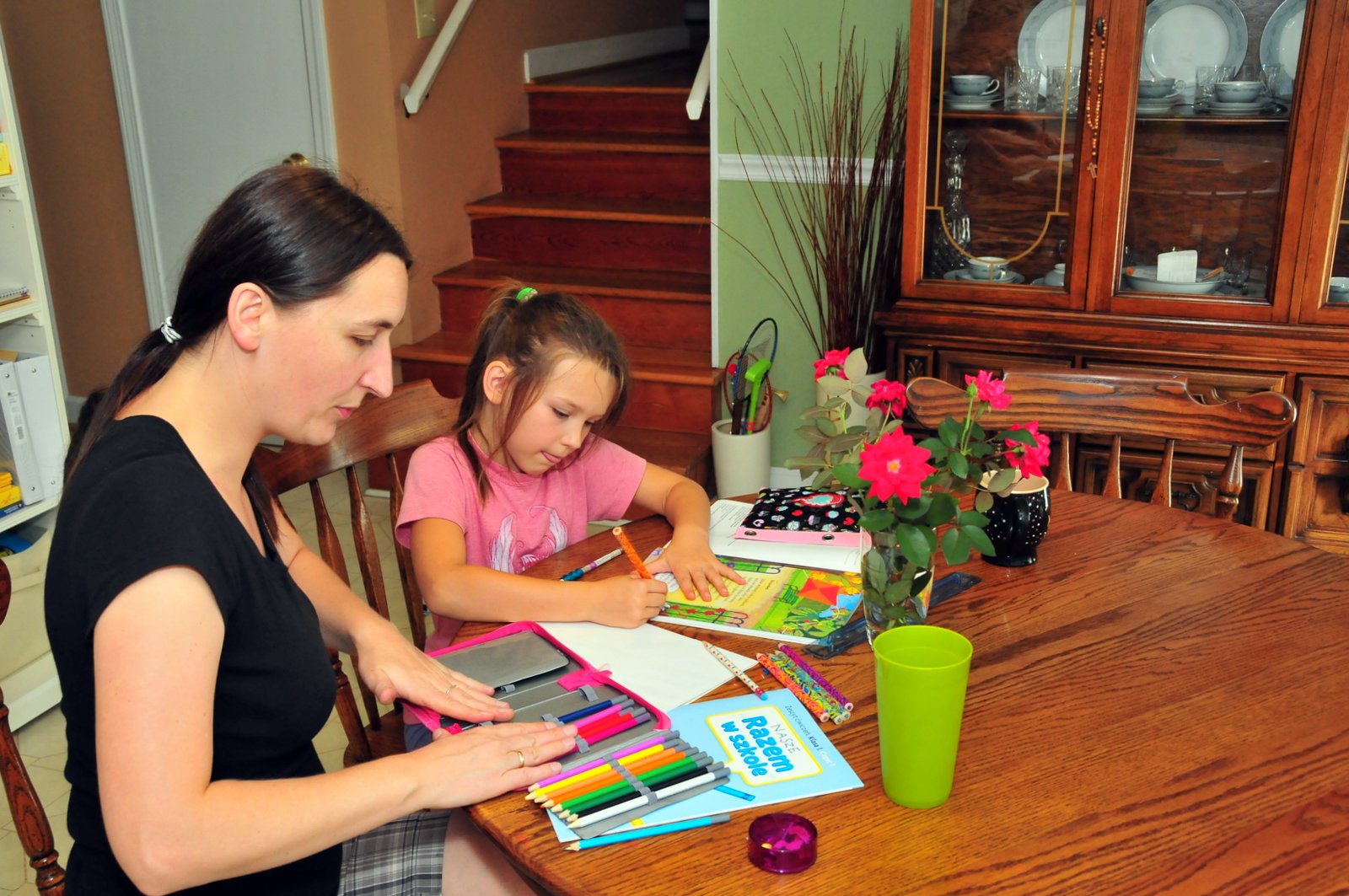
Today the Girl started Polish school, or as the girls refer to it, “polska szkoła.” This is not merely an improvised effort to make sure L stays in touch with her Polish heritage and improves her language skills a bit. This is a formal, institutional organization that follows a traditional Polish school curriculum for students who live outside of Poland. The Girl will be working on math, Polish, computer skills, and one more subject that will certainly cause L much worry and many sleepless nights: English.

“How come?” I asked.

“Because they’re following the Polish curriculum,” K explained. “We could have requested a different language, but what for? Polish is already a second language.”

VIV_8419

I, in the meantime, stuck with what I’m good at: mowing the lawn and making burgers. It is Labor Day, and

VIV_8423

Tag Team Discussion

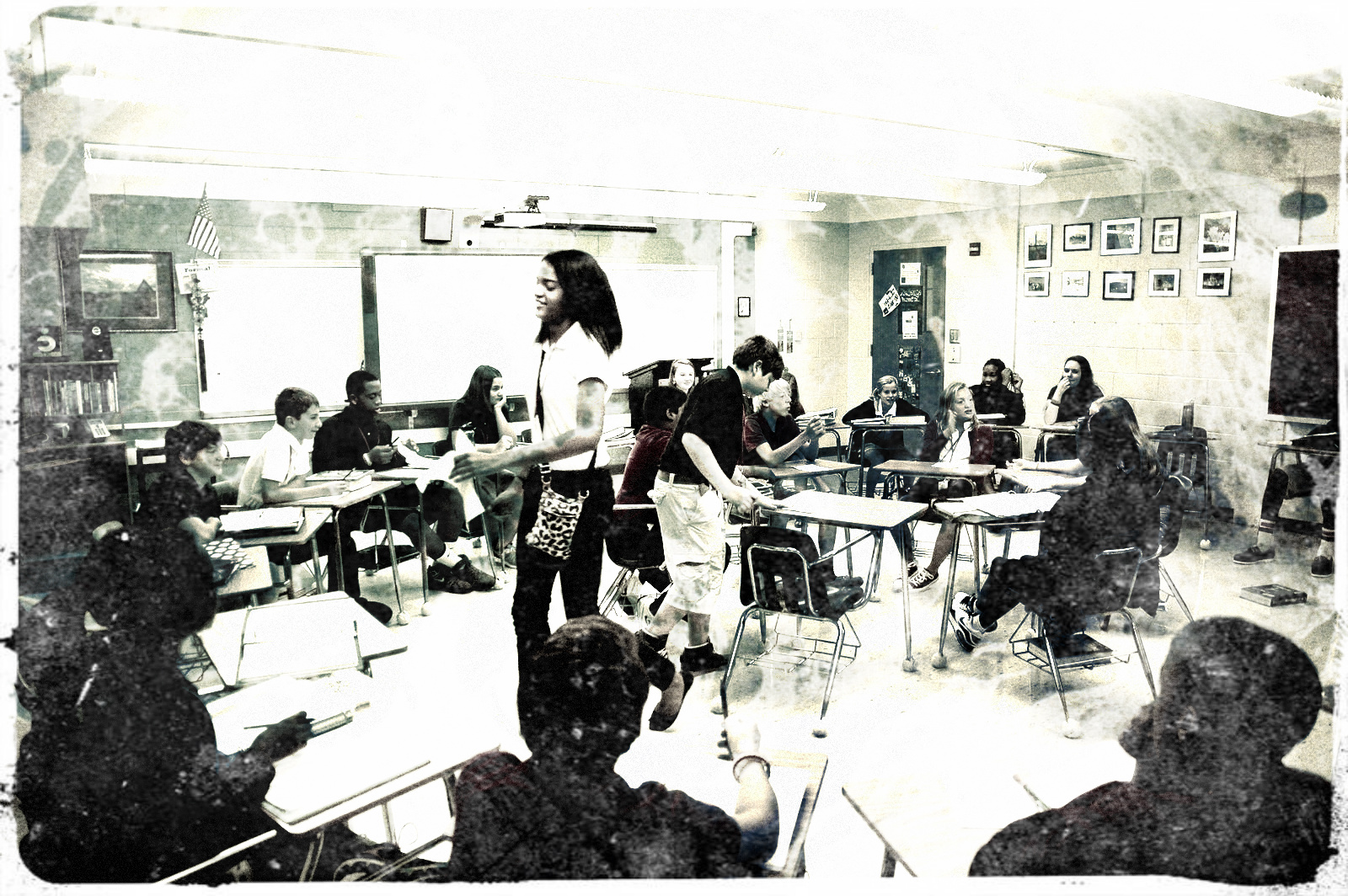
Getting middle school kids really discussing a given topic is an art. I’ve tried at least a hundred different strategies from dozens of books — well, that might be a bit hyperbolic, but I’ve tried so many things I can’t even remember them all. Some are flops; others are moderate success. But nothing prepared me for today’s success, a highly modified version of the Socratic Seminar engagement: kids actively engaged in discussing — of all topics — the degree to which a given story’s conflict is dependent on the story’s setting.

pic

Tonight’s homework:

Answer the following question about today’s Socratic Seminar by leaving a comment on this post. What did you think of today’s discussion activity? What were two things you thought were effective about it? What was one thing you would like to have changed?

Selected responses:

  • I thought today’s activity was somewhat challenging, but it was very enjoyable.
  • I think today’s activity was really fun.
  • I thought today’s discussion activity was a new, different way to make us think.
  • Today’s activity was fun and very helpful.
  • Wow, good stuff; arguments are always fun, aren’t they?
  • I love our activity and I would love to do it again sometime.
  • Overall I loved class today and I hope we get to do more things like that in the future.
  • What we did in class really helped me get closer to being able to analyze the context easily.
  • This activity was very exiting.

Needless to say, I will be using this activity again.

Your Mean Face

I was talking with a student, joking that she is so kind to everyone that she probably doesn't even have a mean face.

"Let me see your mean face," I say with a smile.

"I don't have one!" she insisted.

To elicit some kind of reaction that might lead to a "mean face," I suggest to her a cruel scenario: "Imagine you're walking down the street and you see some kid kick a dog. Show me the mean face you'd give the kid."

She thought about it a moment, then responded, "I would probably go help the puppy first."

If only I had more students like that...

Thinking Critically about the Common Core

Charles Blow writes in a recent article about the Common Core standards,

Our educational system is not keeping up with that of many other industrialized countries, even as the job market becomes more global and international competition for jobs becomes steeper.

We have gone from the leader to a laggard.

The latest attempt to solve this problem is the Common Core standards, a group of national educational standards that is supposed to encourage the teaching of critical thinking and problem solving. The standards I use are available here.

Yet they're not universally accepted. Conservatives tend to bristle at anything they see as Federal mandates from above for national standards of just about anything. Liberals, in support with unions, don't like the idea of using testing as a measure of teacher effectiveness. (The New York Times also had an article on growing opposition to the standards.)

Yet I wonder about what it says now that we must go to great lengths to teach critical thinking in school. I don't recall many activities in high school that seemed geared to practicing critical thinking, and I don't remember any direct instruction in critical thinking, yet somehow I became a critical thinker. Take for example the skill of inferring. I go to great lengths to teach my students what inferring is and what it isn't, to differentiate between merely observing and inferring, and to apply the skill to texts. Yet I don't remember anyone teaching me that. It just seemed like something I picked up along the way as I read increasingly complex texts.

Another new feature of the Common Core standards is an increased emphasis on what the Common Core Consortium calls "informational texts." We just called it non-fiction. The Consortium points out that in the traditional educational progression, students spend all of high school reading literature and then they're suddenly required to read informational texts in college. It's as if reading the one has no influence on reading the other. I don't really recall having to read or to analyze much more than literature in high school, yet I somehow didn't have any problem making the switch to the "informational texts" of my college career. In the meantime, this push for greater emphasis on "informational texts" means that an entire generation will be underexposed to literature, one of the prime makes of society and social consciousness. (Of course, that's really only true to any significant degree in in the pre-Internet world, I suppose.)

The big question of course is whether this whole enterprise will work. With states that originally adopted the Common Core standards increasingly backing out, it seems like it might just turn out to be yet another educational fad.

First Day at School

L has been worried about starting school this year. New teacher; new students; new room in a new hall — new everything.

“I don’t want to be a first grader,” she lamented.

“I don’t want to go to that school,” she whined.

“I want to go back to Ms. B’s class,” she begged.

I recall being somewhat nervous about starting new grades. First grade for me too was tough: I was starting a new school, and the bathrooms we used were situated between first and second grade (it was an open classroom design). That meant every time I went to the restroom, I ran the risk of encountering an unimaginably large second grader. It was terrifying.

L had different worries, different concerns. Her first disappointment came when she learned that she would no longer be the first released to the car line. “Well, you’re not in kindergarten anymore,” I explained. Her first bit of pride came a little before that, though, as she was walking down the hall with her class and encountered a favorite teacher from last year.

“Did you say ‘Hi’?” K asked as we talked about it over dinner.

“No, Mama! We were walking down the hall. We couldn’t talk. We’re first graders! We can’t do that!”

Welcome Back, Terrence

hoodie.psd

Dear Terrence,

Every year — every single year — I make the same promise to myself around the end of third quarter: “Next year I will start the year as an authoritarian jerk. I will rule my classroom with an iron cliche and only later loosen my grip.” It’s easier, after all, to loosen things than to tighten them up. And then by the beginning of the year, I begin second guessing myself. “Nobody likes a jerk,” I say, “and that would essentially would be acting like a jerk.”

It’s a delicate balance to achieve when you have a classroom filled with students of varying interest levels, social skills, intellectual abilities, cultures, races, economic realities, and a thousand other variables, and my job is to focus them all on one goal: improving their ability to read and to write. Some of them love school and are inherently interested in this common goal; some of them hate school and don’t care about anything I have to say; some of them love school but, being more mathematically inclined, are not inherently interested in what I have to teach; some of them don’t even seem to know what they’re doing in school; some of them have only one goal: attract as much attention as possible. And they’re all in my classroom.

This dilemma about how to open the year boils down to how to deal with one group of students: the disengaged, interest-lacking student who wants to pass most of the class period chatting. In other words, students like you, Terrence. Indeed, in every class — that is, in every on-level class — there is at least one Terrence who simply says what he thinks when he thinks it without any thought to the approriateness of the moment. I’ve literally had a student say, “If I think it, I say it.” If in that classroom, there are a few more students who, with that initial proding, will join into a conversation (in other words, they remain generally quiet until someone speaks to them), then we’re going to have little pockets of chaos throughout the classroom that add up to a disrupted and disruptive class. As the year develops and relationships grow, it seems like this might be easier to control, but the reality is often frustratingly the opposite. When you and your friends behave like this, Terrence, you rob others of an education, because I have to spend time dealing with your behavior rather than teaching.

To be a teacher, one has to be something of an idealist, somewhat naive regarding human nature. One has to look at these impulsive, often rude, sometimes cruel children — no more than two or three in a class — and think, “They must understand that their life can be better. They must want to change and simply not be able.” It’s easy to think of them even as victims — victims of neglect, of a shallow society, even of irresponsibile or possibly cruel parents. And so the second balancing act: to understand that they’re responsible for their own actions, but that they’re acting from habits formed in an environment not entirely of their choosing.

But naivete and idealism aren’t really necessary if I remember one thing: it’s all about the relationships. You and other students like you, Terrence, might have developed bad social habits because of a lack of positive adult relationships in your life, but I don’t have to be an additional, negative relationship simply in the name of “classroom management.” So at the beginning of this new school year, before I’ve even met you, I say to you what I say to every student. No matter what it feels like, no matter how harsh I seem to be, I am always on your side. It’s just that I’m on every student’s side, and when one student is taking from another her opportunity for an education, I am going to intervene and stop it. If that means coming down on you because your talking is disturbing others, then that’s what will happen; if that means coming down on others because their talking is disturbing you, then that’s what will happen. But no matter what, I am always on your side.

Regards,
Your Soon-To-Be Teacher