matching tracksuits

fun in threes, sometimes fours

education and teaching

Queen Mab

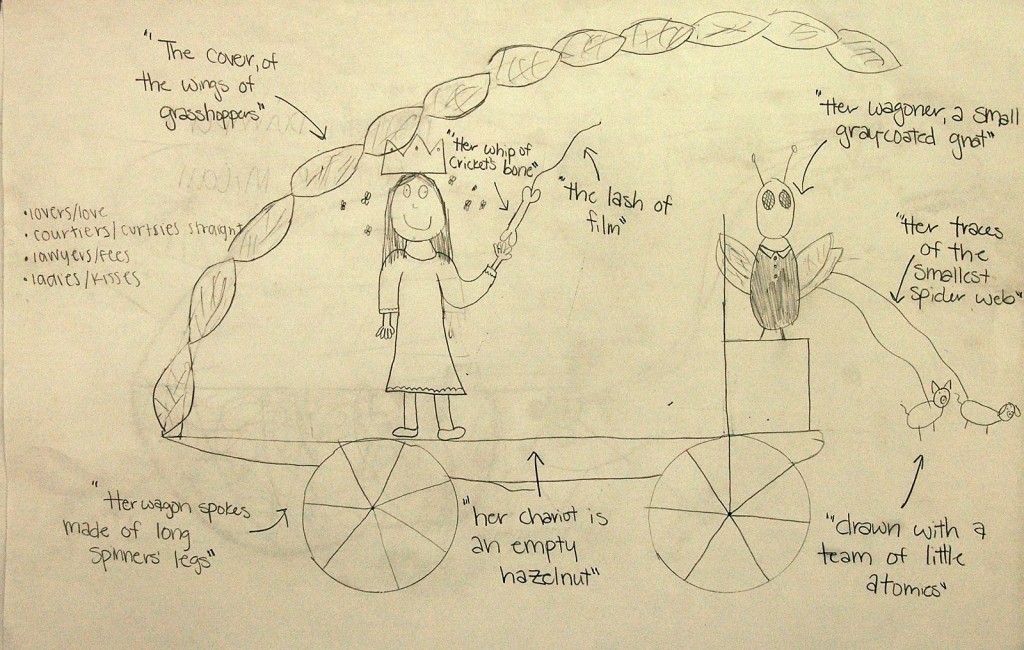
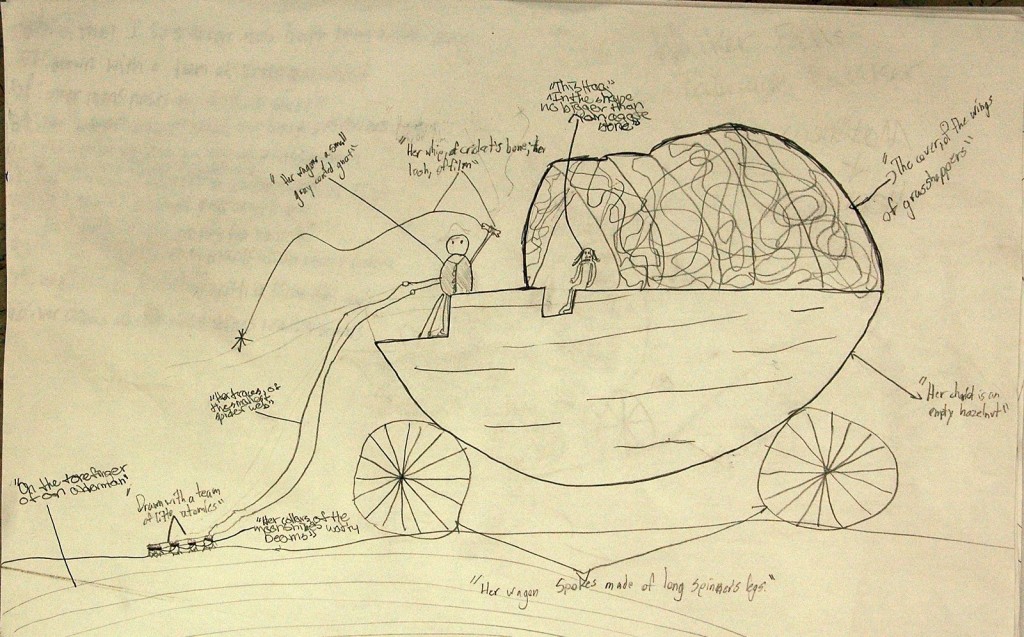
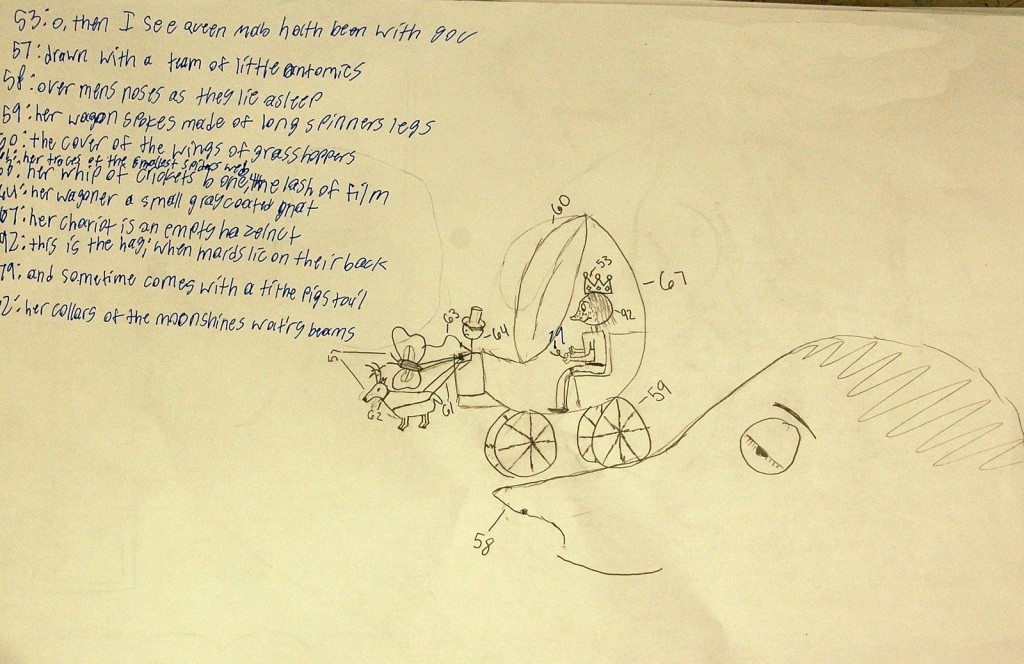
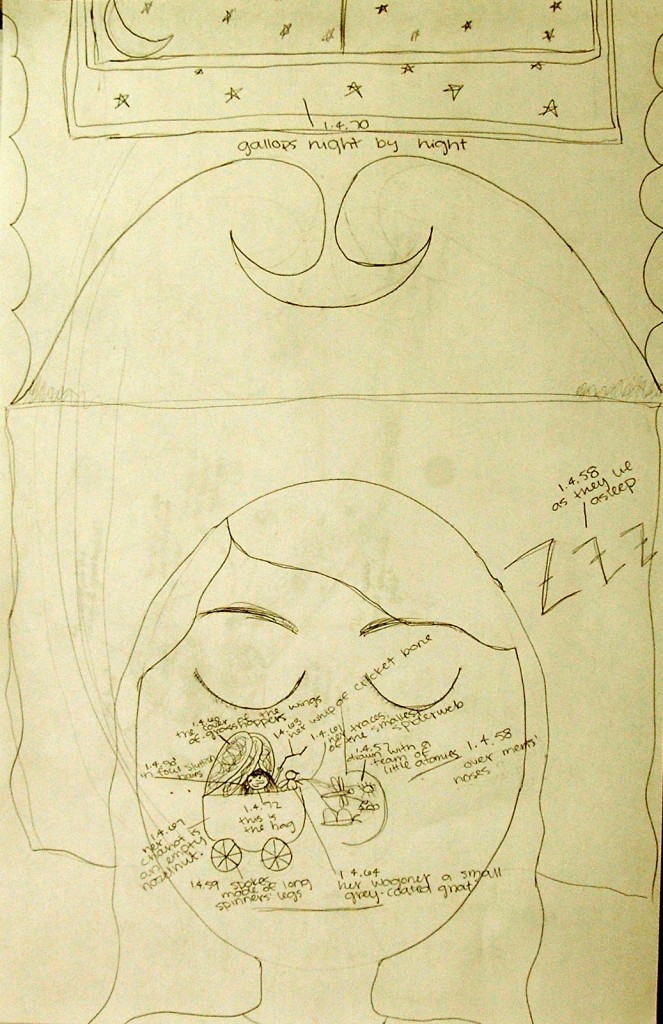
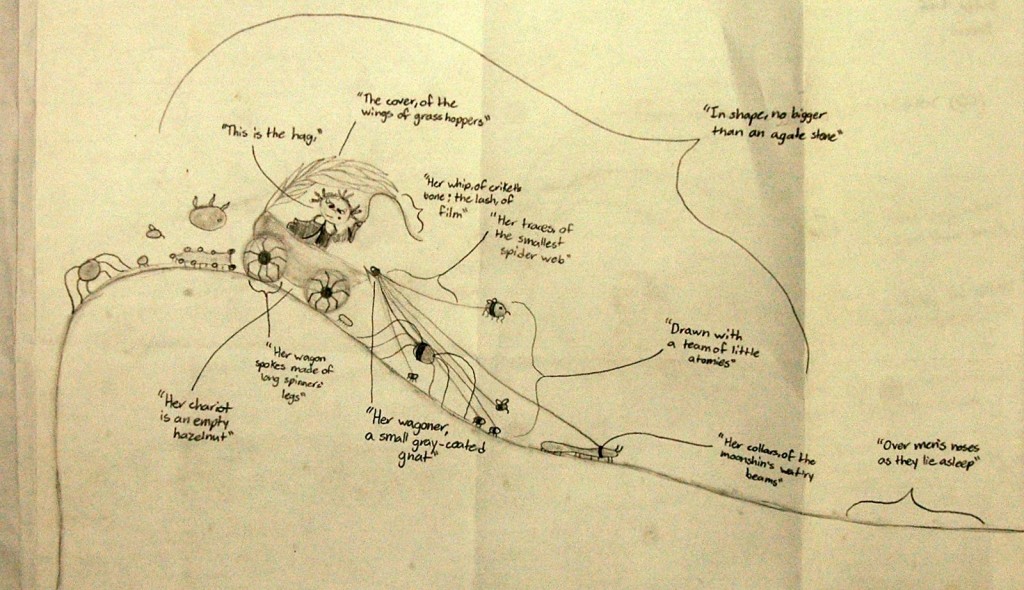
Students' drawings of Queen Mab.

O, then, I see Queen Mab hath been with you.
She is the fairies' midwife, and she comes
In shape no bigger than an agate-stone
On the fore-finger of an alderman,
Drawn with a team of little atomies
Athwart men's noses as they lie asleep;
Her wagon-spokes made of long spiders' legs,
The cover of the wings of grasshoppers,
The traces of the smallest spider's web,
The collars of the moonshine's watery beams,
Her whip of cricket's bone, the lash of film,
Her wagoner a small grey-coated gnat,
Not so big as a round little worm
Prick'd from the lazy finger of a maid;
Her chariot is an empty hazel-nut
Made by the joiner squirrel or old grub,
Time out o' mind the fairies' coachmakers.
And in this state she gallops night by night
Through lovers' brains, and then they dream of love;
O'er courtiers' knees, that dream on court'sies straight,
O'er lawyers' fingers, who straight dream on fees,
O'er ladies ' lips, who straight on kisses dream,
Which oft the angry Mab with blisters plagues,
Because their breaths with sweetmeats tainted are:
Sometime she gallops o'er a courtier's nose,
And then dreams he of smelling out a suit;
And sometime comes she with a tithe-pig's tail
Tickling a parson's nose as a' lies asleep,
Then dreams, he of another benefice:
Sometime she driveth o'er a soldier's neck,
And then dreams he of cutting foreign throats,
Of breaches, ambuscadoes, Spanish blades,
Of healths five-fathom deep; and then anon
Drums in his ear, at which he starts and wakes,
And being thus frighted swears a prayer or two
And sleeps again. This is that very Mab
That plats the manes of horses in the night,
And bakes the elflocks in foul sluttish hairs,
Which once untangled, much misfortune bodes:
This is the hag, when maids lie on their backs,
That presses them and learns them first to bear,
Making them women of good carriage:

Apologies

Dear Teresa,

Two observations.

First, not all apologies begin with I’m sorry. In fact, some of the most graceful and moving apologies have ended with those words.

Second, and more significantly for you, not all utterances including “I’m sorry” are in fact apologies. For example, if you were to get in trouble with a teacher yet feel that you had done nothing, saying “I’m sorry you think that I…” only feels like an apology because it includes those sometimes-deceptive words. It is, in fact, an accusation.

Mildly amused and annoyed,
Your Teacher

How to Plagiarize

Dear Terrence,

I understand you didn't really like the sonnet assignment. That's fine: not every assignment has to be to your personal liking or approval. Understand, though, that, because this is not a poetry writing class, I had no intention of grading it with the kind of severity that would result in a bunch of failing grades. It was the struggle of writing in iambic pentameter that I was after, as well as the experience of having to think about each and every word as you wrote. That's probably not something you've ever done before, but you'll write plenty of things in your life that you should consider word by word.

Cheaters
Cheaters

But, you didn't like it. Perhaps you even thought you couldn't do it. As a solution, you decided to bounce around the internet for a while until you found a sonnet that you thought you could pass off as your own, then you typed it up and attempted to do just that.

I wish you had spoken to me about this earlier: I could have given you some pointers to help you not get caught. But you are caught. Still, in the spirit of charity, I'll share the pointers anyway.

  1. Be aware that I have taught English for a long time. I know how eighth graders sound, even the most gifted, when they're writing. I know what kind of topics they choose. I know what kind of vocabulary they're likely to use. So at least choose a sonnet that sounds like a kid wrote it, not a hormonally challenged adult. With that much experience, I have a pretty strong intuition about what is and isn't from the pen of an eighth grader.
  2. Understand that I know your personal writing voice. It's not just that I know how eighth graders write; I know how specific eighth graders -- including you -- write. I know what kind of ideas you're likely to write about and which ideas might never cross your mind. I've given you standardized testing that provides me with ample information about what kinds of words you're likely to understand and to use in your own writing.
  3. I expect it. I know someone will do this, and I read every paper with the thought that, no matter who the author, there's a latent (don't pawn off work with that word in it: I know you don't know what it means) chance of someone trying to pull one over on me.
  4. I've caught them all. Every single one. Remember the Terminator? That's me. Only without the bulging muscles. Or the Austrian accent.
  5. Make sure you know all the words in your plagiarized work. It's awfully telling when a teacher uses a word (intentionally, of course) that you've used in your work only to receive blank looks from the one person who used the word (a word like, say, "latent") in "her" work. (I put her in quotes because, well, you understand.)
  6. Choose a sonnet that's about a topic that the average eighth grader would be interested in. I know you personally, so it's not just a matter of an abstract idea: I know what type of thing you're likely to write about. Burning passion is not one of them. No eighth grader would write about that topic, especially you.
  7. Finally, I know I've said this before, but it bears repeating: make sure it sounds like an eighth grader. Eighth graders to speak of anyone's "wanton fiery beauty." Eighth graders don't write poems with final lines beginning "pleasure me."

With these ideas in mind, I'm sure you'll be more successful in your next efforts to act as a thief and pass off someone else's work as your own.

Regards,
Your Disappointed but Not Surprised Teacher

Where’s Waldo?

A pleasant Friday afternoon surprise: two students, classified by some as “average” in every way, working on a web site evaluation activity, noticed something I hadn’t even noticed. First, they notice that two sites mention the same book.

1-Fullscreen capture 1182013 15145 PM

Next they notice that one site gives the title incorrectly.

2-Fullscreen capture 1182013 15157 PM

Excitement.

“I guess this means it’s a less reliable web site, right Mr. Scott?”

I’ll say.

Letter from a Former Student

I simply adore my school and the people in it, especially the teachers. I haven’t had any English teacher as great as you though. I still value and appreciate your teachings. You greatly influenced my writing by inspiring and cheering me on. Every time we receive a writing assignment, you appear in my mind.

Enough to make you puff your chest out a little more…

Bell Ringer

The idea is to get students working immediately. They walk into the classroom and find work projected on the Promethean board and are to get started.

From today.

GATHER ye rosebuds while ye may,
Old Time is still a-flying:
And this same flower that smiles to-day
To-morrow will be dying.The glorious lamp of heaven, the sun,
The higher he ‘s a-getting,
The sooner will his race be run,
And nearer he ‘s to setting.That age is best which is the first,
When youth and blood are warmer;
But being spent, the worse, and worst
Times still succeed the former.

Then be not coy, but use your time,And while ye may, go marry:
For having lost but once your prime,
You may for ever tarry.

Robert Herrick. 1591—1674

AND AFTER YOU’RE DONE GATHERINGYE ROSEBUDS, GATHER YE STARTERS WHILE YE MAY. OLD MR. SCOTT’S A-CHECKING THEM TODAY

About the Difference Between Prose and Poetry

Because They Asked

Simple instructions — the starter — great them when they enter the classroom.

Complete: “Poetry is…”. Write at least five facts about poetry. Then complete “Poetry isn’t…” and write five more things poetry isn’t.

They get started scribbling a list, a list we will share and debrief once I’m done checking roll and making sure I have all my materials for the day’s work in order.

1-Fullscreen capture 10222013 20504 PM

Then the poem: “Because You Asked about the Line Between Prose and Poetry” by Howard Nemerov.

Sparrows were feeding in a freezing drizzle
That while you watched turned to pieces of snow
Riding a gradient invisible
From silver aslant to random, white, and slow.

There came a moment that you couldn’t tell.
And then they clearly flew instead of fell.

After reading a couple of informational texts about how to read a poem, students try their hand at Nemerov’s analogy:

prose : poetry :: sleet : snow

It’s slow going at first, for it’s such a strange poem for eighth graders. “It claims it’s going to be talking about poetry and prose in the title,” one student complains, “and then it’s all this stuff about birds and rain and snow.”

Tomorrow I will model the steps of interpretation, relying heavily on the questions and steps in the two texts about reading poetry they went over today, with the hope that they’ll be able to do it for themselves, at some point.

Natural Consequences

A kid shoots a paper wad at the trash can and misses I sit and look at him, at the wad of paper on the floor, back to him -- what's a logical, natural consequence? There really isn't a natural consequence, I guess, but a logical one? A negative reinforcer? Or even a punishment?

I hate moments like this. I find myself being far more analytical in situations than I really need to be.

M-Jezzy

Dear Terrence,

Seven years ago, on 13 October 2006, I wrote this, I worked at a day treatment facility for kids who had been unable to find a path to success in school.


Yesterday, one of the boys in our program asked if he could use the computer for a little while. “No problem,” I said. He’s had a great week, and it was a slow morning.

The week was much improved over the past. We were both frustrated about how things were going in my class – he much more than I. At the end of the last six weeks, when we were working on science (now we’ve switched to social studies for the second six weeks), M-Jezzy (his nom de plume at our program’s blog) was trying to make up some missed work, and getting very frustrated about it.

“Man, I just hate science,” he exclaimed.

“That’s fine,” I said. “Not everyone likes science. What we can do, though, is use that as a way to make up some of your work.” I instructed him to log into our blog, akacoolpeople.com, and write about science and why he hates it. “Explain three reasons you don’t like it, and we’ll count that as one of your missed assignments.”

He wrote,

I do not like science at all. And i,ve got three reasons why. One reason is because it is so confusing. likewhe gives the homework out. I dont know what he is talking about beause. They would be so many things that he is talking about. An the other reason iswhen he gives the i want know what to do because. It will be so many things that you would have to look for an you would have to do so much research. And the last reason is the things that he teaches in class i dont know wat in the world that hebe talking about. Likewe was talking about an atom an what i have to study about it is so hard because. The atom has so many things in it. And you will get mixed up with all the parts of an atom. Beceause you will not know how to put them in oder. An if you get this and you are really feeling wat i am saying to you then mail me back M-JEZZY out. I hate science so bad i wish i did not have it at all. (science)

I read it and thought, “What an indictment of me. I obviously don’t explain things for him, and I can’t even make myself clear when assigning homework.”

Depressing.

But fixable.

I talked to the head teacher about it; I talked to the program director about it; I talked to the head counselor about it. The consensus: M-Jezzy does not deal with ambiguity well (as if anyone really does). Like most people, he wants to know where he’s going and what he’s going to have to do to get there.

Starting this week, I began something new. Something obvious. Something basic. Something I should have been doing all along. I blocked off a portion of the white-board and wrote an outline of what we’d be doing, including information about what kind of activity it would be.

Next class, M-Jeezy was like a different young man – much more attentive, much more focused, much more involved. He asked penetrating questions, and he didn’t giggle too much.

A success, I thought.

Back to yesterday morning. M-Jezzy sits down at the computer and logs into “aka cool people,” and starts typing. This is what he writes:

now sence my teacher was started to put the agenda on the board i am starting to learn more in class and i know no wat to do.And i am not getting confused write me

I can’t remember the last time I felt so good.

Yet it was not what M-Jezzy wrote that made my day – it was that he did it spontaneously.


M-Jezzy was fifteen when I wrote this, theoretically a tenth-grader but he was still in eighth grade because of behavior. He’d been tossed out of regular school because of his behavior — basically an unwillingness to regulate his impulses in any way whatsoever — and then tossed out of alternative school for the same reason. All of this left him with few alternatives, which is how he landed in our day treatment facility — a last ditch effort to teach him the social and personal skills he so clearly lacked and so desperately needed.

In the end, it’s clear that we didn’t get through to M-Jezzy, for later this week, he’ll be going to trial facing six charges: misdemeanors and two felonies. The former: trespass charges and assault on a female; the latter: first degree murder and intentional child abuse with serious physical injury. He stands accused of beating to death his girlfriend’s four-year-old son.

From the accounts I’ve read in newspapers, it seems a reasonable assumption that he’s guilty. Knowing him personally and seeing his temper in action, I find it tragically plausible that he did indeed beat a toddler to death.

The vindictive (read: human) side of me thinks his punishment should be based on a simple mathematical equation. A proportion, really. Take the pounds per square inch of his punch over the weight of the child he beat to death. The other side of the proportion you can probably figure out: x over his weight. Solve for X. Then he should be beaten regularly by someone who can hit with that much force. Beaten for weeks on end. Months on end. The end will come — eventually, he’ll be beaten to death in one, long session. But he’ll never know which one it will be. So each time he sees his executioner, he’ll have to ask himself the same question his victim asked himself: how will it end this time?

Fortunately, I’m not in charge of sentencing. The compassionate side of me realizes that such punishment is cruel, but again, the vindictive side says, “Who is he to deserve mercy?” It’s a conundrum.

I write this to you because I want to be perfectly clear with you: I don’t know how M-Jezzy got from where he was merely a disruptive kid in an under-funded day treatment facility to a young man facing serious prison time (if he survives: my aunt, who worked in the prison system for twenty years, assures me that as soon as inmates find out what M-Jezzy got convicted of, if he’s convicted, they’ll take care of the problem). I don’t know the road he took, but I do know this: you remind me of him so much sometimes it’s terrifying. And now, it should be terrifying for you.

With concern,
Your Teacher