matching tracksuits

fun in threes, sometimes fours

education and teaching

Ancient Modern

In English I Honors, we've been accompanying Odysseus as he struggles to make it back to Ithaca and his beloved Penelope. We reach Tiresias's prophecy from the underworld and the confusion starts.

‘Great captain,
a fair wind and the honey lights of home
are all you seek. But anguish lies ahead;
the god who thunders on the land prepares it,
not to be shaken from your track, implacable,
in rancor for the son whose eye you blinded.
One narrow strait may take you through his blows:
denial of yourself, restraint of shipmates.
When you make landfall on Thrinákia first
and quit the violet sea, dark on the land
you’ll find the grazing herds of Helios
by whom all things are seen, all speech is known.
Avoid those kine, hold fast to your intent,
and hard seafaring brings you all to Ithaka.
But if you raid the beeves, I see destruction
for ship and crew. Though you survive alone,
bereft of all companions, lost for years,
under strange sail shall you come home, to find
your own house filled with trouble: insolent men
eating your livestock as they court your lady.
Aye, you shall make those men atone in blood!
But after you have dealt out death–in open
combat or by stealth–to all the suitors,
go overland on foot, and take an oar,
until one day you come where men have lived
with meat unsalted, never known the sea,
nor seen seagoing ships, with crimson bows
and oars that fledge light hulls for dipping flight.
The spot will soon be plain to you, and I
can tell you how: some passerby will say,
“What winnowing fan is that upon your shoulder?”
Halt, and implant your smooth oar in the turf
and make fair sacrifice to Lord Poseidon:
a ram, a bull, a great buck boar; turn back,
and carry out pure hekatombs at home
to all wide heaven’s lords, the undying gods,
to each in order. Then a seaborne death
soft as this hand of mist will come upon you
when you are wearied out with rich old age,
your country folk in blessed peace around you.
And all this shall be just as I foretell.’

They see the line about being "lost for years," and with with some guidance, realize that this is Calypso and that the blind prophet says it using future tense ("under strange sail shall you come home").

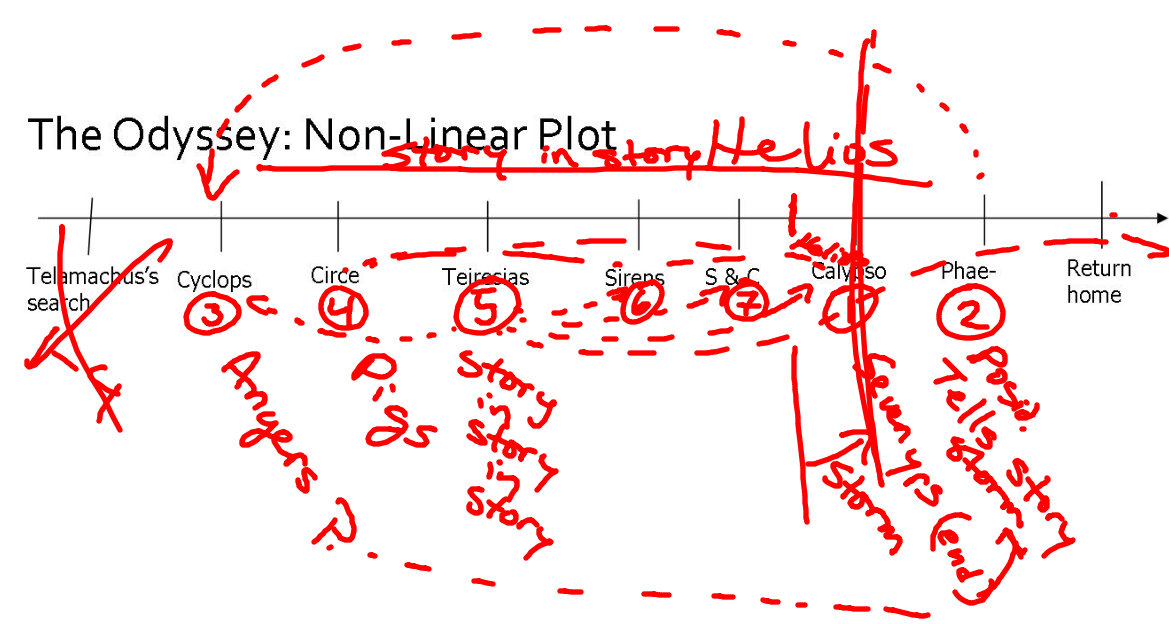
"Wait," they say. "That's what the Odyssey begins with? How is it in future tense?" (We begin our exploration of the Odyssey on Calypso's island in book five, skipping all of Telemachus's search in books one through four.) With some more guidance they realize it's a story within a story. A prophecy in something like a flashback. Which itself is all set within the larger story: a story within a story within a story.

1-Fullscreen capture 2192014 13743 PM
Notes from the board

"And people liked to praise about Pulp Fiction's non-linear storyline," I say with a smile, but no one gets it.

Classwork

Glimpse into Your Future?

As an eighth-grade teacher, I’ve sometimes found myself in a situation that is difficult to believe: a student, already in trouble, burrows herself even more deeply into the issue, verbal fangs and claws showing. “It’s surely a defensive mechanism,” I thought, wondering why this person was essentially standing in front of a wall banging her head mercilessly against the cinder blocks and growing more angry that the only result was pain for her with no visible effects to the wall. “Surely this is automated response,” I almost mused aloud.

Such situations have left me wondering what I could do to help such a student and frustrated that I didn’t handle the situation better at the time. In such cases, if the kid has been somewhat troubling through the year, it can be difficult to resist the temptation to poke at the situation a bit like a bloodied knee. What does it cost me? It only hurts the other person, and don’t she deserve it for all the nonsense I’ve put up with through this year? Yet I’m the adult in the situation, and thankfully I can say that I’ve generally resisted the temptation to provoke further in such situations.

“Surely it’s something they grow out of.” It’s the only hope sometimes. And then I saw this.

Increase

Among all the metrics we use to measure kids' performance, the most useful in many ways is the MAP test. We give it at the beginning of the year and again at the end, and in past years, we've set personal performance goals using it as a standard. Average yearly growth for an eighth grader reading at grade level is about three points. Great growth is around seven or eight points. For those a little below eighth grade level, good growth is around six or eight points.

This year, I've conducted an experiment, pairing daily during silent sustained reading students who excel at reading with those who excel at other academic ventures. The idea was simple: the strong readers would help the weaker readers by explaining what and how they inferred things in the article, working together to figure out word meanings in the article strictly from context clues, discussing the contents of the article, and a number of other tricks and practices. We've been doing that most of the semester. Recently, the students took a shortened version of the MAP test and the results merited a Klondike ice cream party: average growth for one semester was 7.4 points, with two students increasing by an astonishing 15 points and one student by 14 points.

It was a good day to be a teacher.

Up

Dear Terrence,

To see your excitement when you got your report card this afternoon was one of those moments that makes all the silliness I have to put up with as a teacher worth it. You're the type of kid who is simply used to having an F or two on your report card. The question for you, I think, has always been how many. And so when I told you "Not a single F" as I handed the report card to you, I would have loved to capture your expression. We could use it as a visual illustration of "pride."

Next goal: honor roll.

Smiling with you,
Your Teacher

Intent

Dear Terrence,

I'm really starting to wonder if you're not doing this on purpose. I mean, you just got back from a long out-of-school suspension today, and yet you didn't even make it through the whole day before you got into a fight. (When I wrote that, I dithered between "couldn't make it" and "didn't make it." I figured the former was too fatalistic.) You tell me you want to do well in school. We have the conversation about impulse control at least once or twice a week. I explain to you regularly the effect your reputation -- created from experience and rumor -- has on how teachers treat you. And yet you do it still: indeed, if you hadn't gotten into a fight today, you still likely would have been suspended, for I know a teacher wrote an administrative referral on you because of your completely disruptive behavior in class.

So I'm wondering what the deal is.

There are two options, both frightening, but one is positively terrifying. The first option is that all this is intentional, that you're trying to get into alternative school. Don't laugh -- it's not so far fetched. One of your colleagues just down the hall has expressed that intention openly. Still, you insist that's not what you're up to when I ask you about it. That leaves the second option. The terrifying option: you honestly don't have a clue how to control your impulses. You've built up such a habit of just going with whatever wild thought enters your head that that's your standard operating model now. What's terrifying about that? People like that usually don't meet with a lot of success in life. People like that usually end up bouncing in and out of jail, spending some time in prison, collection welfare while not incarcerated, completely unable to hold down a job, and if they happen to be male, leaving several fatherless children in their wake. (Yes, I know, it does take two to do that particular dance, but that simple fact does nothing to negate your responsibility.)

At its heart, your unwillingness to control your impulses is a kind of immaturity. Toddlers don't control impulses well, but with guidance from parents, teachers, and other adults, they learn how to curb those crazy compulsions. So your refusal -- and at this point, I'm not sure how else to describe it -- to reign in these urges is at heart a refusal to grow up. Sure, that's not fun in a way, but I would imagine it's a whole lot more fun than a lifetime of incarceration, joblessness, dependence, frustration, and anger.

I end reiterating what I've said to you many times: I'm here for you. You drive me absolutely nuts in class, but I'm still not giving up on you. Your decisions today, though, make me wonder if you've given up on yourself.

Sadly,
Your Teacher

In the Text

Socrates
Socrates

In all my classes, I emphasize the importance of being able to back up assertions about a given text with information from the text. "Where do you see that in the text?" It's a typical question in the classroom.

With one group today, we were doing a Socratic Seminar on the question of who is ultimately responsible for Juliet's fake death at the end of act four in Romeo and Juliet. Our discussion skill focus was on backing everything up from the text and, equally important, recognizing when others have made claims that aren't necessarily backed by the text and calling them on it.

"Where do you see that in the text?"

"Show me from the text."

"I don't see that in the text."

At the end of the day, a young lady came back to inform me that during math class, she'd felt the teacher was wrong and said, "Excuse me, Mrs. M, could you show me that in the text?"

First Day 2014

I’m always a little bit nervous about the first day back to school after a long-ish break, and today was no exception. I’ve had some absolutely splendid days after Christmas break and some absolute nightmares. Every year, as I go to bed the Sunday (most often) before we head back to school, I find myself wondering what kind of day tomorrow will be.

Yet I'm also always a bit excited: it's like a first day of school, a new school year without some of the frustrating awkwardness of an actual first day. There are no schedule changes following schedule changes following yet more. Students aren't moving into and out of your class. I know all well, and there are no worries about figuring who might be the most problematic student as quickly as possible in order to deal with potential issues proactively.

1-DSC_4724
Stylized illustration actually of students who are productive in 99% of the time

Today was amazing, in all classes.

I have a couple of classes with several students who have substantial behavior problems, and obviously I was most nervous about these classes, but they amazingly well. Sure, there was a little side talk, but by and large, most students were on task most of the time. People were talking to each other about their work, helping each other, sharing fascinating facts they’d learned in their research process.

Where did that come from? Don't ask such questions -- just enjoy the glow of feeling productive through the entire day.

I'll have to hold on to that feeling when the third quarter blues begin and I -- no we -- find myself ourselves wishing it would just be late-May already...

Exposure

We’re in class, reading the play The Diary of Anne Frank, acting out some sections, comparing others to the original diary. Today, we’re working to analyze the text to determine places where one character implied something and/or another character inferred something. In the story, Anne and Peter’s romance is just beginning, and Anne is getting reading for an evening visit with Peter as she talks with her mother and sister in her room:

1-Fullscreen capture 12142013 80034 AM

In groups, after we act it out, students analyze the text together to find specific lines (“You have to be able to point to it in the text,” I explained) that clearly show either an implication or inference.

As we’re debriefing as a class, a student points out one of the key lines I was hoping students would see: “Then may I ask you this much, Anne. Please don’t shut the door when you go in.” Mrs. Frank is of course not implying that she thinks that Peter and Anne will do anything untoward; she’s merely worried about giving Mrs. van Daan (in reality, her name was van Pels) something else to complain about.

The student didn’t see it that way, though.

“What is she implying?” I ask.

“That Anne will expose herself to Peter!” he said proudly, with utmost sincerity and seriousness.

We all laughed, but my own belly laugh got them laughing even harder.

Romeo, Wherefore Art Thou So Disappointing?

1-DSC_4895-001

We’re knee-deep in Romeo and Juliet, as is always the case this time of year. One scene into act three, we’ve really hit the point in the play at which events start accelerating. Juliet will shortly embark on her gorgeous soliloquy about the dangers of taking Friar Laurence’s potion.

I have a faint cold fear thrills through my veins,
That almost freezes up the heat of life:
I’ll call them back again to comfort me:
Nurse! What should she do here?
My dismal scene I needs must act alone.
Come, vial.
What if this mixture do not work at all?
Shall I be married then to-morrow morning?
No, no: this shall forbid it: lie thou there.

What if it be a poison, which the friar
Subtly hath minister’d to have me dead,
Lest in this marriage he should be dishonour’d,
Because he married me before to Romeo?
I fear it is: and yet, methinks, it should not,
For he hath still been tried a holy man.
How if, when I am laid into the tomb,
I wake before the time that Romeo
Come to redeem me? there’s a fearful point!
Shall I not, then, be stifled in the vault,
To whose foul mouth no healthsome air breathes in,
And there die strangled ere my Romeo comes?
Or, if I live, is it not very like,
The horrible conceit of death and night,
Together with the terror of the place,–
As in a vault, an ancient receptacle,
Where, for these many hundred years, the bones
Of all my buried ancestors are packed:
Where bloody Tybalt, yet but green in earth,
Lies festering in his shroud; where, as they say,
At some hours in the night spirits resort;–
Alack, alack, is it not like that I,
So early waking, what with loathsome smells,
And shrieks like mandrakes’ torn out of the earth,
That living mortals, hearing them, run mad:–
O, if I wake, shall I not be distraught,
Environed with all these hideous fears?
And madly play with my forefather’s joints?
And pluck the mangled Tybalt from his shroud?
And, in this rage, with some great kinsman’s bone,
As with a club, dash out my desperate brains?
O, look! methinks I see my cousin’s ghost
Seeking out Romeo, that did spit his body
Upon a rapier’s point: stay, Tybalt, stay!
Romeo, I come! this do I drink to thee.

Capulet will soon make his ultimatum to Juliet: marry Paris or be not my daughter!

Day, night, hour, tide, time, work, play,
Alone, in company, still my care hath been
To have her match’d: and having now provided
A gentleman of noble parentage,
Of fair demesnes, youthful, and nobly train’d,
Stuff’d, as they say, with honourable parts,
Proportion’d as one’s thought would wish a man;
And then to have a wretched puling fool,
A whining mammet, in her fortune’s tender,
To answer ‘I’ll not wed; I cannot love,
I am too young; I pray you, pardon me.’
But, as you will not wed, I’ll pardon you:
Graze where you will you shall not house with me:
Look to’t, think on’t, I do not use to jest.
Thursday is near; lay hand on heart, advise:
An you be mine, I’ll give you to my friend;
And you be not, hang, beg, starve, die in
the streets,
For, by my soul, I’ll ne’er acknowledge thee,
Nor what is mine shall never do thee good:
Trust to’t, bethink you; I’ll not be forsworn.

Of course the dual suicide scene, with Romeo’s melodrama: “Eyes, look your last!”

You’d think it’s the perfect play for thirteen-year-olds. It’s got so much pathos that it almost chokes you on it. Yet they’re beginning to find Romeo tiresome, and when he falls on the floor in Laurence’s cell in a few days, they’ll have lost the last shred of respect for him that they might have been clinging to.

It is, in a short, the highlight of my school year: students’ first real experience with Shakespeare and their budding recognition that they can make sense of his seemingly convoluted, inverted sentences, his arcane vocabulary, his foreign sense of propriety, and his unexpected sense of humor.