I am not an engineer. Other than understanding that engineers design things and use specific computer software to do it, I know nothing about engineering. My father was an engineer, though, so I’ve been in an engineer’s cubicle, looked through an engineer’s papers, and sat at an engineer’s desk. My father even let me play with CAD software a few times when it was still the new thing–the future. So taking all this vast engineering experience into account, I would feel perfectly within my rights and abilities to sit on a panel deciding which engineering standards to adopt. Certainly I would need someone to explain the significance of this or that line of a standard or the implication of this or that sub-point, but I feel confident than the standards that would result from such cooperation would be safe, effective, and meaningful.
Who wants to cross a bridge designed to those standards? Who wants to ride in a car designed to those standards? Who wants to work in a building designed to those standards? Who wants to use an appliance designed to those standards?
No one?
Why in the world not?
Because I’m not qualified to decide on engineering standards.
Oddly enough, though, legislators seem to think that just because they’ve been to school themselves and have talked to a handful of education professors–few of whom likely have ever had any in-class experience–they have all the knowledge they need to evaluate and accept or reject given education standards. They have the misconception that they can do this, and they have the power to do so. And so the ever-changing political winds blow this way and that, tugging teachers, administrators, and children this way and that, all in the elusive hope of solving our vast educational problems.
And vast they are indeed. I don’t need to rehearse in detail the litany of statistics regarding the relative freefall of American education, how far behind the rest of the developed world our educational system has dropped. Our math scores, relative to the rest of the developed world fall steadily as do our science scores. Our literacy rate is shameful compared to almost every other Western country. So we all wring our hands, and we all mutter, “How is this possible? How have we gotten to this state, to this point, where, for example, the majority of graduate engineering students are coming from former third world countries, now second world countries, fast becoming first world, nations like India and Brazil? How could this have happened?”
This mystery leaves us wondering about the solution, leaves our legislatures trying year after year, decade after decade trying this solution, that solution: Common Core, STEMS, classroom management schemes by the dozens, assessment schemes by the hundreds, left and right, No Child Left Behind, Title Nine, legislation, legislation, legislation, when in fact all we are doing is slapping Band-Aids on cancer patients then ripping them right back off, convinced that it’s the style of the adhesive bandage that’s the problem: we should try Flexible Strips, Sheer Strips, Water Block Plus, Clear Spots, all the various Band-Aid product varieties, when in reality all we’re doing is ripping off one cartoon bandage for another. Spiderman doesn’t do the trick? Let’s try Dora! Scooby-Do doesn’t work? Perhaps we need My Little Pony! All the while we’re convinced we’re trying radically different approaches when in fact all we’re doing is turning our children’s education into a farce.
The problem is we’re working off an incorrect diagnosis. We’re trying to cure a disease we’ve confused with its symptoms. We don’t see the real problem, so how can we see the actual solution? To express the problem is to sound like Chicken Little, but sadly, this time Chicken Little is right: the sky is falling. Our society is in freefall: the standard institutions that, throughout the history of the Western society held together the societies that literally invented the modern world, those institutions are have been doubted and criticized for over a century and have faced an outright full assault for over five decades. We have doubted and questioned and prodded and experimented with, ultimately dismantling or even destroying the very institutions that gave us the stability necessary to create capitalism, entrepreneurial competition, and the middle class, all of which were necessary for the explosion of technology we’ve witnessed in the last century. But it’s easier to point the finger at schools and say that it’s essentially a problem of bad teachers, poorly funded schools, and myriad other solutions.
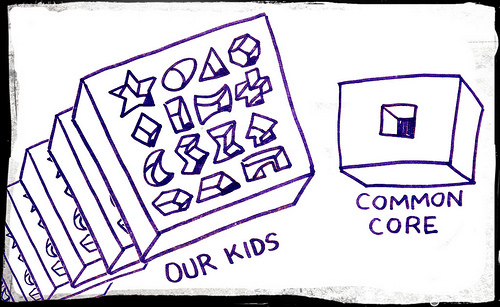 The solution that so many have favored in the last two decades has been explicit educational standards followed by extensive testing, a way to provide a supposedly accurate metric of teacher, administration, and school effectiveness. This of course doesn’t work because it doesn’t factor in the true problem our education system is facing — chronic student apathy and even antipathy to education itself — because it measures all students by the same yardstick no matter their behavior in class, their absences, their rate of transferring in and out of schools, and a whole host of other elements that teachers, administrators, and schools have absolutely control over. But teachers have played along with this, adapting, re-working, or even scrapping lessons and methods as states adopt, drop, change, reword, and constantly rework the standards in an effort to get supposedly accurate metrics.
The Common Core State Standards (CCSS) were an effort (and I use the past tense because it is undoubtedly an effort soon to be relegated to the past in most states that initially adopted them) to standardize that effort across the entire country. It was an attempt to solve several actual problems in this misguided attempt to solve the larger problem. Among these issues was the relative disparity in state standards and resulting disparity in test results (harder tests produce less appealing results). Another problem was the thought that schools were graduating students that weren’t really ready for college and/or the workforce.
There were a number of reasons I disliked the CCSS. It placed an undue emphasis on what it called “informational texts,” new jargon for nonfiction. This nonfiction, though, was not creative nonfiction — essays, speeches, and such — but news articles, science reports, and the like. As a result, literature, one of the true loves of my life and my job, was relegated to a supporting role. In addition, I felt many of the language standards were too broad to be of much use.
On the other hand, I appreciated the emphasis on argument analysis and writing. Most of the writing we do in “real life” is not literary analysis but argumentative writing of one form or another. And though I disliked the emphasis on “informational texts,” one of the effects of the CCSS was to spread the responsibility for student literacy among all disciplines. Reading a text for science is different than reading a primary source in history, which is different still from reading an explanation of a mathematical principle, which in turn is different from reading a novel. The CCSS understood this and took it into consideration.
When our state adopted the CCSS, I was a little irritated: it meant that I would, once again, have to go through all my lesson plans, deconstruct them, remove portions that no longer corresponded to the new standards, and create new engagements for the newly required skills. Still, I thought, I’ve done it before; I can do it again.
“Just wait,” said another English teacher. “This is just another fad. We’ll be redoing everything again in a few years.”
I nodded in polite agreement, knowing she was probably right, but hoping in a way she wasn’t. There are not many professions that have to reinvent itself like education has to every time new standards come around. It’s an exhausting, time-consuming, often frustrating exercise. We have to let go of some of our babies, units and projects we’ve developed and perfected over the years that suddenly are useless. So when the backlash against the CCSS began eighteen or so months ago, I began to accept the fact that my colleague was right.
Yesterday, the South Carolina senate made it official:
The bill, which passed 42-0, is a compromise of legislation that initially sought to repeal the math and reading standards that have been rolled out in classrooms statewide since their adoption by two state boards in 2010. Testing aligned to those standards must start next year, using new tests that assess college and career readiness, or the state will lose its waiver from the all-or-nothing provisions of the federal No Child Left Behind law. (Source)
“Did you hear the news?” asked my colleague this morning. I shook my head. “Common Core is out.” We stood in the hallway, contemplating the repercussions and shaking our heads at the causes.
“It’s the far-right, Evangelical movement — you know that right,” she said.
I’m (now) no liberal by any stretch, and I knew my colleague isn’t either, but I had to agree when it comes to South Carolina, at least in part. And that’s what’s doubly frustrating for me about the whole thing: I feel betrayed by conservative colleagues who appear to have had a knee-jerk, emotional reaction to something they really don’t seem to understand. Almost all conservative criticisms of the English CCSS are based on basic misunderstandings of both the standards and their implementation. They’re straw man arguments in so many cases that I’ve found myself wondering if they’ve actually read the standards.
When we look at the standards themselves, they hardly seem scandalous. A few selections from the eighth-grade standards:
- Cite the textual evidence that most strongly supports an analysis of what the text says explicitly as well as inferences drawn from the text.
- Write arguments to support claims with clear reasons and relevant evidence.
- Determine a central idea of a text and analyze its development over the course of the text, including its relationship to supporting ideas; provide an objective summary of the text.
- Analyze the purpose of information presented in diverse media and formats (e.g., visually, quantitatively, orally) and evaluate the motives (e.g., social, commercial, political) behind its presentation.
- Demonstrate command of the conventions of standard English capitalization, punctuation, and spelling when writing.
- Analyze how a text makes connections among and distinctions between individuals, ideas, or events (e.g., through comparisons, analogies, or categories).
- Analyze how particular lines of dialogue or incidents in a story or drama propel the action, reveal aspects of a character, or provoke a decision.
- Determine the meaning of words and phrases as they are used in a text, including figurative, connotative, and technical meanings; analyze the impact of specific word choices on meaning and tone, including analogies or allusions to other texts.
- Analyze how differences in the points of view of the characters and the audience or reader (e.g., created through the use of dramatic irony) create such effects as suspense or humor.
But apparently these are somehow immoral, unpatriotic, ineffective, or all three. To be fair, some conservatives might have issues with the suggested reading selections, but they were just that: suggested.
Another complaint among conservatives was the notion that this is somehow the nationalization of education, the federal government taking control of all states’ education programs. The real aim of making national standards was to encourage consistency among states. No real conspiracy there.
There is, however, another sense of betrayal that is perhaps more profound for me. In the end, standards are standards: what will replace the CCSS will, by and large, likely be exactly the same. The verbiage will be slightly different; some of the emphases will be different. On the whole, though, it will be more similar than different. And so in the end, all this will amount to an enormous example of government waste prompted by the very people who claim to detest government waste.
The state of South Carolina has spent millions in the planning and implementation of the new standards. Districts have spent additional millions in their own efforts to make sure teachers understand and are able to implement the standards. Districts and schools have bought new books, computer programs, and instructional aids to help with the implementation. District coordinators, school instructional coaches, principals, and teachers have all spent hundreds of thousands, likely millions, of man-hours retooling lesson plans, re-orienting procedures and best practices, and adding new material for the new curriculum requirements. All of that, all the money, time, work, and creativity, are now declared null, void, and useless by the wisdom of those in Columbia, men and women who have never set foot in a classroom except when touring pre-choreographed visits that show them only the best and brightest, shielding them from the reality teachers face every day.
State Senator Larry Grooms, who supported initially the immediate withdrawal of the CCSS, realized, in his merciful compassion, that that’s unrealistic, and so he supported a one-year period in which we continue with the CCSS while the state Department of Education reinvents the wheel. Grooms said, “Our teachers have already been pulled through a knot hole backward through this process. We want to do this in an orderly fashion.”
Well, thanks for that at least.