matching tracksuits

fun in threes, sometimes fours

education and teaching

Monday Afternoon

Yesterday was such a busy day that I didn't even take the time to share everything that happened. The Christmas tree got a mention but little else, and the promise of the lights we put up around the house was about there was of the final product. So it would be tempting just to post those pictures and call it day. After all, there is continuity with the pictures and the day's before.

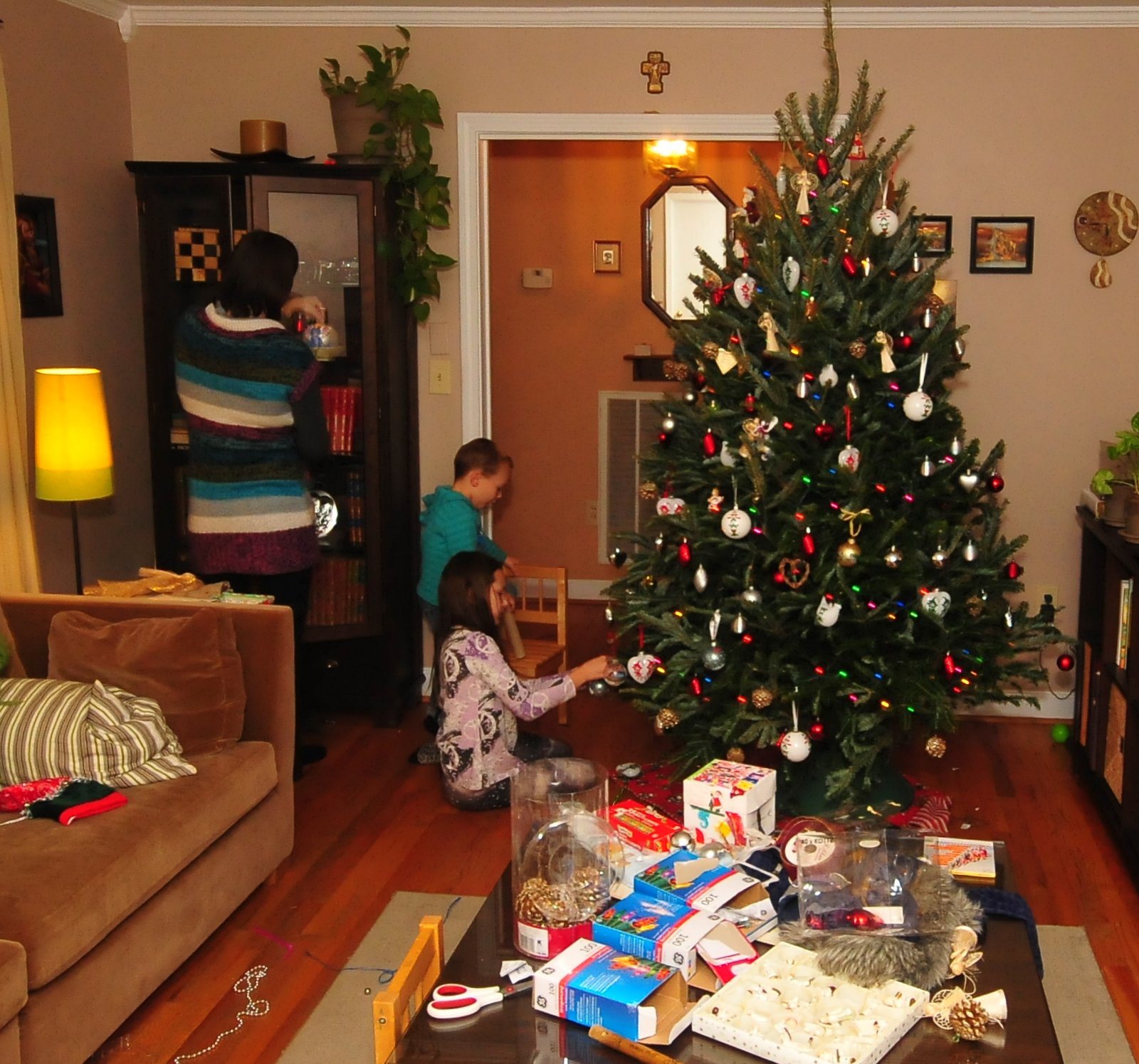
"That tree is enormous" seemed to be the general consensus -- certainly the biggest one we've ever brought into our house. "Remember that first tree stand we used?" K mused as she held the tree later that night while I, sprawled on the floor, loosened all the screws holding the tree in place and reinforced it with planks of wood. He might have held a tree half the size of the one we have in our living room now, but it would just laugh at the tree we brought home Sunday.

1-DSCF7437

But to leave today's story at that would be leaving out the wonder of today. For example, a girl in my most challenging -- and as a result, often most rewarding -- class left the room without asking permission. It's not the kind of thing I would have expected her to do. I went out to talk to her and determined that she'd removed herself from a stressful situation so that she wouldn't say something she regretted. It turned out, she'd already kind of said that anyway, making a comment under her breath that probably shouldn't have even been said at all. "But she was off task, and being distracting," S protested. I suggested that she really didn't need to say what she said, no matter what M was doing, and after some thought, she agreed. We went back into the room and I suggested that to be really mature, to take the situation to the next level, she might want to apologize to the girl in question. And she agreed. And in a few moments, the two of them were in the hall together, working out their problems like forty-year-olds instead of fourteen-year-olds. So to leave that out of the day's story would be a minor tragedy.

But there was still the Boy and our time exploring before dinner.

As I was putting on my shoes, E pointed out that the giant ladder truck that had been mine at his age and which Nana and Papa had saved was in sad repair. "It's not new and shiny like it was when you got it," he observed rather philosophically. "Did you get that from Santa?" he asked after a pause, and I thought, "Well, here it is." It's a moment I knew was coming, was surprised that never came with L, and yet while dreading it in a way, paradoxically never really gave it too much thought.
But it reminded me of something I wrote on a blog I used to run, now almost ten years defunct, in which I dissected the statements of leaders of various religious groups that all clung to the same beliefs I grew up with after the church in which I grew up declared its own beliefs heretical and moved to Protestant orthodoxy. When L was born, I struggled to find the time and motivation to keep it up, so in August of 2007, I resigned:

I’ve been struggling—to find topics for this blog, to maintain my interest in all things Armstrong, to find time to care.

Truth be told, to care.

Jared said it best in a recent comment:

[A] moribund XCG is [not] entirely a bad thing either. After all, there’s only so much one can say about Armstrongism before you’ve said it all. (Source)

I don’t feel like I’ve said it all—there are thousands of words that could still be written about the phenomenon of Herbert Armstrong and the sect he formed. Yet, I really no longer have the interest or time to write anymore words about it.

I feel like Chicken Little, for our common XCG sky will continually fall. David Pack will talk about his web site statistics until the day he dies. Rod Meredith will provide critics with still more reasons to call him Spanky until the day he dies. Those in the upper echelons of the dwindling WCG will continue to talk about their amazing transformation until the day they die.

But I will not be commenting on them at that point, and I certainly won’t be commenting on them when I die.

About six months ago, I started preparing a final post, but I kept putting it off. I thought, “Maybe I’ll just write a little here, a little there,” for a while. Several have noticed and commented on this, and I have remained silent as to the cause of this dip in output.

My initial draft of this post might provide clarification:

Certain things in life force us to see things in a different perspective. Births, deaths, marriages, divorces, conversions—these are the kinds of things that make us stop and reflect on where we are, what we are, and most importantly, what we’re doing with the short time we have on Earth.

We have twenty-four hours in a day. We work at least eight of them; we sleep six to eight of them; we wash, shave, cook, eat, clean, drive, exercise and a million other forms of maintenance for another three or four a day. That leaves us with precious few hours a day for ourselves.

What do we do with that time?

Until recently, I spent time looking at, analyzing, and even mocking the beliefs and actions of a group of people I no longer have anything in common with.

Recent developments in my life now make that a less-than-ideal way to spend my free time.

The “certain event” I was referring to was the birth of my first child.

Since then, I’ve been of thinking about what I want my daughter to know about my own religious past. Truth is, I want her to know as little as possible. Because of shame? Embarrassment? Certainly not. I don’t want her to know for the simple reason that it no longer impacts my life. I can’t see much positive coming from me ever going into any detail with her about what I used to believe, about what her grandparents used to believe, about the fact that a true handful of people in the world still believe it. I don’t believe it, and that’s that.

And so, to quote one of my favorite authors:

“The time has come,” the Walrus said,
“To talk of many things:
Of shoes—and ships—and sealing-wax—
Of cabbages—and kings—
And why the sea is boiling hot—
And whether pigs have wings.”

To talk of many things—but not the XCG. And not here.

I appreciate all the support I’ve received during this little two-and-a-half-year adventure. I thank all the fellow contributors who, throughout these last nearly thirty months, have helped to make the discussion here a little more balanced. I am grateful to all you regulars. You really kept the site going.

Most of all, I’m heartened by some of the comments of the past, folks telling me that I have helped them in some way. I appreciate you sharing those thoughts, for it gave me a certain joy that I will truly never forget.

But the time has come.

Best wishes to all, ill wishes to none, and I leave with the hope that if we ever meet again, we’ll have so much more to talk about than the XCG.

And since then, the Girl never once asked about Santa for me (for we didn't celebrate such heathen festivals), and I'd really forgotten about it. Of course I still write about the phenomenon, as evidenced by a post earlier this week (and as the thirtieth anniversary of Herbert Armstrong's death is just a little over a month away, I will likely write about it again in the near future). But I hadn't thought about what I'd say to the Boy or the Girl about my religious upbringing. It just didn't seem important at all in a way. Until E asked me if Santa had brought me the ladder truck. I thought about it for a moment, realizing that a philosophical/theological treatise was certainly not required, and simply answered, "No, buddy, Santa didn't bring it to me." Maybe some day, he'll ask about it again. Probably not. We'll cross that little relatively insignificant bridge when we come to it.


Showing, Not Telling

What do you do when you come into work to find that a tool you’ve used for almost ten years, a tool you’ve created yourself and spent probably thousands of hours over the course of almost a decade, a tool you use now daily as a result of the initiative of your principal and his vision of turning your school into a true tech academy — what do you do when that tool is suddenly, inexplicably, and without any notification made completely unavailable to your students? It was the situation I found myself in this morning, as my first group of students filed in, logged on, and one by one said, “Mr. Scott, the site is blocked.”

My first reaction, of course, was fury. For the briefest of instants, I took it personally, as if my web site was specifically targeted for blocking. That took only a few moments to clear up in my mind: surely it was just a new filtering rule that had been applied, and like dolphins caught up in a net trawling for tuna, my poor site just got dragged into the mix. In the end, I’m really not sure what was going on, and I’ll likely never know the cause. What’s most important is not the cause but the effect: one of the most useful tools in my classroom is unavailable because of the actions of unknown people who work for the same organization as I.

At this point, the astute reader is probably thinking, “Surely that is a mechanism in the school district through which teachers can request that a site be unblocked.” Indeed, there is. I’d made such a request a couple of years ago and another one at the beginning of the school year. According to the district records, those requests are still pending. There are many different ways to explain this, but none of them are particularly complementary of the school system’s mechanism for unblocking web sites. Still, I filled out the online form, and even sent an email, CC’ing my principal, explaining the situation and the fact that “all of my requests [for unblocking] are still pending” and my worry ” that it might be several months before any action is taken on this issue,” requesting that the powers that be “process this request immediately,” and expressing how much I “appreciate [their] prompt help in this matter.”

As a third fail-safe, I called the help line and explained my situation. The lady with whom I spoke explained that she had no power to unblock web sites, which was what I expected. She mentioned that she saw my email, which was what I expected. She explained that she’d forwarded it on to tier three, which I didn’t quite understand as I don’t know how many tiers there are in this particular case, but it was still a little unexpected. It sounded like progress. I asked if I might have some kind of contact information for someone in this tier three, and the help desk attendant explained that she didn’t even really know who they went to, simply that they went to tier three, which I somehow expected.

But how to turn it into a teaching experience? My second class filed in, and by then, I was in a white-hot righteous fury of epic proportions. The more I thought about it, the angrier I got, which sounds about right for me. Yet the students could not discern how angry I was, for I did my absolute best not to manifest it at all. In that particular class, I’m blessed to have a co-teacher, and when she entered, I explained to her what happened, then explained to the class what had happened. I went so far as to say that I was extremely angry about it. But I excused myself, went to the restroom, ranted for a little bit, washed my face to freshen up, and went back to the classroom and carried on as if nothing had happened. Students were finishing up summaries of a reading we’d just finished, and I and my co-teacher went from student to student, advising, helping, praising, encouraging — all the things we try to do on a daily basis to build the self-confidence of the students in this class, all of whom read below grade level. A corollary to this low reading ability for many of them is a low level of self-control. Several of them say what comes to mind when it comes to mind. Many of them, when they come into the classroom angry about some excessively emotional interaction that occurred in the hallway — “drama” they call it — enter the classroom already doomed: they will sit and stew about it the entire class, refusing to work, refusing to calm down, often disrupting the class further.

On Monday, I’ll be able to debrief them about how I dealt with my anger. “Please notice,” I’ll begin, “that I didn’t take it out on you and that I didn’t refuse to work. I dealt with it and moved on. Was I still angry at the end of class? Very much so. But I kept it from controlling me.” Will it help? Perhaps. Teaching by example is always better than teaching by words. Show, don’t tell. Who knows — that might turn out to be the most valuable session we had all year for some students.

Is it love?

Does Romeo really love Juliet? Can Juliet trust her emotions about Romeo?

The first group just dives in. They've got proof from the text -- they're ready to go. Never mind that during the preparation period with their partners, they didn't know whether they would be arguing that it is love or that it isn't. No matter: they're prepared for both.

1-DSC_8951

The second group takes a bit more to get going. They're quieter, both as a simple group of kids and as a class. But once they get going, they're backing everything -- I mean everything -- with direct quotes from the play. "In act one, scene five, lines x through y, we read..."

This is why my job is so fun -- getting kids to the point that they can have discussions like this.

(Originally published on my school web site.)

Good Day

DSCF7036Have you ever had a good day? Well, I did today!!!! It was a really good day.

  1. When I got to school today my teacher told me to go to the library so I can be the leader of the month. So I went on the morning news, and said my name, grade, and teacher. Then I got a picture, sticker, and two coupons.
  2. We had a sub in P.E. ( she was my P.E. teacher last year and I got to see her again).
  3. We got to start reading groups.
  4. We ONLY had half a math sheet and spelling for homework!!!!!!!!!!!!!!!!!!!!!
  5. We got to watch Goosebumps for recess ( it was raining all day).
  6. E (my brother), mama (my mother), and I went to McDonald’s for ice cream (that was one of the coupons).

That was my good day.

The Two Extremes

It's third period -- my first academic period this year, as my  two planning periods are at the start of the day. (Why? Not so important, but it's a nice schedule: I have plenty of time to get ready for classes, then the classes themselves just fly by. Suddenly I hear the afternoon announcements and think, "Already?!") The first student comes in well before any other student.

01-VIV_9269
"Daddy, let's play."

"Whew! I missed the hall-pocalypse!"

Clever kid, that boy. Makes me laugh quite often.

02-VIV_9277
"Where?" "In the sandbox!"

Fourth period. Kids are starting The Diary of Anne Frank. I have them exploring the Anne Frank museum's interactive tour of the Secret Annex. Kids who might otherwise be distracted and distracting are silent, looking at the last place Anne Frank was physically free.

07-BW0_9346

Fifth period -- also Anne Frank, but a little ahead of the other class. They're acting out the first scene in preparation for mini-projects that involve staging select scenes from the play. A student who can be disruptive and disrespectful turns out to be a masterful actor.

05-BW0_9320

Sixth and seventh periods -- English I Honors. We're finishing up a unit on poetry, looking at Shakespeare's sonnets in preparation for the upcoming unit on Romeo and Juliet. I have them look at sonnet 130:

My mistress' eyes are nothing like the sun;
Coral is far more red than her lips' red;
If snow be white, why then her breasts are dun;
If hairs be wires, black wires grow on her head.
I have seen roses damask'd, red and white,
But no such roses see I in her cheeks;
And in some perfumes is there more delight
Than in the breath that from my mistress reeks.
I love to hear her speak, yet well I know
That music hath a far more pleasing sound;
I grant I never saw a goddess go;
My mistress, when she walks, treads on the ground:
And yet, by heaven, I think my love as rare
As any she belied with false compare.

We go over unknown vocabulary.

06-BW0_9337

04-BW0_9296

08-BW0_9376

The school day's over then, but not really -- there's always hall monitoring to get through as the kids head home. Ten minutes after the first students are dismissed, I see her. She stops dead in her stride and half glares at me.

"Why did you write that on my report card?" She pulls it out to show me, but I know what I wrote. She was one of several students for whom I left extensive comments in the grading system, comments that get included on the report card.

09-BW0_9381
"Let's hide from N!"

The comment was an honest assessment of how this young lady has been doing in my class. I pointed out that she has "demonstrated some very disruptive behavior this quarter" but that recently has shown improvement. I explained that she needs to improve her ability to "reply disrespectfully to teacher redirection" and mentioned her "problems staying focused and refraining from disruptive side-conversations."

"Why'd you write that?"

"Because I need your folks to know what's going on in the classroom. I haven't been able to get in touch with them."

10-VIV_9386

"But now I'm gonna get cussed out!"

And suddenly everything becomes a little clearer.

Difficult

Dear Terrence,

It’s difficult to respect you sometimes because you so disrespect yourself by disrespecting everyone around you. It’s hard to be pleasant with you because your attitude and demeanor so often are so very unpleasant that I quite frankly would rather not even see you during the day. It’s difficult to care about you because no one, it seems, has really cared about you, and you have internalized all that and decided that you’re going to make sure that no one cares about you by being so terribly disrespectful and rude to everyone around you.

I can handle your daily disrespect of me: you’re just a child, and quite honestly, what you say to me has come to mean nothing because you never say anything that’s not disrespectful. You’re just like a toddler, forever pitching a fit. The problem is, when you do that, you do it in front of others, thereby challenging my authority, and that forces me to do something. I know, I know, you don’t care about referrals. You don’t care about suspension. You don’t care. But your apathy now affects the rest of the class, and by being so disrespectful and disruptive, you simply take away from them their opportunity to get the education I am offering. That is why, even though your words mean little to nothing to me already (Isn’t that sad? It only took seven weeks for you to completely alienate yourself and turn any potential adult allies against you, or at the very least make them apathetic to your obvious plight — tragic.), I will write those referrals and pursue those suspensions because we do better without you in the room.

I would hate if someone who was trying to help me said that about me. I would feel utterly miserable about myself. But if I were to say this to you, I know your shoulders would shrug, your lip would curl into its customary sneer, and you’d suck your teeth.

I can see your future, Terrence. And unless you change 180 degrees, it’s difficult.

Exhausted and sadly somewhat apathetic to your problems anymore,
Your Teacher Babysitter

Follow-Up

Dear Terrence,

I’ve said it before, and I’ll probably say it a million times more: nine times out of ten, when you get in trouble, it’s not what you originally did that gets you in trouble but how you react to teacher redirection that causes the issues. Today was no different: had you simply moved when I directed you to, things would have ended right there. Instead, you decided to turn it into a battle of wills. By insisting that I tell you why I wanted you to move, you put yourself on the same level as I, or at least tried, suggesting that my authority depends upon the legitimacy of the instructions I give you. By asking “Why” — and not just asking it, but asking it time after time after every calm repetition of the direction I provided — you suggested to everyone that you might move if you think the instructions were justified, and if you didn’t think they were justified, you would simply refuse. In other words, it was a direct challenge to my authority as a teacher.

After your week of excessive talking, if you didn’t know why I wanted you to move, I would be surprised if you didn’t know why I wanted you to move. The fact that you continually asked “Why?” — and in an increasingly disrespectful tone — suggested to me that you were never going to move anyway. It was a losing battle, and it was sucking time from the class and doing serious damage to the classroom atmosphere, and that’s why I decided to end it then and there by requiring that you get out your school-provided discipline card for me to notate the incident.

“Oh, the card!” you replied sarcastically. “I’m scared! I’m terrified! The card!

And at that moment, young man, you sealed your fate. Previously, you’d simply been disrespecting me and my authority. But mocking the school-wide discipline program, you disrespected the entire school, the entire administration, and the entire teaching staff that came up with a school-wide plan to help you and students like you change some of the damaging behaviors you and students like you so clearly and brazenly exhibit. These are behaviors that will destroy your future if you do not make a serious attempt to change them, and our school discipline plan is intended to help prevent that, to help you see in an on-going basis the negative (and positive) behaviors you’re showing. And so it is not intended to scare or frighten or even punish: it’s intended to help. But you showed that you don’t want help, that you’re set the way you are, that you see a bright future with your behaviors. Ironically, it was that very short-sightedness that we’re trying to help you correct.

Sad because of the disciplinary referral I now have to write,
Your Teacher.

Defining Up

Dear Terrence,

It really wasn’t that much I was asking you to do: put your head up. Simple. You began the class as you almost always do: head up but not really attentive. Within a few minutes, though, you folded those arms and dropped your head into the angle of your elbow.

“Terrence, put your head up, please.” Notice: I was polite. I was respectful. You can’t learn anything with your head down, so I needed you to raise your head and your attention. And you did. For a few seconds. Down it went again.

“Terrence, put your head up.” Notice: I was a little less polite. It’s hard to be polite with someone who’s being so disrespectful, and that’s really what it amounted to. When you don’t do what a teacher instructs you to do, it’s disrespect. Whether or not you agree with that is, sadly, irrelevant, because most of the world would accept that as a fair description of what you were doing. Your head went up, but this time, so did your arm, with your head now balanced on the side of your hand as you rested your elbow on your desk. So in a sense, you were obeying: your head was more “up” than it had been a few moments ago, but you knew perfectly well what I meant.

“Terrence, put your head up.” Notice: I was still polite. I tried to keep the edge out of my voice, because I was getting quite irritated with the whole situation and the disrespect you were showing in front of the whole classroom. The child in me wanted to respond in a similar fashion, with disrespect, with sarcasm. But thankfully I reminded myself that I am the adult, and while you could choose to act like an adult, you generally choose to act as you did.

It was at this point that you really crossed the line. But standing up and walking out of the classroom, you disrupted the class, you showed incredible disrespect, and you left me with no choice but to refer the matter to the administration. And you know that will mean an immediate three-day suspension. With your dreams of playing football — I eavesdrop in the hall, as do other teachers — that doesn’t seem like something you’d want. A discipline record and poor grades guarantee your disqualification from school sports. So it seemed very short-sighted of you.

See, here’s what you don’t understand: if I didn’t care about you, I’d just let you leave that head down. It’s much easier to let you sleep. So I ask you to put your head up knowing that I’m only making my life more difficult. I do it every day because I refuse to give up. You might force my hand as you did today, and if that’s the case, then I’ll do as instructed by my superiors and write you up every single time you do it. It doesn’t seem like a very productive way to spend my time, but I follow instructions. All I’m asking is that you do the same.

Still a little frustrated,
Your Teacher

Technical Difficulties

I was hoping to get caught up on grading over the weekend: a long weekend is good for that because I don’t have to do it all at once. I can tinker at it around the edges, so to speak. However, I am currently unable to access the Google Drive account issued by the school district because the district routes all log-ins through their servers, which apparently are experiencing some difficulties. The login page has been replaced by this page, which has no “Submit” button!

1-Fullscreen capture 952015 92519 AM

So I cannot access my school Drive account, which means I cannot access my Google Classroom account. They’re both Google products, but because of technical problems at the district’s servers, I am unable to access them.

Technology is great until it doesn’t work.

Play Too Much

Dear Terrence,

I watch you walking down the hall, getting upset by the least little thing, and I worry. Someone bumps into you, and you’re upset. Someone says something to you that you don’t want to hear, and you’re upset. Someone doesn’t do this or that, and you’re upset. And then today, you’re about to get into a fight because — because why exactly? I could never get more out of you than, “He play too much.”

Of course, you’re not the first to say that. I hear it a lot. “You play too much.” “They play too much.” “Mr. Jones play too much.” I hear it a lot, but I’m not sure what it means. I’m fairly certain you don’t mean that literally: I don’t think it’s the amount of time this or that person spends playing video games that upsets you. We’re not playing any sport in the hallway, so you’re not referring to that. What you must mean is that the person in question plays mind games too much. That’s the only thing I can figure. But an odd thing about mind games: they take two to play. So if he plays too much, if she plays too much, it only means that you’re playing along too much.

So he bumps you and perhaps it’s on purpose: it’s only “playing” if you play along. So someone says something you don’t like: it’s only “playing” if you play along.

Why not try ignoring the people who play too much? If they have no one to play with, they’ll go look for a new playmate. Simple.

Playfully,
Your Teacher