matching tracksuits

fun in threes, sometimes fours

education and teaching

Locker

It's really not always been a pleasant task, morning duty. I stand by my doorway, keeping an eye on the kids in the morning as they head out to their lockers in shifts (girls, boys, then late-comers) and keep an eye on my room as well. In some years, it's been horrific: because of the fact that the lockers for my class are, logically, more or less by my door, I'm surrounded by my homeroom class, and when it's a class that's challenging, it's exhausting. There's misbehavior in the hallway; there's misbehavior in the classroom -- watching one means neglecting the other.

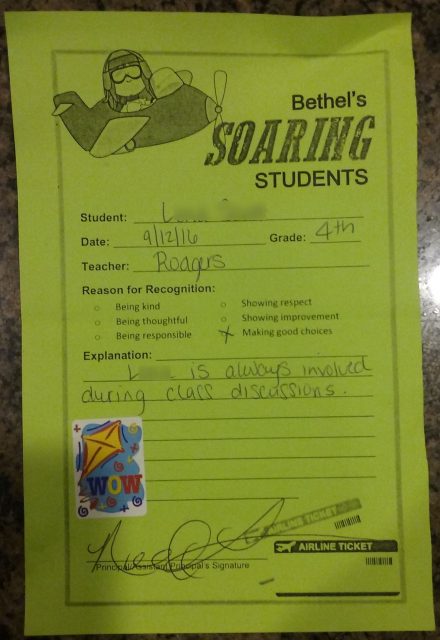
This year, though, I have a class of high achievers for my homeroom, which always means few if any behavior issues. And just outside my door, one of the sweetest students I've ever had the pleasure of teaching has her locker. She always, always is in a good mood, and it's evident in everything she does.
1-dscf0835

Today I mentioned to her that I'd noticed that and really appreciated it.

"Are you always in a good mood?" I asked.

"Pretty much."

"Why?"

"I see other people happy, and it makes me happy."
1-dscf0823

Other people's joy makes her joyful. Such a radical notion, it seems, when you're jaded with the behavior of some of they challenging students, students who have such warped worldviews that it's difficult to believe it took only thirteen years to reach that level fatalism.

"Other people's happiness makes you happy," I said as I headed back into my classroom to get a paper for an student. "That's beautiful."
At the Dinner Table

We sit around a few tables during a planning period and talk about how to use the data we've received from this year's fall MAP testing, a test which provides information about skill levels of our students. There's a general score that summarizes everything called the RIT score. (I don't know what it stands for.) That in turn can be correlated to grade levels by looking at national norms. For the longest time, eighth grade nation norms were 220 at the beginning of the year and 222 at the end. This year, the re-calculated norms have fallen three points. In addition, the data show that in a single, mixed-group classroom (something like science or social studies that is not grouped according to ability), a teacher can have a student reading at the kindergarten level and another reading at the level of a college sophomore, with all the other levels mixed in.

How does one teach a group like that?

There is a predictable corollary to that: the students who read at a second-grade level often behave on a second-grade level. Or perhaps worse, because they exhibit second-grade behavior in nearly-adult size bodies. A dangerous combination at times.

1-dscf0802

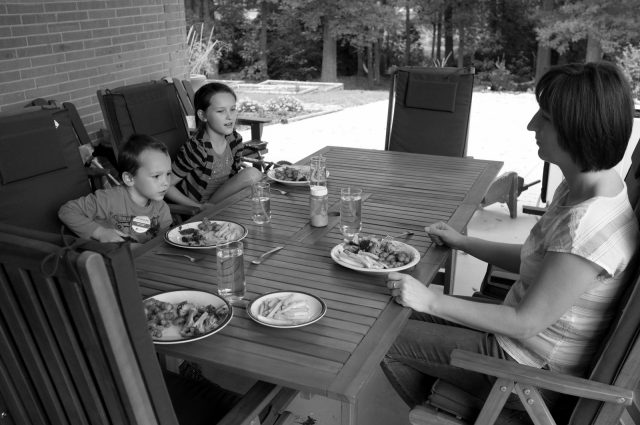
At the dinner table, we talk about our day. L tells us the latest adventures with Timmy, a student who moved here recently from up north and has been seated in L's group. He refuses to work. He's mean to other students. He cursed at a teacher today. He flagrantly disobeys. I suggest that he's probably acting out because he doesn't want to be there, and he's hoping his behavior will somehow get him moved back up north. It's a fairly logical assumption. But here's the thing: his behavior is affecting my child's education. The teacher is having to take time out of instruction to deal with him.

"He's even worse that Demarcus, and I thought he was bad." Demarcus has been the subject of a few stories, and I've found myself thinking that I have a few older versions of him in my classes. Struggling in class. Unable to work and so entertains himself. It's a common cycle, a chicken-egg mystery by the time they reach my classroom: does the behavior cause the low academic achievement or does the low academic achievement cause the behavior? It's probably a bit of both.

I kept my story to myself and let E tell how Jameson picked a scab in class and now it will bleed forever. I love how he's always trying to join in "adult" conversations. He aims, shoots, and hits the target but generally only grazing it on the side.

E's problem is relatively insignificant; L and I, though, are facing the same issue from two different sides of the desk at two different ends of the same problem. What I can do as a parent is quite different than what I can do as a teacher.

But there's a third role: citizen. This is an issue that is larger than just my school, L's school, our district, our state. It's likely the condition of the majority of schools around the country.

It's hard not to be pessimistic about this reality.

First Impressions

Dear Teresa,

You caught my eye from the very first moment I walked into the room. You were sitting at the end of one of the two-seat tables your teacher uses instead of desks, talking to your friend. It was obvious you weren't supposed to be there: the lab tables are designed for two people, not three. When I moved to the front of the classroom, clipboard in my head, obviously ready to take role, you didn't move back to your seat. I hadn't said anything earlier because I didn't want to assume you were being anything other than a friendly student who knew when to move back to her seat. So your behavior from the beginning was something that called attention to you.

When I asked you to move to your seat, you insisted that that was your seat. I'm a patient man, and I thought that perhaps you were just being a typical playful seventh grader, so I calmly and politely repeated that you needed to move to your seat. When you again insisted that you were in your seat, I saw the whole interaction unfold before me. I knew you were going to be defiant. I knew you were going to show an attitude. I knew that you were going to be disrespectful. I knew all these things because I've seen people behave like you behaved many times, and I know the behaviors that lead up to it. As I stated, I had my eye on you from the moment I walked into class because of your behavior: you called attention to yourself immediately.

Now, what was most troubling about our interaction was when I asked you what your name was. I asked you, and you said nothing. I asked you again, and you were silent. Your rigid body language said plenty, though. It said, "I will not respond to you. I will not reply." However, someone in the classroom said your name. The problem with that is simple: I wasn't asking the question "What's her name?" to the class. I was asking you, "What's your name." So when you didn't answer, you were being defiant yet again. And when I kept insisting and you finally said, "You hear my name. You hear them telling you," I knew we were close to the end.

It was our discussion in the hallway that sealed it. You refused to look at me. You answered in a very disrespectful tone. You huffed and puffed, smacking your teeth. You all but flipped me off with your behavior. Your behavior screamed profanity, screamed disrespect. I'm very sorry that you didn't see that. I'm very sorry you didn't realize the horrible things your body language was saying. However, it was at that moment that I knew there was no way to salvage the situation. I knew that, if you stayed in the room, you would not have a positive impact on the class. so I asked the administrator to take you out.

Look at the situation from my perspective: I come into your classroom during my planning period to cover for a lacking substitute teacher. I simply asked you to move to your seat. And from that, you have created a very strong and very negative first impression. Should I see your name on my role next year, it will be hard for me to start with a clean slate with you. However, that's just what I'll do, for two reasons: first, because I'm an adult. Simple as that. Second, I don't know what happened to you this morning leading up to our encounter that might have soured your whole day. I don't think I deserved for you to take it out on me, but still, you're a kid, and kids often don't have the cognitive and emotional mental tools yet to deal with such situations. (Truth be told, many adults don't either.)

So I just wanted to let you know that, should you still be a student here next year, I'll do my best to let that first impression side. But here's the thing: if that's how you always behave, you'll quickly create that same first impression with every teacher in the eighth-grade hallway, and you'll find yourself in situation after situation like the one you experienced today. You might say to that, "I don't care," and perhaps you don't. That would be a tragedy. But I think you do care.

If you'd like some help learning how to make better first (and second and third) impressions, I'd be happy to help you out. Just let Ms. Smith know, and we'll figure out something we can do.

Regards,
Your One-Period Sub

Planning Help

My students are about to embark on a paired-down version of the short story project I've been using for years. Paired down is hardly accurate: it's radically changed. Instead of reading The Tell-Tale Heart and writing three analytic paragraphs about it, they're adding on to something they did earlier this year. More choice. Less grading. Seems like a win-win situation.

Less is sometimes more for everyone.

Homework

1-dscf0638
1-dscf0639

Zugzwang

I’ve begun a chess club at school. Today was our informational meeting, and around twenty students showed up, including three girls. We set up a meeting schedule — first and third Mondays of the month — and I had them take a little “quiz” to see if they knew how to use algebraic notation, had the instinct to do more than take the “free” pawn in the King’s Gambit, could recognize the next move of the Sicilian Defense, and knew what stalemate means.

One small problem: we don’t have any chess sets. PTSA to the rescue. And as I was talking to someone about how to fill out the paperwork to request the funds, I had an epiphany: why not use chess in the classroom on a regular basis? The benefits are manifold, especially the thought of encouraging such dedicated, focused attention for some period of time, weighting options and making a decision, and overall critical thinking. So with some careful planning, I might actually be able to pull it off.

Coming home, I discovered that the Boy wants to play soccer. A good sign. And out of the blue, he wants to play chess.

Sometimes life gives you zugzwang — a situation in chess in which one player would rather not move but has to move. And occasionally, it gives you the opposite.

Note from School

l_card

Saturday Remembered

1-bw0_5519

Grading, grading, grading -- school is definitely back in session.

How Many?

They always seem a little surprised that I can do it. I strike up a conversation with a student before school, someone unknown, someone who's caught my attention. We chat a bit, and then I ask the question: "If it's not too forward, can I ask you how many referrals you got last year?" Today's student, E, raised his eyes to the ceiling as he began count, but I didn't let him continue. "It's okay," I explained. "The number is not the point. The question is the point." He looked at me with a bit of confusion. "Did you notice I didn't ask you, 'Did you get any referrals last year?' but rather, 'How many referrals did you get?', which is a different question entirely." I paused. "Do you want to know how I knew you'd gotten referrals even though I've never seen you before in my life?"

Later, when E is in class with me, I recalled for the class, with his permission, the conversation. They were intrigued and asked if I could do it again.

"Really? You want me to put you on the spot like this?"

"Yes, we don't mind!"

I pointed to a boy who had already been quite chatty. "You've gotten a few." I pointed to a girl who, despite her best effort to hold it in, had displayed a bit of attitude. "You got a few." I mentioned two or three other students, and I was not wrong with a single one of them.

"Do you want to know how I do it? Do you want to know why I can confidently say that I could walk down the all on other team and tell you who'd gotten referrals, that I could go up to the sixth grade hall and make bets on who would get referrals within a few weeks?" They all wanted to know, so I explained the simple fact: "You are constantly, constantly communicating. With everything you do." I glanced around the classroom and created a list on the fly: "The way you're sitting in your desk communicates," I said to a young man who was slouched in his desk. "The way you carried on at the beginning of class, before we really got started, communicated," I said to the girl who was arguing loudly at the start of the period. "The way you wear your clothes," I said to a girl who obviously takes a great deal of pride in her physical appearance.

"Every little thing about every one of you communicates, some of it positive, some of it negative. Some of it you're aware of; most of it, I would guess, you're not aware of." And so many of them are not. They don't see that they're communicating disrespect with their body language and get upset when a teacher calls them on out on it. They don't see when they're communicating apathy by the simple way that they hold themselves. They think they're riddles wrapped in mysteries, but so much of it is just so obvious.

"Are you saying you know everything about us?" one girl asked.

"Certainly not. I'm only making inferences based on what I see, inferences based on past experiences. I don't know why you all do the things you do." That was a bit of a lie: I don't know about the specifics for this or that student, but I know many of the contributing factors.

Every year, I have this same conversation. Every year, I have the same hope that I can help them change.

New Start

Dear Terrence,

Tomorrow is the first day of the new school year, and I'm assuming I'll meet you tomorrow, but sometimes you don't really show up until the second or third week. That is to say, your behaviors don't show up until then.

I'll be honest: I've talked to your administrator from last year, and I have a pretty good idea who you might be, but that of course is never certain. The move from seventh to eighth grade works wonders sometimes, and you disappear into the crowd and become just another student. Still, you sometimes like to come out swinging, letting me know that very first period who you are with your disruptive and sometimes disrespectful behavior.

I would just remind you of a simple fact: you don't have to go that direction this year. You can choose to make a different path for yourself. You don't have to play the same part with the same actors as last year, possibly the year before. It can be different. It can be better. All you have to do is meet my smile with one of your own, and when in doubt, don't speak. Don't get me wrong -- I want to hear what you say, but what you say can sometimes be disruptive, so just keep the burner on low for the first week and let's see how things go.

With hope,
Your New Teacher