matching tracksuits

fun in threes, sometimes fours

education and teaching

The End, 2017 Edition

Last year, one of the teachers on our team was a novice. Like all new teachers, she began the year with a little trepidation and a lot of excitement. When the year ended and students were walking off the eighth-grade hallway for the last time, she got a little teary.

“You going to get all sentimental this year,” I asked a few days ago.

“No,” she replied quickly.

It’s a common enough reaction: that first year, watching the kids leave and knowing you won’t see them again, you feel a little sinking feeling. They’re your kids, your first kids. The ones that taught you more about teaching than any class in college ever did. You fall in love with them in a way: they’re special, even the ones who drive you crazy. And when they leave, you’re not quite sure you’ll ever have kids that you feel so warmly about, kids quite like this. After a year or two, though, you see that the next batch of kids comes in and replaces the old batch. You can’t even recall many names from the last year without stopping to concentrate on the task. And you feel just the same way about this group as you did last year’s.

It’s then that you stop being quite so sentimental about it all–and all teachers, no matter how cynical or burned out they are now, were sentimental about teaching at one point–and realize, yes, you will have kids just like this next year.

There will be another Susan, whose loud and constant talking drives you nuts but who seems to have a potential about her that she herself doesn’t even fully realize.

You will have another Albert, who sometimes can’t foresee the consequences of his actions or the implications of his body language and so comes across sometimes as being quite a disrespectful child.

Another Amelia will sit among your students, seeming always to be enveloped in a happiness that spreads to all around her.

There will be another Chester, who has poor physical and social coordination and tries to make it up by showing off intellectually.

Another Davonte will dance through our door and then proceed to do nothing. Ever.

Every student you have this year will come back next year–and the next, and the next, and the next–with a different name, a different face, but the same basic personality. Or with a similar face and different name and radically different personality. Or any and all combinations of those three, hardly exhaustive possibilities.

For a teacher, it’s not the end. It never is, until you quit teaching.

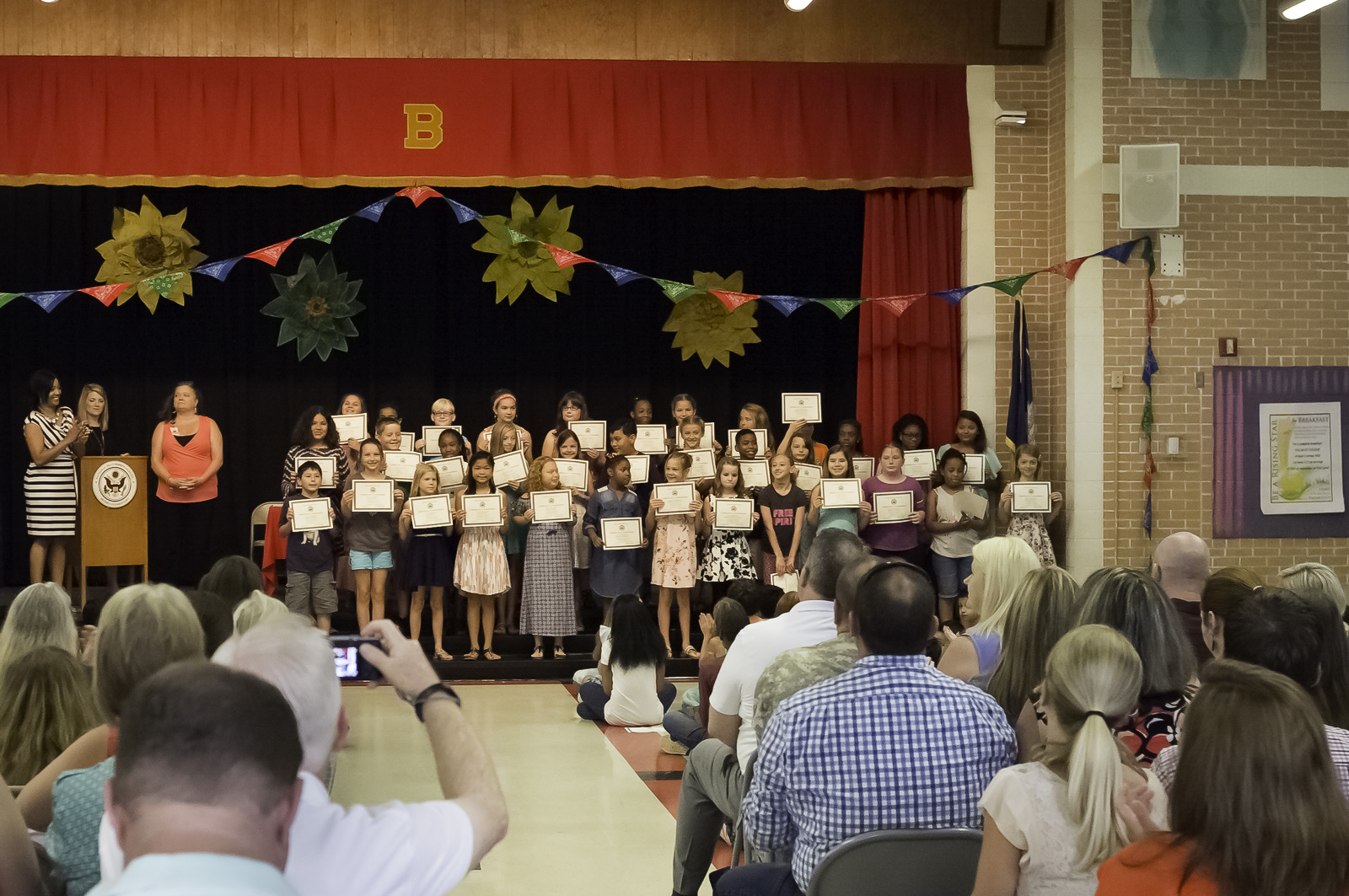
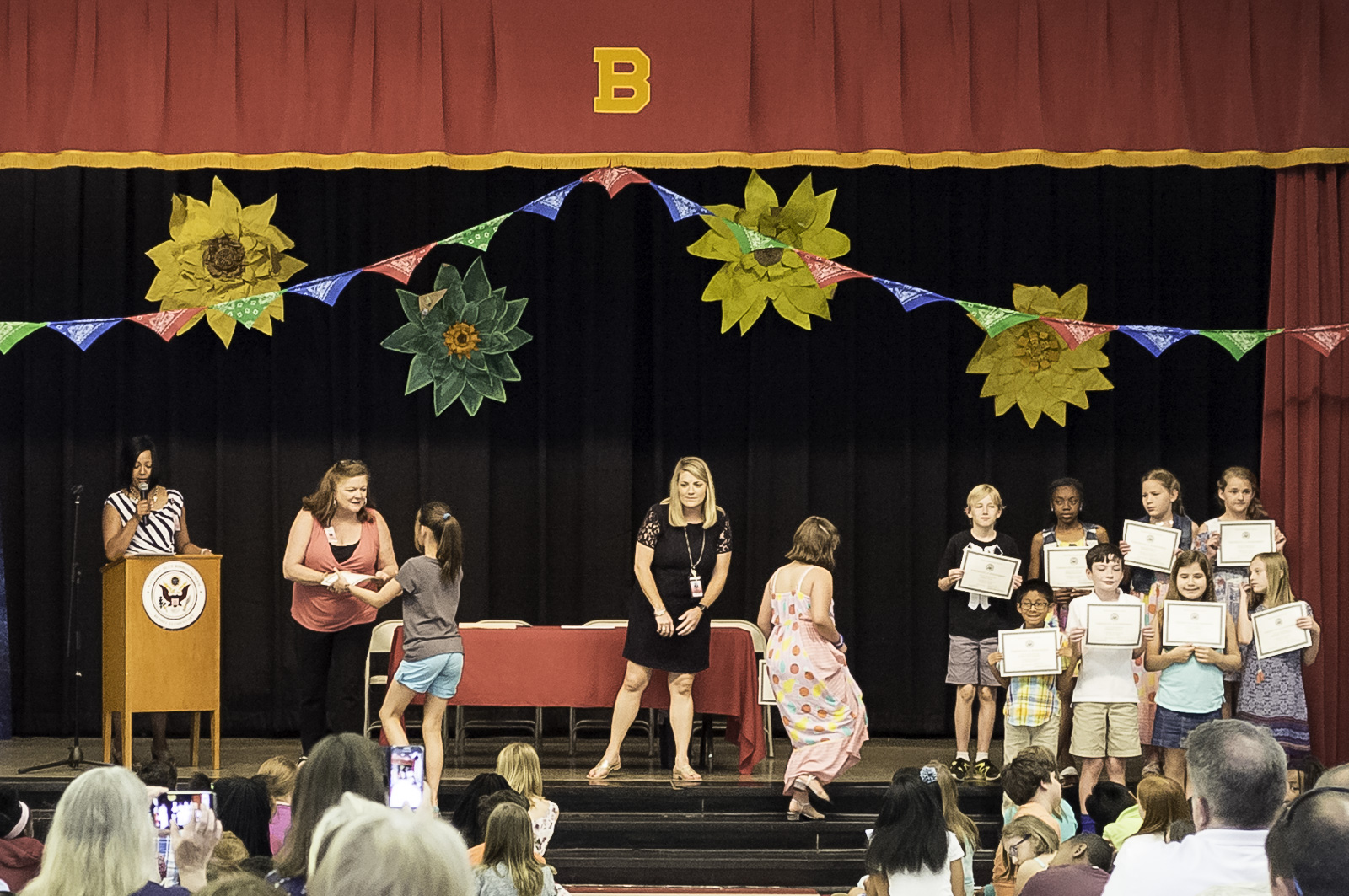
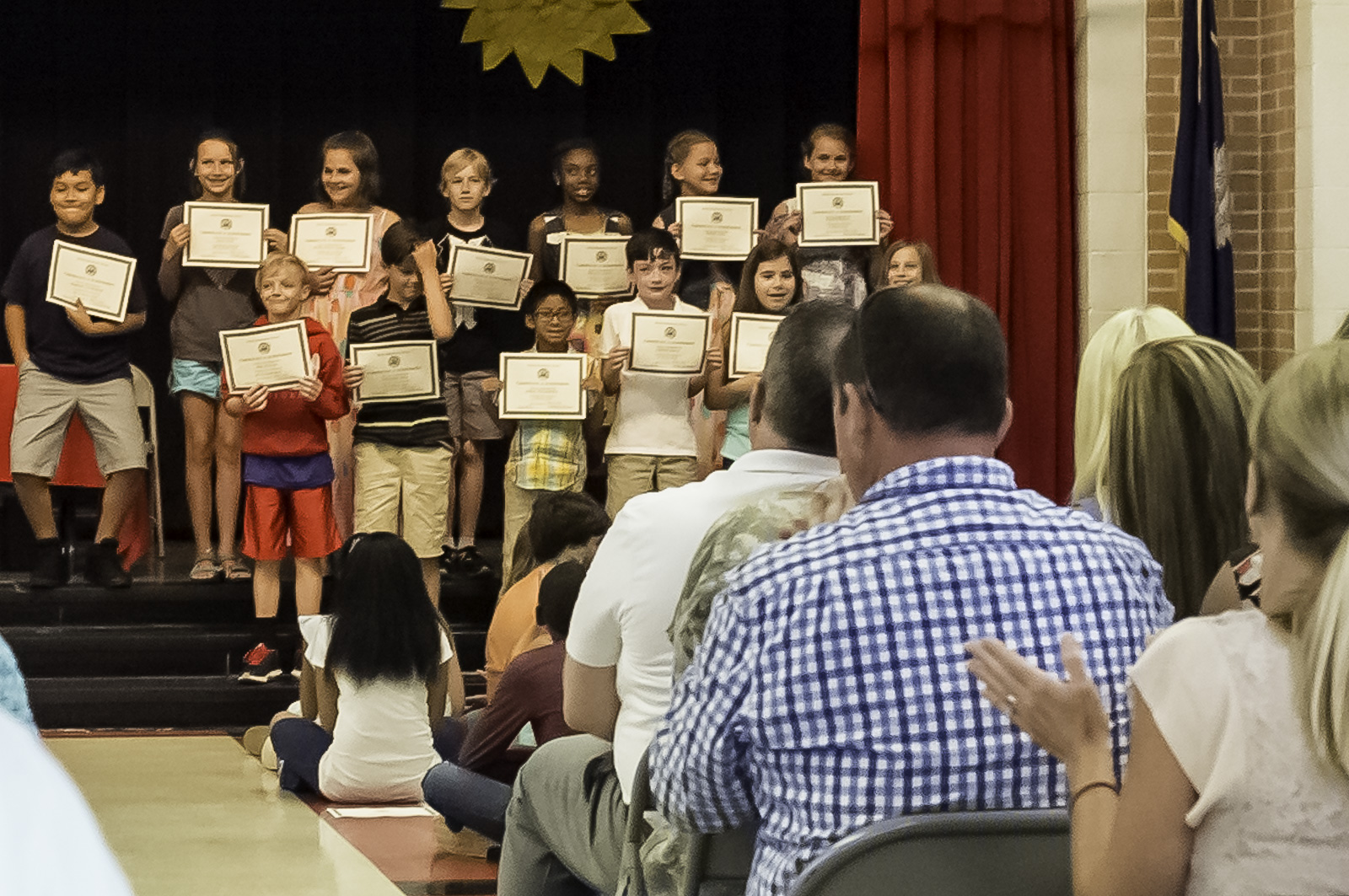
Awards Day

Four awards, including all A's.

Random Fidget

The Girl apparently is anxious to get one -- they're all the rage at her school. Everyone's got one, and they're so fun.

It's the same at our school -- the now-ubiquitous fidget spinner. They're marketed as aids for kids with attention issues and hyperactivity issues. Supposedly they'll help these kids to focus by giving them a little outlet for their hyperactivity.

What ends up happening, though, is that the kids who have them become fixated on them. They're just another in a long line of distractions that keep them from staying focused for more than a few moments. The kid in the front row who can't keep his eyes on his work for more than two seconds now has to contend with this little gadget in his hand and, when he starts sharing it, who's got it and when he can get it back.

A similar trend (in our school anyway) is the fight with the eternally-in earbuds.

"Take the earbuds out," I tell a student.

"You tell me that every day," he says.

Not only that, but I've referred the matter to the administrator a couple of times and he's sat in ISS (probably with his earbuds in ) -- but every day, there they are again.

What do these to things have in common? Simple: they're symptoms of the current generation's need to be constantly stimulated with something.

L is starting to develop those symptoms as well. She loves to have something playing on her little CD player at all times. She wants to read with it on, do homework with it on, color with it own, play on her tablet with it on. However, what she's playing on it is somewhat different than what the kids walking down our hallways have blaring into their heads. (How much rap can you take before you go insane? How much misogynistic, materialistic machismo can you listen to before you realize how empty it is?) No, no music for the Girl: she's always listening to a recorded book.


Back to School

I've had enough experience teaching now to realize that my worries about returning to school after spring break -- potential laziness, potential mutiny, potential problems of every sort -- are almost always unfounded. The first week back is almost always painless. But it's busy, getting used to the schedule again.

This week was the last week before testing. Our school has decided to do the state-mandated testing a little differently this year, and I applaud the decision. Instead of having a week of eighth-grade testing, where we test day after day after day (math, then English, then science, then social studies), followed by a week of seventh-grade testing and a third week of sixth-grade testing (divided by grade because we still don't have enough Chromebooks for the whole school to test at the same time), we're testing one day a week for four weeks. Next week we begin, and once those four weeks of testing are over, the school year is almost over. Perhaps that's what makes the transition from spring break always a bit easier: we all know we have that final push until the big break.

After talking to Babcia

It's also the time of year that students who are at risk of failing a given class -- students who throughout the whole year have usually done very little other than disrupt class -- decide they might want to try to do something to save themselves. There's always one or two who don't, and they usually move on the ninth grade anyway through this or that administrative and summer school magic. I'm not putting down our school: it's a phenomenon that occurs throughout the country, I suspect. But I do have mixed feelings about it.

Morning snack

On the one hand, what will keeping these students back accomplish? It's not like they're going to behave any differently if they repeat. Because our district -- perhaps state? never cared enough to check into it -- has a policy that a child cannot fail two years, they're just going to get pushed on, and if they have already been held back, they know they can't be held back again, which probably prompts a lot of the apathetic behavior. (Students have told me, "I've already failed one grade: you can't hold me back again.")

Getting things in the ground

On the other hand, isn't this just teaching them a wonderful lesson for the future? "I can do nothing and still succeed!" What happens to them when they get to high school and the rules change? I've told several students over the years, "When you get to high school and fail freshman English, they don't say, 'Well, he was close. Let's give it to him.' They say, 'Try again.' And if it looks like you're going to fail a second time, they don't say, 'Well, he's already failed once. Let's move him on.' They say, 'Nope. Try a third time.'" And by then, they're old enough to drop out, and they do. What happens to them when they try to keep a job with that kind of thinking? In short, they don't. They can't.

Proof that it's shaping up to be a good day

So this is the time of year all of this swirls through my head, and I find myself thinking about my own responsibilities. It's much easier for me, regarding paperwork and the like, just to move the kid on as well. It's much easier for me to make my class almost impossible to fail. I think to myself, "They're still kids: they'll grow out of it." But I look around at some millennial young adults and find myself thinking, "Well, maybe not."

It's also the time when thoughts and plans for summer are solidifying. This time last year I was getting a little nervous about the huge project that was looming on the horizon. I didn't know what all was behind the walls, what all awaited us. And now I know what's behind the walls because I put it there, and the only thing that awaits us in the kitchen is a bright, open space now.

But plans are just that, and now it's time to get planting, get mowing, get weeding -- all the joys of spring that just leave you exhausted but strangely satisfied.

And time to play guitar with your neighbor.

Turn Around

Dear Terrence,

What a turnaround you've had these last two weeks. If I hadn't seen it, I wouldn't have believed it. (That's not quite true: I would have believed it because I've seen it happen before, but not often. Not often enough, for certain: such kids are certainly outliers.) For the year to date, your Class Dojo positive behavior percentage has been right around 45%, which means you're a negative influence on the class the majority of the time.

I'm not quite sure you realize the extent of your behavior. You couldn't go more than a minute or two without talking to someone -- and that's not hyperbole but probably an understatement if anything. You turned in absolutely nothing for most of the year. When I ran a missing assignment report for the year to date a few weeks ago, you were missing 45 assignments, to go along with your 45% percent, I guess. At that point, I couldn't have possibly given you more than 50 or 55 assignments, so that means you hadn't turned in 85-90% of your work. Your grade was abysmal as well.

Then two or three weeks ago, something happened. What exactly, I really don't know. Perhaps your mentor finally said something that really made an impact. Perhaps our counselor, who's been pushing you all year, finally said something that made an impact. I'm afraid it wasn't I who said something that made an impact because, I'm a little ashamed to admit, I had all but given up on you. You have to understand: I have 120 students. I can't expend all my energy on one at-risk kid, and there comes a time when I have to say to myself, "I can keep going after this kid, which hasn't worked for three-quarters of the year, or I can take that energy and apply it to that kid, who really has shown some growth." Finite resources and all. So it wasn't I, I'm afraid, but someone said or did something, and you've been a different person since then.

Last week, you turned in your article of the week and worked as hard as I'd ever seen you work. Sure, you didn't turn in one assignment, but you did turn in two. That's a vast improvement right there. Then there was that surprising Dojo percentage: 79%. I was shocked. You probably were, too.

Last weekend, I was wondering: "Will Terrence make it two weeks in a row or will things go back to normal?" Tuesday you approached me and said, "Mr. S, I left my article of the week at home, so I won't be able to work on it as my bell ringer." Wednesday, when you walked in the building and passed where I had hall duty, you waved your article at me: "Got it today!" You did your work; you set a good example. And that Dojo percentage? 90%. I like to frame things in reference to things you guys get, so I made the obvious parallel to basketball: "Think of that, Terrence: if you're shooting 90% from the field and I'm your coach, I'm going to make sure you get paid whatever you have to get paid to stay on our team, and I'm going to tell the rest of the players, 'Just carve out a little space for him and give him the ball. He'll do the rest.'" That smile was unforgettable: "I know, right!?"

The truth is, Terrence, it's not just in basketball that that 90% will get you whatever you dream of. Just about anywhere will work.

This week, it was an honor to have you in class. I can't say I've always felt that way, though. Here's hoping we both keep bring our A-game for the rest of the school year.

Impressed and still smiling,
Your Teacher

Optional

Dear Terrence,

When did a response to "Good morning" become optional? When did manners become a matter of personal preference?

For you, considering all that has passed between us, my behavior likely seems two-faced. You think, "Here he is trying to be all nice to me, and when I get to class, he's going to be on my back about everything." That's not an accurate interpretation of my behavior, though. You see, I won't deny a simple fact: despite the fact that your behavior often is the most irritating aspect of my entire day, despite the fact that your behavior disrupts the whole class, despite the fact that your behavior often descends into outright disrespect (never mind the fact that disruptive behavior is itself disrespectful) regardless of how politely I redirect you, and despite the fact that some of your behavior seems downright spiteful, I try to approach each day as if it were the first day you and I ever encountered each other. I try to give you the benefit of the doubt each and every day. In short, I try to start fresh daily.

It seems only fair. You are, after all, only a kid. Your personality and behaviors have not completely congealed, and there's always hope that you will mature during the school year and come out the other side a different kid. It does happen. And so I want to foster that possibility, however remote, in your behavior by starting anew every morning, and the simplest way I can do that is simply saying as cheerfully as I can muster without sounding false, "Good morning."

Ironically, this type of behavior extends even into the adult world. There have been plenty of times, in both my teaching career and in other jobs I've held, that I've come to work with a sore spot for some colleague or other. It's hard to leave it all behind, and sometimes that sore spot gets irritated just by seeing that person, and the last thing in the world I want to do is to be cheerful and polite. But that's part of the game. It's not being false or two-faced to hide those true feelings; it's called being professional. It's called being an adult, realizing that these little rituals like "Good morning" are just that, rituals that really mean nothing more than "I acknowledge your existence this morning." True, it is a shortened form of an older greeting, "I wish you a good morning." But even my worst enemies I wish a good morning: if things are going well for them, they're not likely to take anything out on me.

So let's try this again. I'll say "Good morning, Terrence," and you say, "Good morning, Mr. Scott." And we both know we've started our day off with each other on a positive note.

First practice is tomorrow morning.

Kindest regards,
Your Teacher

Rain Day

Snow days — those make sense here in South Carolina. Most municipalities don’t have the equipment to clear snow properly and effectively. Add to it the lack of general experience drivers here have with snow and it’s fairly obvious why everything shuts down. The snow starts falling in the morning on a school day, and everyone realizes it’s likely only a matter of time before the announcement. At our school, it’s usually something like this: “Teachers, please check your email.” And there we find the procedures we will follow for early dismissal.

Rain, though? I remember there was a kid in the apartment complex we lived in when I was in kindergarten whose mother would keep him home if it rained, but I thought that was a one-time thing, an exception.

Today, I found otherwise.

By the end of fifth period today, probably a third of the school had already gone home. Early dismissal. To be fair to parents, there was supposed to be a horrible storm passing through: flash flooding, potential tornadoes. Nothing to take lightly. But what ended up happening was so much less dramatic: a few parents began taking their kids out of school, and every other kid, realizing the possibility, texted home. Probably something like this: “Everyone else is going home. Come get me — please!” And soon, there were so many parents waiting to pick up their kids that instead of calling individual classrooms as with the standard procedure, general announcements echoed through the school.

“Will the following students please come to the office for early dismissal,” and then ten, twelve, fifteen names. Five minutes later, “Will the following students please come to the office for early dismissal,” and then ten, twelve, fifteen more names.

Later in the afternoon, an apologetic email from the principal: “I understand that very little teaching can take place due to the announcements,” it began. But what was to be done?

I sent a text to K during lunch: “L is going to be sad because she didn’t get early dismissal. Kids are leaving here in swarms.” Something along those lines. K texted back: “I’m at home with the Boy. He had early dismissal, too. We’re going for L soon.”

And so what do you do with an unexpectedly free afternoon, that rarest of all gifts?

There was a movie, of course. The latest from Netflix, another Studio Ghibli film, Pom Poko. (We as a family have grown to love those films. Not a bad one in the bunch.)

There was a bit of playing, of course. The Boy can find entertainment anywhere. Just add some cars and he’s set.

And K finally got some time to work on a project that’s been haunting us for years: pictures for our living room and kitchen. What to include? How to arrange them? What, sadly, to leave out?

Tomorrow, everything goes back to normal, but only for two days as we near Easter and spring break.

Turnabout

One of the Boy's favorite books for a while was My Cold Went on Vacation, which tells the story of a little boy who catches a cold and recovers, only to wonder where the cold has gone. He loved it because in each picture, the cold -- a green-faced, long-nosed, always smiling circle -- was visible somewhere; I loved it because of the style of the illustrations. It was an educational book for the Boy as well: we got to talk about how colds are spread, and he told me about kids in his pre-school class who had gotten ill throughout the year. He reminisced about his own colds and giggled each time he saw that the cold eventually returned home to visit with his sister a while.

Morning drawing

So went our week as a family. The Boy started us off with a stomach virus on Monday that kept him home Tuesday as well. He let it take a leisurely stroll around the neighborhood before letting it back in Thursday to lay me out all day Friday. And then last night, K was complaining about being more tired than she should have been, and I knew where our family virus had gone after it left me.

Re-organizing the Boy's Crayons.

As a result, most of this week has been kind of start-and-stop. The Boy got sick and everything slowed down; he got better and everything returned to normal. And so went the cycle.

Late-morning nap

It's something of a short metaphor for this time of year: the end of the school year is within sight, but it's still off in the distance a bit, just a little way down the line. We can see it, and we're all ready for it. We're ready to close the year out, pack our bags, and fly to Poland for a few weeks. But it just keeps chugging.

"I'm wearing gloves so I can get the thorns out of the way."

And so do we. But that light -- it's there, in the distance...

Body Language

Dear Terrence,

The fact today that you didn’t know your body language was so disrespectful — not to mention your tone — is only mildly surprising. What is more unexpected was the question you asked next, though it shouldn’t have been.

“You’re going to tell me that my body language is disrespectful even when it’s not my intention?”

To begin with, I’m impressed with that construction. That you would use the word “intention” like that — for some reason, it was surprising. Perhaps that’s because of the way you’ve spoken for the rest of the year.

But more surprising was the fact that you didn’t know that body language can be disrespectful without intention. I work hard to teach my own children just such things: there are things you can say and do that, even though you don’t mean disrespect, show disrespect. In the matter of disrespect, especially when dealing with people in positions of authority over you, it’s the question of interpretation that is often more important than the question of intention.

I don’t think you realized what your body was doing, though, because it’s hard to imagine someone sitting as you sat without realizing how much disrespect you were communicating as I spoke to you.

  • First of all, you were slouched down in your chair. This communicates a lack of effort, that you don’t even care to sit up and pay attention. It suggests you’re just enduring the current moment.
  • Next, you had your elbow on the table with your hand resting on a balled fist. A balled fist always suggests aggression. And having your head down like that communicates, “You are so exhausting me with this nonsense…”
  • Most tellingly, your facial expressions exuded disrespect. There was that scowl: eyebrows slanted downward, a frown. Your nostrils flared occasionally as well.
  • There was also your inability (or unwillingness) to make even cursory eye contact. Refusing to look at someone who is talking to you is about as disrespectful as you can get. It’s also a little immature.

I only mentioned your body language, but there were other non-verbal cues that suggested disrespect.

  • Your tone of voice when you mustered an occasional, monosyllabic response was edged with anger and contempt.
  • Your continual tooth sucking — don’t know what else to call it, so I’ll call it what you call it — suggests that you would say something to me but it’s not worth my time. You start to take the breath to speak, then realize I’m not worth it, and open your mouth to let the now-unneeded breath out.

To your credit, when I pointed all this out to you, you began slowly to change. You sat up, you made a bit of eye contact, and you stopped sucking your teeth.

But here’s the big problem: when you do this with me, I take this to be another teaching moment. It’s tiring, that’s for sure: “Here I go again, having to teach kids things they should already know by this age, things that have nothing to do with my subject matter.” But still, though I feel overworked with such issues, I see it as my job. I teach in order to prepare you for the future, and sometimes, interpreting figurative language seems the least significant subject matter for your success. However, you will soon encounter people who are not interested in teaching you these things, not interested in even dealing with it. These people will probably have the ability to make your life very miserable very quickly. I’m talking about bosses, and they’ll fire you in such a situation.

I know that’s meaningless to you. You say things like, “I’ll just get another job.” Unfortunately, getting other job when you’ve lost one is not like getting another pencil from you next teacher when you’ve lost it in the previous class.

I hope we can get this habit of yours under control before you head off to high school (there are teachers there who will treat you like the aforementioned boss), but even if we can’t, I hope we’ll continue making progress.

Regards,
Your Teacher

Crossing

Dear Terrence,

I know some of the materials — most of the materials — I give you are merely crossing your desk. I stand here at the hole punch, making three even holes in these Frayer diagrams, preparing them for a long and lustrous life in your binder, but I understand that this paper, like so many others, simply won’t make it there. You don’t have a pencil most days, and you often can’t remember your password to use our Moodle installation, so how can I expect you to keep up with a single sheet of paper? I just punch the holes out of habit, I suppose.

Yet it’s not asking that much. I’ve told you things like this before, but the only really significant thing that separates you from the kids in the “smart” class is not intelligence but habits. I have students in that class, Terrence, that can produce materials I gave them at the beginning of the year. I can say, “Get out the graphic organizer we used for project X because we’re going to add some things to it and reuse it for this project.” And a fair number of them — a majority, I would say — can produce the material in question. That’s why they’re in that class. They’re not smarter than you. They care to be organized, and they are, therefore, simply more organized than you.

For you, though, the materials just cross your desk and often end up in the floor. It’s like so many things in your life . Even your housing situation seems to be just crossing the arc of your life: you don’t speak of living somewhere, only staying. So with so many things in flux in your life, its little wonder that this too is in flux. It seems like yet another example of non-curriculum skills we need to be teaching you, but in the age of testing, testing, testing, it just seems to fall through the cracks for all of us as you guys are crossing through our classrooms on your way to the future. Perhaps we all just need to cross ourselves and try harder.

A bit cross with myself and with you, as well as frustrated,
Your Teacher