matching tracksuits

fun in threes, sometimes fours

education and teaching

End of April

It's difficult to believe that April is over, and when I look at my school calendar for May, I realize that the year is, for all intents and purposes, over. We have no single week of school remaining that is a regular, five-day, testing-free week, except for the last week, which consists of three half days.

April in a way flew by, but it also crawled. We're still not done with the renovation: "Two more weeks" has been the eternal refrain. We're so close now it's ridiculous: the walls and ceilings primed, ready for painting tomorrow; tiles in the bathroom and shower installed, ready for grout; hardwood floor installed in the bedroom, read to be sanded and finished next Monday. It feels like forever and no time at the same time.

Spring Monday

I was worried that this would be the first of several very difficult days. With no one here to help with the kids (read: E) in the morning, it's difficult for me to get out of the house very early. This week, however, is my duty week: I get to spend thirty minutes before my contracted arrival time supervising kids on the eighth-grade hallway. It's loads of fun, but the downside is that I have to leave much earlier than usual. Which created a dilemma: what to do with the Boy. Two options: ride with the neighbor or leave without breakfast and have it at school.

At around 6:15 this morning, the Boy toddled downstairs, still rubbing his eyes, and presented a third option: "I'm just going to eat breakfast now."

"Are you sure? You could still sleep another half hour."

"Nah, I'll stay up."

And so the Boy proved once again that life is like calculus: there's often more than one (or even two) solutions to a given problem.

Once at school, the usually peaceful morning duty transformed temporarily into one of those moments when, as a teacher, I see a student's future and think, "Wow, if this kid doesn't make some serious changes, do some serious maturing, she's in for a long, tough life." And much of that, in most cases, is due to environment: they're not choosing necessarily to be a disrespectful kid. It's something that works on the streets and/or at home, and they just bring it into the school as well.

That particular exchange foreshadowed the discussion I was to have with my honors English kids, who read Plato's "Allegory of the Cave" last week as their article of the week. We began with a review via video:

Then the kids went through a few discussion questions:

  1. To what extent do you find Socrates's point about the human tendency to confuse "shadows" with "reality" relevant today?
  2. What could be the elements that prevent people from seeing the truth, or regarding "shadow" as the "truth"?
  3. In society today or in your own life, what sorts of things shackle the mind?

The common theme that came through in all of these discussions was the role social media plays in creating false realities, in preventing people from seeing truth, in shackling the mind. It's ironic: I see so many of these kids buried in their phones before and after school, yet they're strangely aware of the negative effects.

After school, I hopped out of the car thinking, "So far, other than the little issue in the morning during hall duty, this supposedly tough day is surprisingly enjoyable. After dinner, it was even more so: one of E's choices in his literacy log is to find a pleasant place to sit outside and read for a while.

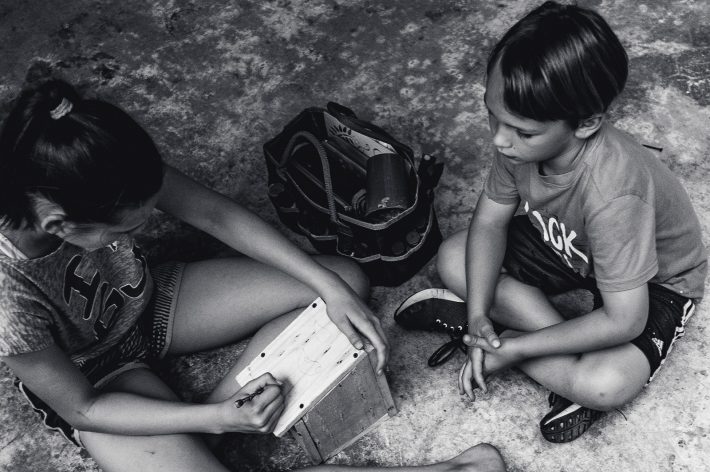
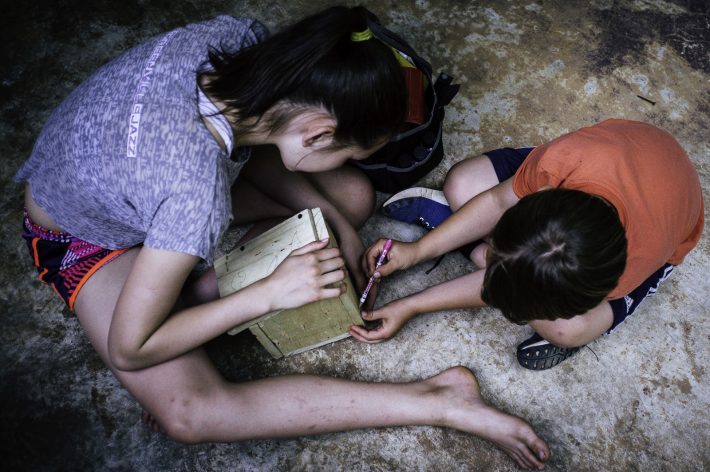
And after that, a little project: a bird house. Where did this idea come from? I don't know. The Boy simply talked K into buy him a piece of pressure-treated 1 x 6, and although he originally planned on building a tree house from that single plank, he was flexible enough to realize that a bird house was probably more in the scope of that single plank. So he found instructions on YouTube, gathered tools, and together we built a little bird house.

"Once you're done, I want to help with the painting," the Girl declared, and so with twenty minutes to go before the start of E's evening ritual, they began working.

"Let's decorate it with birds," the Girl suggested. They began drawing various silhouettes of birds while I got the dog's dinner ready, only to discover we were out of dog food.

"Alright kids, you'll have to do the actual painting tomorrow. E, you'll have to go with me to the store to buy some food for Clover." I was expecting a small fit, some protesting at the very least, and I was reluctant to stop the work in progress: it's so rare that they find something that really engages them both.

Still, the Boy was surprisingly mature. "Okay," was all he said, and off we went to get some kibble for the pup.

And so at the close of this surprisingly pleasant day that was supposed to be the first of several tough ones, I find myself realizing anew that "tough days" and "bad days" and "rough days" depend more on our perception than anything else, just like Plato's shadows suggest.

Frog and Toad

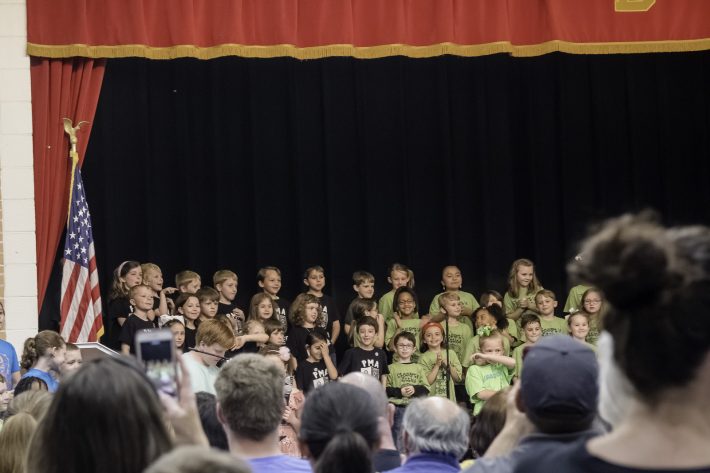
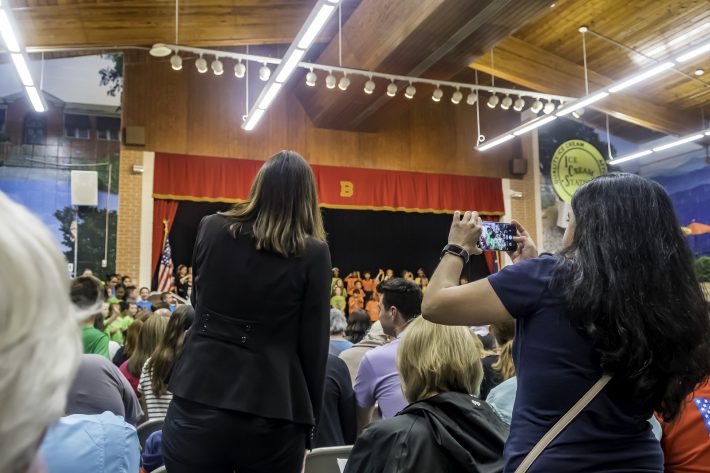
The Boy performed with all the other first graders this evening. They put on a small musical about Frog and Toad, about whom we’ve read in countless books.

All the parents were thrilled to watch their kids; we were thrilled to have an opportunity to watch so many parents.

Three Photos from School

The Books

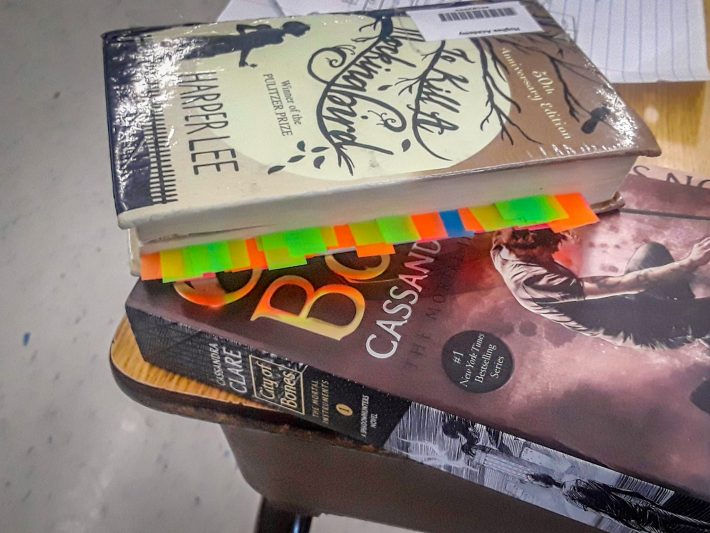
I am fortunate to teach three honors classes. This means I work with kids who, by and large, do everything I ask of them. So when I said, “As you read the chapter on Tom Robinson’s testimony, you need to note passages of importance,” this young lady took it seriously. Plus, she has her own personal reading she’s keeping up with.

Spring

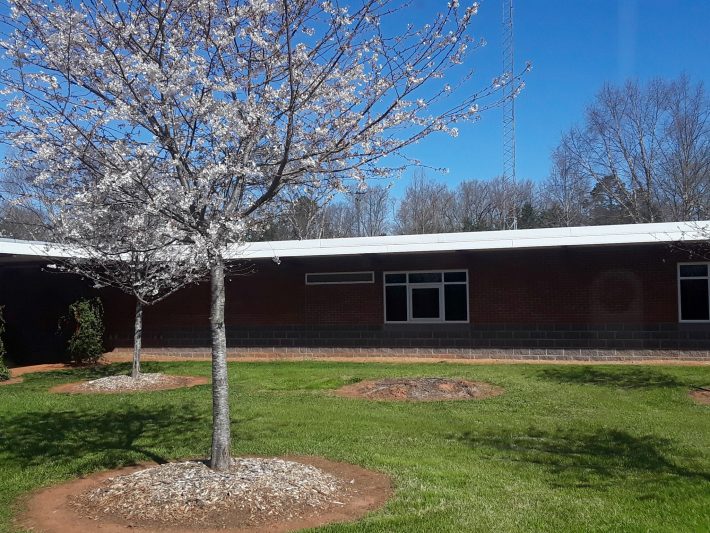
The cherry trees outside my classroom are starting to blossom. Everyone is taking note.

Notes

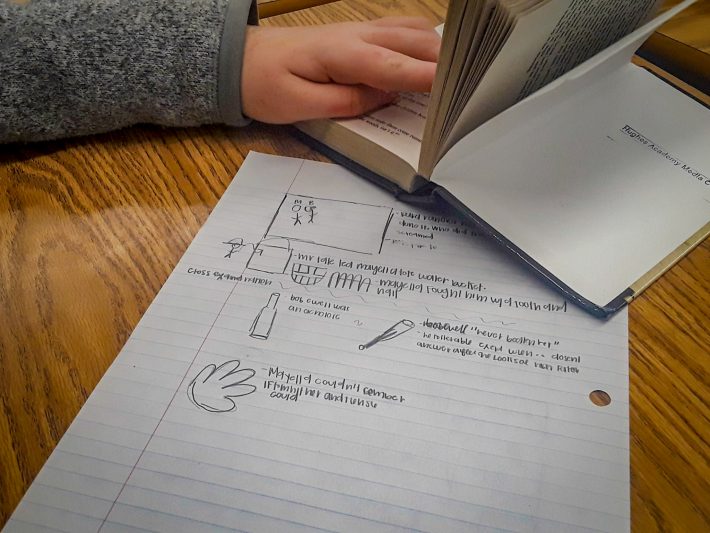
Once we’re done with To Kill a Mockingbird, I have a special lesson for the kids: a local trial lawyer comes in and discusses the case from the point of view of an attorney who has himself defended individuals against rape and murder charges. How would an actual lawyer with such experience view the case? It’s always eye-opening to the kids.

To prepare for it, I have the kids make detailed notes about the case from the testimony of Heck Tate, Bob Ewell, Mayella Ewell, and Tom Robinson. “Make schematics of all the movements,” I say. “Make sketches of anything described in detail. Make sure you note what you know explicitly from the text and what is inference. Also make sure you note what things are less than clear.”

Homework

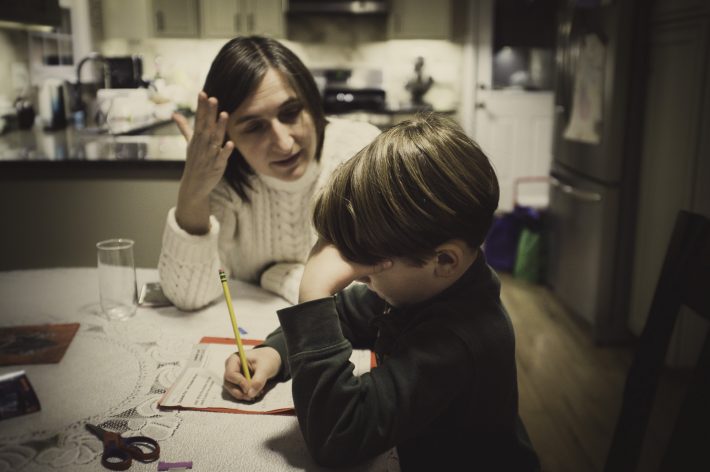
Sometimes, everyone gets a little frustrated with homework.

Wednesday Virus

The Boy wanted to go to school today. He really wanted to go. Mainly because they weren't going to be in school -- it was field trip day to the local science center where they have a Tesla coil, explode hydrogen balloons, and generally thrill kids of all ages. But the rash he'd gone to bed with, the little splotches on his cheeks, had spread all over his body.

"E, we have to go to the doctor," K explained.

"But it's nothing. Look -- it will go away in no time."

She tried to explain to him the risks of passing something on to other children.

"They won't get it! I know they won't!"

In the end, he lost. The doctor said it was a virus going around. "He's through the worst of it, but you should keep him home today."

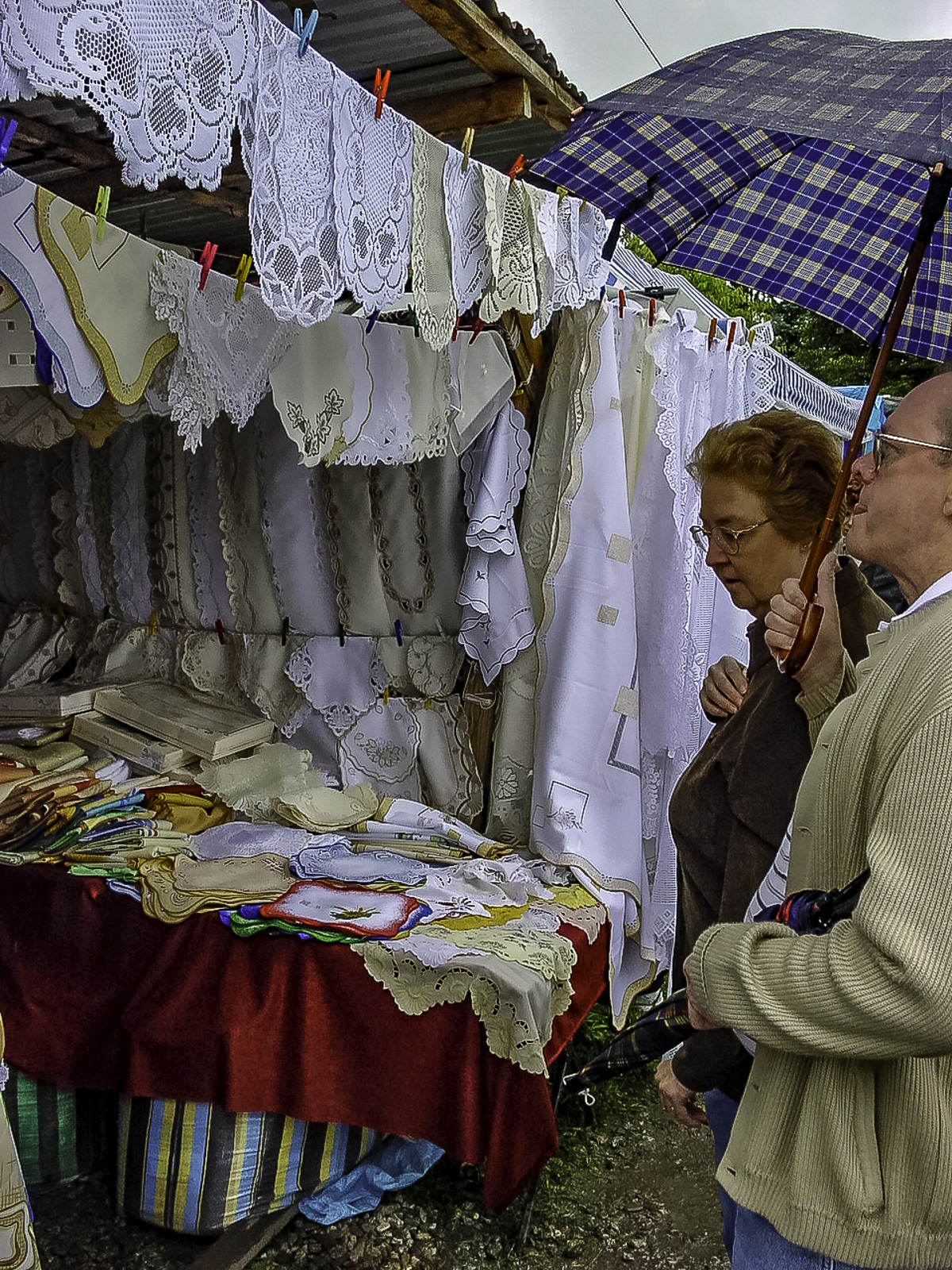
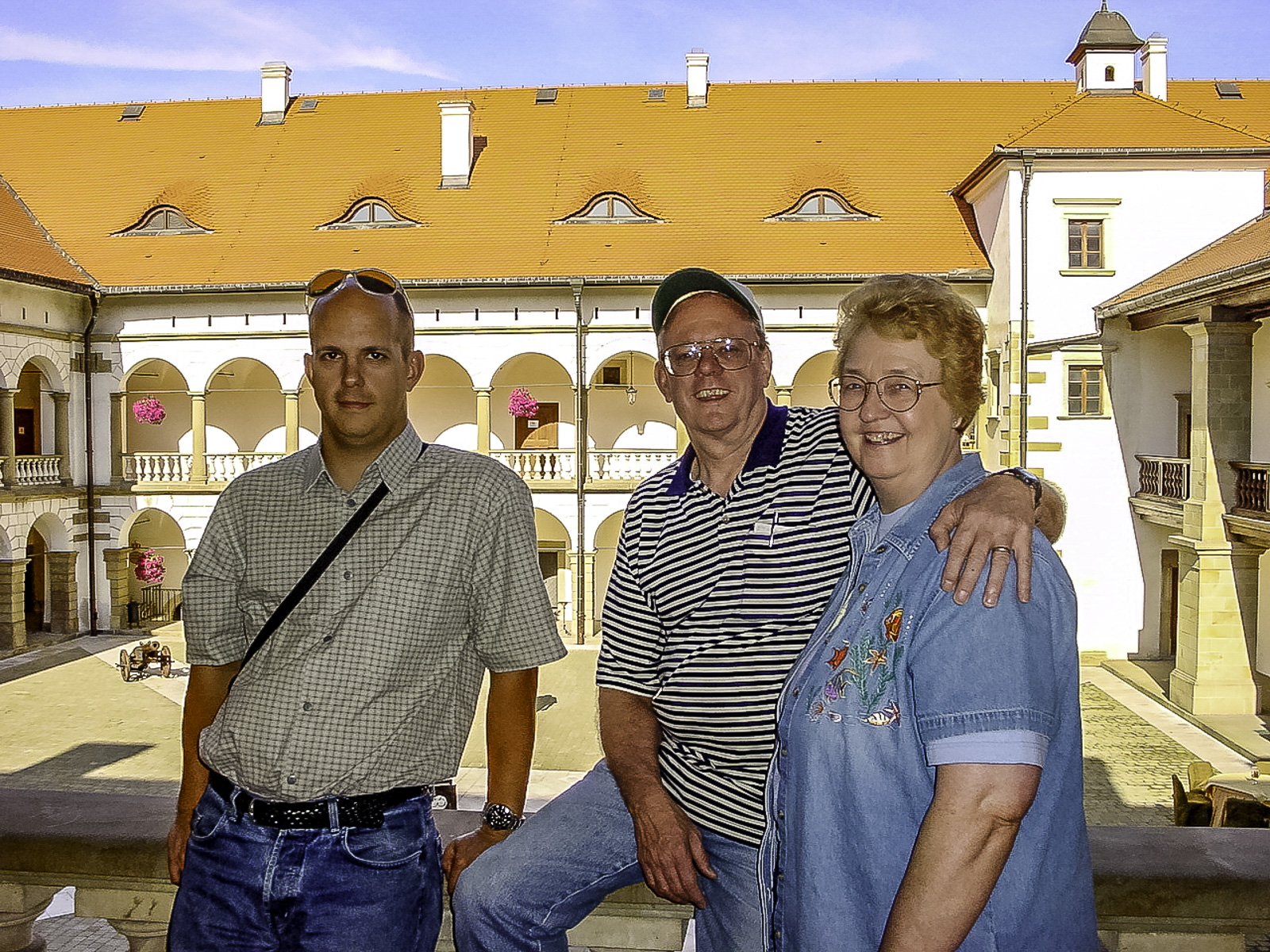
For today's pictures -- fifteen years ago in Budapest and Poland with Nana and Papa, when they came for our wedding. I was going through pictures this evening, revisited these, and did some editing.

Lunch with Nana, Dinner with Papa, and Work

With Nana still in rehab and Papa alone, we take care of them the best we can. Poor Nana has to put up with institutional food, which, she claims, is not terrible, but which I also know is not great. Poor Papa can cook eggs and warm things up in the microwave, but he's never done much more than that.

This afternoon, since it was MLK Day and the kids and I had the day off, we took over a favorite chicken sandwich for Nana and cheered as we saw evidence of an ever-increasing appetite.

In the evening, we went to make dinner at Papa's. We either cook something here and take it over every night or take everything there to cook.

Dinner a couple of nights ago

Other than that, an uneventful day. I spent an hour in the morning planning lessons for the next several days (this week and a little beyond) for one class and another hour in the afternoon planning for another class, plus half an hour in the evening grading papers.

This year, I've kept track of all my out-of-classroom hours -- planning, grading, going to meetings, etc. For this first semester, I've spent 115 hours above the 40-hour work weeks. That's just a little over half a day shy of three full work weeks. If I keep this pace up -- and I see no reason why I wouldn't -- I'll have spent close to six weeks' worth of time outside the classroom doing work. Add to that the half-hour morning duty I have every third week, which makes 2.5 hours a week or 30 hours for the year, and I'll have 260 hours of additional work on top of my normal work week. That's six and a half weeks of work. I have about nine weeks off during summer break, but I probably spend an additional 40 or so hours over the summer planning for the coming year. (I'll keep track this summer.) That's seven and a half weeks of work, which means my summer "vacation" is really not much of vacation -- I've just put in the hours in advance.

Papa looking at bills

I don't say this to complain. Much of the time I spend grading is because I try to push my kids as hard as I can, which produces a lot of material for me to assess. I have a reputation to keep up, after all: students tell me that they've heard since they entered the school in sixth grade that I'm the most demanding teacher in the school. I don't know about that, but it certainly doesn't hurt one's sense of self-worth to hear something like that. In other words, I could do less work and get by, but then it wouldn't be the Dread Teacher Mr. Scott's.

Finally, I must have been under a rock, but I just learned of Mary Oliver's death tonight, listening to the news in the car. A poet of fairly simple verse, she's always a great choice for thirteen-year-olds. In past years, when I had students put together annotated portfolios as their culminating poetry unit project (which is not to say I have my students read poems for one dedicated unit and then neglect poetry for the rest of the year, but I find it's good to spend three or four weeks focusing on what makes poetry poetry to equip them for the rest of the year), almost every student included an Oliver poem, and they all said they liked her because she's easy to understand. I personally have always liked poems that require a bit more digging, but that's not to say I'm a big fan of someone like Louis Gluck, someone who writes poetry that is almost impenetrable. My favorites -- Bishop, Heany, Levine, and the like -- require some thought, require a bit of effort, but always reward with a moment of stunned epiphany.

And since I've been talking about work, why not include Levine's poem on the same subject:

Gallery of Shakespeare

I posted the seven quotes around the room, seven key passages from the second and third scenes of Romeo and Juliet act three. The kids spread out in groups of three or four and took four to five minutes looking at the quotes, completing three steps:

  1. Define up to three words on the Post-It note.
  2. Note any language tricks (inversions, elliptical constructions, parallel construction, figurative language, etc.).
  3. Discuss and note what earlier passages in the play this reminds you of; mark specific elements.

After time was up, they rotated to the next quote. (It’s called a gallery walk in edu-speak.)

The kids read Juliet’s thoughts about Romeo:

Come, gentle night, come, loving, black-brow’d night,
Give me my Romeo; and, when he shall die,
Take him and cut him out in little stars,
And he will make the face of heaven so fine
That all the world will be in love with night
And pay no worship to the garish sun.
O, I have bought the mansion of a love,
But not possess’d it, and, though I am sold,
Not yet enjoy’d: so tedious is this day
As is the night before some festival
To an impatient child that hath new robes
And may not wear them.

And sure enough, they picked up on the parallels with Romeo’s words in the balcony scene:

But, soft! what light through yonder window breaks?
It is the east, and Juliet is the sun.
Arise, fair sun, and kill the envious moon,
Who is already sick and pale with grief,
That thou her maid art far more fair than she:
Be not her maid, since she is envious;
Her vestal livery is but sick and green
And none but fools do wear it; cast it off.

They read Juliet’s furious reaction to the news that her newlywed husband killed her beloved cousin:

O serpent heart, hid with a flowering face!
Did ever dragon keep so fair a cave?
Beautiful tyrant! fiend angelical!
Dove-feather’d raven! wolvish-ravening lamb!
Despised substance of divinest show!
Just opposite to what thou justly seem’st,
A damned saint, an honourable villain!
O nature, what hadst thou to do in hell,
When thou didst bower the spirit of a fiend
In moral paradise of such sweet flesh?
Was ever book containing such vile matter
So fairly bound? O that deceit should dwell
In such a gorgeous palace!

And they caught the parallel with Romeo’s words in the first scene:

Here’s much to do with hate, but more with love.
Why, then, O brawling love! O loving hate!
O any thing, of nothing first create!
O heavy lightness! serious vanity!
Mis-shapen chaos of well-seeming forms!
Feather of lead, bright smoke, cold fire,
sick health!
Still-waking sleep, that is not what it is!
This love feel I, that feel no love in this.

And they actually think it’s, to use their words, pretty cool.

Wednesday Night Inferring

A busy day for everyone culminates in us arriving separately at home after seven, two hours after we normally eat dinner. After school, a long meeting, and a visit with Nana (out of the hospital and back in rehab -- hurrah!), I'd stopped for something for us to eat; after work, shuttling the Girl to choir practice while taking the Boy shopping, running the Boy to basketball practice after dropping the Girl off at volleyball practice, then picking everyone up, K arrived shortly after.

As we ate, the kids and I decided that K's plan for the rest of the evening was flawed.

"I'll put away all the groceries and then go to bed if you'll put the Boy to bed."

"Nope. I'll put away the groceries while you take a hot bath, and then I'll put the Boy to bed while you go to bed yourself." L and E agreed -- Mama needed to call it a day. As I was bustling about the kitchen, I remembered it was garbage night.

"L, take the garbage and recycling out," I said, expecting a little fussing.

"Okay." Nothing more.

She came back in, a little whiny, and said, "E always takes out one of them. Can he take out the recycling? I'll go with him."

"No, sweetie, it's late. Just do a little more than you have to."

"Oh, okay." Nothing more.

From this, a simple inference: our daughter really is growing up. She's not just sprouting vertically (she's almost 5'4" now); she's not just developing into a young woman; she's maturing. With my nose pressed to the ever-present every day, I forget that sometimes. It escapes me.

While all this was going on, the Boy had started his homework.

"What are you working on tonight?" I asked him.

"Inferring. We learned it today."

As an English teacher, I've been working on the Boy's (and the Girl's) inferring skills for years. I taught him the word; he must have forgotten. The teacher did a better job today. "What's that?" I asked.

"Making a good guess."

Not a bad definition. I usually tell my students it's "making a reasonable guess based on evidence."

And there you might notice something: I teach eighth grade; my son is in first grade. Am I really teaching inferring again? Well, I'm not teaching inferring -- they know what it is. But we're still practicing it. Like mad. Especially (really, that should read "solely") with my lower-achieving students. I give them a text like this:

Every day after work Paul took his muddy boots off on the steps of the front porch. Alice would have a fit if the boots made it so far as the welcome mat. He then took off his dusty overalls and threw them into a plastic garbage bag; Alice left a new garbage bag tied to the porch railing for him every morning. On his way in the house, he dropped the garbage bag off at the washing machine and went straight up the stairs to the shower as he was instructed. He would eat dinner with her after he was “presentable,” as Alice had often said.

I then ask a question: What type of job does Paul do? How do you know this? I have the students back up their answers with three specific pieces of evidence from the text, then explain how that evidence is evidence. A good student response (an actual student response) looks like this:

Paul is a farmer.I know this because he is wearing muddy boots. Wearing muddy boots is evidence that he is a farmer because if he were to work in an office or inside he wouldn't have muddy boots. Also, he is wearing overalls in which he would not have been wearing if he was working inside. Finally, Paul’s overalls are dusty and most farmers work a lot outside so he must have gotten dirty from working outside.

So I applied the same thing to the Boy's work. The same thing -- a text followed by a question:

Everyone was singing for Mark. He blew out his candles. He had many presents. It was his special day. What special day was it?

E read the text and said, "It's his birthday!"

"How do you know this?" I prodded.

"Because he got presents."

"But we get presents at Christmas as well. How do you know it's not Christmas?" He looked stumped for a moment, so I told him what I tell my own students: "Go back to the text. Find something in the text that shows it's not Christmas."

He read a while, thought a while, then said with a smile, "Because it says it's his special day, not everyone's special day. Christmas is everyone's special day."

I thought he'd pick up on the candles. That's the more obvious piece of evidence. He went the more subtle route.

"That's great. A very good observation. Now, can you find a third piece of evidence?"

Again, he looked, read, thought. "The candles. You don't blow out candles on Christmas."

After a tiring day, what a perfect ending.

Revisited

In my journalism class, we’ve decided to shift from pure journalism to a bit of literary nonfiction, so we began the day with a writing exercise. I provided a starter and fifteen minutes to write: “During winter break, I learned…”

I wrote along with them and found myself thinking again of Bida and so began writing again about Bida:

During winter break, I learned anew that love and pain are often so closely twined that one cannot separate the two, that tugging on one brings the second along with it. I learned all this watching and participating in my daughter’s grief as our family cat slowly died as she lay on our couch.

We’d had Bida for ten years. My daughter had never known life without that gray, grumpy, yet sweet rescue cat. She looked pitiful when we got her, hence the name, which means “poor little thing” in Polish. She looked even more pitiful as she lay dying, thin, slow, her bones protruding, her long gray hair matted because we could no longer brush her without causing her pain.

When we arrived home that night, my wife went to check on her in the room in the basement where Bida always loved to sleep. In a panicked voice, she called me downstairs. The poor cat had fallen off the bag of insulation that she loved to sleep on and landed on her back, wedged between the bag and some shelving. I thought she was already dead, but when I pulled her out gently, she shuddered, gasped, and began breathing in shallow breaths.

“Go get the kids,” I told my wife. “They’ll want to say goodbye.” She headed upstairs while I gently carried Bida to the couch in our basement family room and lay her down on the middle cushion. The four of us sat around the old, ornery cat for two hours as her breathing slowed, then stopped.

The first to come running from upstairs was L, my daughter. She was already beginning to cry, and when she saw Bida, the cat that had been around for as long as she could remember, she broke down into a sobbing, shuddering cry.

“No, Bida!” she shouted, dropping to her knees beside the couch and throwing an arm protectively but gently over the cat, who lay with her eyes open, her mouth gaping, the only movement being her rib cage that went up and down, up and down, up and down. “No, Bida! No!” she cried, her body shaking more and more violently.

I’d never been a big fan of that cat. I put up with her because L loved her so. But in that moment, watching my daughter wrecked with pain, her face a puddle, her voice almost instantly hoarse from crying, I realized I loved that cat because she loved that cat. I understood that I was near tears because she was in tears, and even because I was sad to see that grumpy cat go, to see that sweet cat suffer, to see my daughter suffer along with her.

When you love something, you open yourself up to pain because of that. You will feel that person’s pain with them; you will feel the pain of separation; you will eventually feel the pain of ultimate loss.

To love someone is to love their mortality, their temporariness, and the ________ness of everything they love.

A first draft — shows some promise, but nothing spectacular. That’s the idea.

Afterward, I had students choose the sentence they like most, the sentence they’re most proud of. “Be prepared to explain to a partner why you like that sentence, why that sentence fills you with a bit of pride,” I instructed. For my own sentence, I chose the first one: “During winter break, I learned anew that love and pain are often so closely twined that one cannot separate the two, that tugging on one brings the second along with it.”

“I like it because of the word ‘twined.’ I don’t think I’ve ever used that word, and it somehow provides a theme for the whole piece that I could go back and incorporate — images of thread, fabric, sewing, weaving, and so on,” I explained.

It was just the final lesson of a day filled with successful engagement from all students. I always worry a bit about how students will perform that first day back, and I’m always impressed. And then ask myself, “Why are you always worried? They’re always great!”