matching tracksuits

fun in threes, sometimes fours

education and teaching

Day 67: Cleaning, Surveying, Surviving, and Commenting

Cleaning Out

The end of the school year always brings a lot of cleaning and paperwork. We have an entire list of things we teachers have to do before going home for the summer.

  • We have to return materials to the media center.
  • Emergency guides need to go back to an administrator.
  • We have to make it easy for everything to be removed from our room, so that usually means packing up all the books on my bookshelves and storing them somewhere.
  • The plant engineer needs to check our room for any issues that will hamper the cleaning of our room over the summer.
  • We have extensive checks about grades as well as reports we have to print out for the office staff in case there are any questions about grades over the summer.
  • We have to return our keys to the a designated administrator.
  • We have to return our receipt books to the accountant.
  • We have numerous meetings about various things, some of which feel incredibly important and some of which feel not so important.
  • Prepare letters to go home with final grades.

The first year I was a teacher at this school, it took three days to get everything ready because, in addition to all this (and a lot of stuff I’ve forgotten/neglected to mention), we had to put copies of the final report cards in permanent records and then organize the permanent records based on which high schools students were attending. These last two steps are now out of our hands, but it still takes a while to get all this done.

Part of the challenge is getting signatures. At the end of the whole process, we are to provide the principal with a checklist that has been initialed by everyone involved to show that we’ve done all the steps above. Sometimes, it’s a bit of a trick tracking down a given administrator.

I went to the school today for the end-of-year checkout, arriving at around ten in the morning, and by twelve, I was done.

This is just another way that this year is exceptional.

I’m not complaining: I didn’t have to move my books at all because the custodial staff, in an effort to get a head start on the summer’s duties, has already cleaned my room, most significantly the floor (cleaned and waxed). Turns out they just worked around the bookshelves. The curmudgeon in me will forever after complain, “Why can’t you just do that every year? It’s not like I ever move my room around — everything goes back to the same place, year after year.” Still, I would have preferred a regular ending to this year, and for that, I would have willingly done the whole check-out procedure — twice, if necessary.

Surveying the Changes

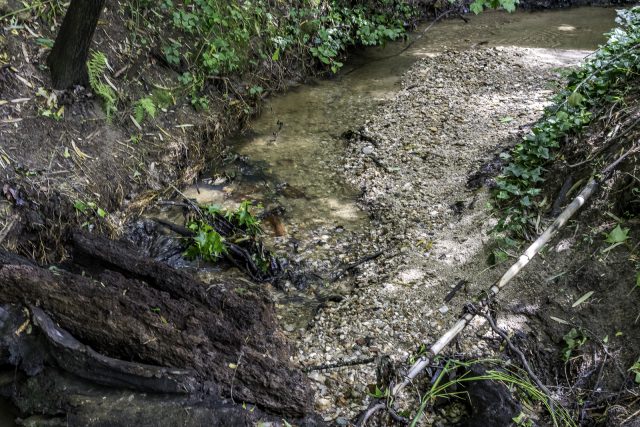
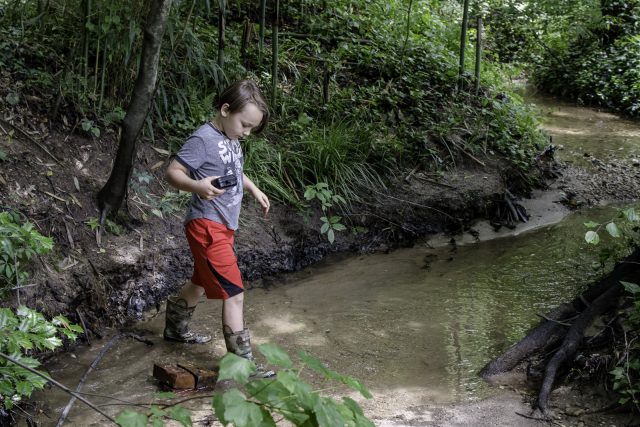
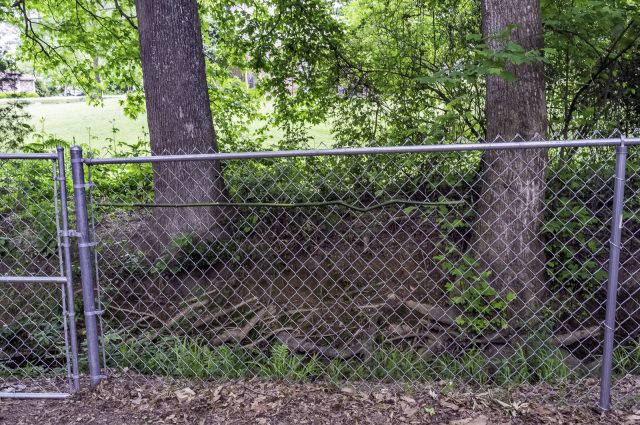
Every time we have a significant rainfall that results in the creek behind our house rising to food or near-flood levels, the Boy and I like to go out and see what has changed. The surging waters bring new flotsam and jetsom after it washes away existing flotsam and jetsom.

It changes the flow of the creek, too. For example, the spot where we usually cross was just wide enough that I could step over it with one stretching step. Now it’s much wider. As I was wearing tennis shoes during our afternoon adventure, I was unwilling to take the chance of getting them wet. The Boy kindly built a stepping pylon out of the bricks we’d brought down last year to help with the crossing in another spot.

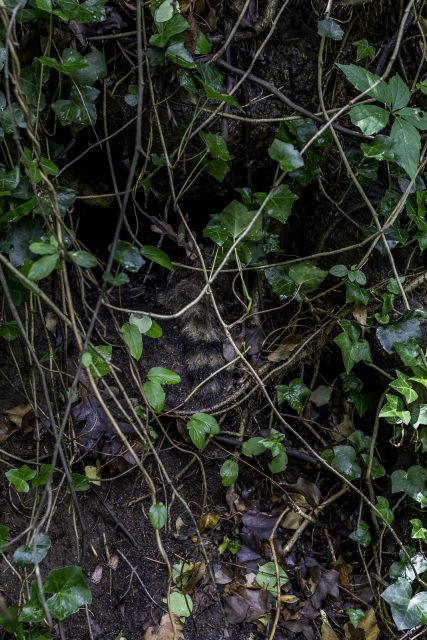
During our exploring, the made a grisly discovery: the raccoon we thought was just inexpertly hiding the other day was in the same spot.

“So it died there?” the Boy asked. “Did it attack something there? What could kill a raccoon?!” He related some video he’d watched in which a farmer explained how raccoons killed some of his chickens. “It would have to be something really big to take down a raccoon!” I could see the wheels turning: he was thinking about what type of enormous preditor could be lurking in that wooded area we explore with seemingly careless abandon.

I suggested that perhaps it was just sick and crawled in there to die.

“Or maybe the snake we saw bit it and that’s where it died,” the Boy intelligently suggested.

That sounds reasonable.

Survival Gear

The Boy is into survival skills. He’s been watching a couple of YouTubers who do survival stuff as their main content. The primitive building of two weeks ago, with plans to build a vast underground bunker complete with swimming pool — forgotten. Completely. Not a word about it.

He used some of his money this week to buy a survival kit.

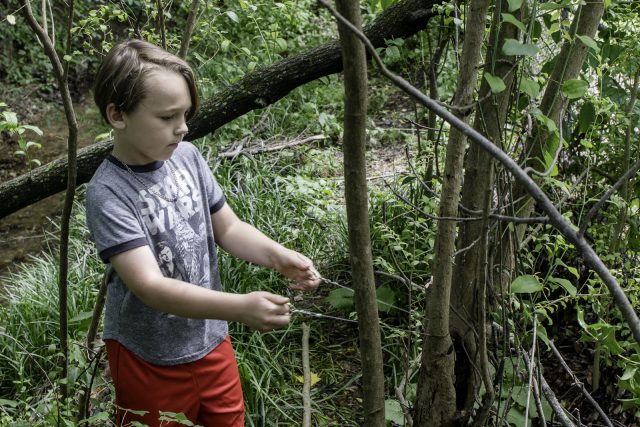
He just had to try out the saw today.

The Comment

A former student shared a video on social media. I watched about 5 minutes of it. Bill Gates and 5G networks are conspiring to spread the virus. I made a comment: “This is just getting ridiculous.”

“Why?” someone asked.

My response was admittedly a bit barbed: “If I have to explain it, there’s no point. You’ve swallowed the conspiracy theory Kool-Aid.”

My former student took me to task:

You wrote something is ridiculous without explaining why, so it’s normal to ask ‘why?’

What did you think was ridiculous? Which one of the statements that this parliamentarian was providing was ridiculous? I know we don’t hear these statements in MSM but I think that it’s better to check all information available before ridiculing anyone. It’s too easy to discredit something just because it sounds ridiculous. There were many things in history that sounded absurd to many and yet with time they proved to be true.

Anyway wherever the truth is, it’s always a good idea to ask questions and there can be nothing and no one that should be unquestionable.

After the comment, I went back to watch the video, only to find it had been flagged by fact-checkers. I simply pointed them to a couple of articles and left it alone.

What I wanted to say:

  • “What did you think was ridiculous?” The whole thing. The idea that someone could possibly take this nonsense seriously.
  • “Which one of the statements that this parliamentarian was providing was ridiculous?” Every single one of them. Each sentence that came out of the woman’s mouth. They’re all demonstrably false and completely illogical.
  • “I know we don’t hear these statements in MSM” — there’s a reason for that: it’s called presenting facts as opposed to obviously false, idiotic statements. It’s like the old joke: there’s a name for alternative medicine that works — medicine.
  • “but I think that it’s better to check all information available before ridiculing anyone.” Point taken. Now, go check the facts.
  • “It’s too easy to discredit something just because it sounds ridiculous.” At least you’re admitting it sounds ridiculous. That’s a start.
  • “There were many things in history that sounded absurd to many and yet with time they proved to be true.” Other than quantum theory, name one.

I should be used to this kind of nonsense now, but I’m not. Nor should I be. It’s normal now but it shouldn’t be.

Day 64: Working, Ending, and Reading

Working and Ending

We’re nearing the end of the year — only a couple of weeks to go. These weeks promise to be anything but typical. For one thing, I’m giving assignments with the understanding, on both sides, that I will provide minimal feedback and that the grade depends more on effort than accuracy. That’s the district policy during our quarantine teaching. It might be the state policy. So some kids do their absolute best, like this analysis of chapter 24 of To Kill a Mockingbird:

Chapter 24 is important because it shows how the town of Maycomb isn’t as “Christian” or as “nice” as they claim to be. For example, Mrs. Farrow Mentions how they can educate them and try to make them Christians but till there will be, “no lady safe in her bed.” The antecedent ambiguity that Mrs. Farrow makes using “them” as in the African Americans shows a sense of judgment she has towards them. Not only that but when she mentions how much they are fighting a losing battle and women still can’t be safe shows the hierarchy these white people have put themselves in showing that no matter what an African American will never be better as a person of white ethnicity. Similarly, Merriweather states how there are some, “Misguided people” in the town who think they were “Doing right”, but all they did was “Stir [them] up.” This second case of antecedent ambiguity this time towards Atticus shows the real hypocrisy of Mrs. Merriweather. Mrs.Maudie backs that up with a remark showing how Mrs. Merrieweather doesn’t feel any ounce of remorse talking trash, but eating Atticus’ food. Showing how really bad Mrs. Merriweather actually is.

Other students don’t turn in anything. Despite calls to parents. Despite emails. Despite encouragement. Despite the constant reminder that this the only time they’ll have to pull in a handful of 100s (nine of them, in fact) for simply doing the work. Just putting forth the most minimal effort. It’s frustrating, not to mention tiring.

The Boy, though, gets no mercy. Just try to skip something, or not do his absolute best — K is on him to get everything done, and when she’s not, I am. Truth be told, though, she’s done the lion’s share of the work with him — probably something like 95% of the work with him even if I’m being generous with myself. I have spent most of that time in the basement, “grading” things, sending emails, planning things, meeting on Google Meet. She has kept him on his toes, kept his nose to the cliche grindstone, which means she’s been keeping her own to the grindstone as well.

I am usually keeping my own students’ noses to the cliche at this time of year, especially the English I students. They’ll soon be writing their letters to next year’s students, and I have to make sure their final impressions of the class will help them create the appropriate first impressions in next year’s classes. They’re usually finishing up Great Expectations or Lord of the Flies at this point in the year. They’re out of breath, academic legs aching, making the last mad dash for the finish, and I’m there cheering them on and behind them whipping them faster, mixing metaphors left and right. The letter is supposed to be completed in one class period. That’s what makes it so impressive to the students next year.

“How would you rate this letter’s organization?” I ask. They usually are moderately impressed.

“How would you rate this letter’s length?” I ask. They usually are moderately impressed.

“How would you rate this letter’s persuasiveness?” I ask. They usually are moderately impressed.

“Last year’s students wrote these letters in one class period. These are, therefore, first drafts.” I pause for effect. Everyone begins looking at each other. “Whose opinion of these letters has risen noticeably?” Every hand — every single one — goes up.

And this year? How can I make sure each student only spends the equivalent of one class period on her letter? In short, I can’t.

Not the end of the world, but frustrating.

Reading

E and I finished Twenty Thousand Leagues Under the Sea last night. After complaining about how he didn’t understand everything for the last couple of weeks, he changed his tune when I realized we wouldn’t find out what happened to Captain Nemo.

“Is there a sequel?”

“I think there is. Or at least he appears in another book,” I say.

“Can we read it?”

No — not now. Enough Jules Verne for now.

Our next book: The Adventures of Tom Sawyer. We begin with a history and culture lesson: I talk to the Boy about the n-word. It appears in the book. There’s no escaping it. He’ll encounter it in one way or another soon enough.

Then we begin reading. I’m hoping he’ll find it amusing. If he doesn’t… well, I guess we’ll have to try something else. But soon enough, he’s laughing:

The summer evenings were long. It was not dark, yet. Presently Tom checked his whistle. A stranger was before him—a boy a shade larger than himself. A new-comer of any age or either sex was an impressive curiosity in the poor little shabby village of St. Petersburg. This boy was well dressed, too—well dressed on a week-day. This was simply astounding. His cap was a dainty thing, his close-buttoned blue cloth roundabout was new and natty, and so were his pantaloons. He had shoes on—and it was only Friday. He even wore a necktie, a bright bit of ribbon. He had a citified air about him that ate into Tom’s vitals. The more Tom stared at the splendid marvel, the higher he turned up his nose at his finery and the shabbier and shabbier his own outfit seemed to him to grow. Neither boy spoke. If one moved, the other moved—but only sidewise, in a circle; they kept face to face and eye to eye all the time. Finally, Tom said:

“I can lick you!”

“I’d like to see you try it.”

“Well, I can do it.”

“No you can’t, either.”

“Yes I can.”

“No you can’t.”

“I can.”

“You can’t.”

“Can!”

“Can’t!”

The Boy is laughing so hard by the time we get here. We reenact the dialogue a number of times, each time to more uproarious laughter. I’m not sure what he finds more amusing: the idea of “whip” meaning “to beat up” or repetition of assertion and denial.

We continue:

An uncomfortable pause. Then Tom said:

“What’s your name?”

“’Tisn’t any of your business, maybe.”

“Well I ’low I’ll make it my business.”

“Well why don’t you?”

“If you say much, I will.”

“Much—much—much. There now.”

The whole “much-much-much” just about doubled him over. It’s what an eight-year-old might do, after all.

After his evening dental hygiene session (what a way to describe an eight-year-old boy brushing his teeth), we embark on chapter two, the most famous of all Twain’s passages: the whitewashing scene.

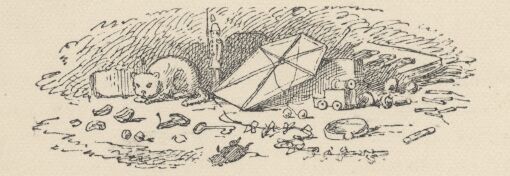
Tom gave up the brush with reluctance in his face, but alacrity in his heart. And while the late steamer Big Missouri worked and sweated in the sun, the retired artist sat on a barrel in the shade close by, dangled his legs, munched his apple, and planned the slaughter of more innocents. There was no lack of material; boys happened along every little while; they came to jeer, but remained to whitewash. By the time Ben was fagged out, Tom had traded the next chance to Billy Fisher for a kite, in good repair; and when he played out, Johnny Miller bought in for a dead rat and a string to swing it with—and so on, and so on, hour after hour. And when the middle of the afternoon came, from being a poor poverty-stricken boy in the morning, Tom was literally rolling in wealth. He had besides the things before mentioned, twelve marbles, part of a jews-harp, a piece of blue bottle-glass to look through, a spool cannon, a key that wouldn’t unlock anything, a fragment of chalk, a glass stopper of a decanter, a tin soldier, a couple of tadpoles, six fire-crackers, a kitten with only one eye, a brass door-knob, a dog-collar—but no dog—the handle of a knife, four pieces of orange-peel, and a dilapidated old window sash.

The idea of “a dead rat and a string to swing it with” was just terribly amusing for the Boy.

As he was drifting off to sleep, he remembered another favorite line — once I explained key vocabulary — and muttered it one last time: “would have bankrupted every boy in the village.”

Day 59: Morning Work Hooks the Companion

Morning Work

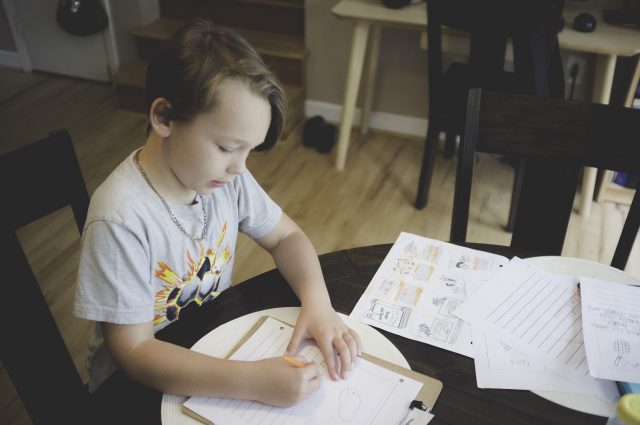
Since I didn’t have much to do for school this morning, I took over the first part of E’s homeschooling adventure. Our first task: to write the first chapter or two of his book about frogs and toads. Six chapters will constitute the final product:

  1. Introduction
  2. Toads
  3. Frogs
  4. Similarities
  5. Differences
  6. Dedication

As we read, I saw the difficulties and frustrations lying ahead: when it would come time to write the book, he might fuss, “Now we’ll have to go back through the text again. We have to read it again!!” So I taught him a little trick as we read that I use with my students.

“As you’re re-reading, highlight facts you might want to rewrite in your own writing. Then put a number beside it to indicate which chapter you’ll use it in. When it comes time to write, then, you’ll just have to look at all the numbers for the chapter you happen to be working on.”

There are two reasons for this: first, it will help him with his writing later. That’s the most obvious way it assists him. Less obvious but more importantly, it helps him develop skills as a critical, analytic reader. My own students often have difficulty reading because they’re not reading for a particular reason. Giving kids a purpose as they read gives them a goal and a metric to measure comprehension and success.

As we read, E grew more confident about the whole process; as he began writing the first chapters, he realized the sense behind it all. That might lead to a little less fussing as he continues to work on the piece.

Hook

Mr. F, our neighbor, is a keen fisherman. He’s got a boat, countless rods and reels, and multiple tackle boxes filled with endless lures and hooks. Heading out to the lake regularly, he often comes home with enough fish for his family and some neighbors: he’s given us many, many pounds of fish over the year. He’s the type of fisherman that, as regards fishing equipment, if he doesn’t have it, it probably doesn’t exist.

The Boy often goes over to help Mr. F. He’s something of a third grandfather to E, which makes him really like a second grandfather since Dziadek passed before E was a year old and E knows him only from pictures.

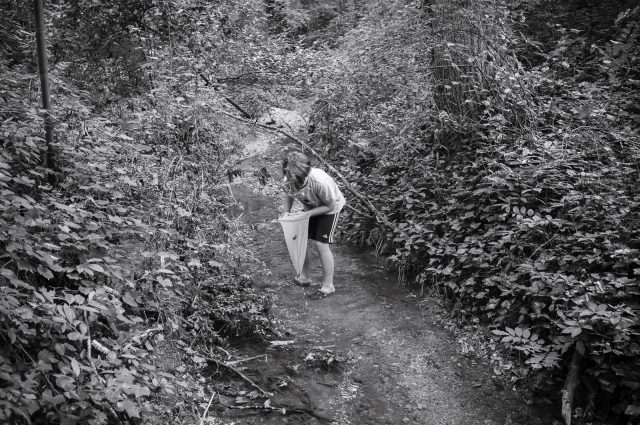
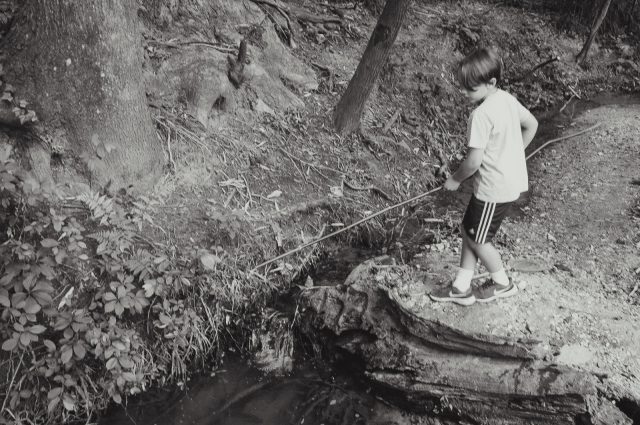
When E and I discovered in the creek that runs behind our house a couple of pools that are deep enough for larger minnows -- some looking to be three or more inches long, maybe even four inches long -- I commented that they’re almost big enough actually to use a hook and bait. Recalling the little minnows we caught in Lake Jocassee with just a line, a hook, and some bread, I suggested that we could use a bamboo cane and make a real, old-fashioned playin’-hooky-to-go-fishin’ cane fishing pole.

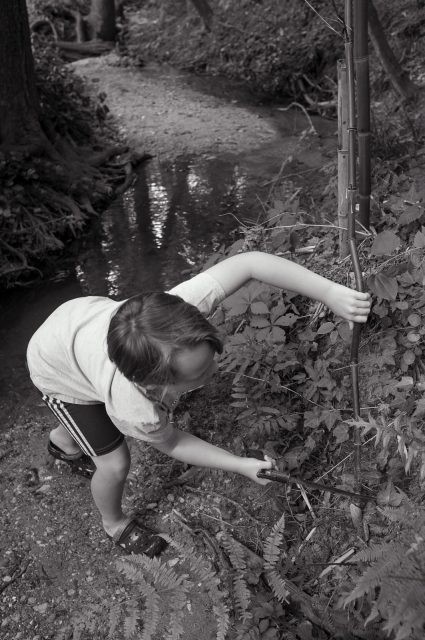
After we were both done with school, we headed down, saw and net in hand. “I still want to try to net some minnow,” he explained. We found an adequately small cane and cut it after a bit of unsuccessfully netting attempts.

“Now we just need the line and a hook,” the Boy said as we headed back, adding as a sad afterthought, “but we don’t have any.”

“Why not ask Mr. F?” I suggested.

“Oh yeah!”

Then the real question as far as I was concerned: with Mr. F not out, he would have to go knock on the neighbors’ door, and I decided it was something he was going to have to do by himself. Would he do it?

“Just go knock on their door,” I said after he protested that Mr. F wasn’t outside at that moment.

“What if Mrs. P answers the door?”

“Just tell her that you have a favor to ask of Mr. F.”

He paused in thought. “Okay.”

When he came back, the Girl had joined us and was snooping about to figure out what was up. I explained. “Oh.” No protests about how awfully cruel it would be to catch a minnow with a hook. “With a hook!? Jabbed in its mouth?!” I could just hear her indignantly and incredulously asking.

When the Boy headed down for some fishing, I suggested that L might want to go with him. “Don’t let her talk you into letting her have the first turn because she will try to bamboozle you,” I warned.

He headed down by himself, though. I thought for a while that I should go with him at least to memorialize the moment photographically. Then I thought better of it: he needs some independence, and since he didn’t even ask me (with the explanation of being scared or worried about this or that) to go with him, I stayed behind.

He came back up a few minutes later, a scowl on his face as he stomped up the hill.

“Guess what?” he began, not waiting for a response. “I had one or two good tries and then the hook got stuck. When I tried to pull it out, the hook came off!” He plopped in a chair. “Now I can’t fish at all today!”

“Sounds like we might need to go get our own hooks,” I suggested.

More incredulity: “At the store?!” E is the most worried about cornavirus in our family. I think he’s convinced, despite our efforts to explain everything, that one can just get it, that it just lurks in the air waiting for unsuspecting victims.

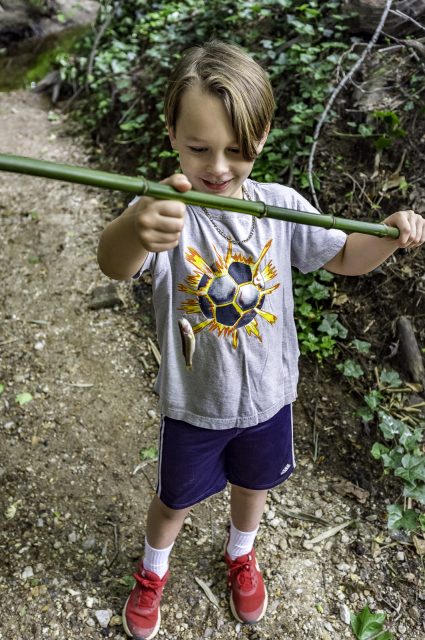
In the end, we didn't have to go get more hooks: the Boy remembered he had one small hook still on his fishing pole, so we cut it off and tied it onto the cane pole. We took some bread from a dinner roll we had, rolled it back into dough, and put it on the hook.

Soon enough, we had a minnow.

But our catch-and-release plan was thwarted by the difficulty of removing a hook from such a small fish. In the end, something terribly traumatic happened to the poor fish as we were removing the hook, and it went belly up immediately upon release.

The Companion

Clover has become a companion dog. She doesn’t wander around, looking to find what she can get into. She doesn’t sneak off to try to get on the couch. She doesn’t (always) go off searching for a toy. She plops down next to someone and just relaxes. When we’re outside and L is, for instance, in our fort reading and Papa is on the deck listening to music (he’s become a real Spotify fiend), the pup moves from person to person, spending a little time by my side, a little time by Papa’s side, and a little time with L.

Another sign that she’s no longer a puppy.

Then she goes over to the fence just to antagonize the neighbors’ dog, so many not so much...

Convenient cane pole storage system

Day 57: Math, Mowing, Painting, and the Missionary Society

Math

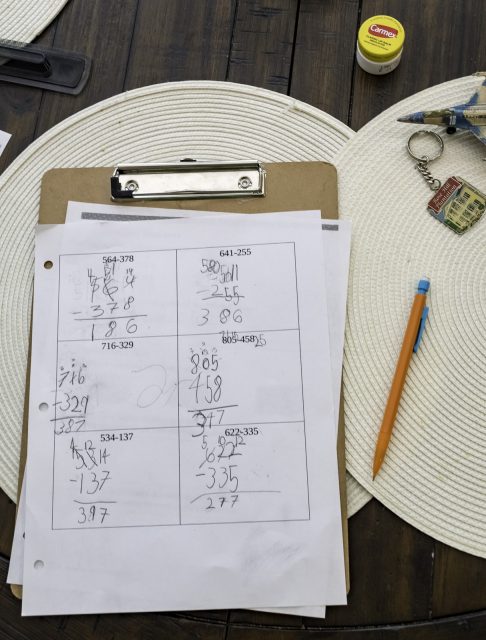
The Boy was having trouble this morning with three-digit subtraction, things like 352-178. He was thinking a little too much, mixing prior knowledge with current practice. For example, in the number above, he would know he had to borrow a 10 from the 10s place in order to subtract 8 properly, but then that would leave him with 4. Instead of writing 4 above the crossed-out 5, he wrote 40. Which is technically correct. But the be was subtracting 7 from 40 and coming up with 33, and before long, he was subtracting one three-digit number from another three-digit number and coming up with a six-digit answer.

I remember the frustration of borrowing numbers in subtraction. I, too, experienced it in second grade: I just couldn't figure out how those numbers were shifting around, 5 becoming 4 so I could subtract something from the 1s place. Everyone tried explaining it to me: my teacher, mom, dad, the girl who babysat me from time to time. It just didn't make any sense to me no matter how often and how many different ways it was explained.

So I understood the Boy's frustration this morning. I sat with him a while, taking a break from my own work, and tried to help him through it.

"Yes, but Daddy, that's the 10s place, so it's not just 4, it's 40."

"Technically, you're correct, but..."

"What do you mean 'technically'? What does that even mean?!"

It was another moment that I found myself in awe of elementary school teachers. I don't teach many new skills: I mainly take existing skills and improve them. The kids can write when they come to me; I just help them write better. They can read when they come to me; I just give them tricks for comprehending more challenging texts: things like "make sure you keep track of your pronouns' antecedents -- you need to know who 'he' is when the author uses that pronoun," or "determine the part of speech of that unknown word -- that will help you a lot in inferring a possible meaning." But just taking a kid who doesn't know at all how to read and turning her into a reader? I haven't got the slightest clue how to do that. I know it's just a matter of training: I minored in education in college, but in secondary education -- not primary. An entirely different field of study.

Still, having experienced that frustration myself, I had a certain patience and understanding of his frustration.

This is why some feel that teachers who teach subjects they were always good at isn't as effective as alternatives. We -- for I was always good at literature and decent at writing -- know how to do these skills seemingly instinctively. It's hard to teach someone how to do something that you can do, relative to the struggling student, without thinking. It's better to teach something that you yourself have struggled with, goes the thinking. But the problem with that: where's the passion? I don't teach English just because I want to teach and happened to choose English. I teach it because I myself enjoy writing; I teach it because I love reading. I teach it because I have a certain excitement about certain books, certain poems, even certain reading skills that I love to share with students. I struggled with math, and the only passion I feel about it is a certain kind of revulsion.

Mowing and Painting

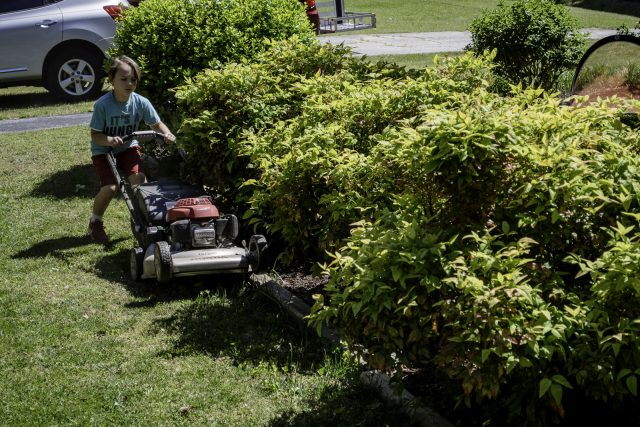
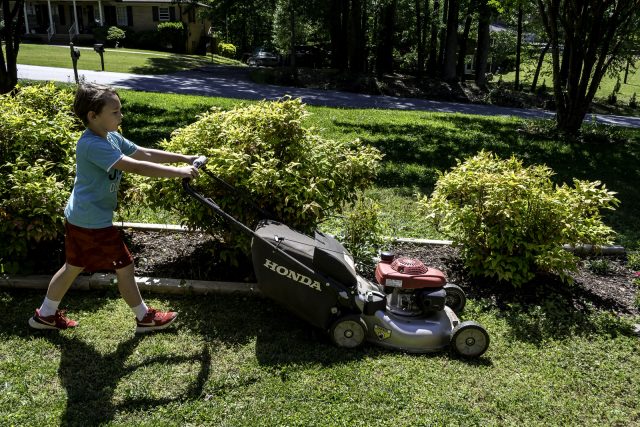
The Boy loves working in the yard. We bought a battery-powered weed eater just so he could help (which is now out of trim line, which we don't have). Today, after scolding me a little bit about still not having the right line, he asked if he could help mow.

When we first started doing this, I would let him do the little flat, straight portion in the front yard just between the flower bed and the crape myrtles. Today, I let him tackle some of the more challenging areas.

"Make sure you keep the line of uncut grass just on the inside edge of your outside wheel," I explained, demonstrating just what I meant.

He tried, poor fellow, but he just couldn't stop drifting inward, leaving slivers of uncut grass with every row.

Still, I can't help but be pleased that he's still willing to help. At some point, the job will be his entirely.

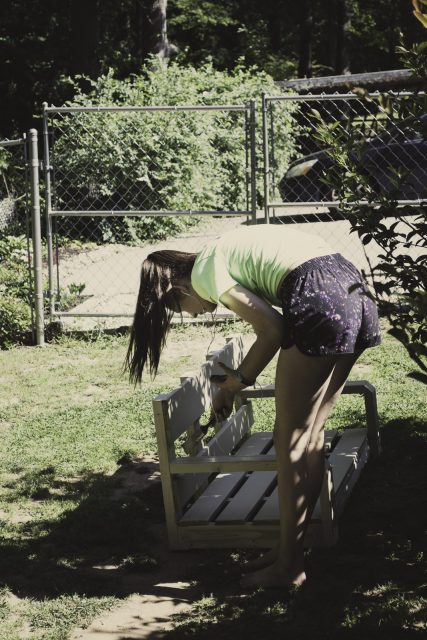
The Girl finished up the afternoon with a little more painting: the swing I'd started Saturday for K's Mother's Day gift is nearing completion.

The Missionary Society Meeting

It's always a chapter that confuses students: the 24th chapter in To Kill a Mockingbird feels like someone took a chapter out of a completely different novel, changed a few names to match a few characters' names in Mockingbird, and just slipped it into the stream of the story. The only connection it seems to have with the rest of the book is the news of the death of Tom Robinson toward the end of the chapter. I contend that in many ways it's one of the most important chapters in the book as it fully develops one of the book's major themes: the hypocrisy of Southern white Christians.

Most of the chapter centers around Aunt Alexandra's hosting the Maycomb Alabama Methodist Episcopal Church South Missionary Society meeting. Scout attends as "a part of [Alexandra's] campaign to teach [Scout] to be a lady." Poor Scout is lost from the beginning: she asks about what they studied and gets confused immediately:

“Oh child, those poor Mrunas,” [Mrs. Merriweather] said, and was off. Few other questions would be necessary.

Mrs. Merriweather’s large brown eyes always filled with tears when she considered the oppressed. “Living in that jungle with nobody but J. Grimes Everett,” she said. “Not a white person’ll go near ‘em but that saintly J. Grimes Everett.”

Mrs. Merriweather played her voice like an organ; every word she said received its full measure: “The poverty... the darkness... the immorality—nobody but J. Grimes Everett knows. You know, when the church gave me that trip to the camp grounds J. Grimes Everett said to me—”

“Was he there, ma’am? I thought—”

“Home on leave. J. Grimes Everett said to me, he said, ‘Mrs. Merriweather, you have no conception, no conception of what we are fighting over there.’ That’s what he said to me.”

“Yes ma’am.”

“I said to him, ‘Mr. Everett,’ I said, ‘the ladies of the Maycomb Alabama Methodist Episcopal Church South are behind you one hundred percent.’ That’s what I said to him. And you know, right then and there I made a pledge in my heart. I said to myself, when I go home I’m going to give a course on the Mrunas and bring J. Grimes Everett’s message to Maycomb and that’s just what I’m doing.”

A skilled reader with a moderate amount of background knowledge immediately understands: this J. Grimes Everett is a missionary to the Mrunas, who, in turn, are clearly an African tribe ("Not a white person’ll go near ‘em but that saintly J. Grimes Everett").

The reason the author includes the Mrunas is clear only toward the end of the missionary society meeting, when Mrs. Merriweather begins talking about Atticus's decision to represent Tom:

Mrs. Merriweather nodded wisely. Her voice soared over the clink of coffee cups and the soft bovine sounds of the ladies munching their dainties. “Gertrude,” she said, “I tell you there are some good but misguided people in this town. Good, but misguided. Folks in this town who think they’re doing right, I mean. Now far be it from me to say who, but some of ‘em in this town thought they were doing the right thing a while back, but all they did was stir ’em up. That’s all they did. Might’ve looked like the right thing to do at the time, I’m sure I don’t know, I’m not read in that field, but sulky... dissatisfied... I tell you if my Sophy’d kept it up another day I’d have let her go. It’s never entered that wool of hers that the only reason I keep her is because this depression’s on and she needs her dollar and a quarter every week she can get it.”

“His food doesn’t stick going down, does it?”

Miss Maudie said it. Two tight lines had appeared at the corners of her mouth. She had been sitting silently beside me, her coffee cup balanced on one knee. I had lost the thread of conversation long ago, when they quit talking about Tom Robinson’s wife, and had contented myself with thinking of Finch’s Landing and the river. Aunt Alexandra had got it backwards: the business part of the meeting was blood-curdling, the social hour was dreary.

“Maudie, I’m sure I don’t know what you mean,” said Mrs. Merriweather.

“I’m sure you do,” Miss Maudie said shortly.

Yet this is where students really get lost. In typical Southern gentile fashion, Mrs. Merriweather won't deign to gossip about anyone -- how uncivilized -- so she simply makes talks about Atticus in the third-person plural. And everyone in the room knows exactly who she's talking about -- everyone but Scout. And our young readers.

Today, my English I students started the adventure of figuring out this marvelous chapter. I always read the relevant passage aloud in class. It's one of the most enjoyable things I do all year. I lay on the Southern accent, dropping final rs ("squalor" becomes "squala") and altering the cadence and tone of my reading. How to do that when in lock-down? Simple: record it. My favorite part -- that passage above.

Day 53: Changes

Schedule

A couple of weeks ago, I got an email from my principal. It read, in part,

We are working on the schedule for next year, and I wanted to run something by you. In an effort to simplify people’s assignments and avoid teachers having 3 preps, we are looking at the possibility of you teaching all of the English 1 sections. [...] My one hesitation is that 4 sections of E1H is a lot for one person. A lot to grade and be responsible for.

English I Honors is indeed a handful. Each class is about 30 students usually, and whereas 60-65% of students in English 8 turn in a given assignment, it's something like 90% in English I. Many English 8 students often have issues with time management and apathy, so it's rare for a student in those classes to turn in all assignments in a given quarter. English I is exactly the opposite thought: it's rare to have more than two or three students in a given class not turn in a given assignment.

Another element adding to the E1 workload is the simple fact that, compared to English 8, it's two classes combined into one: reading and writing are separated into two classes for English 8, and I have always taught the reading/literature portion. English I isn't, so I have to teach both, which means a lot of writing to assess.

So I was hesitant to accept such an offer. At the same time the idea of working with students who have almost no serious behavior problems, who are all working hard most of the time, who all see the value of education, is pretty hard to resist.

My other concern was regarding the fact that having all the English 1 classes would mean Mrs. H, the other English I teacher, would have none. I knew how she enjoyed teaching that class, and if the tables were turned, I would not want to give up English 1 even for the tempting offer of having only one prep. I expressed my concerns to the principal, and he, in turn, discussed those concerns with Mrs. H. It turned out that for her, the thought of having only one prep was indeed enticing enough to give up English I. In fact, she was somewhat worried about the workload that I would be facing, and she emailed me about those concerns. Receiving this email and having assurances from my principal that Mrs. H would not feel as if I were somehow taking these classes away from her (because that's how I felt: if I to take these classes, that means she loses them, and I can always say no), I agreed to take the 4 English I classes.

Yesterday the official master schedule for the 2020-2021 school year was released.

And there I am back-to-back-to-back-to-back English 1 classes.

I'm happy about this for a number of reasons, not the least of which that I will have very few behavior issues to deal with. It's also a great joy to work with students of actually do want to learn and you actually do put forth their best effort on a consistent basis.

On the other hand, working with a class that includes a significant number of at-risk students has its own rewards. I often feel I have the opportunity to teach them even more important skills like anger management, delayed gratification, empathy, impulse control, and appropriate self-efficacy.

The change will be significant. The increased workload will be noticeable. The rewards? Well, it is indeed a trade-off.

The Fort

L decided today that she wanted to get involved in the fort.

"You guys did the hardest part," she said, "But still -- I want to help."

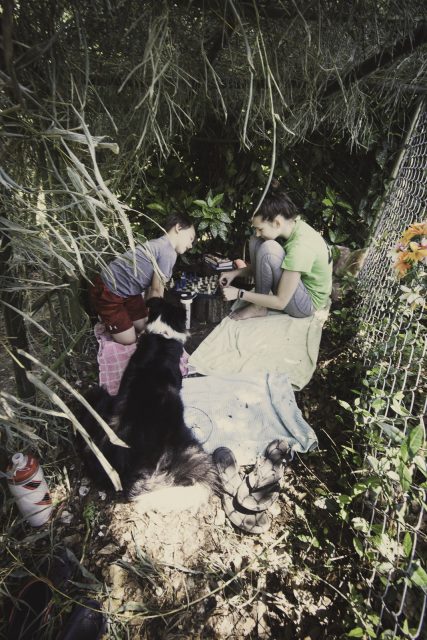
She brought an interior design eye to the project, bringing ground covering (old towels), decorations (old silk flowers), entertainment (books, a chess board, and more), and snacks.

Day 51: Seeing Anew

Atticus Finch -- what a hero. What a fantastic lawyer. That's what we all walk away thinking the first time we read To Kill a Mockingbird. We read his cross-examination of Bob and Mayella Ewell and think, "He did a really good job establishing Tom's innocence," and can't understand how Tom could be found guilty-- though we can understand it because it's Depression-era Alabama.

The state has not produced one iota of medical evidence to the effect that the crime Tom Robinson is charged with ever took place. It has relied instead upon the testimony of two witnesses whose evidence has not only been called into serious question on cross-examination, but has been flatly contradicted by the defendant.

Nailed it -- keep hammering on the fact that no doctor was called, Atticus.

She was white, and she tempted a Negro. She did something that in our society is unspeakable: she kissed a black man. Not an old Uncle, but a strong young Negro man. No code mattered to her before she broke it, but it came crashing down on her afterwards.

Her father saw it, and the defendant has testified as to his remarks. What did her father do? We don’t know, but there is circumstantial evidence to indicate that Mayella Ewell was beaten savagely by someone who led almost exclusively with his left. We do know in part what Mr. Ewell did: he did what any God-fearing, persevering, respectable white man would do under the circumstances—he swore out a warrant, no doubt signing it with his left hand, and Tom Robinson now sits before you, having taken the oath with the only good hand he possesses—his right hand.

There it is -- that brilliant evidence that someone lefthanded inflicted the bruises on the right side of Mayella's face. Tom's left arm was mangled in a cotton gin when he was young -- he couldn't have done it. Case closed.

And then that impassioned closing:

Thomas Jefferson once said that all men are created equal, a phrase that the Yankees and the distaff side of the Executive branch in Washington are fond of hurling at us. There is a tendency in this year of grace, 1935, for certain people to use this phrase out of context, to satisfy all conditions. The most ridiculous example I can think of is that the people who run public education promote the stupid and idle along with the industrious—because all men are created equal, educators will gravely tell you, the children left behind suffer terrible feelings of inferiority. We know all men are not created equal in the sense some people would have us believe—some people are smarter than others, some people have more opportunity because they’re born with it, some men make more money than others, some ladies make better cakes than others—some people are born gifted beyond the normal scope of most men.

But there is one way in this country in which all men are created equal—there is one human institution that makes a pauper the equal of a Rockefeller, the stupid man the equal of an Einstein, and the ignorant man the equal of any college president. That institution, gentlemen, is a court. It can be the Supreme Court of the United States or the humblest J.P. court in the land, or this honorable court which you serve. Our courts have their faults, as does any human institution, but in this country our courts are the great levelers, and in our courts all men are created equal.

I’m no idealist to believe firmly in the integrity of our courts and in the jury system—that is no ideal to me, it is a living, working reality. Gentlemen, a court is no better than each man of you sitting before me on this jury. A court is only as sound as its jury, and a jury is only as sound as the men who make it up. I am confident that you gentlemen will review without passion the evidence you have heard, come to a decision, and restore this defendant to his family. In the name of God, do your duty.

What a perfect defense! What insight! What an amazing job defending a man in a hopeless situation!

That's what we think when we're not lawyers, though. But what about a trial lawyer who's had twenty years' experience in the courtroom? Someone who's represented defendants against charges of rape and murder?

During the 2018/2019 school year

Every year, as the kids finish up Mockingbird, I have Jim Bannister, a local defense attorney, come in and walk the kids through the details of the trial and evidence. He's been doing this presentation for some years, ever since a friend's daughter read the book. The friend asked him what he thought of Atticus's defense and, not having read the book since middle school, Bannister reread the chapters dealing with the trial.

"I would have handled things a little differently," he remarked. "To be fair," he's always added when talking to the kids, "Atticus seems to be a tax and/or estate lawyer, so he was not in his area of specialization at all." Still, he helps the kids see the mountains of evidence that Atticus could have brought into the trial that doesn't even get a mention.

The most damning evidence does appear in the book, but Atticus doesn't push it hard enough: no doctor was ever called.  This means there's no evidence that the crime even took place. But there's so much more than that.

What about clothing the accused and supposed victim were wearing? How could Tom, who's left arm is all but useless, hold down Mayella as she claimed, take off his clothes, take off her clothes, and rape her while using only one arm? It doesn't make sense -- it's physically impossible.

What about defensive wounds on Tom? Mayella said she fought him "tooth and nail." There should have been scratches all over Tom's face.

What about the window through which Bob says he saw the rape in progress? Earlier in the book, the Ewell house is described and we discover that there's cheesecloth over the windows instead of glass panes. How clean was that cheesecloth? How much could Bob actually see?

And if his daughter was being raped and all that stood between him and the rapist was a bit of cheesecloth over a window no more than three feet above the ground, why didn't he dive through the window and attack Tom? Instead, he claims he witnesses the rape in the front room and runs around the entire shotgun house and enters through the back door.

All these were failures on the part of Heck Tate, the sheriff, who did absolutely no investigation at all. "I would tear him apart on the stand," Bannister laughs.

For me, though, the most jaw-dropping piece of evidence was a little gem hidden in Tom's account of the event.

"Mr. Finch, I was wonderin’ why it was so quiet like, an‘ it come to me that there weren’t a chile on the place, not a one of ’em, and I said Miss Mayella, where the chillun?”

Tom’s black velvet skin had begun to shine, and he ran his hand over his face.

“I say where the chillun?” he continued, “an‘ she says—she was laughin’, sort of—she says they all gone to town to get ice creams. She says, ‘took me a slap year to save seb’m nickels, but I done it. They all gone to town.’”

Tom’s discomfort was not from the humidity. “What did you say then, Tom?” asked Atticus.

“I said somethin‘ like, why Miss Mayella, that’s right smart o’you to treat ’em. An‘ she said, ’You think so?‘ I don’t think she understood what I was thinkin’—I meant it was smart of her to save like that, an‘ nice of her to treat em.”

Why in the world didn't Atticus call to the stand that ice cream salesman?! Everybody in the town knows the Ewells; everyone knows how poor they are. To see all seven of them come traipsing up with nickels in hand to buy ice cream would have been a once-in-a-lifetime, always-remember-it moment.

So he comes every year to lead students through these pieces of evidence, suggesting at the outset that they pretend like he's the lead attorney and they are his paralegals, investigators, and co-attorneys. "Let's see if we can't put together a better defense for Tom Robinson."

Except he couldn't come this year for all the obvious reasons. Yet when I asked him if he'd be willing to give it a shot on Google Meet, he didn't hesitate: "What dates are we looking at?"

And so he sat in his study and led several of my students through a discussion via Google Meet, and my eighth-grade vice principal (well, she will be next year after our current, much-loved vice principal retires) popped in eagerly when I told her what we were planning.

Despite the frustration of the lockdown, it was a good day to be a teacher.

The Day's Adventures

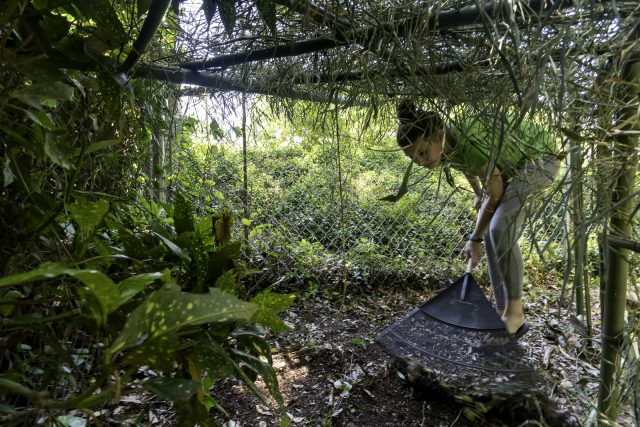
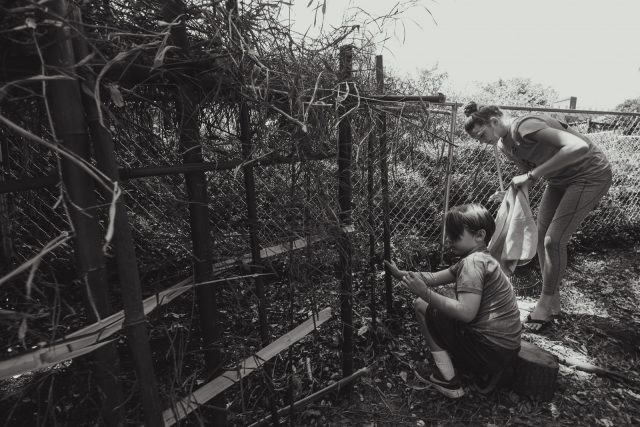
The Boy has wanted to build a bamboo structure of some sort for some time now. He had in his mind a large and grand structure, perhaps with a swimming pool beside it and a diving platform coming out of the second story.

Heading down to play in the creek after "school"

Today, I suggested a little more modest structure: "We could simply use the corner of our fence and Mr. F's fence and build it there.

Looking for minnows

And so we went out into the stand of bamboo growing in Mr. F's back yard (more or less -- not really sure of property lines there) and took a few canes.

Dew-laden web, photo by the Girl

We stripped off the small branches on which grow the leaves, cut them to length,

dug a few holes, and we had our basic frame. A little more work and we had a functional structure.

A good day to be a dad.

Day 46: Snakes, Dogs, and Balls

Some years ago, there was a little flu epidemic here in the upstate. I'd forgotten all about it until I read the entry from the "Time Machine" widget at the bottom of the page.

I wrote,

Students come running into the classroom, desperate not to touch anything but the bottles of hand sanitizer that they’re most eagerly sharing amongst themselves. They sit down and put their hands in the air as if they’re being held up at gun point. They open doors with their feet and they laughingly refuse to touch the copies of Much Ado About Nothing we’ve been using in class.

A quick look around the room confirms my suspicions: I won’t be able to accomplish anything without dealing with this first.

That was 11 years ago now, and it seems so insignificant compared to what we're living now. Our flu outbreak affected a small part of the state; this viral reality is affecting the entire world. Magnify something and its significance seems often to increase exponentially like the curve of new cases in many places. That curve seems to have reached its summit in some areas. Everyone seems eager for that to be the reality, though. Do we have the maturity and self-control needed to keep the curve from turning back upwards again? I don't know.

Looking for the snake E and our neighbor saw

I know the kids have simply settled into the new rhythm and joke about it. The Girl is having an easier time than the Boy in some ways because she's in more constant contact with her friends through Facetime -- they sometimes just leave it on while they're doing other things, as if to have a companion near.

The Boy gets to see his friends daily with their whole-class Google Meet. (An aside: It's amazing the difference between elementary students and middle school students when it comes to these online meetings. When E's class meets, almost everyone is there; when my classes meet, almost no one is there. I suppose there's more parental involvement in the younger children's lives.) Still, that's hardly a substitute for their usual day together, which includes a bit of down-time to talk and of course recess.

Another entry from the nostalgia widget:

I wrote,

My reaction over the years has changed. In the past, I was just trying to survive at this point in the year. Perhaps that was because of a lack of clear and clear-headed goals for students; maybe that was a result of my inexperience and ineffectiveness; possibly that was because I had some exceptionally challenging students. Or perhaps it was all that and more. At any rate, I find myself eager, after a short break, to begin again. A sufficient “short break” in this case would be about three weeks or so, but I’m fortunate that we get about four times that.

That short break I was referring to was a hypothetical three-week summer break before getting back to school. I was suggesting that perhaps the whole summer is necessary. Indeed, it's a luxury. But now -- we'll have a break from mid-March until mid-August, and even then, I doubt we'll get back to normal.

In the end, "normal" will have to shift. Our state superintendent is already talking about possibly going to school in shifts to maintain an appropriate distance. I'm assuming that would mean dividing the eighth-grade student body in half: group A goes Monday and Wednesday and group B goes Tuesday and Thursday. Friday? Who knows. Who knows anything at this point. It's odd that the longer this stretches out, the more the uncertainty in some sense.

Day 23: Conferencing and Apologizing

Conferencing

We had a chat in English I today about the mad dog scene.

I was helping the kids see the significance of this seemingly out-of-nowhere scene. Students’ reaction to the chapter was fairly unified:

S1: It opened up a lot of questions to me about Atticus; what was his past life? How did he have the knowledge to shoot, and how did he shoot so well?

S2: I was in shock, mostly because of how I was pondering it’s relevance to the book. The act it’s self didn’t perturb me but it did show how close the community is.

Once I got the kids to see that the scene is there to set up one way that Atticus has, contrary to his children’s view, hero qualities in the traditional sense (read: macho sense), we’re ready for them to understand why he kept it under wraps for so long. (The Mrs. Dubose scene is critical for that.)

At the end of the conversation, one student asked me about our dog. (When experimenting with Flipgrid, I made a video for the kids, and in it, I showed them our dog.) There was a bit of a misunderstanding in our conversation today, though:

S1: How’s your dog?

Mr. Scott: She’s in heaven

S1: Wait, did she die???

Mr. Scott: She’s never had so much attention or gone on so many walks

S1: OH

S2: I was worried.

S3: I thought she died too-

S4: O I thought you meant she died

It struck me as odd that they thought I might use a phrase like “She’s in heaven” to tell them the dog had died.

Apologizing

We go on a walk just about every single evening these days, and when we come back, if we have time, the kids want to play a game. Monopoly has held a monopoly lately, but today, the Girl talked E into trying Sorry again.

She was probably sorry she did.

E jumped into the lead and before almost any of us had more than one pawn in the “Home” circle, he had three. And his remaining pawn was stuck at “Start.” Forever. And ever. So long that we all caught up to him.

I have to admit, I was really rooting for him. When I drew I “One,” which would have allowed him to start moving, I wished I could slip it back in the deck for him. He’s so frustrated with board games because he never seems to win.

I wasn’t exactly helping L, though. I Sorry’ed her a couple of times, and at least once, when I drew the “Move forward ten or back one” card, I moved back one just to knock her back to start. Part of it was to see how she dealt with frustration. She did admirably well — that girl is growing up. (Slowly, but I guess we wouldn’t have it any other way. Well, about most aspects.)

The game kept going until it was a four-way tie: all four of us had three of our four pawns in the “Home” circle and the other pawn three or four moves away from victory. K stole the win from E, which is fair in a sense: in Monopoly, we’ve taken to calling her “slum lord” because of her property choices and indebtedness. She deserved a win. (Though she did come out fairly strong on the last time we played Monopoly…)

“Can we play for second?” L asked.

I somehow managed to get second place, which I really didn’t want. Again, hoping for the Boy to get a little bit of an upset.

“Can we play for third?” the Girl asked.

And the Boy swooped in to steal third.

Day 16: Uncertainty and Certainty — Random Thoughts

I am no longer certain about anything regarding school. We've been out for almost three weeks now and we have another three to go, but the rates of infection here in South Carolina are not decreasing. I, and many of my students, suspect and fear that we won't be heading back this year. But we could be wrong; I hope we're wrong.

I am no longer certain about Papa's condition. Something neurological seems to be going on, and with COVID-19 pillaging our country right now, it throws the whole medical community into comparative chaos. It's not a simple matter getting an appointment with a doctor anymore.

I'm no longer certain I want to update this daily. It's been my longest streak: over 100 consecutive days at this point, stretching back to December 22. I've been doing it more out of a sense of stubbornness than anything else. "I've made it a month: might as well try to make it two." "I've made it two months: might as well try to make it three." And to what end? And if I do continue, to what loss? A few minutes' time every night to make a record for -- for whom? I don't even think it matters.

I am certain about the value of the increased time we've been spending together. Being it home makes schooling both easier and more challenging, but we're spending more time together as a result of everything being shut down -- nightly walks, movie nights (tonight, Hugo -- E loved it; L claimed it was boring but still demanded we pause it when she went to the restroom), evening games of Monopoly, afternoons spent in the backyard messing around.

Day 12: The Project

The Boy's teacher was ambitious: a project during their time out of school. "Design your own island." The Boy came up with Ice Cream Island, with volcanos that spew ice cream, a chocolate lake, and a whipped cream waterfall...

The Girl let him use her paints with the understanding that she could help.