matching tracksuits

fun in threes, sometimes fours

education and teaching

Remembering and Forgetting

Yesterday, we went over a new poem: Billy Collins’s “Forgetfulness.”

The name of the author is the first to go
followed obediently by the title, the plot,
the heartbreaking conclusion, the entire novel
which suddenly becomes one you have never read, never even heard of,

as if, one by one, the memories you used to harbor
decided to retire to the southern hemisphere of the brain,
to a little fishing village where there are no phones.

Long ago you kissed the names of the nine muses goodbye
and watched the quadratic equation pack its bag,
and even now as you memorize the order of the planets,

something else is slipping away, a state flower perhaps,
the address of an uncle, the capital of Paraguay.

Whatever it is you are struggling to remember,
it is not poised on the tip of your tongue
or even lurking in some obscure corner of your spleen.

It has floated away down a dark mythological river
whose name begins with an L as far as you can recall
well on your own way to oblivion where you will join those
who have even forgotten how to swim and how to ride a bicycle.

No wonder you rise in the middle of the night
to look up the date of a famous battle in a book on war.
No wonder the moon in the window seems to have drifted
out of a love poem that you used to know by heart.

Collins is famous for poems in which a witty, whimsical tone belies a deeper, subtler idea. He’s perfect for teaching kids what I call the two levels of poetry: what’s happening in the poem and what the poem is about. His work also often shows a clear tonal shift, and that’s something I want my students to be able to sense.

Yet eighth-grade students often miss the whimsy in his poems. They read something like this without cracking a smile. They even watch an animated version of it without reaction:

So we have to walk through it carefully.

This year, I started by focusing on the fifth stanza:

Whatever it is you are struggling to remember,
it is not poised on the tip of your tongue
or even lurking in some obscure corner of your spleen.

“Everyone has heard the phrase ‘it’s on the tip of your tongue,’ right?” I asked. Of course they had. But I had to lead them into “lurking in some obscure corner of your spleen.” We mapped it out:

  • “poised” turns into “lurking”
  • “tip” transmutes into “some obscure corner”
  • “tongue” becomes “spleen”

“Have you ever heard anyone say some memory is ‘lurking in the corner of my spleen’?” I asked. And everyone laughed. “That’s what the poet was getting at!”

Once they got it, they saw the other instances of whimsy in the poem:

  • We talked about the idea of “the memories you used to harbor” deciding to “retire to the southern hemisphere of the brain, / to a little fishing village where there are no phones.” “Look at all that absurd detail!”
  • We visualized kissing “the names of the nine muses goodbye” — “I’m going to miss you so much! What will life be like without you!?”
  • We imagined seeing “the quadratic equation pack its bag.” “It’s over, do you hear!? I saw you last week in the park with that pythagorean theorem!”
  • We saw the drama build up with the line “It has floated away down a dark mythological river” only to fizzle out pathetically with “whose name begins with an L as far as you can recall.”

It’s not the first time students have struggled to see the humor in Collins’s poetry. When we do “The Lanyard” next week, the same thing will happen. I’ve come to the conclusion that it’s an age thing: that type of whimsy just goes right over their inexperienced heads.

Late October

Written a couple of years ago but still true

It's late October. The first quarter is drawing to a close, and students sit wading through district-mandated benchmark tests. Despite this, its one of my favorite periods of the school year. The honeymoon period is over, and we're up to our noses in work that occasionally seems like it might sweep over us all. The kids are getting comfortable with the demands of an honors course, and we've all settled in for several months of work. But more than that, more personal, when I look out over the class, the students are now not just faces to which I'm trying to attach names; when I scroll down the roll at the start of each class, the names are not just sitting there waiting for me to combine with a face.

They've emerged as this amalgamation of worry and laughter, of procrastination and focus, of silliness and maturity -- everything that makes thirteen-year-olds and fourteen-year-olds thirteen-year-olds and fourteen-year-olds. They're still kids but in bodies that are nearly fully developed, and the awkwardness that implies radiates from every smile of accomplishment and glistens from every tear of frustration that accompanies the eighth grade. Their brains, developing in new and unexpected ways, are awash in a warm flood of newly-released hormones. They realize they're not adults yet but in some sense are convinced they are. They've become people that I think I might actually have quite warm feelings toward instead of just a list of names an administrator has handed me.

I look around the classroom and see faces behind which are entire universes of experiences, worries, excitements, concerns, joys, and doubts. Each face is a mixture of all these things and more.

I see B, who's new to public school and worried the effect her shyness and lack of experience might have on making friends but who is, nonetheless, making friends because she is a genuinely good soul and everyone sees that. I glance over at J, sitting with his head down, a child I suspect is just on the edge of the autism spectrum, who seems just enough aware of his social awkwardness to be annoyed but not defeated by it. H sits in front of the class, a teacher's dream in so many ways: quick, bright, kind, helpful, she would probably be accused of being a teacher's pet if it weren't so obvious that she does these things because it's just the person she is. In the corner desk is D, who has a mouth that seems incapable of pausing at times yet is impossible not to like despite his frustrating behavior. In the middle of the room sits quiet J, who struggled mightily at the beginning of the year and wanted to leave the class but has in the last weeks blossomed into a determined but struggling writer who has shown more improvement in the last month than some students show all year because she is so very determined to make that improvement.

In short, it's the time of year that I realize I was wrong in my assumptions at the end of the last year, just as I am wrong every year.

"I love these silly kids!" I think at the end of the year. "There's no way any other group can compare to them."

And then the next year's students come, and over the course of a few weeks they go from being names on a list to kids I'm working with, laughing with, fighting with, crying with, and I see that the impossible has happened: once again, I have the greatest group of kids I could ever imagine working with, and I'm equally convinced that they are irreplaceable, that I can never feel for another group of kids what I feel for these kids.

Birds and Testing

The kids are all taking a benchmark test. We’re spending two hours of each of the two days students will be in school taking a district-mandated benchmark test, which, truth be told, will be of little to no value to me. I know where my students are; I know where we’re going; I know what I haven’t covered. Further, I know the students better than a benchmark could show

In the midst of all this, a bird flies up to the window and perches on the sill. It cocks its head as it investigates all the humanoid forms on the inside, all hunched over glowing boxes, almost all oblivious to the bird’s presence. Except Anna. She’s sitting next to the window and has watched the bird flutter up. She takes a break from her test and looks over at the bird, smiling and likely grateful for the break the bird’s presence has brought.

Birds come to this window regularly, but their presence injects a bit of tragic chaos into the class atmosphere. Twice this year, birds have flown into the window with a sickening thud, only to lie outside the window slowly dying of the blunt force trauma the window and physics delivered. They flap about just outside our window as if they are trying to distract a predator to lure it away from its nest. Those times, though, the bird was not faking.

There’s an analogy there, I think. The window is our education system: it can either offer a glimpse into a new world, inviting participation and fascination, or it can just break students, often with rigid testing systems and the one-size-fits-all mentality they can engender.

During this highly stressful year, I think testing is more the break-students type of experience than anything else. Why are we spending two hours of each of the two days this week testing? Our students are in the classroom two days a week. That’s about fourteen hours a week. And we’re four of those hours (about 28.5%) of that time administering benchmark tests? Benchmark tests?! I can tell you just have close my students are to any given benchmark without taking nearly thirty percent of my week’s time with students to do it.

On a positive note, though, the assistant principal came into my room about ten minutes into the lesson with the district’s assistant superintendent so he could see how I’m streaming my class. Apparently, I’m something of a trailblazer with this in the district. I, for one, can’t understand why more teachers aren’t doing it on their own: it returns my planning to normal, pre-covid dimensions. I no longer have to create something separate for the kids at home. I do, though, have a unique situation in that I teach only honors kids, which means that most of them are motivated to log on and follow along from home. Other students might not be so willing. (Still, said students — at risk, we would call them — are not necessarily doing the elearning anyway. What difference does it make which type of online learning they are neglecting? I’m fortunate that most of the kids follow along.

Today in School

We had the PSAT today, so many students were out during class. No matter — it’s recorded and posted on Google Classroom.

We began the day with a short open-note quiz on the two poems we just finished and on poetry in general. We followed that with a short viewing (about a minute) of the Stanford Viennese Ball’s opening waltz:

This was in order to provide students with some perspective about what a waltz looks like when we read “My Papa’s Waltz.”

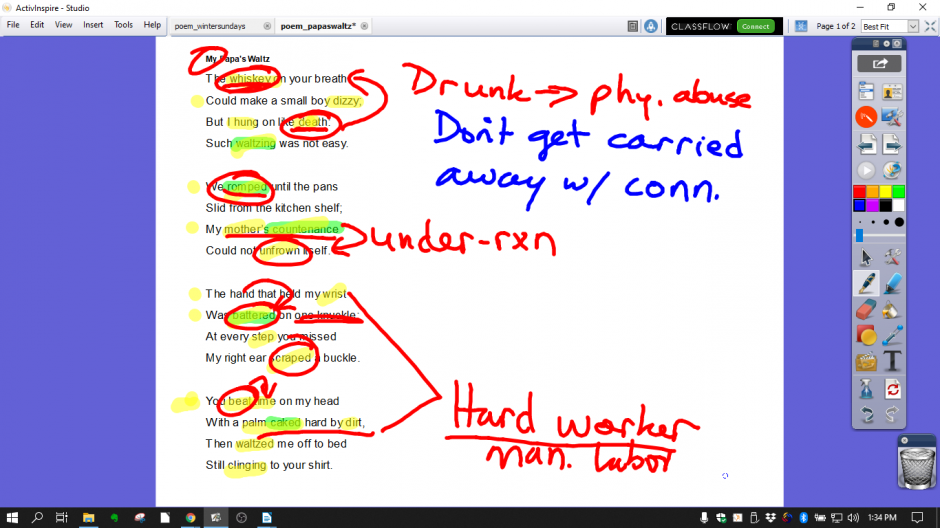
Our reading of “My Papa’s Waltz” was a cautionary tale. At first it seems like so many words have connotations of abuse that the poem is actually about an abusive father.

  • The “whiskey on your breath” line makes us think he’s inebriated.
  • “Death” has obvious bad connotations.
  • “Battered” and “beat” are abusive words.

The problem, though, is this is not a close-enough reading.

  • Notice: his knuckle is what’s battered. Along with the “palm caked hard with dirt,” this suggests he’s a man used to hard manual labor.
  • He’s beating time and nothing else — he’s tapping the boy’s head 1-2-3 to help him keep up with the waltz.
  • The text shows he’s had something to drink; it doesn’t say he’s inebriated. (“Remember what that waltz looked like?” I reminded the students. “Do you think he could do that if he’d been inebriated?”)
  • Note who puts him to bed: the father.

So this was a cautionary tale about reading too much into the connotations of a poem. Don’t overdo it. If there’s no evidence in the text, it’s likely not a valid interpretation.

Streaming

It’s taken a while to get everything lined up, to get everything prepared, to get all the kids set and expecting it, but today, I finally pulled it off.

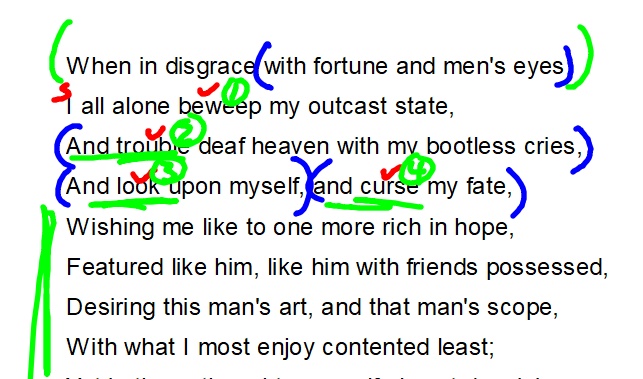
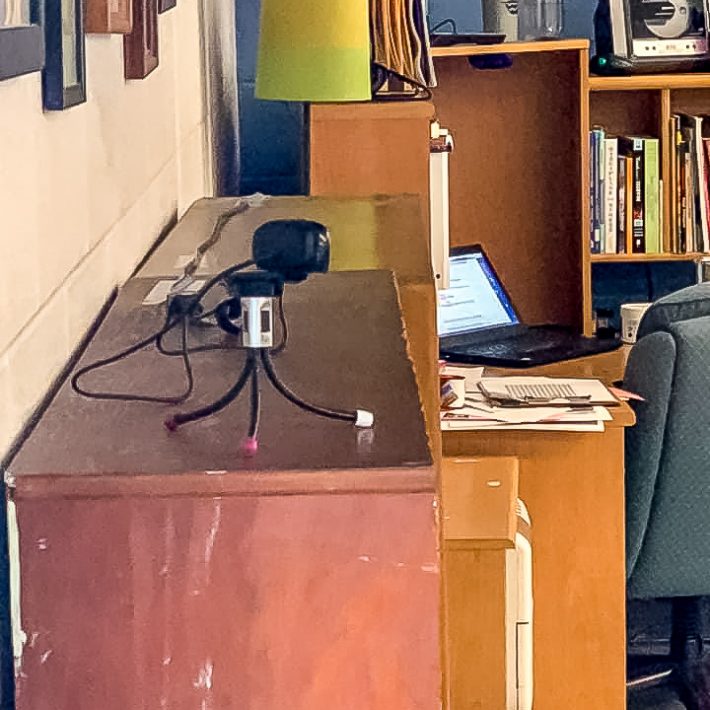
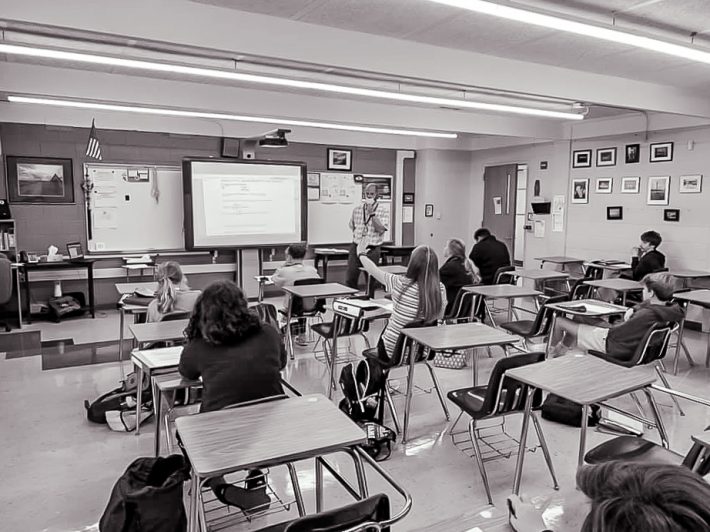
I live-streamed my classes so that students at home could simply follow along. I used a bone-conduction blue tooth headset to hear questions from the online kids and to make sure they heard me clearly, and I presented the screen through Google Meet so they could simply follow along with the text as we annotated it. (And one of the administrators, knowing I was doing this, dropped by to take some pictures, which made it to social media.)

In the past, we’ve had material prepared for kids at home and material prepared for kids in school. I’ve been teaching doubled lessons: I teach the same thing on Monday to the students who attend Monday and Wednesday then I repeat it all Tuesday for the other group. But no more.

The parental response has been completely positive and overwhelmingly uniform:

  • This was great…my son really liked this
  • THIS IS AWESOME!! Would love to see y’all make this happen!!!
  • This was excellent! The most positive school response I’ve seen from my daughter since Covid began.
  • I have wondered from the beginning why this wasn’t done for every class.
  • Rave reviews from my 8th grader!
  • This was a huge help. Thank you, Mr. Scott! Would love to see this happen for additional classes.

So two things now come to mind:

  1. I must plan all my lessons so that they can fit into such a template. (Or almost all my lessons. I don’t know about Socratic seminars and other forms of discussion, but perhaps it’s do-able with a little ingenuity.)
  2. I must talk several teachers off the ledge when word starts getting around that this is going to be required (it won’t) and that it’s terribly complicated (it isn’t) and that it will require much more planning time (much less, actually).

Finally, it’s proved one thing to me as well: snow days are now completely obsolete.

Today in Class

Students have been spending the last two days working on how we can use plot and setting to analyze a short story. Each day's classes came up with slightly different results.

Our first step was to explicate the plot and setting of our story:

We determined that the real heart of the story, and thus of the conflict, was the fact that the protagonist unknowingly kills his brother as he tries to escape from being pinned down on the roof. This is what gives the story its power; this is the heart of the story that cannot be tampered with.

We then began asking whether we could change various elements of the plot. We determined that it doesn't have to be on a roof; it just has to be somewhere the protagonist can be trapped. We decided that it doesn't have to be Dublin, though a historian of the Irish Civil War might tell us that snipers were only active in Dublin. (I have no idea if this is the case. I used it as an example.) At first, everyone thought it couldn't be moved from Ireland because it's set in the Irish Civil War, but we soon figured out that it simply has to be in a setting where a brother could kill a brother without knowing it. Civil war and gang warfare are the most logical locations.

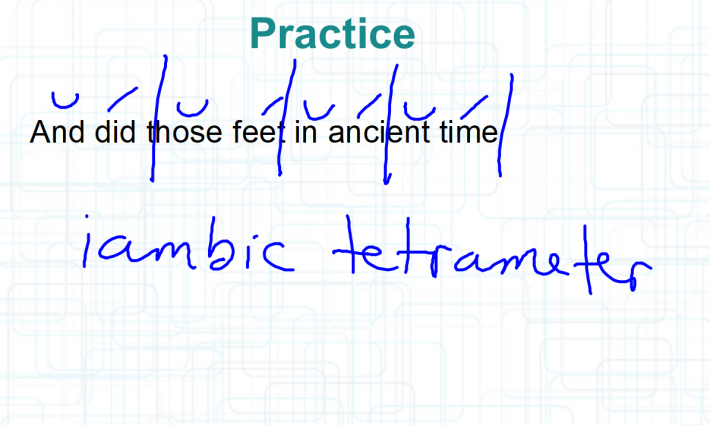
From there, it was fairly easy to create a working TS for our paragraph. We added some CDs before we decided that we had them in the wrong order: CD2 was our first CD so we would actually reverse the order if we were to write this paragraph. Finally, once all the CM was completed, we saw that our TS was a little out of alignment with our chunks, so we gave it a whack to knock it over a bit, adding "In order for the surprise ending to work" at the beginning of the paragraph.

At this point, the majority of the work is done. We still have actually to write out everything, but the hardest part is behind us.

Covid-Era Lesson

Today we began the heavy lifting of the first unit of significance: we're learning the difference between analyzing and summarizing in order to begin analyzing short stories. We looked at Li-young  Lee's "The GIft" in order to determine the difference. The first step was to determine how much of the summary was not from the poem, highlighting those portions in the summary yellow. By the middle of class, it was clear to students that none of the summary should be highlighted yellow as all of the material in the summary comes directly or indirectly from the text.

Next students looked at analysis of the poem:

The poem “The Gift” tells the story of a young boy whose father is removing a splinter from his hand. It is a poem about the fact that everyday events like pulling a splinter out can be in fact gifts, and the poem accomplishes this by highlighting apparent opposites. To begin with, the act of pulling a splinter out of the hand is inherently violent, but the poem creates a tenderness about it. The speaker tells us that instead of focusing on the painful act of pulling the splinter out, he “watched his [father's] lovely face” and listened as his father “recited a story in a low voice.” His father's face and voice were calming, and this undoubtedly helped turn the situation into a calm memory later in life. In fact, instead of being a violent act, this is only a tender moment.

Students, working in groups, were to highlight light blue anything that's an inference and dark red anything that comes directly from the text.

The upshot was the understanding that most if not all of the content for summary comes from the text itself whereas most of the content in analysis comes from the writer's head -- opinion and inference backed from the text.

The final step was to analyze the paragraph for Schaffer completeness. Students determined the following:

  • This sentence feels like a topic sentence (it makes a claim) but is in the wrong location:
    It is a poem about the fact that everyday events like pulling a splinter out can be in fact gifts, and the poem accomplishes this by highlighting apparent opposites.
  • The third sentence feels like it might be a CD because it's got a transition element but it's an opinion, which is not the role of CDs but rather CMs or even TSs.
    To begin with, the act of pulling a splinter out of the hand is inherently violent, but the poem creates a tenderness about it.
  • The fourth sentence has a quote, which means it comes from the writer's source (in this case, the poem) and not his/her head. This means it feels like a CD but is in the position of a CM otherwise.
    The speaker tells us that instead of focusing on the painful act of pulling the splinter out, he “watched his [father's] lovely face” and listened as his father “recited a story in a low voice.”

Schooling 2020

Were this a normal week, I would have finished today feeling that I had laid the foundation my students for the rest of the year by teaching them the basics of the writing system we use. They would have practiced and planned with partners as I wandered about the room, listening to conversations here and there and intervening when I felt it was necessary.

"Please zoom in to 150% on Google Docs," I would have said, "so I can get a peek as I walk by and see if you need direction or not." I would have looked over students shoulders to see if their first attempts with this at-first bizarre system of writing I teach (and insist on students using) were developing according to plan.

I would have told a few students, "Look, you really need some one-on-one time with this, so come by tomorrow during advisory, and we'll make sure you leave feeling much more confident."

Instead, I went step by step with students through the process, but each student was with me for a different part of the process; the other time they worked through it on their own at home with materials I developed. Which means I was unable to assess and assist them as they went along. Which meant I spent an inordinate amount of time assessing things online this week that I never would have assessed in a normal year. Which means I'm not at all confident about my students' development right now.

Covid-schooling.

First Day 2020

It's an odd thing, repeating the same thing four times. Four times. Four times. Four times. But that's what I did today, doing the first day scenario four times as I have four English I Honors classes this year. But in fact, I'll be repeating today's lessons four days, hitting a quarter of the students in a given period each day. That's an altogether different issue: repeating the same lesson sixteen times.

That's the Covid-19, 2020-school-year reality.

The only exception to this is journalism, which is not journalism this year because it's logistically impossible. Instead, it's "Creative Nonfiction" -- close but not really the same at all. In that class, I had the kids start their journals, and I wrote in my own to model the expectation and show that when I say "You can write about anything," I mean it:

The first day of the dreaded 2020 school year is over and what do I have to show for it? Well, I'm quite frankly completely sick of this mask: I haven’t worn a mask continually ever. Evetr. During last week, I took it off in the classroom, but GCS requires teachers to wear a mask when around students, and honestly, if the didn’t require it, I would be a little upset. It’s a pain, but it’s for everyone’s safety.

Still, there were a lot of things I didn’t expect. For one thing, it’s much harder to understand what students are saying when they’re wearing masks. I had one girl who spoke very quietly, and I had to ask her to slip her mask off for a second because I couldn’t understand what she was saying at one point. And it happened more than once now that I think about it. Another unexpected element was how warm my face got with it on. Having not worn a mask for more than a hour at a time, I didn’t realize how my face would warm up and just stay warm. My wife had to wear a mask every day when she was still working at __, and she told me how hot it was, but it really didn’t register that it would be my reality when the school year started. A final unexpected element was how I could get used to it. Despite the heat and the other challenges, there were points that I wasn’t even thinking about it -- until my nose itched and I went to scratch it.

Still, it’s a small price to pay. I’m glad to be back in the classroom with students. That 100% online teaching was hardly teaching. Granted, I didn’t do any teaching today to speak of (well, perhaps showing students how to organize their Drive folders a bit), but still, being physically with the students--there’s no substitute for it. I don’t really like that I won’t see these kids for a week after they leave today, though I know it’s necessary for preventing the spread of our covid reality. Will I remember everyone’s name in a week after not having seen them? I kind of doubt it. I’m so terrible with names as it is: having a week between each meeting will make it all the more difficult. That's tempered by the fact that I”m only learning 4-7 names per period. Despite that, I doubt I’ll remember every name next Monday.

(I just had a realization: if we have a snow day, one group of kids is missing essentially a whole week of school. It’s another argument against having in-person days different lessons from what online kids are doing.)

I will have to write a "first" entry three more times this week.

That's the Covid-19, 2020-school-year reality.

More Surprises

For next week, we're to prepare a week of elearning for the kids. All the students will come in for one class period (for the week), but they'll spend the rest of the time doing elearning at home.

I found out today, though, that I can't make any plans that assume they have computers because they won't be getting their Chromebooks until they come to class that one day. (Never mind that the district set aside this week for students to come in and get their Chromebooks...) So I'm to plan elearning that includes no elearning.

I'm still trying to figure out just how that might work...