matching tracksuits

fun in threes, sometimes fours

education and teaching

First Impressions

“They actually kind of make me dizzy.”

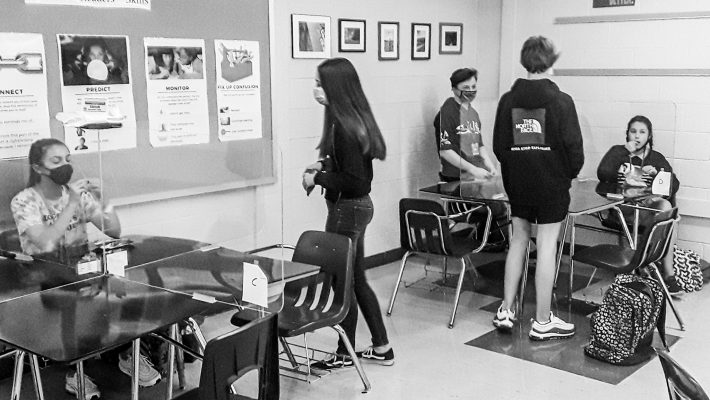
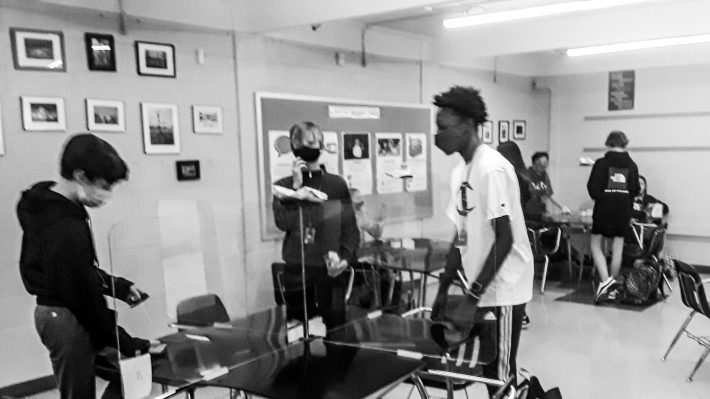
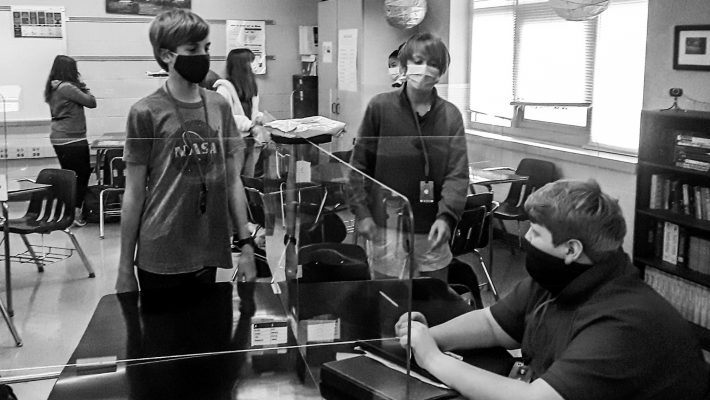
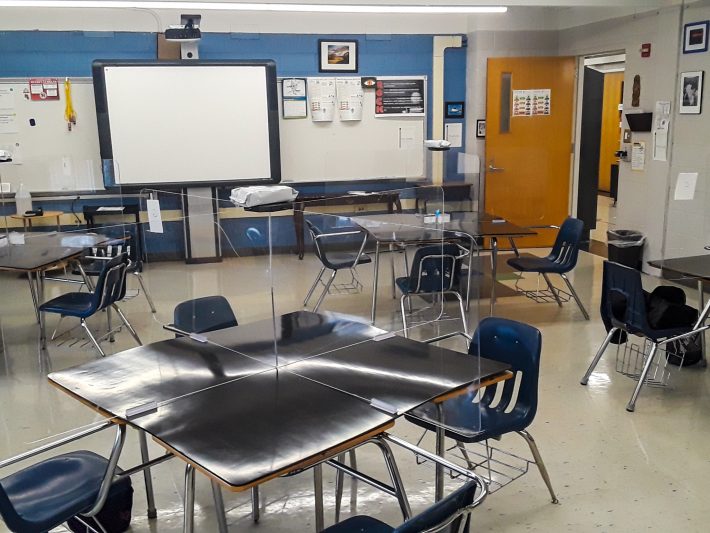
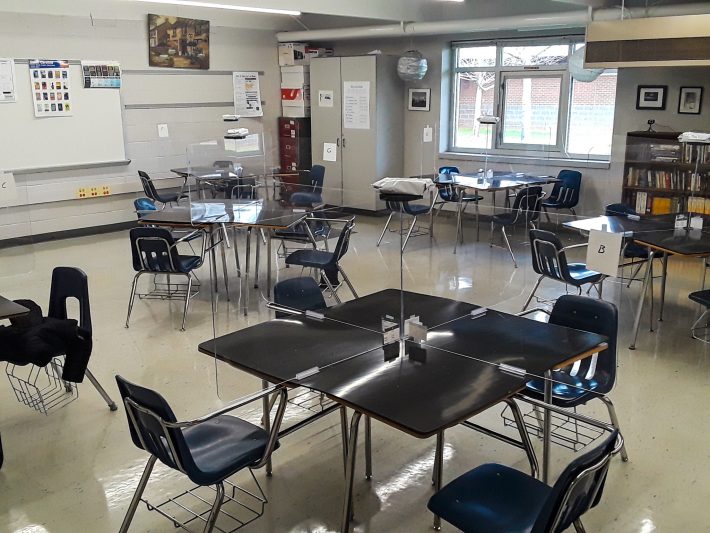
It wasn’t what I was expecting when  I asked Ms. Butler about how things were going in her newly-podded classroom with each student seated in a little box of plexiglass. Perhaps I was expecting something more like, “It’s even more difficult to hear students,” or “It’s weird seeing students through so many layers of plexiglass,” or even, “It’s just weird.” But not dizziness.

“What do you mean,” I asked.

“Well, with all these panels of reflective plastic,” she began, feeling her way through the explanation carefully as if she hadn’t really hadn’t tried to put it into words before. “There’s just all these weird reflections that shift and move as you move around the room.”

“That sounds awful.” I get dizzy easily, and it had me a little concerned about how I might react to it myself.

When I got into the classroom this morning and started placing name tags on everyone’s seat, I saw immediately what she meant. The clear plexiglass that divides students into little almost-self-contained cubes reflected images from around the room. These reflections were, in turn, reflected off the black plexiglass bases on which the whole dividers sat, and the play between these reflections and reflections of reflections had me feeling a little woozy within seconds. It was as if everything were somehow in the matrix film, with solid reality turning into liquid, flowing reflections of reality. What’s worse, the whole broad clear barriers reflected again their own reflections from the black bases and also refracted the images of other tables so that we had reflections of reflections of reflections, all moving and shimmering at different speeds and frequencies.

I felt like I was in a hall of mirrors, a corridor of reflections that caved in on themselves, like waves riding on waves that then crash into other ripples, transforming all of reality into a dancing mirage, a dizzying visual cacophony.

“Dear God, what if it’s always like this?”

As I walked around the room affixing the place holders to their right locations, I realized it wasn’t an issue if I didn’t pay attention to it or even think about it. Like baffles in a large gas tank, I thought that perhaps having people in those seats might draw more attention than the reflections themselves.

As the first period with students began, I apologized for some of the changes the new format necessitates -- no real...

Written in creative nonfiction class as students worked on their own accounts of the first days in the new pods.

The Challenge

I texted a picture to K this morning: “This is what my classroom looks like now,” I said.

“Wow — no more rearranging rooms, I guess,” she replied.

I know a lot of teachers are concerned about the impact this will have on their teaching style, on the types of lessons they can do. I for one am not terribly worried about that because this year I’m teaching only honors classes, and most honors students are relatively mature and somewhat adaptable. There are some things that will take getting used to — not as much motion, more teacher-based lessons, etc. — but overall, I think they’ll do fine.

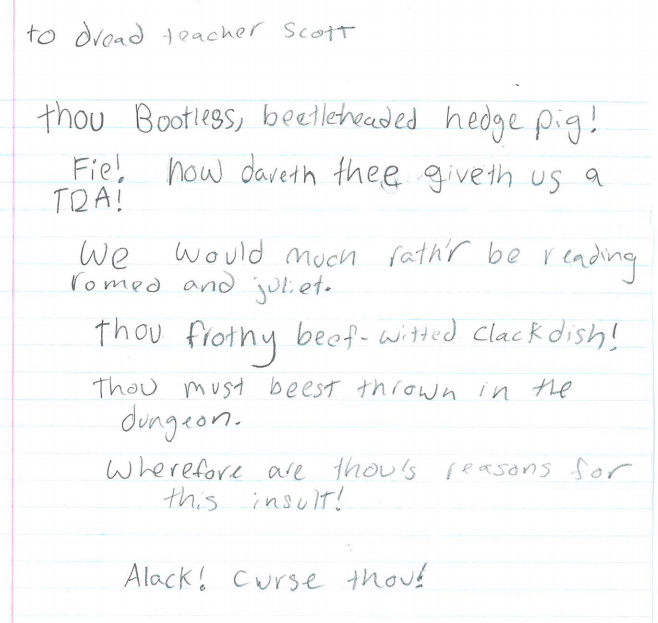
When I got home, I noticed a little paper with Shakespearean insults on the table. Remembering that L’s class has just started Romeo and Juliet, I thought it might have been from her, but the Boy filled me in when he got home from swimming lessons: “The kids in challenge today were working on Shakespearean insults,” he said. He told me about how funny it was when his friends who went to challenge shared it with him, and I’m assuming he got K to help him find a list of insults on the internet and print them out.

It was only then that I realized: E didn’t get an invitation to join challenge when he started this year. The invitations are based on standardized test scores from second grade, and I immediately thought that the Boy must feel a little left out, a little, well, stupid compared to the others.

K had the same concerns, and we talked about it in the evening when the Boy was sound asleep. “He wanted to know if we could sign him up,” she said forlornly, “and I had to tell him you don’t sign up for it; you get an invitation.”

I remember seeing the challenge kids leave — our district was a little worse in their naming: it was the “gifted and talented” group, which makes everyone else feel less gifted, less talented, and that’s exactly how I felt. I watched them troop out of the classroom in elementary school, wondering what they do there, wondering why I wasn’t a part of it.

I got an invitation at the end of fifth grade and spent sixth grade with the GT kids who’d been doing it for several years by that time. I didn’t feel any different, really, and I don’t really recall doing anything all that spectacular. Of course, that was over 35 years ago, so I can justifiably be a little fuzzy on the details, I’m sure.

Throughout high school, I was most decidedly average. I was in the “advanced” classes only insofar as I was not in remedial English or remedial math. I didn’t take algebra until ninth grade; I never took a single AP course; I had no “Honors” affixed to my class names; I didn’t graduate anywhere near the top 10, and I highly doubt I was even in the top 10%. And yet for high school superlatives (how I loath to this day that idea), my peers voted me “Most Intellectual.” (I was tempted to refuse the award during the senior luncheon, but my mother convinced me it would be rude to do so.) So the recognition for my academic achievement was a mixed bag — conflicting signals. In the end, I just didn’t put much stock into what people thought of my intellectual abilities.

But somehow, when it comes to my kids, I feel a little differently. I want them to be geniuses, above and beyond even those who are above and beyond. What parent doesn’t?

The Boy is starting to realize some people work faster than he does, maybe a little more accurately, K and I concluded. And that’s fine. We’re all different. We all have different gifts. But still, I felt the Boy’s sting just a bit, so I went back to his bedroom and cuddled with him a little more.

“You’re very gifted in many ways,” I told him.

“How?”

“You’re a very good reader. You’re an excellent drawer. And you’re very kind and sensitive to other people’s needs and emotions.”

A pause. “Thank you.” He snuggled in a little closer and went to sleep.

Treble Clef

Today the Boy had music for his related art class in school. They're working on the treble clef.

"I took the after-lesson quiz," he explained, "and I got 3 out of 20 right! I took it again and only got 4 out of 20 correct!" His frustration was mounting to the level I'm sure it achieved when he was struggling with the material in class.

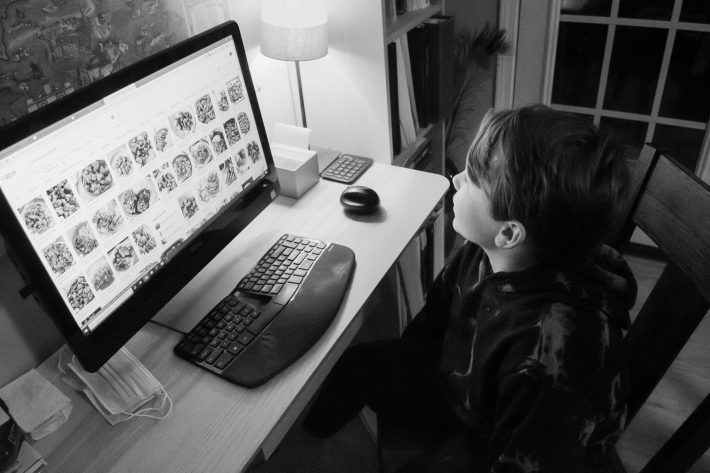
Checking school lunch. "Daddy, this is what I'm having tomorrow! It's delicious!"

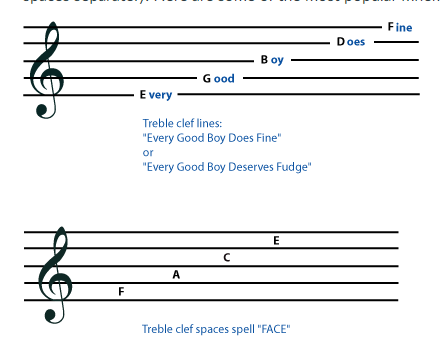
After dinner, I printed out the old methods of memorizing the treble clef: "Every Good Boy Deserves Fudge" and "FACE."

We went through his work together, and he made a perfect score. "That was easy," he decided.

He noticed, though, that there are two D notes on the treble clef: one just beside middle C, and one almost up at the top of the clef.

"Two Ds?!"

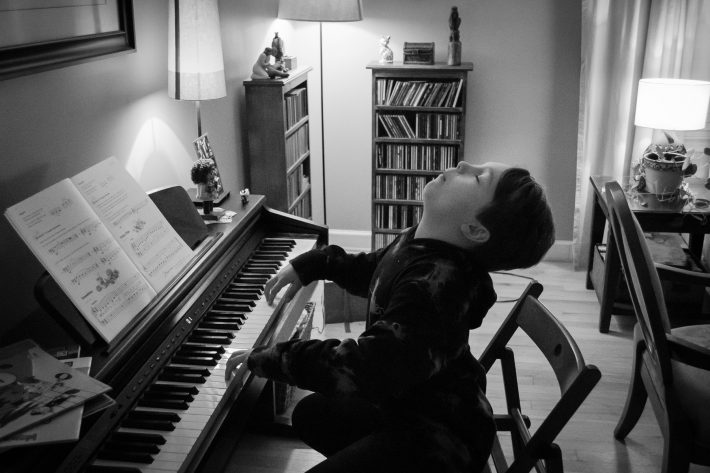
So we went to the piano and started poking around. We talked about the patterns of the black keys and used that as a way to show which keys corresponded to which note.

"This is D," I said. "See how it's between the two black keys? Now show me another D."

Testing, Again

I guess it could be worse. Shoot, it was worse just a few years ago. We had MAP testing and Iowa Basic Skills testing and some other test that I can’t remember, all piled up in the first half of the year, with the MAP test repeated in the spring along with state-mandated testing. Now we’ve lost the MAP testing (the only really useful test for me) and the Iowa Basic Skills (Is that what it was called? I could look it up, but I don’t care enough about it to check), but in their place, we have district-mandated benchmark testing every quarter and two practice TDA tests.

What is a TDA test, you might ask? Text Dependent Analysis. An essay question based on a text, in other words. That’s how we spent today, working on this essay question:

“Inventor Martha Coston” focuses on Martha Coston’s night signal invention. The author claims that it was Coston’s “desire to provide for her family and her determination to succeed [that] made the Coston night signals a great success.” Write an essay analyzing how the author develops and supports the claim. Use evidence from the text to support your response.

If you read that carefully, you’ll see that it’s really just asking students to summarize the argument in the piece. Today, I helped students see that; I’ll do the same tomorrow, as I have to do this in person, and we’re only meeting a given student every other day. Is that teaching to the test? Or rather teaching the test? I don’t know. I don’t care. But I wasn’t about to just toss the test at them and say, “Here, do this.” And I was also not about to let the know, through implication, that I really didn’t want to spend time with this test. “Now, as you look at this district-mandated test…” “If you look at the prompt for the district-mandated test…” “Do you have any questions about the district-mandated test?”

The Unknown

I first heard the rumor when the Monday night phone call from E’s school’s principal came through. He began explaining how it is theoretically possible that we might not be back in school next week and might instead go back to 100% elearning for everyone through Christmas break. Then today, the teacher in the room next to mine said that there’s a rumor bouncing around Hillcrest High that everyone should take all their materials home for the weekend because it might last until after Christmas break. In the afternoon, no word from the principal about that, and he’s always very good about communicating things like that to us. No word from the district, who is often not the best about communicating things like this. (They should address the fact that there are so many rumors roiling around like this. And I would think if an elementary school principal were to include such a comment in his weekly phone blast that there is some legitimate basis for it.)

So we all go home in uncertainty…

One Art

Today, we finish up our poetry unit, going over my all-time favorite poem, Elizabeth Bishop’s villanelle “One Art.”

The art of losing isn’t hard to master;
so many things seem filled with the intent
to be lost that their loss is no disaster.

Lose something every day. Accept the fluster
of lost door keys, the hour badly spent.
The art of losing isn’t hard to master.

Then practice losing farther, losing faster:
places, and names, and where it was you meant
to travel. None of these will bring disaster.

I lost my mother’s watch. And look! my last, or
next-to-last, of three loved houses went.
The art of losing isn’t hard to master.

I lost two cities, lovely ones. And, vaster,
some realms I owned, two rivers, a continent.
I miss them, but it wasn’t a disaster.

—Even losing you (the joking voice, a gesture
I love) I shan’t have lied. It’s evident
the art of losing’s not too hard to master
though it may look like (Write it!) like disaster.

Every year I teach this, after we read it and define the unknown words (“vaster” is always in that list; “fluster” and “realm” are there from time to time), I have the kids jot down questions at the bottom of the page. “What strikes you as odd about this poem? In some ways it seems really simple, but there a few things that just seem out of place. What are those things?” The same questions appear every year — the same questions I want to appear:

  1. Does she mean she really lost houses? How are we to understand that?
  2. What does she mean, she lost cities? And a continent? What does that mean?
  3. What’s up with that parenthesis in the last line?
  4. And why is “Write” in italics?
  5. Why does she begin that final stanza with a — what is that? A hyphen?

I get them working in groups after I point out a few more things:

  • I give a brief refresher on imperative voice and the implied “you” subject they contain.
  • I suggest they might want to consider who this “you” is.
  • I point out that there is a “you” in the poem later and ask them to consider if it’s the same “you” as earlier in the imperative mood sentences.
  • I help them see that there is another imperative in the final line. “Do you think it’s the same implied ‘you’ as the first imperative passages?”
  • I remind them that there are often patterns in poetry. “I’m not just talking about rhyme schemes,” I clarify. “There’s a pattern in the meaning of the poem.”

They break into groups to work. Soon enough, someone notices the pattern: “Everything she loses keeps getting bigger and more significant.” Exactly.

At this point, I add a new twist I saw in the poem. (Great poetry is always revealing something new about itself.) The first word of the final stanza is deceptively ordinary. “Even.”

“Think about how you use ‘even’,” I suggest. “You might say something like this. ‘We’ve all finished the test. Even Steve is done.’ What does that mean?”

“That we’re surprised Steve finished,” someone answers.

“Why?”

“Because we don’t expect it.”

With some more group work, they figure it out. And then someone always states the obvious: “Oh, I see, Mr. Scott. It’s a break-up poem.”

Exactly. But such an exquisite break-up poem…

Meter

Today we finished up a quick day-and-a-half overview of meter after spending about a week on Shakespearean sonnets. I wanted kids really to understand the level of Shakespeare's achievement, how much he wrote in iambic pentameter.

"Remember, kiddos," I said, "he was not only choosing words based on the ideas he wanted to express; he was also having to take into account their length and rhythm."

In the evening, during L's club volleyball signing and uniform fitting, I ran into two of my students who are playing on L's team. They're having a test tomorrow on sonnets but not on meter. It's not in the standards in any sense, so I couldn't justify testing them on it, and I could just barely justify to myself spending almost two days on it. It's just on interpreting, on picking up on some of the rudimentary differences between modern and Elizabethan English. I reminded one of the girls to keep preparing for the test.

"We were going over it in the car," said her father.

Starting the Bard

Students started the final series of poems in our poetry unit, turning to the poems of William Shakespeare in preparation for the next unit, which is on Romeo and Juliet.  We began parsing Shakespeare’s twenty-ninth sonnet:

When, in disgrace with fortune and men’s eyes,
I all alone beweep my outcast state,
And trouble deaf heaven with my bootless cries,
And look upon myself and curse my fate,
Wishing me like to one more rich in hope,
Featured like him, like him with friends possessed,
Desiring this man’s art and that man’s scope,
With what I most enjoy contented least;
Yet in these thoughts myself almost despising,
Haply I think on thee, and then my state,
(Like to the lark at break of day arising
From sullen earth) sings hymns at heaven’s gate;
For thy sweet love remembered such wealth brings
That then I scorn to change my state with kings.

This is a particularly challenging piece with which to begin because it is one single sentence. We began by creating our own version of such a sentence, which in fact has an introductory subordinate clause with lots of other phrases connected to it.

Thursday at Home

We stayed home today because of potential high winds due to the remnants of Zeta. Since we’re all so used to it, switching to online learning was a snap for everyone. K pointed out the now-obvious: they’ll be more willing to do this in the future with less risk because they know we can do elearning.

No more snow days. More wind/rain/inclement weather elearning days.

Unfortunately, the neighbor up the street with the trashy Halloween decorations suffered little damage to his display…

First Day at 100%

We go to school five days a week now, and this has advantages and disadvantages.

First, I get all my friends back. A and O are my two best friends, and because of Covid, I didn’t have them in class since we went to school in different groups. Today, though, we go five days a week, and we don’t have two groups anymore. We talked about the surprise I’m going to do for their mom. I’m going to take a Dobby mask and try to surprise her and maybe spook her a little bit with a fake knife.

Next, I feel better having a big group of twenty people. I think that everyone in one class should be together and not split up into two groups.

However, I have to wear a mask all day, and this is a disadvantage. A mask is uncomfortable because it rubs on your mouth, and it itches. Even though it’s uncomfortable, I have to do it because covid is bad, and we have to stop the spread. Masks help stop the spread.

I think that it’s very much better than two groups because I get so many people to be with.