matching tracksuits

fun in threes, sometimes fours

education and teaching

Connections

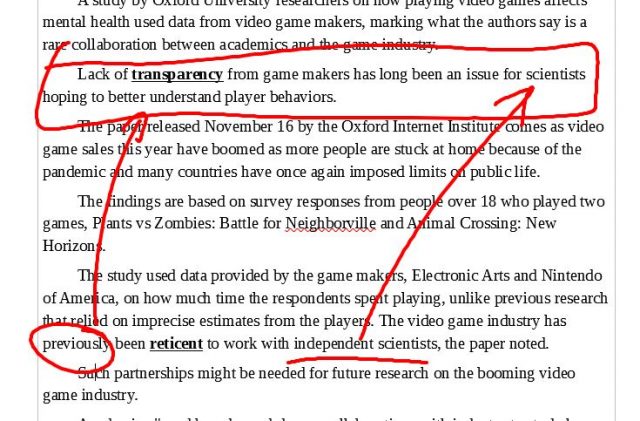
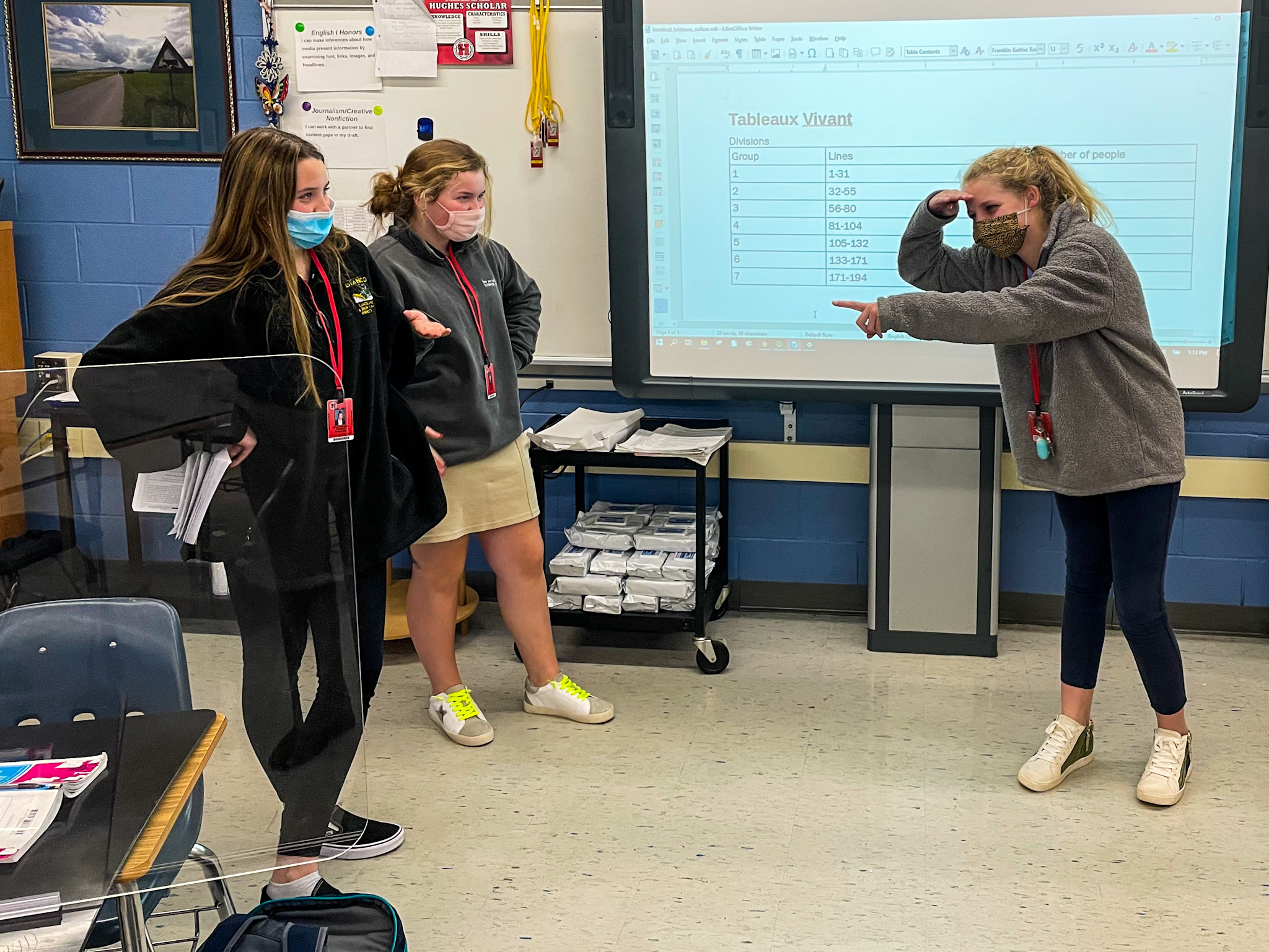
We began today by going over the latest article of the week, looking at a complete of connections that I wanted students to make within the text.

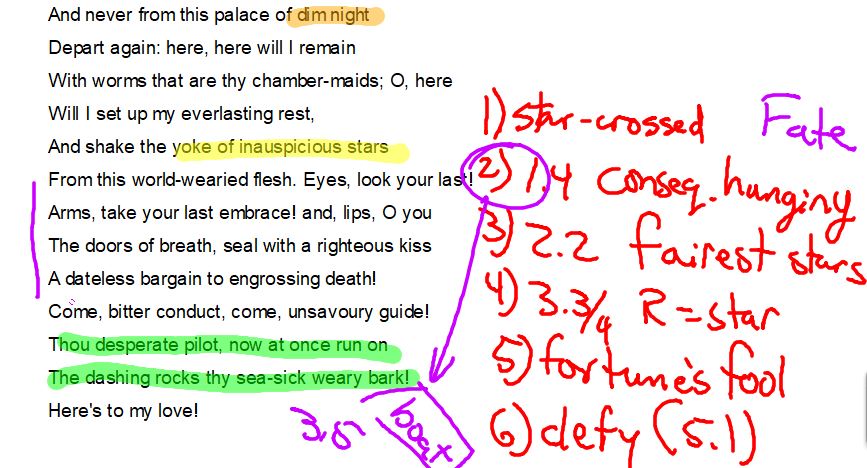
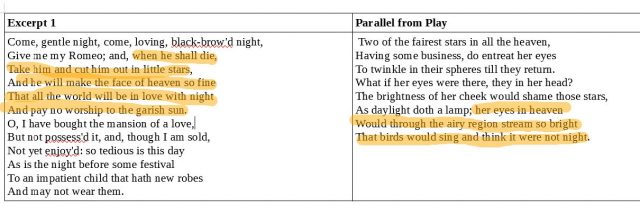
Afterward, we returned to the work of tracking down some of the ways that Shakespeare has characters start echoing each other. For example, we covered this unique echo:

Excerpt 1 Parallel from Play
Come, gentle night, come, loving, black-brow’d night,
Give me my Romeo; and, when he shall die,
Take him and cut him out in little stars,
And he will make the face of heaven so fine
That all the world will be in love with night
And pay no worship to the garish sun.
O, I have bought the mansion of a love,
But not possess’d it, and, though I am sold,
Not yet enjoy’d: so tedious is this day
As is the night before some festival
To an impatient child that hath new robes
And may not wear them.
Two of the fairest stars in all the heaven,
Having some business, do entreat her eyes
To twinkle in their spheres till they return.
What if her eyes were there, they in her head?
The brightness of her cheek would shame those stars,
As daylight doth a lamp; her eyes in heaven
Would through the airy region stream so bright
That birds would sing and think it were not night.

They’re both comparing the other in terms of brightness so intense that it would overpower the night and turn it into daytime. There are a few differences, though:

  • Juliet frames it in the future (Romeo’s death) whereas Romeo frames it in the present. This reflects their personalities as well.
  • Juliet begins to hint at the coming conclusion of the play. “Death is just around the corner for them both,” I reminded them.

I’m tempted to give a little spoiler tomorrow as we finish act 3 and Romeo climbs out of the house in a sort of bookend balcony scene: “This is the last time they will see each other alive.” Tempting…

Echoes

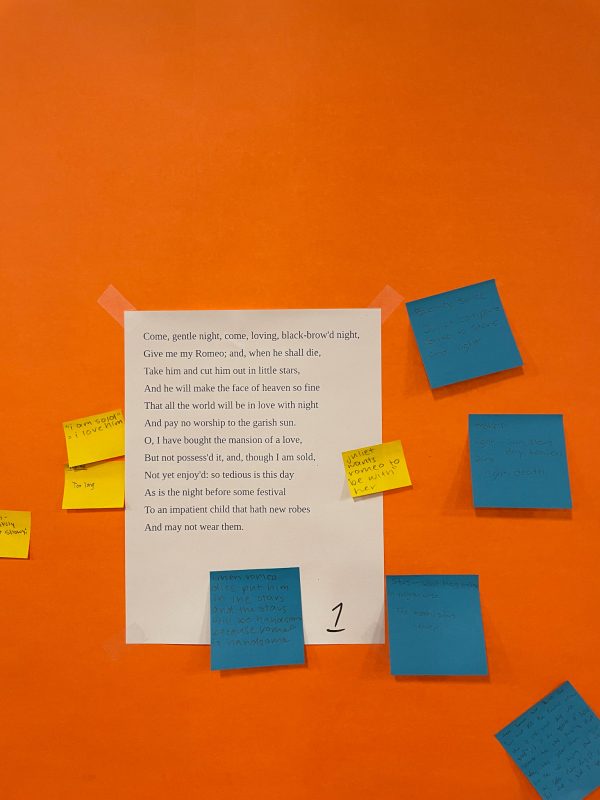
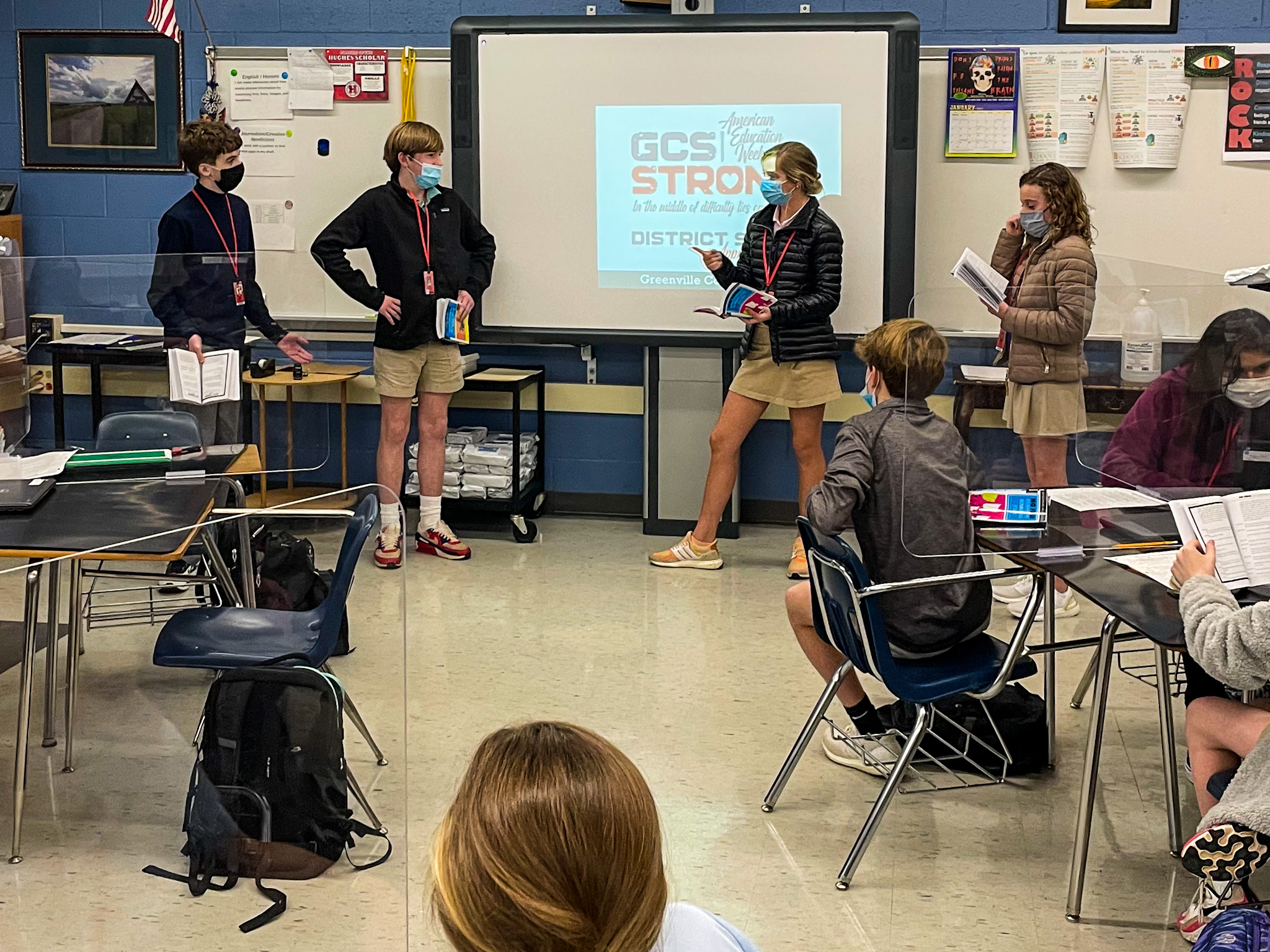
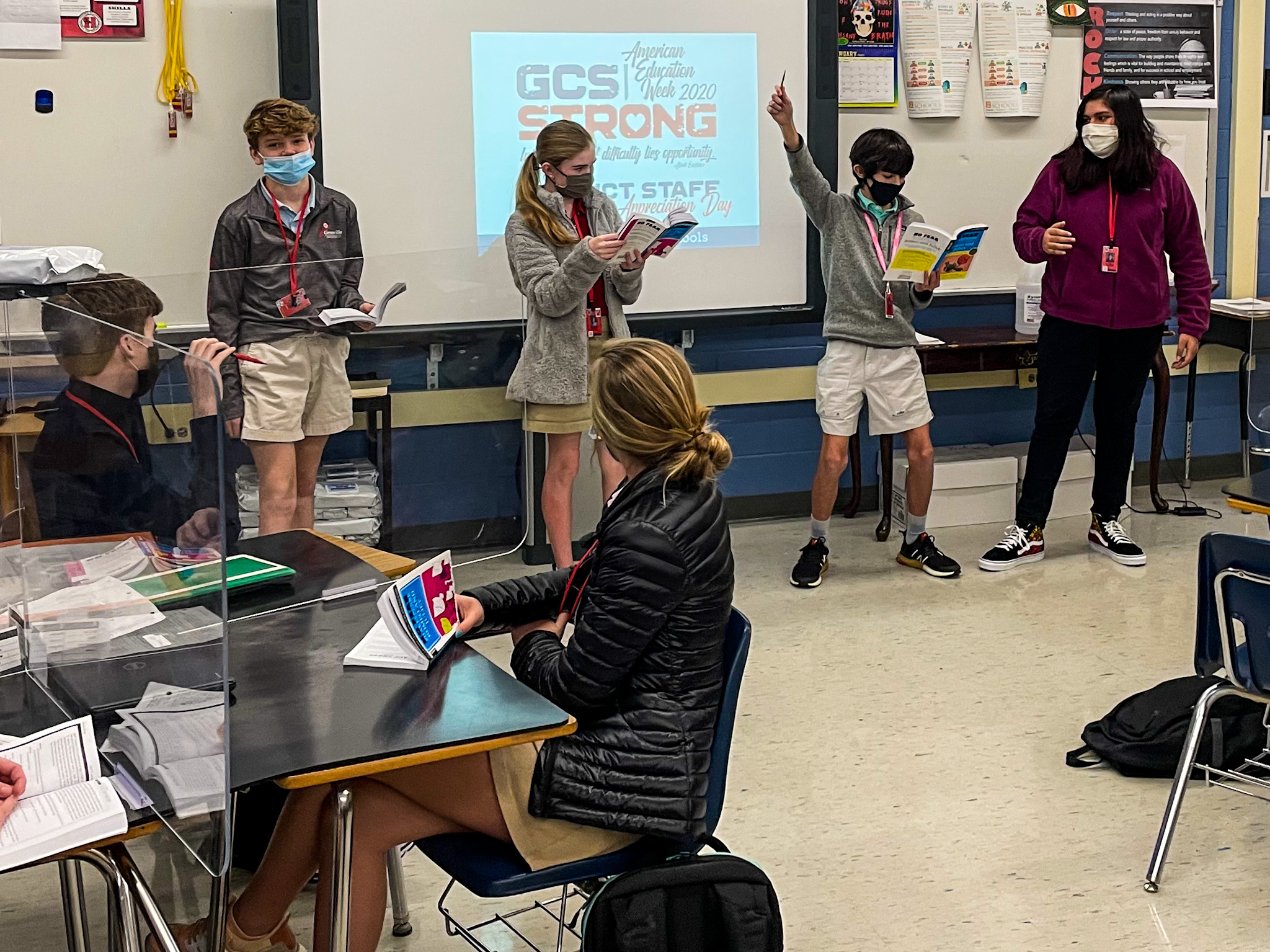
As we move toward the end of the play, I want students to start picking up on how characters echo each other. I want them to see that Juliet in act three echoes Romeo's words in the balcony scene in act two:

Come, gentle night, come, loving, black-brow'd night,
Give me my Romeo; and, when he shall die,
Take him and cut him out in little stars,
And he will make the face of heaven so fine
That all the world will be in love with night
And pay no worship to the garish sun.
O, I have bought the mansion of a love,
But not possess'd it, and, though I am sold,
Not yet enjoy'd: so tedious is this day
As is the night before some festival
To an impatient child that hath new robes
And may not wear them.

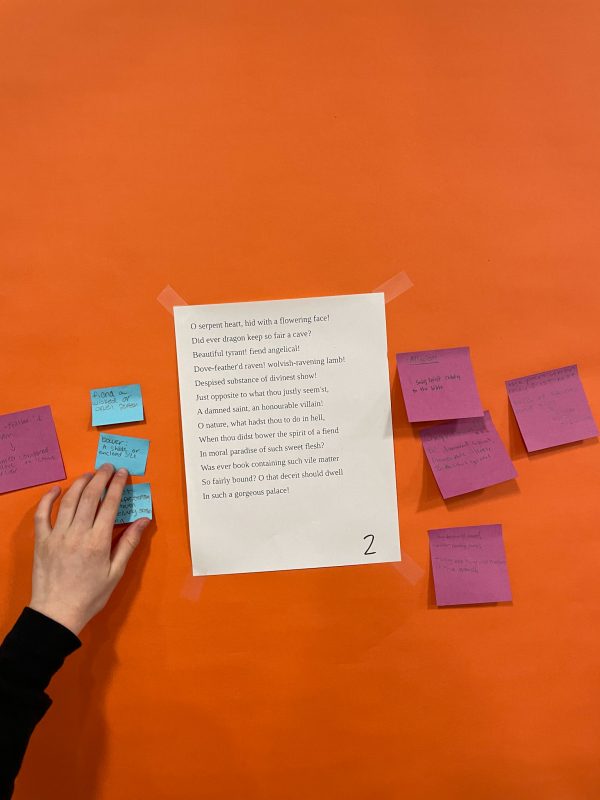
I want them to see that Juliet expresses her anger in act three the same way Romeo does in the first scene of the play, with a litany of oxymorons:

O serpent heart, hid with a flowering face!
Did ever dragon keep so fair a cave?
Beautiful tyrant! fiend angelical!
Dove-feather'd raven! wolvish-ravening lamb!
Despised substance of divinest show!
Just opposite to what thou justly seem'st,
A damned saint, an honourable villain!
O nature, what hadst thou to do in hell,
When thou didst bower the spirit of a fiend
In moral paradise of such sweet flesh?
Was ever book containing such vile matter
So fairly bound? O that deceit should dwell
In such a gorgeous palace!

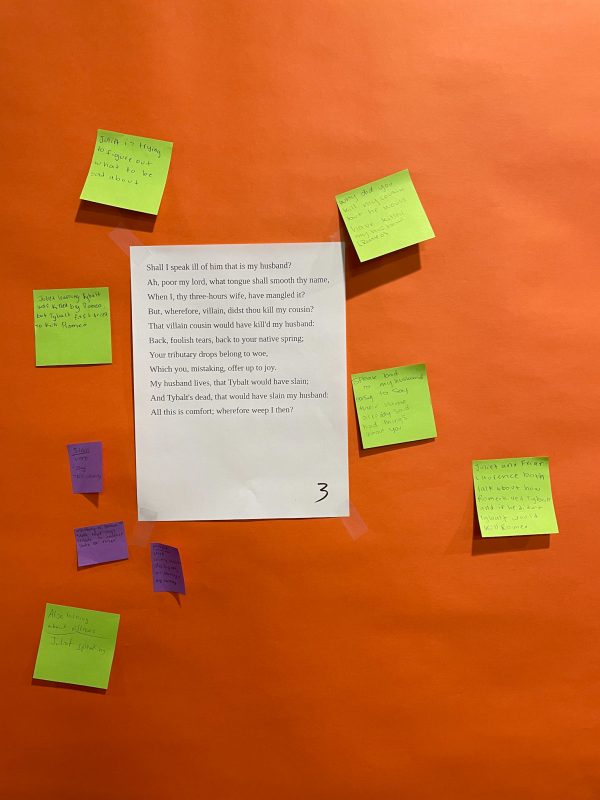
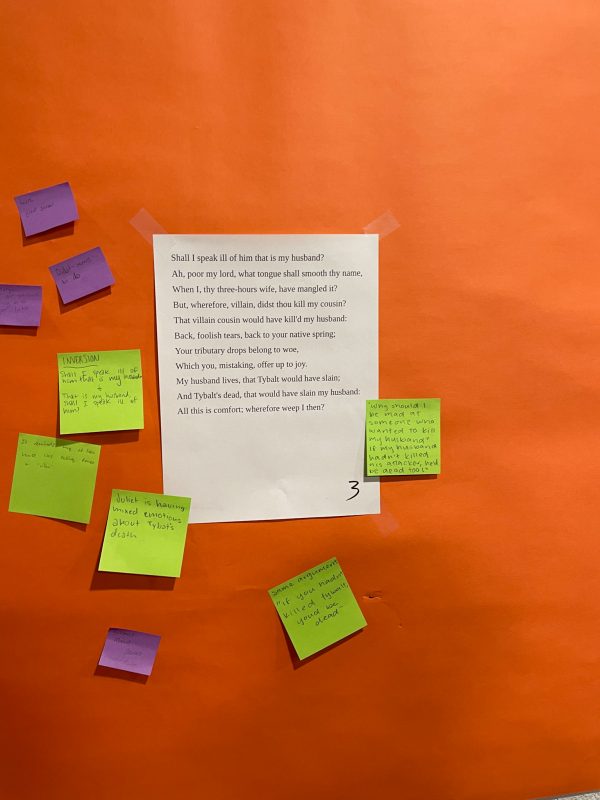
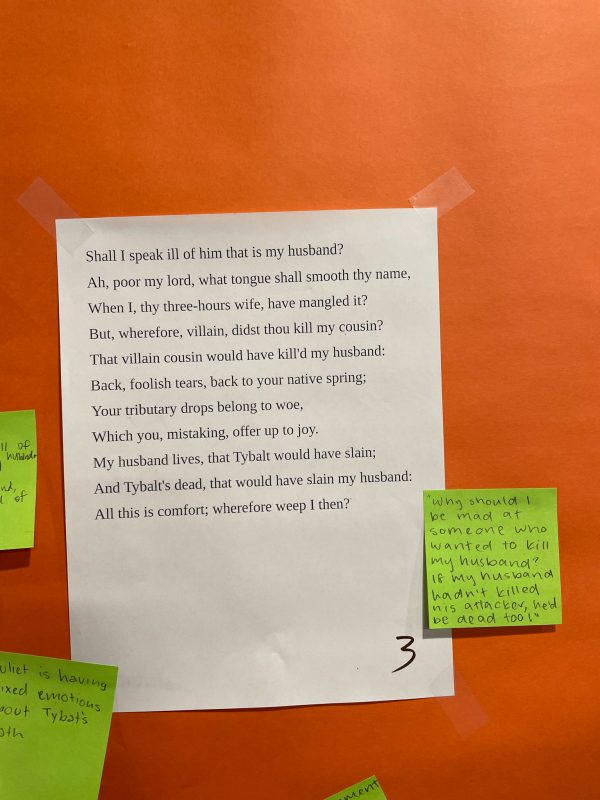
I want them to see that Juliet echoes Friar Lawrence when they learn that Romeo has killed Tybalt. She says about the situation:

Shall I speak ill of him that is my husband?
Ah, poor my lord, what tongue shall smooth thy name,
When I, thy three-hours wife, have mangled it?
But, wherefore, villain, didst thou kill my cousin?
That villain cousin would have kill'd my husband:
Back, foolish tears, back to your native spring;
Your tributary drops belong to woe,
Which you, mistaking, offer up to joy.
My husband lives, that Tybalt would have slain;
And Tybalt's dead, that would have slain my husband:
All this is comfort; wherefore weep I then?

He says:

What, rouse thee, man! thy Juliet is alive,
For whose dear sake thou wast but lately dead;
There art thou happy: Tybalt would kill thee,
But thou slew'st Tybalt; there are thou happy too:
The law that threaten'd death becomes thy friend
And turns it to exile; there art thou happy:
A pack of blessings lights up upon thy back;
Happiness courts thee in her best array;
But, like a misbehaved and sullen wench,
Thou pout'st upon thy fortune and thy love:
Take heed, take heed, for such die miserable.

Echoes.

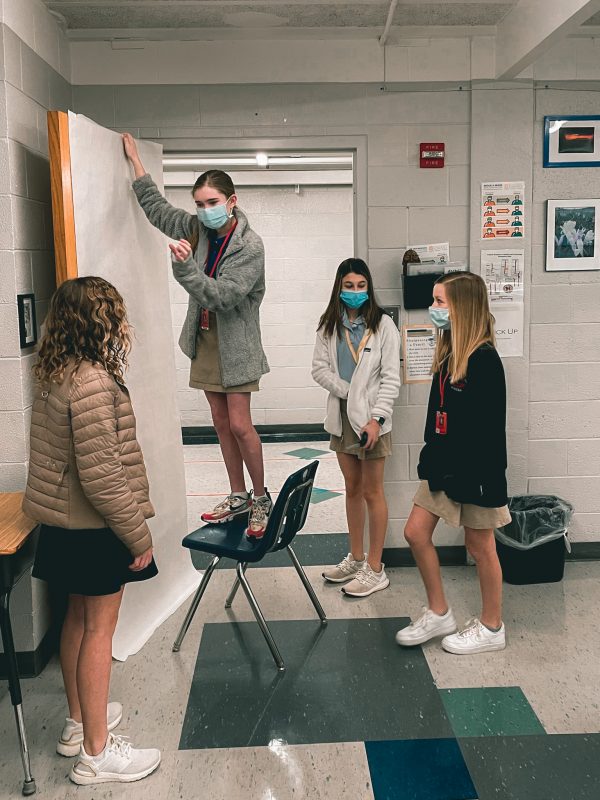
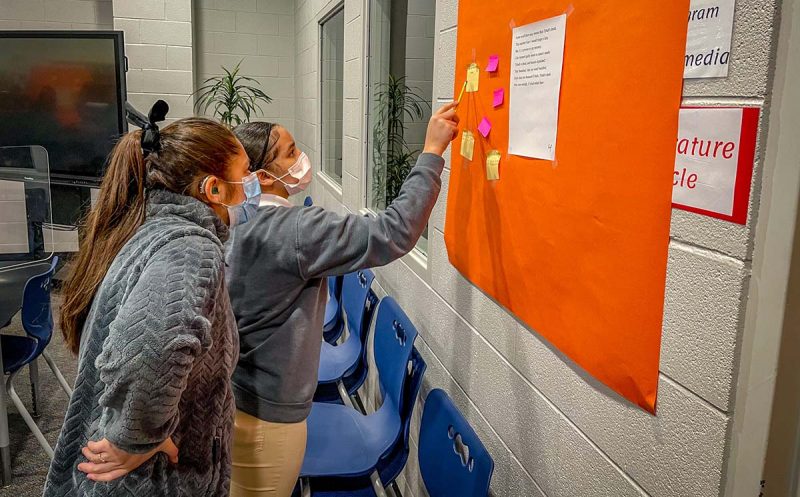
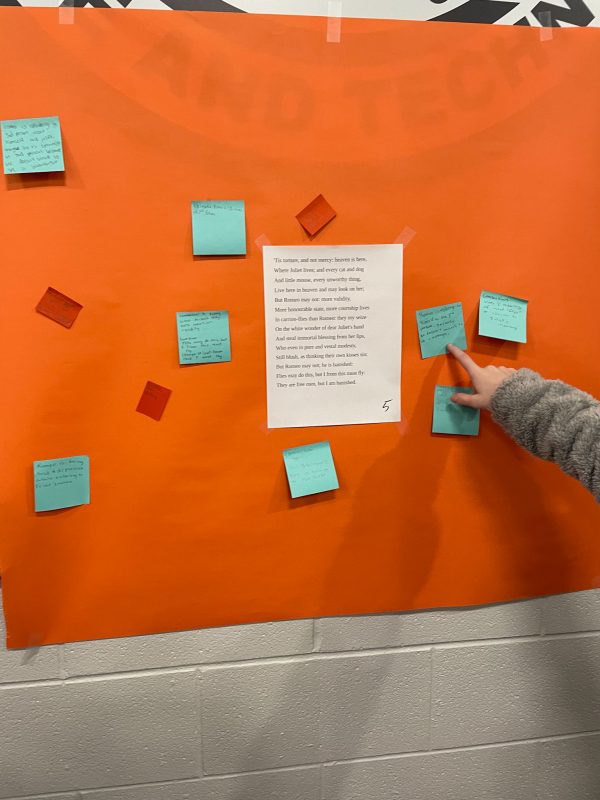
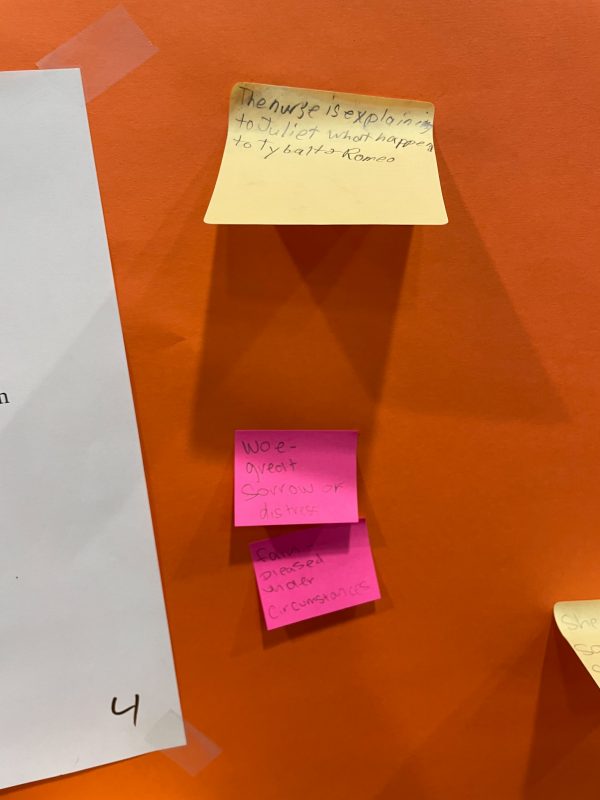
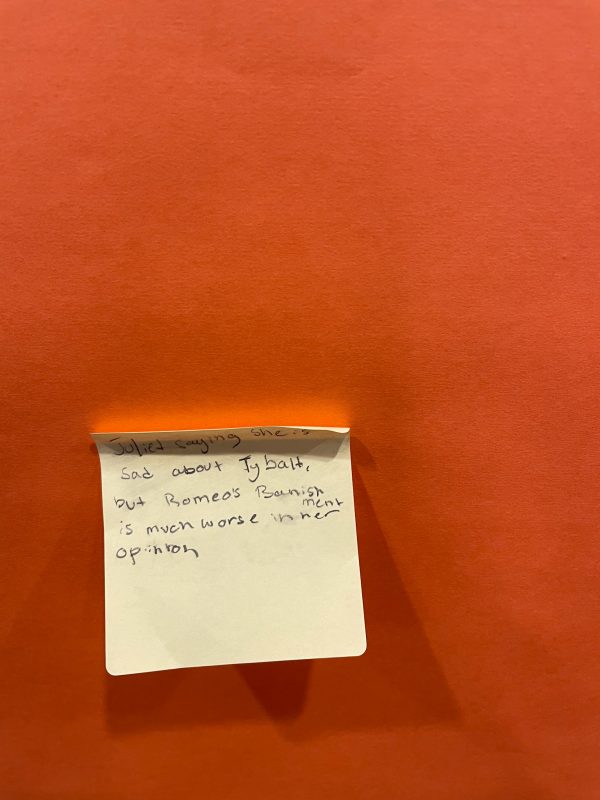
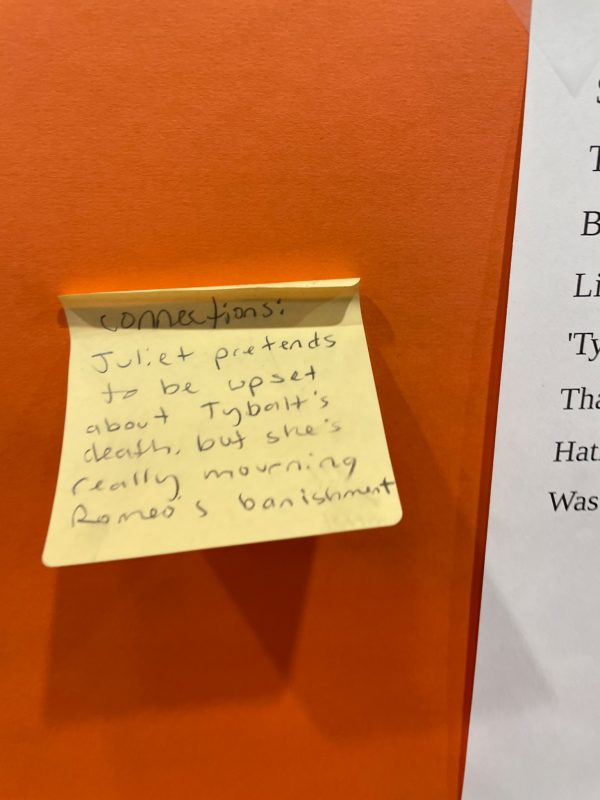
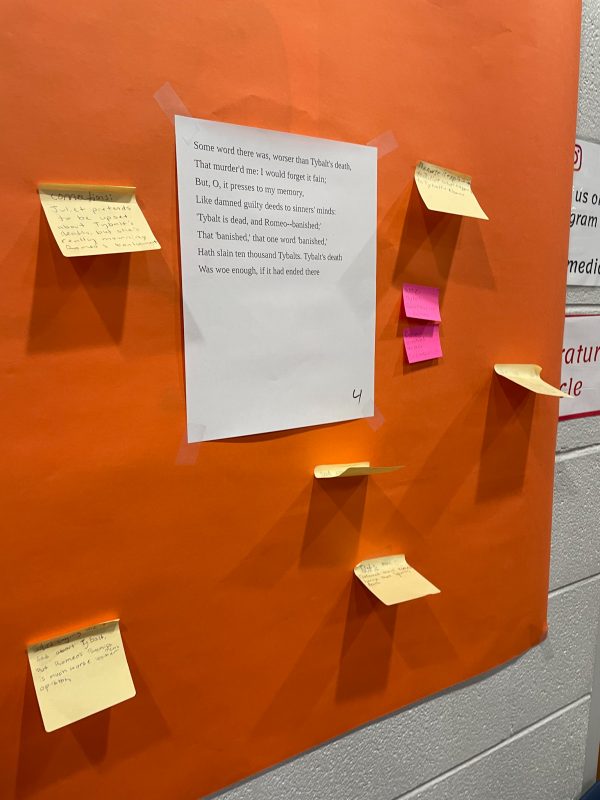
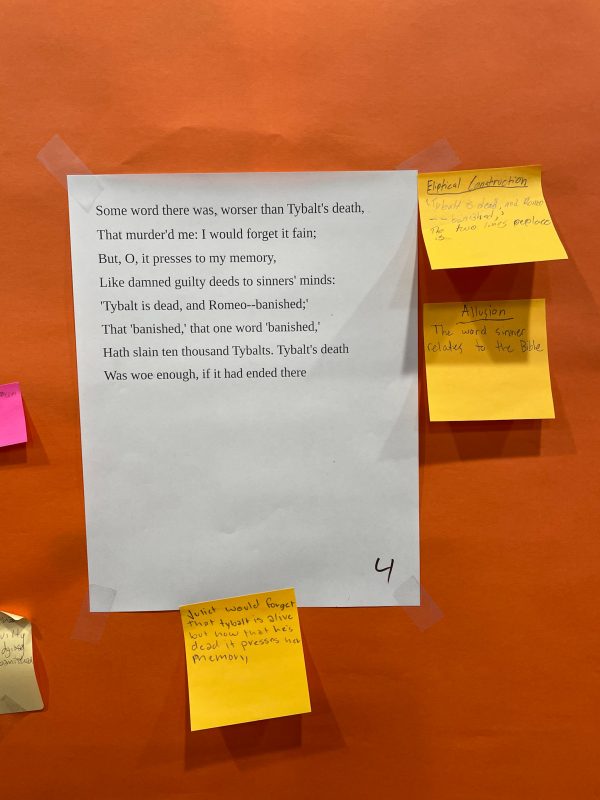
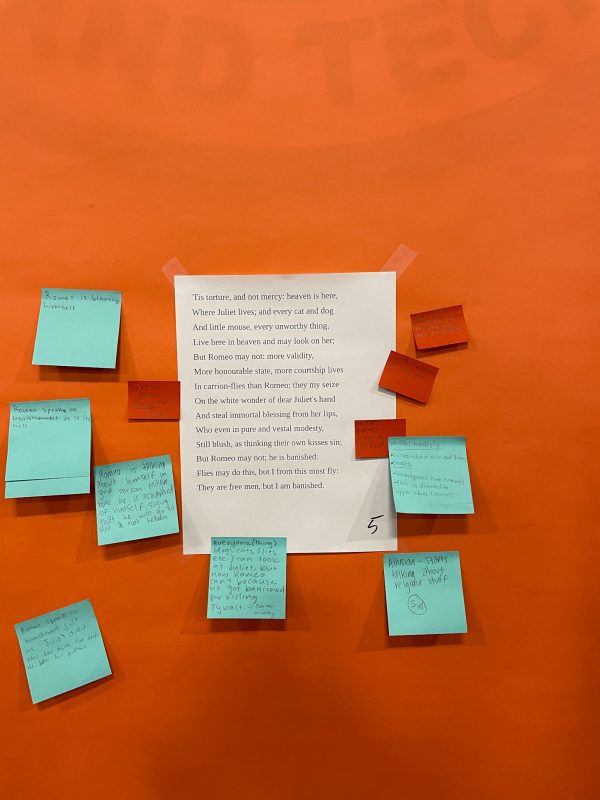
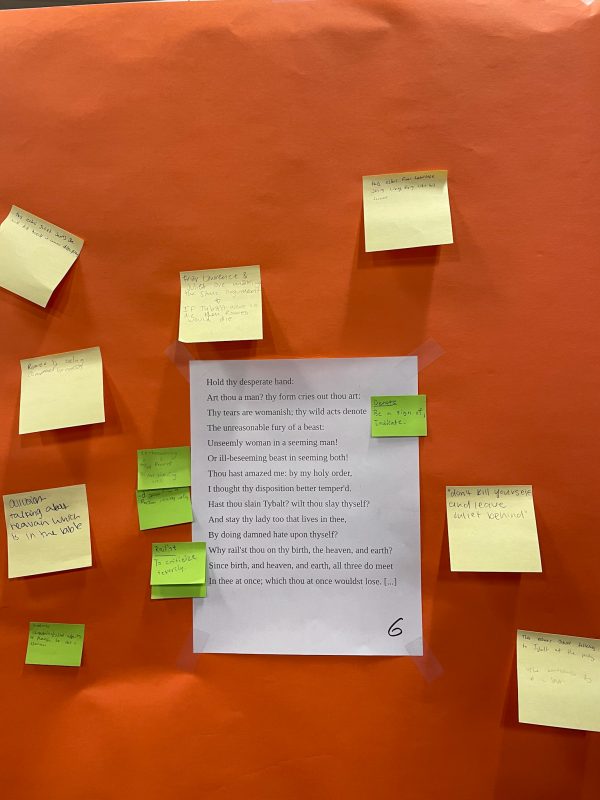
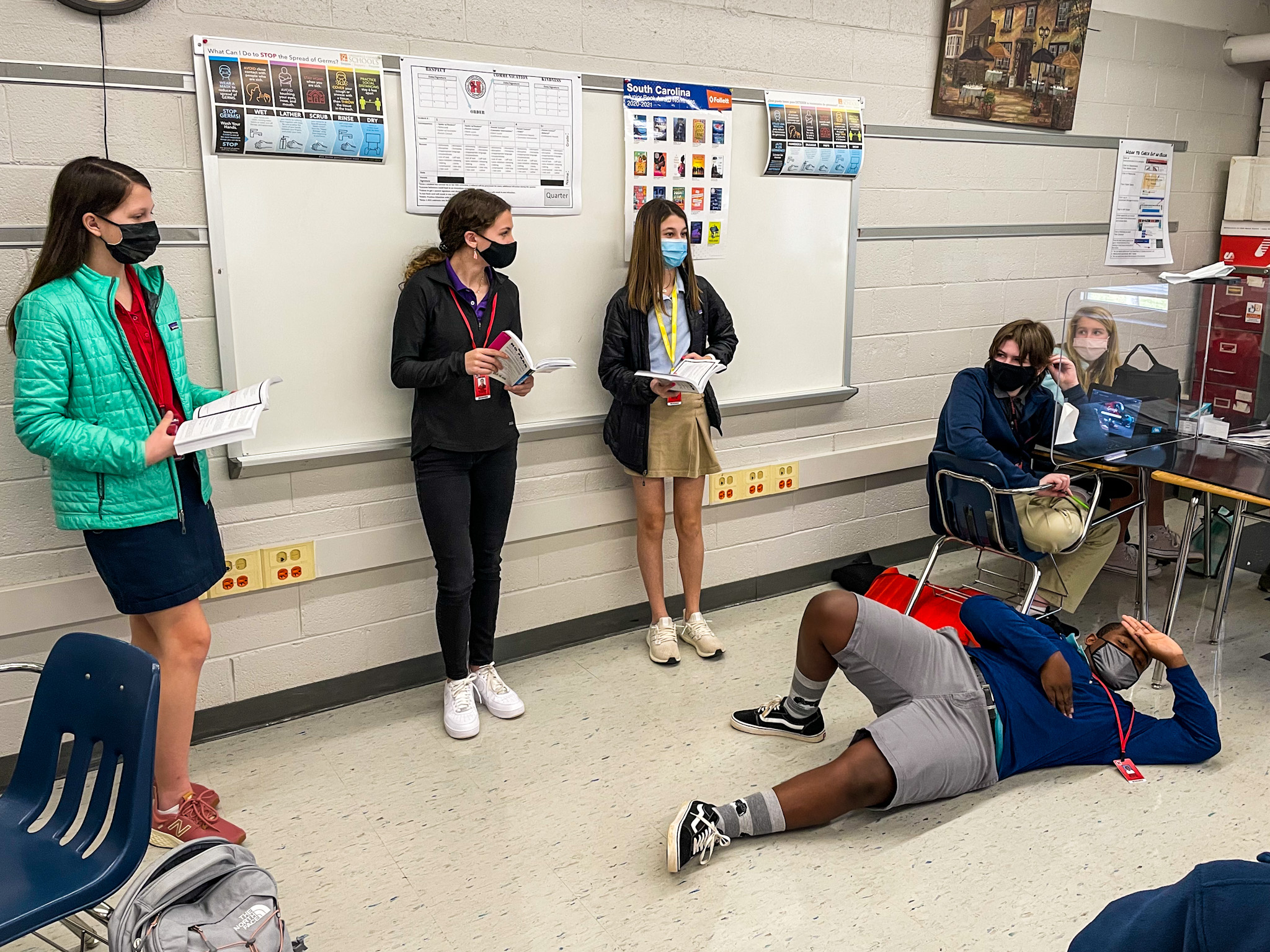
To do this, I've developed what's called a gallery walk: each passage is printed out and put on a large piece of butcher paper. Kids circulate in groups with Post-It notes, making comments about vocabulary, motifs, inversions, elliptical constructions, and, most importantly, other portions of the play about which given passages remind them.

As they circulate, the passages become covered with comments, and students learn from each others' observations. With each rotation, it becomes increasingly difficult to say something original. They have to dig a little deeper, think a little more critically.

And sometimes, a bit of humor appears. While one group was reading this passage

O, I have bought the mansion of a love,
But not possess'd it, and, though I am sold,
Not yet enjoy'd: so tedious is this day
As is the night before some festival
To an impatient child that hath new robes
And may not wear them.

I overheard an outspoken girl -- one of my favorite students this year, though I'm not supposed to have those, right? -- summarize it succinctly to her group: "Juliet just wants to get laid."

Notes from a Class

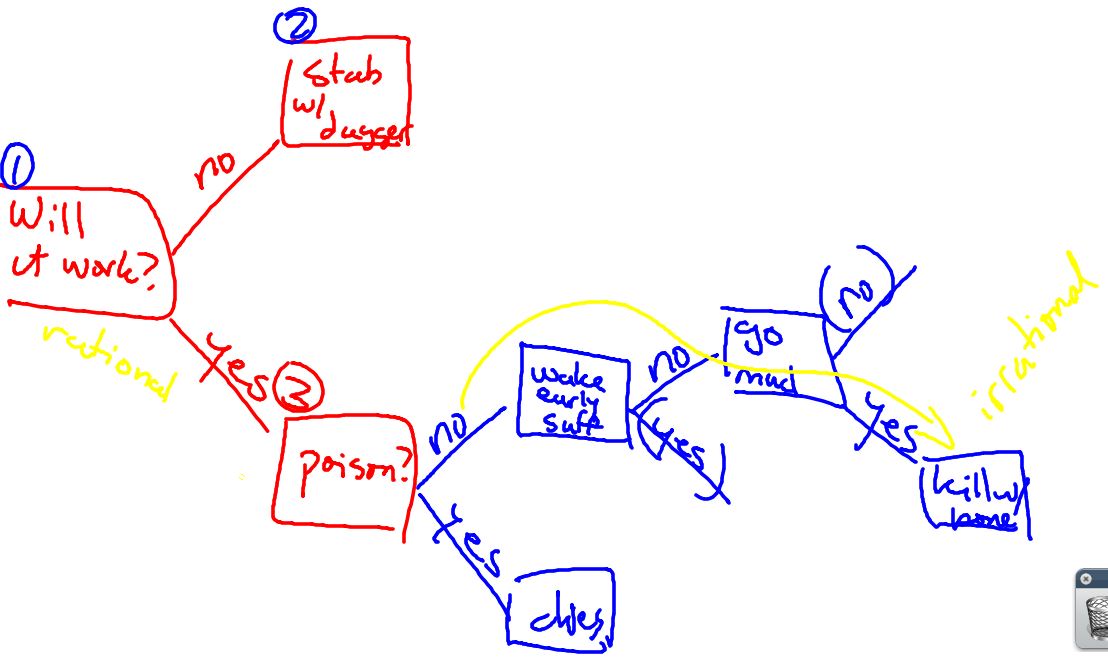
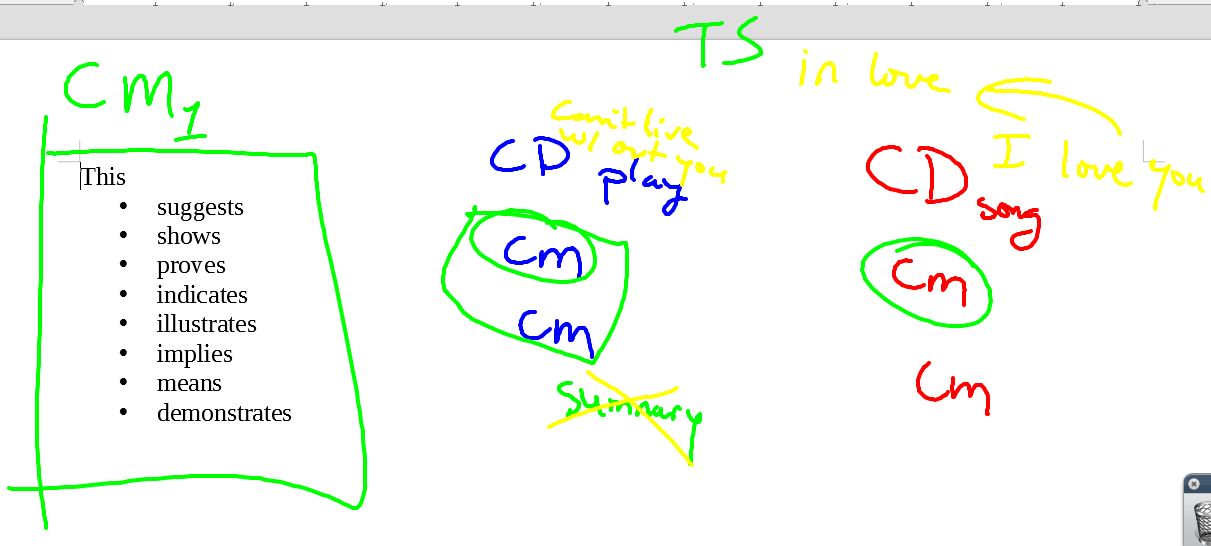
It’s funny how much meaning a few notes scribbled on the board can have for a group of fourteen-year-olds and yet be completely incomprehensible to others — to other students, to other teachers, to other adults in general.

Below are the notes from today’s class. The scribbles don’t look like much, but to the kids with whom I’ve been working now for several months, they represent the last little bit (though critical bit) of guidance for a major writing assignment. These few words and abbreviations include notes about organization, notes about planning, notes about content, guidance for self-correction, potential problems and their solutions

We’ve developed our own shorthand, or own codes, or own abbreviations, as I do with every class every year. And it all moves the students toward writing that they would have found impressive a few months ago and now is their new-normal, their new standard.

It’s an honor to be a part of that growth, to play a small part in it.

The Tension Dials Up

Act 3 scene 1 -- everything changes. The challenging becomes almost impossible. Romeo effectively erases any hope of any future with Juliet.

"Things are going to speed up from here on out," I tell the kiddos.

Media on January 7

As an English teacher, there are times that demand I drop what we’re doing in class and talk about what’s going on. Or as Kelly Gallagher put it,

Sometimes when history unfolds, it immediately supersedes tomorrow’s lesson plan. Today is one of those days. Students will need to read, write, and talk about this.

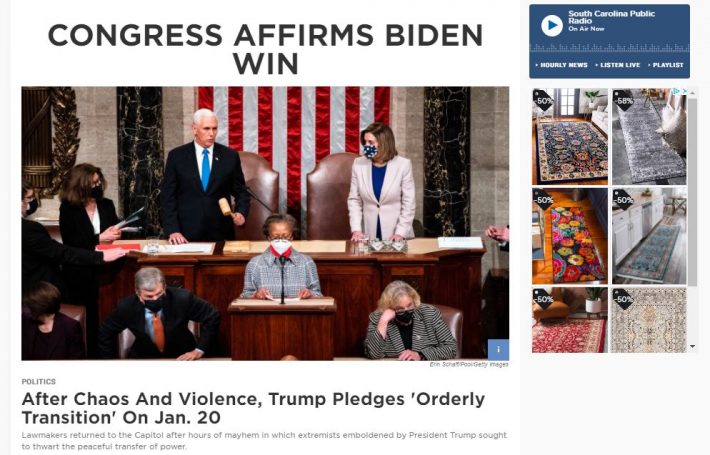
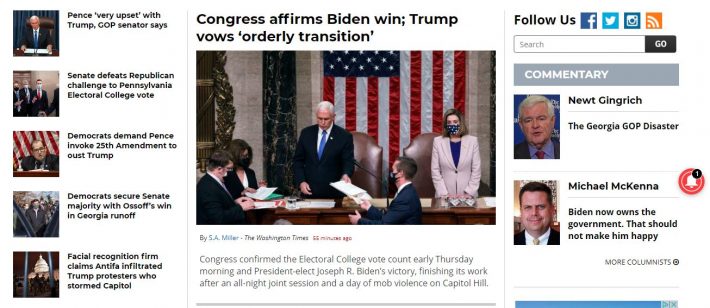
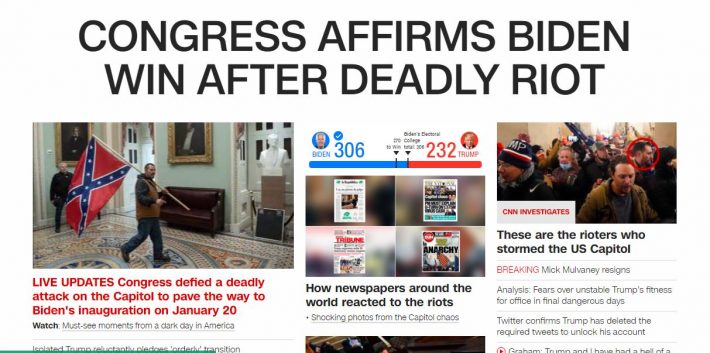
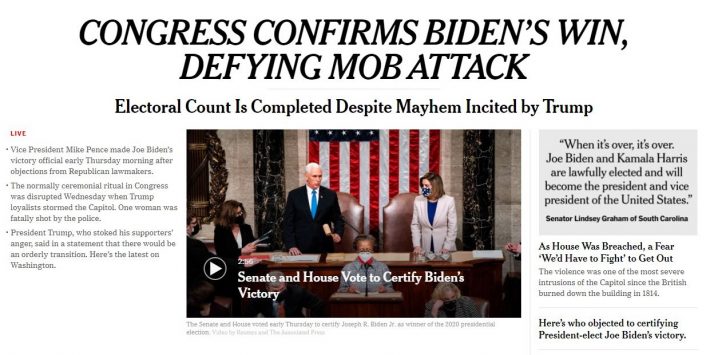
I took his thoughts (and one of his ideas) to heart and took the opportunity to do a short media studies lesson. We looked at seven screenshots of seven media outlets and asked a few questions about them:

  • What is said?
  • What is not said?
  • How is it said?
  • What images were selected?
  • What images were not selected?
  • Why this order of links?
  • Why the selected font sizes?
  • Who is the intended audience?
  • What is the intended purpose?
  • What inferences can we draw about the source?

As best I could, I scrubbed all indications of the source from the screenshot. I missed a bit from the CNN shot, observant students probably noticed the “South Carolina Public Radio” media player on the NPR shot, and I accidentally left in image attribution for The Washington Times but otherwise, I kept them a mystery. (The first time I went through the lesson, I told the students which images came from which sources. Because of the reaction, I decided not to do that in subsequent lessons.)

Here are a few things the students noted.

Screenshot 1: NPR

Of the two big stories from January 6, this source focused on the positive (for the survival of our democracy, that is) story. The attack on the capital was referred to only as “chaos and violence.”

Screenshot 2: The Washington Times

Students, after I explained who Newt Gingrich is and what “GOP” refers to, decided this was definitely targeting a right-leaning audience. I was surprised that not a single student knew what GOP meant.

“Why did Republicans get that nickname?” they all asked.

“I don’t know.”

“Do Democrats have an equivalent nickname?”

“Not that I know of.”

Screenshot 3: CNN

Students immediately commented on the amount of screen real estate the headline takes up. They also commented on the vote count graphic.

“I’ve only ever seen this on election day,” I pointed out.

We discussed the use of the term “rioter.”

“What else could we call the people who participated in that event?” I probed.

They came up with a list:

  • protesters
  • gang
  • terrorists
  • attackers
  • mob

I added one more: insurrectionists.

We put the words on a continuum, and they decided that the most benevolent was “protesters.”

“Using that term would suggest they support them,” one student succinctly observed.

At the far end: insurrectionists. All that being said, they felt that “rioters” was the most objective.

Screenshot 4: The New York Post

Students immediately noticed that, with source 4, we could win a beach house vacation! In other words, they realized quickly that this site relies heavily on ad revenue.

“Maybe it’s a blog,” someone ventured.

As to the content, they thought it was striking that the lead story was about the rioter who was shot, but they also thought it was significant that the headline left so much out.

“In the Capitol — it sounds like something happened to a tourist or something.”

Screenshot 5: The New York Times

This source included a video, which suggests that the images in the other articles are screen grabs from this video.

There’s also the word choice: mob and mayhem.

“What’s ‘incited, Mr. Scott?” they asked. “Isn’t it like ‘encouraged’?”

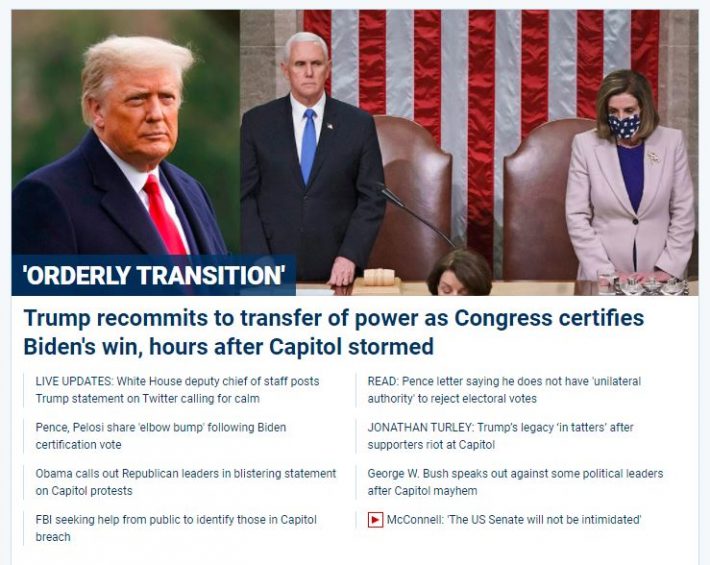
Screenshot 6: Fox News

The immediate thing students noticed was “Orderly Transition” is the headline. It’s in all-caps, so it somewhat dominates the second headline below it.

Also, in the picture, Pelosi looks a little weak: she’s a little slouched over with downcast eyes. If this was from a video, it could have been a conscious choice, which would indicate a bias. Additionally, with the placement of Trump’s picture, it seems to highlight the distance between the two parties.

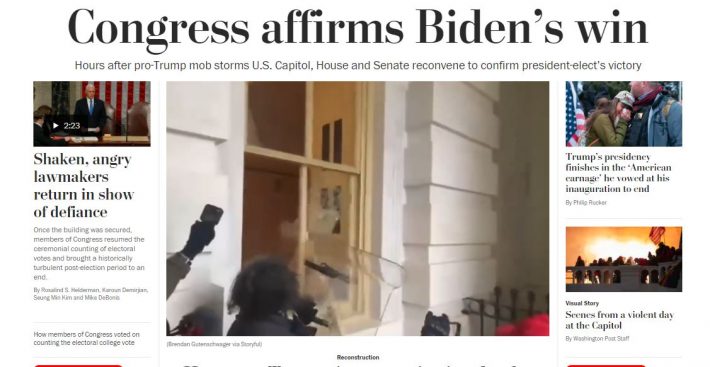
Screenshot 7: The Washington Post

The final shot came from The Washington Post. It seemed, the kids noted, to balance between both: the headline was about Biden; the image was from the assault.

“If you look at the area just below it,” I pointed out, “you’ll see what looks like the tops of letters. That was the headline for the second story, which was about the assault.”

Once we were all through, I reminded kids that the purpose of the lesson was not to teach them what to think but rather how to think. “An informed citizenry is critical to the success of any democracy,” I said.

Oh, the things we (rightly) leave unsaid in the classroom when talking about such matters, though…

Working in the Evening

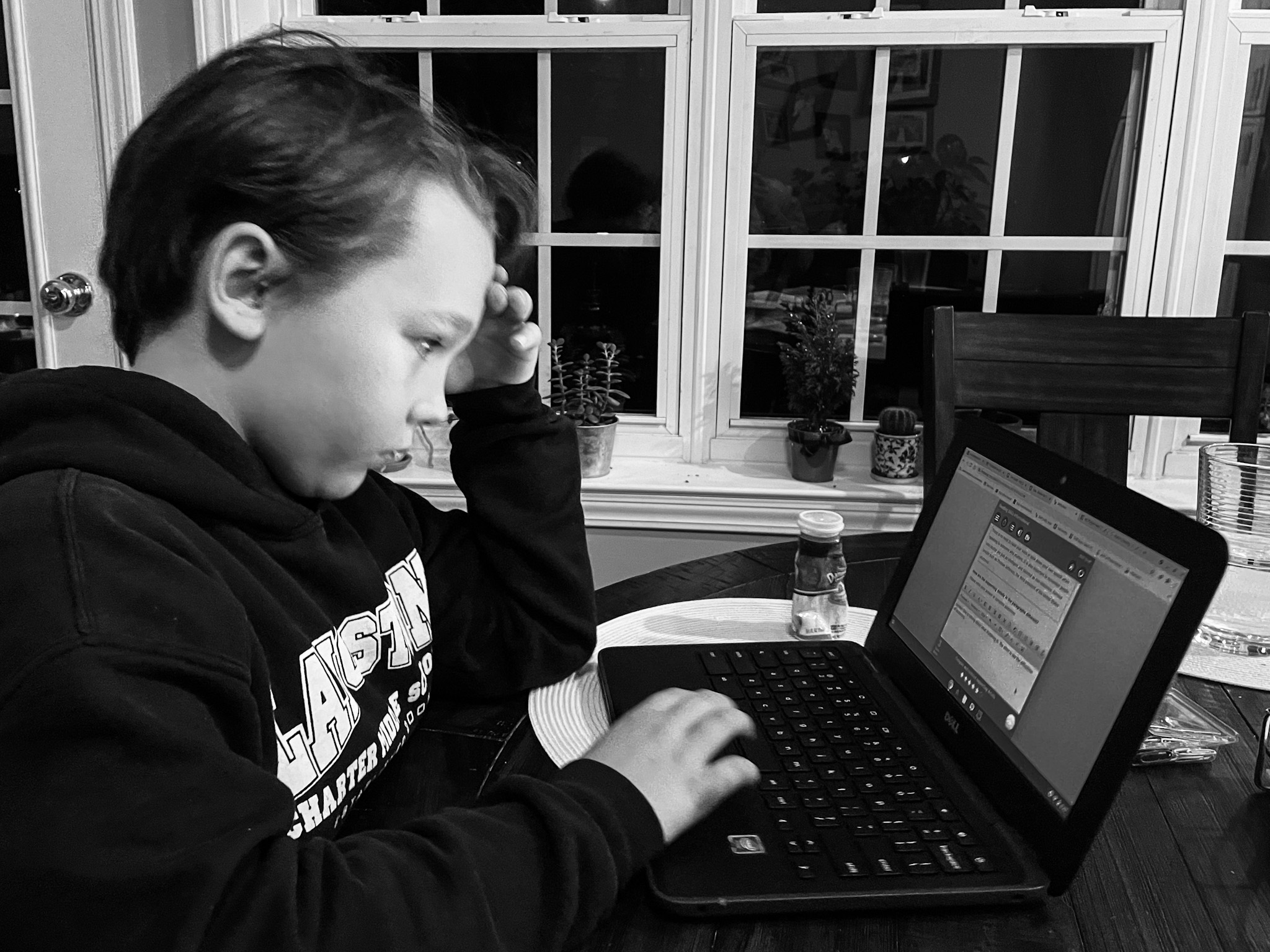
The Boy sometimes has trouble getting work done in class. I say “sometimes” but in fact, it’s more like “most of the time.” He’s easily distracted; he takes his time sometimes; he gets off task. The end result is a fairly common occurrence: we spend some time during the evening getting caught up with his work.

We worry about his ability to keep up with things return to “normal” (whatever that might be) and teachers are no longer so very forgiving. We worry that we might hear suggestions of “ADHD” and, more ominously, “medication” from well-meaning, concerned teachers.

I don’t recall ever having any significant issues like this growing up, but I also wasn’t surrounded by electronics and instant gratification. It must put a strain on the attention unlike anything we ever experienced growing up.

Various Visions

Today, we looked at six performances of various parts of the famous so-called balcony scene. I’d just discovered a new one:

This calm, nuanced performance has become my favorite.

Opłatek 2020

It’s always the highlight of the school year for me, introducing American students to the lovely tradition of sharing the opłatek wafer. The kids love it; the administrators and counselors I invite in love it; I love it.

And I thought that we wouldn’t be able to do it this year. But I’m not one to give up easily when I think it’s something valuable for my kids, so I came up with an alternate plan.

Instead of sharing food, I had kids bring in their own snacks.

“What are we doing, Mr. S?” they asked.

“You’ll see.”

It’s important that they have a bite to eat during the process because that’s what the tradition is all about: breaking bread together.

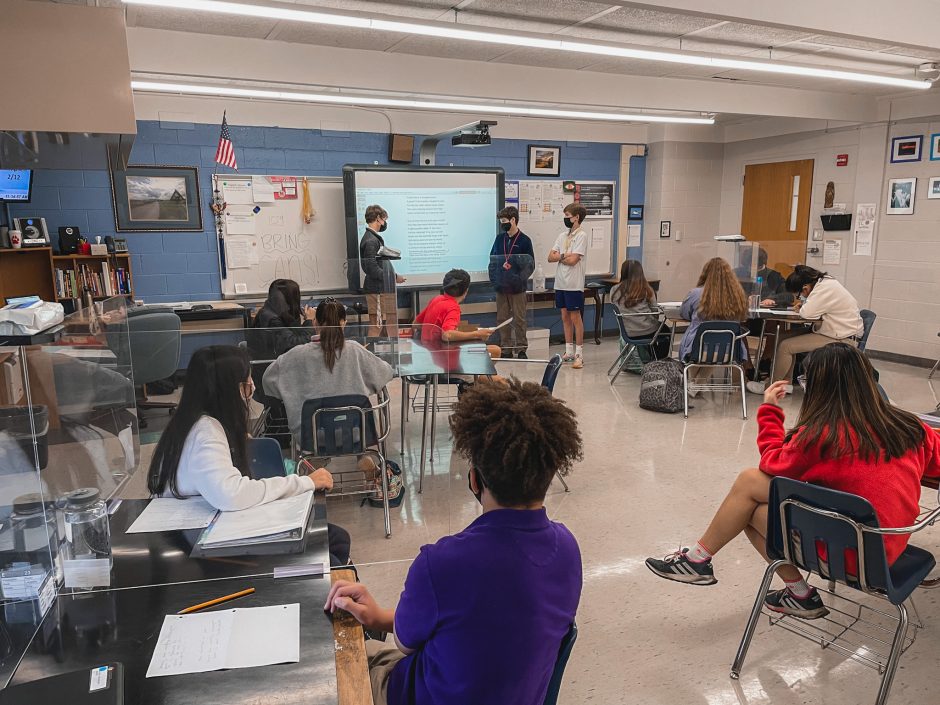
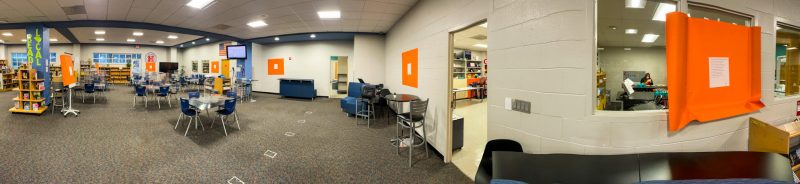
So the kids divided into two groups, with the inner group rotating in sync, always maintaining social distance, and never touching any other seat.

I showed them pictures from previous years.

“That looks really fun,” one girl said.

Well, it is more fun than what we did today, but perhaps they got a little glimpse of the perfection that is the sharing of the opłatek.

The Letter

We just started Romeo and Juliet, and a lot of the kids are quite excited about that.

I found this waiting on my desk at the end of the day. (“TDA” is a “text-dependent analysis” — the district requires us to give a couple of practice TDAs in preparation for the state-mandated one at the end of the year. No one really likes them…)

Growing and Writing

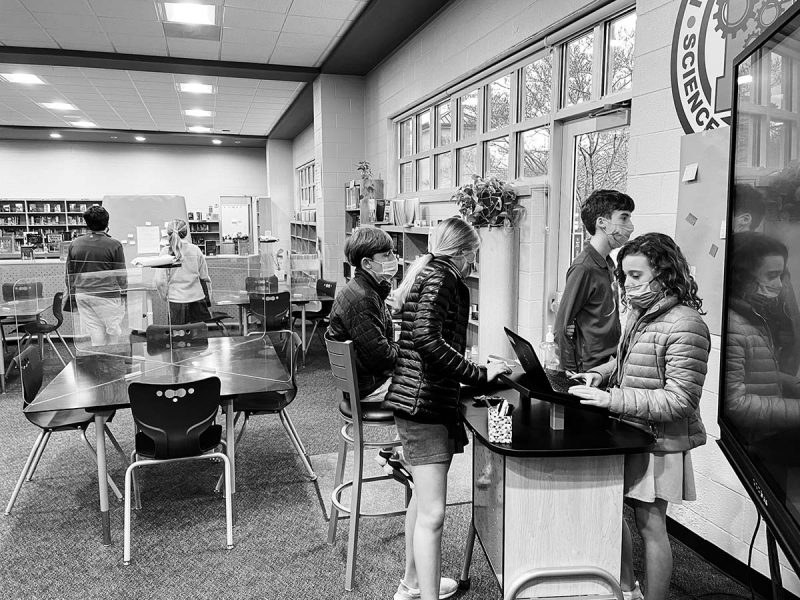
My classes are growing. More specifically, they grew today — doubled, in fact. Today was the first day we had all students back at the same time. Sixth grade has been doing it for a couple of weeks now; seventh grade began last week; this week was eighth grade’s turn. So each class had 18-24 students in plexiglass-enclosed quad-desks, each six feet apart. “Remember,” I said countless times, “these plexiglass shields only serve as protection for you and your neighbor if you have your masks on.” This mean that it was the first day for everyone wearing masks all day.

How long will we stay like this? What effect will the Thanksgiving surge, now in full swing, have on it? I really don’t know.

As part of my promise to K about my beard (“I’ll get rid of it when we’re back in school 100%.”), I had the Boy shave me last night.

That was how we had some of our Daddy-E time. Tonight, it was writing: the Boy has discovered fountain pens,

and that discovery has inspired him to write short stories. We’re working on a tag-team zombie story now.