Matching Tracksuits

fun in fours

education and teaching

Are They Listening? (No, They Are Not)

Today's journal prompt for students touches on a universal motif:

Have your parents ever said something like, “Listen to me!” or “You’re not listening to me!” when they’re talking to you? What are you doing when they say that? Why do they think you’re not listening? What does it mean to listen?

We're working our way through a unit on communication, and this week, we'll be focusing on active listening. It should be a fairly straight-forward week, especially since we only have three days in school: Monday and Tuesday constituted our fall break, one week after and 100% longer than the Boy's. (Wasn't fall break three days at one point? At least two days. Greenville County Schools cut it back this year or last, I suppose.)

As students work, I find myself thinking now-familiar thoughts: this work is so much easier than teaching English, and it's also easier, I think, than the other teachers' responsibilities, which leaves me feeling a little guilty.

Why should I? It's not like I'm spinning my wheels with the kids, just giving them busy work and straight 100s, which I theoretically could. I think that might be one of the reasons why the principal, who was my grade-level administrator at my old school, hired me to teach this leadership class: cruising is so tempting, and she knew I wouldn't do that.

Compared to what I was doing, I certainly feel like I'm cruising. Gone are the hours of reading and providing feedback on a seemingly-endless pile of essays. Gone are the hours of tedious planning. Gone are the painful and endless meetings about "data." (I swore last year I wouldn't use that word anymore. Now that the year is over, perhaps I can lighten up.) Gone are the emails asking me to provide clarification for this or that element of a lesson that the instructional coach (what in the world even is that job? do some research: though every school has one, you won't find a consistent definition or list of responsibilities) had observed and made notes about. Gone are the meetings leading up to a given benchmark during which administrators (and the instructional coach) encouraged us to encourage our students, motivate our students, push our students to take the benchmarks seriously even though almost none of the teachers took them seriously because of the lack of transparency in the benchmark and our inability to use it as a teaching aid in any sense because of its proprietary nature.

Count that: thirteen individuals with a job title that includes "Superintendent" in it, with the attendant six-figure salaries. With only an average of $150,000 a year -- and the superintendent himself making over $300,000 -- that comes to $1,950,000 for the salaries of thirteen people who work in public education and do little to nothing directly with students. They do nothing with the teachers. They are so far removed from actual education that to call them educators in anything more than a theoretical sense is insulting.

I often felt the district administrators, from the Superintendent to the Deputy Superintendent down through the seven (yes, seven) Assistant Superintendents for School Leadership, the Assistant Superintendent for Transformation, the Associate Superintendent for Academics, and the Associate Superintendent for Operations all could have used a lesson or two in active listening.

When my previous principal asked me if there was anything he could do that might convince me to stay, I told him there was nothing he could do because it's all out of his hands. I rehearsed the list; he agreed. But why was it out of his hands? Because the thirteen six-figure-salary superintendents (almost none of whom I ever met except to speak with the superintendent ten seconds when he visited our school a decade ago and one of the assistant- or associates- when they visited our school as we were coming out of COVID lockdown) take those options out of principals hands. "You should tell them at the next meeting you have that you lost a teacher that you most certainly did not want to lose because of your inability to be flexible in any way," I wanted to say, but they wouldn't have listened. We'd all be wasting our breath.

So I'm not working nearly as hard as I used to, but I still feel I'm working, and doing important work at that. Sadly I'm not impacting many of the students who would most benefit from a class like mine (and what I could make it if I did have those at-risk students in the class), but I'm coming to terms with the fact that I don't have to sacrifice my mental well-being and time for my entire teaching career. I made my sacrifice: time to move on.

But the Boy still has to face all nonsense that drove me out, but he faces it as a student. The endless cycles of benchmark tests with their weak questions drive him to the same level of frustration as they did me. He bemoans how poorly he does on them whether or not he tries, and he speaks of the frustration of hearing his teachers fuss at those who did poorly on the benchmark. "Next time they say that, politely suggest to your teacher that everyone might do better the next time if the teacher could take some time with the class and go over some of the questions the majority of students got wrong," I decide to tell him when I get home today and listen to him fuss about the latest benchmark nonsense. I know full well that the teacher can do this. I know perfectly well that the teacher himself can't even see the benchmark test but instead gets a report with the question number, the standard it supposedly covers (and don't even get me started about how poorly the questions align with the standards), and whether or not a given student got that question right, with a cumulative report for each question and each class. It's like doing target shooting with a blindfold on and being told only, "You missed. Try again."

One teacher apparently told him the benchmark is so important that it will impact her decision about which high school class to place him in later this year. "Bullshit," I want to say when he relates this to me, but I restrain myself and simply tell him that that's not accurate. But who can blame teachers for doing things like this when everyone from the thirteen superintendents down to the principal, the assistant principal, and the instructional coach all harp on the same nonsense: getting students to make an acceptable score on these tests is equivalent to ending world poverty.

"Don't tell him not to take this seriously," K constantly admonishes me, and I do indeed tell the Boy that he should look at the benchmark as must an opportunity to practice with questions like the ones that will be on the end-of-the-year SC Ready test (which, yes, is just as useless but useless at a state level instead of just a district level). But even that is not accurate: the company that creates the benchmarks is not the one that creates the actual test, and while one might think that doesn't really make a big difference, the quality of the questions from the latter is somewhat improved over the former.

So I am out of the system, out of the haranguing reality of GCS schools, but because E still has three quarters of a school year in middle school (all the testing ramps down in high school: it's just End of Course exams, SAT, ACT, and AP tests), we still suffer through it together as a family.

Field Trip

Guests

We're guests in our current school building. The charter high school with which we are affiliated (indeed, for which we will be the feeder school) is letting us use one hallway to house all 150 of our middle-school students. So none of the facilities are ours. The cafeteria is not ours. The gym is not ours. My classroom is not mine: I'm only using it until our building is completed, and we move in, which is supposed to be some time in the middle of the second semester. March-ish.

While we use their facilities, the teachers we displaced are "floaters." They have one class here, one class there. always moving from room to room. 

"That's how almost all teachers in Poland are," I explained to my colleagues, adding the notion of the Polish cohort: a group of kids with whom you spend all day, every single day, throughout high school. "Oh my God! No way!" is the typical student reaction; "I'd hate not to have my own space" is the typical teacher reaction. Both are understandable.

Being a long-term guest is liberating in a sense. I've not bothered putting much of anything on the walls. I put up some pictures on existing nails, but I haven't added any holes that weren't already there. I'm using the teacher's desk while mine sits along one wall virtually unused. Everything the teacher, Mr. W, left hanging on the walls is still just where he left them. I leave as much untouched as possible. Liberating.

Yet I've already gotten into routines of using certain things that I won't have when we move. Mr. W has a number of small dry-erase boards, each probably about a foot square, which is great for students to use for notes and such that are not critical but need to be shared with others. He has a hanging divider on the wall where I store six folders (one for each class) that has work in it I need to grade. (All are currently empty: a great feeling.) The chairs are fablous for middle schoolers: there are four possible positions the kids can choose from (and they all make different choices from day to day, believe me). All of that will change when we move to the new school, and while I usually hate change like that, I've gone into the year with the understanding that it is by nature a year filled with change. So I'm surprisingly calm about it.

End of Season

Tuesday

I was speaking with my current students about how differently I teach this leadership class than I taught English classes. I told them how much work I gave the students, how hard the assignments were, how stressed some of the students were. When they laughed that they were glad I'm not their English teacher this year, I also revealed that most of my students found English in high school to be very easy after my class. Several students then changed their story: "You need to teach us English in eighth grade!" they exclaimed.

But do I want to teach English anymore? I'm enjoy this too much.

KB departs

A traumatized kid enrolls in our school, and only weeks later, he's gone, entangled in the court system with all the fatalism and unfulfilled dreams that that entails for a fourteen-year-old black boy. 

That sentence itself is a tangle of contradictions and enigmas. "A traumatized kid enrolls" suggests that the kid made the decision, completed the paperwork, and entered our school community. Or it implies a parent made the decision to enroll him in our school and completed the requisite paperwork to enroll. In this child's case, neither is likely: the kid, of course, is a minor and couldn't do it; the parent (and statistically likely only one, and most statistically likely only the mother) seems from all accounts to be relatively uninvolved. 

“Only weeks later, he’s gone” suggests more volition that he likely lacked. It implies that he just didn’t like it — wasn’t challenged or felt the dress code too stifling. In truth, he was taken away, with all the ambiguity that passive-voice sentence suggests. More accurate from our perspective is simple: “only weeks later, he disappears.” That still suggests he is in some sense a agent in the decision, and while his behavior certainly played a role in it all, that behavior was likely not entirely consciously volitional and at least in part the crusted-over habit of years of surviving a trauma-filled life no kid should endure.

When I first met him, he was respectful, demure even: "I don't like saying I came from West Greenville," he quietly began when we first met, referring to one of the district's alternative schools, "because they think I'm a bad kid."

"Well, we all make mistakes in life," I reassured him. "I'm sure no one will judge you on where you came from but rather on your behavior."

Yet his record suggested he was what quick judgment would label a "bad kid." He came to us from alternative school, and as teachers reviewed his records, we saw that he had been in not one but two different alternative schools that year. A kid who makes a single bad decision that lands him in alternative school -- say, bringing a vape to school -- would not have such a record.

Still, he knew how to play the game: he knew first impressions count, and he made a good one. Once he got into class, though, it was another story. Passive incorrigibility and even the occasional aggressive defiance became the norm. Once, in the hallway when I was trying to direct him where he needed to go, he shouted, "Man, this is why I hate white people."

Over a few weeks, I'd managed to establish a decent relationship outside of class, though, and that helped inside the class. He began applying himself just a bit, here and there, occasionally. But much like an abused dog will bear its teeth at any perceived threat or provocation, KB’s interactions continually belied that demure front he’d put on at the start of his time with us. 

“Who’s that kid?” A teacher on another team asked as KB passed by. I told her, and she replied, “He’s really something.” Soon, everyone on the hall knew who he was, and not because of the sterling impression he was making on everyone. 

Occasionally he would be absent and return to school a few days later explaining he’d had a court appearance. “For days?” I’d think, but I kept my doubts to myself. 

There are kids teachers encounter that we know will disappear into the vast cracks in our system and appear on the evening news as a suspect in some crime or other (one former student), or perhaps as a fatality after a police chase involving a stolen car (another former student). We all pay for these kids: our tax dollars will support them in one form or another. But they pay for it as well with lost and wasted lives that represent a net negative on our society, indicting us all: that’s the true price we pay.

Everyone Sees It

The board of directors of the charter school, where I now teach, has a meeting this evening. The principal of our school asked me to have my students in the leadership class to write brief notes of gratitude to the members of the board of directors.

"What else can we write other than 'thank you for our school?'” they asked.

I suggested they could be specific: “Thanks to them, you can attend a school that has a bit more freedom in its curriculum than the average public school.”

“You mean, they’re the ones who decided we don’t have to do benchmarks?” one student asked.

When I confirmed this, I can see that several of them immediately began adding that to their thank you notes.

Later in the day, when the principal came by to pick up, thank you notes, I mentioned this to her. She said that some Greenville County schools are even worse. Apparently, they had a pretest recently for the benchmark. This is, I’m assuming, so that they can even use his first quarter to measure growth somehow. Here’s how students started in the first quarter; here’s how they ended the first quarter. Previously, we had to wait until the end of the second quarter to get that data. Now Greenville County teachers have more data. But I’ve always maintained it that useless data is just trivia. And there’s no data more useless than the data benchmarks and pretest and CFA and CSA‘s gather.

So why did they do it? Why does Greenville County even require so much testing? it’s a conservative county, which means its constituents should want fiscal conservative principles as well as social conservative principles. I’ve never met a teacher who suggested that this data was in anyway truly useful. I’ve never spoken to a parent who spoke positively of these benchmark tests. And every single kid I’ve ever met (including my own) complains about them. So the tests seem to be one colossal waste of money.

And it would have to be an enormous amount of money because all of these tests are created by third parties and they administered to third-party software. That means these test questions cost money. Subscriptions to Mastery Connect software costs money. And it’s all just a waste of time, which means the salary for teachers to administer the test costs money. None of the true stakeholders see any value in it. Why do we keep doing them?

Simple. There are a whole class of administrators in the district office who have to justify their six figure salaries.

I started doing some research about just how many people at the district office make over $100,000, and I found an article in the local paper about it:

More than 100 administrators earn six-figure salaries in Greenville County Schools, according to the school district.

That's more than $10 million in annual salaries for just the 100 top-paid employees in the state's largest district.
None of the district's 4,000 classroom teachers earns a six-figure salary, according to a document provided by the district.
The 100 top-paid school employees are all district-level and school-level administrators.

Some of the top earners:

  • Burke Royster, superintendent: $256,717.
  • Charles Gary, deputy superintendent: $178,807.
  • William Brown, executive director, educational technology services: $154,000.
  • Lynn Gibbs, executive director, human resources: 150,270.
  • Jeffrey Knotts, executive director, finance: $149,995.
    John Mills, executive director, construction management: $146,577.
  • Jeffrey McCoy, associate superintendent, academics: $142,314.
  • Rodney Webb, legal counsel: $142,314.
  • Traci Hogan, assistant superintendent, special education: $139,503.
  • Elizabeth Farley, executive director, planning and demographics: $139,264.
    Michelle Meekins, assistant superintendent, school leadership-elementary: $139,264.
  • Richard Barber, director, internal auditing: $138,308.
  • Jason McCreary, director, accountability and quality assurance: $138,308.
  • Charlotte McLeod-McDavid, executive director, academic innovation and technology: $134,927.
  • Phillip Davie, assistant superintendent, administrative school support: $132,814.
  • George Skipper, principal: $132,483.
  • John Peake, principal: $132,483.
  • William Rhymer, assistant superintendent for school leadership-high school: $128,937.
  • Ella Beltran, information assurance and archives: $128,441.
  • Andrew Crowley, principal: $126,567.
  • Darryl Imperati, principal: $126,567.
  • Kent Owens, executive director,  student services: $126,181.
  • David Smith, executive director, career technology education: 125,299.
  • Brenda Byrd, assistant superintendent for school leadership-elementary: $124,251.
  • Terisa Brinkman, executive director, strategic community engagement: $124,251.

Of the top 25 earners in the county, four are principals, twenty-one are district administrators, and not surprisingly, none are teachers.

Here's the real kicker, though: that article is from August 28, 2017. It's eight years old. There are even more administrators at the district office. There are deputy superintendents and assistant superintendents and associate superintendents. And they all have to justify their jobs, show that they're doing something to earn their money. What better way than to make spreadsheets and PowerPoint presentations for speeches to this or that group of other administrators. (Or rather, to have their secretaries make these spreadsheets and PowerPoint presentations -- you don't think they do that?)

Returning to the Court

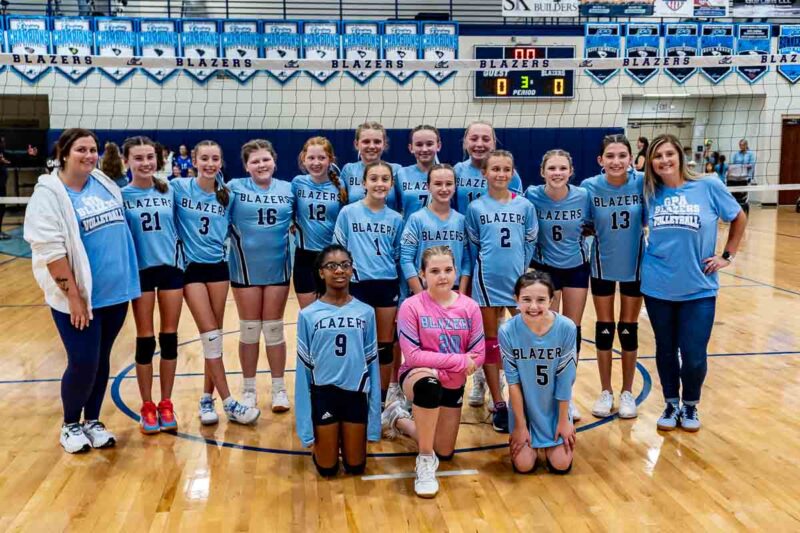
For our students, our school is all of ten days old now. That's how much experience our volleyball team has, as well. Less, in fact. Add to it the fact that, unlike all other middle schools in the area, we don't have any eighth-grade players because we don't have an eighth grade and it's clear the girls are going to be in for a tough year.

You know it's going to be a tough year when the first set finishes 4-25, the the girls celebrate wildly after ever point they get. Big celebrations. Wide-eyed smiles and literal jumps for joy. Every single point.

But today, they achieved the unexpected: a second-set win. It was classic middle-school volleyball. The other team clearly outmatched them, but they fell apart in the second set and made a lot of unforced errors, and our girls took advantage of it. They ended up winning 25-22, and their reaction was as if they'd won the national championship.

Sixth Graders

Of my six classes this year, four are with sixth graders. It's a whole other world. Of course, there's the issue of size: one girl I teach, a sweet and observant girl who quietly observes everything around her, barely comes up above my belly. She probably only weighs double her bookbag. I suggested that today as she waited in the hallway for her next class. She smiled and agreed. Most eighth-grade girls are getting close to their final height, and few of them don't at least reach a little past my shoulders.

They're also just a little more helpless. They're coming from elementary school where there's a lot more coddling, a lot more worrying. Hall passes are an entirely new thing. Having different classes with different teachers among different students each period is an entirely new thing. They have to adapt to the personalities, habits, and routines of six different teachers instead of just a main teacher and a couple of related arts teachers.

But most strikingly different from eighth graders is the pure sweetness some of them exhibit. One girl came up to me between classes, insisted on giving me a hug, and said, "I love you, Mr. S." The most you'd ever get out of an eighth grader is "I tolerate you."

Baseball Surprise

Greenville Water bought tickets for its employees to watch a Greenville Drive baseball game. It was all going along like a normal baseball game (hype man, mascot, etc.) and then it came time for the national anthem. The announce explained that the young lady who'd be singing it was already an accomplished artist, performing as Annie in Annie and several other leading roles. He explained that she would begin her studies shortly at Boston Conservatory and asked us to give a warm welcome to AW.

"AW?!" I exclaimed, turning to K. "She was my student!"

After she sang, of course, I spoke with her. We talked about how wonderful Boston is, how her fellow students from her class were doing, and then I told her, "You probably don't know this, but I'm not teaching at Hughes anymore."

"I know," she said with a grin. "Gossip travels fast at Greenville High."