matching tracksuits

fun in threes, sometimes fours

education and teaching

Sentence Frames

It’s a tough prompt: the analysis required might be too much for my students even at the end of the year; at this point in the year, it’s an impossibility. But I can apply various supports that will help them ease into the whole argument unit.

“What evidence does the author use to support the claim that MLK was the right man born at the right time?”

We’re not evaluating the argument: we’re not even looking to determine the claim. The claim is settled: MLK was the right man born at the right time.

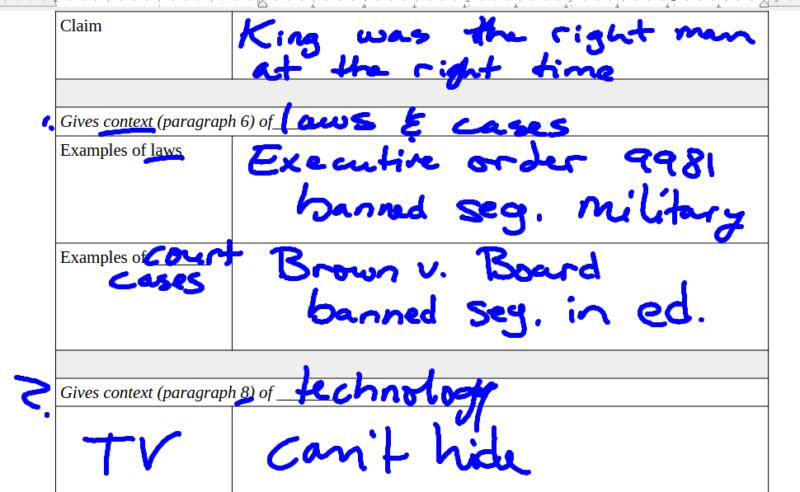
I look over the passage and realize that the key idea is that he was born at the right time. It’s a question of context. He rose to prominence after Excecutive Order 9981 desegregated the military and Brown v. Board did the same (in theory) for schools. The author also points out that the rise of television helped King and the civil rights movement as it made it impossible to ignore the brutality directed at the African American community.

I help the students see all this, creating a graphic organizer to put this information into manageable form.

At the end of the lesson, I wrap up how our planning would form an answer:

The author supports the claim that King was the right man at the right time by showing the context of his leadership. For example, the author gives the context of laws and court cases. He explains Executive Order 9981, which banned segregation in the military. He also explains how Brown v Board ended school segregation. In addition, the author gives the context of technology. He points out that television made it impossible to hide how African Americans suffered.

As I say this, I point to each part of the organizer to show where the ideas are coming from.

The next day, I plan for an easy task. We’re simply going to take our graphic organizer and turn it into sentences. “I gave them all the answers yesterday,” I think to myself. “How much of a challenge can this be for them?”

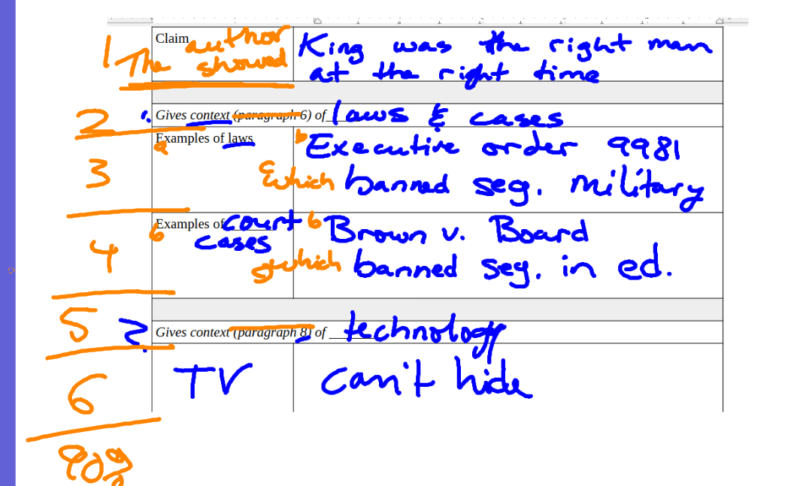
We begin reviewing our work, and I add some more schaffolding: I number the sentences they need to write and add some transitional elements to help them connect things:

Each line, each numbered element becomes a sentence. I remove the parenthetical annotations to make it even easier. So I’m hoping students will see “Gives context of laws and cases” and realize the only thing missing is the subject. I don’t even expect or even hope that they will think in those terms. All they have to do is read it and think about it:

“‘Gives context of laws and cases.’ Who gives the context of laws and cases?” That’s the first step, but some of them struggle even realizing this.

One young man comes to me for help.

“I don’t know what to do with number two,” he admits.

“Well,” I begin, “read the text for number two.”

“Gives context of laws and cases.”

“What’s missing? What question do you have when you say that?”

He looks at me, a completely blank expression suggesting that there’s so much he doesn’t understand about it that he doesn’t even know where to begin. I decide to simplify.

“Imagine I walk up to you and say, ‘Gives her an apple.’ What question comes to mind when I say that.”

How hard can it be for this kid to see that we have an action here and we have no idea who’s doing it? How difficult can it be to realize that the simplest question in response to this “Who”?

I finally help him to see that we don’t know what’s going on there and that the questions, “Who gives her the apple?” And I think we’re ready to return to my original question.

“So, when I say ‘Gives her an apple,’ the obvious question is ‘Who gives her an apple.’ So if I say ‘Gives the context of laws and cases,’ what’s the obvious question?” I don’t even bother looking up at him because he should catch this almost immediately. It’s the same problem. He just stares at me.

Even after I get through to him that we’re trying to figure out who provided the context, he can’t take the next step. I’ve had this problem with other students, and they get confused about what we’re really writing about. They ask, “Martin Luther King?” sheepishly.

This is a deceptively complex question we’re working on: we’re not asking a question about the contents of the text itself — what it’s about — but the decisions the author made in creating the text. It’s not an analysis of the contents of the text but of the structure of the text, of the process and thinking behind the writing of the text.

But this level of questioning is not even our ultimate goal. We’re ultimately supposed to get students ready to answer questions about evaluating the claim and evidence of an argument. Here, I’m giving the claim and the paragraph in which to find the evidence. I’m just asking them to figure what the evidence is. I’m not asking them to find the claim. I’m not asking them to find the evidence among all the paragraphs. And I’m certainly not asking them to make decisions about the quality of the evidence provided. And as far as potential counterclaims — forget it. I just want them to find the evidence.

While I’m working with this boy, a handful of students realize the relatively straightforward nature of what I’m asking them to do and how it’s all on the board and write beautiful (although simple and short) paragraphs about it.

These kids are in the same class along with a boy who speaks very little English and a boy who speaks no English at all, and the state expects me to get them all to the same place in nine months: analyze the argument in an eighth-grade level text and evaluate its effectiveness.

And they are struggling to do it when I’ve already done it with them. Using a fifth-grade level text.

1.5

End of the Break

The break is over: the kids go back tomorrow, with E starting his second semester in middle school and L beginning her last semester as a junior. Two facts that are hard to comprehend: the Boy is 11; the Girl just turned 17. One more hard-to-believe fact: the school year is half over now.

I went back to school today for a teacher’s workday. Walking down the halls this morning I had the realization that we only have a matter of months before the end-of-year testing kicks in, and few of my on-level kids are ready for it. Granted, they’ve made progress this first semester, but there’s still so much more to do. One of the frustrations I have with all this testing is that it’s heartlessly uniform in its expectations: growth doesn’t matter; improvement doesn’t register — everyone has to reach the same place at the same time. The kids who go from struggling to write a paragraph with more than three sentences to writing fully-formed Schaffer paragraphs that make a claim, provide evidence, and explain that evidence will still get a “Not Met” score at the end of the year even though they’ve grown more than the English Honors kids who will score “Exceeds Expectations.” The kids who had so many emotional issues that sitting in a class and focusing for more than a few moments who grow to the point that they can remain focused for ten minutes at a time and work collaboratively with their peers without getting off-topic for a full five minutes — they’ll still “fail” despite all the evidence I could provide to the contrary.

School Oplatek and Holiday Party

That Time of Year

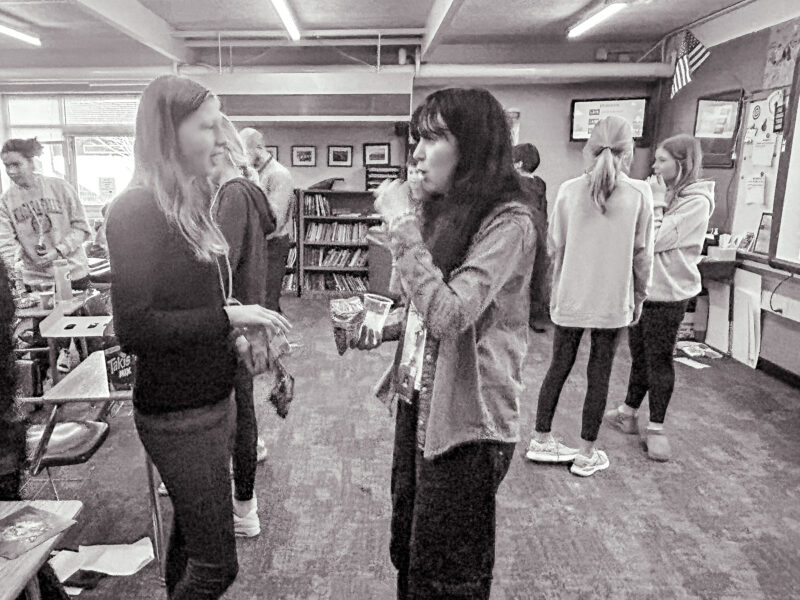
We always have some kind of decorating competition in school around Christmas -- door decorating, hall decorating, tree decorating. And there's always a group of kids who are so very eager to do the work.

It's also this time of year that we often start Romeo and Juliet. I've about completed the whole first act in a single week. We could have pulled it off if it weren't for today's quiz...

Basketball 2023

Cheering for my students -- few things are better.

December Friday

Today was our annual trip to the district's vocational school to give our soon-to-be-high-schoolers an overview of what's available to them there: everything from cosmetology to firefighting, from diesel engine repair to culinary arts, from mechatronics to nail tech. It's quite an impressive variety.

Once I got back home, I saw that the inevitable has begun: our poor widowed neighbor has moved out of her house and family and friends have already started on the house -- they took down the back deck that looked to be made of nothing but rotten boards.

"Wonder what kind of neighbors we'll get," will become a common topic of discussion, I'm sure -- not that we have any say in the matter.

For dinner, Babcia made placki ziemniaczane with mushroom sauce -- utter heaven.

And after dinner, a walk with the dog while the rest of the family went to church, a walk that included a street I haven't been on in ages. I'd forgotten about the holiday scene they create.

Eighth-Grade Meeting

Imagine

An imaginary email:

Thank you for attending the Q2 Student Progress Monitoring meeting with Bob Smith from the district office. As we prepare to engage in the Q3 Student Progress Monitoring process, please discuss and have one person from your collaborative team respond to this email no later than 4pm on Thursday. Please Cc: Bob Smith when you respond.

  • Question 1: What is the title of your current unit of study and what date do you anticipate finishing this unit?
  • Question 2: What is the title of your next unit of study and what date do you anticipate beginning this unit?

Let me know if you have any questions/concerns.

An imaginary response:

Thank you for your email thanking me for my attendance at the mandatory meeting. I appreciate the chance to sit with my colleagues and hear from someone at the district office how to do my job. Since I'm completely unfamiliar with monitoring student progress having taught only 24 years now, I appreciated the refresher of the basic ideas with which only the rawest of new teachers are unfamiliar. However, given the amount of time it took to fill out the forms your method required, I think I will have to politely decline further participation. I trust the district office will understand that my experience should suffice.

Games