Matching Tracksuits

fun in fours

education and teaching

Four Numbers

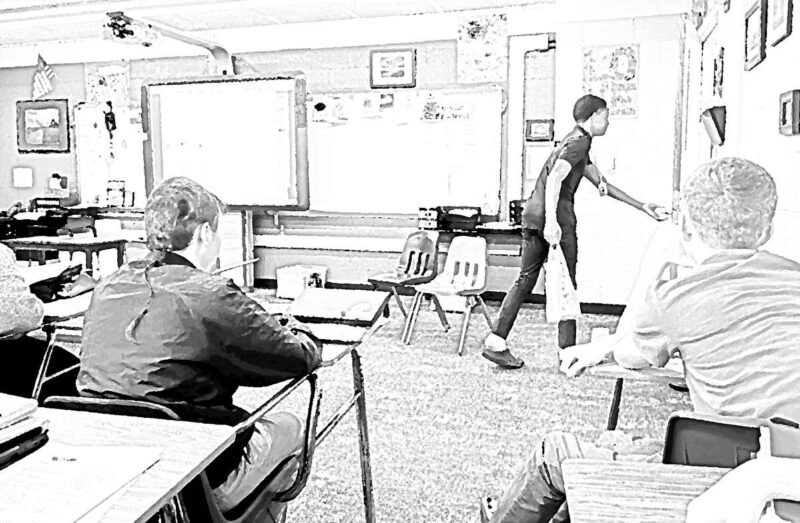
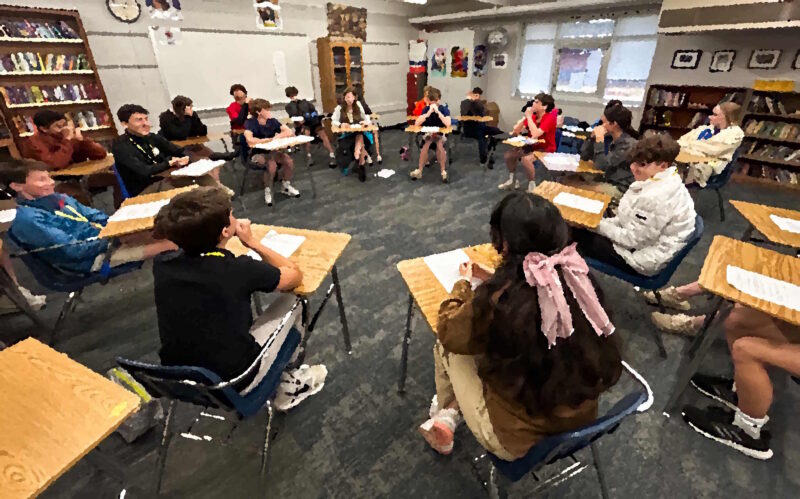
The setup is simple: two circles of desks created of triads of one inner-circle desk and two outer-circle desks. Students in the inner circle can talk; students in the outer circle can only listen until they tag in and exchange places with an inner-circle student. However, the desks are usually set up in rows, so students have to rearrange the desks to get them in these circles.

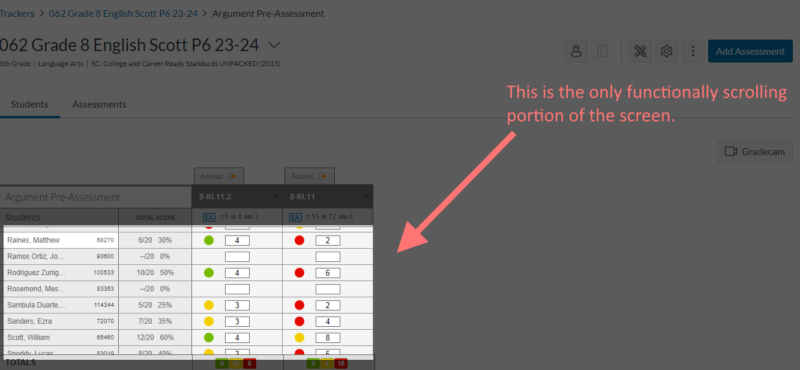
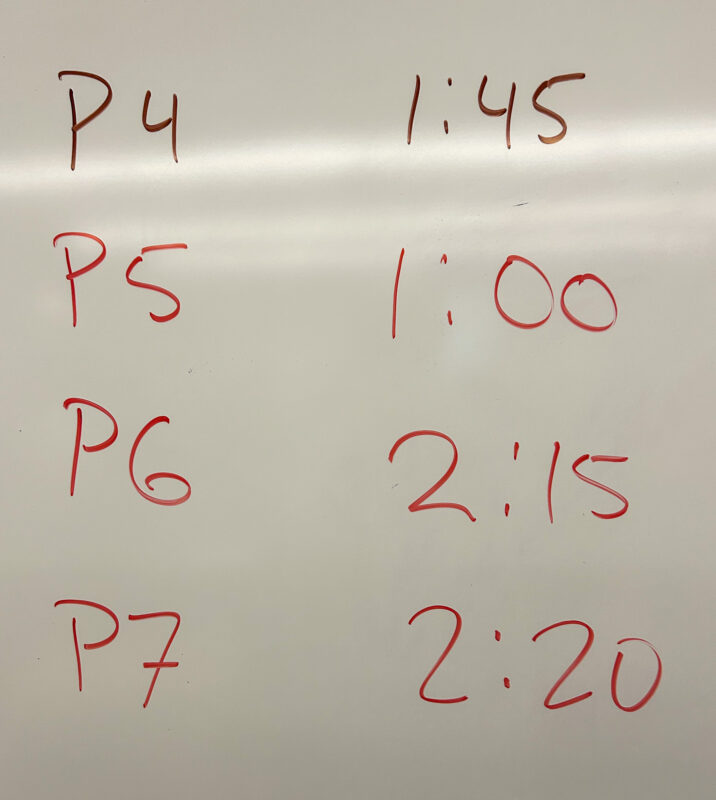
I often race classes to see who can settle the rearrangement the fastest. The results are telling:

My P4 and P5 classes are my honors classes; my P6 and P7 classes are my on-level groups. The result is consistent: the honors classes get the job done faster than the on-level classes.

Why is this?

The on-level classes sometimes refer to the honors classes as "the smart-kids classes," and I often point out that they're not smarter. They usually just work harder. They stay focused in class and give their best effort at all times. When I ask them to do something at home, they generally do it. The thing is, they've been doing this for years, so they've gradually become increasingly better students -- better readers, better writers.

I know that for many of the honors kids, there is a socioeconomic element at play as well. They most likely live in homes with more books. Their fathers and mothers are lawyers and teachers, so they see reading and writing modeled frequently. And most of them come from two-parent family, which offers great economic advantages over single-parent households. This is not to say all these factors are true for all honors students or that none of these factors are true for on-level students. There are a lot of factors at play.

Be all that as it may, though, the honors kids get the desks arranged faster. This is connected to executive functioning more than academic achievement. So which came first? Probably neither: both were nurtured at every turn by a number of different adults, and the numbers tell that story.

Monday Thoughts

School Thoughts

We received a new student on our team today: a fifteen-year-old boy from Central America who doesn't speak a word of English and has not been in school since the first grade.

I have reservations.

I'm not fussing about any extra work entailed by having such a kid in my classroom. I've already got two complete-non-speakers and a fourth kid who barely speaks English. My reservations are about how effectively I can really help these kids. They are, of course, in my lowest level classes, which means there are a lot of behavior issues in those classes. I'm supposed to create a new curriculum for these boys because they're so low with their English that modified materials don't do anything for them in my class. In science, yes. In math, certainly. In social studies, a qualified yes. In English class, though? It's impossible just to modify the curriculum. This newest student is illiterate in his first language: I can't modify my curriculum that includes standards like "Determine one or more themes and analyze the development and relationships to character, setting, and plot over the course of a text; provide an objective summary" and "Determine the figurative and connotative meanings of words and phrases as they are used in text; analyze the impact of specific word choices on meaning and tone, including analogies texts." You can't do this with pictures. Besides, I struggle teaching the native speakers these things because of their low motivation -- teaching a non-English-speaking student with the aid of pictures? Not going to happen. So I'll have to invent a curriculum for these boys.

Is that type of teaching really in these boys' best interest? Wouldn't a part-time immersion with classes like gym and art coupled with a couple of direct English instruction courses be more effective? The people at the district office downtown will say, "No, the data don't support that." But I think that's bullshit. I know from my own experience in Poland that dumping me into an environment where I didn't speak the language without any direct language instruction would have only frustrated me, and that's with me being 22 years old at that time. If I were only 14 in such a situation -- forget it.

Parenting Thoughts

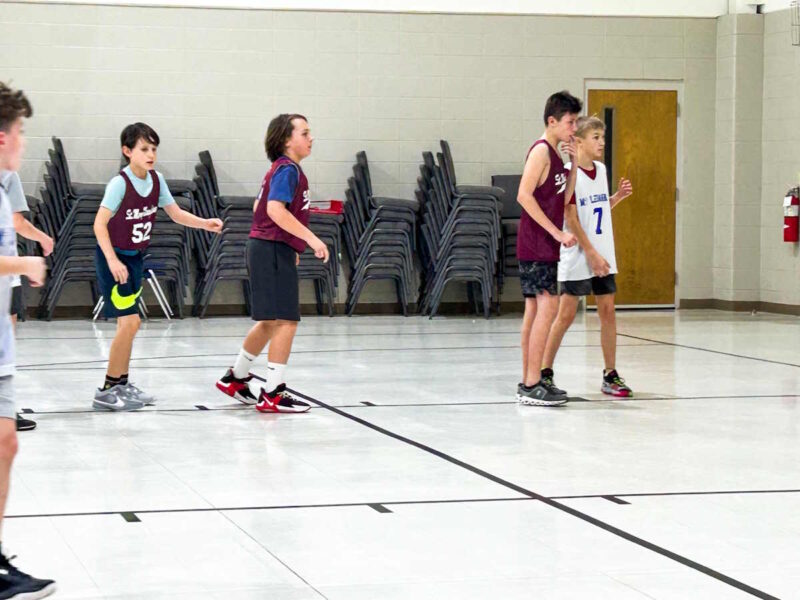
The Boy's church league basketball team had their last game this evening, which sadly they lost 22-30. It was a tough season: they went 1-8. But it wasn't the losing that bothered the Boy so much; it was the unsportsmanlike conduct so many of the players on the other teams exhibited. Tonight, for example, there was one boy who screamed at every shot attempt our team made in an effort to distract our boys.

I had some choice words to say in texts to K about this kid's behavior.

"Just keep your cool," she gently reminded me.

"Of course -- he's just a kid," I replied. But that type of behavior doesn't come from nowhere. Either his parents never tried to correct him because they saw nothing wrong with it, or they actively encouraged and/or taught him to behave like that.

Were I to coach such a kid, I'd tell him and his parents, "Look, if you do that, I bench you for the quarter. You do it again, it's for the rest of the game. And every time after that, it's for the rest of the game."

The Boy's inherently empathetic outlook on things means such behavior would never enter his mind. Was that something we had to teach him? I guess we did, but I don't remember doing so, and I suspect his empathy would lead him not to do that even if we didn't explicitly teach him that.

School Drama

How much of drama in the school is from adult modeling, both in the popular media and the home? The norm is to be upset about something, to be stressed about something, to feel wronged by someone. It's a victimization mentality, a life lived in the passive voice and ordered by second and third conditionals. What we see on the tabloids while waiting to check out at Publix is what the kids try to emulate in their daily interactions with others, both because of what they see in the media and because the media informs the behavior of so many adults around them.

Watch any reality TV show: it is one constant conflict. Granted, it's a hyped, artificial conflict: this or that individual doesn't want to get kicked of this or that show, and the backstabbing and conniving of other participants creates conflict and heightens audience self-identification: "Hey, I've been stabbed in the back like that myself!" we say when we known someone's scheming on reality TV has paid off.

That ain’t us

"Every single kid in this class been suspended at least once."

It was a fair claim, and honestly speaking, I knew the girl who said it might actually be right. At least for half a second, that's what I thought. A quiet voice beside me reminded me that that probably wasn't the case.

"I haven't."

The shy words came from one of the best students in the class, a hard work boy who never has any behavior problems. The two girls with whom I was speaking -- with whom I'd drifted so off topic from our classwork that I felt somewhat guilty continuing it and did so only because of a perceived need to explain some basic facts to some confused girls -- the two girls just looked at him. I jumped in.

"And in fact I can show you a whole class of students that have never been suspended." I had in mind my honors group, but times are changing, and being in an honors class no longer necessarily means perfect behavior, so they argued, tossing a couple of names at me. Knowing they were likely right, I persisted nonetheless in asserting that none of them had been suspended.

Finally, the girls turned to the fatalistic refrain of at-risk kids: "Well, that's them, not us."

"But it could be you," I suggested, and one would think I'd suggested that they could fly to the moons of Jupiter by their own power, such was the looks of disbelief.

"That ain't us!" they insisted.

The Bird

The kids are all taking a benchmark test. We're spending two hours of each of the two days students will be in school taking a district-mandated benchmark test, which, truth be told, will be of little to no value to me. I know where my students are; I know where we're going; I know what I haven't covered. Further, I know the students better than a benchmark could show

In the midst of all this, a bird flies up to the window and perches on the sill. It cocks its head as it investigates all the humanoid forms on the inside, all hunched over glowing boxes, almost all oblivious to the bird's presence. Except Anna. She's sitting next to the window and has watched the bird flutter up. She takes a break from her test and looks over at the bird, smiling and likely grateful for the break the bird's presence has brought.

Birds come to this window regularly, but their presence injects a bit of tragic chaos into the class atmosphere. Twice this year, birds have flown into the window with a sickening thud, only to lie outside the window slowly dying of the blunt force trauma the window and physics delivered. They flap about just outside our window as if they are trying to distract a predator to lure it away from its nest. These times, though, the bird is not faking. 

The Girls

I was on my way out to my car when the two little Muslim sisters (I knew this because they both cover their heads with scarves) passed me. I greeted them and somehow, we began talking. A group of their friends, all girls, gathered around us, all talking to me at almost the same time. I asked them where they're from, and one girl said that she's from Afghanistan.

"Do you speak Dari or Pashto at home?" I asked. Her jaw dropped.

"You know those?!"

"No, no, not how to speak them. I just know they exist. I know they're the primary languages of Afghanistan."

She smiled ear to ear: "We speak Pashto."

"I'm from Iran," another girl said. "I speak Persian at home."

"Oh -- Farsi, right? Isn't 'thank you' in Farsi 'Mersi'?" I asked.

Another jaw dropped.

"I just always found it strangely beautiful that it's a loan word from French."

"Do you speak French" the lone boy asked.

"Un peu," I responded, winking, hoping he wouldn't push me beyond my meager limits in the language.

But before that could happen, one of the young covered girls announced, "I'm Fatima!" They'd been telling me their names, and she finally got hers squeezed in.

"Oh, like the prophet Mohammed's daughter, right?" I asked.

Her eyes got enormous and she ran back into the classroom, presumably to tell someone.

The fact that I know these little tidbits seemed to me simply basic education about other cultures. I know Dari and Pashto were Afghan languages because of our country's involvement in that country and learning a little about it and its history at that point. I know "mersi" was one way in Farsi to say "thank you" because I sat next to an Iranian woman and her child on a flight from Charlotte to Munich in 2015 when I followed K and the kids to Poland a few weeks after they'd left. I know Mohammed's daughter was Fatima because I read parts of a book about the supposed apparitions of Mary at Fatima. I know a bit of French because I too two years of it in college. Just a few tidbits of knowledge about these girls' (and one boy's) language and culture, but it seemed to make their day.

So little to create so much.

Overheard

“We’re just trying to teach the responsibility,” she said, explaining the reasoning her son’s teacher gave for assigning some work that the mother felt was unnecessary.

The words had hardly left her mouth when her interlocutor jumped in with how he would have responded and perhaps in doing so, suggesting how she likely replied or wanted to respond: “That’s my job.”

So many ideas packed into that handful of words.

The overarching notion is that there are some things that a teacher teaches, but there are some things that only a parent teaches. This notion of non-overlapping domains is popular with those who lean right, and it is fast becoming a key right-wing talking point. Whether it’s issues of race or questions of gender, the right is quick to point out that there are things that parents teach and it’s hands-off for everyone else.

I’m certainly not suggesting that there aren’t things that are predominantly in the domain of parents. Religion, for example, is something that as far as proselytizing is strictly off-limits for teachers, and rightly so. The problem with religion and issues about science is that the right is constantly redefining what is acceptable. It’s no longer acceptable, some feel, merely to teach students the beliefs and rituals of other religions for them to be educated about the beliefs and motivations of others. This is growing to include ideas like scientific literacy. Young Earth creationist parents resist the teaching of evolution in schools as an infringement on their religion as much as they do about teaching students the basics of Buddhist belief. If it contradicts or threatens Christian faith, they want it out.

Perhaps none of this applies to the individuals I overheard. Perhaps it all is. (Living in the South and overhearing this at a Scouting function, I would suspect it’s likely that at least some of it is.) What I found most interesting was the realization I had on hearing this that many parents in America have no idea at all what’s going on in schools. Teaching responsibility might very well be something the parent I heard does regularly and well, but schools are filled with students who are not taught these basic things at home. Teachers have to pick up the slack that negligent parents, overwhelmed parents, single parents, and any other parents leave.

Presentations

Literal

We're reading the balcony scene and looking closely at Romeo's famous monolog (almost a soliloquy) when we get to the second half where he begins comparing Juliet's eyes to stars:

Two of the fairest stars in all the heaven,
Having some business, do entreat her eyes
To twinkle in their spheres till they return.
What if her eyes were there, they in her head?

"What would happen if that exchange happens? If Juliet's eyes were replaced by stars and vice versa?"

"Um, she would burn up from the heat of the stars, Mr. Scott," says Mr. Literalist in the front row.

Sentence Frames

It’s a tough prompt: the analysis required might be too much for my students even at the end of the year; at this point in the year, it’s an impossibility. But I can apply various supports that will help them ease into the whole argument unit.

“What evidence does the author use to support the claim that MLK was the right man born at the right time?”

We’re not evaluating the argument: we’re not even looking to determine the claim. The claim is settled: MLK was the right man born at the right time.

I look over the passage and realize that the key idea is that he was born at the right time. It’s a question of context. He rose to prominence after Excecutive Order 9981 desegregated the military and Brown v. Board did the same (in theory) for schools. The author also points out that the rise of television helped King and the civil rights movement as it made it impossible to ignore the brutality directed at the African American community.

I help the students see all this, creating a graphic organizer to put this information into manageable form.

At the end of the lesson, I wrap up how our planning would form an answer:

The author supports the claim that King was the right man at the right time by showing the context of his leadership. For example, the author gives the context of laws and court cases. He explains Executive Order 9981, which banned segregation in the military. He also explains how Brown v Board ended school segregation. In addition, the author gives the context of technology. He points out that television made it impossible to hide how African Americans suffered.

As I say this, I point to each part of the organizer to show where the ideas are coming from.

The next day, I plan for an easy task. We’re simply going to take our graphic organizer and turn it into sentences. “I gave them all the answers yesterday,” I think to myself. “How much of a challenge can this be for them?”

We begin reviewing our work, and I add some more schaffolding: I number the sentences they need to write and add some transitional elements to help them connect things:

Each line, each numbered element becomes a sentence. I remove the parenthetical annotations to make it even easier. So I’m hoping students will see “Gives context of laws and cases” and realize the only thing missing is the subject. I don’t even expect or even hope that they will think in those terms. All they have to do is read it and think about it:

“‘Gives context of laws and cases.’ Who gives the context of laws and cases?” That’s the first step, but some of them struggle even realizing this.

One young man comes to me for help.

“I don’t know what to do with number two,” he admits.

“Well,” I begin, “read the text for number two.”

“Gives context of laws and cases.”

“What’s missing? What question do you have when you say that?”

He looks at me, a completely blank expression suggesting that there’s so much he doesn’t understand about it that he doesn’t even know where to begin. I decide to simplify.

“Imagine I walk up to you and say, ‘Gives her an apple.’ What question comes to mind when I say that.”

How hard can it be for this kid to see that we have an action here and we have no idea who’s doing it? How difficult can it be to realize that the simplest question in response to this “Who”?

I finally help him to see that we don’t know what’s going on there and that the questions, “Who gives her the apple?” And I think we’re ready to return to my original question.

“So, when I say ‘Gives her an apple,’ the obvious question is ‘Who gives her an apple.’ So if I say ‘Gives the context of laws and cases,’ what’s the obvious question?” I don’t even bother looking up at him because he should catch this almost immediately. It’s the same problem. He just stares at me.

Even after I get through to him that we’re trying to figure out who provided the context, he can’t take the next step. I’ve had this problem with other students, and they get confused about what we’re really writing about. They ask, “Martin Luther King?” sheepishly.

This is a deceptively complex question we’re working on: we’re not asking a question about the contents of the text itself — what it’s about — but the decisions the author made in creating the text. It’s not an analysis of the contents of the text but of the structure of the text, of the process and thinking behind the writing of the text.

But this level of questioning is not even our ultimate goal. We’re ultimately supposed to get students ready to answer questions about evaluating the claim and evidence of an argument. Here, I’m giving the claim and the paragraph in which to find the evidence. I’m just asking them to figure what the evidence is. I’m not asking them to find the claim. I’m not asking them to find the evidence among all the paragraphs. And I’m certainly not asking them to make decisions about the quality of the evidence provided. And as far as potential counterclaims — forget it. I just want them to find the evidence.

While I’m working with this boy, a handful of students realize the relatively straightforward nature of what I’m asking them to do and how it’s all on the board and write beautiful (although simple and short) paragraphs about it.

These kids are in the same class along with a boy who speaks very little English and a boy who speaks no English at all, and the state expects me to get them all to the same place in nine months: analyze the argument in an eighth-grade level text and evaluate its effectiveness.

And they are struggling to do it when I’ve already done it with them. Using a fifth-grade level text.