Matching Tracksuits

fun in fours

current affairs

Mob Mentality

The kids wrote another TDA today. I’ll be giving them feedback over the next couple of weeks regarding this as we near the final, actual TDA portion of the state-mandated year-end testing.

Since it was a testing schedule, we only had a few minutes in each class. As they’d already been writing for two hours in the morning, students got a chance to relax a bit and watch 20 minutes or so of the film version of To Kill a Mockingbird. I let them choose from a few scenes:

  • Opening (Meeting Dill)
  • Shooting the Mad Dog
  • Sneaking a Peek at Boo
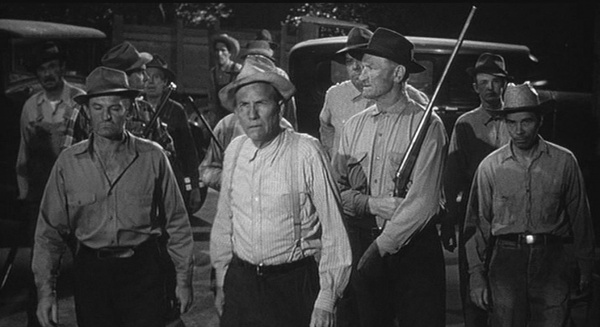
  • The Attempted Lynching
  • Bob Ewell’s Revenge
  • Meeting Boo

Most classes chose “The Attempted Lynching” and “Bob Ewell’s Revenge.” Every class was surprised about the number of men there trying to lynch Tom Robinson.

“I thought there were only four or five,” one student said, to which almost everyone else nodded in agreement.

We talked for a while about the effect being in a mob has on human behavior. They all suggested good reasons (not getting caught, getting pulled into the emotion of it all, the sheer force and power of numbers), but no one really thought of the anonymity that a mob provides and the way people tend use that anonymity to cloak their on complicity and to hide their own guilt.

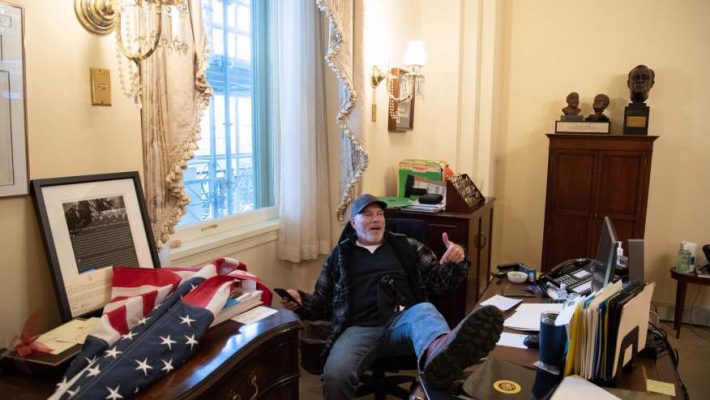
We touched on recent events: “I’m not really doing anything. It’s the mob. I just walked into this open building.”
Media on January 7

As an English teacher, there are times that demand I drop what we’re doing in class and talk about what’s going on. Or as Kelly Gallagher put it,

Sometimes when history unfolds, it immediately supersedes tomorrow’s lesson plan. Today is one of those days. Students will need to read, write, and talk about this.

I took his thoughts (and one of his ideas) to heart and took the opportunity to do a short media studies lesson. We looked at seven screenshots of seven media outlets and asked a few questions about them:

  • What is said?
  • What is not said?
  • How is it said?
  • What images were selected?
  • What images were not selected?
  • Why this order of links?
  • Why the selected font sizes?
  • Who is the intended audience?
  • What is the intended purpose?
  • What inferences can we draw about the source?

As best I could, I scrubbed all indications of the source from the screenshot. I missed a bit from the CNN shot, observant students probably noticed the “South Carolina Public Radio” media player on the NPR shot, and I accidentally left in image attribution for The Washington Times but otherwise, I kept them a mystery. (The first time I went through the lesson, I told the students which images came from which sources. Because of the reaction, I decided not to do that in subsequent lessons.)

Here are a few things the students noted.

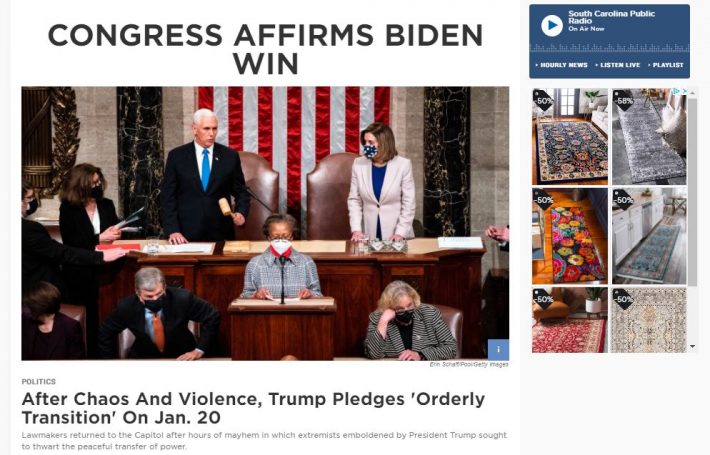
Screenshot 1: NPR

Of the two big stories from January 6, this source focused on the positive (for the survival of our democracy, that is) story. The attack on the capital was referred to only as “chaos and violence.”

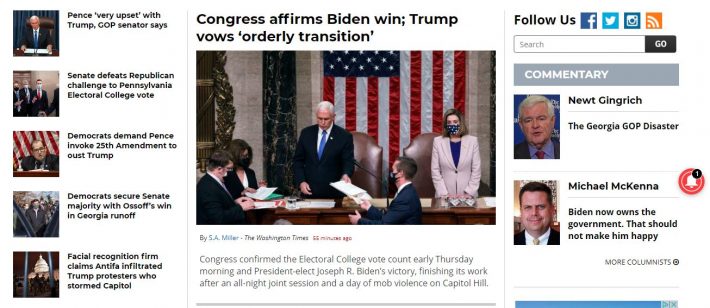
Screenshot 2: The Washington Times

Students, after I explained who Newt Gingrich is and what “GOP” refers to, decided this was definitely targeting a right-leaning audience. I was surprised that not a single student knew what GOP meant.

“Why did Republicans get that nickname?” they all asked.

“I don’t know.”

“Do Democrats have an equivalent nickname?”

“Not that I know of.”

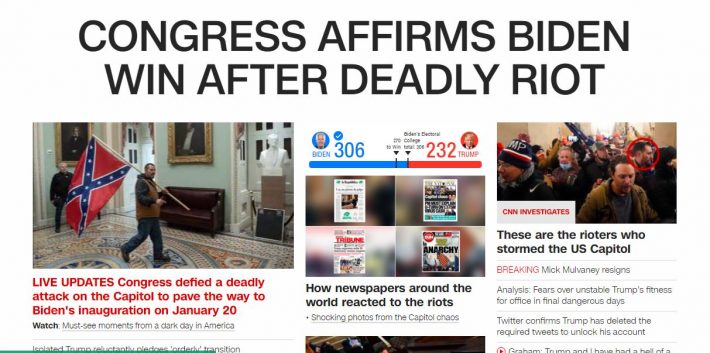
Screenshot 3: CNN

Students immediately commented on the amount of screen real estate the headline takes up. They also commented on the vote count graphic.

“I’ve only ever seen this on election day,” I pointed out.

We discussed the use of the term “rioter.”

“What else could we call the people who participated in that event?” I probed.

They came up with a list:

  • protesters
  • gang
  • terrorists
  • attackers
  • mob

I added one more: insurrectionists.

We put the words on a continuum, and they decided that the most benevolent was “protesters.”

“Using that term would suggest they support them,” one student succinctly observed.

At the far end: insurrectionists. All that being said, they felt that “rioters” was the most objective.

Screenshot 4: The New York Post

Students immediately noticed that, with source 4, we could win a beach house vacation! In other words, they realized quickly that this site relies heavily on ad revenue.

“Maybe it’s a blog,” someone ventured.

As to the content, they thought it was striking that the lead story was about the rioter who was shot, but they also thought it was significant that the headline left so much out.

“In the Capitol — it sounds like something happened to a tourist or something.”

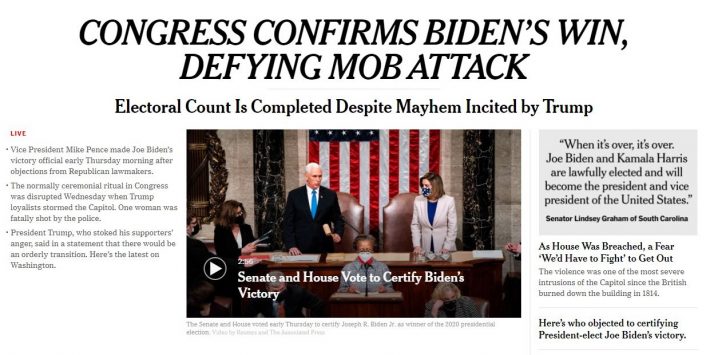
Screenshot 5: The New York Times

This source included a video, which suggests that the images in the other articles are screen grabs from this video.

There’s also the word choice: mob and mayhem.

“What’s ‘incited, Mr. Scott?” they asked. “Isn’t it like ‘encouraged’?”

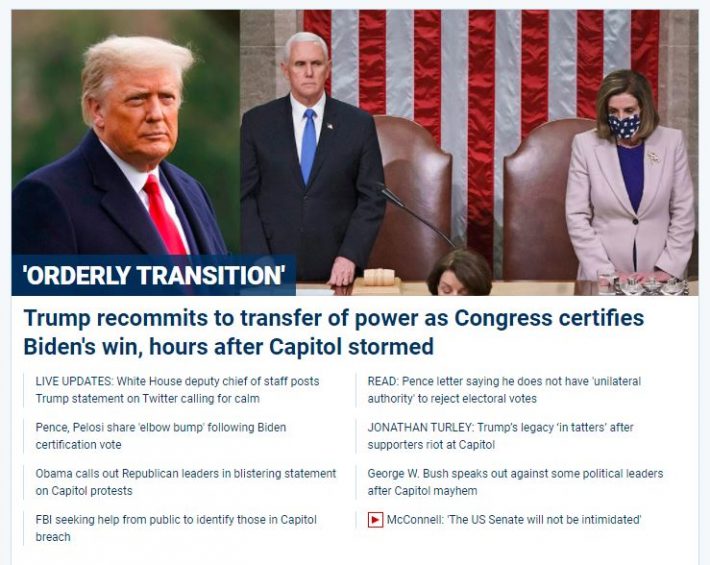
Screenshot 6: Fox News

The immediate thing students noticed was “Orderly Transition” is the headline. It’s in all-caps, so it somewhat dominates the second headline below it.

Also, in the picture, Pelosi looks a little weak: she’s a little slouched over with downcast eyes. If this was from a video, it could have been a conscious choice, which would indicate a bias. Additionally, with the placement of Trump’s picture, it seems to highlight the distance between the two parties.

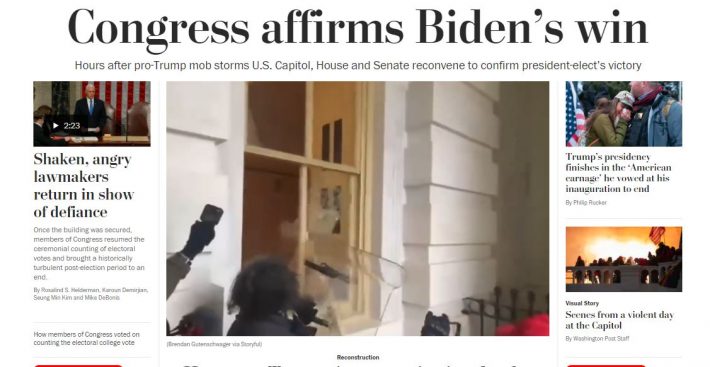
Screenshot 7: The Washington Post

The final shot came from The Washington Post. It seemed, the kids noted, to balance between both: the headline was about Biden; the image was from the assault.

“If you look at the area just below it,” I pointed out, “you’ll see what looks like the tops of letters. That was the headline for the second story, which was about the assault.”

Once we were all through, I reminded kids that the purpose of the lesson was not to teach them what to think but rather how to think. “An informed citizenry is critical to the success of any democracy,” I said.

Oh, the things we (rightly) leave unsaid in the classroom when talking about such matters, though…

Thread of Democracy

It could have been worse.

When Sen. James Lankford was speaking and an aide informed him that so-called protesters had entered the building, that announcement could have come in a flurry of gun shots. After all, it’s not hard to imagine that the majority of the rioters were armed.

If this many people had charged the capital with guns blazing, the capital police would not have stood a chance.

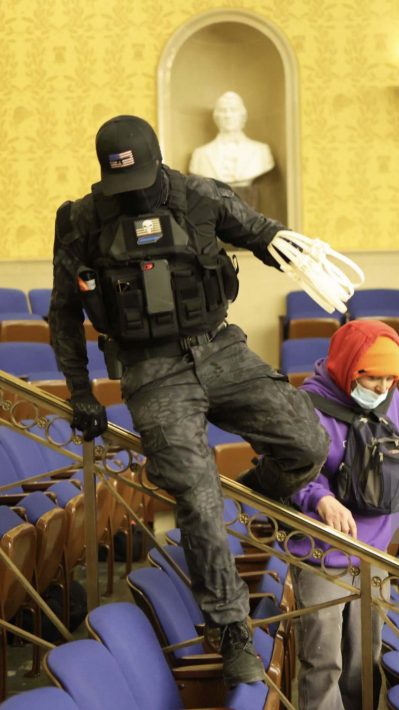
Once they’d achieved that, the insurrectionists’ plans seem fairly obvious:

They came with zip ties to do in DC what they could not do in Michigan. And once they zip-tied them, we all know they wouldn’t have been content with just this:

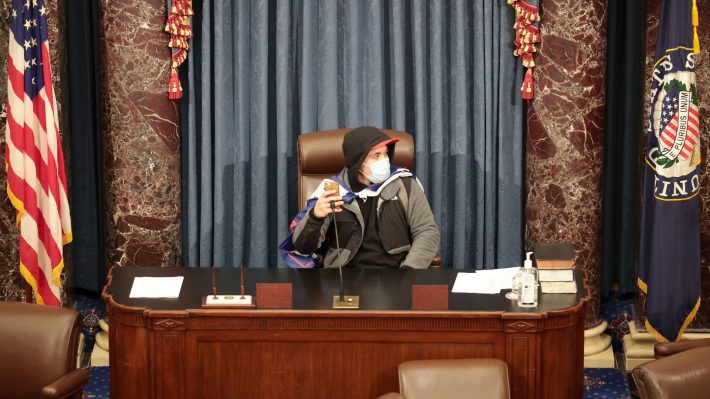
Or this.

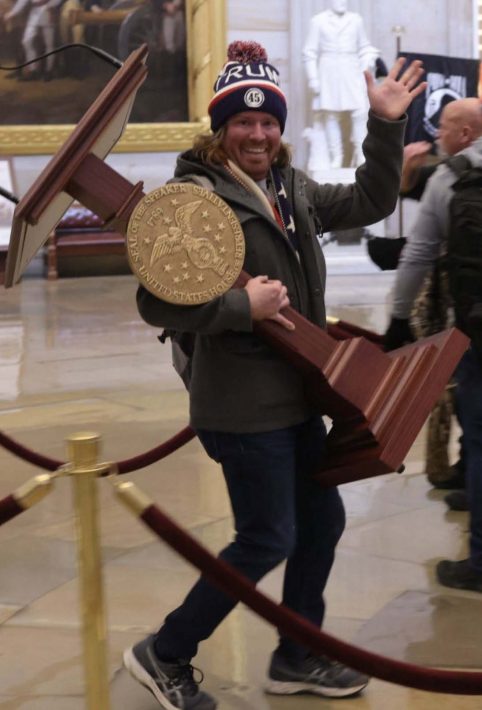
Or even this.

No, they had different things in mind.

Everyone who incited this needs to face justice. We need to see Rudy Guiliani standing before a judge.

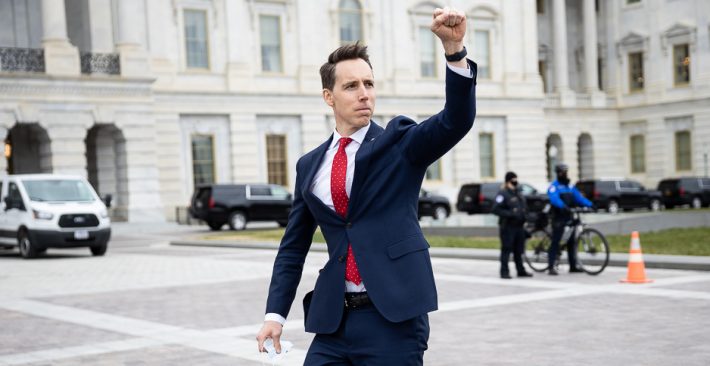
Josh Hawley needs to be removed from the senate.

And Donald Trump should be impeached and convicted immediately in order to prevent him from running for federal office again.

That anyone needs even to consider the validity of these last three statements — let alone the fact that millions would dispute them, and some violently — shows the hole into which America has fallen.

That anyone would ever consider voting Republican again shows the hole into which America has fallen.

That (to my knowledge) not a single person was arrested for this immediately shows the hole into which America has fallen.

That almost every single inhabitant in America is not out marching in the streets, shouting these things in a deafening roar, shows the hole into which American has fallen.

Shifting Ground

Coming out of cultic, conspiratorial thinking is a process. It's not something that happens overnight. It's not the flip of a switch: "I believe in lizard people. BOOM! Now I don't believe in lizard people." There's a push and pull, a rise and fall to the process. It starts with the most basic thought: "I could be wrong about this." But turning your back on a set of theories (for lack of a better term) that one has invested so much into is difficult, and giving up all that, admitting that one is wrong is tantamount to admitting that one wasted a significant portion of the short life we have here on earth.

DeAnna Lorraine, the QAnon conspiracy theorist and rabid Trump supporter who recently ran for Congress, seems to be making those mental movements in a recent video. She begins with the assumptions of QAnon:

Because we have so much trusted this plan, we always think he's playing 5-D chess. Anything that looks questionable, we think, "Okay, it's a strategy. He's playing 5-D chess. We don't have anything to worry about." Is it possible that that is a detriment to us?

That's a level of self-reflection and vulnerability I would not have expected. She seems to be suggesting that her assumptions about Trump's acumen and about the whole farcical idea that he's battling a cabal of Satanic, cannibalistic pedophiles that has embedded itself in the government and entertainment industry -- she sounds like she's suggesting she might be wrong.

Later in the video, she says,

We're going to know for sure. Is Trump really the 5-D master chess player who is just going to totally decimate the swamp and arrest all these deep state operatives and everything we've seen up to now is just a massive, you know, all these brilliant chess moves and it's all going to come into play in a sting operation and QAnon is real and everything is happening and everyone was right. Is justice finally going to be served? Are we finally going to see that checkmate? Are we finally going to see the traps close? Or, we're not. Or we're going to find out the truth. Maybe things failed. Maybe QAnon operation wasn't real. Maybe, maybe some things weren't really the truth, right? But we're going to know in about twenty-five days.

Such an admission, it seems to me, is something we should be applauding. Yes, Lorraine has done tremendous damage in spreading the QAnon nonsense, but if she can manage a shift, if she can see the light for herself, perhaps there's hope for others. Perhaps she could be a force that mitigates the damage of the QAnon cult.

Unfortunately, I fear she's going to be mocked. Right Wing Watch explained the video thusly:

https://twitter.com/RightWingWatch/status/1343999462633570304?s=09

Perhaps I'm wrong. Perhaps she'll never stop rationalizing. One user tweeted in response:

https://twitter.com/WasOptimist/status/1344001808906256389

But maybe that pessimism is wrong. Maybe we should give her the benefit of the doubt and not mock her. Mocking never works. It's fun, I know -- I've done it enough in my online life. But we know it never works. It's like a cold wind trying to blow the jacket off someone: she just holds on more tightly. It's a natural reaction. Mocking certainly does little to reverse this slide into hyper-partisanship we're suffering in America now.

If anything, the more I think about it, the more I realize folks like this need compassion more than anything. They're trapped in conspiratorial thinking that is not often easy to escape. That sounds condescending, but it's not meant that way. These people aren't stupid. They might have ruts in their thinking; they might lack critical thinking skills; they might gain a certain comfort from this kind of gnostic, insider thinking; they might be lacking in education to one degree or another. But they're not stupid.

I think Michelle Obama was right: when they go low (however we might define that), we go high.

Cutting

Tonight, I spent a fair amount of time going through photos from the last year to create our yearbook. It’s a simple process: go to Lightroom; create a new collection with all flagged pictures from the year; begin deleting pictures. I started out with 1800; I’m down to 330 now.

It’s a good way to get an overview of the year. We had dozens of pictures of the family playing games (Sorry, Monopoly, hearts, etc.); we had dozens of pictures in the park going for walks; we had dozens of pictures of E and me exploring in our creek. How many nearly-identical pictures does one need?

Random Thoughts About Today’s Mass Reading

Today’s gospel reading was the famous parable of the talents:

Jesus told his disciples this parable: “A man going on a journey called in his servants and entrusted his possessions to them. To one he gave five talents; to another, two; to a third, one–to each according to his ability. Then he went away. Immediately the one who received five talents went and traded with them, and made another five. Likewise, the one who received two made another two. But the man who received one went off and dug a hole in the ground and buried his master’s money.

“After a long time the master of those servants came back and settled accounts with them. The one who had received five talents came forward bringing the additional five. He said, ‘Master, you gave me five talents. See, I have made five more.’ His master said to him, ‘Well done, my good and faithful servant. Since you were faithful in small matters, I will give you great responsibilities. Come, share your master’s joy.’ Then the one who had received two talents also came forward and said, ‘Master, you gave me two talents. See, I have made two more.’ His master said to him, ‘Well done, my good and faithful servant. Since you were faithful in small matters, I will give you great responsibilities. Come, share your master’s joy.’ Then the one who had received the one talent came forward and said, ‘Master, I knew you were a demanding person, harvesting where you did not plant and gathering where you did not scatter; so out of fear I went off and buried your talent in the ground. Here it is back.’ His master said to him in reply, ‘You wicked, lazy servant! So you knew that I harvest where I did not plant and gather where I did not scatter? Should you not then have put my money in the bank so that I could have got it back with interest on my return? Now then! Take the talent from him and give it to the one with ten. For to everyone who has, more will be given and he will grow rich; but from the one who has not, even what he has will be taken away. And throw this useless servant into the darkness outside, where there will be wailing and grinding of teeth.'”

I noticed a few things about this parable that I’d never seen before: first, the master leaves all these things and then “he went away.” There’s nothing in the text that indicates the master expected the servants to do anything with the money. Perhaps that’s implied, but it’s not explicitly stated that the master expected any growth on his investment or that it even is an investment.

Second, I find it entirely reasonable that the third servant hides the money. What if he invested it and lost it? Wouldn’t the master be even angrier then?

Third, what’s all this stuff about “harvesting where you did not plant and gathering where you did not scatter”? Just what are the master’s expectations? What kind of a man is this? He doesn’t seem very reasonable at all.

Finally, there’s the disturbing ending: why the severe punishment?

I know, I know — it’s a parable. It’s not really about the money at all but it’s about an individual’s talents. At least that’s how everyone has always interpreted it. That leads to a realization I’ve had recently: why did Jesus speak in parables? If his goal is to transmit information, metaphor and parable are not the most effective, efficient means of doing that.

Politics, As Always

It’s Fine When We Do It

A lot of people are supporting Trump because, although they don’t think he’s an ideal candidate, they see him as better than the boogie-man-Stalinst-wannabe straw man they fear Biden is. In other words, they see it as a question of the survival of the republic: if Biden wins, he and far-left radicals will work to turn the US into a socialist/communist country, they fear. The United States will cease to be, they say.

Yet some take it a bit further:

Someone like Wiles would likely be willing to let Trump be president for life, and make it hereditary — get rid of elections, in other words — in order to protect the US against this perceived threat. In other words, to save the country, he would be willing to destroy the country. Shades of the Battle of Bến Tre.

This sort of worship of Trump is surprisingly common in the evangelical community.

For a group that calls itself Christians and swears never to put any god above their god, they certainly do that an awful lot with Trump.

Neighbors’ Signs and Our Swings

We went for our typical walk this evening -- a route that wanders primarily through the neighborhood on the other side of the main-ish street off of which several neighborhoods spiral. As we walked by a house, a man came up to us saying that he'd been meaning to meet us several times he's seen us go by. It seems he's quite the border collie fan and has noticed our cute pup as we walk by. We got to talking and talk turned to corona. He pointed to a sign in his yard -- not quite like the sign at right but the same general idea -- and said, "I guess it's obvious where I stand."

I glanced over at the sign in his neighbor's yard. I found myself wondering how they get along. I know for a fact that my views are more liberal than our neighbors' views, but I tend not to talk about politics with them. When the topic does come up, I might make a non-committal comment every now and then, but by and large, I keep my views to myself.

It's not that I think they'll be angered that I have different views than they hold. It's not that I fear damaging the relationship we have (though I wonder if they might not think less of me were they to know what I think of our president). I just don't see the point in adding politics into a relationship like that.

It reminds me of Frost's line, "Good fences make good neighbors," and while I don't necessarily agree with the sentiment, I would say good fences make great backyards. As do swings, hammocks, trampolines, dogs, and tennis balls.

Opportunity

Rarely do such stark opportunities emerge to rise to one’s professed principles or to sink to rank hypocrisy as this moment for Republicans. What will it be? Will they prove themselves to be a party of principle or a party interested only in gathering unto itself increasing political power? Will they, now that the shoe is on the other foot, treat Democrats as they demanded they be treated in 2016?

That’s the real irony of this looming crisis: Republicans wrap themselves in the pages of the Bible, proclaiming themselves to be the vanguard of all that’s decent — according to their definition of the term, which is always couched in religious ideals. But when it comes down to it, they are no more interested in principles or basic decency than your average thug.

In Armando Iannucci’s brilliant The Death of Stalin, there’s a telling scene in which Lavrentiy Beria, facing his own doom, demands to be treated in accordance with the law and then begs for mercy. In his brutal career, he faced such pleas countless times, I’m sure, and he always responded with barbarity and cruelty. When he lost power, he begged for just that which he would not give to others.

Lindsey Graham, Mitch McConnell, Marco Rubio, and Ted Cruz are on record:

So when Mitch McConnell said “President Trump’s nominee will receive a vote on the floor of the United States Senate,” he showed himself to be perhaps the best, clearest example of a hypocrite that one could imagine. It’s hard to envision a more clear-cut case of blatant, power-grabbing hypocrisy than what we’re witnessing now in the Republican party.

Any Congressional Republicans who go along with this show their constituency that they are not individuals of their words, that they are the basest liars, that they should not be entrusted with any power, and on the basis of principle alone, their Republican constituents should vote them out.

Will this happen? Of course not. Why won’t Republicans do this? Because the Republican party no longer exists. It is a party of only one principle, and that’s power. Republican states are no longer red states (Isn’t it ironic that the color for Republicans is the color associated with communism? Isn’t it ironic how cozy our current Republican president is with the Russian leader trying desperately to reconstitute Soviet power?); they are orange states, to match the hue of their lord and savior.

“The Names”

A poem by Billy Collins for the first anniversary of the 9/11 attacks

Yesterday, I lay awake in the palm of the night.
A soft rain stole in, unhelped by any breeze,
And when I saw the silver glaze on the windows,
I started with A, with Ackerman, as it happened,
Then Baxter and Calabro,
Davis and Eberling, names falling into place
As droplets fell through the dark.
Names printed on the ceiling of the night.
Names slipping around a watery bend.
Twenty-six willows on the banks of a stream.
In the morning, I walked out barefoot
Among thousands of flowers
Heavy with dew like the eyes of tears,
And each had a name —
Fiori inscribed on a yellow petal
Then Gonzalez and Han, Ishikawa and Jenkins.
Names written in the air
And stitched into the cloth of the day.
A name under a photograph taped to a mailbox.
Monogram on a torn shirt,
I see you spelled out on storefront windows
And on the bright unfurled awnings of this city.
I say the syllables as I turn a corner —
Kelly and Lee,
Medina, Nardella, and O’Connor.
When I peer into the woods,
I see a thick tangle where letters are hidden
As in a puzzle concocted for children.
Parker and Quigley in the twigs of an ash,
Rizzo, Schubert, Torres, and Upton,
Secrets in the boughs of an ancient maple.
Names written in the pale sky.
Names rising in the updraft amid buildings.
Names silent in stone
Or cried out behind a door.
Names blown over the earth and out to sea.
In the evening — weakening light, the last swallows.
A boy on a lake lifts his oars.
A woman by a window puts a match to a candle,
And the names are outlined on the rose clouds —
Vanacore and Wallace,
(let X stand, if it can, for the ones unfound)
Then Young and Ziminsky, the final jolt of Z.
Names etched on the head of a pin.
One name spanning a bridge, another undergoing a tunnel.
A blue name needled into the skin.
Names of citizens, workers, mothers and fathers,
The bright-eyed daughter, the quick son.
Alphabet of names in a green field.
Names in the small tracks of birds.
Names lifted from a hat
Or balanced on the tip of the tongue.
Names wheeled into the dim warehouse of memory.
So many names, there is barely room on the walls of the heart.

Assumptions

We go through our lives with basic assumptions that we often never question. Some of those assumptions are small, relatively insignificant; others involve reality on a global scale.

Take for instance the Cold War: growing up, I never thought it would end. And yet it did. I never would have conceived of the Soviet Union not existing; and it's been gone close to thirty years now.

What about the threat of Germany? We mostly thought some kind of far-right resurgence could never happen -- at least I always thought that. At least in my adulthood. In my childhood -- that's a different story. At any rate, an interesting article appeared in the New York Times the other day about just what I have thought all my adult life is impossible:

One central motivation of the extremists has seemed so far-fetched and fantastical that for a long time the authorities and investigators did not take it seriously, even as it gained broader currency in far-right circles.

Neo-Nazi groups and other extremists call it Day X — a mythical moment when Germany’s social order collapses, requiring committed far-right extremists, in their telling, to save themselves and rescue the nation.

Today Day X preppers are drawing serious people with serious skills and ambition. Increasingly, the German authorities consider the scenario a pretext for domestic terrorism by far-right plotters or even for a takeover of the government.

“I fear we’ve only seen the tip of the iceberg,” said Dirk Friedriszik, a lawmaker in the northeastern state of Mecklenburg-Western Pomerania, where Nordkreuz was founded. “It isn’t just the KSK. The real worry is: These cells are everywhere. In the army, in the police, in reservist units.”

New York Times

I'm such an anti-conspiracy theorist that I forget that people actually do conspire sometimes...