Matching Tracksuits

fun in fours

COVID-19 quarantine

Day 61: Fear, Faith, and Fun

Fear and Faith

Imagine fear nestled into anxiety burrowed into terror, and all of that is supposed, in the end, to be a source of great joy. "In my beginning is my end" T. S. Eliot wrote, but for some evangelical Christians, it might be reworded, "In my anxiety is my comfort," for they view their everyday reality through an apocalyptic lens. They post things like this on social media:
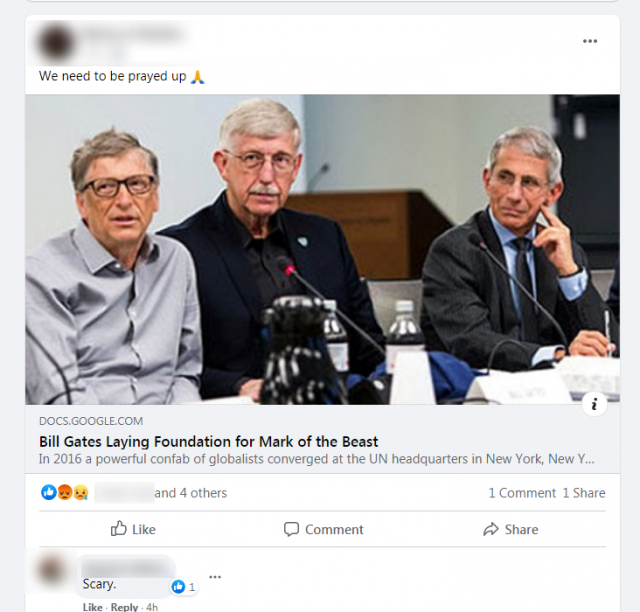
The single comment "Scary" reveals the paradox at the heart of this line of thinking.

On the one hand, there is a sense of terror at what's coming. Such believers look at the Bible as a roadmap for the future, seeing all sorts of ideas that, to those of us on the outside looking in, seem patently ridiculous. They see a coming world-engulfing violent cataclysm that will wipe out wide swaths of humanity and subject the survivors to near-slavery under the rule of some world-dominating ruler known simply The Beast, who will rule in what they call The Tribulation. During this time, there will be mass executions of believers and worldwide oppression.

At this point, the vision starts fracturing. What will happen to Christians, to good Bible-believing Christians who saw all this coming and gave themselves over to the Lord long ago? Some suggest that these poor Christians will have to go through all this; others (most) believe firmly that they'll all be whisked away to heaven before all this -- the rapture.

I grew up being taught that, like the rapture, God would supernaturally protect all his faithful Christians from this onslaught of literal hell on earth, but instead of being taken away into heaven, we would escape to a location of protection, which got the name the Place of Safety. Our religious leader conjectured it would be in Petra, Jordan. There we would spend the three-and-a-half years that the devil, through his Beast, would rule and torment the world, emerging at the end when Jesus returns to put the devil in his place and us in charge of rebuilding the world. Sounds crazy -- but not any crazier than being whisked away like the Left Behind book series narrates.

Whatever the belief, though, these groups have one thing in common: the believers -- the right-believing faithful -- will be saved. This, then, should be a time of joy for such Christians. The end is almost here, and because they believed the right things all these times, they won't have to endure the horrors coming.

So why the fear? Just look at the thoughts that follow the original "Scary" comment:
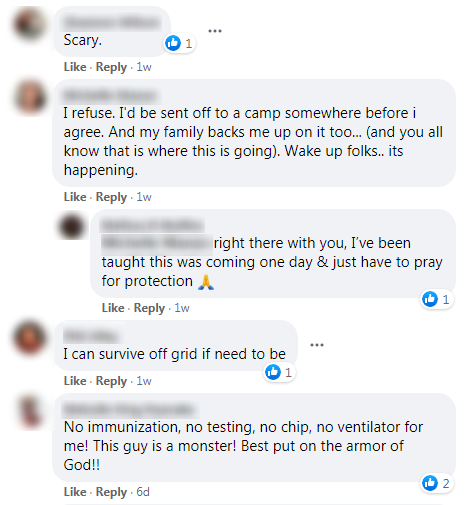
These poor folks are genuinely scared about Bill Gates's supposed plans to use this pandemic and the resulting vaccine, which they fear will be mandatory (which it should be), to implant chips into them.

There is an amusing irony in all this, though:

Such a strange mix of confusion, and it's driving thousands upon thousands to outright terror.

There is, of course, one thing that these fear-stricken Christians can do: they can pray about it.
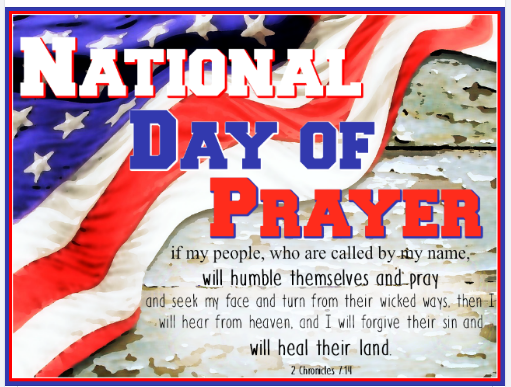
Yet what is the effectiveness of this prayer? This verse from the Bible promises that "if my people, who are called by my name, will humble themselves and pray" that God "will heal their land." If that doesn't sound like a promise from omnipotence that is directly applicable to our current situation, I don't know what does.

But we've tried this before:

These Christians will point out that there are conditions: the petitioners must "turn from their wicked ways" before this promise will be fulfilled, so that's probably the problem: America is still aborting pregnancies, fornicating, and tolerating homosexuality (the three biggies), so God is just waiting for that to stop.

On March 30 televangelist Kenneth Copeland must have decided he would not wait for the stubborn, God-hating Americans to repent and simply "exercised judgment" on the pandemic, thus ending it:

But four days later, he realized he had to try again:

And yet it's still not over.

Here's where another layer of anxiety enters: these poor souls must be wracking their brains and souls trying to figure out what they're doing wrong. So it seems to me that this type of Christianity does not relieve anxiety but only heightens it. Instead of these beliefs calming you, they add another layer of anxiety when one’s prayer’s and petitions are either ignored or answered in the negative, and the natural response is to blame oneself: “God promised. I must have done something wrong.”

So by the time we get to this level, we have the following fears, some conscious and some less so.

  1. The end of the world is literally around the corner. If I’m right with God, I’ll be spared. Am I right with God?
  2. Even if I’m right with God, my interpretation of end-time prophecy might be a little wrong and Jesus might not return until after the tribulation. So if I go through this horror, how will I know I’ll be spared in the end?
  3. I know God doesn’t always answer prayers, but his Word says he will if I repent and pray, so if I or someone close to me becomes infected, I’ll pray, but it might not be his will.
  4. And even if it is his will, I might have done something wrong. Or my country might be doing something wrong.

For something that’s supposed to bring comfort, that’s an awful lot of sources of anxiety.

In a sense, these folks have a right to their anxiety. The First Amendment guarantees that right. But some of these anxiety-inducing conspiracy theories have long-reaching effects. They lead people to reject science for religious-based superstition:

Conspiracy theories have been around for ages, and fundamentalist Evangelical Christians have often been particularly willing to believe them. After all, their whole religion is a conspiracy theory: the devil is constantly trying to get humans to do his bidding unknowingly. The group I grew up in went so far as to call itself the only group of true Christians in the world: the rest of the "so-called" Christians were actually worshipping a Satan-created replacement Christianity. These "so-called Christians" were, for all intents and purposes, worshiping the devil himself. But even among the milder, less cultish groups, there is a sense of conspiracy. Indeed, this conspiracy goes all the way back to the Garden of Eden, when the devil tried to usurp God's control over humanity.

I'm certainly not the only one to notice this similarity:

Arthur Jones, the director of the documentary film Feels Good Man, which tells the story of how internet memes infiltrated politics in the 2016 presidential election, told me that QAnon reminds him of his childhood growing up in an evangelical-Christian family in the Ozarks. He said that many people he knew then, and many people he meets now in the most devout parts of the country, are deeply interested in the Book of Revelation, and in trying to unpack “all of its pretty-hard-to-decipher prophecies.” Jones went on: “I think the same kind of person would all of a sudden start pulling at the threads of Q and start feeling like everything is starting to fall into place and make sense. If you are an evangelical and you look at Donald Trump on face value, he lies, he steals, he cheats, he’s been married multiple times, he’s clearly a sinner. But you are trying to find a way that he is somehow part of God’s plan.”

So we're at the point that we're all living in different realities. The Atlantic has an article about this now: "The Prophecies of Q," aptly summarized, "American conspiracy theories are entering a dangerous new phase."

The power of the internet was understood early on, but the full nature of that power—its ability to shatter any semblance of shared reality, undermining civil society and democratic governance in the process—was not. The internet also enabled unknown individuals to reach masses of people, at a scale Marshall McLuhan never dreamed of. The warping of shared reality leads a man with an AR-15 rifle to invade a pizza shop. It brings online forums into being where people colorfully imagine the assassination of a former secretary of state. It offers the promise of a Great Awakening, in which the elites will be routed and the truth will be revealed. It causes chat sites to come alive with commentary speculating that the coronavirus pandemic may be the moment QAnon has been waiting for. None of this could have been imagined as recently as the turn of the century.

Would could imagine a scenario in which a prankster began something like Q and then it quickly gets out of hand. The prankster tries to step forward and point out that he began it all. "Look, I have evidence!" He could have even had the foresight to record everything he did on video and through screen-recording software, yet that wouldn't be enough once the conspiracy had gained a life of its own. One can only imagine what such a prankster would feel as he watched his creation ravage reasonable -- a modern Frankenstein, with the conspiracy theory being his unnamed monster.

Yet Frankenstein could reason with his creation, and in fact did attempt to talk to him. Conspiracy theories are like memes: they're elements of the brain that are belong to no one and are somewhat self-replicating. In short, there's no reasoning with a conspiracy theory, and there's little ability to talk to a believer in one:

Taking a page from Trump’s playbook, Q frequently rails against legitimate sources of information as fake. Shock and Harger rely on information they encounter on Facebook rather than news outlets run by journalists. They don’t read the local paper or watch any of the major television networks. “You can’t watch the news,” Shock said. “Your news channel ain’t gonna tell us shit.” Harger says he likes One America News Network. Not so long ago, he used to watch CNN, and couldn’t get enough of Wolf Blitzer. “We were glued to that; we always have been,” he said. “Until this man, Trump, really opened our eyes to what’s happening. And Q. Q is telling us beforehand the stuff that’s going to happen.” I asked Harger and Shock for examples of predictions that had come true. They could not provide specifics and instead encouraged me to do the research myself. When I asked them how they explained the events Q had predicted that never happened, such as Clinton’s arrest, they said that deception is part of Q’s plan. Shock added, “I think there were more things that were predicted that did happen.” Her tone was gentle rather than indignant.

There's no reasoning with them because they often don't even see themselves as conspiracy theorists:

“Some of the people who follow Q would consider themselves to be conspiracy theorists,” [David] Hayes[,  one of the best-known QAnon evangelists on the planet] says in the video. “I do not consider myself to be a conspiracy theorist. I consider myself to be a Q researcher. I don’t have anything against people who like to follow conspiracies. That’s their thing. It’s not my thing.”

So in the end, it's hard not to be at least somewhat depressed about all this, and that in turn tends to make me just a little pessimistic about our future as a species -- yet again. I can help our children develop the critical thinking skills (the painfully basic critical thinking skills) to avoid falling into this trap themselves, but that's two in a nation of millions. These ideas are gaining momentum, and the alternative cultures they spawn are growing.

Fun

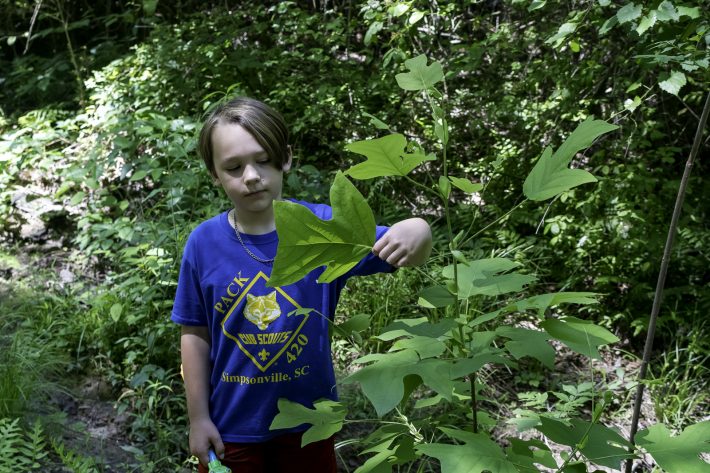
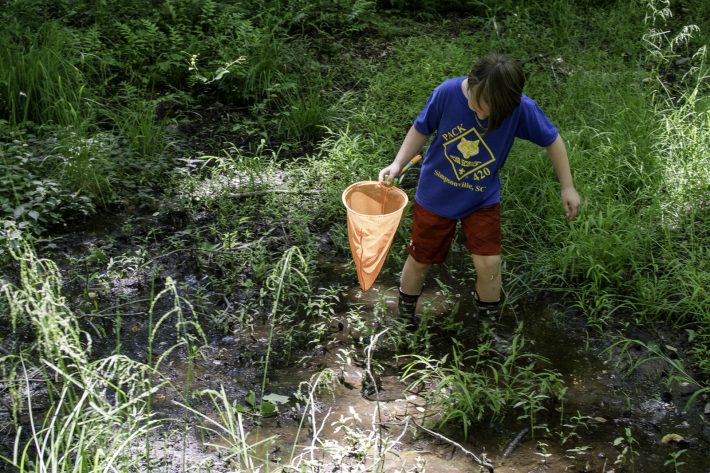
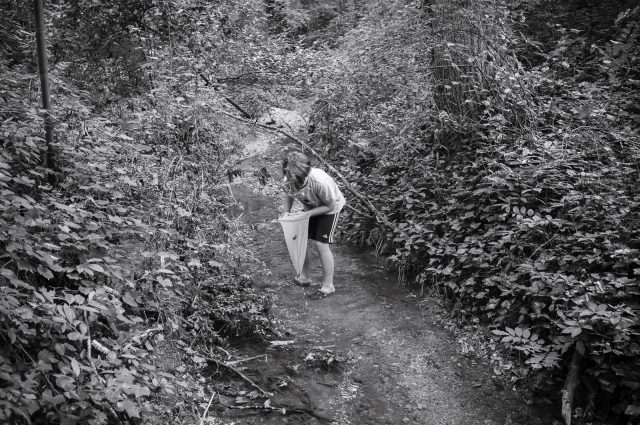
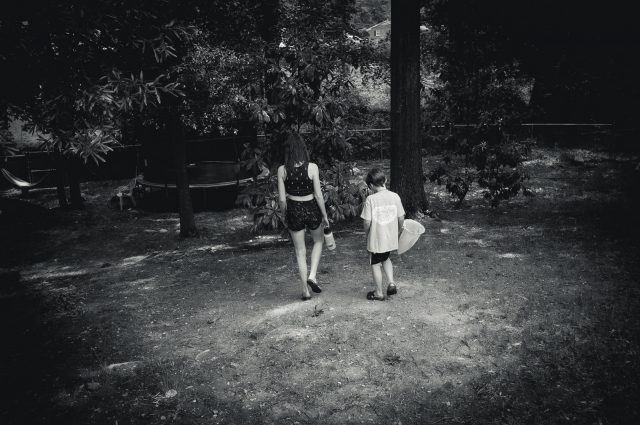
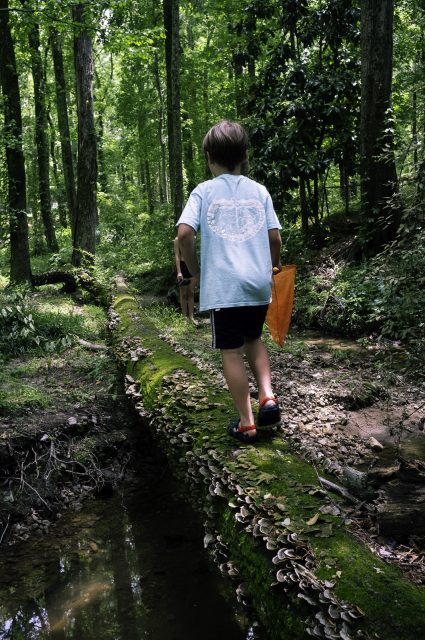
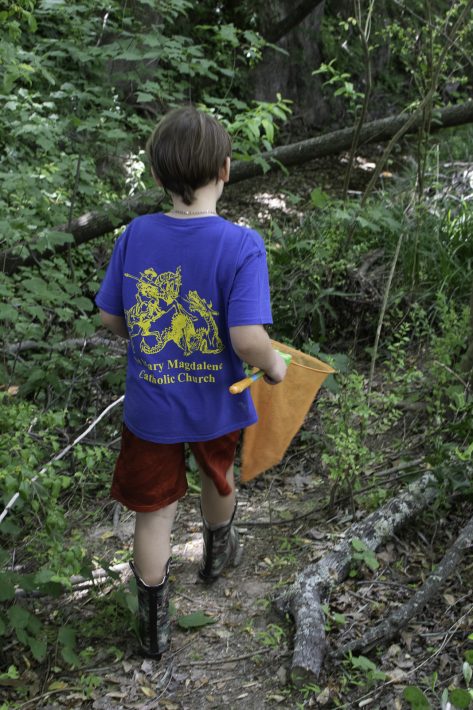
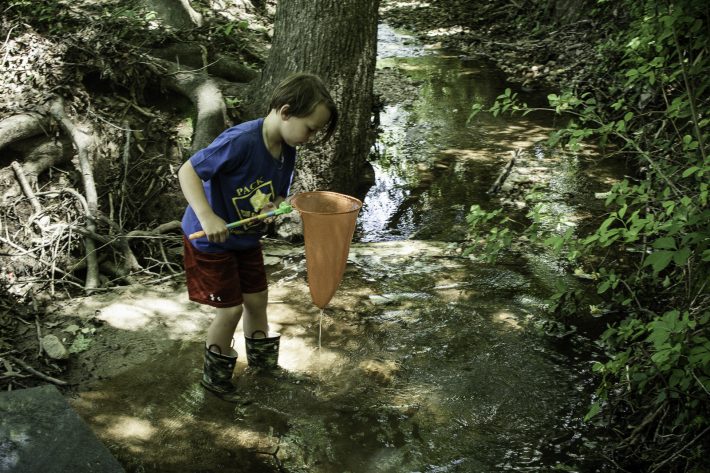
The Boy and I went out exploring again today. He had to try his new gumboots. I warned him about deep water: "If the water goes over the top of the boot, your foot will be permanently soaked." He stepped in water that was too deep. One foot got soaked. We laughed quite a while about the squishing sounds coming from his boot.
Day 60: Eighth Birthday

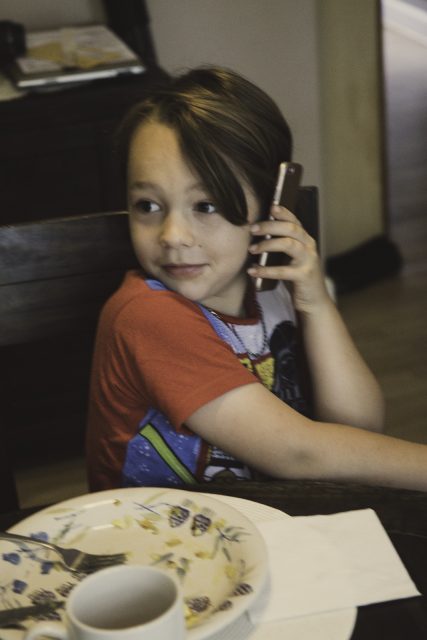
A proper birthday has to start with a proper birthday breakfast and a phone call from Babcia. For E, this meant an omelette for breakfast. Never mind that this was only the second time he's ever had an omelet, a proper omelette, but  he fell in love with it earlier this week, on Mother's Day, and decided that it was his favorite breakfast of all time. Making omelets though is a time-consuming task, so although I layered the sauteed onions, sauteed peppers, and bacon bits very carefully for the Boy, the rest of us got it all mixed up in scrambled eggs.

"I could have it that way, I guess," he confessed. "It's the same thing, just all mixed up."

The phone call from Babcia was a little less fluid. E is reticent to speak Polish, so although he understands everything Babcia says, he usually responds in English then turns to K, expecting a translation. Today Babcia tried to help him out, tried to ease his anxiety. She asked him simple questions like, "Are the flowers blooming?" or "What color are the flowers?" Yet he was still reluctant to speak Polish.

School today for him was relatively simple. At first, he wanted yesterday to complete as much of today's work in addition to yesterday's work as possible. But yesterday in the afternoon he decided that was not the best plan after all. He was ready for some free time. This meant of course that he had all the work for today to complete.

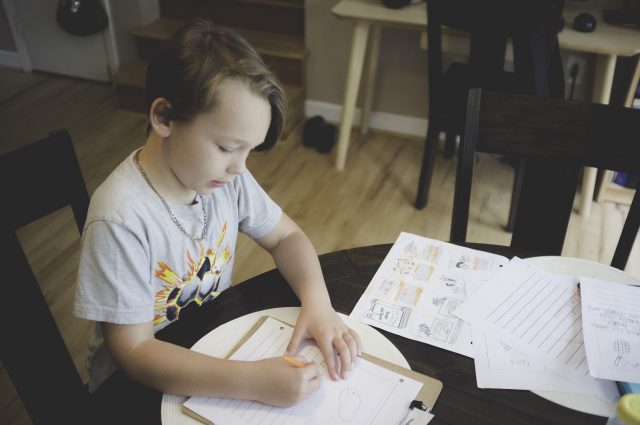
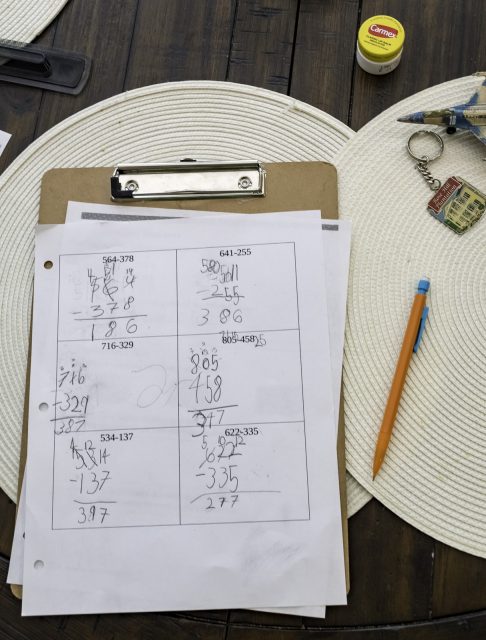
At the beginning of this quarantine, a day's worth of work was just that: a day's worth of work. The amount was greater than it is now, to be sure, but he fussed incessantly how about the frustrations he was feeling, about the difficulty of the math problems, about the length of the readings. We are half expecting such antics today, interspersed with cries of, "But it's my birthday. Why do I have to work on my birthday?" However, he plowed through his work with relative ease, making it through math, which was subtracting three-digit numbers from three-digit numbers, each problem requiring regrouping and then word problems, in less than fifteen minutes. He wrote two more chapters of his frog/toad book and was done.

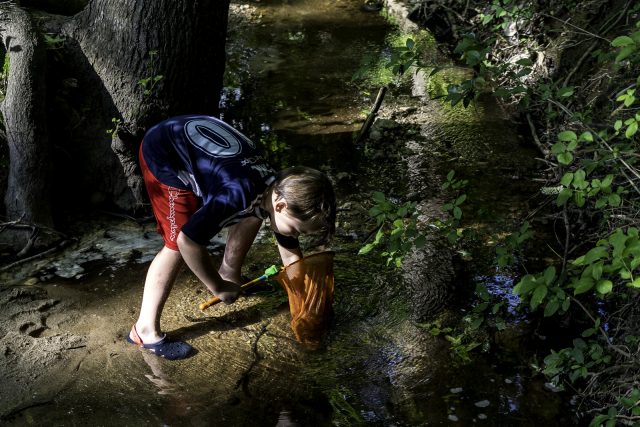
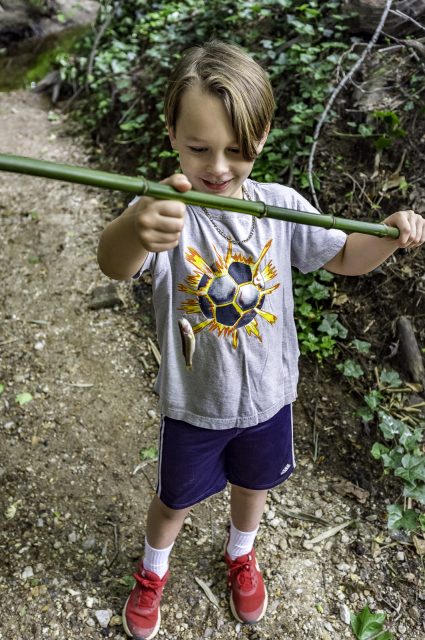
In the afternoon, we headed back down to the spot where we'd caught and inadvertently killed a minnow yesterday. I thought perhaps we might have a repeat, feared it in some ways -- who wants to just go around killing little fish? Yet E was keen to try again. We did try again, and caught three fish. Two of them made it back to the water fine.

One of them -- well, we didn't quite hook him in the mouth but somehow hooked him through his body. He was already bleeding when we pulled him out of the water.

While we were down there, L came to the balcony and yelled across the yard, "You guys need to come back! Now!" At first, I was afraid that something had happened to Papa. Of late he's been spending afternoons on the deck wallowing in nostalgia by exploring songs he hasn't heard in decades, all thanks to Spotify.

Instead, we all got a pleasant surprise:

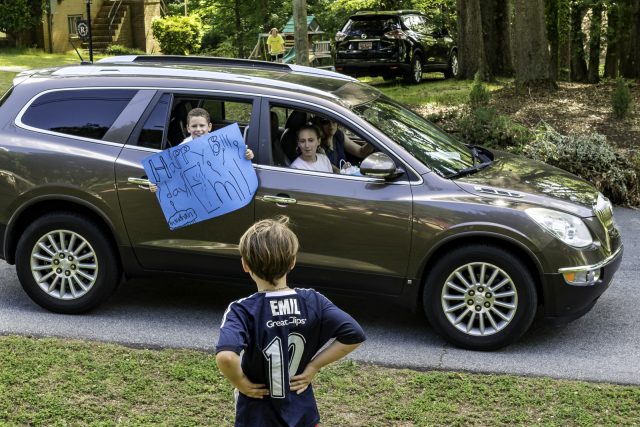
E's best friend's mother drove him by our house to wish the Boy happy birthday.

As for our celebration, we played a trick on him that Nana and Papa played on me a couple of times: give him something that's relatively worthless without the other item. Like a cable to hook up a laptop to something suggesting that it might work with an old laptop, then giving a new one as a surprise (a la Nana and Papa).

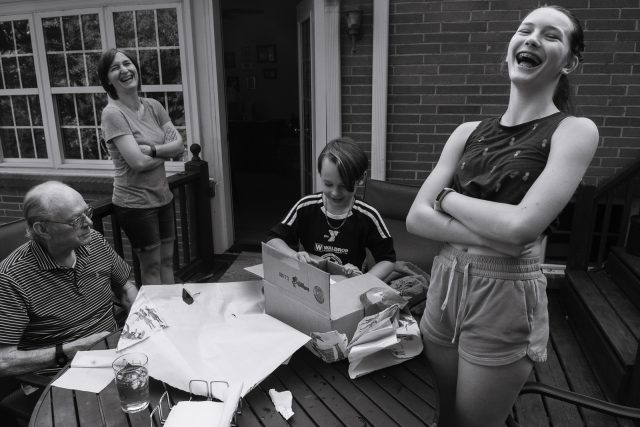
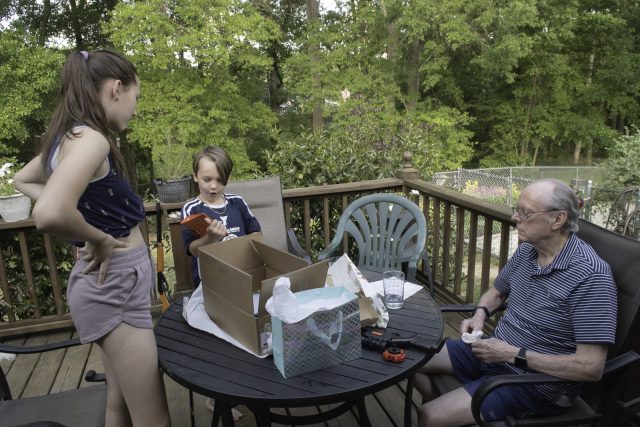
We gave him a tablet case and screen protector. He'd been asking for a tablet for some time, and we thought we'd see what would happen if he got only the empty shell. "You can keep and maybe you'll get a tablet next year," I suggested. "Oh, that's great," he said very calmly -- not really upset, not really thrilled.

Then, when he opened Papa's present, lo and behold -- an Amazon Fire, just for him.

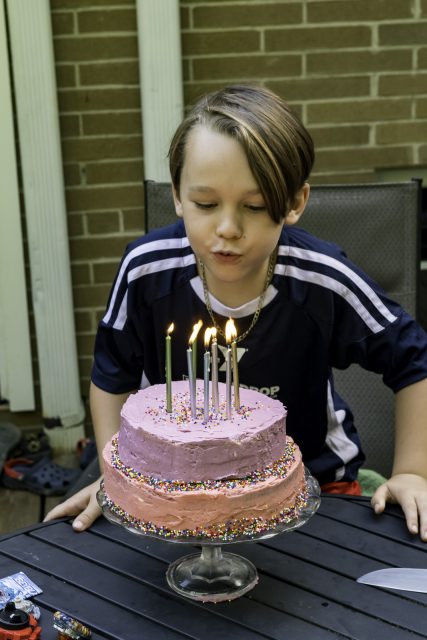
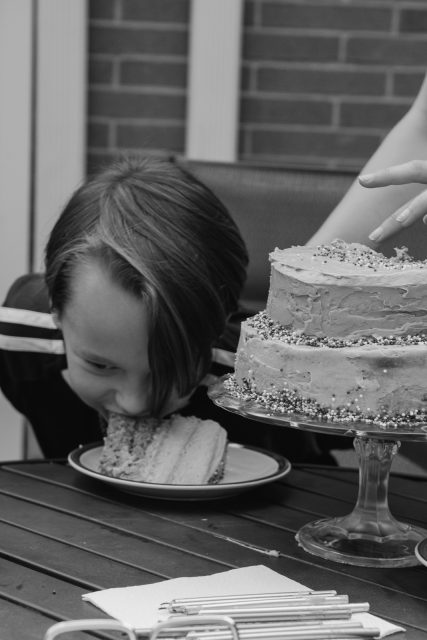
Finally, there was the cake. L began working on the cake yesterday and decided to add to it today. A two-tiered cake, each with two layers.

The slices were impressive to say the least. K and I split one: she took the top tier, and I worked on the bottom one. The Girl is getting the flavors down -- she's still not thrilled with the presentation, though.

"Patience and practice," K said to her. Though perhaps not quite so much practice while we're all locked down.

Previous Years

Day 59: Morning Work Hooks the Companion

Morning Work

Since I didn’t have much to do for school this morning, I took over the first part of E’s homeschooling adventure. Our first task: to write the first chapter or two of his book about frogs and toads. Six chapters will constitute the final product:

  1. Introduction
  2. Toads
  3. Frogs
  4. Similarities
  5. Differences
  6. Dedication

As we read, I saw the difficulties and frustrations lying ahead: when it would come time to write the book, he might fuss, “Now we’ll have to go back through the text again. We have to read it again!!” So I taught him a little trick as we read that I use with my students.

“As you’re re-reading, highlight facts you might want to rewrite in your own writing. Then put a number beside it to indicate which chapter you’ll use it in. When it comes time to write, then, you’ll just have to look at all the numbers for the chapter you happen to be working on.”

There are two reasons for this: first, it will help him with his writing later. That’s the most obvious way it assists him. Less obvious but more importantly, it helps him develop skills as a critical, analytic reader. My own students often have difficulty reading because they’re not reading for a particular reason. Giving kids a purpose as they read gives them a goal and a metric to measure comprehension and success.

As we read, E grew more confident about the whole process; as he began writing the first chapters, he realized the sense behind it all. That might lead to a little less fussing as he continues to work on the piece.

Hook

Mr. F, our neighbor, is a keen fisherman. He’s got a boat, countless rods and reels, and multiple tackle boxes filled with endless lures and hooks. Heading out to the lake regularly, he often comes home with enough fish for his family and some neighbors: he’s given us many, many pounds of fish over the year. He’s the type of fisherman that, as regards fishing equipment, if he doesn’t have it, it probably doesn’t exist.

The Boy often goes over to help Mr. F. He’s something of a third grandfather to E, which makes him really like a second grandfather since Dziadek passed before E was a year old and E knows him only from pictures.

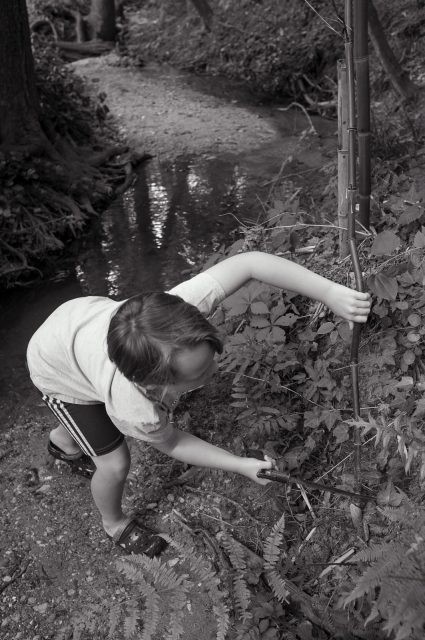
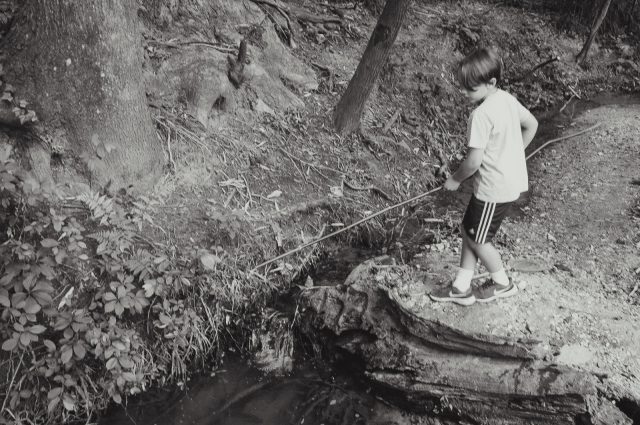
When E and I discovered in the creek that runs behind our house a couple of pools that are deep enough for larger minnows -- some looking to be three or more inches long, maybe even four inches long -- I commented that they’re almost big enough actually to use a hook and bait. Recalling the little minnows we caught in Lake Jocassee with just a line, a hook, and some bread, I suggested that we could use a bamboo cane and make a real, old-fashioned playin’-hooky-to-go-fishin’ cane fishing pole.

After we were both done with school, we headed down, saw and net in hand. “I still want to try to net some minnow,” he explained. We found an adequately small cane and cut it after a bit of unsuccessfully netting attempts.

“Now we just need the line and a hook,” the Boy said as we headed back, adding as a sad afterthought, “but we don’t have any.”

“Why not ask Mr. F?” I suggested.

“Oh yeah!”

Then the real question as far as I was concerned: with Mr. F not out, he would have to go knock on the neighbors’ door, and I decided it was something he was going to have to do by himself. Would he do it?

“Just go knock on their door,” I said after he protested that Mr. F wasn’t outside at that moment.

“What if Mrs. P answers the door?”

“Just tell her that you have a favor to ask of Mr. F.”

He paused in thought. “Okay.”

When he came back, the Girl had joined us and was snooping about to figure out what was up. I explained. “Oh.” No protests about how awfully cruel it would be to catch a minnow with a hook. “With a hook!? Jabbed in its mouth?!” I could just hear her indignantly and incredulously asking.

When the Boy headed down for some fishing, I suggested that L might want to go with him. “Don’t let her talk you into letting her have the first turn because she will try to bamboozle you,” I warned.

He headed down by himself, though. I thought for a while that I should go with him at least to memorialize the moment photographically. Then I thought better of it: he needs some independence, and since he didn’t even ask me (with the explanation of being scared or worried about this or that) to go with him, I stayed behind.

He came back up a few minutes later, a scowl on his face as he stomped up the hill.

“Guess what?” he began, not waiting for a response. “I had one or two good tries and then the hook got stuck. When I tried to pull it out, the hook came off!” He plopped in a chair. “Now I can’t fish at all today!”

“Sounds like we might need to go get our own hooks,” I suggested.

More incredulity: “At the store?!” E is the most worried about cornavirus in our family. I think he’s convinced, despite our efforts to explain everything, that one can just get it, that it just lurks in the air waiting for unsuspecting victims.

In the end, we didn't have to go get more hooks: the Boy remembered he had one small hook still on his fishing pole, so we cut it off and tied it onto the cane pole. We took some bread from a dinner roll we had, rolled it back into dough, and put it on the hook.

Soon enough, we had a minnow.

But our catch-and-release plan was thwarted by the difficulty of removing a hook from such a small fish. In the end, something terribly traumatic happened to the poor fish as we were removing the hook, and it went belly up immediately upon release.

The Companion

Clover has become a companion dog. She doesn’t wander around, looking to find what she can get into. She doesn’t sneak off to try to get on the couch. She doesn’t (always) go off searching for a toy. She plops down next to someone and just relaxes. When we’re outside and L is, for instance, in our fort reading and Papa is on the deck listening to music (he’s become a real Spotify fiend), the pup moves from person to person, spending a little time by my side, a little time by Papa’s side, and a little time with L.

Another sign that she’s no longer a puppy.

Then she goes over to the fence just to antagonize the neighbors’ dog, so many not so much...

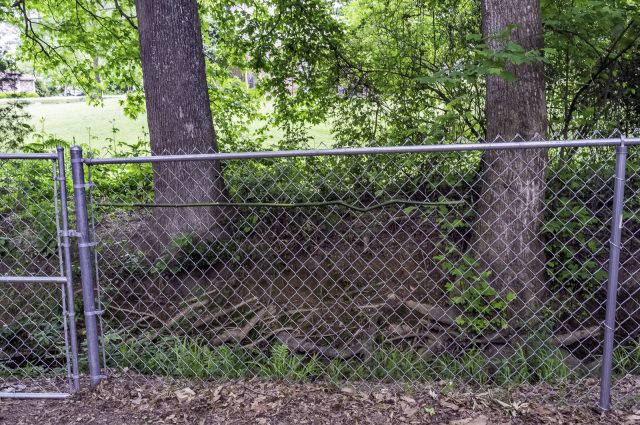
Convenient cane pole storage system

Day 58: The Ball, the Berry, the Photo, and the Border

Kicking the Ball

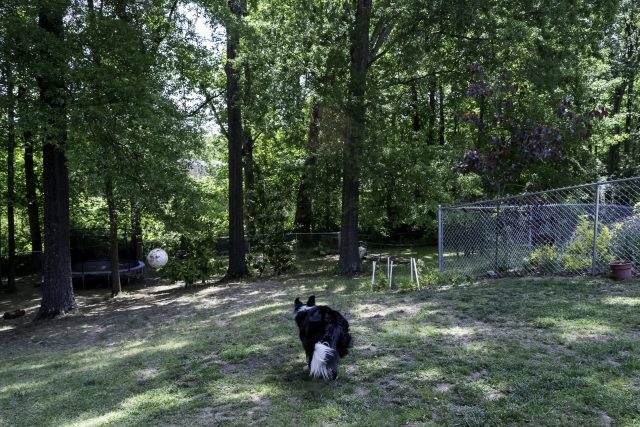
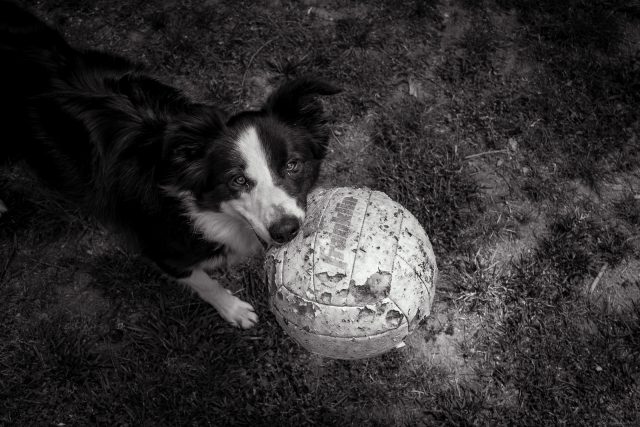
Clover loves to play fetch with balls: tennis balls, volleyballs, basketballs -- whatever. She prefers anything over a basketball because she cannot grasp it in her teeth and has to herd it up the hill of our backyard with her nose. This is why I personally prefer a basketball with her because it is much more amusing to watch her bring the ball back.

However, as enjoyable as playing ball with Clover is, she can really turn it into an annoyance. Any time anyone comes into the backyard, she thinks they've done so expressly to play with her. No other options are conceivable. So she runs to get the ball and drops it near your feet and backs off expectantly. She looks at the ball, looks at you, looks back at the ball. If you don't kick it, she'll run up, give it a little nudge with her nose, then back off again, ready to streak down the hill after the ball.

This is cute if you're just out with your son, doing this or that. It's less cute when you're trying to do something, like build a fire or finish a swing. I try to accommodate her even then, occasionally kicking the ball for her or simply shove it away from me with the vague hope that it will roll down the hill that is our backyard and distract the dog for at least fifteen seconds.

I shouldn't complain, though: I love our dog, even though I joke that I don't. She's stubborn and overly hyper; she gets jealous of any dog which is receiving giving attention; she plays rough and tries to boss smaller or large and more docile dogs about. Despite these minor shortcomings, it's hard not to adore her: her jealousy just comes from her love. Her pestering just comes from a desire to play, which she rightly realizes we often enjoy as much as she.

Shooting and Berries

During our morning break, the Boy and I went shooting in the backyard. He's become quite the shot with his bb gun. While we were retrieving an errantly kicked ball (over the fence to the driveway, rolling down to the blueberry bushes), he decided to take a few shots at the archery target at the other end of the yard. From where we stood, though, he was shooting only at the side, a target of about 15-18 inches wide. He hit it the first time; he hit it the second.

"Man, I'm good," he said.

Yes, he certainly is. Sometimes we have to work on that modesty a bit, though. Yet, on the other hand, he is so lacking in confidence about some things -- especially academic tasks -- that perhaps a bit of bragging is a good thing. I don't know.

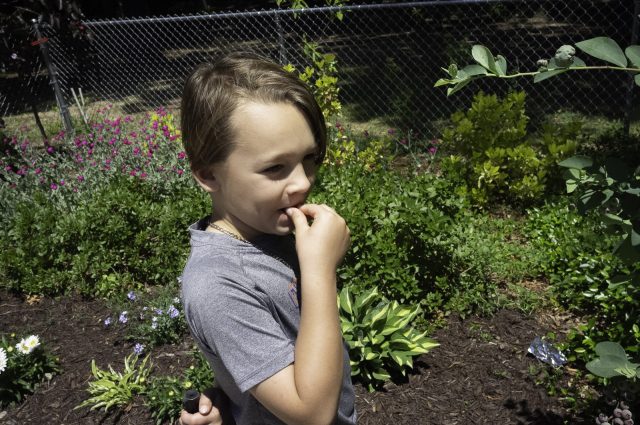
I do know that he was impressed with the number of berries on our bushes and wondered what would happen if we were to try them now, long before they're ripe.

"Go ahead and try one -- but you probably won't like it," I suggested.

He tried one.

"Oh, oh! Yuck! It's so hard and sour!"

Photo Walk

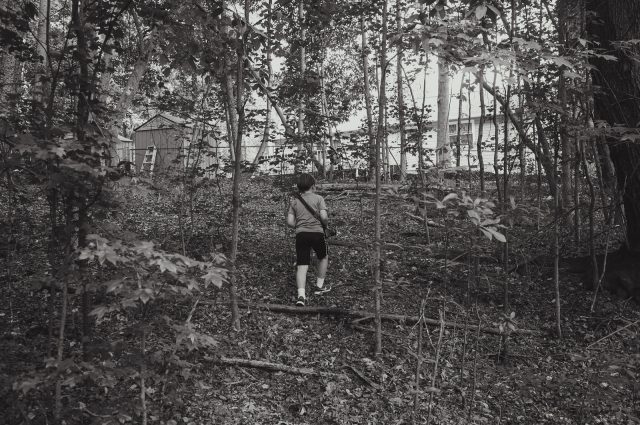
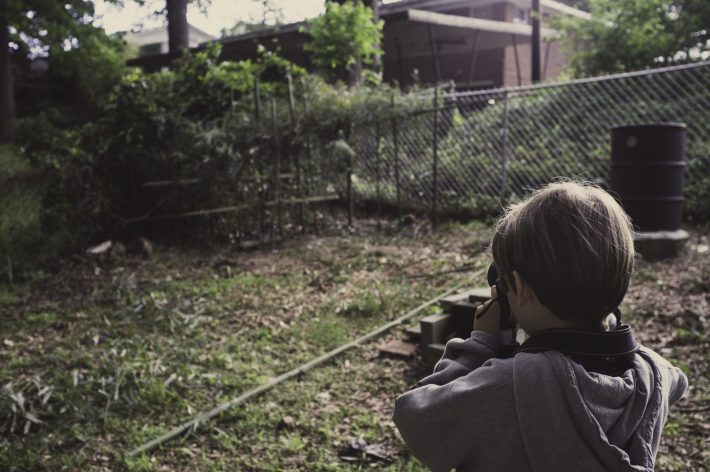
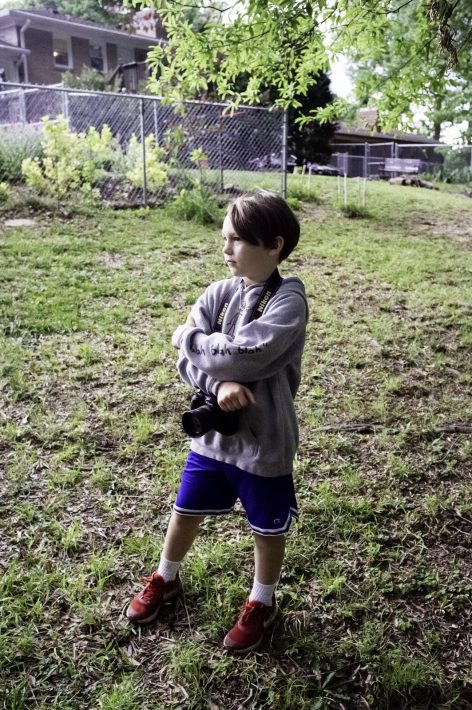
After school was finished, the Boy was eager to go on a photo walk together. "I'm not so into photography anymore," he explained, "but it's still fun." So I gave him the old D70 and took our little X100 for myself and off we went.

We passed the house where, for whatever reason, the owners are storing an old toilet on the back deck. The Boy loves the idea of a toilet on the back deck. "That way you can poop and be in nature!" That's one way of looking at it -- a very seven-year-old way at that. When we got to the house, he tromped boldly up to the fence, took a moment to compose his shot, and walked calmly back down. In the past, he didn't really want to do that.

"What if they see me? What if they say something?"

I tried to explain: "The most they would do is to tell you not to take a picture of their house. In that case, you just smile, apologize, and say, 'Sorry -- I'll delete it.' Simple."

And where are the pictures he took? I haven't taken them off the camera. I've been trying to teach him to use Lightroom and use his edits as well, but we didn't have time today to complete the whole project.

We had to hurry home for dinner.

My Hometown

I grew up in Bristol, which is a unique city as it sits on the Virginia/Tennessee border. The border runs right down the middle of the main street downtown, State Street. A divided city such as Bristol has unique features: for instance, sales tax in Virginia is much lower than that in Tennessee because Tennessee doesn't have an income tax. Smart folks, then, live on the Tennessee side and shop on the Virginia side.

Back before Daylight Savings Time was an almost-nationwide phenomenon -- I don't know what else to call the arbitrary changing of the clock -- one state used it and the other didn't. That meant you could cross the street and gain or lose an hour.

When I first went to Poland in the Peace Corps, I stayed with a Polish host family in Radom for twelve weeks during training. The son was fascinated with State Street: "Does that mean if you commit a crime on one side of the city and the police chase you and you cross the border, they have to stop chasing you?"

The two-state status of the city is relevant now in the time of COVID-19 as Tennessee and Virginia are taking different courses through the pandemic. CNN had a story about it yesterday.

Day 57: Math, Mowing, Painting, and the Missionary Society

Math

The Boy was having trouble this morning with three-digit subtraction, things like 352-178. He was thinking a little too much, mixing prior knowledge with current practice. For example, in the number above, he would know he had to borrow a 10 from the 10s place in order to subtract 8 properly, but then that would leave him with 4. Instead of writing 4 above the crossed-out 5, he wrote 40. Which is technically correct. But the be was subtracting 7 from 40 and coming up with 33, and before long, he was subtracting one three-digit number from another three-digit number and coming up with a six-digit answer.

I remember the frustration of borrowing numbers in subtraction. I, too, experienced it in second grade: I just couldn't figure out how those numbers were shifting around, 5 becoming 4 so I could subtract something from the 1s place. Everyone tried explaining it to me: my teacher, mom, dad, the girl who babysat me from time to time. It just didn't make any sense to me no matter how often and how many different ways it was explained.

So I understood the Boy's frustration this morning. I sat with him a while, taking a break from my own work, and tried to help him through it.

"Yes, but Daddy, that's the 10s place, so it's not just 4, it's 40."

"Technically, you're correct, but..."

"What do you mean 'technically'? What does that even mean?!"

It was another moment that I found myself in awe of elementary school teachers. I don't teach many new skills: I mainly take existing skills and improve them. The kids can write when they come to me; I just help them write better. They can read when they come to me; I just give them tricks for comprehending more challenging texts: things like "make sure you keep track of your pronouns' antecedents -- you need to know who 'he' is when the author uses that pronoun," or "determine the part of speech of that unknown word -- that will help you a lot in inferring a possible meaning." But just taking a kid who doesn't know at all how to read and turning her into a reader? I haven't got the slightest clue how to do that. I know it's just a matter of training: I minored in education in college, but in secondary education -- not primary. An entirely different field of study.

Still, having experienced that frustration myself, I had a certain patience and understanding of his frustration.

This is why some feel that teachers who teach subjects they were always good at isn't as effective as alternatives. We -- for I was always good at literature and decent at writing -- know how to do these skills seemingly instinctively. It's hard to teach someone how to do something that you can do, relative to the struggling student, without thinking. It's better to teach something that you yourself have struggled with, goes the thinking. But the problem with that: where's the passion? I don't teach English just because I want to teach and happened to choose English. I teach it because I myself enjoy writing; I teach it because I love reading. I teach it because I have a certain excitement about certain books, certain poems, even certain reading skills that I love to share with students. I struggled with math, and the only passion I feel about it is a certain kind of revulsion.

Mowing and Painting

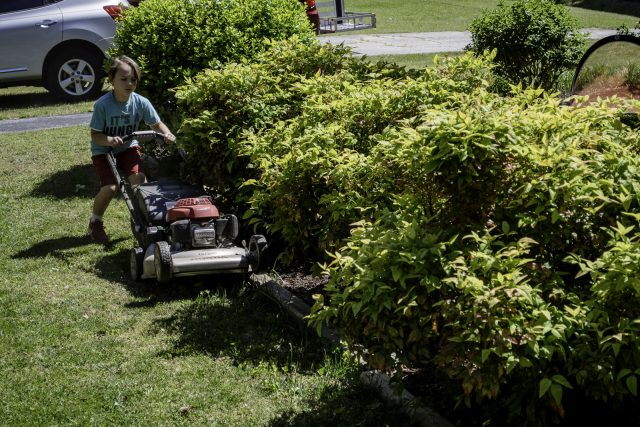
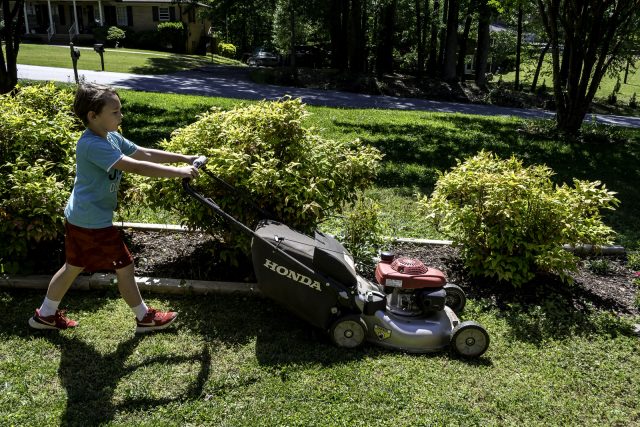
The Boy loves working in the yard. We bought a battery-powered weed eater just so he could help (which is now out of trim line, which we don't have). Today, after scolding me a little bit about still not having the right line, he asked if he could help mow.

When we first started doing this, I would let him do the little flat, straight portion in the front yard just between the flower bed and the crape myrtles. Today, I let him tackle some of the more challenging areas.

"Make sure you keep the line of uncut grass just on the inside edge of your outside wheel," I explained, demonstrating just what I meant.

He tried, poor fellow, but he just couldn't stop drifting inward, leaving slivers of uncut grass with every row.

Still, I can't help but be pleased that he's still willing to help. At some point, the job will be his entirely.

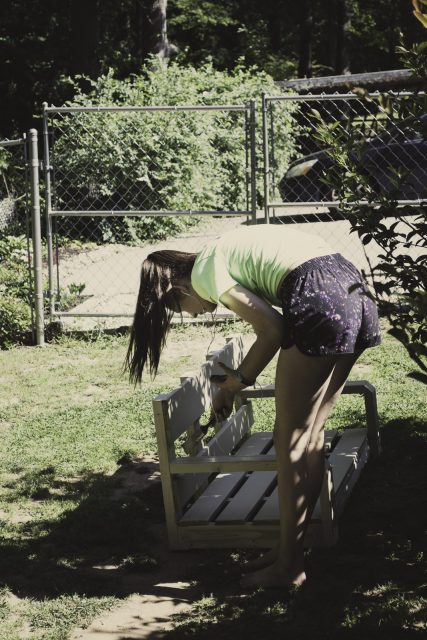
The Girl finished up the afternoon with a little more painting: the swing I'd started Saturday for K's Mother's Day gift is nearing completion.

The Missionary Society Meeting

It's always a chapter that confuses students: the 24th chapter in To Kill a Mockingbird feels like someone took a chapter out of a completely different novel, changed a few names to match a few characters' names in Mockingbird, and just slipped it into the stream of the story. The only connection it seems to have with the rest of the book is the news of the death of Tom Robinson toward the end of the chapter. I contend that in many ways it's one of the most important chapters in the book as it fully develops one of the book's major themes: the hypocrisy of Southern white Christians.

Most of the chapter centers around Aunt Alexandra's hosting the Maycomb Alabama Methodist Episcopal Church South Missionary Society meeting. Scout attends as "a part of [Alexandra's] campaign to teach [Scout] to be a lady." Poor Scout is lost from the beginning: she asks about what they studied and gets confused immediately:

“Oh child, those poor Mrunas,” [Mrs. Merriweather] said, and was off. Few other questions would be necessary.

Mrs. Merriweather’s large brown eyes always filled with tears when she considered the oppressed. “Living in that jungle with nobody but J. Grimes Everett,” she said. “Not a white person’ll go near ‘em but that saintly J. Grimes Everett.”

Mrs. Merriweather played her voice like an organ; every word she said received its full measure: “The poverty... the darkness... the immorality—nobody but J. Grimes Everett knows. You know, when the church gave me that trip to the camp grounds J. Grimes Everett said to me—”

“Was he there, ma’am? I thought—”

“Home on leave. J. Grimes Everett said to me, he said, ‘Mrs. Merriweather, you have no conception, no conception of what we are fighting over there.’ That’s what he said to me.”

“Yes ma’am.”

“I said to him, ‘Mr. Everett,’ I said, ‘the ladies of the Maycomb Alabama Methodist Episcopal Church South are behind you one hundred percent.’ That’s what I said to him. And you know, right then and there I made a pledge in my heart. I said to myself, when I go home I’m going to give a course on the Mrunas and bring J. Grimes Everett’s message to Maycomb and that’s just what I’m doing.”

A skilled reader with a moderate amount of background knowledge immediately understands: this J. Grimes Everett is a missionary to the Mrunas, who, in turn, are clearly an African tribe ("Not a white person’ll go near ‘em but that saintly J. Grimes Everett").

The reason the author includes the Mrunas is clear only toward the end of the missionary society meeting, when Mrs. Merriweather begins talking about Atticus's decision to represent Tom:

Mrs. Merriweather nodded wisely. Her voice soared over the clink of coffee cups and the soft bovine sounds of the ladies munching their dainties. “Gertrude,” she said, “I tell you there are some good but misguided people in this town. Good, but misguided. Folks in this town who think they’re doing right, I mean. Now far be it from me to say who, but some of ‘em in this town thought they were doing the right thing a while back, but all they did was stir ’em up. That’s all they did. Might’ve looked like the right thing to do at the time, I’m sure I don’t know, I’m not read in that field, but sulky... dissatisfied... I tell you if my Sophy’d kept it up another day I’d have let her go. It’s never entered that wool of hers that the only reason I keep her is because this depression’s on and she needs her dollar and a quarter every week she can get it.”

“His food doesn’t stick going down, does it?”

Miss Maudie said it. Two tight lines had appeared at the corners of her mouth. She had been sitting silently beside me, her coffee cup balanced on one knee. I had lost the thread of conversation long ago, when they quit talking about Tom Robinson’s wife, and had contented myself with thinking of Finch’s Landing and the river. Aunt Alexandra had got it backwards: the business part of the meeting was blood-curdling, the social hour was dreary.

“Maudie, I’m sure I don’t know what you mean,” said Mrs. Merriweather.

“I’m sure you do,” Miss Maudie said shortly.

Yet this is where students really get lost. In typical Southern gentile fashion, Mrs. Merriweather won't deign to gossip about anyone -- how uncivilized -- so she simply makes talks about Atticus in the third-person plural. And everyone in the room knows exactly who she's talking about -- everyone but Scout. And our young readers.

Today, my English I students started the adventure of figuring out this marvelous chapter. I always read the relevant passage aloud in class. It's one of the most enjoyable things I do all year. I lay on the Southern accent, dropping final rs ("squalor" becomes "squala") and altering the cadence and tone of my reading. How to do that when in lock-down? Simple: record it. My favorite part -- that passage above.

Day 56: Mother’s Day and Conspiracies

Two radically different thoughts that rattled around my head today, completely unconnected other than the fact that I thought about them during the same 12-hour period...

Mother's Day

It’s the first Mother’s Day without Nana. A year ago, we were just about ready to move Nana and Papa into the almost-completed living space, and we had a Mother’s Day dinner at Nana’s and Papa’s. We all sat around Nana’s bed as we ate, and L and I gave her a small succulent that was small enough to sit on her bedside table. I don’t remember what we ate; I don’t remember what we talked about. Had we known then that it was our last Mother’s Day with her, we probably would all remember those details, but that’s the problem with most lasts -- we don’t know they’re the last this or last that.

It reminds me of how a priest once explained how he avoids becoming complacent and (did he say this? He might have used this word) even bored with the Mass, saying the same thing day in and day out, over and over again. “I try to treat every Mass as if it’s the first, last, and only Mass I’ll ever celebrate.” When we know it’s the last time we do something, we tend to slow down and savor it.

I used to get very upset at lasts. I wanted, as Counting Crows’ Adam Duritz sings, “to hold on to these moments as they last,” and when it’s the last one, it doesn’t last long. (That’s an odd little thing, isn’t it? “Last” as a verb and “last” as an adjective. “How long does the last one last?”) When I knew the last moments of some experience were approaching or the last time I would do something was nearing, I always grew just a touch melancholy.

The last day of school, for instance, used to be a little sad because I found myself thinking that I’d never see these kids in whom I’d invested so much. I’d forged relationships with them, some of which were hard-won and very frustrating as they developed. It had taken me a long time with some of them to convince them that I was, indeed, on their side, that even when I was giving them a hard time about their behavior, doling out consequences that they felt were unfair, I was still on their side.

From K's iPhone

But endings are often beginnings. I think of Eliot’s “East Coker,” which ends, “In my end is my beginning.” It is, of course, a reference to the afterlife, but all endings are also beginnings -- an old, time-worn truth. The end of every school year promises the beginning of the next.

That is where I differ from the rest of the folks in our household: they all believe that Nana’s end was her beginning; sadly, I have my doubts. It’s a lovely thought, and one that of course I hope is true in a sense because Papa, for instance, has so much invested emotionally in that idea. But if I’m right, we’ll never know; we’ll only know if I’m wrong.

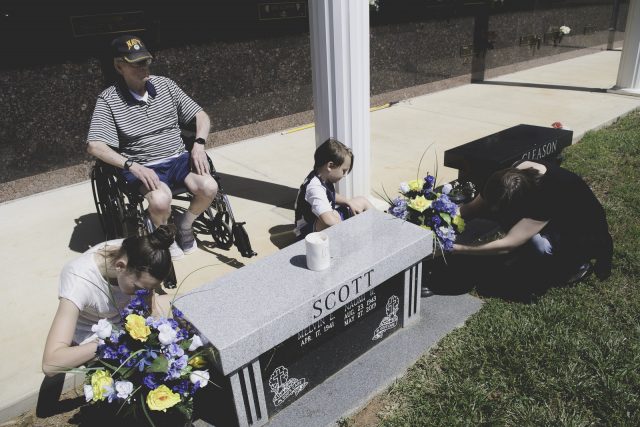
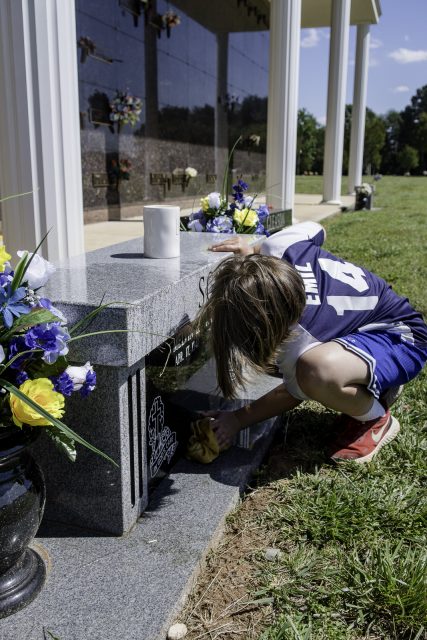
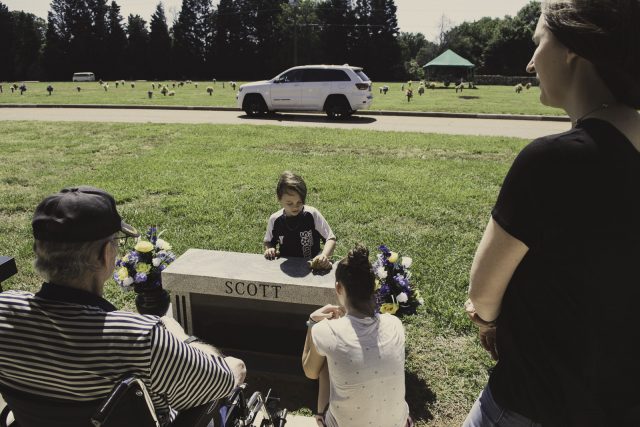
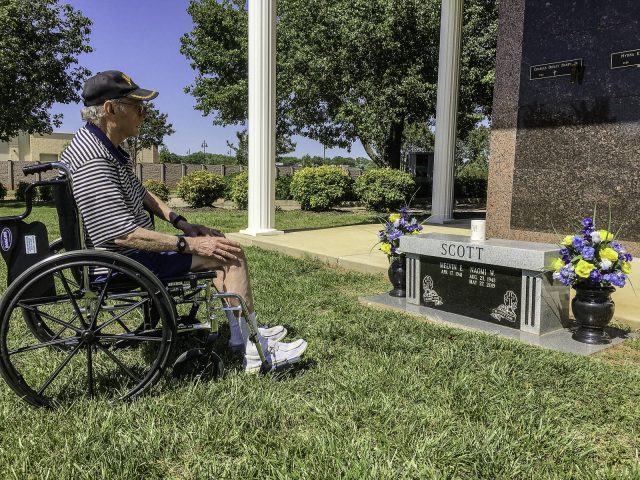
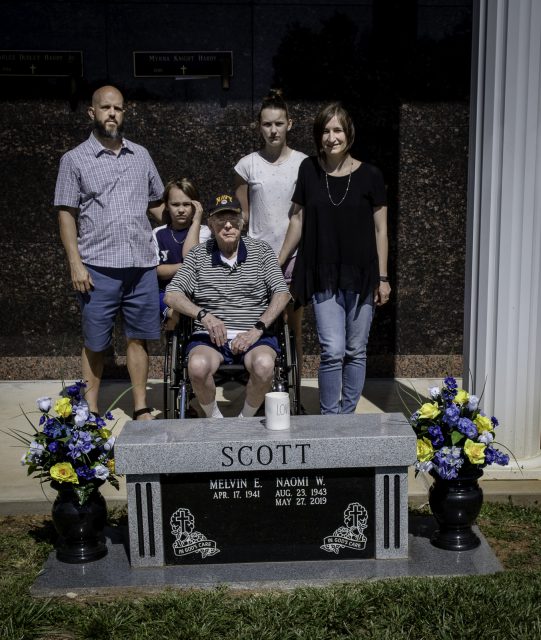
It was with all these thoughts in my head that I drove the family to visit Nana’s grave today for Mother’s Day. Papa bought a couple of new bouquets of artificial flowers -- lovely ones of multiple shades of blue with yellow and white roses to off-set the sea of blue. Nana would approve, no doubt. Blue was her favorite color, and there are enough shades of blue in the bouquets to fill the sky.

Conspiracy

I’m currently reading Stalin: In the Court of the Red Tsar by Simon Sebag Montefiore, a book about Stalin’s Great Terror ( I love the Russian name, Большой террор -- makes me think of the ballet!). At its heart, the Great Terror was unimaginable without Stalin, but it was also impossible without others. Many others. How do you get so many people to go along with that? Simple: conspiracy theories.

Today it seems impossible that virtually every factory and railway line was being sabotaged by Trotskyite terrorists within their management, but Soviet industry was riddled with mistakes and cursed with thousands of accidents thanks to poor management and the breakneck speed of the Five-year Plans: for example, in 1934 alone, there were 62,000 accidents on the railways! How could this happen in a perfect country? “Enemies” among the corrupt elite had surely caused the failures. The arrest of saboteurs and wreckers in the industrial factories and railways spread.

By the time the Terror turned to the army and the Party itself, Stalin was most definitely in complete, unquestioned control. At his word, people lived and died, and very few people questioned his decisions.

Reading this got me thinking about the current situation in America and the conspiracy theories that seem to be popping up like mushrooms are growing positively dangerous.

Some people belittled her, others suggested she was a paid actor or was a healthcare professional who had no direct involvement with the treatment of Covid-19. Others accused her of being an abortion doctor.

"It was heated, people were very fired up about what they had to say," she told CNN. "A lot of the top comments we got were about us being fake nurses, there was a huge majority of them that still believe this virus is fake, that it's a hoax and not real at all. They were convinced that we're fake nurses and that's why we weren't talking."

Quite the opposite of a fake nurse, Ms Leander volunteered to work at her hospital's Covid-19 unit full time, and has been on the front line working with infected patients for the past month.(Source)

I saw footage of this on Now This but can’t find it now. There is a definite political element to this: all the protestors were wearing “Trump 2020” paraphernalia, and I would bet that every single one of them believes the Deep State conspiracy nonsense. So I read the passage in Montefiore’s book and started wondering what it would take for something like that to happen in America.

Could these people support wholesale executions of people they see as participating in anti-state conspiracies? I don't know.

We all want to say, "No, no -- we're better than that." We think about our neighbors and even those nameless faces we see in our own towns and think it impossible. Would Vasili Blokhin's neighbors or acquaintances have thought he was capable of the acts he committed? He was a prolific executioner who killed many during the Great Terror but most infamously executed over 7,000 Polish officers personally in 28 days in the forest of Katyn.

Just as we never know when an end of this or that is coming, we never know how current events are going to play out. COVID-19 was a problem in China, over there, far away until it wasn't. With quarantines being lifted around the country before we even really have adequate testing capabilities in place, it's not inconceivable that we might experience a sharp increase in the number of cases, forcing states to decide whether or not to reimpose restrictions. What will these protesters do then? We've already seen armed protesters storm the Michigan statehouse; what else are they capable of? If something happens that results in bloodshed, how will protesters (i.e., rabid Trump supporters) react in other states? We already see signs reading "Give me liberty or give me COVID."

That's not a far cry from the original formulation that encouraged revolution.

Day 55: The Swing, the Dog House, and the Bench

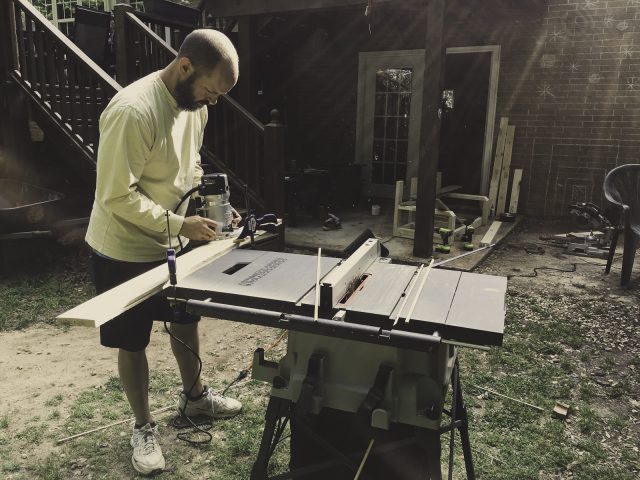
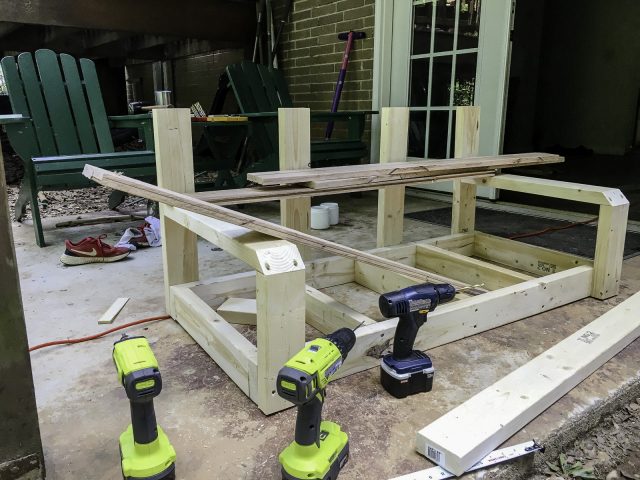
I don't know how it inevitably happens, but projects with me just seem to swell completely out of proportion from my original estimates. Sometimes it's simply that my estimates are wrong. No, that's most of the time. I tend to underestimate the time required because I tend to overestimate my skills. Today, though, my estimation of the time required to make K's Mother's Day present was just about dead on. True, it took me longer in the end, but that's because I decided to pull out the router and round over every edge. Why? Because I have a router and quite honestly don't have that many opportunities to use it.

From K's iPhone

I also decided as I was working to countersink all the screws and go back with wood filler and hide them all. That added a bit of additional time. But the raw building itself took just about as long as I anticipated.

What got me off track was not the time it took to make the bench but rather the time it took to gather the needed materials. The wood was the real trick.

I went to Lowe's expecting to be back fairly quickly. All I needed was a bit of additional chain for the swing, a few hooks to connect the swing to the chain, and some 2x4s for the framing of the swing. The chain took quite some time -- probably more than twenty minutes -- because I pressed the "Press here for assistance" button and no one came for what seemed like an eternity.

From K's iPhone

Finally, I was ready to pick up the lumber and haul it back to the in-store sawing station to have them cut the 96" studs down to 48" pieces that would fit in K's Rogue. The first trick was to find a lumber cart. I finally gave up looking for one, went to the cashier, paid for the hardware, took it out to the car, and returned with a lumber cart from the parking lot. I loaded my six 2x4s and headed to the cut station. Where I found a sign that read, "Saw not functioning."
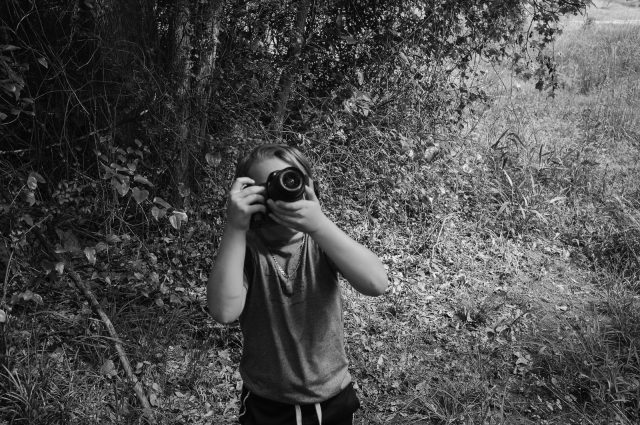
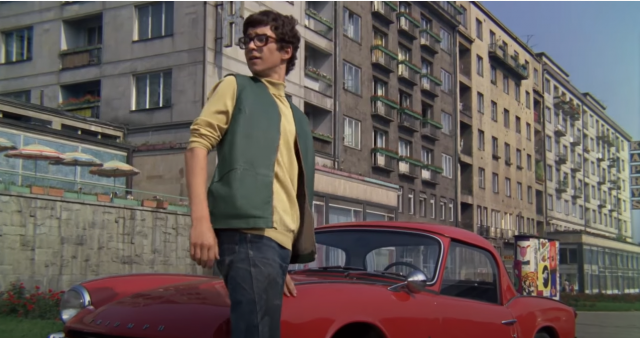
I felt like I was in the film Nie Lubię Poniedzialku except that I was in Greenville not Warsaw and it was Saturday not Sunday.

I just left the cart there with the lumber on it. It was a somewhat crummy thing to do -- I could have at least taken the lumber back.
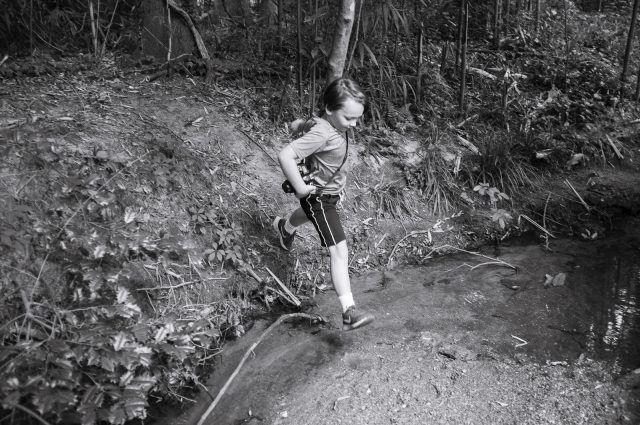
From K's iPhone

After dropping off the hardware at the house (because it was on the way), I headed to Home Depot. The saw there was completely functional. The studs I picked out, though, were not 96" but only 93". So when I told the shop assistant to cut them at 48", adding "I just need them in half-size pieces," he did just that: he put one end of the board on 48" and cut. And the resulting pieces were of a significantly different length. That's when I measured and saw they weren't 96". I could have checked. I didn't. I just sighed.

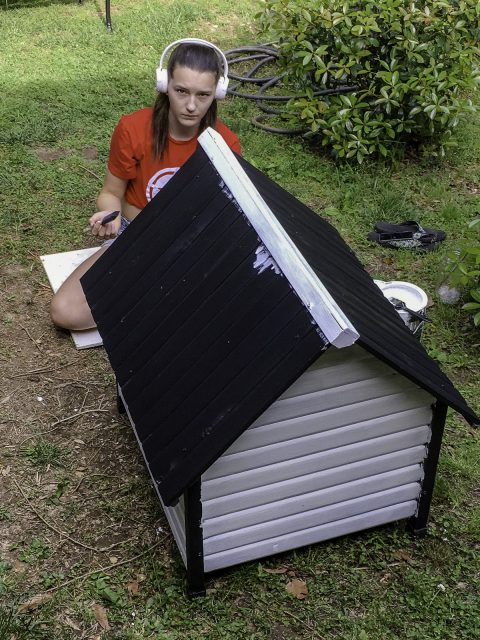
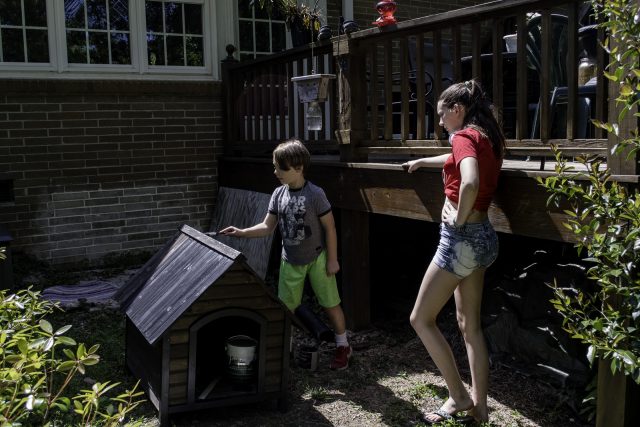
While all of this was going on, the Boy alternated between helping me and helping the Girl, who was painting the dog house and the bench.

From K's iPhone

In the evening, we watched Nie Lubię Poniedzialku. We've been trying to expose the kids to some of the classics, and we decided it was time for Poniedzialku. I love that film. It's probably my second-favorite Polish film, right behind Miś. The story, such as it is, is charming: we all laugh at the horrid Monday everyone is having even though none of their trials rise above irritation. There's no shadow of any real tragedy -- just the annoyance of plans going awry.

What I really love about the film, though, is the views of the Warsaw of the early 1970s. Just a quarter of a century after the Second World War, much of the city is still under construction, and what has been completed has the look of 60s communist architecture that was still prevalent in Warsaw when I arrived in 1996.

https://www.youtube.com/watch?v=1M2386VX0Po

Papa decided he'd watch the film with us. "There are no subtitles," we warned him, but he wasn't fazed. We explained critical dialogue, but most of it really didn't require a whole lot of explaining.

The Boy disagreed. "I don't get any of the funny parts, even when you explain them," he fussed.

Perhaps he'll find the next one we've planned a little more enjoyable: the classic Sami Swoi. We found it on Netflix DVDs, which means it will have subtitles. "Kargul, podejdź no do płota!"

Day 54: That Old House

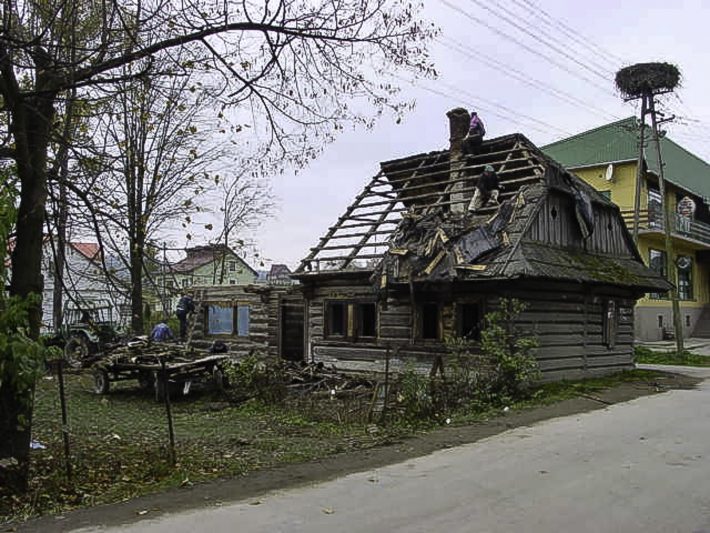
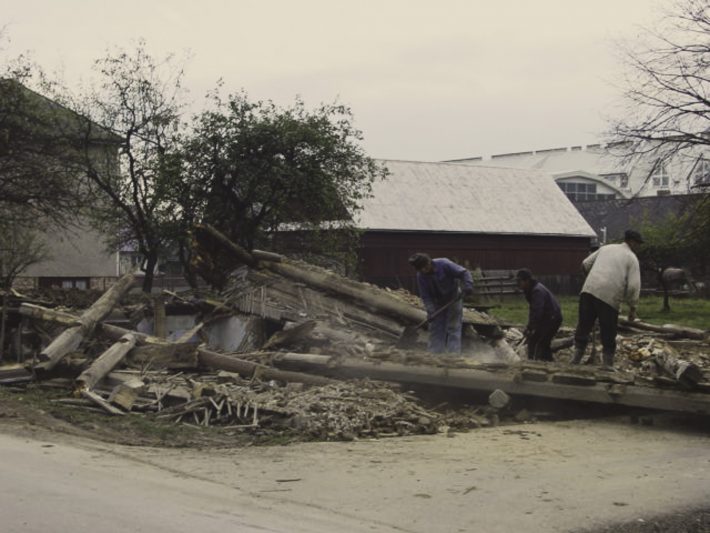
I passed that old house just about every day, especially when I first arrived in Lipnica and made daily trips to the post office to mail a letter. It had been abandoned long before I arrived. An ancient, traditional home, made entirely of wood, it was a jarring contrast to most of the other homes constructed of concrete block. I seldom passed it without wondering what it would take to restore it and if anyone would even be interested.

The location was less than ideal, though. Just beside it was the old communist-era bar with a large area above it that had been converted into a discotheque. Every Saturday night, there were dozens and dozens of people milling about with loud techno music that would have been impossible to shut out. Often one could see a couple just around the back corner locked in an embrace or a line of young men leaning against the long wall of the home facing the bar, smoking and laughing loudly.

Still, growing up in suburbia, I found the old house utterly enchanting. Nothing in the neighborhood where I grew up was older than a couple of decades. The houses were cookie-cutter similar: directly across the street from our house was a house built from the identical plan, which had been flipped to create a mirror image of our home. To the left of our house was a home with an identical floor plan with minor exterior design changes. To the left of that house was still the same house a third time. That same house was scattered throughout the neighborhood — at least a dozen more times, I’m sure.

I doubt anyone would worry much about the loss of such a house from a historic point of view. Certainly, it would be a great tragedy for the house to be destroyed while it was still in use, but had it been sitting unoccupied for decades, most would probably consider its removal a positive development.

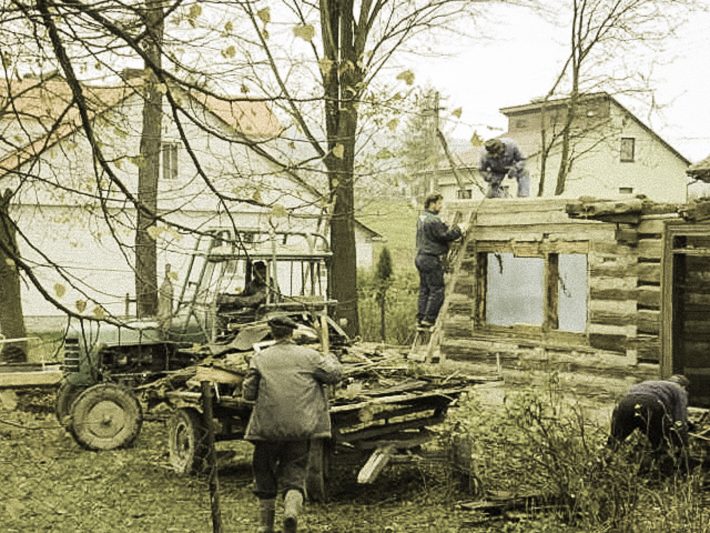
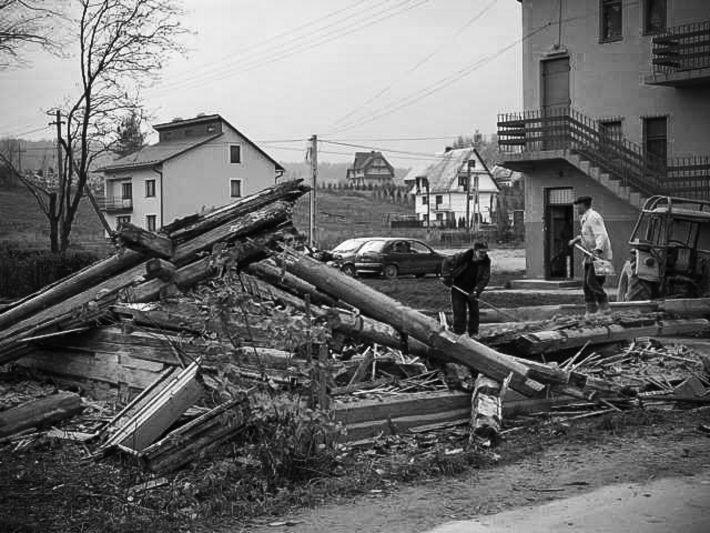
Taking down a house like this, though, and so very unceremoniously, seemed to me, an outsider, to be almost sacrilegious. We are such a young country, the United States, that something that’s a century-and-a-half old is of automatic interest and significance for anyone with a sense of history.

In the end, I never learned what became of all the timber from that house. It lay stacked in haphazard piles by the road for several months and then disappeared. I heard from someone that the owner of the old house had burned it for winter warmth.

That somehow makes it both more and less tragic.

Tearing Down History

Stories

Day 52: A Fort of Sympathy

The Fort

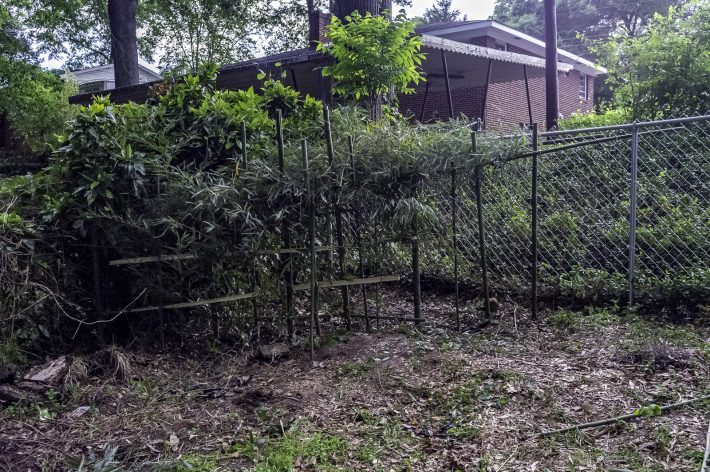
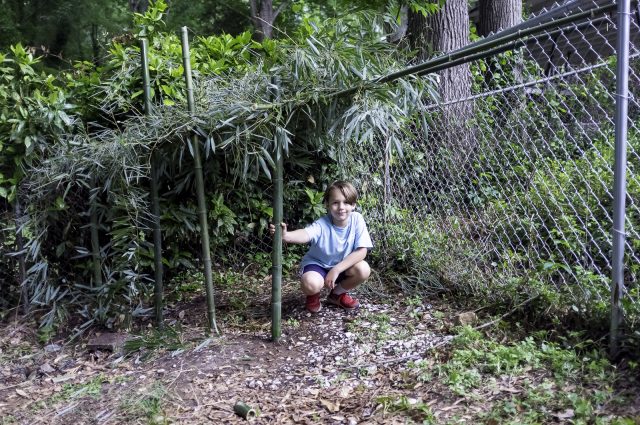
Work continued this evening on the fort. We needed some more bamboo canes, so we headed over to our neighbor's stand of canes and selected four after school was over. By the time we got them back on our property, it was nearly dinner (school for me went really late today), and it was raining, making it impossible to continue working.

After dinner, though...

The process has been one of evolution. We start with a design idea, discover it works, continue for a while, then have another idea. We try to incorporate it into the old idea; it sometimes works; it often doesn't. We see if a third idea will bond the two original ideas a little more firmly. And so on.

E is discovering that the men who do all the primitive building on YouTube are in fact deserving of quotes: "primitive" building, for there's nothing primitive about it except the tools they're using. I could have tried to explain that to the Boy, but I don't think it would have convinced him. Working on it himself, though, has certainly done that.

Sympathy

I went for a run this evening. It's been a while. I get in these phases that I feel certain that a fitter, healthier G is just within reach: I simply have to get a regular exercise routine going and monitor what I snack on (or eliminate it altogether). It's easy -- nothing at all to it. And then I put the Boy to bed and find that I almost fell asleep with him and reason, "I'm already almost asleep. It would be a shame to waste it." Or I just decided a glass of wine and some chess online is a better way to spend my time. Or occasionally (this is a cycle I've been going through for about 18 months now), I get this routine going and then some injury or previous pain flares up and I have to stop running for a week or more, and my motivation is back to where it usually is, which is to say near zero.

So I went out for a first run in probably two weeks, cueing up my running soundtrack on Spotify. The first song shuffled out: Beck's "Devil's Haircut." I wasn't in the mood for it, so I swiped on to the next song: the Stones' "Sympathy for the Devil." (One run, Spotify played "Sympathy for the Devil" followed by Van Halen's "Running with the Devil," and concluding with "Devil's Haircut." A more superstitious person would read something into that.) The second verse began, and it got me thinking:

And I was 'round when Jesus Christ
Had his moment of doubt and pain
Made damn sure that Pilate
Washed his hands and sealed his fate

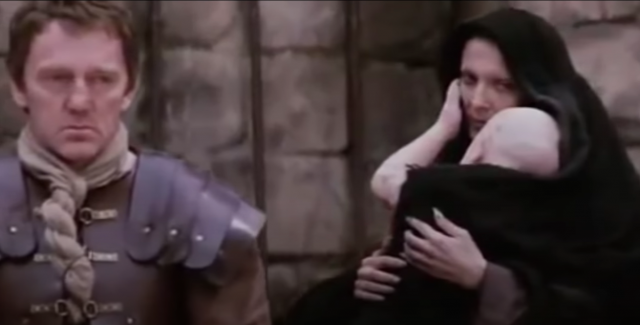
It reminded me of the scene in Mel Gibson's take on the passion story. During Jesus's scourging, a very androgynous Satan crying a child who looks surprisingly old walks through the crowd, looking as if he's somehow winning a victory by having Jesus crucified.

In both these examples, and in general Christian thought, Satan is presented as having had a part in influencing humans to kill Jesus. But why in the world would he do that if Christian claims that Jesus was foretold for millennia? Christian theology teaches that through the crucifixion, Jesus somehow defeated Satan and ultimately saved our souls, and that this plan was in place from the Fall in Eden.

That is kind of confusing as well: if God is omnipotent, he knew that was coming, and so it was part of the plan to begin with. But if it was part of the plan to begin with, it seems like a bad plan, as if the failure implicit in the Fall is integral to the whole scheme. Which means we were made to fail. Odd plan, that.

At any rate, I was wondering why Satan is always shown to be crafty and yet an idiot at the same time. Evangelical views make Satan even more of an idiot: he's going to try to overthrow God in Armageddon, yet he's doomed to fail. All Evangelicals know this. It's preached every Sunday. And yet somehow Satan, a being who is supposedly so much more powerful than humans in every way imaginable, doesn't know about this.

More questions about the devil: why would he torture people in hell? Wouldn't he want to reward them for choosing him over God? Wouldn't he make it a paradise to rival Christian views of heaven just to thumb his nose at God? He's literally an instrument of God's punishment in the Christian view, yet he has free will and hates God. Why in the world would he be God's pawn like that? That's the whole reason he got tossed out of heaven in the Christian story.

And that's another thing: how did this war in heaven happen? How do spirits battle? Wars have to do with one thing: inflicting more death and carnage on your enemy than he can on you. How in the world would immortal spirits fight then? It just doesn't make any sense. Maybe that's why we should have sympathy for the devil: in the grand scheme of things, he's just a schmuck doing God's dirty work in punishing souls who reject God. What a crappy job.

So I was jogging along, all these thoughts bouncing about in my head, and it struck me that perhaps that's as good an argument as any against going for a run: I roll about in silly, useless speculation...

Day 51: Seeing Anew

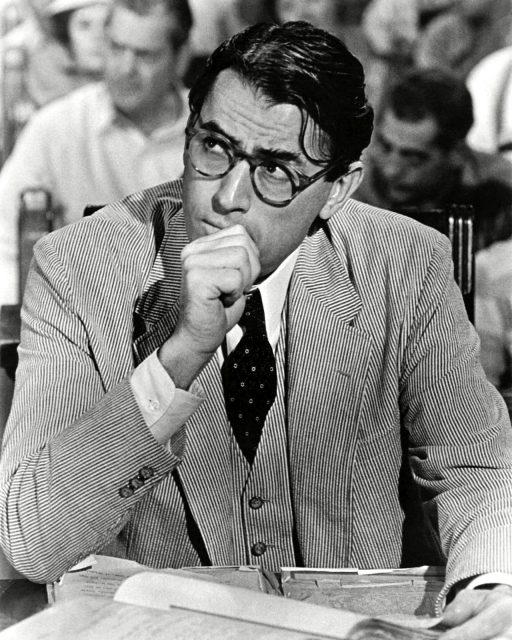
Atticus Finch -- what a hero. What a fantastic lawyer. That's what we all walk away thinking the first time we read To Kill a Mockingbird. We read his cross-examination of Bob and Mayella Ewell and think, "He did a really good job establishing Tom's innocence," and can't understand how Tom could be found guilty-- though we can understand it because it's Depression-era Alabama.

The state has not produced one iota of medical evidence to the effect that the crime Tom Robinson is charged with ever took place. It has relied instead upon the testimony of two witnesses whose evidence has not only been called into serious question on cross-examination, but has been flatly contradicted by the defendant.

Nailed it -- keep hammering on the fact that no doctor was called, Atticus.

She was white, and she tempted a Negro. She did something that in our society is unspeakable: she kissed a black man. Not an old Uncle, but a strong young Negro man. No code mattered to her before she broke it, but it came crashing down on her afterwards.

Her father saw it, and the defendant has testified as to his remarks. What did her father do? We don’t know, but there is circumstantial evidence to indicate that Mayella Ewell was beaten savagely by someone who led almost exclusively with his left. We do know in part what Mr. Ewell did: he did what any God-fearing, persevering, respectable white man would do under the circumstances—he swore out a warrant, no doubt signing it with his left hand, and Tom Robinson now sits before you, having taken the oath with the only good hand he possesses—his right hand.

There it is -- that brilliant evidence that someone lefthanded inflicted the bruises on the right side of Mayella's face. Tom's left arm was mangled in a cotton gin when he was young -- he couldn't have done it. Case closed.

And then that impassioned closing:

Thomas Jefferson once said that all men are created equal, a phrase that the Yankees and the distaff side of the Executive branch in Washington are fond of hurling at us. There is a tendency in this year of grace, 1935, for certain people to use this phrase out of context, to satisfy all conditions. The most ridiculous example I can think of is that the people who run public education promote the stupid and idle along with the industrious—because all men are created equal, educators will gravely tell you, the children left behind suffer terrible feelings of inferiority. We know all men are not created equal in the sense some people would have us believe—some people are smarter than others, some people have more opportunity because they’re born with it, some men make more money than others, some ladies make better cakes than others—some people are born gifted beyond the normal scope of most men.

But there is one way in this country in which all men are created equal—there is one human institution that makes a pauper the equal of a Rockefeller, the stupid man the equal of an Einstein, and the ignorant man the equal of any college president. That institution, gentlemen, is a court. It can be the Supreme Court of the United States or the humblest J.P. court in the land, or this honorable court which you serve. Our courts have their faults, as does any human institution, but in this country our courts are the great levelers, and in our courts all men are created equal.

I’m no idealist to believe firmly in the integrity of our courts and in the jury system—that is no ideal to me, it is a living, working reality. Gentlemen, a court is no better than each man of you sitting before me on this jury. A court is only as sound as its jury, and a jury is only as sound as the men who make it up. I am confident that you gentlemen will review without passion the evidence you have heard, come to a decision, and restore this defendant to his family. In the name of God, do your duty.

What a perfect defense! What insight! What an amazing job defending a man in a hopeless situation!

That's what we think when we're not lawyers, though. But what about a trial lawyer who's had twenty years' experience in the courtroom? Someone who's represented defendants against charges of rape and murder?

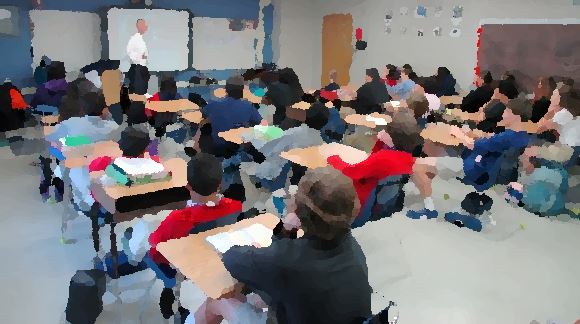
During the 2018/2019 school year

Every year, as the kids finish up Mockingbird, I have Jim Bannister, a local defense attorney, come in and walk the kids through the details of the trial and evidence. He's been doing this presentation for some years, ever since a friend's daughter read the book. The friend asked him what he thought of Atticus's defense and, not having read the book since middle school, Bannister reread the chapters dealing with the trial.

"I would have handled things a little differently," he remarked. "To be fair," he's always added when talking to the kids, "Atticus seems to be a tax and/or estate lawyer, so he was not in his area of specialization at all." Still, he helps the kids see the mountains of evidence that Atticus could have brought into the trial that doesn't even get a mention.

The most damning evidence does appear in the book, but Atticus doesn't push it hard enough: no doctor was ever called.  This means there's no evidence that the crime even took place. But there's so much more than that.

What about clothing the accused and supposed victim were wearing? How could Tom, who's left arm is all but useless, hold down Mayella as she claimed, take off his clothes, take off her clothes, and rape her while using only one arm? It doesn't make sense -- it's physically impossible.

What about defensive wounds on Tom? Mayella said she fought him "tooth and nail." There should have been scratches all over Tom's face.

What about the window through which Bob says he saw the rape in progress? Earlier in the book, the Ewell house is described and we discover that there's cheesecloth over the windows instead of glass panes. How clean was that cheesecloth? How much could Bob actually see?

And if his daughter was being raped and all that stood between him and the rapist was a bit of cheesecloth over a window no more than three feet above the ground, why didn't he dive through the window and attack Tom? Instead, he claims he witnesses the rape in the front room and runs around the entire shotgun house and enters through the back door.

All these were failures on the part of Heck Tate, the sheriff, who did absolutely no investigation at all. "I would tear him apart on the stand," Bannister laughs.

For me, though, the most jaw-dropping piece of evidence was a little gem hidden in Tom's account of the event.

"Mr. Finch, I was wonderin’ why it was so quiet like, an‘ it come to me that there weren’t a chile on the place, not a one of ’em, and I said Miss Mayella, where the chillun?”

Tom’s black velvet skin had begun to shine, and he ran his hand over his face.

“I say where the chillun?” he continued, “an‘ she says—she was laughin’, sort of—she says they all gone to town to get ice creams. She says, ‘took me a slap year to save seb’m nickels, but I done it. They all gone to town.’”

Tom’s discomfort was not from the humidity. “What did you say then, Tom?” asked Atticus.

“I said somethin‘ like, why Miss Mayella, that’s right smart o’you to treat ’em. An‘ she said, ’You think so?‘ I don’t think she understood what I was thinkin’—I meant it was smart of her to save like that, an‘ nice of her to treat em.”

Why in the world didn't Atticus call to the stand that ice cream salesman?! Everybody in the town knows the Ewells; everyone knows how poor they are. To see all seven of them come traipsing up with nickels in hand to buy ice cream would have been a once-in-a-lifetime, always-remember-it moment.

So he comes every year to lead students through these pieces of evidence, suggesting at the outset that they pretend like he's the lead attorney and they are his paralegals, investigators, and co-attorneys. "Let's see if we can't put together a better defense for Tom Robinson."

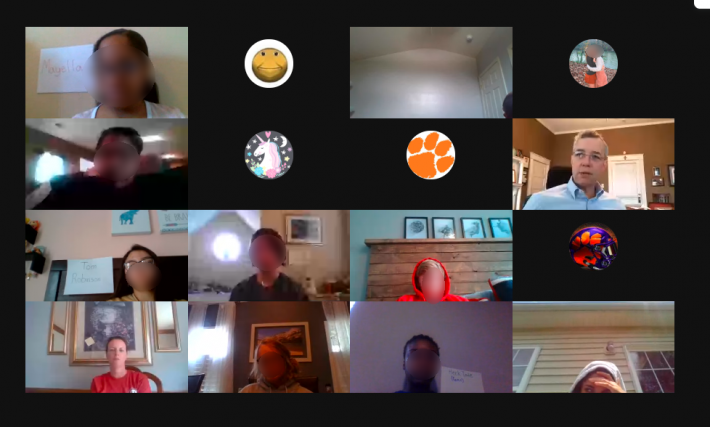
Except he couldn't come this year for all the obvious reasons. Yet when I asked him if he'd be willing to give it a shot on Google Meet, he didn't hesitate: "What dates are we looking at?"

And so he sat in his study and led several of my students through a discussion via Google Meet, and my eighth-grade vice principal (well, she will be next year after our current, much-loved vice principal retires) popped in eagerly when I told her what we were planning.

Despite the frustration of the lockdown, it was a good day to be a teacher.

The Day's Adventures

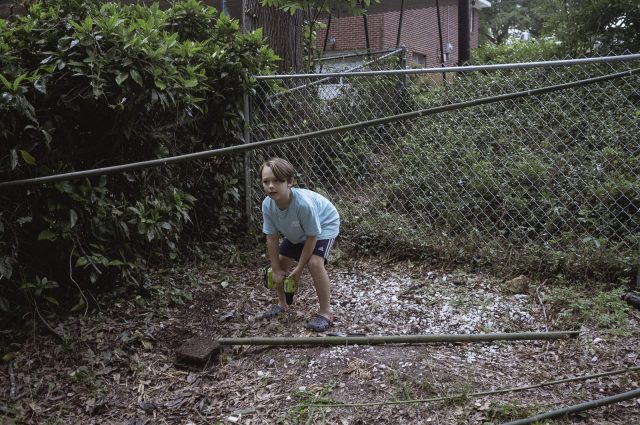
The Boy has wanted to build a bamboo structure of some sort for some time now. He had in his mind a large and grand structure, perhaps with a swimming pool beside it and a diving platform coming out of the second story.

Heading down to play in the creek after "school"

Today, I suggested a little more modest structure: "We could simply use the corner of our fence and Mr. F's fence and build it there.

Looking for minnows

And so we went out into the stand of bamboo growing in Mr. F's back yard (more or less -- not really sure of property lines there) and took a few canes.

Dew-laden web, photo by the Girl

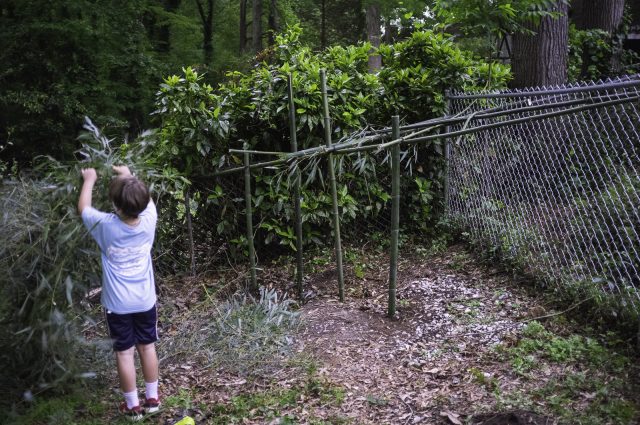
We stripped off the small branches on which grow the leaves, cut them to length,

dug a few holes, and we had our basic frame. A little more work and we had a functional structure.

A good day to be a dad.