Matching Tracksuits

fun in fours

COVID-19 quarantine

Day 81: Frustration

Here are the specs for the order:

Notice: a 2 x 2TB hard drive for data storage.

Here are the properties of that drive (since it’s a raid, the two drives should appear as one 4TB drive):

That’s 2TB. Half of what I ordered.

I called so many people. I chatted with online help. Most of the conversations went like the online chat:

To say I spent most of the day alternating between laughter, fury, frustration, and resignation is a vast oversimplification.

This is the last time I will ever order a computer with customizations online. From here on out, I’m either building the machine myself or having someone else locally build it to my specifications.

All of that to say that we have this incredibly powerful computer that has a woeful lack of storage. I’m working on a short-term workaround, but the upshot is simple: still no pictures for today.
Day 80: Transitions

It’s almost embarrassing how long we struggled along with the same old computer as our main computer. I was the main user: Chromebooks, laptops, and now Nana’s old computer filled the void for the others. We finally broke down and bought a new computer, though, and it’s a beast: Intel Core i9-9900 vPro (3.10GHz, up to 5.0GHz with Turbo Boost, 8 Cores, 16MB Cache) with 48GB of RAM, a 1024GB solid-state drive for programs, and a 2 x 2TB RAID hard drive for storage. It’s blazing fast. Lightroom work should be so much quicker. But there’s the problem: I have 126,000+ image files constituting 1.25TB to move before I even think about installing Lightroom and beginning to reconstruct the LR catalog.

And so for today, I have nothing more than the thought that transitions between computers are probably about the easiest transitions there are. After all, the computers do all the work…

Day 79: Celebration

The eighth-grade assistant principal, Mr. M, retired this year. What a year to retire -- everything tossed in the air and mixed up, then tossed again.

"Are you going to stay another year so you can end normally?" I joked.

"Oh, no!" he laughed -- Mr. M's famous "Oh, no!" that's his default answer to silly questions or ridiculous situations.

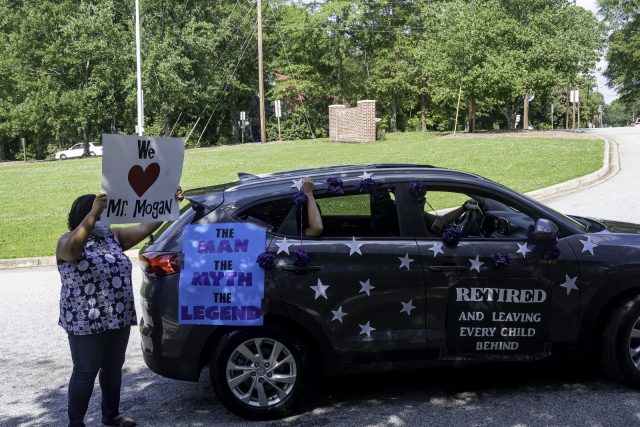
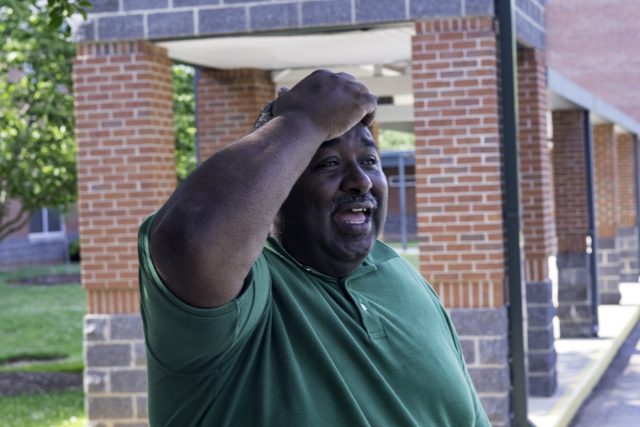
Mr. M, the legend

"Just wanted to let you know that student X decided to get up and tell student Y how very fine he thought she was and how..."

"Oh, no!"

Mrs. M (unrelated), who retired in 2019 after 50 years of teaching

Mr. M, who seemed to know everyone, who seemed able to remember more names than a telephone book. "You remember So-and-so? About six years ago? Well, I saw her working at the Spinx on X Road..." There was not a student he couldn't remember, unless the student was one who flew under the radar the entire three years. "Oh, he's a good kid -- I don't know many of them," he joked. But he was joking about not knowing them and the false dichotomy he had just created -- he didn't really believe in "good" kids and "bad" kids. They're just kids. Some of them seem more determined than others to make their life's share of bad decisions before turning sixteen, but he didn't see them as bad. That's key in an administrator. Or a teacher.

So what could the school do for a man who'd given decades to the school and its students, who was known and loved throughout the community, respected as a tough but fair administrator who wanted all the kids to succeed but wouldn't suffer any foolish behavior that might jeopardize that -- what does a school do when he retires in 2020, when in this last week of school it's been two and a half months since we've even worked together in the same building? In a normal year, we'd have a party with cake and speeches, pictures and laughter, people standing in line to congratulate him, to pat him on the back, to hug him. But this is not a normal year, in any sense of the word.

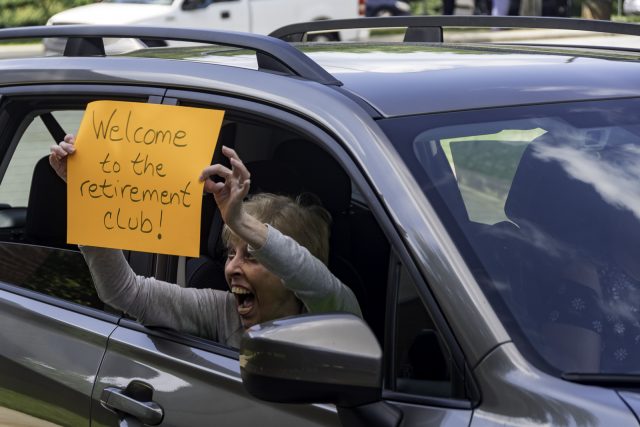
What do we do? We have a party in the new 2020 fashion -- a drive-through party, with honking horns, cheers, signs, and well-wishers blowing kisses from their cars.

Sixth-grade, eighth-grade, and seventh-grade assistant principals and the principal (l to r)

What a thing to be so loved, to be so respected. It's likely every one of us would have a group of people who loved and respected us this much, but some of us might have fewer in that group than Mr. M.

But then again, not all of us are legends.

Day 78: Thoughts of Polska

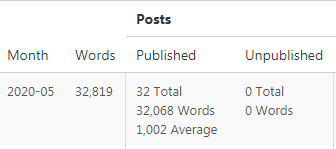
It's June 1, which means that my mad experiment of maintaining a 1,000/word/day average for an entire month is at an end. Adding in the journal writings -- thoughts I want to record but not necessarily share -- brings me to 1,002 per day. At least according to the WP widget that measures that. Something about it seems a little off, but I don't care -- it's all over now anyway.
Tri-cities Regional Airport

The more significant event of it being June 1 is that it's the anniversary of my first departure for Poland in 1996:

I don't know what to write — I don't know what to feel. I've been shoved to this moment by a force more powerful than anything I've ever encountered. It seems time was jerked from me like a tablecloth yanked from a table. It's been so sudden that I don't believe I've even begun to deal with the emotions. What I'm about to do still feels as unreal to me as the landscape far beneath me.

Yet as I leave, as I finally get under way, a calm has settled in. The most difficult part is over. I cannot turn back now even if I wanted to. With that finality is an almost perverse security. Now that I can no longer cling, I no longer reach. Of course this is just the eye in the first of many emotional storms I'll face. I suppose part of it is simply the beauty of flying — it's difficult to be upset up here.
Saturday 1 June 1996

That was 24 years ago; I was 23 on that day -- it was more years ago than I was alive when I was experiencing it. Put it another way: it was more than half my life ago. It's a common sentiment here, I know. It's just that I'm always looking around and noticing it again.

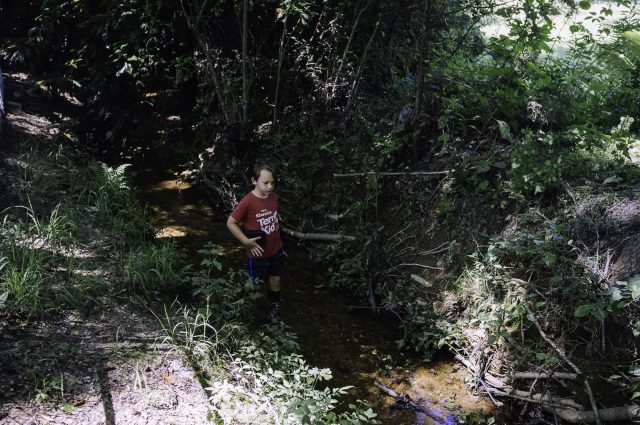
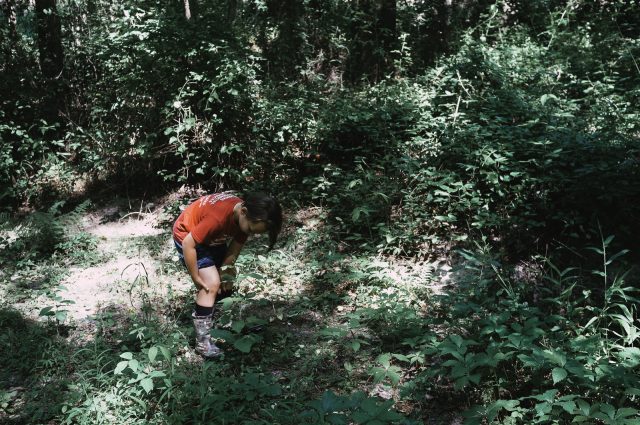
Heading out for some adventuring

My time in Poland was one of my most prolific journaling periods: I averaged 25,000-30,000 words a month. There was so much to write about when everything was new and every day presented new challenges.

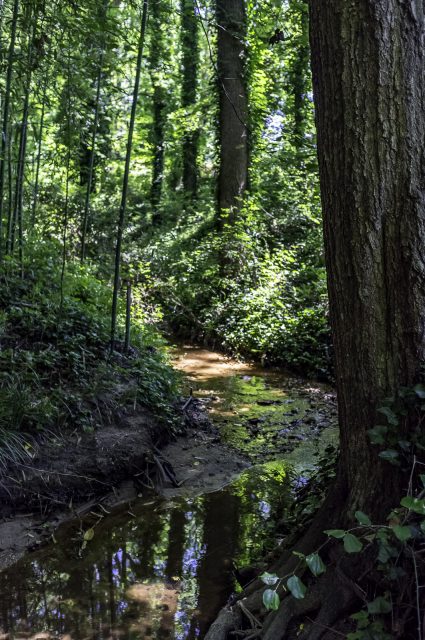
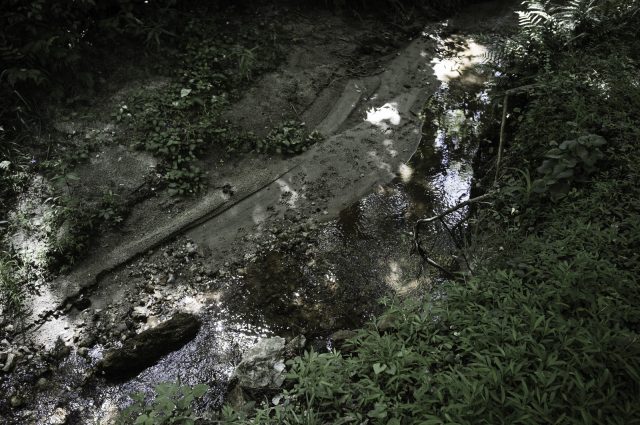
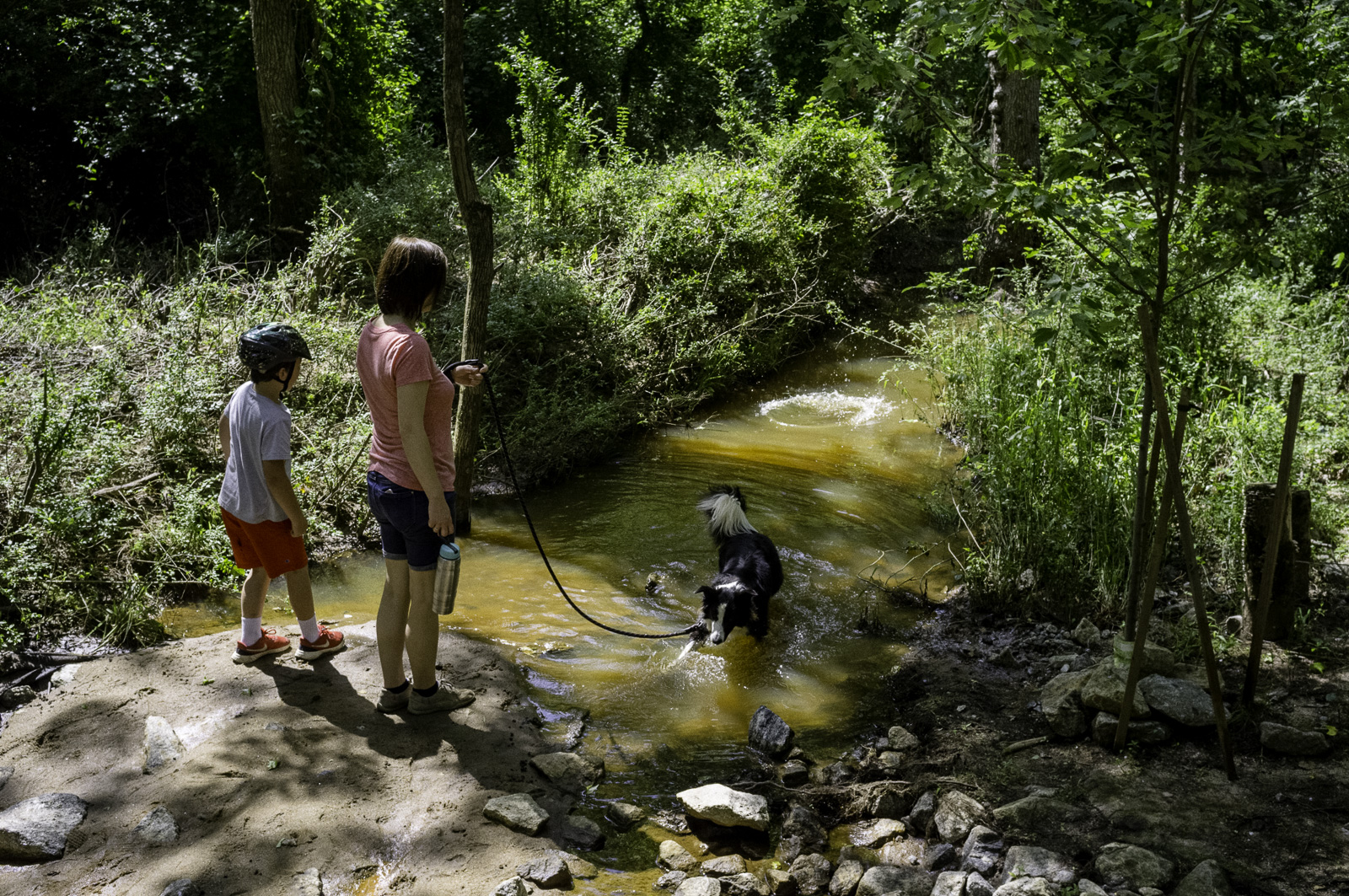
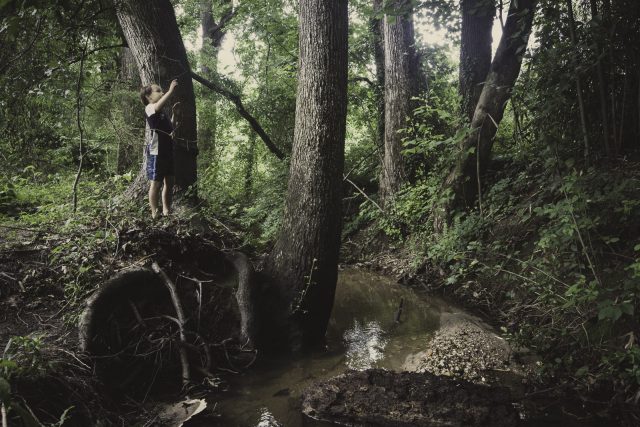
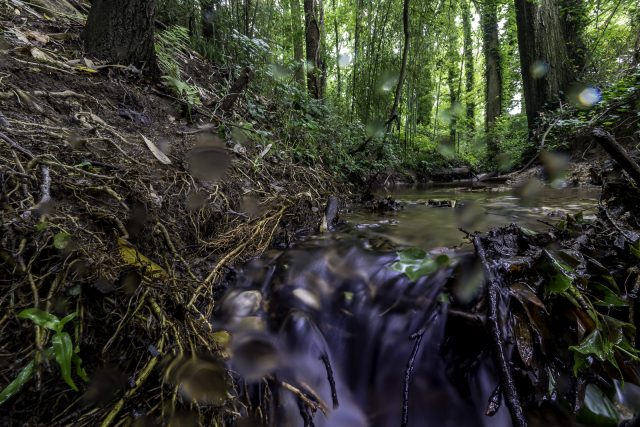
My favorite part of the stream behind our house

That number decreased when I moved back to America. But as I reread my journal from 1996 last night, I decided to do something I used to do fairly frequently but haven't in a couple of years: go look at the day's date twenty years earlier.

I’m back in America. I have been for almost a week now. And I feel awful. Just as I suspected/expected I would. Even “just as I feared I would.” “Tell me that it’s nobody’s fault, nobody’s fault but my own,” sings Beck now, and I guess that’s somewhat appropriate. I don’t know if “fault” is the best word choice, but all the same . . .

I feel like I have a huge choice to make in about six months or so: stay or go. The implications are huge. I want to go back to Lipnica so badly it’s killing me — paralyzing me with depression sometimes. Yesterday I just lay on the couch, thinking, “I have to go back, and yet I can’t go back.” [...]

So what are my options? One option seems most promising: go back for one year to see. I don’t know that I can ever stop thinking, “I might have made a terrible mistake in leaving,” unless I go back for a while and test the hypothesis. At any rate, that’s what I want to do. The implications of that are fairly substantial, though. [...]

And here’s the shock: four years ago I’d just finished my first day of training in Radom. It’s around 4:30 in Poland now — I’d be just about to finish the first day. Four years ago. Four years. That’s 1,460 days ago. A long damn time. No, quite the opposite. Four years is almost nothing. Two years is nothing. I guess it’s true what they say about time going faster the older you get.

What I don’t want is to realize that I’ve been back from Poland for four years and think, “I’ve done nothing important with my life in that time.” I don’t want to think at the age of sixty, “I wasted my life, by and large.” And that’s exactly what I’m afraid will happen — unless I go back. I keep treating that as if it’s my only option, and it really isn’t. But it’s the only one I’m aware of; it’s the one I feel is sure to bring me happiness and fulfillment.

Two quotes — from the same song — seem particularly relevant now:

The nearer your destination,
the more you’re slip slidin’ away. . . .
A bad day’s when I lie in bed
and think of things that might have been.

What makes all this so difficult is that I could talk to someone in Lipnica about my dilemma — Teresa[, a former student], for example — and she would simply reply, “So come back.” How I wish it were that easy!

It turned out, it was that easy. And so almost nineteen years ago, I went back. It all seems so distant and so near at the same time.

Nearly-summer glow

The same thoughts plague us now. We bought airline tickets for Poland this summer well before the pandemic was even a blip on the radar. The tickets for the kids and me are dated June 16. From the beginning, we said, "Let's wait and see." Lufthansa informed us that, due to the pandemic, fees for rescheduling would be waived (I'm assuming for one rescheduling), so we've just sat on the tickets, waiting.

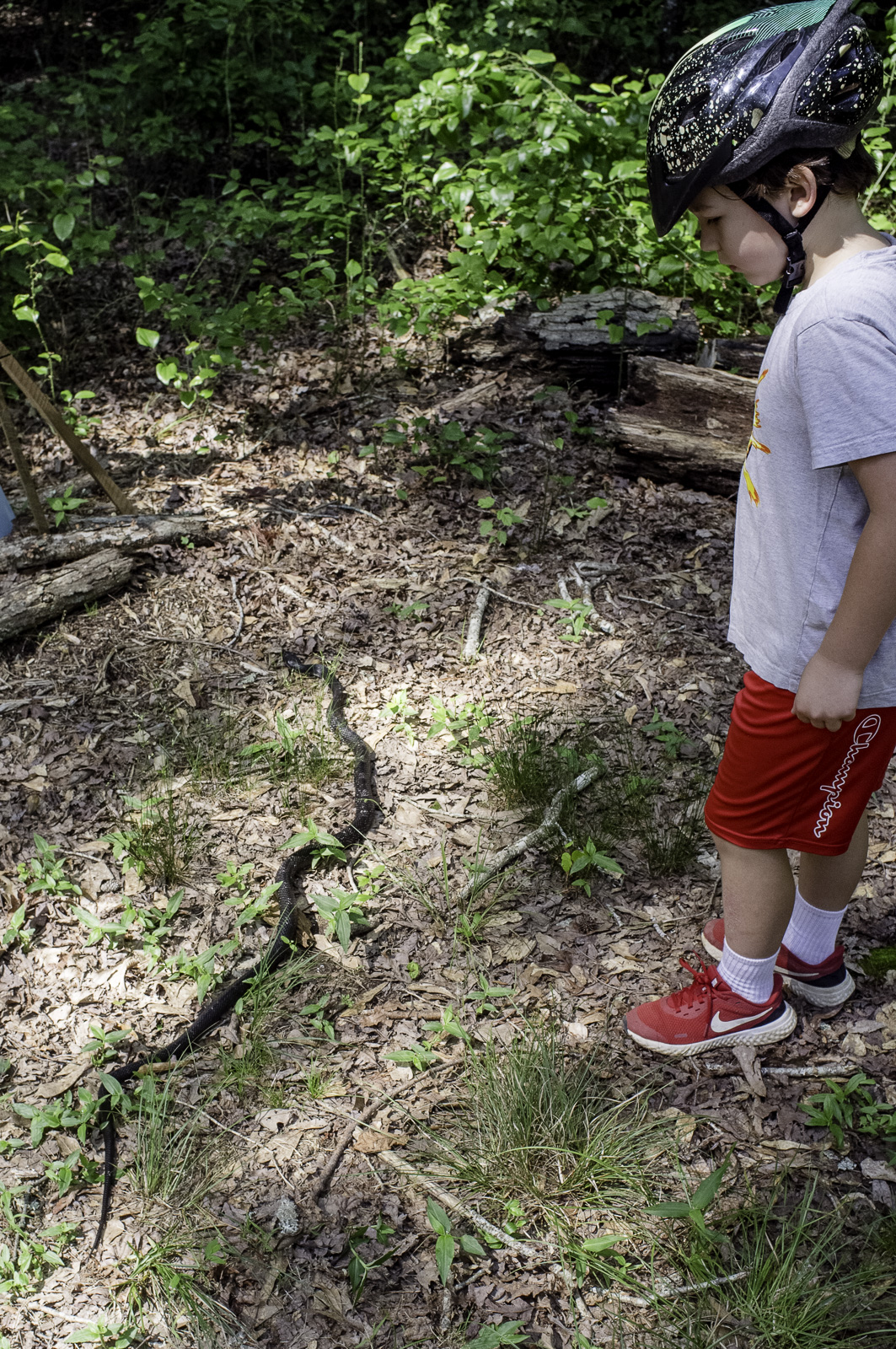
"Something bit me."

"We won't be going," I kept saying. "There's no way." Yet restrictions are lifting. Poland is opening its borders to international flights June 15; Lufthansa says the flights are still a "go." All passengers have to wear masks the entire flight, and there will be fewer people on the plane, but it's not canceled. But then there are the questions.

  • "International" in this case only means "European" it turns out. We'll flying into Poland from Munich, though. Does that make a difference?
  • Would we be quarantined upon arrival?
  • How will the protests around the country affect this? I expect to see a huge spike in cases in a couple of weeks -- just when we're leaving. Will that affect things if it tragically comes to fruition?
  • Most importantly of all: is it even safe and sane to be considering this?

To be honest, we wouldn't be considering it at all if we were on our normal two-year cycle. "We'll skip a year because the situation demands it," we would say. But the problem is, we already said that last year. K hasn't seen her mother in three years now. Sure there are the Saturday-morning Skype chats that can go on for quite a long time, but that's hardly a substitute.

Raccoon tracks

We'll make a decision next Monday, we decided. It will still be a week in advance, and it gives us one more week to sort things out.

Day 77: First Day in Conestee in Rainbows

First Day in Conestee

We've been waiting for our favorite park to open for weeks now. It seemed to us that going for a walk in the park should be something that lends itself rather naturally to social distancing. Certainly, you have to be aware of where everyone is and perhaps not go at the pace you would normally walk, but those are small concerns that mature people can keep in mind and in action relatively easily. But the city kept the parks closed.

Today, they were open, so we went for a walk in the morning when it was likely to be less crowded. We kept our distance from everyone and behaved as model citizens.

The kids were just glad to get out and do something. Perhaps they were also glad to see other faces -- I know I was.

But I've had concerns about this opening up of South Carolina. I don't get the impression that everyone else is being as careful as we are. And the numbers prove it. Earlier this week, we had a day with 300+ new cases -- the highest we'd ever had. Then we had a couple of more days in the 200s or high 100s range, then yesterday we saw that the number jumped up again. Today, there were 312, but there was also an addendum about yesterday's count:

154 cases that should have been reported in yesterday's positive case counts were not updated from suspected to confirmed cases in our database by the time yesterday's news release was issued. An additional quality check of yesterday's positive case numbers revealed the omission of these cases in the daily reporting total. The corrected total of positive cases for yesterday (May 30) has been updated to 420. (Source)

So we've gone from having no single day with more than about 280 to having a day with over 400. Just about two weeks after restrictions were eased. Which is to say that I'm afraid people's stupidity ("This has all blown over -- back to normal") will cause a spike that will undo all we sacrificed over the last months.

In Rainbows

When Noah and the survivors emerged from the ark after God had wiped out all of humanity except them, there would have likely been some consternation: what if God decides to do this again and this time, we don't make the cut? It seems God wanted to assuage exactly those fears:

Then God said to Noah and to his sons with him: “I now establish my covenant with you and with your descendants after you and with every living creature that was with you—the birds, the livestock and all the wild animals, all those that came out of the ark with you—every living creature on earth. I establish my covenant with you: Never again will all life be destroyed by the waters of a flood; never again will there be a flood to destroy the earth.”

And God said, “This is the sign of the covenant I am making between me and you and every living creature with you, a covenant for all generations to come: I have set my rainbow in the clouds, and it will be the sign of the covenant between me and the earth. Whenever I bring clouds over the earth and the rainbow appears in the clouds,  I will remember my covenant between me and you and all living creatures of every kind. Never again will the waters become a flood to destroy all life. Whenever the rainbow appears in the clouds, I will see it and remember the everlasting covenant between God and all living creatures of every kind on the earth.” (Genesis 9.8-16)

A skeptic like me has a lot of issues with this passage. Well, there are a lot of issues about the whole story of Noah and the ark, not the least of which is God deciding to wipe out all of humanity instead of, say, coming down and teaching them how they're making bad choices, like a parent would do. Perhaps a spanking of some sort if we want to get Victorian. Then there's the question of getting all the species in the boat, the inexperience of Noah as a shipwright -- just problems all over the place.

But just these few verses offer a couple of big issues: first, why does God need reminding? "I will see it and remember the everlasting covenant" not "you will see it and remember the everlasting covenant," though I guess that's implied. But I suppose we could work out some literary way to get around that.

What we can't get around is the simple fact that text here seems to suggest that there was never a rainbow before this event: "Whenever I bring clouds over the earth and the rainbow appears in the clouds" certainly hints at this. So you see the opening: "You mean to tell me that the lingering droplets of water in the sky that act as a prism and break the sunlight into its various colors -- an act of physics -- never happened before this?" Rainbows are not mysteries: we know exactly how they form, and I would imagine that meteorological sciences have gotten to the point that they can list several conditions that need to exist before a storm that will set in action a chain of events that will end in said rainbow.

Apologists who take the Bible literally have to deal with this. How to do so? I suppose they could suggest that, yes, God altered the laws of physics at that moment. But a more common explanation is a little more baffling: it had never rained before the deluge, apologist suggest. Mists and dew and the like were enough to water the flora of the Earth.

I mentioned this to K: she raised her eyebrows. "That's the first time I ever heard of that." I suspect it's an Evangelical (i.e., American Christianity) attempt at explaining an obvious problem with the Biblical text in such a way that allows believers to continue interpreting it literally, word-for-word.

I first heard that argument when I was a kid. I want to say, "It struck me as strange even then," but I don't really recall. I remember hearing it, so it made some kind of impression on me, and it stuck in the back of my head as another example of some of the odd contortions literalists bend themselves into in order to continue interpreting the Bible literally.

I heard it again tonight. Or rather, overheard it. I wasn't involved in the conversation, just listening from the fringes. "I mean, God created the world so perfectly that they didn't even need rain -- just a mist was enough," the apologist explained.

It was one of those times that I really wanted to jump into a conversation but knew that there would be no point. Neither of us would budge from our view.

Day 76: Reality in the Shower

We are a pattern-seeking species. And where we find patterns, there we find meaning. Even if that meaning is nonexistent because the pattern itself is an accident of nature. Instead of seeing it like this, though, we often prefer to take these as omens.

I’ve found a few omens, then, in our shower.

There’s a Grateful Dead teddy bear on one tile. I wouldn’t have even noticed it if I hadn’t been such a Grateful Dead fan in high school (now, not so much — they’re okay, but I rarely listen to them).

There’s a bandit with a kerchief covering his mouth. His eyebrows are straight and determined: he’s surely about to commit a crime. Perhaps a home invasion is imminent for us. But our little town is really quite peaceful (we checked with the police department and did some research before buying here), so it’s unlikely.

There’s a fetal-size footprint. Surely this is a hint of things to come? A prophecy of another child on the way? No. It’s just a shape.

There’s the number 12 — certainly, that is not an accident but, like Jesus burned into toast and the Virgin Mary on an underpass, a message from the heavens, some reference to the disciples.

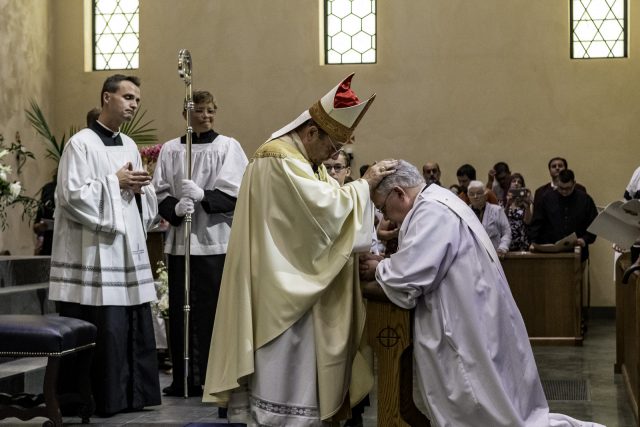
Yes, this is a little something I wrote long ago and just tucked away for just such an occasion: I’m still working on pictures from the Mass I shot (a paying gig this time!) and won’t be done any time soon…

Day 75: Awards

Today was the last day of the school year. Were it a normal year, we would have had three more half days. They're useless for instruction: we've already completed grades, and what can you do with half days? Students clean out their lockers, sign each other's yearbooks, have field day (or in eighth grade's case, eighth-grade day, which differs from field day only insofar as the PTSA feeds the kids at the end of it all), and sundry end-of-the-year things. I use that time usually to pack up my room: I have lots of kids, empty boxes, and books -- they make short work of what would take me a couple of hours. Were it a normal year -- but it wasn't, and three half-days of online instruction when a normal day of online instruction means thirty minutes of work per class -- well, it just doesn't make sense, and much to my surprise, the district realized that and basically thought like teachers for a change.

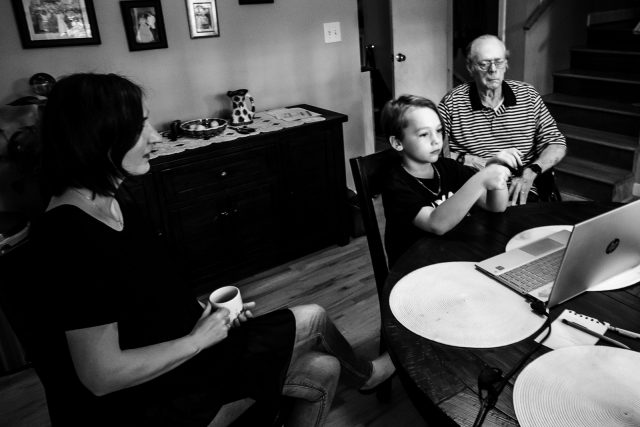
The Boy's teachers had an awards day Google Meet -- a very sweet thing for them to do. They recognized academic achievements like the A/B honor roll. When they began talking about it, I asked E if he thought he as on it.

"I don't know."

Indeed, I didn't either. I knew he'd struggled mightily with a few things, and he was able to finish tests only because the teachers allowed him extra time. "I have to pay for it with less time on the playground, because that's when I finish," he once explained, "but that's okay."

But there was his name on the list, and there was a big smile on his face. High fives from everyone.

Is it a bad thing that I honestly had no idea whether or not he'd made the honor roll? I don't think so: in second grade, grades appear for the first time. Everyone's getting used to them. They're not meaningless, but they're not all that important, so I never really worried about his grades. I don't quite think it was the same for K, but she never made a B (or 4 in the Polish system) even in her worst nightmares, so she put a little more weight on the grades. And to be fair, aiming high is always a good habit to develop. It's not that I wanted him to settle. It's just -- well, it was second grade. I don't remember a thing from second grade.

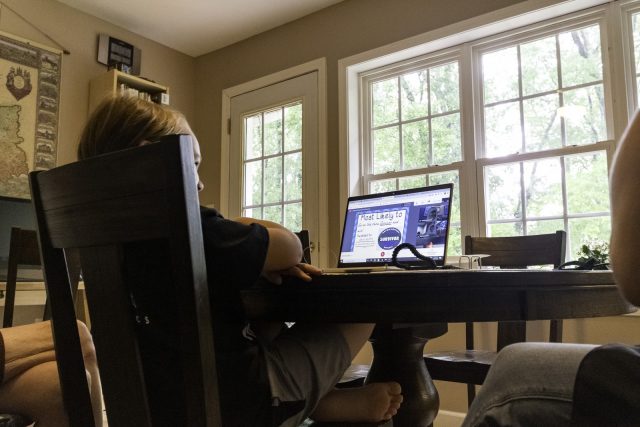
At the end of the program, they gave every single student a special award: most likely to -- superlatives, in other words. E won "Most likely to win an episode of Survivor." The other day during a Google Meet, E showed everyone his survival kit and told them a little about our adventures. That was what stuck in the teachers' minds, and it was a cute award that just made E's day.

What superlative would I give him? Sometimes, with his sensitive nature and keen sense of right and wrong, I think he's most likely to have his heart broken in as many ways as one can imagine. He sometimes gets so frustrated with others' unwillingness to follow basic rules. "That's just not nice!" he concluded many stories about some tragedy that befell him in school. This is not to say that I assume he's always an angel: many of our conversations involved me trying to help him see how he could have been nicer. Still, he's a very by-the-book fellow, and it upsets him that others aren't.

Maybe "Most likely to brighten someone's day." He can sure do that, but that requires a bit of familiarity. He's not entirely comfortable approaching, say, a lonely kid on the playground that he doesn't know but who might need someone to play with. The unknown -- he's not keen on that.

Maybe "Most likely to be an engineer." He does love building things.

Or just "Most likely to make his family proud."

As for the Girl, she got the good news that she definitely made it into geometry and English I Honors. That means she'll be taking the course that I will teach exclusively next year. Were she a student at our school, that might cause problems: I wouldn't want to stress of grading my own daughter.

For me, what's more impressive is the geometry. I didn't take geometry until tenth grade. She's two years ahead of me.

She was worried about the possibility of not making one or both of those classes. Being a teacher and knowing how things often work behind the scenes, I knew it was unlikely. But I also knew that no "behind the scenes" would be necessary: she's worked very hard this year, and she's make sure that her grades are not just good grades but reflections of her actual understanding. She and K spent many an hour going over this or that algebra trick, and it all paid off.

So congratulations to both our kids!

Day 74: Rainy Dickens

Another Rainy Day

We are sick of the rain. Simply sick of it. Every day for the last — how long has it even been? A week? Day in, day out, at some point during every single day, it rains. The air is heavy and moist, and it’s just not a pleasant experience — though it could be worse with all the flooding others are getting.

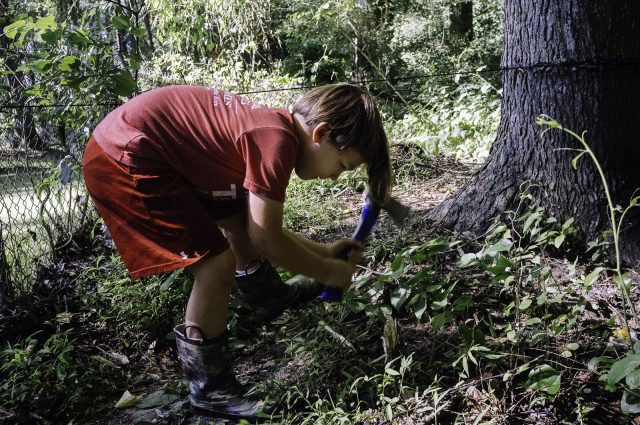
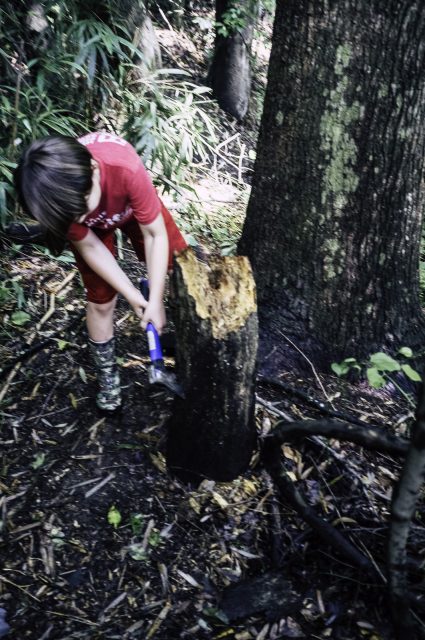
Today, we finally got outside in the afternoon. It was muggy but sunny. What else could we do but head back to our new fort location and work on it. Doing what exactly? Well, chopping things down.

Some things were much easier to chop than others. The mushy, termite-infested stump we discovered to be such a few months back when I gave what appeared to be a 10-foot stump a push and broke it off about two feet from the ground — that stump is quite solid a little further down.

Of course, the sprinkles that filled the morning and early afternoon and kept us inside came back with friends in the early evening just as we got back from our walk.

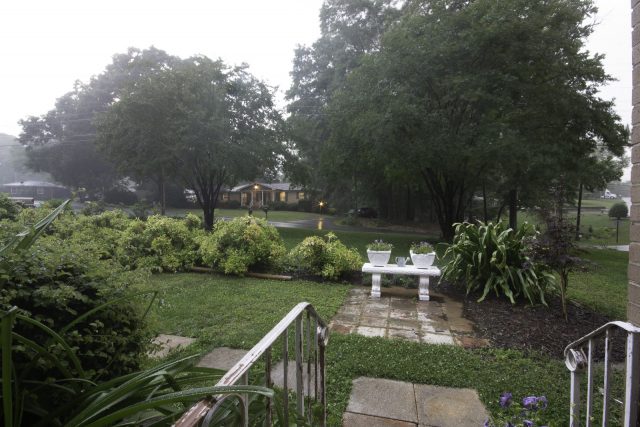
I took a few experimental shots — long exposure. Long exposure for daylight pictures. The above image was about 15 seconds. I don’t know what I was hoping to accomplish — get streaks of rain in the image, I guess — but it just turned out to be a bland shot of our front yard.

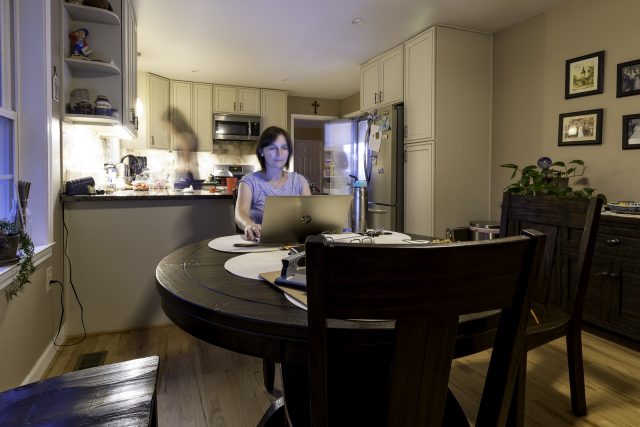
Later in the evening, we tried it inside. When I explained what a long exposure inside would do, the kids thought it was a very unique idea. “Make us ghosts!”

Done.

Dickensian Commonalities

I’ve been listening to Dickens’s Dombey and Son on Spotify this week — the first time in close to 20 years that I’ve read a new (to me) Dickens book. One of the things that I’m enjoying most is the simple pleasure of discovering new examples of Dickensian acerbic wit, like this:

After the lapse of some minutes, which appeared an immense time to little Paul Dombey on the table, Doctor Blimber came back. The Doctor’s walk was stately, and calculated to impress the juvenile mind with solemn feelings. It was a sort of march; but when the Doctor put out his right foot, he gravely turned upon his axis, with a semi-circular sweep towards the left; and when he put out his left foot, he turned in the same manner towards the right. So that he seemed, at every stride he took, to look about him as though he were saying, “Can anybody have the goodness to indicate any subject, in any direction, on which I am uninformed? I rather think not.”

Add to that a classic Dickensian name — can there be a more inept educator than someone named Doctor Blimber? — and it just brought out of me a loud laugh.

I’m discovering too that this is another example of Dickensian exposes on the Victorian view of children, which often enough bordered on abuse. And as always, Dickens does it with a flourish of humor that still has enough darkness around the edges to make the reader shudder just a little at what the child must be going through.

Poor Paul Dombey, at six, has been deposited at a boarding school in an effort to make up lost time in his education due to his generally ill condition. The headmaster, Dr. Blimber of above, is known for instilling in the children a thorough knowledge of Greek and Latin grammar and little else and of assuming that he’s aptly prepared his pupils for the challenges of life. Paul, on his second day of school, is given a pile of books to read and master. He does the best he can with them:

‘Now, Dombey,’ said Miss Blimber. ‘How have you got on with those books?’

They comprised a little English, and a deal of Latin—names of things, declensions of articles and substantives, exercises thereon, and preliminary rules—a trifle of orthography, a glance at ancient history, a wink or two at modern ditto, a few tables, two or three weights and measures, and a little general information. When poor Paul had spelt out number two, he found he had no idea of number one; fragments whereof afterwards obtruded themselves into number three, which slided into number four, which grafted itself on to number two. So that whether twenty Romuluses made a Remus, or hic haec hoc was troy weight, or a verb always agreed with an ancient Briton, or three times four was Taurus a bull, were open questions with him.

‘Oh, Dombey, Dombey!’ said Miss Blimber, ‘this is very shocking.’

‘If you please,’ said Paul, ‘I think if I might sometimes talk a little to old Glubb, I should be able to do better.’

‘Nonsense, Dombey,’ said Miss Blimber. ‘I couldn’t hear of it. This is not the place for Glubbs of any kind. You must take the books down, I suppose, Dombey, one by one, and perfect yourself in the day’s instalment of subject A, before you turn at all to subject B. I am sorry to say, Dombey, that your education appears to have been very much neglected.’

‘So Papa says,’ returned Paul; ‘but I told you—I have been a weak child. Florence knows I have. So does Wickam.’

‘Who is Wickam?’ asked Miss Blimber.

‘She has been my nurse,’ Paul answered.

‘I must beg you not to mention Wickam to me, then,’ said Miss Blimber. ‘I couldn’t allow it’.

‘You asked me who she was,’ said Paul.

Bear in mind that Paul at this point is six years old. “How is your Latin grammar?” asks the headmaster. “I am sorry to say, Dombey, that your education appears to have been very much neglected,” declares his tutor, the headmaster’s daughter. Just what were they expecting of a six-year-old boy?

Day 73: Changes and Changes

Changes I

K has moved into real estate, though she hasn't quite working part-time at her old job. She likes the security it provides. I tell her that things are going fine with real estate: she's just helped a client buy a house, she's got two other clients she's helping, and one of them might be completing two transactions using K's services. "It's all only potential earnings," seems to be her mantra, and that's why she's reticent to quit her hold job completely.

It was a little ironic, then, that one of the memories that popped up in the Time Machine widget at the bottom of the page had to do with our first day out house hunting.

Criteria, Part II

I read through what I wrote then and realize that neither K nor I really knew what we were doing. That's to be understood -- it was the first time we'd bought a house. Still -- were we really so green?

That's one of the reasons I continue writing this thing -- evidence of how much things have changed.

How E and I play-build has changed. It used to be something we did almost exclusively in his room, using blocks and Legos and Tinkertoys and whatever else we could find. It still is, to be sure.

But we often find ourselves outside building something more substantial. Or at last more in the Boy's mind's eye, that's what we're doing. His plans are often overly-ambitious, as every eighth-year-old's plans should be. But as we begin working, more realistic goals form.

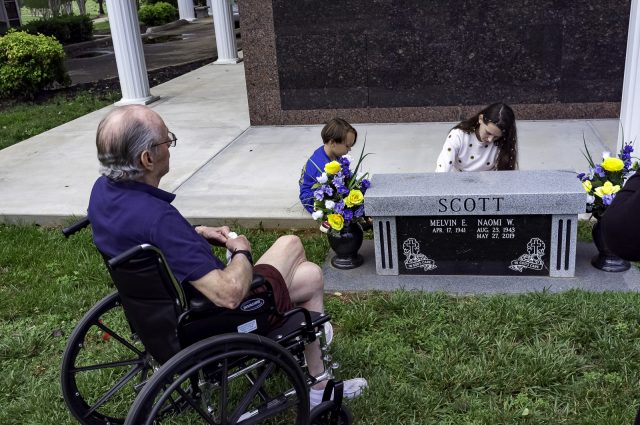
One thing that will never change is the sadness we feel on May 27 from now on -- the one year anniversary of Nana's passing.

I look back on that day and remember very little about it. I know took the dog for a walk around lunchtime and listened to Mozart's Requiem. I know Papa and I had a scotch on the back porch that evening. But it was Memorial Day -- it slowed the pace significantly, which perhaps was a good thing.

And what of today? A year on? Papa still gets blindsided by it occasionally. That's to be expected; that will never go away. I do, too. Also to be expected.

Changes II

I was going through some pictures from 2003 around K's family house at Easter. I hadn't realized how much things had changed.

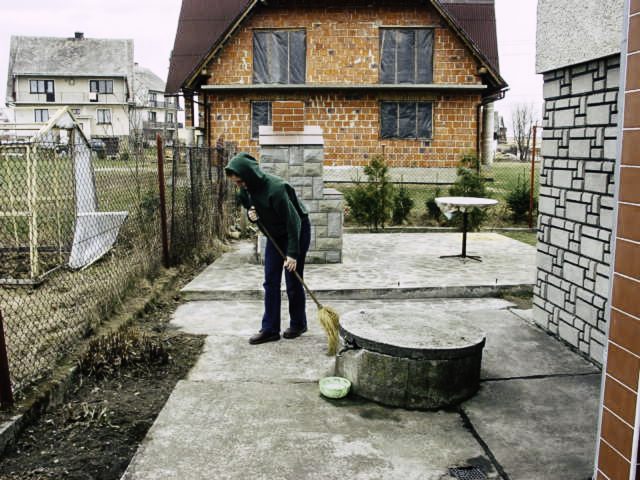
Those saplings in the neighboring lot -- they completely hide the house now. That pad of concrete with an outdoor oven on it -- enclosed and roofed. (That was done long before we left, though.) That fence to the left -- hidden by a taller fence of wood to hide the field behind it. But the house itself, the one in the background still under construction -- exactly the same.

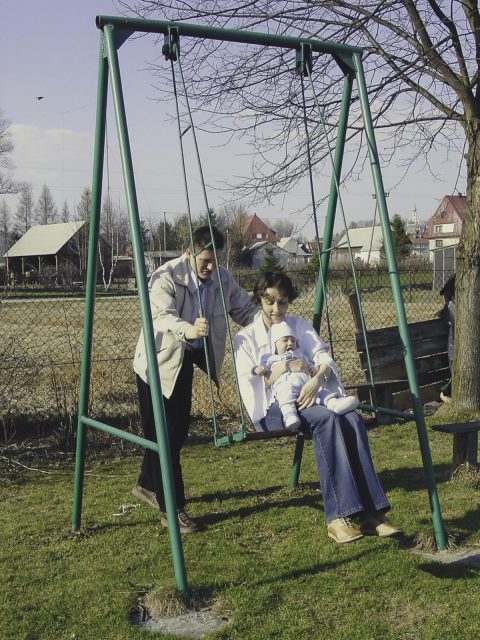
That little baby, K's nephew -- a seventeen-year-old high school student. The field behind the happy family -- storage for a building materials company. But the swing -- still there, still exactly the same. The wooden seat has possibly been replaced, but who knows. Maybe it's still the same one.

One more change -- the most significant:

Day 72: Reflection and Time Together with a Tripod

Reflection

I titled the post “Heading Out.” It comprised one single picture:

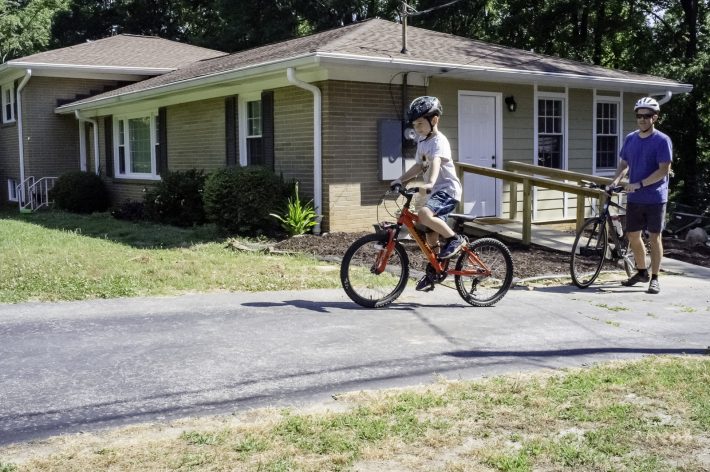
The Boy and I were going out for a Sunday-morning ride. We rode about our neighborhood, the neighboring neighborhood, up to his school, back — a typical ride for us. If there were any puddles I would have had to tell him not to ride through them.

We got back sweaty and satisfied, and after a shower, we had lunch with Nana and Papa and then I headed out to photograph a special ordination Mass for a deacon in our parish, Deacon Richard — now Father Richard.

At some point during the afternoon — I don’t remember because I wasn’t there — Nana went to sleep. K must have texted me about it because I remember thinking, “Well, we gave her an opioid — she always goes to sleep after that.” The Mass ended and the reception began, and after an hour and a half of the reception, K texted me that I should probably come home. “It doesn’t look good,” she texted.

Still, I wasn’t worried. “She’s just asleep. The opioid’s effect will wear off and tomorrow morning she’ll be just as good as new.”

That was May 26, 2019. She passed away sometime in the early hours of May 27. We’re not exactly sure when even though the death certificate has the time the hospice nurse came and checked: 7:30.

“Tomorrow morning she’ll be as good as new.”

I’m not sure how I could have been so blind other than to suggest it was self-deception out of a sense of self-protection. A lot of “self” in that.

“Can we have some time together?”

The Boy asks me every day, “Can we have some time together?” On the one hand, that makes it sound like I don’t spend a lot of time with him. “Poor kid — has to ask his father to spend time with him.” It sounds positively Dickensian. On the other hand, that shows how conscientious he is about spending time with me: he wants to make sure the day doesn’t slip by without us doing something together, and that has happened.

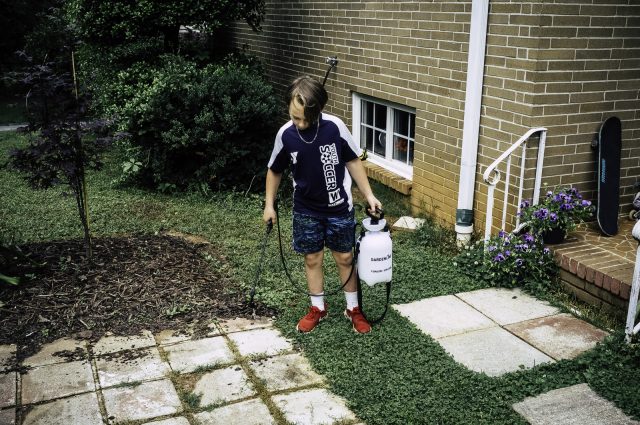
Today, I had some work to do, though, after I completed my school responsibilities (only three more days) and before I could play. The Boy is always eager to learn how to do something, so I invited him along.

Spraying for pests suits him, I think.But then again, you do have to be somewhat systematic — follow a pattern, a plan, a path. You can just spray here, spray there. You have to make sure you have even coverage over the whole area you’re hoping to affect. Much like with mowing, then, I let him work but often took back the equipment to hit a spot he’d missed.

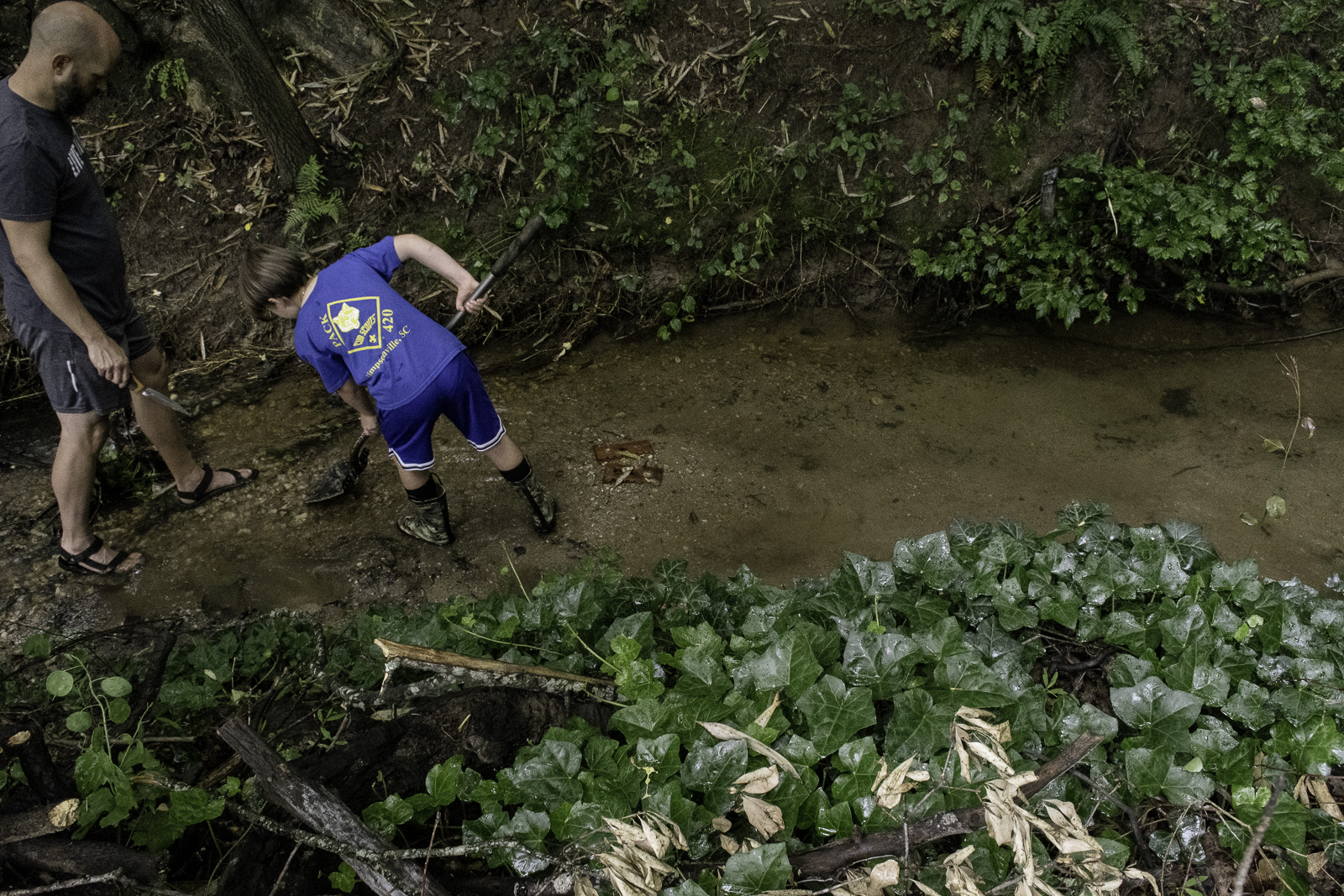
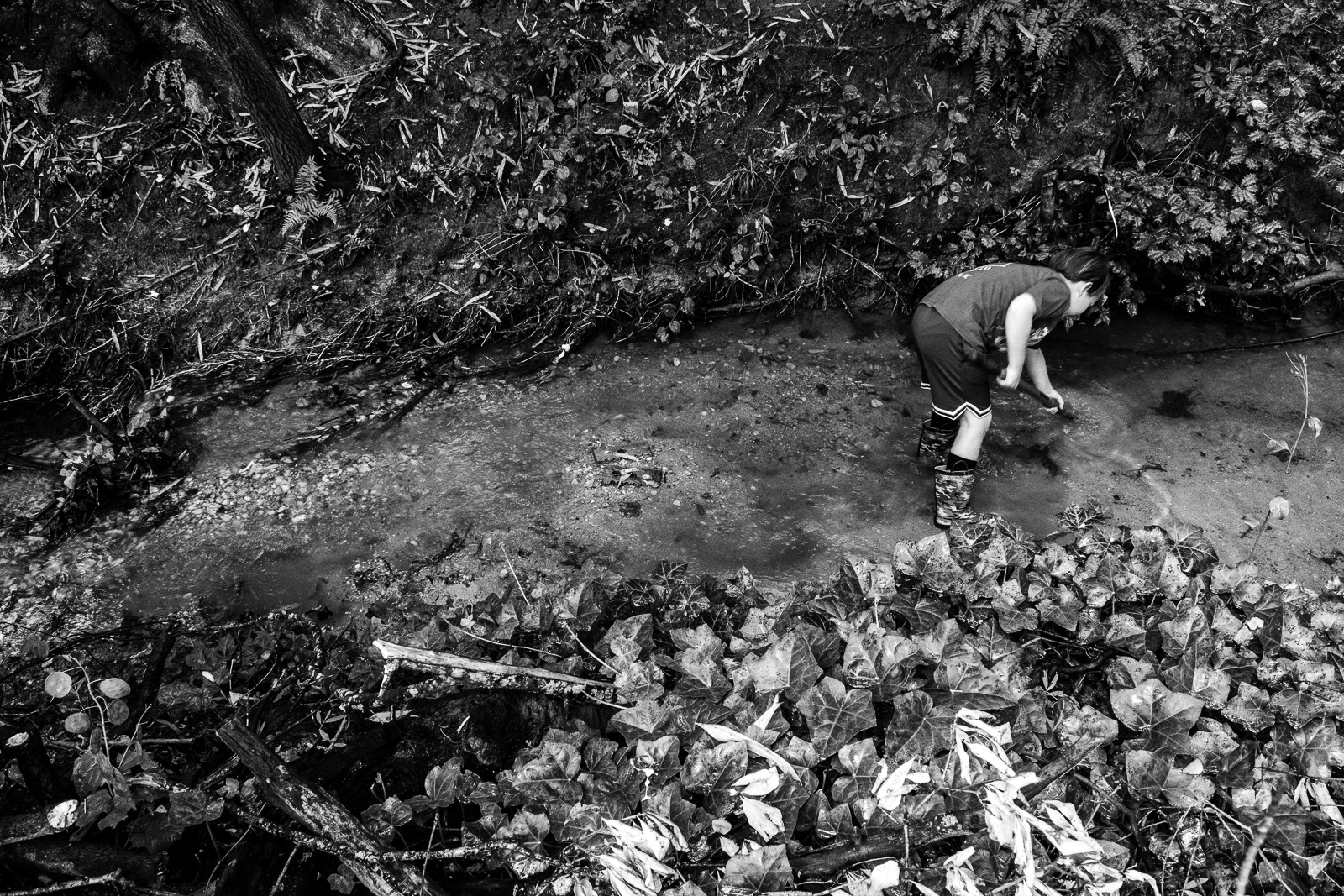
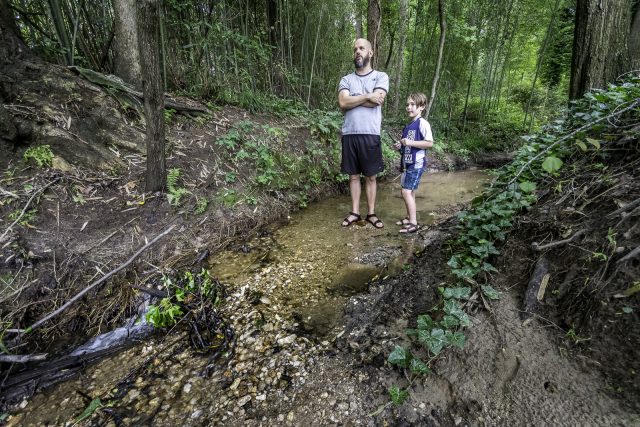
After the work (“Is this our time together?” the Boy asked, concerned), we went back to our favorite spot in the creek and discovered, much to our surprise, that the island we use to assist in crossing the creek was gone. The last flood must have washed it out completely.

We also started planning our next fort. We might get a little less primitive this time. We might even use some 2x4s.

Tripod

I took the camera and tripod out with us today and set the camera to take a picture every minute.

Why didn’t I do that before? I don’t have many pictures with the Boy when we go on these adventures. It’s a simple way to solve that problem.

One can also reverse-mount the tripod and take some pictures otherwise impossible: three-second exposures at water level. That type of thing.