Matching Tracksuits

fun in fours

christianity

Connected to Christ

There's an infographic I've seen several times on several social media platforms. It's meant to encourage Christian parents to take concrete steps to make sure that their children stay Christian.

The fact that such an infographic exists let alone that it has gone somewhat viral speaks to the crisis in which contemporary Christianity finds itself. The "Nones" are the fastest-growing demographic in the States. This has a lot to do with the explosion of social media in the last decade. Skeptics have made good use of these media and present opposing viewpoints that churches were otherwise historically able to keep somewhat hidden from young people. No more -- now skeptics are explaining why Christian theology makes little to no sense and young people are listening. Additionally, Christianity's historic position on gay rights and its relative opposition to science (the Catholic Church's weak protests notwithstanding) leave young believers out of step with church teachings.
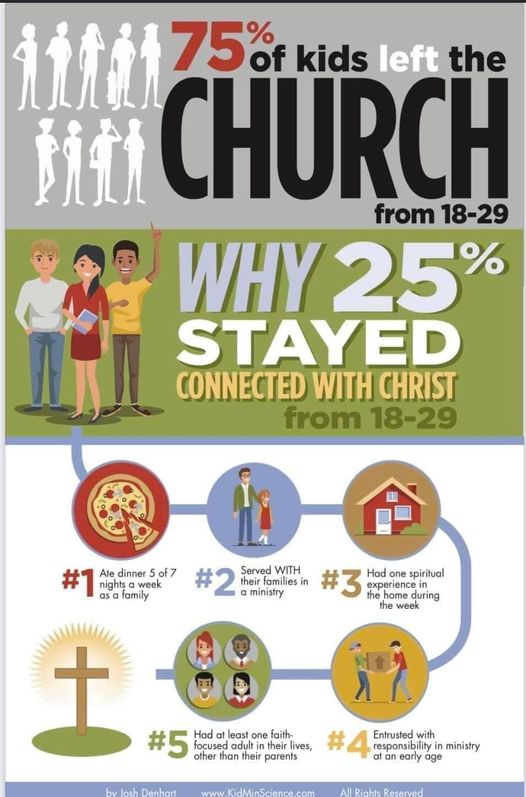
If they're connected with Christ, why are there so many people involved in this? If Jesus is real and the connection is real, why does it need to be so supported socially? Each one of these is a social connection. Each one is an example of what sociologists call plausibility structures. The more people someone has around them supporting their beliefs, the more likely they are to hold those beliefs.

If we look at the wording of each one, we see that it's obvious how this is using social psychology and sociology to enforce belief systems.

  1. Ate dinner with family
    This is critical for the initial creation of plausibility structures. Doing it five to seven times a week gives it the repetition necessary for it to remain relevant. This will be key for young children.
  2. Served with family in ministry
    Again, doing the same thing together with the same underlying motivation will increase the likelihood that an individual accepts as valid that motivation.
  3. Had one spiritual experience per week in the home
    This one is a little vague: what is that one experience? How do we determine that it is spiritual? Most likely this will occur through the instruction of the parents. This will enforce what children learn in church: that warm feeling you get sometimes when listening to "praise and worship" music or reading the Bible is the Holy Spirit at work. The experience itself cannot be questioned; the cause of it can. This makes sure that that cause always leads back to a deity.
  4. Entrusted with ministry responsibility at an early age
    This begins the transfer from trusting others' interpretation of your inner experiences (i.e., labeling them as coming from a god) to making it your own. In treating you like an adult, you become an adult, and when this is tied to "ministry," that ministry becomes part of your adult identity.
  5. Had one non-familial faith-based adult in life
    Again, this is adding plausibility to the belief structure. Step one (dinner as a family) will work with children; this step will be key for teens, who don't necessarily want to listen exclusively to the family because it's part of growing up. A close relationship with a non-familial adult will help the transfer process from "their worldview" to "my worldview."

I, of course, rose to the bait when this appeared on a friend's feed:

If Jesus is real and the connection is real, why does it need so much social support? These are all examples of what sociologists of religion call plausibility structures: the more people you have around you believing the same thing and suggesting, directly and indirectly, that such belief is plausible and logical, the more likely an individual is to accept that belief as such.

The individual who posted this meme responded:

[H]ow long can one coal burn (even with regular blowing) apart from the rest of the fire? We arenโ€™t closed systemsโ€ฆthe World, the Flesh, & the Devil are actively pulling us away from God. Driftwood doesnโ€™t move upstreamโ€ฆit must be acted upon.

It's interesting that this response doesn't deny the fact that these are, in essence, plausibility structures. Instead, the response only highlights it. Sociologist Peter Berger suggests that the only way to maintain a given belief in the face of competing beliefs is to surround yourself with like-minded people. He calls this a "cognitive ghetto." The response posits that just such mental sequestration is necessary to keep out the three enemies:

  1. The World
  2. The Flesh
  3. The Devil

Of course, in such a Christian's worldview, these three can all be subsumed under the last one: the devil. But attributing one's loss of faith when confronted with conflicting viewpoints to the devil does little: it's an untested and unfalsifiable hypothesis without evidence, and as such, it can be dismissed without evidence.

Another person asked,

[D]onโ€™t all relationships require some sort of support to survive? The very word relationship indicates two or more things, factors or people.

I replied:

I just don't understand why a relationship with a supposedly omnipotent being needs support. It seems to me that the omnipotent being could make it so obvious to the believer that it would be folly to reject it. As it is, in my experience with a believer, I only had my own inner experiences and other people's assurances that those experiences were of God.

My interlocutor did not respond.
Who Commanded What

I really don't know why I do it. I follow some of these Catholic groups online for no good reason, I think. Am I there just to pick a fight? I guess.

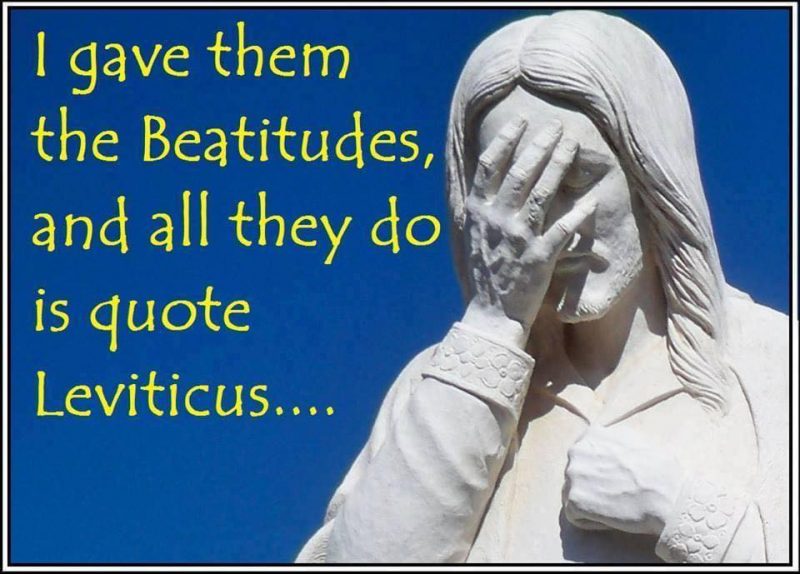
Today, this one popped up as a joke.

Everyone was laughing about it, so I guess humor is the new way of dealing with the awful things God commands in Leviticus. Of course, I replied: "But both come from God. Both are commands from God. That's the problem."

A user named Joseph responded, "no there is no problem. None of the levitical laws are valid anymore. Thus any command from Chirst is superior."

People just don't get it, though. Jesus might have done away with these laws, but because of the trinity doctrine, it was Jesus who created the commands in the first place. I responded to Joseph:

But the fact that they were commanded in the first place -- that's the problem I'm referring to. That God commanded his people to stone to death incorrigible children, stone homosexuals, stone people for breaking the sabbath -- THAT is the problem. Whether or not he did away with those laws is not as troubling as the fact that he made them in the first place.

At this point, Jesse jumped in to help:

[I]f you listened to the first couple of episodes, Fr. Mike clarified it. Some laws were "allowed", just as what Jesus said about the law on divorce. Also that some must be understood that they were given to a savage, nomadic, tent-living, and with frequent streaks of going astray kind of people who lived thousands of years ago.

I've heard this so many times I'm sick of it. No one sees the problem that the same god who gave us the kinder, gentler Jesus also gave us these commands in Leviticus! In fact, because of the trinity, it's the same being! I tried to explain this:

No, that doesn't fly. God didn't allow those laws. He didn't see them stoning people and say, "Well, I'll let you do that for a while." It was God who COMMANDED the stoning. Why does no one get that distinction?

There were a few more responses -- I replied to them all. And then everyone just stopped responding to me. Questions are unwelcome, I guess, and even more so follow-up questions.

Two Problems

I've been working on my own "Why I Am Not a Christian" a la Bertrand Russell's piece of the same name. There seem to be two logical problems Christianity encounters from the very beginning before taking anything else into account.


The two main issues I have with the Christian worldview are the problem of suffering and the nature of Christian salvation. The best way to highlight these problems is to reframe them in strictly human terms to see how much sense it would make for humans to do what the Christian god supposedly does.

The problem of suffering is simple: if there is a loving god who is omnipotent, it would want its creatures to live free of meaningless suffering. There is meaningless suffering in the world. Therefore, this god is either not loving, not omnipotent, or doesn't exist. Christians will likely quibble over the definition of "meaningless suffering," pointing out that that it is a value judgment and that we are in no way to determine if a given example of suffering is meaningless or not (that's their god's decision). Here it becomes useful to put it in concrete human terms: put simply, if I had the power to stop a child from being raped, I would. No questions, no hesitation: I would just stop it from happening if I could. If I had the power to stop a child from starving to death, I would. If I had the power to stop a child from being beaten, I would. The god of Christianity doesn't stop these things from happening. In fact, the supposed representatives of this god are all too often the ones inflicting this suffering on children.

The common apologetic response here is to suggest that the Chrisitan god's ways are not our ways, that we cannot know what good can come from this suffering. That might be so, but that supposed good that can somehow justify the evil and make it in fact a good -- that is merely speculation. What is not speculation is the suffering itself.

In response to this, apologists in turn bring up free will. Their god gave us free will, and we can use it, or we can abuse it. Their god lets us do whichever we wish because to do otherwise would be to limit our free will.

Another example shows the absurdity of this thinking. Imagine you walk in on your twelve-year-old son beating your three-year-old daughter to death with a length of two-by-four. Would you stop it? Of course, you would. But imagine you decide that to do so would be to violate your twelve-year-old's free will, so you let it happen. The authorities find out and charge you. At your trial, you make the defense that, because we all have free will, you are not ultimately responsible and that you were merely allowing your son to exercise his free will. Would the jury accept that defense? If the roles were reversed, and you were on that jury, would you accept that defense?

Thus, reframing the problem of suffering in strictly human terms leads to a strange outcome: we realize that we hold ourselves to a higher moral standard than we hold our idea of a god. We allow a god to get by with things we would find abhorrent in our own behavior by suggesting that we're just not smart enough to see the good that raping a three-year-old can bring.

At this point, the Christian apologist will likely suggest that this is all a moot point anyway because all this is due to the Fall, and then suggest Jesus's sacrifice solves this problem (i.e., the Fall). We might point out that the evil still exists but at least Christians have a way to explain where it comes from: we're flawed in our very nature due to the Fall. Jesus solves all this, the apologists assure us.

What happens when we examine that solution in human terms? Imagine my wife and I have a rule in my home: no one is to spill food while at the dinner table. The penalty for spilling food is three cuts on the forearm with a sharp knife. One night, predictably, my young son spills food. I take his arm and tell him that because of the rules, I have to make three cuts on his arm. However, because I love him so much, I'm going to take that punishment for him. I hand the knife to my wife, and she makes three deep cuts in my forearm. I look at my son lovingly and say, with tears in my eyes, "Do you see, son, how much I love you? I took this punishment for you. This should fill you with an incredible love for me!"

You, as an outside observer, would think all of this is quite absurd. You might question why I had such a strict punishment for such a relatively insignificant "crime." You would likely suggest that it was inevitable that my child would spill some food and ask why I had that rule in the first place. And finally, you would probably think the whole blood-letting for forgiveness was ridiculous: "Why not just forgive the kid if that rule has to be in place?" you'd ask before pointing out yet again that I was the one who created the law in the first place and that it was completely unnecessary to begin with. As for my suggesting that my son should love me all the more because I took his punishment, you'd likely think that it was a highly traumatizing event for my son.

Yet this is just what Christians think Jesus does for them: he takes a punishment that they deserve and in doing so, earns our undying love. However, Jesus is, according to the doctrine of the trinity, God, so this god set the rules himself as well as the punishment. He could have just forgiven us, but for some reason, he's insistent on a blood sacrifice to make up for sins that we didn't even necessarily commit, so Jesus steps in to fulfill that obligation.

At this point, Christians explain that their god would like to forgive us but because of his perfectly righteous nature, he can't. This is some bizarre argument: the nature of this god apparently restricts this god.

Communion

One of the most disturbing passages in the Bible comes in the Gospel of John after Jesus feeds the 5000. In the passage known as the Bread of Life passage, we read,

Jesus said to them, โ€œVery truly I tell you, unless you eat the flesh of the Son of Man and drink his blood, you have no life in you. Whoever eats my flesh and drinks my blood has eternal life, and I will raise them up at the last day. For my flesh is real food and my blood is real drink. Whoever eats my flesh and drinks my blood remains in me, and I in them. Just as the living Father sent me and I live because of the Father, so the one who feeds on me will live because of me. This is the bread that came down from heaven. Your ancestors ate manna and died, but whoever feeds on this bread will live forever.โ€ (John 6.53-58)

This is an echo of what we read in other gospel accounts about the Last Supper:

While they were eating, Jesus took bread, and when he had given thanks, he broke it and gave it to his disciples, saying, โ€œTake and eat; this is my body.โ€ Then he took a cup, and when he had given thanks, he gave it to them, saying, โ€œDrink from it, all of you. This is my blood of the covenant, which is poured out for many for the forgiveness of sins. I tell you, I will not drink from this fruit of the vine from now on until that day when I drink it new with you in my Fatherโ€™s kingdom.โ€ (Matthew 26.26-29)

Mark’s account is similar because his gospel is a source for Matthew’s:

While they were eating, Jesus took bread, and when he had given thanks, he broke it and gave it to his disciples, saying, โ€œTake it; this is my body.โ€ Then he took a cup, and when he had given thanks, he gave it to them, and they all drank from it. โ€œThis is my blood of the covenant, which is poured out for many,โ€ he said to them. โ€œTruly I tell you, I will not drink again from the fruit of the vine until that day when I drink it new in the kingdom of God.โ€ (Mark 14.22-25)

And the same for Luke:

And he took bread, gave thanks and broke it, and gave it to them, saying, โ€œThis is my body given for you; do this in remembrance of me.โ€ In the same way, after the supper he took the cup, saying, โ€œThis cup is the new covenant in my blood, which is poured out for you.” (Luke 22 19, 20)

In all four accounts, Jesus makes the same ghastly claim: eating his body and drinking his blood is essential for human well-being. John 6.52 records the Jews’ response: “Then the Jews began to argue sharply among themselves, ‘How can this man give us his flesh to eat?'” While they’re not saying it outright, they are saying what most modern humans would say were they exposed to this notion for the first time: “This guy’s talking about cannibalism and vampirism!”

Indeed, there are few things in Christianity as disturbing as the cannibalistic ritual at its very core. No matter how one interprets this, it’s simply disgusting and barbaric. Protestants view it symbolically, which seems to lessen the effect, but it’s still troubling to think that millions of Protestants each Sunday symbolically eat human flesh. Catholics have an even stranger view of it, believing that the wafer they eat somehow mysteriously transforms into the actual body of Jesus even though it still looks like a cracker. For them, then, it’s not symbolic cannibalism but actual cannibalism.

If these Christians had not been raised hearing these words on a weekly basis and encountered it in another religion, they would be disgusted. It’s conceivable that Christians would reject whichever religion did teach this primarily on the basis of this teaching.

Thoughts on Hell

Iโ€™ve been in a Twitter conversation with a Christian fundamentalist about hell. What has come to light once again is the Christian double standard regarding hell and Godโ€™s omnipotence. This Christian and many like him suggested God doesnโ€™t send anyone to hell. People choose to go to hell. They choose with their sins, they choose with their blasphemy, and they choose with their rejection of God. And most disturbingly, some will even admit that according to Christian doctrine and the idea of original sin, even newborn babies are deserving of this punishment because of the stain of original sin.

Yeah who determine the parameters that resulted in such consequences? Who determined that transgressions against gods will result in separation from God? God of course. God said all the rules and all the consequences, so why are you might want to try to suggest to ease your conscience that God doesnโ€™t send anyone to hell, he set up all the framers to make that a certainty in some situations.

This Christian continued his argument by explaining that God didnโ€™t Mikaรซl for humans but rather for the devil. Here once again we run into a problem when we accept the idea of God's supposed omnipotence and omniscience. He exists outside time, Christians explain, so he knows all things at all times. That means that when he created hell for the devil, he knew man would eventually end up there as well. But the Christian view creates a surprised God who thinks, "Crap -- that went off the rails quickly! I'd better do something!" My interlocutor explained it thusly:

Can you decide anything yourself? Free will. Man had free will & chose evil. He didnt have to, was warned not to but did anyway. Free will. Then God Himself made the way back. Man sends himself to hell. Your choice.

My response was along the lines above:

God made the consequences of disobedience hell. He could have made the consequences anything. He chose infinite punishment for a finite transgressionโ€”or, thanks to original sin, the transgression of a distant relative of eating a piece of fruit. Perverse.

But he'll likely continue to insist that I just don't understand God's grace, that I don't understand the finer points of the theological argument, that I just don't understand.

And that's another problem: why would a benevolent god make things so difficult to understand, so easy to misunderstand, when eternal punishment is on the line?!

Four Blood Moons

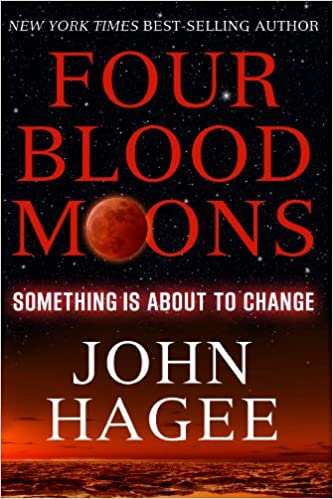
I don’t know why I read things like this. I knew when I reserved it at the library that I was just getting this nearly-decade-old book by fundamentalist nutjob pastor John Hagee to see just how ridiculous it is — to mock it, in other words. Yet since I’m reading a book of primary documents (letters, reports, etc.) from the perpetrators of the Holocaust, I felt I needed some light reading.
The back cover blurb itself was enough to entice me:

It is rare that Scripture, science, and history align with each other, yet the last three series of Four Blood Moons have done exactly that. Are these the โ€œsignsโ€ that God refers to in His Word? If they are, what do they mean? What is their prophetic significance?

In this riveting book, New York Times best-selling author, Pastor John Hagee, explores the supernatural connection of certain celestial events to biblical prophecyโ€”and to the future of Godโ€™s chosen people and to the nations of the world.

Just as in biblical times, God is controlling the sun, the moon, and the stars to send our generation a signal that something big is about to happen. The question is: Are we watching and listening to His message?

It’s rare that Scripture and science align? It’s never happened. Ever. Scripture and history? A handful of times. All three together? Never. Double-never.

But I was intrigued: it sounded from the blurb that Hagee was going to try to get some prophetic meaning out of the positioning of the sun, moon, and stars. That sounds like astrology — one must say that in a rumbling, threatening voice for the full effect. Fundamentalist Christians avoid astrology or anything that looks like it at all costs. So how can a good, Rapture-believing, tee-totaling, fundamentalist, Scripture-literalist have anything to do with astrology?

First, we might want to define astrology. Sure, we allย know what it is, but let’s get a good definition on the table. Let’s Google it and take the first definition: “the study of the movements and relative positions of celestial bodies interpreted as having an influence on human affairs and the natural world.”

Just for kicks, let’s see what astronomy’s definition is, using the same method: “the branch of science which deals with celestial objects, space, and the physical universe as a whole.”

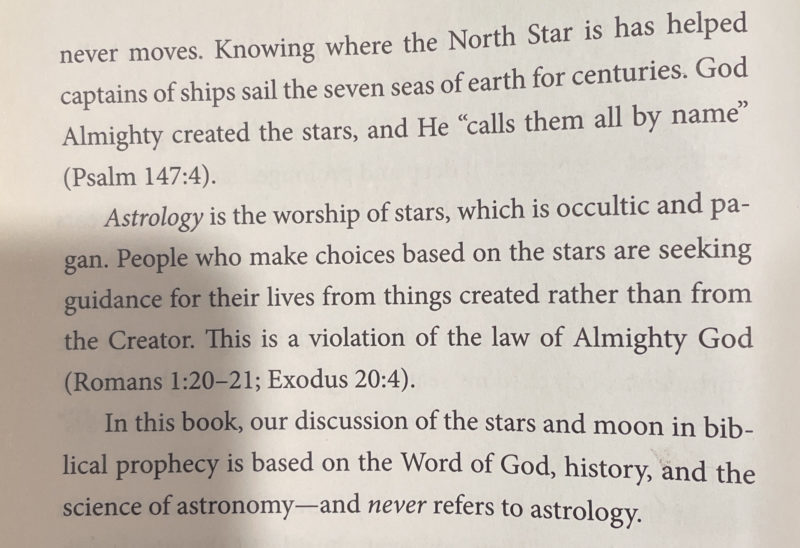
How does Hagee define these?

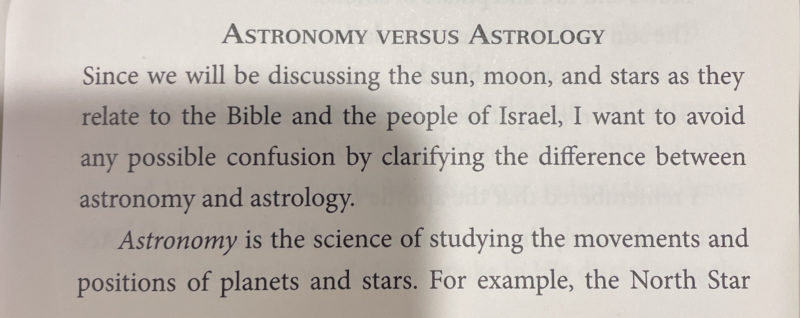
  • Astronomy is the science of studying the movements and positions of planets and stars.”
  • Astrology is the worship of stars, which is occultic and pagan.”

He literally gives the definition of “astrology” for “astronomy.” Don’t believe me (because I’d be skeptical of such idiocy myself)? Here are the shots from the book:

This means one of two things:

  1. He’s completely ignorant about what astronomy actually is, and no one around him corrected him either from deference to his position as “God’s anointed” of their own ignorance.
  2. He knows what astronomy is and is counting on his readersย not knowing how duplicitous he’s being.

Neither option is good.

Christian Visions

I’ve always enjoyed watching Christian apocalyptic films. They’re an insight into the thinking of fundamentalist Christians. They often see these films as representative of true prophecy, some kind of history before history. So how do fundamentalists see this future? It depends on the film, but one of the classics of the genre is theย Thief in the Night series. The third film in the series,ย Image of the Beast, covers the period of time when the antichrist, known as Brother Christopher, rules the world as the head of the newly-established one-world government.ย A scrappy band of Christians, led by Reverand Matthew Turner, fights this evil power.

In one scene, Reverand Matt explains to a character simply known as “Kathy” a picture in a book, saying that it’s “a replica of the temple of Herrod, the one that Christ worshiped in. But today’s temple is defiled by the worst sacrilege that could possibly befall Israel.” When Kathy asks him to explain further, he reveals:

The computer, Kathy. The computer has been the most innovative and time-saving device known to man. Paid bills, made travel reservations, cooked meals. It’s the new golden calf. A computer that speaks and convinces people that it thinks, hundreds of millions of people will worship that inanimate object, and it’s in the temple.

We have to understand that this film was made in 1980, so computers were still relatively exotic. But come on — “A computer that speaks and convinces people that it thinks” which leads people toย worship it?! In what reality would this happen? Even if we created the most magnificent AI neural network possible, does anyone seriously think people wouldย worship it? That reveals such a level of naivete that it’s difficult to comprehend.

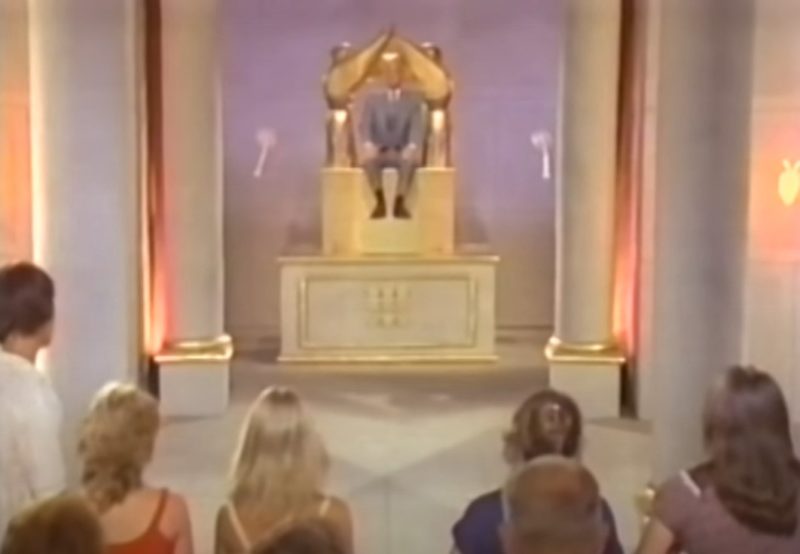
The film then cuts to Brother Christopher, the leader of this one-world government, addressing the globe:

First of all, what theย hell is he sitting on? Is that supposed to be a throne? How does he get up there? Levitate? And what’s with the palm tree emblems behind him? This reflects the fundamentalist view of God’s own throne (notice the angels with outstretched wings, like on the Ark of the Covenant?) because they view everything the devil does as a perversion of what God does.

But better than the imagery is Brother Chris’s speech itself, which is something spectacular:

My friends and loyal subjects, for the last four years, we have worked together to overcome the greatest physical hardships the world has ever known. World war, drought, famine, pestilence, fire, earthquakes and volcanoes of unprecedented violence. But we have prevailed, thanks to our fantastic computer technology and the intervention of his satanic majesty. Where, dear friend, was the loving God of creation during our recent perils? Was he helping mankind, the children of his creation? No, on the contrary, it is he who has visited these disasters upon us, and to you, God, God of wrath and destruction to mankind, I say do your worst, but we will prevail.

There’s so much here! He references “[w]orld war, drought, famine, pestilence, fire, earthquakes and volcanoes of unprecedented violence” to tie into the apocalyptic visions of Christians, but it raises the question of the intelligence of Satan, the bad guy in all this. Fundamentalists insist these events, which culminate in the fall of Satan, have been prophesied in the Bible for millennia, yet Satan apparently either can’t read, doesn’t know about these prophecies, or somehow thinks he can overcome them anyway.

Then there’s the direct acknowledgment of “the loving God of creation,” which suggests that the devil (incarnate in Brother Christopher)ย does know at the very least that God is, well, God, further underscoring this silly question mentioned above.

Finally, there’s theย direct mention of “his satanic majesty.” Somehow, all these so-called Christians who remained (because all theย real Christians got raptured away in the first film) then turn to blatant Satanism (as fundamentalists might view it)?!

Here’s the full scene:

It’s all so staggeringly stupid. But do Christians really take this stuff seriously? At ChristianCinema.com we find the following reviews:

  • A very good film about the end times. I recommend watching all 4 movies in series – Ronnie A T.
  • Very good and realistic. Was looking for Nicolate (sp) but do not see it. – Everette M.
  • Excellent movie. Very realistic and Scriptural! – Everette M.
  • My 12 year old wasn’t interested at first but after a while he wouldn’t leave the room. – Patrick B.
  • This whole series has been a blessing to me and my family I have enjoyed each movie and most important I have learned so much through them. It’s a great movie for believers and of course non-believers. As a believer it makes you think of your walk with the Lord, on how serious you are about following him and how big is your faith and trust in him. Great movie!! – larisa n.

More evidence that we’re too naive as a species to survive indefinitely.

The Veil Removed

There was a short film about Mass that a lot of people shared on the Catholic social media streams I was following last year as I went through the Bible in a Year podcast. It's called "The Veil Removed," and it offers a fascinating idea of what Catholics could argue is, in some sense, going on during the Mass.

In it, angels crowd around the altar, and the priest transforms into Jesus at the moment of consecration while also appearing crucified on a cross above the altar. A drop of blood falls from Jesus's crucified body into the chalice of wine that Jesus is also holding as he stands behind the altar, I guess symbolizing the so-called Real Presence of Jesus in the communion wafers and wine. The fact that Jesus appears literally twice, as a crucified man and as the priest actually celebrating the Mass would not be logically problematic to the average Catholic, I'm assuming, because the average Catholic already believes that God the Father, Jesus, and the Holy Spirit are somehow three but also the same.

In the course of the video, obviously-skeptical congregants miraculously see all the angels and such and lose all sense of doubt.

Yet this whole film, far from assuaging any doubts I have, only creates more: why doesn't this actually happen in Mass? What better proof of the claims of Christianity could there be then for this to be happening in all Masses, worldwide, often simultaneously? This is even echoed in the title: The Veil Removed. Why would a god put the veil there in the first place if this god wants what the Christian god supposedly wants (i.e., the salvation of all)?

Hard Sayings and Sunday Conestee Walk

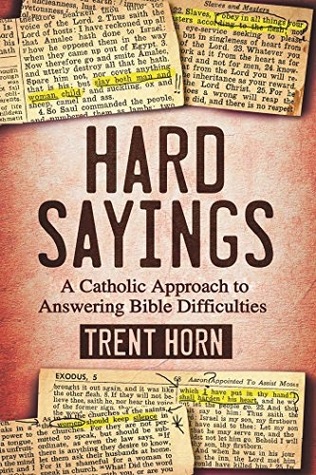
I'm still working my way through Trent Horn's Hard Sayings: A Catholic Approach to Answering Bible Difficulties. I encountered two passages this evening that just left me shaking my head.

The first was about Lot's behavior in Genesis 19:

The two angels arrived at Sodom in the evening, and Lot was sitting in the gateway of the city. When he saw them, he got up to meet them and bowed down with his face to the ground. 2 โ€œMy lords,โ€ he said, โ€œplease turn aside to your servantโ€™s house. You can wash your feet and spend the night and then go on your way early in the morning.โ€

โ€œNo,โ€ they answered, โ€œwe will spend the night in the square.โ€

But he insisted so strongly that they did go with him and entered his house. He prepared a meal for them, baking bread without yeast, and they ate. 4 Before they had gone to bed, all the men from every part of the city of Sodomโ€”both young and oldโ€”surrounded the house. They called to Lot, โ€œWhere are the men who came to you tonight? Bring them out to us so that we can have sex with them.โ€

Lot went outside to meet them and shut the door behind him and said, โ€œNo, my friends. Donโ€™t do this wicked thing. Look, I have two daughters who have never slept with a man. Let me bring them out to you, and you can do what you like with them. But donโ€™t do anything to these men, for they have come under the protection of my roof.โ€

โ€œGet out of our way,โ€ they replied. โ€œThis fellow came here as a foreigner, and now he wants to play the judge! Weโ€™ll treat you worse than them.โ€ They kept bringing pressure on Lot and moved forward to break down the door.

But the men inside reached out and pulled Lot back into the house and shut the door. Then they struck the men who were at the door of the house, young and old, with blindness so that they could not find the door.

How can Lot be considered righteous when he offered his daughters up to be raped?

Ice from last night's freeze

Trent explained it, in part, thusly:

Lot's righteousness is also seen in his hospitality toward strangers, which was a sacred duty in ancient Mesopotamia. In a time when you couldn't go to a department store for clothes or check in at a motel when you needed shelter, the kindness of strangers could mean the difference between life and death. Lot understood that anyone who slept outside in Sodom was in grave danger of being attacked. Therefore, he offered the city's visitor's shelter and wouldn't take no for an answer.

That, I admit, is at least somewhat reasonable. It seems to be the bare minimum as far as morality goes, but it's at least a step in a good direction.

But what about Lot's offer to give the crowd his daughters to be raped? How can that be justified? Surely it can't.

But that doesn't stop Horn from trying. The very next sentence:

Even Lot's misguided decision to offer his daughters to the mob can be seen as an act of hospitality meant to protect the guests dwelling under his roof.

Go back and reread that sentence.

It's unlikely you've ever read apologetics so preposterous. It's hard to take this book seriously after reading that.

Yet the second passage that floored me this evening makes it clear that the book is not even meant for me, however seriously (or not) I take it.

Crumbling pot

Horn closes one chapter with a quote from Karl Keating:

The Bible appears to be full of contradictions only if you approach it in the wrong way. If you think it is supposed to be a listing of theological propositions, you won't make heads or tails of it. If you think it is written in literary forms you're familiar with, you'll go astray in interpreting it. Your only safe bet is to read it with the mind of the Church, which affirms the Bible's inerrancy. If you do that, you'll see that it contains no fundamental contradictions because, being God's word inspired, it's wholly true and can't be anything else.

I have so many issues with this that I don't know where to begin.

Making new friends

First, I take umbrage with the assertion that there are only three options to approaching the Bible:

  1. reading it as "a listing of theological propositions"
  2. reading it assuming "it is written in literary forms you're familiar with"
  3. "read[ing] it with the mind of the Church"

None of these approaches accurately describe how I'm reading it. I'm reading it with the claim that it is the word of a god firmly in my mind and then seeing what kind of god appears in its pages.

What Keating (and by quoting him, Horn) is suggesting is that we first assume that the Bible is the word of the Christian god, read and interpret the Bible as the Catholic church instructs, and that will clear up all our difficulties. I've never seen such an obvious, almost-celebrated example of begging the question in my life.

And it's that notion that makes it clear that I am not the intended audience of this book. This book is not intended to respond to skeptics' concerns; this book is for Catholics who've discovered those skeptics and are starting to have doubts. Thus Horn is leaning heavily on his shared assumptions with his audience. He knows that they, at one point or another, at least gave lip service to the proposition that the Bible is inerrant. He's just calling them back to that notion. He even once admitted that he's not trying to answer these objections but simply to show that there are possible answers out there. Well, sure, there are possible answers out there, but they're not terribly convincing -- unless you're a believer starting to feel pulled under by doubt, then they're a lifeline.

Question-Begging

29533993. sy475 In the introduction to Hard Sayings: A Catholic Approach to Answering Bible Difficulties, Trent Horn quotes Dan Barker’s succinct point about the Bible: “An omnipotent, omniscient deity should have made his all-important message unmistakably clear to everyone, everywhere, at all times.” By this, Barker of course means that a god who is all the things the Christian god is supposed to be would send a message that couldn’t be so easily misunderstood, so easily used to justify so many conflicting ideas, as the Bible is.

There would be no difficult scriptures. For example, from the Catholic point of view, references to the “brother of Jesus” are troubling because Mary was, according to the Catholic Church, always a virgin. There was no way then that Jesus had brothers. How do we explain this, then? Well, in Aramaic, there is no term for “cousin.” Everyone is a “brother.” So that’s what the passage means. The only problem is that, although Jesus and his disciples would have been speaking Aramaic, the Gospels were written in Greek, a language that does have a word for cousin. In that case, why didn’t the Christian god inspire the gospel writers to say “cousin” and avoid all this confusion?

Horn responds to Barker’s claim most curiously:

I agree with Barker that God should provide an opportunity for all people to be saved since 1 Timothy 2:4 says God wants all to be saved. But that is not the same thing as saying that the Bible should be easily understood by anyone who reads it. Perhaps God has given people a way to know him outside of the written word? For example, St. Paul taught that God could make his moral demands known on the hearts of those who never received written revelation (Rom. 2:14-16). The Church likewise teaches that salvation is possible for those who, through no fault of their own, don’t know Christ or his Church.

Yet Barker never said anything about salvation. It’s not that Barker’s argument is that this god is doing a bad job of getting his salvific message out, but that’s what Horn’s response suggests. “No, no!” says Horn, “it’s not that people might lose their salvation over a confusing book. God also, according to St. Paul, communicates directly with people’s hearts.” In Horn’s strawman argument, Barker accepts that there is a god who wants everyone to be saved but just feels that this deity could be doing a better job of communicating that plan. But Barker is arguing the opposite: the massive amount of confusion stemming from this book suggests that is has a most decidedly human origin with no divine influence whatsoever. He’s arguing from the book to the hypothetical god that would have created it and saying that there is a significant incongruity between that hypothetical god and the Christian god.

Not only that, but Horn is quoting the Bible (Rom. 2:14-16) to provide evidence of his rebuttal (that God provides other means of salvation rather than through the knowledge gleaned from his book) when in fact it’s the Bible’s validity itself that’s at stake.

The problem is that for Horn, it’s impossible to see how someone could not accept the Bible as divinely inspired. He’s working with that presupposition so firmly in his mind that he doesn’t even realize when it causes him to go question-begging as he does in this response.