Matching Tracksuits

fun in fours

christianity

Modern Gnosticism

I encountered a meme that got me thinking about the relationship between Christianity and conspiracy theories. It was a meme dealing with the supposedly soon-coming apocalypse that will usher in the end of the world and the return of Jesus (if you're a post-trib millennialist, I guess).

This sort of hyperventilating anticipation of being able to say "I told you so!" is fairly typical of the fundamentalist Christian mindset, and it's one of the reasons I'd be nervous having a fundamentalist Evangelical in the White House: he (and it would certainly be a "he") would be tempted to make decisions based on a sense of what might help prophecy along. At any rate, the meme suggests that skeptics will soon be put in their place:

This sort of gnostic conspiracy theory is part and parcel of the Evangelical tradition. They await anxiously the events suggested in the meme, and the suggestion that Christians have been waiting for 2000 years for something like this is wasted breath. Every Christian generation has had a portion of people who are sure that they are the last generation. Indeed, Jesus himself in the earliest gospel seems to think this:

And he said to them, ‘Truly I tell you, there are some standing here who will not taste death until they see that the kingdom of God has come with[a] power.’

Mark 9:1

I grew up in a heterodox sect that took this gnostic conspiracy theory nonsense to the next level, suggesting that its members (numbering less than 150,000 at its peak) were the only true Christians on the entire planet. That's probably why I'm so skeptical of this nonsense.
Review: The End of White Christian America

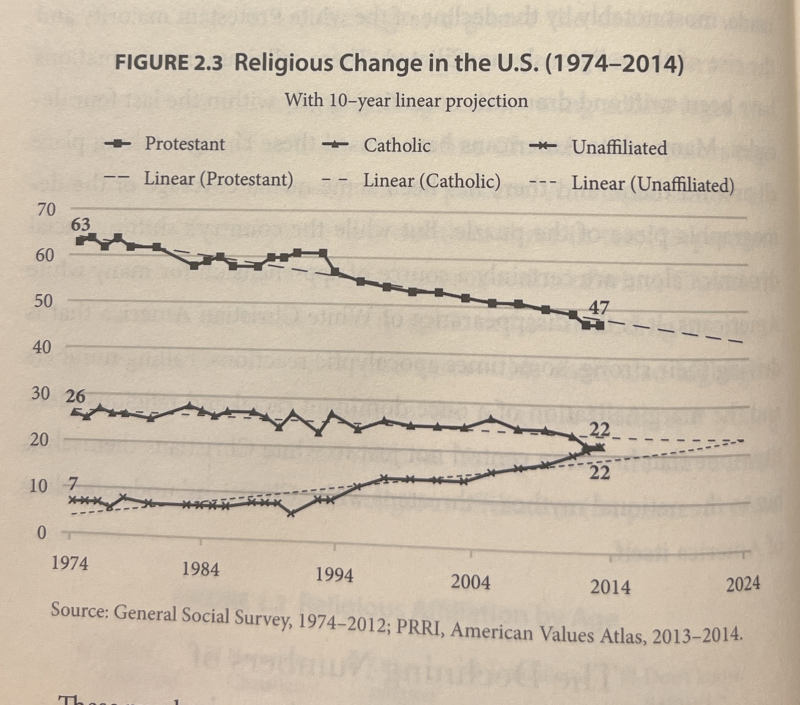
Evangelical Christianity as the dominant political force in America is dying from a self-inflicted wound. To suggest that Christianity in America is not waning is to ignore the obvious. But just in case, there are data to back it up:

Robert Jones's book looks at the decline of white Christian America (which he shortens to WCA) through a couple of lenses, but most significantly, the decline of WCA is due to its stance on homosexuality:

Today, many white Christian Americans feel profoundly anxious. As is common among extended families, WCA's two primary branches, white mainline and white evangelical Protestants, have competing narratives about WCA's decline. White mainline Protestants blame evangelical Protestants for turning off the younger generation with their antigay rhetoric and tendency to conflate Christianity with conservative, nationalistic politics. White evangelical Protestants, on the other hand, blame mainline Protestants for undermining Christianity because of their willingness to sell out traditional beliefs to accommodate contemporary culture.

Traditional Protestantism and more progressive Protestantism are both point their finger at the other, but the dilemma is real:

Moreover, more than seven in ten (72 percent) Millennials agree that religious groups are estranging young people by being too judgmental about gay and lesbian issues. Seniors are the only age group among whom less than a majority (44 percent) agree. The dilemma for many churches is this: they are anchored, both financially and in terms of lay support, by older Americans, who are less likely to perceive a problem that the overwhelming majority of younger Americans say is there.

As a skeptic, I can't help but find hope in this.

Selective Reading

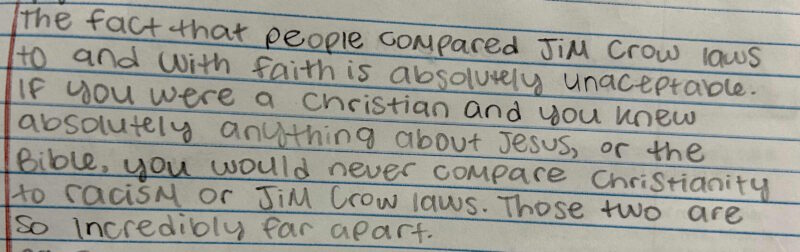
The kids were reading about Jim Crow laws as part of the To Kill a Mockingbird unit that we started a couple of weeks ago. Part of the article dealt with the religious justification some Christians used to explain the harsh segregation of Jim Crow times. One young lady -- a sweet kid that always has a smile -- wrote the following comment:

It reminded me of the suggestion that Christians who don't read their Bibles are Catholic, Christians who read their favorite parts are Protestants, and Christians who read the Bible critically from cover to cover become atheists. It is, perhaps, an over-simplification, but I'd be willing to bet this young lady goes to one of those Protestant churches that are well-versed (no pun initially intended) in the parts of the Bible that make the feel good and avoid completely the tricky parts.

Parts like 1 Peter 2:18: "Slaves, in reverent fear of God submit yourselves to your masters, not only to those who are good and considerate but also to those who are harsh."

Or Philemon 1: 15, 16, in which Paul sends back a slave to his owner, suggesting, "Perhaps the reason he was separated from you for a little while was that you might have him back forever—no longer as a slave, but better than a slave, as a dear brother. He is very dear to me but even dearer to you, both as a fellow man and as a brother in the Lord." He could have suggested that slavery is wrong, but he chose not to.

Or all the countless passages in the Old Testament instructing Israelites on the proper use of their slaves.

I, of course, said none of these things to her. It's not my place: I'm there to teach them, in part, how to think critically, not what to think. However, a close reading of the text...

Check, Please

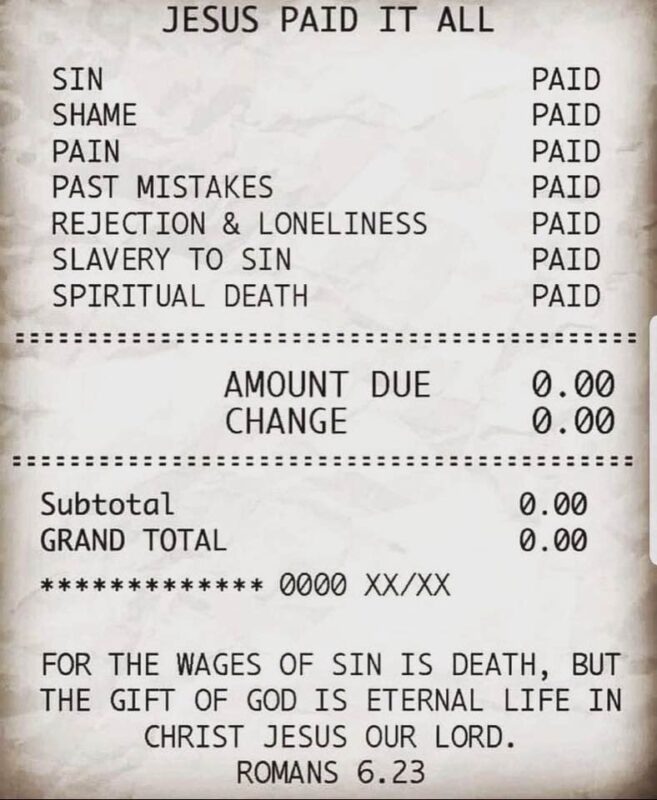
I need to contest some of these charges.

To begin with, I don't accept your view of sin. Sin is the violation of a deity's will; since I don't believe in a deity, I don't sin. You can say I sin, but that's just in your perspective, accepting as a given the deity you believe in.

Additionally, the shame you indicate I should have never showed up. I don't feel shame for sinning -- see above.

As for the pain and past mistakes, I don't think your product does anything for that. My past mistakes remain mistakes; pain remains. It's a defective product, in other words.

Rejection and loneliness? I know a lot of people who use your product and experience that. Indeed, your sales force itself practices rejection on a regular basis. Come to think of it, it regularly engages in shaming people as well.

Slavery to sin? See above.

Spiritual death? I don't even know what that could possibly mean.

Jesus might have paid it all in your scheme of things, but I bought none of it.

Leaving the Faith

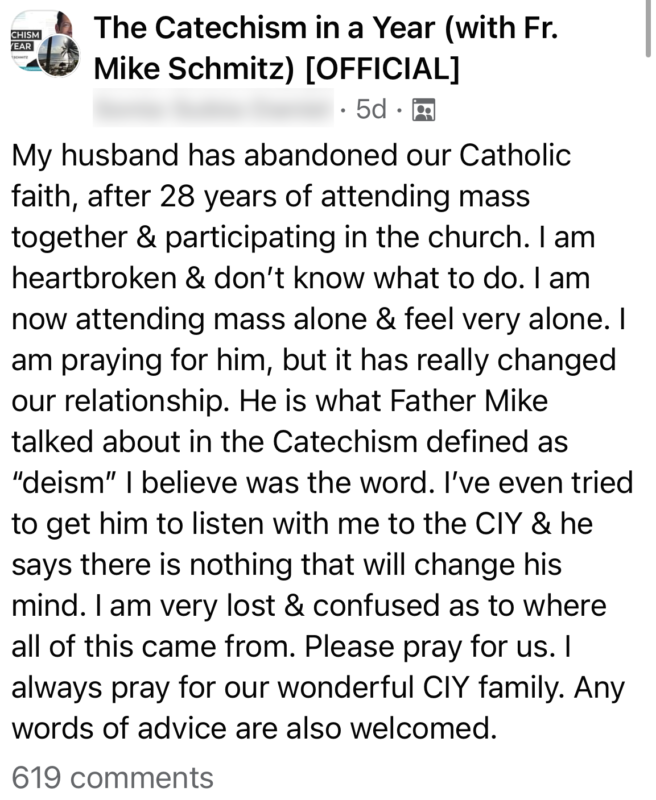
The post stood out immediately: I can relate, and so can K. Granted, I hadn't been attending Mass as long as the gentleman in question, but I could see myself in the post:

"I am very lost & confused as to where all of this came from," she admits, and I find myself wondering how this came about. Perhaps the husband had been on this long road of deconversion for years and simply kept it to himself because he didn't want his wife to worry. Perhaps as the issues piled up in his head he was in some sort of denial. Perhaps he dropped hints, unsure how to begin the conversation outright, and she just didn't pick up on them because they were so incongruous with everything she knew about him or because he, inexperienced with dropping such hints, was unable to do so in a sufficiently clear way. (That's the double problem with dropping hints.) Whatever the case, from her perspective, it's coming out of nowhere.

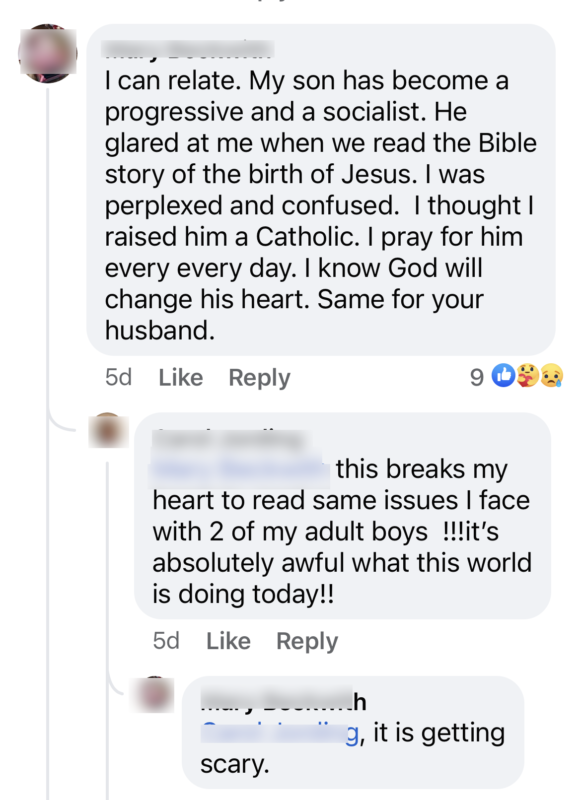
In responding to this, some people shared that they can relate. But at least a couple had me wondering if effective communication was actually taking place. One response declared that her son had become "a socialist."

Perhaps he does not align with a socialist political position, but knowing conservatives of the 2020s, it could simply be that he's now aligned himself with the Democratic party and the mother, true to Fox News talking points, simply labels him a socialist.

To that response, someone commiserated that "it's absolutely awful what this world is doing today," to which the original commenter replied that "it is getting scary." She suggests it's "this world," which is American Christian-ese "the Satan-influenced, Satan-worshiping society we live in," which in turn is simply the non-Christian segment of the population. And it's getting "scary" because more and more people are realizing that they don't need Christianity in their lives: church attendance is plummeting, especially among those under 40. These two ladies see the issue in terms of society as a whole, but they fail to understand the underlying causes, attributing it most likely to Satan's growing influence.

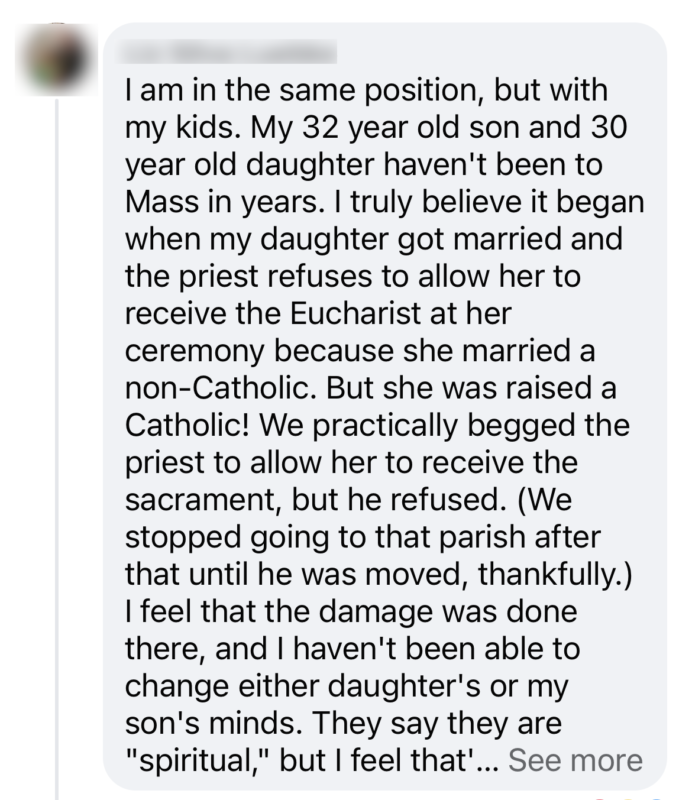
Some, however, did see that it wasn't simply a question of Satan's supposed influence but also a question of the hypocrisy and judgmental nature of contemporary American Christianity:

This comment reveals what I see as one of the primary causes of declining church attendance: the church is continually creating situations that amount to self-inflicted wounds.

Fundamentalist Christians insist that the Genesis account is accurate and that evolutionary theory is a Satanic lie. Then their children learn about the mountain of evidence supporting evolution and they're forced to choose between the faith of their parents or, as they see it, reality.

Fundamentalist Christians insist that homosexuality has no place in a Christian worldview. Then their children meet queer people and realize, "Hey, they're not the devils they're made out to be," and another church teaching falls to the side.

Fundamentalist Christians remove from their fellowship individuals who choose not to live according to fundamentalist interpretations of sexual morality, and their children find out their soccer coach has been fired, despite parents' and players' begging, mid-season because she got pregnant out of wedlock. Then the players are crushed, and a handful of them start thinking, "If this is how Christians behave, I don't think I need that in my life."

These are just a handful of the ways modern Christianity is sabotaging itself. Perhaps something like this went on with these commenters' children.

Others tried to fix the problem.

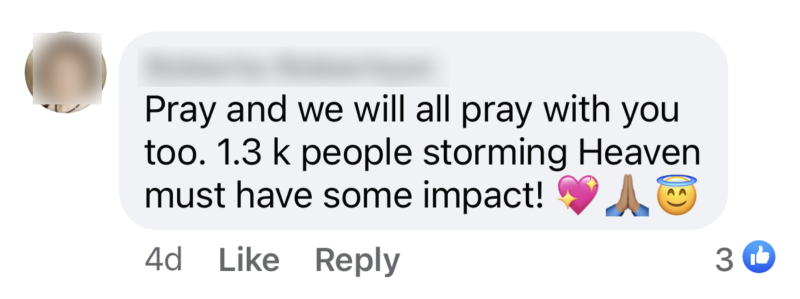
What happens when prayer doesn't work, though? What happens when these people are still not returning to church? These poor folks then have a second layer of doubt: why isn't God helping my child save herself? What am I doing wrong that is preventing this prayer from being answered?

As an aside, the metaphor of prayer as "storming heaven" is always a little strange for me. "Storming" is always used in the sense of an assault -- storming the beaches of Normandy. Soldiers storm a position because it's held by the enemy. In this case, "storming heaven" has connotations of viewing God as an enemy. I'm certain this is not what they intend, but I'm equally certain they've never really thought about the metaphor. It just sounds like strong, intense praying -- praying really hard.

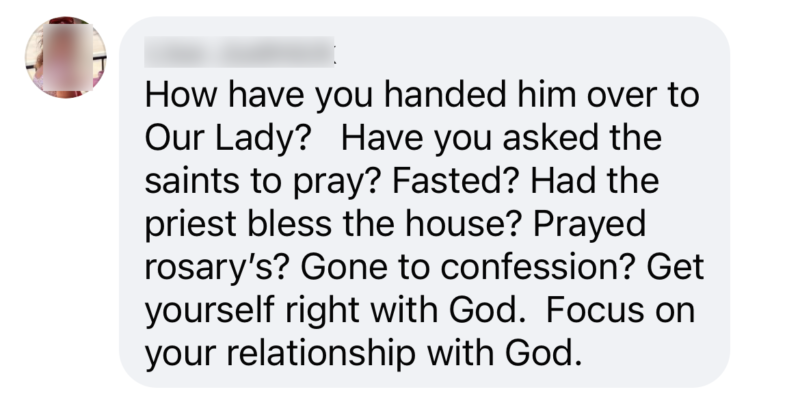
Some people just passively-aggressively blamed the believers: it's your fault. You're not trying hard enough. You're not holy enough.

This could not possibly be helpful. Such a response only increases the sense of overwhelming guilt these people must feel. As with the "storming heaven" metaphor, this commenter probably didn't even think this comment out.

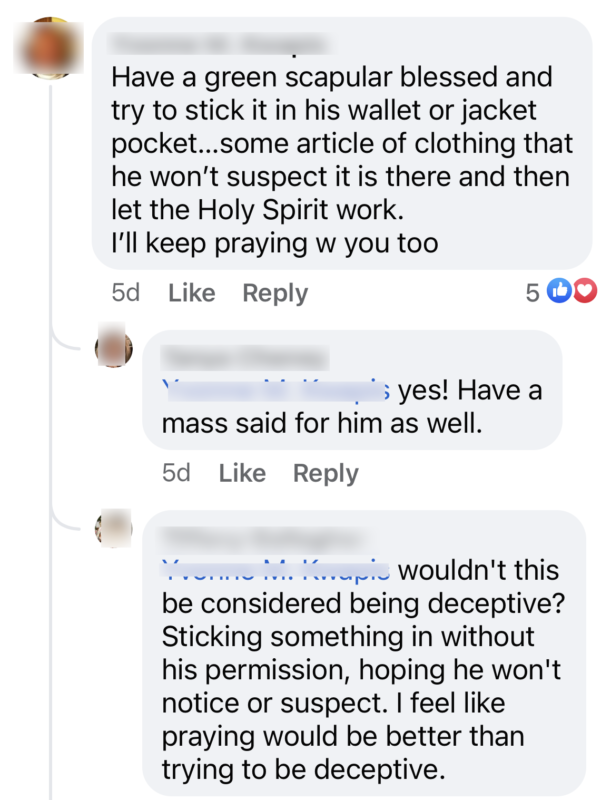
Finally, there was the Catholic sense of magical thinking on full display:

The Catholic reliance on relics and holy objects fascinates me. What would this scapular actually do? How would it affect things? And since this husband would be unaware that it's there, would that amount to God acting against this guy's will, thus negating the cherished notion of free will, a staple among Christians for explaining how evil exists on earth given the existence of an all-knowing, all-powerful, completely-benevolent god?

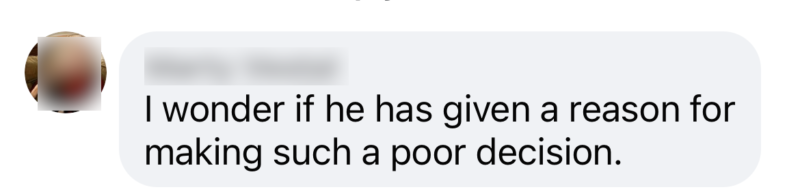
I can't really blame them for their thinking, though: there are certain lines a Christian cannot cross, and "he might have had perfectly good reasons for leaving Christianity, and he might have done so in good faith" is one of them. In such a case, if he found a reason to leave, perhaps I could as well -- and that's unthinkable.

No matter the reason he'd give, though, it wouldn't be good enough for them.

The Shift: Initial Thoughts

I've begun reading The Shift: Surviving and Thriving After Moving from Conservative to Progressive Christianity by Colby Martin. I've read a number of books and articles about people who start doubting traditional Christianity and end up leaving it altogether, but I'd never read anything about taking that first step but ending up still in some form of Christianity. The idea intrigued me. Not because I'm interested in finding a place for myself in progressive Christianity but rather because I like reading about different people's experiences of faith.

I don't enjoy reading shitty writing, and I'm afraid that's what this is. The ideas might be good, but the writing so far is awful. Take a look at this passage from the introduction:

Not to brag, but I'm pretty good at sleeping. Normally, it welcomes me like a freshly hired Walmart greeter. But one evening, just before finishing this book, it treated me more like the Costco exit guard who scans your receipt, glances with unprovoked judgment toward your cart, and won't let you go until you acquire the Sharpie swipe of victory. Frustrated, I stared into the darkness, scanning the receipt of my brain for what held me back from passing to the void. I tossed and turned on my Casper mattress. I fluffed and re-fluffed my Tuft & Needle pillow. Maybe my issue is that I fall prey to too many Facebook ads? Nah, that's ridiculous, I thought as I unclasped my MVMT watch.

Dear Lord, why do people who have no idea how to construct compelling figurative language insist on doing it anyway? I know there's tone-deafness; is there metaphor-deafness as well?

And what is the point of all this brand name dropping? His "Casper mattress"? His "Tuft & Needle pillow"? His "MVMT watch"? Did he read somewhere that good writing includes details and so he's going to include the brand of every damn thing he mentions?

An Apologist’s Response

While discussing the difference between the Old Testament god and the vision of the Christian god we see in Jesus, a social media commenter suggested I read Dr. Jeff Mirus’s “Making Sense of the Old Testament God” in which he attempts to “make God’s ways under the Old Covenant easier to understand” as a reader had requested. He concludes his introduction by admitting that he “can only do [his] best,” which seems to be a tacit admission that there really is no way definitively to reconcile these two visions of the Christian god and that it’s a matter of faith.

Mirus begins by suggesting that there’s not such a disparity between the seemingly harsh god of the OT and the loving god of the NT. There are two ways he does this. First, he argues that there are many passages in the OT that show a deity in line with what we see from Jesus. Fair enough. But he then suggests that Jesus had a harsh streak himself: Jesus’s “denouncing hard-hearted Jewish leaders, lamenting those who lead others into sin, rebuking the wealthy, condemning hypocrites, and foretelling disaster for unbelieving communities” were harsh elements of “Our Lord’s effort to wake us up.” He then quotes Matthew 11:21-24 in which Jesus does a lot of “Woe to you”-ing. Yet there is a big difference between genocide and harsh words. There is a chasm between rebuking someone and stoning them. This is like saying Truman was as harsh as Stalin because he yelled at people.

As the article develops, so does the offensive weirdness of Mirus’s logic. Regarding the harsh nature of the OT god’s commands to slaughter so many people, he suggests, "Finally, we must not forget the decisive separation of the sheep from the goats—those who will be sent into eternal fire." He is literally saying that the acts of cruelty we see from the Christian god in the OT pale in comparison to hell. In other words, "Yes, our god was pretty cruel in those times, but just think about how cruel he'll be toward you for eternity in hell!" There are elements of our god that are even more appalling than what we see in the OT, so this god is really actually good. This is another example of how Christians seem to suffer from Stockholm Syndrome: the very god that "saves" them is the being that creates the conditions from which they long to be saved!

Mirus then deals with a second “misconception [..] that the Old Testament authors thought of God’s will in exactly the same way as we do today."

This gets at the tension between the obvious fact that humans wrote the Bible and yet Christians claim that their god inspired the Bible. Where does divine authorship/inspiration leave off and human creation begin? In saying that "the Old Testament author thought of God's will" in any way that could be discernable in the text is to negate the divine authorship. Surely what the human authors thought would not interfere with the divinely giving knowledge of the reality of the situation. But this very idea that somehow the Biblical authors' own ideas got inadvertently mixed in with the divine revelation gives apologists the room they need to excuse the OT god of any wrongdoing.

Mirus continues by asserting that many of the abuses in the Bible are not God's responsibility: "It is easy to fall into the trap of believing that everything recounted in the Old Testament is the will of God." He then relates the story of Jephthah, who made a vow to sacrifice the first thing that came out of his door if his god would grant him military victory. When Jephthah returns home, his daughter runs out to greet him, which necessitates him slaughtering her as a sacrifice to his god.

Mirus argues that this is all on Jephthah and that we cannot hold the OT god accountable for this. That might very well be a good point that solves this dilemma, but it does nothing for the seemingly-countless times this god does indeed command people to do awful things. It’s a softball pitch intended to make readers more confident in the Bible and Mirus's argument.

In dealing with the OT god's commands for genocide, he asks, "Is there a significant difference between reading what God has done to this or that person or this or that people in the Old Testament, either directly or indirectly, as compared with the manner in which He appoints our lives, including the circumstances and agencies through which we will die, and which He alone both knows and contains within His own Providential limits?" In other words, our god is in control of how we die anyway, so does it really make him such a monster to kill us in this manner or that manner? He is, after all, a god: he can do what he wants! He made us; he sustains us; it's his choice.

First, imagine saying that about your own infant child: "Surely I can kill this child. I made her. I sustain her." What wretched monster would think like that?

Second, apologists can use this line of reasoning to excuse any action they undertake, no matter how horrific

Why Don’t I Believe?

I was having an exchange on Twitter (I would say "conversation," but that would be a terribly inflated label given the medium) about my disbelief. "Do you know why the Bible says you don’t believe?" my interlocutor asked.

I was confident I'd hear Romans 1:20: "For since the creation of the world God’s invisible qualities—his eternal power and divine nature—have been clearly seen, being understood from what has been made, so that people are without excuse." It's a favorite among apologists, so I was ready to hear my questioner suggest that I really had no excuse, that I did believe but was just hiding the fact -- probably because I "just want to sin." These moves are as standard as any established chess opening.

Taking that all into consideration, I responded, "I have a hard heart. I refuse to see despite the evidence all around me. Lay the verse from Romans on me, baby! I'm ready!"

Instead, the fellow replied with a verse I'd never really noticed: “He has blinded their eyes and he hardened their heart, so that they would not see with their eyes and perceive with their heart, and be converted and I heal them” (John 12:40).

How could I have not noticed this verse before? This passage presents a positively damning view of this god, and I pointed this out: "He then is responsible. Your god created me, blinded me, then damned me for being blind. Do you guys not see how sick this is? Do you guys not understand it's perverse thinking like this that prompts so many to question their faith?"

I was expecting an explanation for how this can make the New Testament god appear to be heartless and even capriciously cruel, that preventing someone from believing and then punishing him for that disbelief is in fact some unfathomable mystery that ultimately will work to this god's "greater glory" (what an immature, insecure being this god of Christianity is, always demanding praise and worship and smiting those who don't fall in line -- sounds a bit like North Korea). Instead, I got another verse:

But their minds were blinded. For until this day the same veil remains unlifted in the reading of the Old Testament, because the [veil] is taken away in Christ.

2 Corinthians 3:14 (New King James Version)

That "Old Testament" bit sounded a bit strange, so I looked it up to find other translations:

  • But their minds were made dull, for to this day the same veil remains when the old covenant is read. It has not been removed, because only in Christ is it taken away. (New International Version)
  • The people were stubborn, and something still keeps them from seeing the truth when the Law is read. Only Christ can take away the covering that keeps them from seeing. (Contemporary English Version)
  • But their minds were hardened. Indeed, to this very day, when they hear the reading of the old covenant, that same veil is still there, since only in Christ is it set aside. (New Revised Standard Version)

I suspect this translation to "Old Testament" instead of "old covenant" is to create a sense of continuity between the New Testament and what it views itself as replacing in some sense -- a propaganda move, in other words.

Still, I resisted the urge to comment on that (and thus radically derail the topic under discussion) and stuck to the point: "So your god blinds me and then punishes me for being blind. How can you not see how perverse that is?"

He, however, had no qualms about radically changing the topic, which I see as another typical apologetic move. Instead of dealing with what I said, he replied, "I see someone who fights tooth and nail against God. What makes you more deserving? You are already under the judgement [sic] of God."

"It’s like you willfully misconstrue my objection," I concluded.

Fences and Guardrails

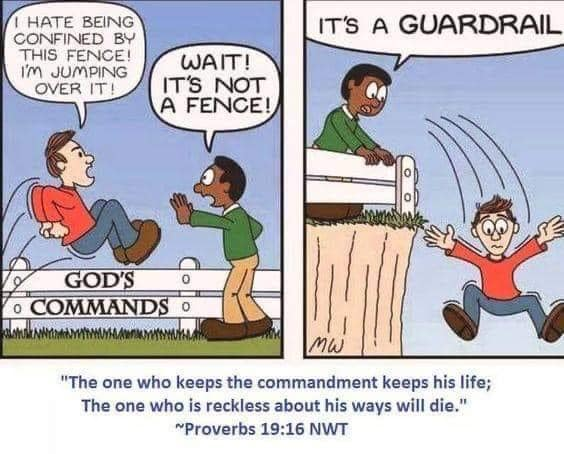
"God just puts these laws in place for our protection!" seems to be a common apologetic response to criticism of the laws of the Bible and the sense of absurdity some of them engender. There's even a cartoon about it.

This is such a silly cartoon -- it shows the absurdity of the argument better than apologists recognize. Most basically, the things that this god's law supposedly protects us from were created by that god himself! He made all the universe, according to apologists. He created all the laws of physics. He created all the contingencies and consequences. In other words, to relate it back to the cartoon, he created the fence ("guardrail") and the cliff. And he put the guardrail right at the edge of the cliff.

To turn it back to Christianity itself, this god created the laws and the consequences for breaking them (i.e., eternal damnation). If it were any other way, he would be dealing with something he didn't create.

This also plays into the idea of Jesus's salvific sacrifice. He's saving us from the consequences of breaking some god's laws. The trouble is, according to the doctrine of the trinity, he is that god! He's saving us from himself.

No matter how many times I point this out to believers, they just don't see it. They bring up free will and all that: "God created us with free will, and we can abuse it and reject God."

"Yes, but this god put in place the laws and their consequences. He's the one sending you to hell and then saving you from it," I reply.

"Yes, but he loves us so much that he sacrificed himself for us, to pay our debt."

"Our debt to him!" I want to scream.

If I am beating a child and then stop beating that child, I haven't saved him any more than the mafia, when receiving payment, is not saving you from anyone other than themselves.

How do they not see this?

Beheading Hydra — A Review

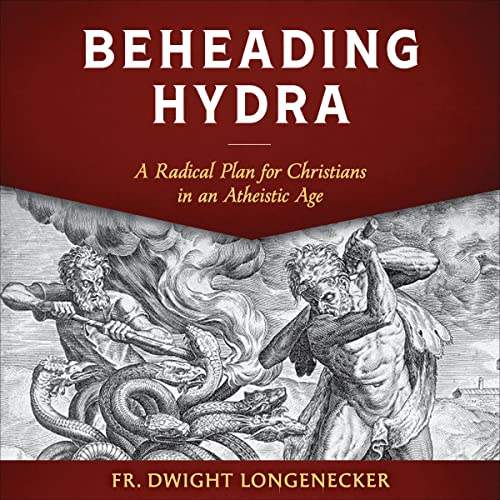
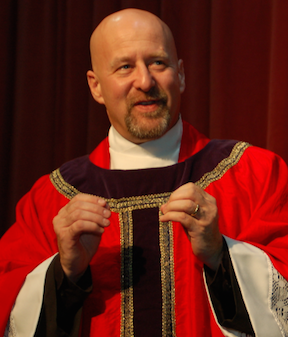
Dwight Longenecker is the pastor of the parish we used to attend. He's a prolific author, and the title of one of his books caught my attention: Beheading Hydra: A Radical Plan for Christians in an Atheistic Age. It purports to be a "radical plan" for believers in an age of atheism. As a once-Catholic-now-atheist, I thought it would be interesting to see how Longenecker defines the problem and what this radical solution might be.

Fr. Longenecker

The problem of what Longenecker seems to see as a predominately atheistic society is a "perfect storm" which is "the culmination of five hundred years of devious philosophies, half-truths, godless ideologies, false religions, and rebellion against God, his Church, and His timeless truths" (7). That's quite a list of problems there, but what's key to me is the five-hundred-year timeframe. What really began happening then? Modern science was slowly emerging from the mix of alchemy, philosophy, and superstition that had been used to explain the world in the past. The rise in atheism tracks closely to the success of the scientific method. Granted, what I'm suggesting here is one of the "-isms" that Longenecker claims is problematic, namely scientism, which is the claim "that science alone can render truth about the world and reality" (Source). I certainly don't believe science is the only source of truth in our world, but when it comes to the physical world itself, it is certainly the most successful. Science continually knocks at religion's door and says, "Here, we'll explain that now," whereas religion never offers explanations that supersede previously accepted science.

But the book is not about just scientism but a whole bunch of "-isms"

  1. atheism
  2. materialism
  3. historicism
  4. scientism
  5. utilitarianism
  6. pragmatism
  7. progressivism
  8. utopianism
  9. relativism
  10. indifferentism
  11. individualism
  12. tribalism
  13. sentimentalism
  14. romanticism
  15. eroticism
  16. Freudianism

That's a whole lot of "-isms" to tackle in a book just a bit over 200 pages in length, but Longenecker plows through them all, explaining how they're problematic for Christians and how they contribute to this "atheistic age" he sees us in.

But how can this be? How can we live in a largely atheistic society when most atheists point out the number of elected officials who are Christian is many times larger than the number of elected officials who are atheist (to use one simple metric)? It's simple: "most atheists are blind to the fact that they are atheists" (21). I read that and immediately realized where he was heading: if you're going to call yourself a Christian, you'd better act like a Christian and a Christian as I define it. He frames it by saying that this tide of atheism can be slowed with people living authentic Christian lives, but suffice it to say his definition of "atheist" would leave most atheists scratching their head.

"But I'm not an atheist!" I hear you say. Really? Then why do you live like one? If you do not pray, if you do not tithe, if you are living without a real relationship with God, then your belief in God is only a theory (144)

That's the answer: prayer, tithing, and creating a close community.

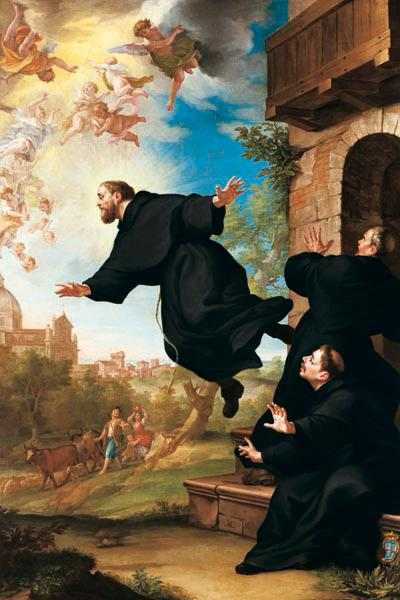
While the book is not an effort to disprove these "-isms" definitively, he does take some time to point out what he sees as flaws in them. Regarding atheism and materialism, for example, he makes the argument that miracles "remind us that weird things happen," and then gives us examples: "Friars float. Dead saints smell like flowers thirty years after they were buried. Seventy thousand people said they saw the sun spin and plummet to earth at Fatima" (30).

St. Joseph Cupertino

This short list he makes refers to

  1. St. Joseph Cupertino, who had "the gift of levitation" (27).
  2. St. Bernadette's body, which smelled like flowers thirty years after her death.
  3. The appearance of Mary at Fatima.

Cupertino lived from 1603 to 1663: this was a time when people were burning witches, so that Longenecker takes these fanciful claims that he could levitate seriously suggests to me a naivety that I would not have expected. Bernadette's body does indeed look lovely, but that's because of the efforts of the faithful: she's not that way naturally. And Fatima? It's just as hard to take that seriously.

It's easy to understand why Longenecker might willingly accept these things: "The spiritual person sees miracles--divine interruptions--all around him, and and through his everyday experience" (31). If you're looking for it, you'll find it. That might be advice he's giving believers, but I think it's a double-edged sword: when you go so far as to believe in 17th-century floating friars and someone else says, "Wait a minute," you're creating a crack in your belief system that doesn't have to be there.

What are his suggestions for dealing with all these "-isms"? It's to develop a "creatively subversive alternative." Real Christianity. Deep Christianity. Prayerful Christianity. After all, it's happened before: "Every five hundred years, there seems to be a major crisis in the Faith, and at each juncture, a new wave of witnesses rise up." First there was ancient Rome, but "the first Christians simply lived a graced life of charity and peace, and the pagan world was drawn to their example and converted." Then, in the sixth century, "St. Benedict stepped out and established simple communities centered on prayer, work, and reading," which served as a bulwark against the "listless and corrupt" church. By 1000 CE, there was more corruption and crime but the "Benedictine Order surged forth in the great Cistercian renewal." Finally, there was the Reformation and the Catholic Church's Counter-Freformation which "brought renewal simply by living out the creatively subversive alternative" (133).

Yet Longenecker's suggestion that this same kind of solution (returning to a prayerful traditional Christian life) will work in 2023 is almost laughably naive. The forces at work now are much more powerful than the forces at work in the previous periods, and they're driven by one thing: the internet. Subversion and alternate views can reach even the most sheltered people now, and the amount of material available that simply picks at thread after thread in the tapestry of Christian belief is overwhelming. Skeptics have methodically taken apart argument after argument and shown how the arguments simply don't make sense. They constitute an ever-present "yeah, but" to everything Christian apologists say, and no amount of praying is going to make that go away.

Really, the only answer is complete sequestration, and that is in essence what Longenecker is suggesting, and it's what he was doing in the parish, and it's a significant reason we left.