Matching Tracksuits

fun in fours

christianity

Rebranding

Thereโ€™s a local mega-church that rebranded a few years ago to โ€œRelentless Church.โ€ I thought that was an odd name. I always assumed it was suggesting that the Christian god is relentless in trying to reach the so-called unchurched, but there was something needlessly aggressive about that name. To be relentless seems antithetical to one of Christianityโ€™s claimed attributes (claimed only, I would argue): that itโ€™s built on mercy. To relent is, to some degree, to show mercy. Still, I thought they could have chosen a sillier name.

The pastor, a large man named John Gray, caused some controversy a few years ago when he bought his wife a $200,000 Lamborghini SUV. It made the Today Show:

His defense was that he used money from the coupleโ€™s reality show and his book sales to purchase the vehicle. It still seems pretty tone deaf to be a supposed servant of God and spend that kind of money on a vehicle.

But apparently tone deafness is one of Grayโ€™s predominant qualities, for heโ€™s decided to rebrand his church once again. This time: Love Story Church.

Considering the stream of sexual abuse scandals in countless denominations over the last few years, I couldnโ€™t possibly imagine a worse name for the church
Flames

On the Corner

I could hear him long before I could see him. K and I were walking up Main Street last night, returning to our car after a night out, and I could hear an amplified male voice in the distance.

"Most likely a street preacher," I thought, although sometimes the Black Hebrew Israelites make an appearance on the downtown sidewalks. As we approached, though, it was clear it was an evangelical street preacher.

"You need Jesus! If you don't know the name of Jesus, you need to invite him into your life..."

It always astounds me how these guys say nonsense like that: we live in America, in the damn Bible Belt. There is no one in this area who has never heard of Jesus. It is utterly impossible, regardless of your religious views, not to have heard of Jesus while living in South Carolina.

"There is no one walking on Main Street," I said to K, "who might be thinking, 'Now this Jesus fellow -- never heard of him. Who is he?'"

As we neared, we had to stop at the corner to wait for the light. Our street preacher started going on about the perils of living a self-centered life, completely oblivious to the irony.

"Here these people are, taking advantage of the lovely weather to enjoy their favorite restaurant's outdoor seating option, and they have to listen to this jackass as he gets his saving-the-world fix," I said to no one in particular and everyone in earshot. One guy laughed a little, most everyone else ignored my stupid comment.

I wanted to say that to the preacher himself, and came close to doing just that, but in the end, I decided not to add to the guy's persecution complex.

Villain

Who is the villain in the story of Adam and Eve? Christianity and Judaism will have you believe it's the serpent, but I think a close reading without the blinders of preconception proves God is the villain.

To begin with, notice when in the narrative God forbids the Tree of the Knowledge of Good and Evil:

The Lord God took the man and put him in the Garden of Eden to work it and take care of it. And the Lord God commanded the man, โ€œYou are free to eat from any tree in the garden; but you must not eat from the tree of the knowledge of good and evil, for when you eat from it you will certainly die.โ€

The Lord God said, โ€œIt is not good for the man to be alone. I will make a helper suitable for him.โ€

Genesis 2.15-18

That second paragraph is crucial because it shows that God gave the command to Adam before Eve even existed. He told Adam, "Don't eat of the tree." He said nothing to Eve. In fact, if you read the text closely, he never talks to Eve at all.

The temptation occurs in the next chapter:

Now the serpent was more crafty than any of the wild animals the Lord God had made. He said to the woman, โ€œDid God really say, โ€˜You must not eat from any tree in the gardenโ€™?โ€

The woman said to the serpent, โ€œWe may eat fruit from the trees in the garden, but God did say, โ€˜You must not eat fruit from the tree that is in the middle of the garden, and you must not touch it, or you will die.โ€™โ€

โ€œYou will not certainly die,โ€ the serpent said to the woman. โ€œFor God knows that when you eat from it your eyes will be opened, and you will be like God, knowing good and evil.โ€

Genesis 3.1-5

A few questions arise here:

  1. Where was Adam? Since God communicated with him about the cursed tree, he should have been careful to prevent an unknowing Eve from approaching the tree.
  2. Where is God? Since God never communicated with Eve, I'm assuming he assumed Adam would take this role. Now that it's obvious that Adam is doing nothing, why wouldn't a loving God step in.
  3. Why the hell is the tree there in the first place? This is the fundamental question. It's like putting a knife in a baby's crib. What do you expect is going to happen?
  4. Why did God allow the serpent to enter the garden to being with? Again, it's like putting a circular saw in the nursery.
  5. Why didn't God do something to prevent this? He is all-knowing: he knew this is going to happen. He didn't take a single step other than warning Adam. And of course this gets us back to the question of why the hell God made this tree to begin with.
  6. Why is the tree of knowledge that's forbidden? What's so dangerous about knowledge. Oh, never mind...
  7. How could God expect them to obey him (i.e., to realize it was a sin, i.e., to understand it was evil to disobey him) when they clearly didn't know the difference between good and evil? Now we've got a knife and a circular saw in the crib of a blind toddler.

The narrative continues:

When the woman saw that the fruit of the tree was good for food and pleasing to the eye, and also desirable for gaining wisdom, she took some and ate it. She also gave some to her husband, who was with her, and he ate it. Then the eyes of both of them were opened, and they realized they were naked; so they sewed fig leaves together and made coverings for themselves.

Genesis 3.6, 7

First of all, we see that Adam was right there with her. What the hell was he doing? Why didn't he stop her?

More significantly, we see that the serpent was telling the truth: "the eyes of both of them were opened." But the didn't die, despite God's telling Adam that "in that day you shall surely die." They didn't die: God lied.

So let's build the case for the serpent being the villain:

  1. He encouraged the couple to disobey God. However, God only bothered to tell Adam, and Adam did nothing to stop Eve. More troubling, they didn't even know what good and evil as concepts were, so there's no way we can hold them accountable for that.

That's it. One point, a point that's really not significant at all. What's the case for the serpent being the hero?

  1. He was encouraging them to increase their knowledge.
  2. He told the truth: they did not die when they ate the fruit.
  3. He told the truth: they did receive knowledge when they ate the fruit.

There's not much, but at least he has the truth on his side.

How about the case for God being the villain:

  1. He put a tree in the garden that he decided was forbidden and chose to punish Adam and Eve for eating of it.
  2. He only told Adam not to eat of it; he didn't even bother to communicate with Eve.
  3. He lies to Adam about the consequence of eating of the tree.
  4. He expected obedience from
    • newly-formed creatures who
    • didn't know what good and evil were.
  5. Once Eve and Adam eat of the tree, he punishes all future generations for the crime (which they couldn't know was a crime because they didn't know good and evil). And according to Christianity, the punishment is eternal torment. Eternal torment for a finite crime committed by other people!
  6. He turned Adam and Eve's daily life to a relative hell of struggling for mere subsistence.
  7. After having told Adam and Eve to "be fruitful and multiply," he makes the act of childbirth painful and potentially lethal.
  8. He creates Adam and Eve and the garden and everything else with complete foreknowledge of this catastrophe (for which he is responsible).

And the case for him being the hero? Well, I guess according to the text, we have him to thank for our existence since he made everything. But since that "everything" includes hell and a guaranteed ticket there for the vast majority of humanity, that one point in his favor is hardly significant and is in fact a point against him.

This all of course depends on the narrative being factually accurate, which of course it isn't. But imagine trying to square all of this with a literal interpretation of this passage: anyone who worships this being is worshiping a monster.

No Rest in Hell

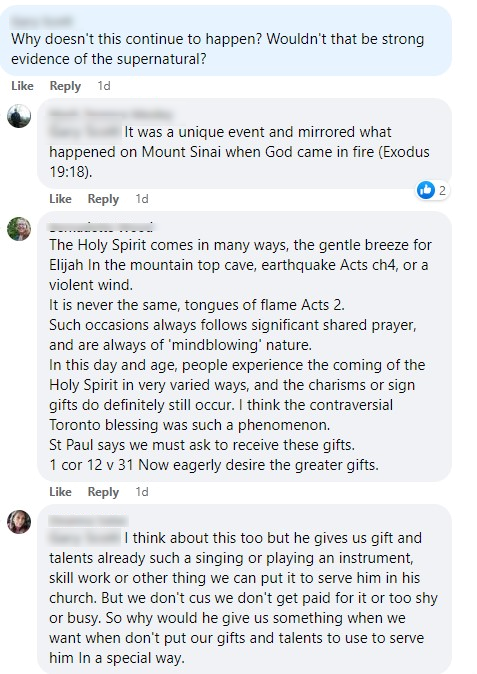
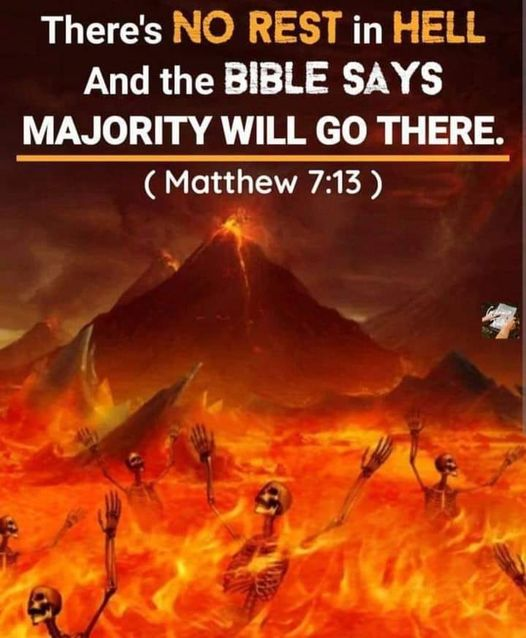
I recently dipped into a social media feed titled "HELL IS REAL" to see what kind of discussion goes on there. Not much discussion -- mainly just a bunch of disturbing memes.

Meme 1: No Rest in Hell

The question that comes immediately to mind: why would an all-loving and omniscient god create a bunch of creatures he knew would end up in eternal torment that he himself created? It just makes no sense.

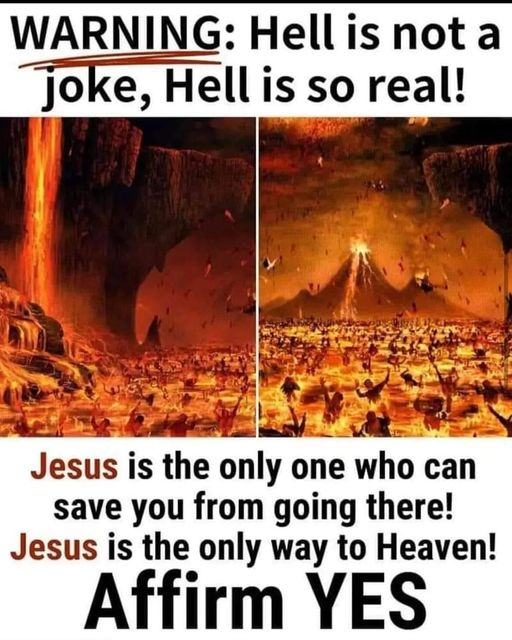
Meme 2: Hell is not a joke

Two things struck me about this: first, the imagery is so disturbing. Second, "affirm yes"? Did the creator of this meme think that at some point we would be standing in front of God, and he'd patiently point out that we didn't affirm "Yes" (redundant much?) in our social media feed so it's off to eternal torment for us...

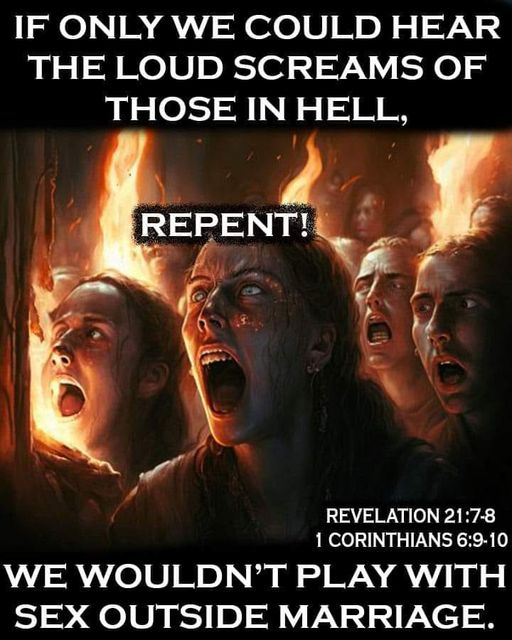
Meme 3: Hear Hell

This one is so oddly specific. If we could hear the people screaming in hell, we might not fornicate. We might lie; we might do drugs; we might murder (see meme below), but we sure as hell wouldn't fornicate.

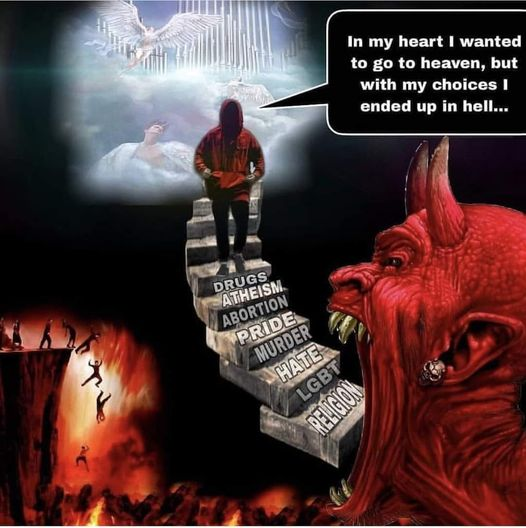
Meme 4: Choices

Why is the devil eating this guy? And do hoodies lead you to hell?

Meme 5: Roads

If only this god who so wants to spend eternity with us had done a better job getting us to that point...


It's disturbing that in 2023 people still have such simplistic, brutal, and illogical views. They pass this poison on to children and scar them for life. I just can't understand how they can posit a) a loving god and b) an eternity of torment. It just makes no sense to me.

Crusades

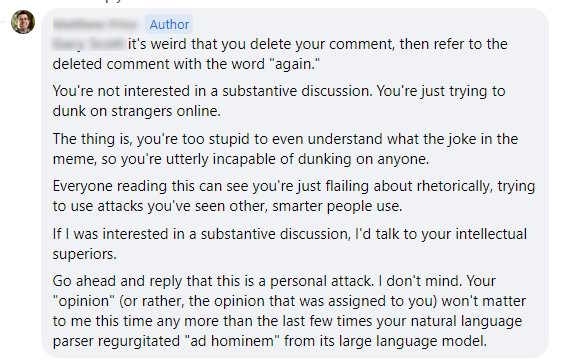
The meme -- I couldn't pass it up. The Crusades -- not something one would joke about. So I said so.

In the end, the original poster devolved to this:

I'm not sure what he was referring to when he complained I deleted a comment: I didn't knowingly delete any comment. Still, the rest of the comment left me wondering how someone like that can function in society. If you're an adult willing to call someone stupid, who is willing to behave in such a juvenile manner, how can you hold a job? If it takes so relatively little to get you to behave like a pouting child, how can you keep your mouth shut when it really matters?

In the end, I left the conversation with the following final words: "Thanks for the wonderful Christian example. I'll leave you to have the last word. Make it a good one!"

Review: Is God a Vindictive Bully?

As with many apologetics books, the intended audience of this seems like it might be the skeptic community when in fact it is clearly written for Christians. In other words, this is not a book that will convince skeptics but is intended to ease the worries Christians have about the God of the Old Testament.

The first clue for this comes from the title: the average skeptic will not simply call the Old Testament god a bully. This being is a moral monster -- which is actually the title of another book by Copan. The subtitle gives a clearer indication of the intended audience: "Reconciling Portrayals of God in the Old and New Testaments." This book is written for people who love the god of the New Testament (i.e., Jesus) but finds the Old Testament god a bit off-putting. This is important because Christianity declares that, appearances to the contrary, these are the same being, albeit in different "persons," which makes no logical sense, but that's an argument for a different review. So this is an effort to reconcile kind Jesus with the evil god of the Old Testament by trying to remove the "appearances to the contrary" part of the argument altogether.

How do I as a skeptic read it, then? I tried to give it the benefit of the doubt, I tried to "treat another's writing as you yourself would want your own writing to be treated" (6) as Copan suggested we do with the OT text, but in the end, I was just disappointed. There were no apologetic tactics in this book I had not encountered (and dismissed) before. The primary problem with this book from a skeptical point of view is that all the moves the author makes to square the two gods of the Bible simply belie the underlying Christian contention about Biblical authorship. In other words, he relies primarily on that old tired tactic "context." Indeed, he has an entire chapter called "A Bit of Near Eastern Context." For example, in justifying the harsh punishments proscribed in the Old Testament, Copan brings up the exaggerations of the Code of Hammurabi and then suggests that these are merely exaggerations as well and that "it is likely that the death penalty was rarely utilized" (85). This suggests that the authors of the Old Testament merely used the same tactics as the authors of Hammurabi's Code. Yet how could that be? Didn't the Christian god inspire the Bible? This apologetic tactic undercuts the claims of divine authorship, but Copan has a solution, explaining that the "Mosaic law didn't start from scratch or reinvent the wheel" and suggests that it "appropriated sources apart from any direct divine revelation to Moses, who selected and adapted material resulting in a 'special synthesis'" (37). Just Copan never explains just what this "special synthesis" might be and how we might discern Moses's borrowing from surrounding cultures and divine intervention.

The other primary tactic Copan uses is qualification. This might be, or that could be, or this is a logical inference, or that is implied. This is probably an exaggeration and that is probably not carried out. In other words, it's all conjecture.

This is a book that will not convince anyone who genuinely questions the text. This is a book for Christians looking to feel better about the god of the Old Testament.

Unfortunately Predictable

I'm reading Is God a Vindictive Bully? by Paul Copan, which purports to square the "genocide, racism, ethnic cleansing, and violence" in the Old Testament with the seemingly different deity presented in the New Testament in the form of Jesus. I've tried to go into this with an open mind; I've tried to avoid presumptions and judgments before I read. But by page six, he's already making moves that put the argument exactly where I anticipated:

Consider a "golden rule" of interpretation: treat another's writing as you yourself would want your own writing to be treated. This doesn't mean being naive or uncritical; it does mean being charitable and fair as we honestly examine challenges in the text.

Is God a Vindictive Bully, 6.

Why would I treat the Bible the same as other documents? Christians claim it is the word of God: they claim that it's not like other ancient documents, and if it's written by a deity, it isn't like other documents. Why treat a supposed god's words with kid gloves? Why do I need to be "charitable and fair"? Wouldn't a god do a better job writing a document?

This hints at a problem I know will appear in this book: how does the tension between "God composed this book" and "humans physically wrote it down" resolve? No Christian would deny that humans wrote the actual physical Bible: it didn't just float down from heaven. However, they also claim that it is of divine origin. Humans, they insist, were just the instrument. The actual composition is God's. However, when apologists start using historical context to explain something, they have immediately removed the composition from God's purview and made the Bible a strictly-human document. It's coming--I know it is.

Random Picture for Today

Image from 2017 trip to Warsaw

Religious Time Machine

I've sometimes wondered what it might be like to travel back in time with our current understanding of the physical world to a time when people thought witches cast spells, that comets were harbingers of the future, that thunder and lightning were from the gods. What kind of frustrating hell would that be to experience others making decisions -- occasionally life and death decisions -- based solely on uneducated superstition? We would watch in horror as pseudo-physicians drilled holes in epileptics' heads to allow the evil spirits to escape. We would watch aghast as women accused of witchcraft were burned at the stake, crushed, drowned, and killed in ineffably evil ways. We would witness the spread of the Black Death through Europe and the accompanying brutal attacks against the Jews, whom the non-Jews viewed as responsible for the plague through supernatural means.

With all this swirling around us, we would, I think, find it difficult to keep quiet. As we would attempt to explain to these scientific illiterates the reality of germs, epilepsy, and the complete lack of evidence for the efficacy of witchcraft, we would likely find ourselves labeled as perpetrators of similar acts. Our defense would get us labeled as being "in league with the devil" and likely result in our own persecution or death. If we kept quiet, the frustration of watching people killed, maimed, and tortured in the name of superstition and illogic would take quite a toll on our mental health.

Yet we don't have to imagine what it would be like to live among the scientifically illiterate who have only the most tenuous grasp on logic because we already do. This is the reality we're experiencing now watching Qanon proponents try to explain that there is a group of Satan-worshipping pedophiles who harvest adrenochrome from kidnapped babies who are then raped and devoured. This is the reality we're experiencing now watching people make unsubstantiated claims about stolen elections even when adequate evidence to the contrary exists. This is the reality we're experiencing now watching people fall in line behind the far-right position that Russia is the good guy in its war with Ukraine, which has in fact been in various nefarious conspiracies with this or that group bent on world domination. People are swallowing whole lies that are so obviously and ridiculously false that it strains one's imagination that anyone could respond to such suppositions with anything other than incredulous laughter.

Why would people believe this?

It's simple: they're primed to believe things like this. Most of those who hold these various conspiracy theories are on the far-right of the political spectrum, and that usually aligns with the fundamentalist wing of Christianity. These individuals are disproportionally evangelical Christians, and this means they take the Bible literally. There really was a talking snake in the Garden of Eden (indeed, there really was a Garden of Eden with Adam and Eve). Balaam's donkey really did rebuke Balaam for beating him. Jonah really did survive in a fish for three days. People really do suffer demon possession that results in behavior suspiciously similar to epilepsy. And behind this all lurks an evil spirit secretly pulling the strings of all left-leaning individuals, institutions, and ideologies in an effort to ensnare souls and drag them down to hell with him.

Evangelicals are not the only ones holding these conspiracy theories; Catholics increasingly are falling for them as well. Their view of the source of evil in the world so much the less nuanced that they have a prayer about it:

Saint Michael the Archangel, defend us in battle. Be our protection against the wickedness and snares of the devil; May God rebuke him, we humbly pray; And do thou, O Prince of the Heavenly Host, by the power of God, thrust into hell Satan and all evil spirits who wander through the world for the ruin of souls.

Yet no matter whether Evangelical or Catholic, these fundamentalists have one thing in common: their religion itself is a conspiracy theory.

Response: Iโ€™m Not All That Impressed with Exvangelical Deconstruction Stories

"Deconstruction" is the current term for deconverting from Christianity. I'm sure it's applicable to other religions, and I know not all people who deconstruct end up abandoning their faith altogether, but by and large, the end result of deconstruction is a new skeptic.

The Christian response to this has fallen into a few categories:

  1. They deny that the person was ever a true Christian to begin with.
  2. They blame the churches for incomplete catechesis.
  3. They play down the deconversions by calling them silly or suggesting that their objections are basic and even juvenile.
  4. They suggest that the new skeptic "just wants to sin."
  5. They blame the parents for not teaching their children their faith well enough.
  6. They suggest that de-conversions do not result in a lack of faith but rather a change in where the faith is placed.

Occasionally, a Christian response can't quite decide which tack to take and simple mixes and matches responses. Such is the case with Grayson Gilbert's "Iโ€™m Not All That Impressed with Exvangelical Deconstruction Stories" from a couple of years ago.

Gilbert begins condescendingly enough by referencing the "never-ending supply of pastors, pastorโ€™s kids, and artists formerly known as Christians" who are leaving the faith. There may be a number of "grand excuses," Gilbert suggests, but he insists that the "fundamental issue behind every one of these de-conversion stories" is the fact that, as the Bible explains in I John 2.15, they "went out from us, but they were not of us."

Gilbert pretends to preempt objections in the next paragraph by acknowledging that for many it's not an inadequate answer because "itโ€™s a bit too Calvinistic." That's a very theologically based objection, firmly grounded in an acceptance of the basic tenants of Christianity and quibbling over details, but most skeptics' objections would be to question the validity of Gilbert's and St. John's foundational assumption: they left Christianity because they were never really Christian.

Forget for a moment how utterly and arrogantly childish it is to suggest that, despite skeptics' protestations to the contrary, these true Christians can read the mind and know the intentions of those who have rejected Christianity. The truth of the issue is simple: most people who leave Christianity do so reluctantly. They want to believe, but they find they no longer can. Evidence and arguments that once convinced them no longer do. But for a Christian still in the fold, the thought that someone who is a true Christian (how Christians love to be gatekeepers with each other) could lose their faith is terrifying because it means if someone else lost their faith, they could, too. To allay these fears, the only option is to suggest that these individuals never were really Christian in the first place.

Gilbert then deals with a particularly famous ex-evangelical, Abraham Piper, who is the son of John Piper, a Protestant theologian who has written a number of books and runs a successful online ministry in addition to his real-world church. Gilbert points out that "Abraham has taken a fancy to TikTok with clever, catchy tidbits of him mocking the Christian faith." That sentence is just dripping with derision: Abraham's efforts online to point out the flaws he sees in Christianity are not a serious work but instead "a fancy." His succinct observations are merely "catchy tidbits" unworthy of serious consideration. And he is not critiquing Christianity, which would require a measured response; he's mocking Christianity, which can be easily dismissed and forgotten.

In a parenthetical remark, Gilbert suggests that mocking Christianity "is so in vogue today." Never mind that this is not a question of popularity; what's more significant is the notion that critics are merely "mocking" the Christian faith, much like childish bullies mock their victims. It produces the victim complex that Christians expect from exhortations in the Bible, and it downplays the seriousness of the critiques themselves. Christian theology has caused real-world pain and done significant damage in a lot of people's lives. It has destroyed self-confidence in its near-continual insistence that humans are worthless trash. It has caused untold damage in its institutional misogyny and homophobia. It has literally killed thousands upon thousands in religious wars. It threatens the planet with its denial of science. It stifles critical thinking and encourages blind faith obedience. Leaving this mindset can produce a sense of relief, but if this is something that the new skeptic's parents taught them, something that's been a central pillar in their life for so long, there can be understandable anger arising as a result. Gilbert explains he uses some of Abraham Piper's videos to discuss "the nature of the Proverbial fool" with his son, thus attempting to ensure that his son instinctively reacts as he does without giving further thought to the motives or reasoning behind a de-conversion.

Far from the fact that the son of a celebrated and admired pillar in the Evangelical community has left the faith might depress Gilbert, he insists that he now has "a deeper appreciation for John Piper.  "It led me to see that despite Abrahamโ€™s brutal mockery of all his father and mother stand for and love, it testifies of his paternal faithfulness," he insists.

How does Gilbert square this round hole? He explains that it is a sign of "the faithfulness of a man like John Piper in raising his son to be so inundated with biblical truth that he still canโ€™t quite get away from it well into his adult life. It is constantly on the tip of the tongue; he cannot go about life without thinking of the God he professes to reject." This is an attempt, in other words, to turn a loss into a win. Gilbert doesn't consider the possibility that the reason Abraham Piper is critiquing Christianity online is to try to help people who are facing the pain and frustration that rigid, fundamentalist Christianity can inflict (see above). Notice, too, the wording: "the God he professes to reject." This is a not-so-subtle dig at Piper through a subtle allusion to Romans 1:20:

For ever since the world was created, people have seen the earth and sky. Through everything God made, they can clearly see his invisible qualitiesโ€”his eternal power and divine nature. So they have no excuse for not knowing God.

Abraham doesn't really reject it, in other words. He knows there's a god -- he just wants to sin.

Still, even if John Piper had not been a good Christian parent, it's not his fault if his son rejects faith (and thereby condemns himself, in the Christian view, to hell):

Many a parent neglected to make the Word central in the home, raised their children to be good, obedient pagans, and then wondered why their children came back from school with all sorts of ideas that run contrary to the Christian faith. The onus is still on these children to search out the truth of Scripture, regardless of how bad a job mom and dad have done.

As a skeptic, I have to wonder how one could worship a god that creates such a confusing book that requires a library of explanation and commentary to understand and then sends you to hell if you don't understand it properly. That's probably something along the lines of what some of these de-conversion experiences went through as well.

Soon after this, Gilbert switches his argument and employs the "well, everyone is religious" suggestion: the "Religious Nones" are in fact misnamed: "everyone is a devotee to some belief system, whether agnostic, atheistic, or the ever-vague โ€œspiritualistic but not religiousโ€ group." It's funny how "religious" becomes something of an insult in this case.

Finally, after tossing this argument and that argument at the idea of de-conversion, Gilbert launches his main attack:

Iโ€™ve come to be more and more convinced that the vast majority of those who reject the Christian faith do so on the basis of intellectual laziness, intellectual dishonesty, or simple ignorance. They either donโ€™t care to find the answers, they donโ€™t care to hear the answers, or, they donโ€™t know where to even begin.

He classifies the case various ex-Evangelicals have leveled against Christianity thusly:

The objections that people like Rhett and Link, Abraham Piper, the Gungors, Newboysโ€™ former member George Perdikis, dc Talkโ€™s Kevin Max, Joshua Harris, Derek Webb, et al., have, are basic, Sunday school level objections. In where we are in the history of the church, these arenโ€™t even the interesting questions that Christians have any more. These are some of the most basic elements of the historic Christian faith that it leaves many of us wondering if these people took much time at all to crack open some dusty, old tomes from dead guys on the subjects.

This is because for

anyone who has taken the time to actually study these things in depth, the question isnโ€™t if someone has given a satisfying answer to reconcile the apparent contradictions of the Scriptures, given exhaustive treatment on things like textual criticism and transmission, or provided ample solutions to the โ€œproblem passagesโ€ we find as finite readers.

In other words, they reject Christianity because they are lazy, and even though all the answers to all their objections have been covered time and time again, they reject them in their ignorance. In still other words, they haven't read the right books, and indeed they probably haven't even looked for the right books.

Speaking as someone who has done the reading and looked for the answers, I can simply say this: it is entirely possible that someone can start questioning their faith, look for and find answers to their questions, and find those answers unconvincing. We cannot choose what ideas convince us and what ideas don't, and to suggest that the only other alternative is ignorance or laziness sloppy argumentation at best and simple vilification at worst.

But in the end, that's to be expected when we consider the intended audience. Gilbert is not seeking to convince wayward Christians of the errors of their ways; he's soothing the worried faith of those who worry that they in turn might find their Christian faith lacking. If someone like Abraham Piper can reject Christianity, anyone can. But not us, assures Gilbert. We're real Christians; we know that no matter the objection, there's an answer for it out there. Notice, though, that Gilbert didn't rehearse any of the objections or their answers. He simply swept them all away with an easy flick of the wrist: the answers are out there. Surely they're convincing...